Digital marketing now powers global business growth. The American Marketing Association projects that the global digital advertising and marketing market will reach US$786.2 billion by 2026, highlighting how businesses are increasingly shifting budgets toward online channels and performance-driven strategies.

This scale of investment changes the equation. As companies increase spending on paid media, analytics, automation, and AI-driven optimisation, they seek professionals who can generate measurable returns, not just traffic.
The importance of digital marketing is established. Now, the more relevant issue is whether taking digital marketing courses remains the best approach for building these essential skills.
To address this, we outline what digital marketing courses teach, their duration, costs in Singapore dollars, and likely career outcomes in 2026.
Further, we consider how these skills apply within real-world professional environments, helping you evaluate if this investment aligns with your long-term growth goals.
Key Takeaways
- There is no universal “best” social media platform. ROI depends on audience intent, business model, creative execution, and funnel integration rather than platform popularity.
- Platform behaviour must match buying behaviour. Aligning user mindset with your offer significantly improves conversion efficiency and overall profitability.
- Paid strategy is essential for scalable ROI. Organic reach builds credibility, but predictable growth requires structured advertising and retargeting.
- Creative quality directly impacts performance. Strong hooks, platform-native content, and continuous testing often determine success more than targeting precision alone.
- Measurement determines optimisation. Tracking revenue, CPA, and customer lifetime value ensures investment decisions across social media platforms are data-driven rather than assumption-based.
What Are Digital Marketing Courses?

Digital marketing courses are structured programmes that teach individuals how to promote products and services through online channels. These channels include search engines, social media platforms, email marketing, paid advertising networks, analytics platforms, and increasingly, AI-powered tools.
Unlike traditional marketing education, digital marketing courses focus heavily on measurable performance. You learn how to track clicks, conversions, cost per acquisition, return on ad spend, and user behaviour. In other words, it is marketing grounded in data rather than guesswork.
Today, digital marketing courses range from short online certifications to university-issued professional diplomas and executive programmes. Some focus purely on tactical execution, while others teach strategic planning, growth frameworks, and performance optimisation.
Why Digital Marketing Skills Matter More in 2026

The marketing landscape in 2026 looks very different from just three years ago. AI-driven search engines, generative content tools, predictive analytics, and automation platforms have become essential in everyday marketing operations.
Businesses are shifting budgets toward measurable channels. They want clear attribution models, scalable growth strategies, and performance visibility. This means marketers are expected to understand not just how to run campaigns, but how to interpret data and optimise them.
Digital marketing skills now go beyond posting content or launching ads. Professionals must understand:
- SEO and Generative Engine Optimisation
- Paid media strategy and bidding algorithms
- Marketing analytics and attribution modelling
- Conversion rate optimisation
- AI workflow integration
Companies offering high-level digital marketing services now invest heavily in these capabilities because clients demand measurable results. Clients now expect profitability, not just visibility.
For individuals, this shift means course value is determined by real, job-relevant outcomes, such as mastery of emerging tools, increased employability, and readiness for future market demands, not just theoretical knowledge.
What You Actually Learn in Digital Marketing Courses
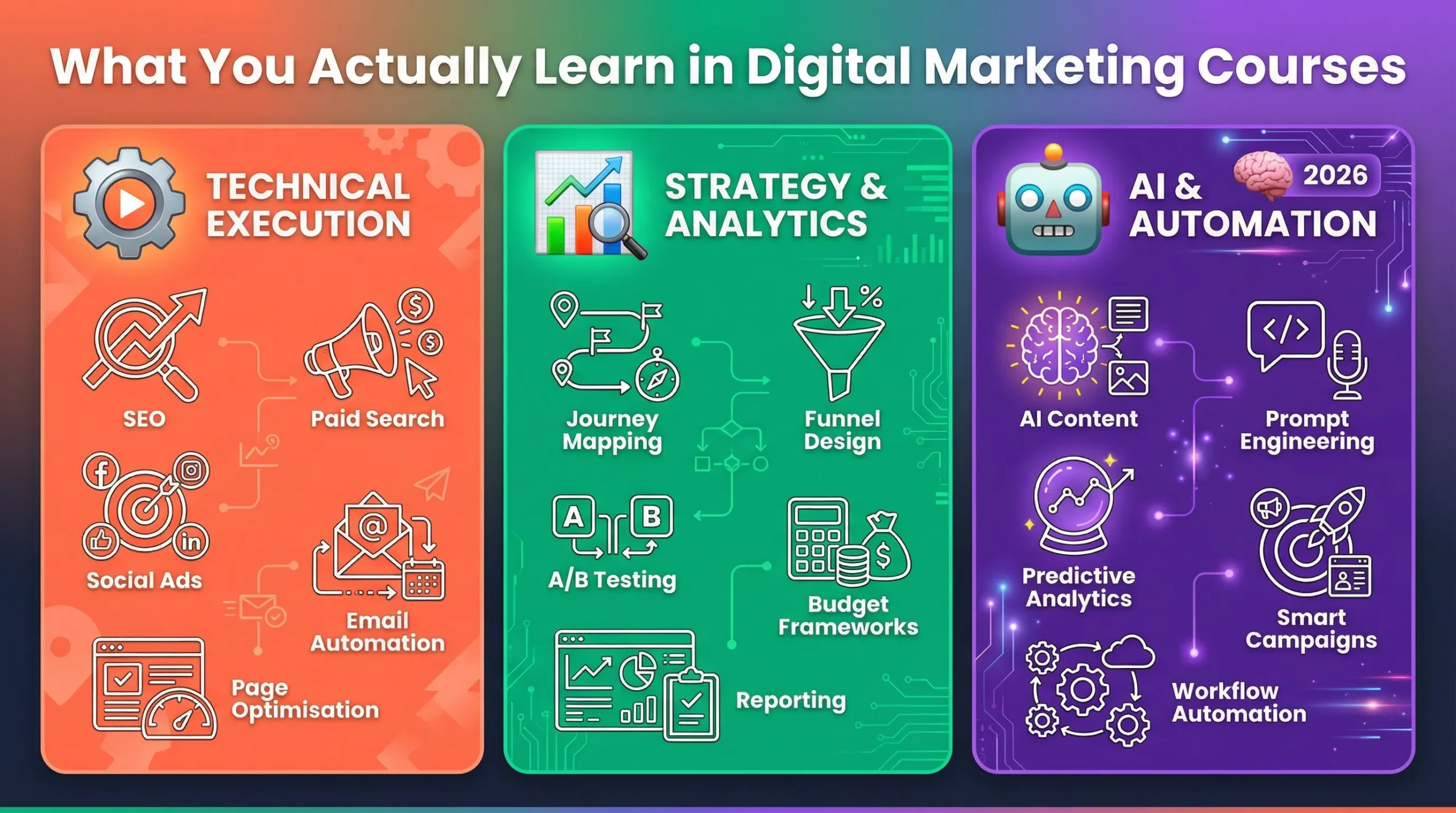
Not all digital marketing courses are structured the same way. However, most reputable programmes include three key areas: technical execution, strategic thinking, and analytical measurement.
Core Technical Skills
Students typically learn:
- Search engine optimisation fundamentals
- Keyword research and content strategy
- Google Ads and paid search campaigns
- Social media advertising
- Email automation systems
- Landing page optimisation
These skills form the foundation of digital performance marketing. Without understanding how each channel works, it is difficult to manage integrated campaigns.
Strategic and Analytical Skills
Beyond tactics, stronger digital marketing courses teach:
- Customer journey mapping
- Funnel design and optimisation
- Budget allocation frameworks
- A/B testing methodologies
- Data interpretation and reporting
Many entry-level programmes fall short in this area. Executing tasks without strategic direction only produces activity, not growth.
AI and Automation Skills in 2026
Modern programmes increasingly include:
- AI-assisted content development
- Prompt engineering for marketers
- Predictive performance forecasting
- Automated campaign optimisation
- Data-driven decision systems
Courses that do not integrate AI risk becoming quickly obsolete. The industry is evolving toward greater efficiency, automation, and intelligent optimisation.
Digital Marketing Courses Timeline
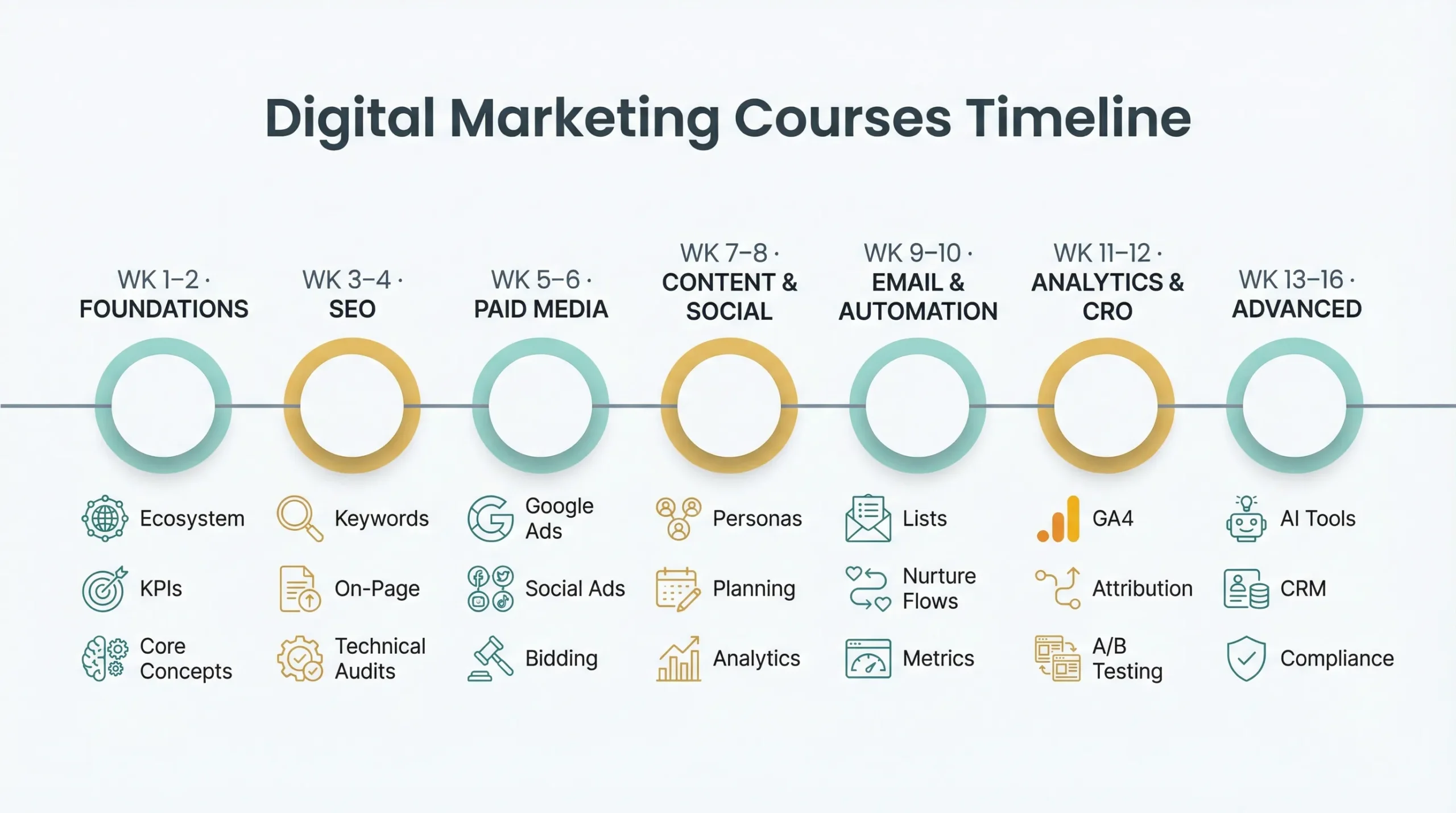
In 2026, most structured digital marketing curricula follow a progression that builds foundational knowledge first, then adds strategic and analytical skills, ending with applied projects and real-world scenarios. Here’s a typical timeline you might expect:
Week 1–2: Digital Marketing Fundamentals
- Introduction to the digital marketing ecosystem
- Core concepts (SEO, SEM, analytics, social media, email marketing)
- Understanding performance goals and KPIs
Week 3–4: Search Engine Optimisation (SEO)
- Keyword research and intent mapping
- On-page optimisation and content strategy
- Technical SEO basics and site health audits
Week 5–6: Paid Media & Advertising
- Google Ads fundamentals (Search & Display)
- Social ad platforms (Facebook/Meta, TikTok, LinkedIn)
- Bidding strategies, quality score, campaign structure
Week 7–8: Content Marketing & Social Strategy
- Audience demographics and persona building
- Editorial calendars and social content planning
- Engagement metrics and social analytics tools
Week 9–10: Email Marketing & Marketing Automation
- List segmentation and lead scoring
- Automated nurture sequences
- Deliverability, open rates, and conversion metrics
Week 11–12: Analytics & Conversion Optimisation
- Google Analytics 4 and dashboard setup
- Tracking conversions and defining attribution models
- A/B testing and optimisation frameworks
Week 13–16: Advanced Topics & Integration
- AI tools for marketing (content generation, predictive analytics)
- CRM integration and cross-channel attribution
- Data privacy, compliance, and ethical targeting
Week 17–20: Capstone Project / Practical Application
- Running a full campaign from planning to report
- Real or simulated budget management
- Presentations and performance review
Total Estimated Time: 3–5 months (depending on pace and format)

This progression represents a comprehensive, industry-aligned approach. In contrast, shorter courses often cover only the foundational stages, while more advanced programmes extend to project work and specialised modules.
How Much Do Digital Marketing Courses Cost in 2026?
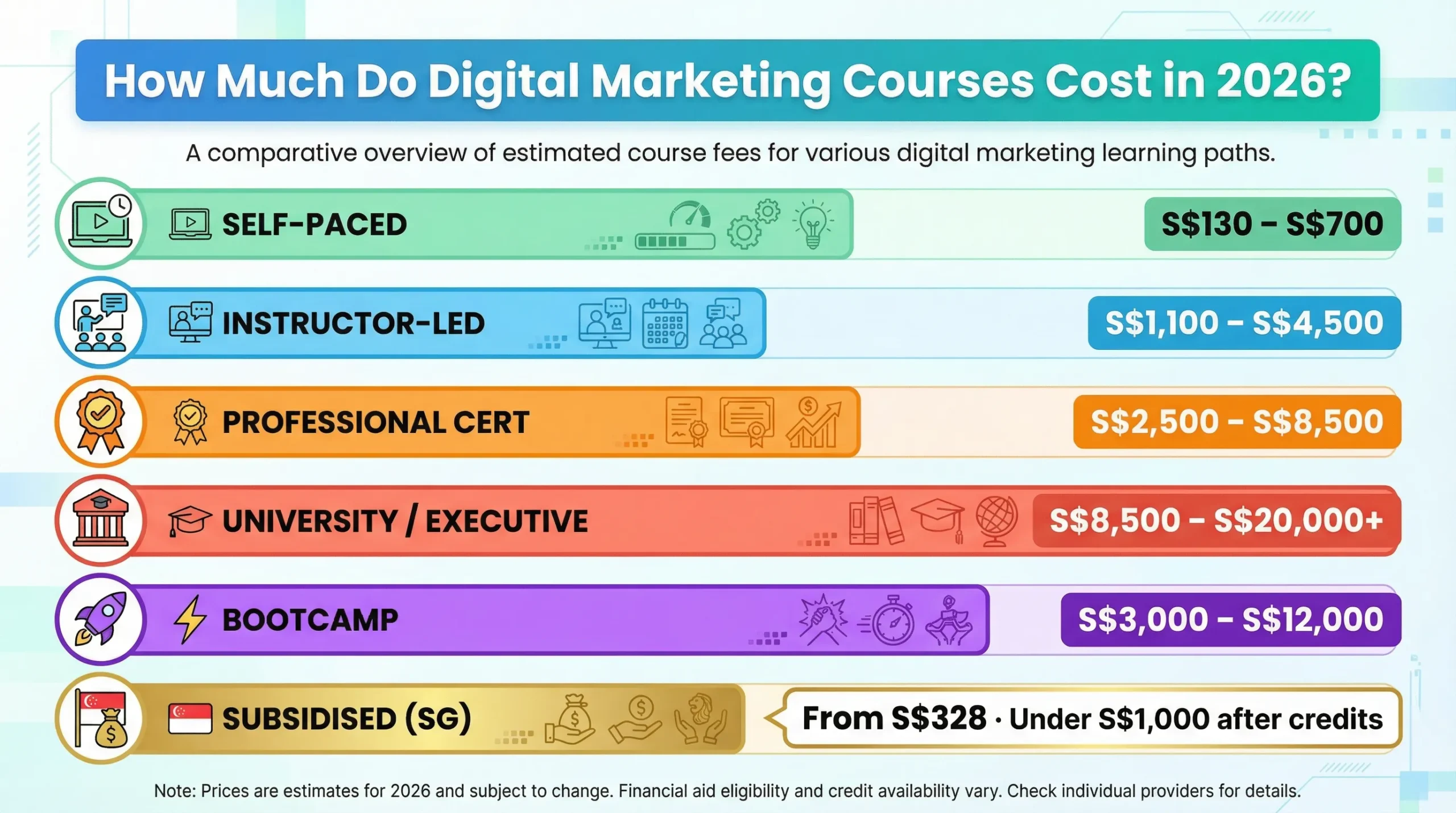
Course fees vary widely depending on format, depth, accreditation, and practical components. Below are realistic ballpark ranges based on typical offerings in Singapore and internationally:
Self-Paced Online Courses
- Typical Price Range: S$130 – S$700
- Examples include beginner digital marketing bundles or introductory modules on platforms like Udemy, as well as short online courses.
Instructor-Led Online Programmes
- Typical Price Range: S$1,100 – S$4,500
- Structured online classes with live sessions, assignments, and some support. These often convert standard international prices into SGD.
Professional Certificates / Specialist Programmes
- Typical Price Range: S$2,500 – S$8,500
- Comprehensive programmes with analytics, ads, strategy, and applied projects (e.g., offerings from regional training providers).
University-Affiliated or Executive Courses
- Typical Price Range: S$8,500 – S$20,000+
- Accredited certificates, deeper strategy modules, networking opportunities, and longer duration. Some advanced certifications from universities or business schools may command premium pricing (before funding support).
Bootcamps (Intensive)
- Typical Price Range: S$3,000 – S$12,000
- Intensive short-format training with real application work and portfolio focus.
Singapore Specific Examples
- Funding-supported modules (e.g., subsidised digital marketing modules) can be as low as S$328 per module after subsidies.
- Comprehensive short courses may cost around S$3,000 before GST and subsidies.
- Some advanced professional certificates at institutions like SMU Academy are listed at up to ~S$20,928 before maximum funding (can be a fraction with subsidies).
- Subsidised bootcamps may reduce total fees to under S$1,000 for eligible Singapore citizens/PRs after credits are applied.
How to Interpret These Figures
- Entry-level and short courses (self-paced or introductory) are ideal for beginners testing the field without a heavy financial commitment.
- Mid-tier structured programmes balance cost with practical skills and often include mentoring, assessments, and project work that employers value.
- High-end executive certificates offer strategic depth and recognised credentials that may help in managerial or specialised roles, but only if the curriculum matches current industry requirements.
Before committing, evaluate the return beyond the price tag. Consider whether the programme includes real campaign exposure, measurable skill development, access to mentorship, and portfolio-building opportunities.
Ultimately, the best course is one that bridges knowledge and execution. When theory translates into practical results, the investment becomes far more than a certification; it becomes a growth multiplier.
Career Outcomes After Completing Digital Marketing Courses
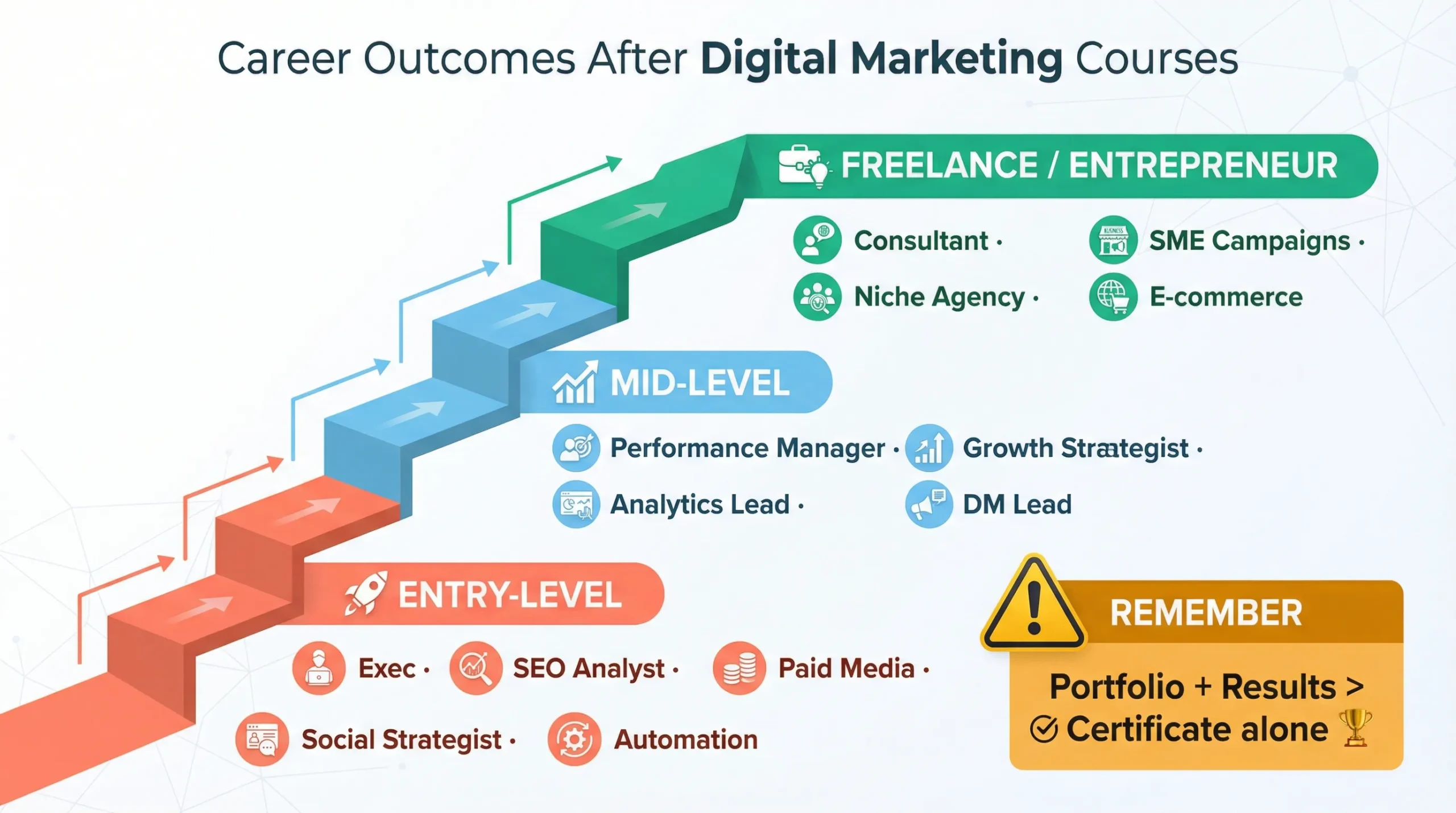
One of the main reasons people enrol in digital marketing courses is career opportunities.
Entry-Level Roles
Graduates often enter roles such as:
- Digital marketing executive
- SEO analyst
- Paid media specialist
- Social media strategist
- Marketing automation assistant
These roles focus on implementation and channel execution.
Mid-Level and Growth Roles
With experience, professionals can move into:
- Performance marketing manager
- Growth strategist
- Digital marketing lead
- Analytics manager
These positions require strategic oversight, cross-channel planning, and budget responsibility.
Entrepreneurial and Freelance Path
Some individuals use digital marketing courses as a launchpad for:
- Freelance consulting
- Running paid campaigns for SMEs
- Starting niche agencies
- Scaling e-commerce businesses
Understanding digital acquisition channels can directly impact business profitability. This makes the skill set highly transferable across industries.
However, employability depends on more than certification alone. Employers prioritise portfolio evidence, campaign results, and practical understanding over certificates in isolation.
Alternatives to Traditional Digital Marketing Courses

Digital marketing courses are not the only pathway into the industry.
On-the-Job Learning
Working within an agency or in-house marketing team exposes individuals to live campaigns, real budgets, and performance accountability. The learning curve can be steep but practical.
Apprenticeships and Mentorship
Learning under experienced marketers accelerates skill acquisition. Direct feedback shortens the trial-and-error cycle.
Self-Led Practical Projects
Building your own website, running small ad budgets, and testing SEO strategies can provide hands-on experience at a lower cost. The challenge is the lack of structured guidance.
Agency-Level Exposure
Observing how professional teams deliver integrated digital marketing services can provide clarity on what advanced execution looks like. This often bridges the gap between theory and scalable implementation of growth.
The right pathway depends on your learning style, risk tolerance, and timeline.
Enhance Your Skills With Digital Marketing Courses
Digital marketing is no longer just a supporting function in business; it is a core growth engine. In 2026, the difference between average and exceptional marketers lies in their ability to combine data, strategy, automation, and AI-driven execution into measurable results.
Digital marketing courses can be a powerful accelerator if they are current, practical, and aligned with real industry demands. The right programme equips you not just with certificates, but with the confidence to analyse performance, optimise campaigns, and drive revenue impact.
Whether you are a fresh graduate, a career switcher, or a business owner aiming to scale sustainably, investing in the right digital marketing education can shorten your learning curve significantly.
Choose wisely, apply consistently, and focus on building demonstrable results. In a performance-driven economy, skills that generate growth will always remain valuable.
If you want to see how these strategies are executed at scale in real campaigns, explore how MediaOne delivers measurable results through its integrated digital marketing services. Contact us now!
Frequently Asked Questions
Do digital marketing courses require prior marketing experience?
Most beginner-level digital marketing courses do not require prior experience, as they start with foundational concepts. However, intermediate and executive programmes often assume familiarity with basic marketing principles or business strategy.
Can I take digital marketing courses while working full-time?
Yes, many digital marketing courses are designed for working professionals and offer part-time, evening, or self-paced formats. The key challenge is not scheduling, but consistently applying what you learn alongside your job responsibilities.

How quickly can I transition into a digital marketing career after completing a course?
Transition speed depends on your prior background, portfolio readiness, and market demand. While some learners secure roles within 3–6 months, others may need additional practical experience to strengthen their employability.
Are digital marketing courses recognised internationally?
Recognition varies by provider. University-affiliated certifications and globally recognised platforms tend to carry more weight, but practical experience and results often matter more than brand name alone.
Should business owners take digital marketing courses themselves?
For small business owners, digital marketing courses can provide clarity on strategy, budgeting, and performance metrics. However, scaling execution often still requires partnering with professionals or agencies specialising in digital marketing services.