| AI Summary
AI inbound marketing helps businesses manage enquiries from website forms, email, chat and connected messaging channels. AI can interpret questions, summarise conversations and suggest replies. Connected workflows can save contact details, assign an owner and arrange follow-ups. Singapore SMEs need reliable records, approved answers, appropriate data handling and human support. Faster acknowledgement helps, but success depends on relevant answers and completed sales conversations. |
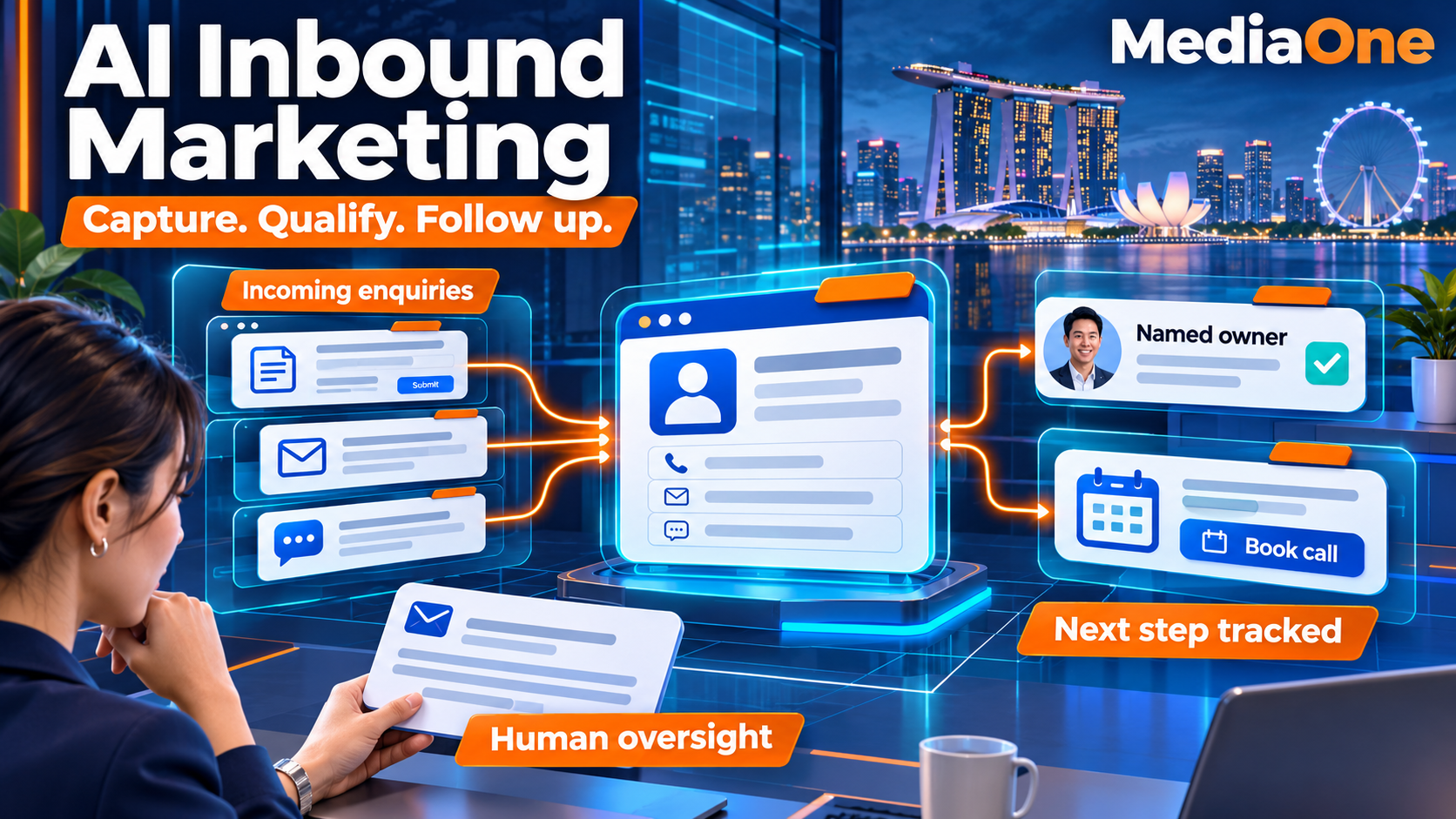
AI inbound marketing combines artificial intelligence with connected marketing and sales tools to handle incoming enquiries. The system can capture contact details, ask qualifying questions, suggest answers, route enquiries and support meeting bookings. People remain responsible for complex requests, commercial commitments and customer relationships.
Key Takeaways
- Every connected enquiry channel needs a named owner and a backup.
- Automatic acknowledgements and substantive answers need separate response targets.
- Lead scores help prioritise work; missing information should trigger review.
- Follow-up sequences need exit rules for replies, bookings and opt-outs.
- Performance reports should track attended meetings and qualified opportunities alongside response speed.
A prospect messages a Singapore service business after dinner. The team has finished work, but the prospect still wants to know whether the company can help.
AI inbound marketing can keep that enquiry moving. An approved acknowledgement confirms receipt, a short question gathers missing details, and the conversation reaches the right person.
The goal is to reduce unattended enquiries without creating inaccurate answers or unwanted messages. A practical system connects fast replies with responsible follow-through.
What AI Inbound Marketing Does
AI inbound marketing supports the wider process of attracting customers and responding when they show interest. Within an inbound marketing programme, content brings people to the business, while enquiry handling helps them take the next step.
An inbound AI agent is software that can interpret a message and perform permitted actions through connected tools. Its abilities depend on its information, integrations and permissions.
Common tasks include:
- Identifying the service mentioned in an enquiry.
- Summarising a conversation for a salesperson.
- Suggesting answers from approved business information.
- Asking a relevant follow-up question.
- Updating a customer record.
- Offering a booking option when appropriate.
AI and fixed automation do different jobs
Fixed automation follows a rule. A submitted form might trigger a confirmation email and create a task.
AI handles less structured information. A message such as “We need office cleaning twice a week in Jurong” can contain several details worth recording.
| Enquiry task | Suitable approach |
| Confirming receipt of a form | Approved automatic template |
| Identifying the requested service in a message | AI-assisted classification |
| Assigning an owner by service area | Fixed routing rules |
| Summarising a long conversation | AI-assisted summary |
| Approving a negotiated price | Authorised person |
A basic workflow may solve the main delay without additional AI. AI lead generation becomes more valuable when interpretation or repeated manual reading creates extra work.
Why Faster Replies Need a Next Step
Speed to lead means the time between an enquiry arriving and the business responding. However, an automatic receipt and an answer to the customer’s question serve different purposes.
“Your message has arrived” confirms delivery. “Our team covers Jurong, and we need your office size before preparing a quotation” moves the conversation forward.
A practical response plan separates three events:
- Acknowledgement: The customer knows the message arrived.
- Substantive response: The business answers or asks a relevant question.
- Sales follow-through: A named person handles the next action.
A five-minute acknowledgement can be an internal target, but it is not a universal standard. The target should reflect channel expectations, staffing and the urgency of the service.
A promise needs an owner
An after-hours message should state when a person will respond. A business should promise a morning callback only when someone owns that task.
An approved reply might say:
“Your enquiry has reached our team. Our office opens at 9 am on weekdays. A team member will respond during business hours.”
An urgent request also needs a separate route when the business provides one. A routine booking sequence should never imply that emergency assistance is on its way.
How the Inbound Lead Workflow Works
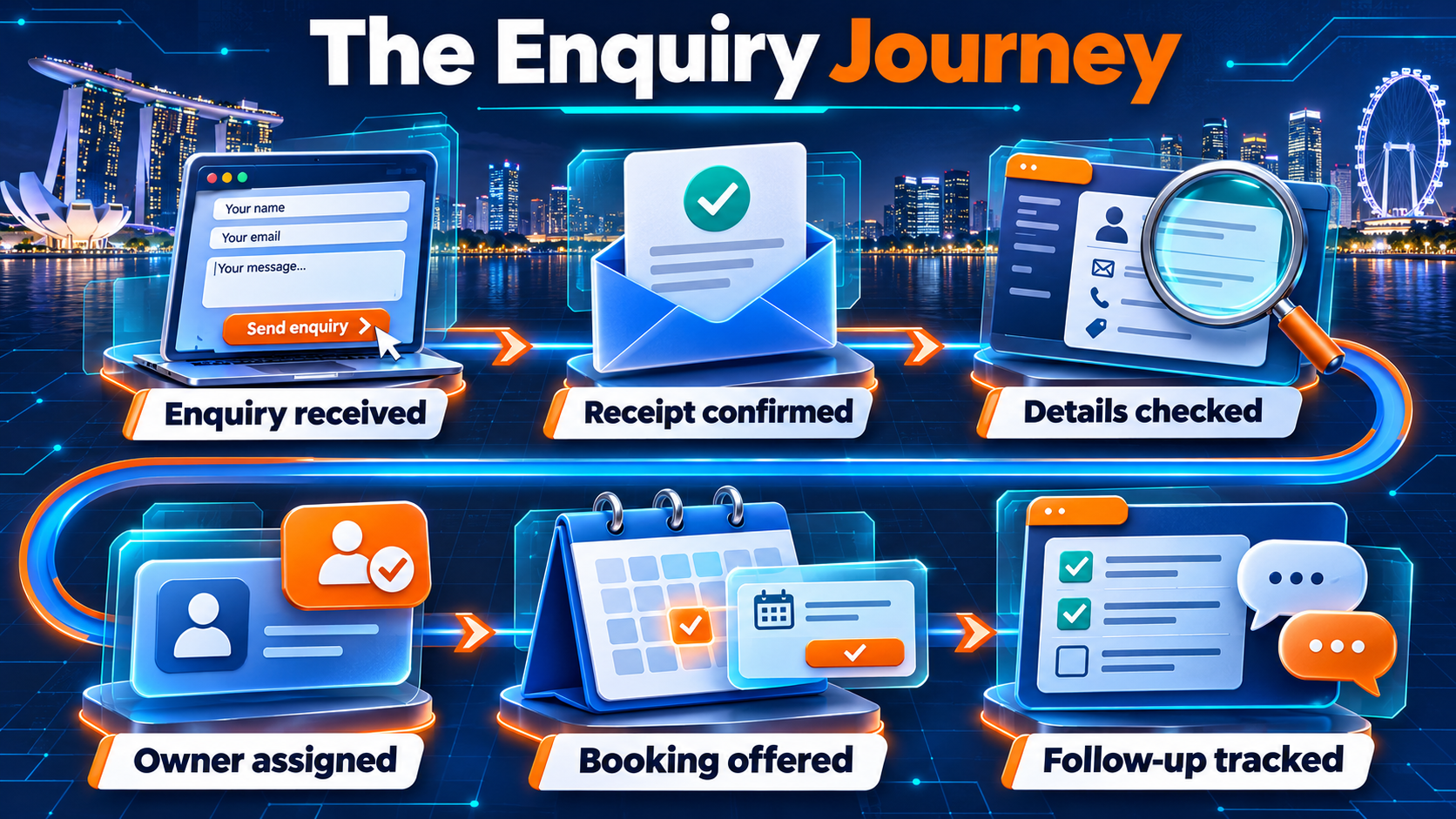
A dependable workflow connects six stages: capture, acknowledgement, qualification, routing, booking and follow-up. Each stage needs a recorded outcome so unfinished enquiries remain visible.
A customer relationship management system, or CRM, holds contact details, conversation history and sales tasks. Customer relationship management gives teams a shared view of what happened and who responds next.
Each enquiry record should contain:
- Contact details provided by the customer.
- Enquiry source and arrival time.
- Requested service or product.
- Original message and relevant conversation history.
- Assigned owner.
- Current status and next action.
- Communication preferences and relevant permission records.
A connection must exist before a channel can feed that record. A website chatbot does not automatically capture personal WhatsApp messages or missed calls.
2. Acknowledge the request
The first message should confirm receipt and explain the next step. An approved template often handles this without AI.
HubSpot’s workflow documentation describes how events such as form submissions can enrol contacts into workflows. Available actions depend on the subscription and setup.
A helpful acknowledgement contains:
- The business name.
- Confirmation that the enquiry arrived.
- A realistic response window.
- One relevant action, if needed.
Repeated questions create friction. A form that already collected a service location should pass that detail into the conversation.
3. Qualify with a few relevant questions
Qualification checks whether the business can help and what the customer needs next. The first exchange should collect only information needed to act.
For an office cleaning enquiry, the relevant details might be:
- Office location.
- Approximate floor area.
- Required cleaning frequency.
- Preferred starting date.
AI can identify details already present and ask about missing ones. Uncertain information should remain unconfirmed.
A message saying “We might move next month” should not become a confirmed start date in the CRM. The original wording should remain available.
4. Route the enquiry to a named person
Routing assigns responsibility using agreed rules. Service type, location, existing account ownership and staff availability can determine the destination.
A simple priority order might be:
- Existing customers go to their account owner.
- Urgent service requests go to the designated queue.
- New enquiries go to the relevant service team.
- Unmatched requests go to a monitored shared queue.
A backup owner handles absence or inactivity. An assigned enquiry still needs an overdue alert if nobody takes action.
5. Offer a suitable booking option
Meeting booking helps when a call, visit or demonstration is the correct next step. Some customers need a direct answer before they need a meeting.
The booking system should reflect:
- Actual staff availability.
- Meeting duration and preparation time.
- Relevant staff or service teams.
- Singapore time and any customer time-zone differences.
- Rescheduling and cancellation options.
A confirmed booking should update the CRM and stop invitations to arrange the same meeting.
6. Follow up until a defined stopping point
Follow-ups should respond to the customer’s request. A quotation enquiry might receive a reminder asking whether the customer can provide missing measurements.
An email marketing lifecycle connects messages to customer actions and helps prevent outdated sequences.
Each sequence needs a stopping point, including:
- A customer reply.
- A completed booking.
- An active sales conversation.
- An opt-out.
- An invalid contact address.
- The final scheduled attempt.
A salesperson’s reply should pause the automated sequence. Otherwise, the customer may receive conflicting messages from the same business.
How Lead Scoring Supports Sales Decisions
Lead scoring assigns values to agreed information or actions. The score helps teams prioritise enquiries; it does not prove that someone will buy.
HubSpot’s lead scoring documentation describes scores based on record properties and actions, with score properties available for workflows, segments and reports.
A small team may begin with three labels: ready for contact, more details needed, and outside current services. Numerical scoring becomes worthwhile when those labels no longer provide enough detail.
An illustrative scoring example
The example below shows one possible approach for a commercial service business. These values are invented for explanation and are not industry benchmarks.
| Confirmed information | Example points |
| Requested service is available | 30 |
| Location is within the service area | 20 |
| Customer requests a quotation or consultation | 25 |
| Timing falls within available capacity | 15 |
| Contact details support a reply | 10 |
A high score could trigger a sales task. An incomplete record should enter a review queue, since missing information can suppress the score of a genuine prospect.
Scores need review against outcomes
The sales team should compare scores with attended meetings and qualified opportunities. A scoring model that rewards frequent browsing may favour researchers over buyers.
Regular reviews should examine:
- Low-scoring enquiries that became customers.
- High-scoring enquiries that proved unsuitable.
- Missing fields that affect prioritisation.
- Incorrect information added through enrichment.
Enrichment means adding information from other sources. Relevant data needs an identifiable source, appropriate permission where required, and a way to correct errors.
How to Choose and Connect the Tools
The first purchasing decision concerns the task causing delays. A team may need better form-to-CRM connections, shared messaging or booking controls before it needs an autonomous agent.
A demonstration should follow an enquiry from arrival to completion. A polished chatbot conversation alone cannot prove that records, ownership and follow-ups work.
Tool categories and their roles
| Tool category | Main role | Main purchasing check |
| CRM | Stores enquiries, owners and tasks | Data structure and access controls |
| Chat or messaging tool | Handles supported conversations | Channel coverage and handover |
| AI assistant | Interprets messages and drafts replies | Approved information and action limits |
| Workflow connector | Moves records between systems | Error reporting and duplicate prevention |
| Booking tool | Offers appointments | Availability and CRM updates |
| Reporting tool | Tracks progress and outcomes | Consistent definitions and records |
Connected content marketing platforms may support the content that attracts enquiries. The enquiry workflow still needs its own operating checks.
A purchasing checklist
A supplier should demonstrate:
- Supported connections to existing systems.
- Visibility into messages and actions.
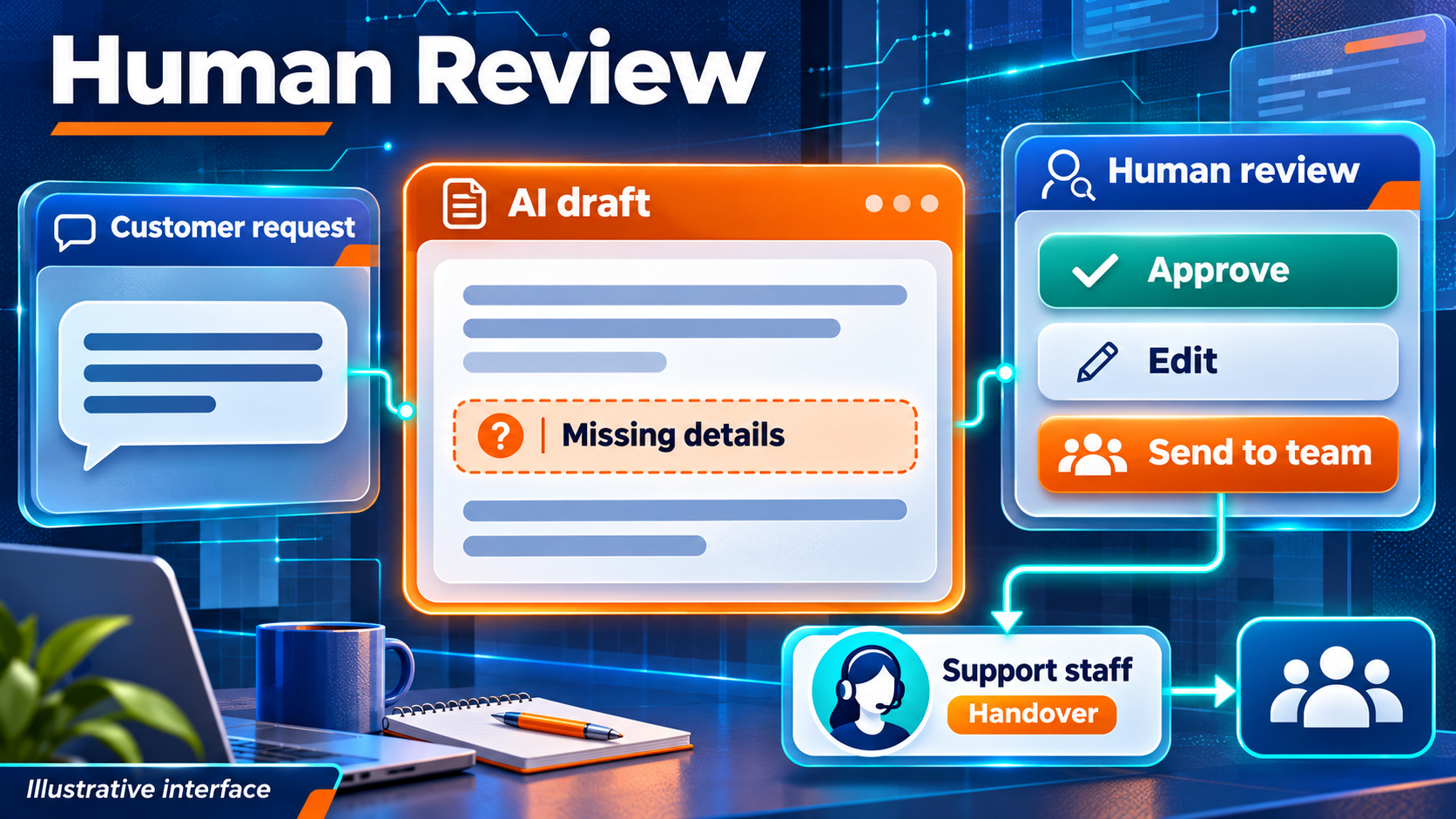
- Human approval and pause controls.
- Human handover with conversation history.
- Failed-action alerts and retry handling.
- Data export and deletion options.
- Charges for users, messages, usage and integrations.
Total cost includes setup, review time and maintenance. A low subscription price can hide substantial manual work if staff must repair records daily.
A connection test
A test enquiry should travel from its original channel into the CRM, create the correct task and reach the intended owner.
A second test should repeat the same submission. The outcome should follow the business’s duplicate-handling rules without creating repeated messages or conflicting owners.
Where Human Review Belongs
Human review should reflect the consequences of an error. A receipt confirmation carries less commercial risk than a negotiated quotation.
The NIST AI Risk Management Framework provides a voluntary framework for managing AI risks. A practical application is to define permitted actions, monitor results and assign responsibility.
A simple task review
| Task | Starting control |
| Receipt confirmation | Approved automatic template |
| Request for missing details | Approved questions |
| Answer about published services | Restricted source information and testing |
| Conversation summary | Staff access to the original exchange |
| Negotiated quotation | Authorised human approval |
| Complaint or disputed promise | Human ownership |
Speed alone should not decide what runs automatically. A fast task can still create a serious problem if it changes prices or promises unavailable services.
Approved information limits errors
The AI assistant should work from maintained service details, opening hours, policies and escalation instructions. An information owner should update those sources when the business changes.
A missing answer should produce a handover. A suitable response might say:
“Our team needs to confirm that detail. Your question has been added to the enquiry.”
Customer messages also need to remain separate from system instructions. A request to ignore pricing rules should never authorise a discount.
Singapore Data and Messaging Requirements
AI inbound marketing handles contact details and conversation records. Singapore businesses need to account for personal data rules and the requirements of each messaging channel.
A customer’s request for an answer should not automatically enrol that person in unrelated promotional campaigns.
Personal data needs a defined purpose
The PDPC’s AI recommendation and decision systems guidelines explain how personal data protection applies to relevant AI systems. The document addresses consent, information provided to individuals and safeguards.
Practical controls include:
- Collecting information needed for the stated purpose.
- Limiting staff and vendor access.
- Recording relevant permissions and preferences.
- Setting retention periods.
- Checking overseas data handling.
- Reviewing whether vendors use submitted data for model training.
The PDPC’s data protection obligations also cover retention and overseas transfers. Vendor settings should support those obligations.
Promotional follow-ups need separate checks
The Do Not Call provisions govern specified marketing messages to Singapore telephone numbers, subject to applicable consent rules, exceptions and exclusions. AI authorship does not remove these requirements.
An enquiry response and a later promotional campaign can have different purposes. The workflow should record that distinction and honour opt-outs across connected tools.
WhatsApp has channel-specific rules
The WhatsApp Business Messaging Policy includes permission requirements and rules for automated conversations. For the Business Platform, replies outside the 24-hour customer service window require approved message templates, and automation needs an available escalation route.
A form submission should not trigger WhatsApp contact unless the necessary permission exists. Channel-specific settings should control when messages send and which formats they use.
How to Launch a Controlled Pilot
A pilot should cover one enquiry source and one service team. A limited scope makes problems easier to identify before more customers encounter them.
Week 1: Record current performance
The baseline should show how the team currently handles enquiries. Recent records can reveal delays without requiring a new campaign.
The review should record:
- Arrival and first-response times.
- Unanswered enquiries.
- Assigned owners.
- Bookings and attended meetings.
- Qualified opportunities.
- Common customer questions.
Missing records are findings too. A baseline cannot explain sales performance when the business does not record what happened after the first reply.
Week 2: Connect and test
The test set should cover ordinary enquiries and failures. Examples include incomplete forms, repeat contacts, unavailable staff and requests outside the service area.
Each test needs an expected result. A simulated integration failure should produce an alert and a recoverable record.
Week 3: Run with supervision
Approved acknowledgements can run automatically. AI-generated answers should begin with human review while the team checks accuracy and tone.
A daily review should examine unfinished tasks, wrong owners, duplicate messages and failed actions. A pause control needs an identified operator.
Week 4: Review the evidence
The team should expand only when the workflow performs reliably. Faster replies alongside missed handovers signal unfinished work.
A small pilot may not produce enough sales to establish a return on investment. Operational improvements can support a further test without proving additional revenue.
How to Measure Business Results
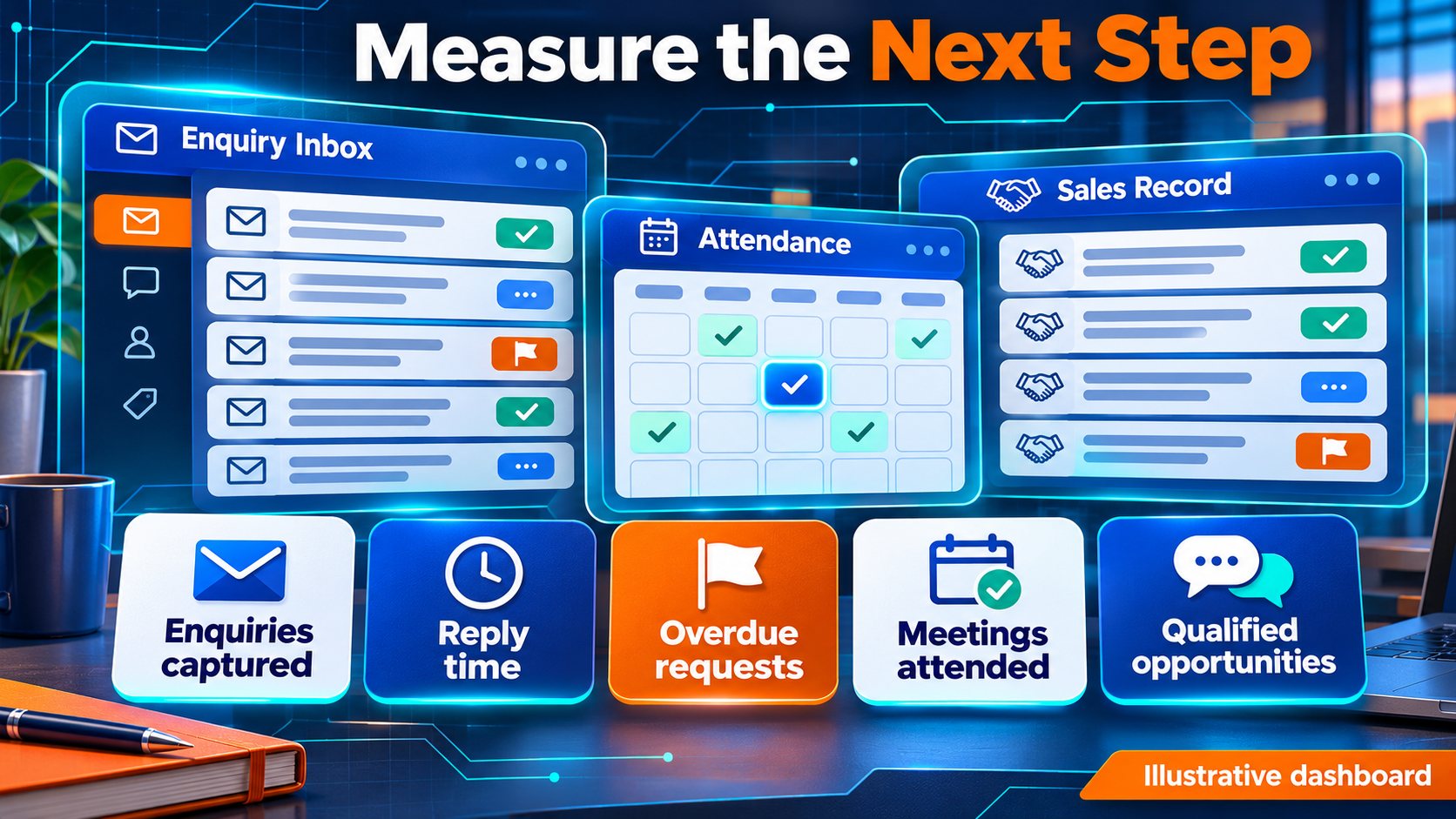
AI inbound marketing needs measures that distinguish activity from progress. A high message count can reflect repeated questions or customer frustration.
Lead generation campaign measurement should connect enquiries with qualification, sales conversations and outcomes.
| Metric | What it shows |
| Capture coverage | Whether source enquiries reach the CRM |
| Acknowledgement time | How quickly receipt is confirmed |
| Substantive response time | How quickly the customer receives help |
| Overdue enquiries | Requests still awaiting action |
| Attended meetings | Bookings that become conversations |
| Qualified opportunities | Enquiries sales accepts for further work |
| Opt-outs and complaints | Signs of unwanted or poor communication |
Median response time describes the middle enquiry. A separate count of overdue requests reveals customers left waiting behind an otherwise favourable average.
Google Analytics key events can measure important website actions, including a correctly configured enquiry submission. CRM records are still needed for later sales outcomes.
A before-and-after review should account for changes in traffic, service demand and staffing. A busier month or a different campaign can affect results independently of automation.
Give Every Enquiry an Owner and a Next Step
AI inbound marketing connects enquiry capture, relevant replies, qualification and follow-up. Reliable records and human oversight help Singapore SMEs reduce delays while tracking whether conversations progress.
At MediaOne, we connect lead generation with marketing, CRM integration and automation. Our team can review how enquiries reach your sales process and where delays occur. A consultation with us can help identify the first workflow to improve.
FAQs About AI Inbound Marketing
Can AI handle enquiries in several languages?
A multilingual system needs testing in each supported language. Product names, informal expressions and mixed-language messages can cause errors. A native speaker should review representative conversations before launch, with human support available when meaning remains uncertain.
Does AI inbound marketing work for a business with few enquiries?
A low-volume business may gain enough value from shared records, automatic receipts and task reminders. AI becomes more relevant when enquiries require repeated interpretation or detailed summaries. The decision should reflect saved work and service quality.
Can an AI assistant handle voice enquiries?
Some systems support connected telephony, transcription and voice conversations. Capabilities vary by supplier and setup. A voice workflow also needs suitable recording practices, accurate transcription, human transfer and a fallback when the caller cannot be understood.
How can a business avoid dependence on one supplier?
A supplier assessment should check whether contact records, conversation history and workflow settings can be exported. Documented processes and business-owned accounts make future changes easier. Cancellation terms should explain access, data retrieval and deletion.
Should an AI assistant send payment links?
Payment links need strict controls. Links should come from approved payment systems and lead to verified business destinations. Any payment request should follow the business’s authorisation process, with additional review for unusual amounts or changed payment details.