Website hosting keeps your site online and fast for every visitor who types your address. For Singapore small businesses and marketers, the choice of plan matters more than most people expect. A plan that is too small slows checkout during a sale, and one that is too large drains budget you could spend on marketing.
This guide explains how hosting works, what each type costs in S$, and when a site outgrows its plan. We argue that shared hosting is usually the right place to start, and that the costly decision is timing the move to a managed VPS. Moving too early wastes money, while moving too late loses customers.
Key Takeaways
- Shared hosting is a sensible starting point for Singapore small businesses, with local entry plans around S$10 to S$13 a month at list price.
- Introductory rates are not monthly prices. Budget for the renewal rate, which can run two to four times higher than the headline figure.
- The real cost decision is timing the move to managed VPS, not choosing the cheapest plan on day one.
- Use the Hosting Upgrade Decision Matrix in this guide to score visitors, peaks, technical skill and e-commerce use, and land on a tier.
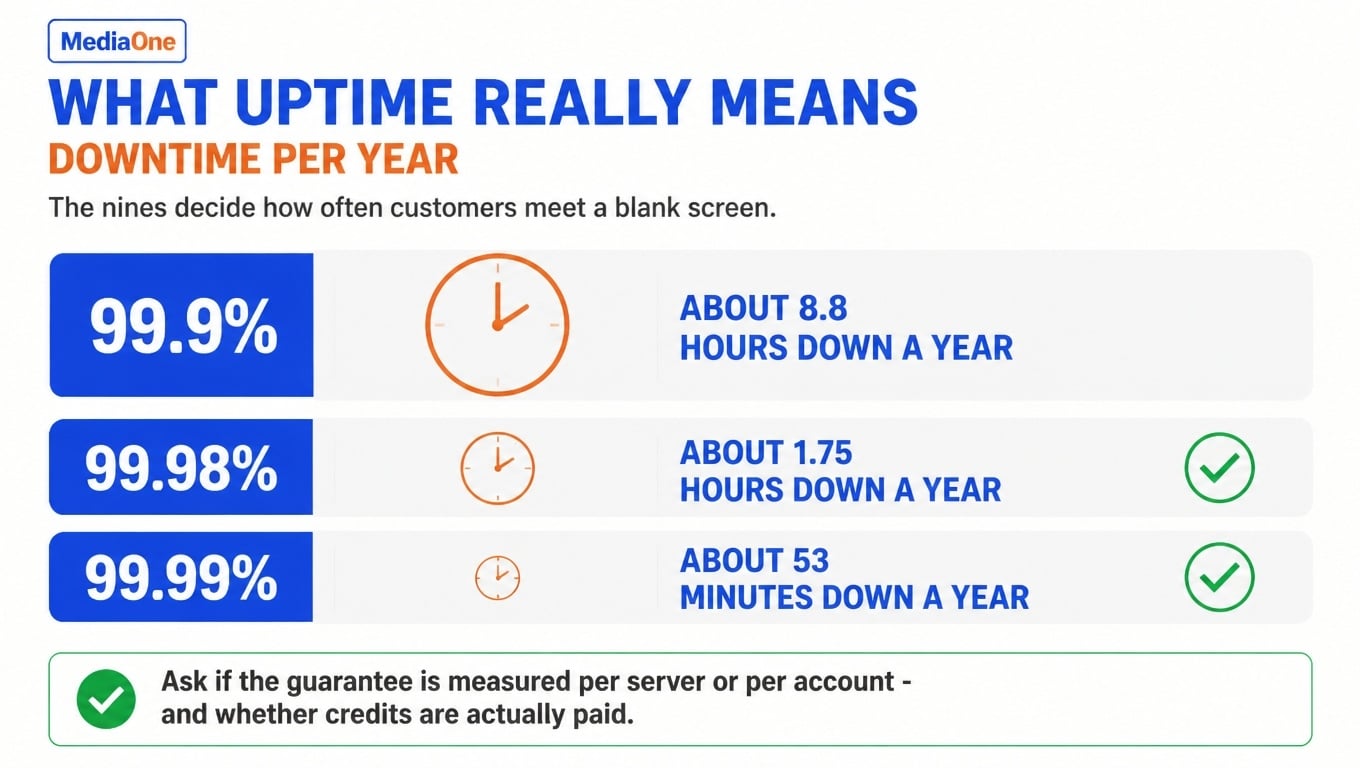
- 99.9% uptime allows roughly 8.8 hours of downtime a year. Local providers increasingly offer 99.98% or better, which cuts that to under two hours.
- Count migration cost in downtime and staff hours, not just the new monthly fee.
What Website Hosting Is and Why It Matters
How a web host stores and serves your site
Every website is a set of files, images and database records that must sit on a server connected to the internet. A web host rents you space on that server and keeps it running around the clock. When a visitor types your domain, the request reaches the server, which returns the page files within milliseconds. If the server is slow, offline or overloaded, visitors meet a blank screen or a timeout. Slow responses also lift your bounce rate before a visitor ever reaches your offer.
The quality of that service depends on hardware, network and how the provider manages the machine. Hosting that works well for a brochure site can fail under a spike from an email campaign. That is why we treat hosting as a performance decision rather than a line item.
The features that affect speed, reliability and security
Three factors matter most.
- Storage type shapes speed. SimplerCloud, a Singapore provider, states its solid-state drives deliver up to 300% faster page loads than regular hard drives — that is the vendor’s own claim, so treat it as directional rather than measured. For the user-facing side of that, see how to improve Core Web Vitals.
- Uptime shows reliability. 99.9% is the common industry baseline, which allows roughly 8.8 hours of downtime a year. SimplerCloud advertises 99.98% on its Singapore plans; Vodien offers a 99.99% guarantee.
- Security is table stakes. SSL certificates, backups and firewalls should be included, not sold as extras. If you are unsure what to demand, our website security checklist for Singapore SMEs covers the minimum.
Types of Hosting and What They Cost in Singapore
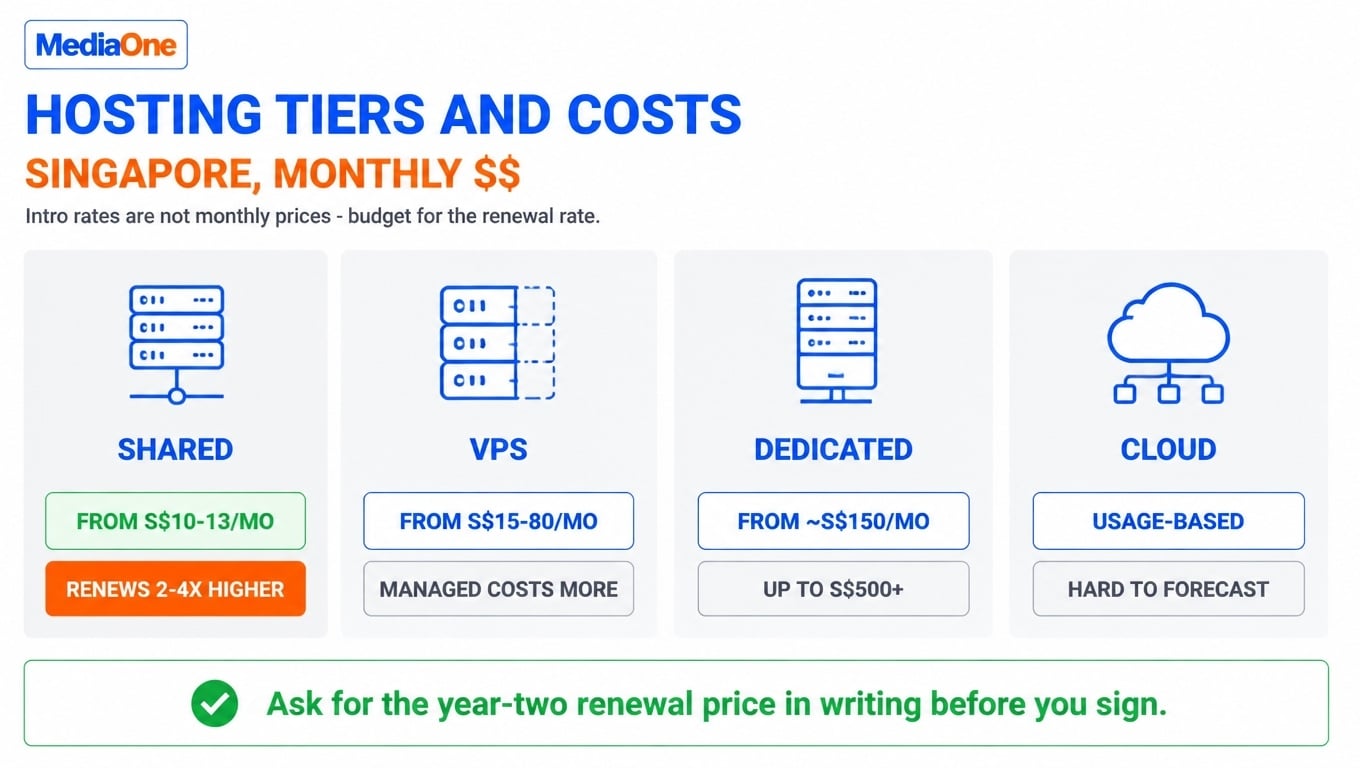
The Singapore market splits into four tiers. Entry pricing is aggressive, but renewal pricing isn’t, so read both columns in any quote.
|
Type |
Listed monthly cost (SGD) |
Best for |
Main limitation |
|
Shared |
About S$10 to S$13 at list; S$2 to S$4 on long prepaid terms |
Brochure sites, small WordPress blogs |
Neighbours compete for CPU at peaks |
|
VPS |
About S$15 to S$80 |
Growing sites, custom stacks |
Unmanaged plans need admin skill |
|
Dedicated |
About S$150 to S$500+ |
Heavy databases, sustained high traffic |
Highest fixed cost |
|
Cloud |
Usage-based, hard to forecast |
Unpredictable or spiky traffic |
Budgeting is harder |
Shared hosting places your site on a server with many others. Vodien’s shared plans list at around S$9.99 to S$12.99 a month. Hostinger goes lower — about S$2.49 to S$2.99 a month — but only when you prepay a 48-month term, after which the plan renews at roughly S$11 to S$26 a month. Bitcatcha’s 2026 Singapore comparison shows the same pattern in one line: S$1.74 a month on a 48-month term, renewing at S$18.89.
That gap is the single most misread number in hosting. Shared plans suit brochure sites and small blogs, but strain when traffic spikes and neighbouring sites compete for the same CPU and memory.
If WordPress is your platform, our WordPress hosting guide for Singapore goes deeper into the specific requirements, and our WordPress website design service covers build and hosting together.
VPS hosting: control without buying a server
A virtual private server gives you a dedicated slice of resources and root-level control. Singapore-local VPS plans typically range from about S$15 to S$80 a month, with HostSG quoting S$43.60 a month for an entry VPS without a control panel. Entry prices near S$5 to S$10 usually mean an overseas data centre or a promotional first term, not a local managed plan.
The management decision matters more than the specification. An unmanaged plan leaves patching, hardening and monitoring to you. Managed plans cost more, and the honest range is wide: Hostwinds puts unmanaged pricing “up to 50% lower” than managed for equivalent resources. For a business without an in-house developer, that premium usually buys back more staff time than it costs.
Dedicated servers and cloud hosting
A dedicated server is a single physical machine for one client, typically starting at about S$150 a month in Singapore and going well past S$500 at the top of the range. It makes sense for heavy databases or sustained high traffic.
Cloud hosting spreads your site across multiple servers, so capacity grows or shrinks with demand. Costs are harder to forecast because billing follows usage. It suits genuinely unpredictable traffic, not a site that simply expects to grow. Whichever tier you land on, the platform you build with shapes the requirement — see how to choose a CMS for SEO.
The market context is worth knowing: the global web hosting services market is expected to reach USD 149.3 billion in 2026, up from USD 126.4 billion in 2025, and Singapore’s own hosting market is projected to grow at close to 15% CAGR from 2026, according to Vodien’s 2026 Singapore hosting guide. Growth in the category has not made local hosting cheaper — it has made the choice more consequential.
Local Versus Overseas Hosting Providers
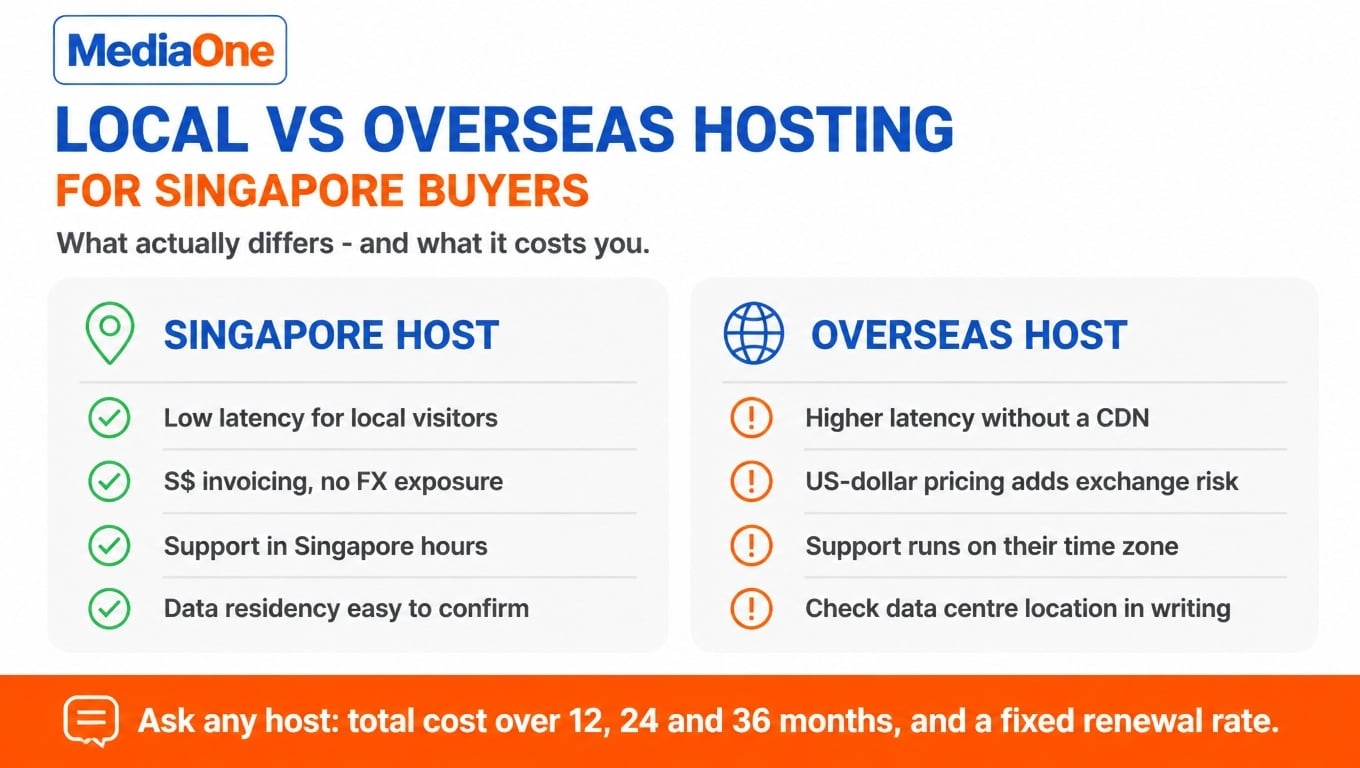
Choosing a Singapore host or an overseas one changes how fast your site feels and how much your team has to manage.
Latency. Physical distance adds delay to every request. A server in Singapore usually answers local visitors faster than one in the United States or Europe, which matters most for stores and lead forms where each second of waiting costs sales. If nearly all your customers are in Singapore and Southeast Asia, a local data centre is the simpler default. A global CDN closes much of the gap for a distributed audience.
Everything else that shows up on the invoice. Local providers quote in S$, invoice locally and support during Singapore business hours. Vodien’s own guidance is blunt about the commercial side: ask for total cost over 12, 24 and 36 months, request a fixed renewal rate for at least the first year, and check whether migration is included. Overseas providers often price in US dollars, which adds exchange-rate exposure, and their support runs on their time zone rather than yours.
Data residency. If you need data kept in Singapore, confirm the data centre location in writing before you sign, not from a marketing page.
The Hosting Upgrade Decision Matrix
Most hosting advice stops at “start small and scale later.” That is not a decision rule — it is a deferral. Score four levers from 1 to 4 and add them up.
|
Lever |
1 point |
2 points |
3 points |
4 points |
|
Monthly visitors |
Under 5,000 |
5,000–20,000 |
20,000–50,000 |
Over 50,000 |
|
Traffic peaks |
Flat, predictable |
Seasonal |
Campaign spikes |
Daily peaks or live sales |
|
Technical skill in-house |
None |
Can use a control panel |
Comfortable with SSH |
Developer on staff |
|
E-commerce use |
No transactions |
Catalogue, enquiries |
Checkout live |
Checkout plus peak sales |
Reading the score
|
Total |
Tier |
What to do |
|
4–8 |
Shared |
Stay. Fix caching and images before changing plans. |
|
9–11 |
Shared, upper tier |
Move to a better shared plan. Re-score in six months. |
|
12–14 |
Managed VPS |
Move. Budget the management premium and migration time. |
|
15–16 |
Dedicated or cloud |
Move. Model 12 months of cost before committing. |
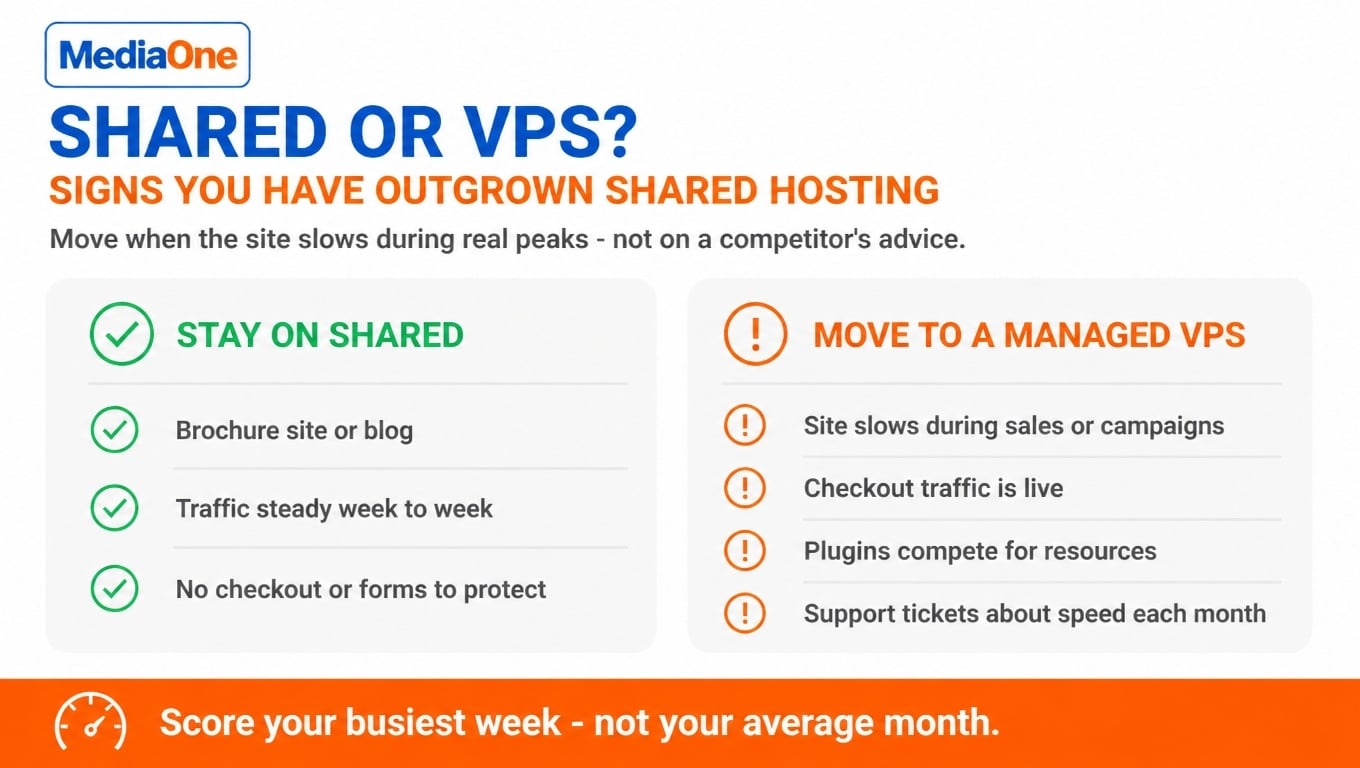
Two rules keep the score honest. First, score your busiest week, not your average month — peaks are what break sites, and they are what your customers remember. Second, if the technical-skill lever scores 1, ignore any unmanaged option regardless of total. A cheap server you cannot administer is more expensive than a managed plan you can.
How to Choose a Hosting Plan: A Step-by-Step Checklist
Work through these five before you pay for anything.
- Estimate traffic and peaks. Start with monthly visitors and your busiest week. A brochure site with 2,000 visitors a month rarely strains a plan. A store running a sale can spike far higher within an afternoon. If you are launching a store, our e-commerce launch checklist sets out the traffic and conversion requirements hosting must support.
- Check the uptime guarantee and how it is measured. At 99.9%, expect about 8.8 hours of downtime a year; at 99.98%, about 1.75 hours, as an uptime and downtime calculator confirms. Ask whether the figure is measured per server or per account, and whether credits are actually paid when it is missed. An SLA and uptime calculator converts any percentage into downtime per day, month and year.
- Confirm backups, SSL, CDN and security. Include daily backups, a free SSL certificate, and a CDN rather than adding them at checkout. Confirm who restores a backup and how long it takes — and see our website maintenance schedule for Singapore for what routine upkeep actually involves.
- Confirm the renewal price in writing. Ask for the rate you will pay in year two, and for the total across three years. A 2026 Hostinger cost breakdown shows how far renewal rates sit from introductory ones across the shared, WordPress and VPS tiers.
- Test support before you commit. Send a pre-sale question at 11 pm on a weekday. Response time and quality tell you more than any marketing claim.
Two cost lines people forget: a domain renewal, which is separate from hosting and covered in our Singapore domain registration guide, and business email, which some hosts bundle and others charge for separately.
If you would rather have the platform choice made alongside the site build, our website design service covers hosting selection as part of the project. For a budget view of the whole build, not just hosting, see how much website design costs in Singapore.
Choose the Best Web Hosting Service in Singapore
Shared hosting is a sensible place to start for most Singapore small businesses. The real decision is not whether to leave it, but when — and the honest trigger is a number, not a competitor’s blog post.
Score your site against the Decision Matrix using your busiest week. If you land at 12 or above, move, and budget the management premium and the migration downtime alongside the new monthly fee. If you land below it, spend the difference on traffic instead. If you want a second opinion on the score, talk to our team.
Frequently Asked Questions
For most brochure sites and blogs, yes. Local shared plans list around S$10 to S$13 a month, and long-term promotional rates go far lower. The question is not the price but whether your site will outgrow the plan, which depends on your traffic peaks and whether you run a store.
What uptime should I expect from a website host?
99.9% is the baseline, allowing about 8.8 hours of downtime a year. Local providers increasingly offer more: SimplerCloud advertises 99.98% on Singapore plans, which allows roughly 1.75 hours of downtime, and Vodien guarantees 99.99%. Ask whether the guarantee is measured per server or per account, and how credits are issued when it is missed.
Is a local Singapore host always faster?
Not always. Proximity helps latency, but specification, caching and storage often matter more. Test your site from a Singapore connection before deciding, and check where the data centre actually sits rather than assuming based on the provider’s name.
Move when the site slows during predictable peaks, when checkout traffic is live, or when plugins compete for resources. Score the Decision Matrix: at 12 or above, a managed VPS is usually justified. Below that, a better shared plan is the cheaper fix.
Do I need a managed plan?
If you have no in-house technical skill, yes. Unmanaged pricing can run up to 50% lower, but you pay that difference back in staff hours for patching, monitoring, and incident response. If the technical-skill lever scores 1, treat managed as mandatory.