
Singapore domain name registration starts with one question: is your business eligible for an .sg name at all? Many businesses assume a .com is the default and never check whether a Singaporean domain is open to them. The .sg namespace follows local eligibility rules, and those rules decide which extensions you can consider before price or prestige matters. Check them first.
Our view is that the local-presence rule decides most choices. If you cannot meet it, the rest of the decision does not apply. This guide covers who runs the .sg registry, how to compare extensions on eligibility, cost and control, and the registration, renewal and transfer steps. It finishes with the mistakes that cause domains to be lost or suspended. Keep your registration details current so the registry can always reach you.
Key Takeaways
- Check eligibility first. Both Singapore-based and overseas registrants can hold a .sg name, but the registrant must meet the local presence rule. Confirm you qualify before searching for a name.
- Separate the owner from the administrator. The domain owner can be based in any country. The domain administrator contact must be in Singapore. Many businesses miss this split.
- Price the domain per year. A .sg domain can cost as little as S$8.88 for a one-year registration. Compare the annual cost of each extension over the life of the business.
- Test the name against its shelf life. Names tied to a passing trend, such as “Web2.0-agency.com”, date quickly. Ask whether the name will still describe the business in five years.
- Treat generic extensions with care. Since ICANN’s New gTLD Program opened in 2012, more than a thousand new generic extensions such as .app, .dev and .shop have been added, so a generic extension is less distinctive than it once was.
- Score each candidate before you buy. Rate each option on eligibility, annual cost and administrative control. Shortlist the extensions you qualify for, then rank them by cost and control.
What You Need to Know Before Registering a .sg Domain
Who the .sg Registry Is and Why Local Presence Matters
The .sg country code is run by a registry that sets the rules for who can hold a name and how each name is administered. Those rules explain why many businesses find the .sg option closed to them until they pass a basic test. Under the Singapore domain registration guide, a business in Singapore usually needs a local footprint, such as a local address, a local company or proof of local residency, before an application is accepted. Singapore network information must be accurate from the outset, because it is checked before an application is accepted.
That test is local presence. The registry’s eligibility rules require registrants to show a link to Singapore, such as a local address, a local company, or proof of local residency, as set out in the guide for registering a Singapore domain. The test is checked before price or branding matters. Without a Singapore footprint, you cannot simply buy a .sg name and wait for it to arrive.
Administrative control is the second layer. The registrant, the legal owner of the name, can be based anywhere. The domain administrator contact manages the record and must be in Singapore, as Asia Registry’s .SG domain overview explains. Confirm both roles before you start, because buyers often assume one answer covers both. Gather the information the registry requires for each role, including any additional information the name registrar requests, so your application isn’t delayed.
Singapore Domain Name Extensions: .sg, .com.sg, .edu.sg, .gov.sg and .med.sg
Singapore uses several extensions, and each serves a different purpose:
- .sg is the main country code extension. It carries local eligibility rules and is open to businesses and individuals who meet the local presence test.
- .com.sg sits under the commercial category. It also requires a local link and is a common choice for Singapore companies that want a locally recognisable address.
- .edu.sg is reserved for educational institutions. Sponsored domains like this are restricted to eligible entities.
- .gov.sg is for government bodies only.
- .med.sg is for healthcare entities.
These three sponsored extensions aren’t general options. They serve government, education and healthcare, and they are usually free or limited to qualifying organisations. If you run a private school, clinic, or government agency, check the sponsored route first. If you run an ordinary business, your realistic choices are .sg, .com.sg or a global extension such as .com. For a school specifically, the .edu.sg registration page is a useful place to confirm the current route.
Domain Name Format and Policies
Every domain name follows a basic format: a second-level label, a dot, then the extension. Labels can use letters, numbers and hyphens, but they cannot begin or end with a hyphen. Choose a trusted domain name that is easy to spell and remember, since it will appear on your correspondence for years.
Domain registrations are governed by the SGNIC registrant agreement and the SGNIC resolution policy (SDRP). The registrant agreement is the contract between you and the registry or registrar, and it sets out the minimum terms you accept. The end user agreement your registrar provides covers your use of the name, and the dispute resolution policy explains how a name challenge is handled. You can challenge and remove a name that infringes another party’s rights, even after you have paid for it. Keep your domain information current with your registrar, since a later domain transfer depends on accurate records. Read the user agreement your registrar presents, as it may add terms beyond the registry’s own. If you are unsure which terms apply to your case, the registry’s information centre is the place to ask before you commit.
Policies also cover how long a name lasts, when it can be renewed and what happens if it expires. Read those terms before you register. A name you assumed was yours indefinitely may carry a fixed term and a renewal deadline you need to diarise. Confirm the renewal and grace windows with your registrar, because they can differ between registrars and are set by the registry rules.
Eligibility, Registrars and Local Presence Requirements
Many businesses assume any company can register a .sg name, and that the only question is which registrar to use. In practice, the registry’s rules determine whether you can register at all, and you can only proceed once you meet them. The local presence test is the rule that settles most choices, so check it first. This section explains those rules and gives you a way to check your eligibility, starting with the domain search and the domain information the registry publishes.
Local Presence Requirements for .sg Domains
The .sg registry, which is operated by DNRS, enforces local presence. Registrants must have a presence in Singapore, which can take the form of a local address, a locally registered company or proof of local residency. The registry’s own eligibility policy sets out the details, so please refer to it before you rely on any summary. Singapore domain name registration services follow the same local presence test, and every registrant must accept the SGNIC registrant agreement before a name is issued. Confirm the exact evidence a registrar accepts before making any payments.
Gather one of the following before you search for a name:
- A Singapore business address that you can document
- A registered local company, for example, one registered with ACRA
- Proof of local residency for an individual registrant
If you do not meet this test for .sg or .com.sg, you can still consider .com, .app, .dev or .shop. The rest of this article shows how to choose among them.
Registrar Accreditation and General Eligibility
Not every company that sells domains can sell .sg names. You need a registrar accredited for the .sg namespace. Accreditation means the registrar follows the registry’s eligibility checks and dispute procedures. Avoid registrars that cannot confirm their accreditation, and confirm this with the Singapore Network Information Centre before you pay.
When you compare registrars, confirm three things in writing:
- The registrar is accredited for .sg, not only for generic extensions.
- It asks for evidence of your local presence during checkout.
- It explains how it handles disputes under the dispute resolution policy sdrp that governs .sg names.
If a registrar skips the eligibility check, it can cancel the registration later. You may then lose the domain and the money you paid for it. A cancelled name can also complicate a later domain transfer, so resolve eligibility at the start. Check that your registrar’s own end user agreement matches the registry terms, since the end user is the party most exposed when the two conflict. A trusted domain name is one whose registrar has passed these checks, so a business in Singapore should treat that accreditation as the starting point.
Registrar Technical Requirements (General)
Registrars also need the technical capability to manage a .sg name. In general, a registrar submits your contact details, passes DNS changes to the registry, and processes renewals on time. As a buyer, your registrar should offer a working control panel, DNS management, and renewal reminders. Your registrar should also provide the additional information the registry asks for during setup, and clearly state the registration time it applies before payment.
Ask your registrar whether it can:
- Update your name servers without a support ticket
- Send renewal notices before expiry
- Provide the registrant and administrator contact details on request
A registrar that cannot answer these questions will be harder to work with when something goes wrong. Registrars serving the wider Asia Pacific market often run these checks in the same way, but they confirm the .sg specifics directly.
Sponsoring Organisation and Name Servers
Each domain needs name servers, which tell the internet where to find your website and email. Your registrar or hosting provider supplies them. Keep a record of them, because a wrong name server entry can take your website and email offline.
The sponsoring organisation manages a sponsored registration on the registry’s behalf. You do not need to contact it for normal registration. You do need to know who it is when you read a dispute notice or a transfer request, because that is where the process is controlled.
EDU.SG Domain Registration
The sponsored domains .gov.sg, .edu.sg and .med.sg are reserved for government, education and healthcare entities. They are usually free or restricted to eligible organisations, so a typical private company cannot use them. If you run a school, a university, a clinic or a government body, check the eligibility rules before you assume a sponsored domain is available.
The registrar Instra notes that Singapore companies can tap into more than 600 local and offshore financial institutions. That point concerns access to financial services. It does not make a .edu.sg name available to companies outside the education sector.
Where to Register a .sg Domain: Five Providers Worth Comparing
Choosing a .sg registrar is about more than finding a cheap first year. You are choosing the company you will depend on for renewals, contact changes, DNS access and transfers when your website or email is at stake.
Start with the official SGNIC accredited registrar list. All five options below appear on it; Vodien is listed through Dreamscape Networks International, represented by its Vodien subsidiary. This shortlist is organised around different business needs, not a claim that one provider is best for everyone. sgnic.sg
Quick Comparison: Which Provider Fits Your Business?
| Provider | Worth considering for | Why it makes the shortlist | What to check before buying |
|---|---|---|---|
| Vooju | Businesses wanting a provider focused on Singapore domains | Dedicated .sg registration, renewal and transfer services | Renewal fees, support availability and DNS management |
| Vodien | SMEs wanting domains, hosting and email together | A broad range of related services and accessible support channels | Optional add-ons, renewal pricing and cancellation terms |
| Exabytes Singapore | Businesses comparing local support and bundled services | Domain services alongside hosting, email and business applications | Domain-only costs versus bundles, plus renewal and support terms |
| Gandi | Businesses managing local and international domains | Dedicated .sg offering, LiveDNS and published registration/renewal pricing | Billing currency, taxes and the difference between introductory and renewal costs |
| CSC Digital Brand Services | Larger organisations managing important domain portfolios | Enterprise domain management, security and brand-protection services | Service scope, account support and a tailored quotation |
The suitability assessments above are editorial judgements based on each provider’s published services. Vooju
Vooju: A Focused Option for Singapore Domains
Vooju deserves a place on the shortlist because Singapore domains are central to its offering. Its website provides registration, bulk registration, renewal and transfer resources, and describes more than 20 years of .sg registrarship. It also offers hosting and email services if you need them. Vooju
Why consider it: If your immediate requirement is to secure and manage a Singapore domain, its focused service offering makes it a sensible starting point. Ask for the annual renewal fee and a demonstration of how to change nameservers, update contacts and request a transfer.
Reviews: This research did not find a sufficiently substantial independent review profile. That is a reason to test its responsiveness yourself, rather than assume either good or poor service.
Website: Vooju domain registration
Contact: Contact form · info@vooju.com · WhatsApp link on the SGNIC registrar listing. Domain & Hosting Support Singapore
Vodien: Convenient When You Want Several Services Together
Vodien offers domain registration and transfers alongside web hosting, business email and security products. That breadth makes it relevant to an SME that prefers one provider for several parts of its online setup. sg Domains
Why consider it: Consolidation can simplify billing and support. However, compare the domain-only checkout against the bundled option. You should know which services are essential, which are optional and what each will cost at renewal.
Reviews: Vodien’s Trustpilot page displayed 4.5/5 from 1,606 reviews when checked. Feedback includes praise for support staff, alongside complaints about outages, waiting times and migrations. These are company-wide reviews covering several services, not a score specifically for .sg registration. Read Customer Service Reviews of vodien.com
Website: Vodien domain services
Contact: Contact page · +65 6018 3544, as displayed on its current contact page. Vodien Singapore
Exabytes Singapore: Useful for Comparing Domains With Hosting and Email
Exabytes offers .sg domains, domain transfers and bulk searches alongside hosting, business email and other business applications. Its Singapore contact page distinguishes technical support from sales and billing enquiries. Exabytes
Why consider it: It is worth comparing when you need a domain plus other services and want Singapore contact channels. Request an itemised quotation so a promotional bundle does not obscure the ongoing domain renewal cost.
Reviews: Its Singapore Trustpilot profile displayed 3.4/5 from 66 reviews when checked. The profile includes both positive service experiences and complaints. Trustpilot also notes limited recent review solicitation, so the score should be read alongside review dates and the specific service discussed. Read Customer Service Reviews of www.exabytes.sg
Website: Exabytes domain search
Contact: Contact page · +65 6727 2277 · WhatsApp +65 6727 2279
Singapore office: 140 Paya Lebar Road, #08-02 AZ @ Paya Lebar, Singapore 409015. Exabytes.SG (Singapore)
Gandi: Worth Comparing for DNS Control and International Portfolios
Gandi’s dedicated .sg page lists registration, transfer and renewal charges separately. It also lists LiveDNS nameservers with Anycast and DNSSEC among its included features. Its support documentation explains that domains registered with Gandi can use LiveDNS at no extra charge. Gandi.net
Why consider it: It is a useful candidate if your business manages several extensions or your technical team wants documented DNS tools. Pay particular attention to renewals: the page checked showed different registration and renewal rates, and its displayed currency and tax treatment depended on the selected location.
Reviews: This research did not verify an independently readable review profile, so no star rating is reproduced here.
Website: Gandi .sg domains
Contact: Gandi Helpdesk for support requests. Gandi.net
CSC Digital Brand Services: For Businesses With More at Stake
CSC focuses on enterprise domain management and security, DNS, digital certificates, and digital brand and fraud protection. Its offering is relevant when the requirement extends beyond buying a single domain. CSC
Why consider it: A larger organisation managing multiple brands or markets may value portfolio oversight and security more than a low checkout price. Ask how its proposed service would handle ownership changes, access permissions, renewals and urgent incidents. For a small business needing one straightforward registration, the scope may exceed what is necessary.
Reviews: A meaningful independent rating specifically for CSC’s .sg registration service was not verified. Request relevant customer references and assess the proposed service commitments.
Website: CSC Digital Brand Services
Contact: Contact a consultant. CSC
What We Would Check Before Choosing
Ask each shortlisted provider for the same information so you can compare like for like:
- Total cost: Registration, renewal, GST, required add-ons and any restoration charges.
- Ownership: Your business must be recorded as the registrant, with account access controlled by your team.
- DNS access: Confirm who can edit records and change nameservers.
- Renewal safeguards: Check reminder channels, auto-renewal settings and failed-payment handling.
- Transfer procedure: Ask how to obtain the domain transfer password and whether outstanding charges affect departure.
- Support: Ask a practical question before buying and assess how clear the answer is.
SGNIC’s transfer guidance requires a transfer password from the existing registrar and notes that outstanding payments may need to be settled. An easy purchase matters, but so does an orderly exit. sgnic.sg
Research checked on 31 October 2026. Review scores are snapshots and may change. Prices are intentionally linked rather than reproduced because promotions, renewal charges, currencies and tax treatment vary.
The Domain Name Registration Process, Step by Step
Most businesses buy a domain in ten minutes. Months later, many find that the name was never really available to them. The process for registering a domain name in Singapore is simple. Mistakes usually happen earlier, when someone chooses a domain name without checking eligibility, and later, when someone sets up account details carelessly. This section sets out the steps in the order that avoids both. Before choosing a name, applicants should also review the domain name policies published by the Singapore Network Information Centre, the registry for .sg names, and the terms set out in the sgnic registrant agreement.
Checking Domain Availability and Choosing Similar Alternatives
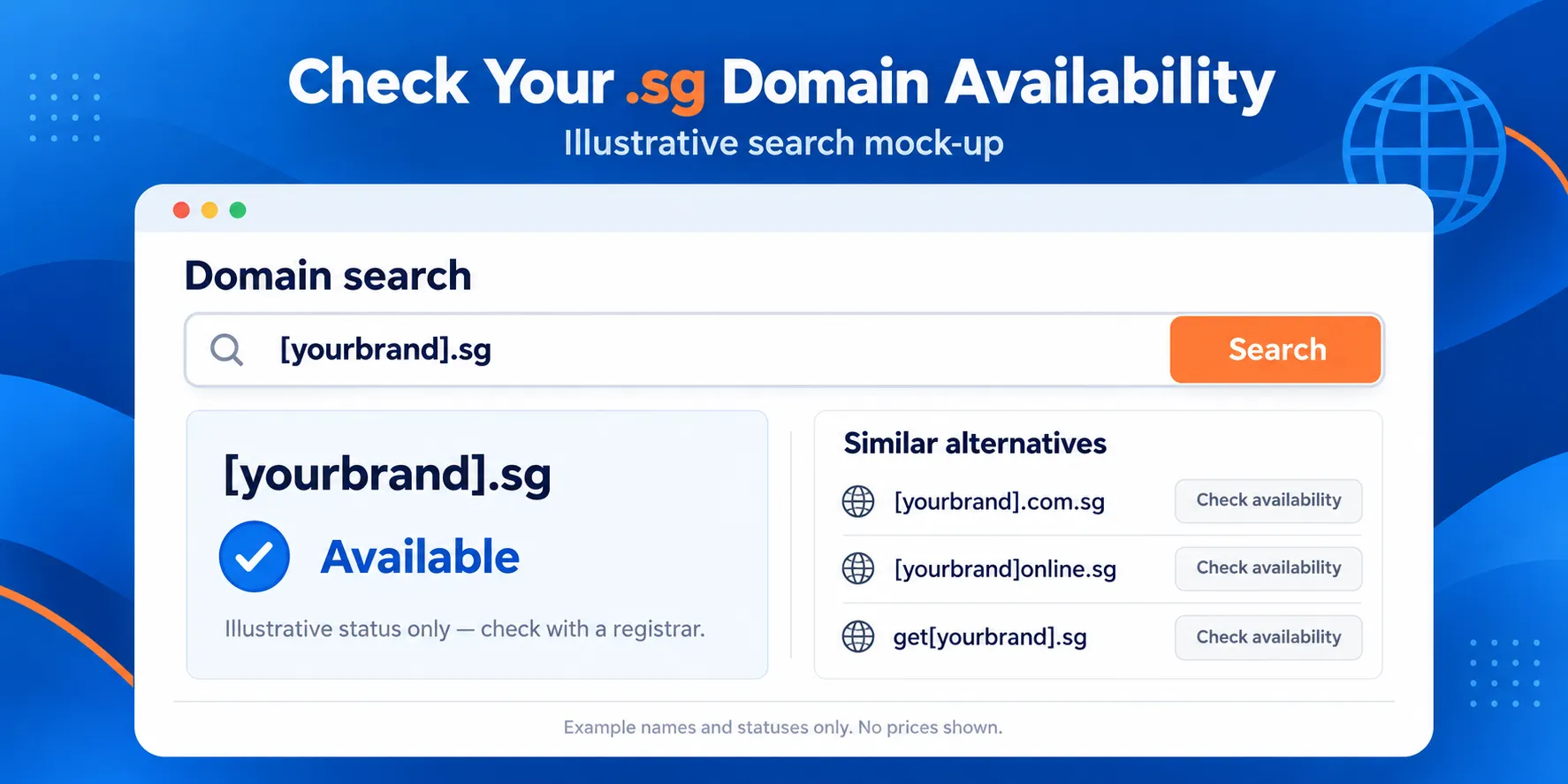
Search for your preferred name across every extension you are willing to use, not just .sg. A search that returns “unavailable” for mycafe.sg tells you little until you see whether mycafe.com.sg, mycafe.com or mycafe.shop is open.
Test each candidate against three questions before you commit:
- Eligibility: Can you register this extension? For .sg and .com.sg, the registry requires local presence. You need an address, a local company or proof of local residency. A name you cannot register isn’t a real option, no matter how good it looks.
- Shelf life: Will the name still make sense in five years? A name that suited a past trend ages quickly. “Web2.0-agency.com” made sense in 2008. “AI-powered-chat.com” will feel dated by 2030. Shorter, brand-led names hold up better.
- Spelling and spoken clarity: Say the name aloud. If a customer has to ask how to spell it, the domain is costing you traffic.
Should your first choice be taken, avoid adding random numbers or hyphens. Try a short descriptive modifier (getmycafe, mycafesg), a different extension that matches your eligibility, or a name built around your location or service. Keep a shortlist of three or four trusted domain name options so you don’t have to start over if your first choice isn’t available at checkout.
Completing the Registration: A Numbered Checklist
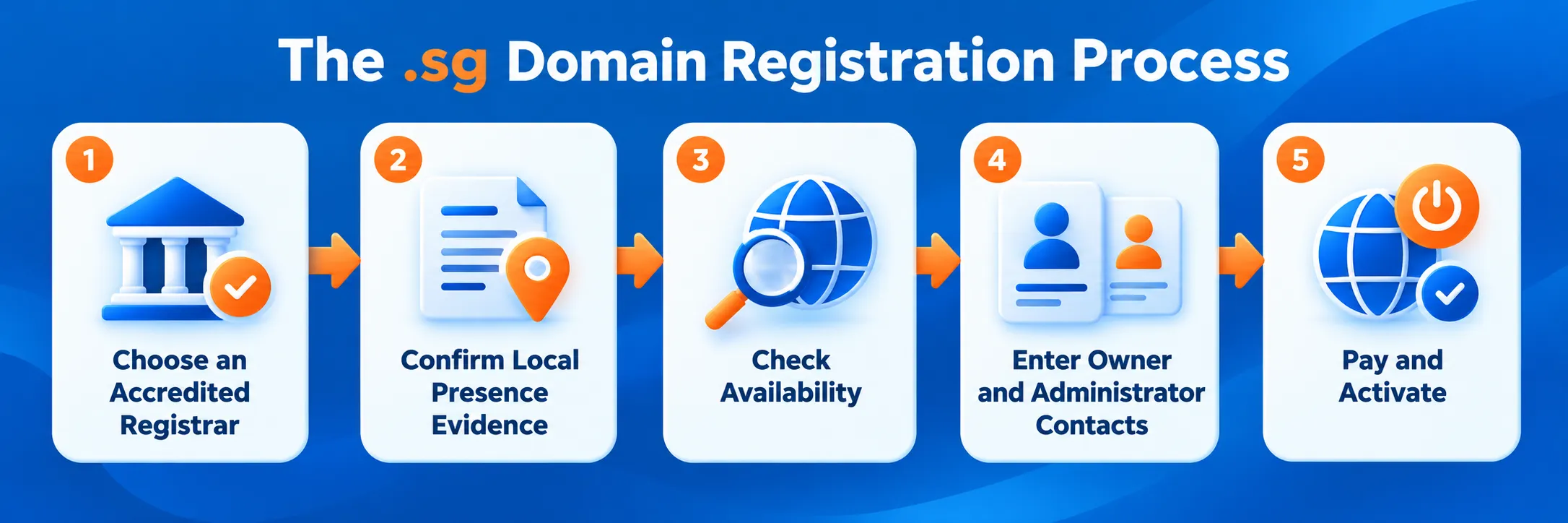
Work through these steps in order. Each one prevents a specific problem that causes lost or suspended domains later. Read the registrar’s end user agreement before you pay, since it sets out the obligations you accept as the end user of the name. Please confirm which information is required for domain registration before you submit anything, to avoid the form being rejected halfway through.
- Confirm eligibility before you pay. Confirm that the registrant meets the local presence rule for the .sg or .com.sg extension you want. Both Singapore-based and overseas registrants are eligible. Overseas applicants should confirm the administrator contact requirement in step 4 before paying.
- Choose a registrar that is accredited for .sg names. Please confirm that it is listed as accredited for the extension you need before entering payment details. Accredited registrars handle domain search and registration services for the Singapore namespace.
- Enter the registrant details accurately. The registrant is the legal holder of the domain. Use the name and address that match your business registration. Mismatched details commonly cause verification delays.
- Name the domain administrator carefully. For .sg domains, the owner can be from any country, but the domain administrator contact must be in Singapore. Name someone who will stay reachable and who will keep the account credentials safe.
- Set the registration period. You can choose a shorter or longer term and renew later. The pricing section below covers renewal terms and the decision rule for choosing a term. Check the registration time you need against your launch plan.
- Add a valid technical contact and email. Registry notices, verification requests and expiry warnings go to these addresses. A mailbox nobody reads is a silent failure.
- Turn on auto-renewal and record the expiry date. Set a calendar reminder as a second safeguard. Use a single reminder time, rather than multiple, so the team can work from one plan.
- Save the account login and registrar support contact. Store them where the wider team can reach them, not on one person’s phone.
- Complete any identity or eligibility verification the registry requests. Respond quickly. An unanswered verification request can lead to suspension. Disputes over a registration are handled under the dispute resolution policy (SGNIC RPPG and SDRP, the Singaporean domain resolution policy, also known as the resolution policy SDRP) rather than through the courts in the first instance.
- Point the domain at your hosting or website. Only after registration is confirmed, configure DNS records so the name resolves to your site or email.
Free Parking, DNS Hosting and Domain Control Manager Features
Most name registrar services offer three add-ons that look like conveniences but affect how the domain behaves. Understand them before you accept the defaults.
Free parking points a newly registered domain to a placeholder page while you prepare a site. It is useful for reserving a name. A parked page carries no content, so replace it before you start marketing the domain. Do not leave a parked page live for months while you advertise the address.
DNS hosting controls where the domain’s records point, including your website address and the mail server that handles your email. Some registrars host DNS for free. Others charge. DNS settings determine whether your website and email work at all, so keep a written record of every record you create.
Domain Control Manager features are the registrar’s panel for managing contacts, renewals, locks and transfers. Use the lock feature to prevent unauthorised transfers. Please confirm that contact changes require verification. Review the panel at least once a year to check that the administrator contact and expiry date are still correct. Record any additional information the registrar asks for in the same place.
The practical rule for all three: decide who controls each setting before you create the account, write it down, and verify it at every renewal.
Pricing, Renewal, Transfer and Expiry
Before you buy, know what a domain will cost each year, what happens if you forget to renew, and whether you can move it later. Most businesses look only at the first-year price, but renewal rates, expiry rules and transfer options matter more over a three- to five-year horizon. Plan for the full domain registration cost, not just the headline rate, so that the domain decisions you make now will hold up later. Check the domain information provided by your registrar before committing to a term. The SGNIC RPPG-accredited registrar list and the Asia Pacific registrar market both offer useful reference points, while the information centre on the registry’s website is a good place to start.
Singapore .sg Domain Name Registration Pricing
The price gap between extensions is wide. According to MediaOne, a .sg domain can cost as little as S$8.88 for a one-year registration. Quoted prices may change, so please check the current rate before you buy and confirm the minimum registration term the registrar requires.
Registrar prices also vary. One registrar quoted in the same source offers domain names from S$9.99 to S$12.99 a year, with a term of one year or up to five years. Compare the renewal price, not only the promotional first-year rate, because many registrars discount the first year and charge full price afterwards. Also check whether the price includes DNS hosting, privacy protection or free parking, since these add-ons change the true annual cost. An end user with a single site should compare each registrar on total cost, not the headline rate alone. Choose a name registrar whose terms are clearly stated.
The table below sets out the main extension options. Figures are indicative and vary by registrar.
| Extension | Indicative annual cost | Local presence required | Who it suits |
|---|---|---|---|
| .sg | From about S$8.88 for one year, confirmed on enquiry | Yes, administrator contact in Singapore | Singapore-focused businesses wanting a local identity |
| .com.sg | Varies by registrar, confirmed on enquiry | Yes, local presence applies | Local businesses wanting a commercial .sg style name |
| .com | Varies by registrar, confirmed on enquiry | No | Businesses targeting global or mixed audiences |
| .app, .dev, .shop | Varies by registrar, confirmed on enquiry | No | Products, technical services and niche online brands |
Domain Renewal, Expiry and Grace Periods
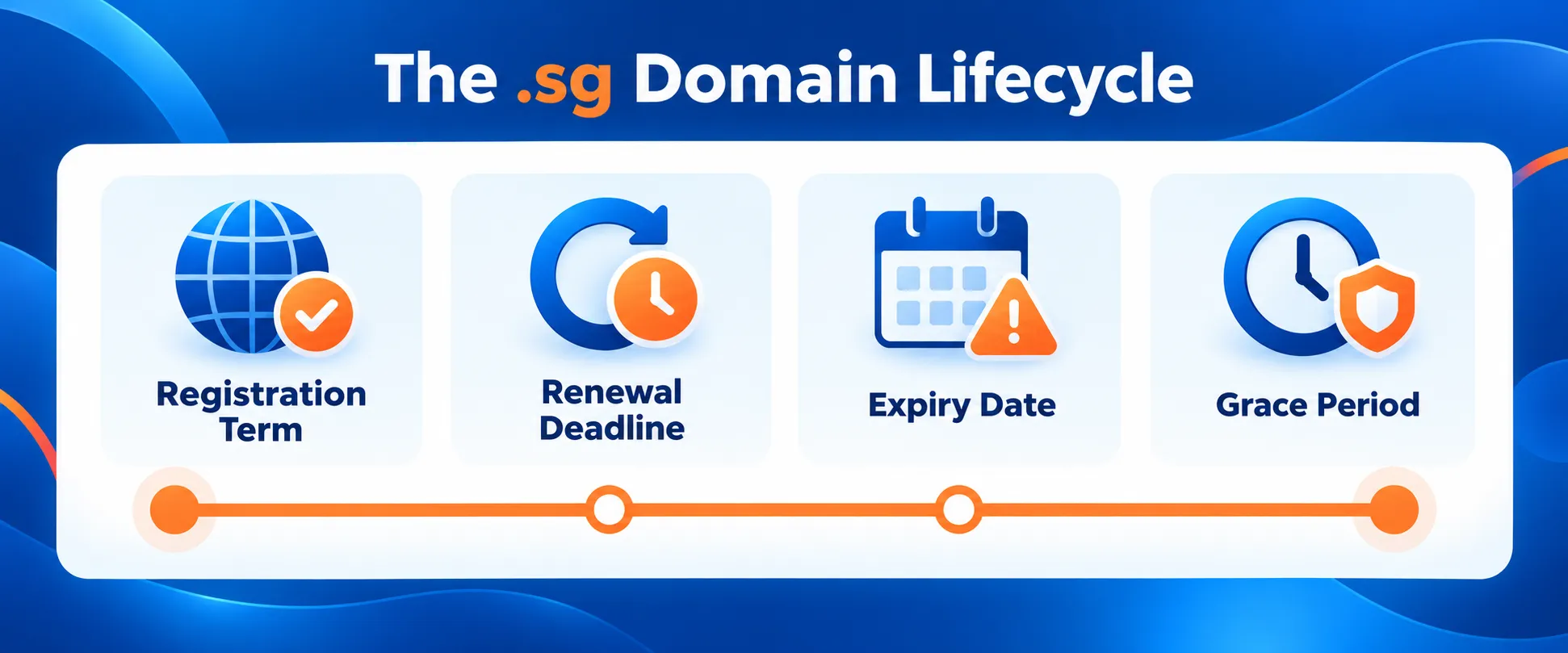
A domain is a rental, not a purchase. If it lapses, you lose it. Set renewal reminders well ahead of the expiry date. A .sg domain can be registered for one year or up to five years, so choose a term that your renewal process can keep up with. For a business that wants fewer deadlines, a longer term reduces renewal events, while a one-year term keeps the price under review each year.
Expired domains typically pass through a grace period in which the owner can still renew, often at the normal price. This is followed by a redemption stage with a higher fee and then release to the public. Exact windows depend on the registry and registrar, so check your registrar’s terms for the grace and redemption dates before relying on any particular window. Most registrars let you enable auto-renewal, which removes the risk of forgetting. Your user agreement with the registrar sets out these terms, so read it before you rely on any window.
For a business, a lapsed domain can mean lost email, a dead website and a rival or squatter registering your name. Treat renewal as an operational task with a named owner, not an annual afterthought. Keep the domain’s network information and contact details up to date so renewal notices reach the right person.
Transferring a .sg Domain to Another Registrar
You can move a domain to a different accredited registrar if the current arrangement no longer suits you. Common reasons include price, support quality or a change in administrative contacts. A transfer usually requires unlocking the domain, issuing an authorisation code, and having the new registrar confirm the request. Check the registration services and end user agreement terms that apply before you start, including the sgnic registrant agreement, which governs .sg names. Run a domain search on the name first to confirm its current status. A domain transfer is a useful checkpoint for reviewing the full registration record at once.
Check two things before you start. First, confirm the domain isn’t in a lock period after a recent registration or transfer. Second, please ensure that the administrator contact still meets the Singapore presence rule, as the new registrar will verify it. If your domain administrator has left the company, update those details first, or the transfer can stall. If a transfer is disputed, the dispute resolution process under the applicable resolution policy, such as the SDRP policy for .sg names, may apply.
How to Evaluate a Singapore Registrar
Most businesses pick a registrar on price alone, then discover months later that renewals are expensive or support is difficult to reach. Evaluating a registrar before you buy takes about fifteen minutes and saves far more than that later.
Start with accreditation. The .sg registry is run by the Singapore Network Information Centre (SGNIC). It appoints registrars that must meet its technical and service standards. Confirm that the registrar is listed as accredited for .sg names, rather than simply offering domains in general. Check the name against the registry’s published list before you pay.
Next, look at the total cost, not the first-year headline. Compare the renewal price, any charges for privacy protection or DNS hosting, and whether the registrar bundles these or bills them separately. A registrar with a low first-year price can cost more than a rival once renewals begin.
Then test responsiveness. Send a pre-sales question about local presence requirements or transfer procedures, and time the response. Vague answers to eligibility questions are a warning sign. A registrar that cannot explain the local presence rule clearly is unlikely to help you when a dispute or suspension occurs.
Finally, assess how the registrar handles the administrator contact. Some make it straightforward to nominate a Singapore-based administrator, while others make changes slow or manual. Since the administrator must be in Singapore, this detail affects every future change you make.
Technical Support Offerings to Look For
Technical support matters most at three moments: when you first point the domain at a website, when you change a name server, and when something stops resolving. A registrar’s support package decides how quickly you recover from each. Domain names registered in Singapore fall under the rules set by SGNIC, so check that your registrar is an accredited SGNIC registrar. Singapore network information required for domain registration is held and managed by SGNIC, so confirm the registrar follows its trusted domain name policies and dispute resolution policy.
The table below sets out the features worth checking and why each one matters.
| Feature | What to check | Why it matters |
|---|---|---|
| DNS management | Ability to edit records yourself, with TTL control | Lets you move hosting without waiting on support |
| Domain control panel | Clear renewal dates, lock status and contact details | Prevents accidental expiry or unauthorised transfer |
| Support channels | Phone or live chat during Singapore business hours | Faster help when a site goes offline |
| Transfer assistance | Documented authorisation codes and transfer steps | Reduces the risk of a stalled or lost transfer |
| Renewal reminders | Notices sent to more than one contact address | Stops a name from lapsing unnoticed |
When you test support, ask a technical question that needs a specific answer. For example, ask how to add an MX record for email or how the grace period works after expiry. A good support team answers directly and points you to documentation. Generic replies signal thin support, and a business in Singapore should expect clear answers on domain registration and transfer questions.
Also confirm whether DNS hosting is free or charged and whether you can change name servers without contacting the registrar. Managing DNS yourself means you control where your website and email point, even if you later switch web hosts.
Common Mistakes That Cause Lost or Suspended Domains
Most lost or suspended domains come from avoidable administrative errors, not disputes. Four mistakes account for most cases.
Using a personal email address for the registrant. If the only contact on file is a mailbox a departing employee controls, renewal notices never arrive. Use a role-based address monitored by two people, and keep a second contact on record.
Letting local presence details go stale. Singapore-based and overseas registrants are both eligible, but the details you submitted must stay accurate. Singapore network information for a business in Singapore must match its current registration details. If the company dissolves or the address changes and you do not update the record, the domain can fall out of compliance. Please review these details whenever your company information changes.
Missing the renewal date. Expiry can move a name into a grace period and then release it to the public. Set the renewal date in your calendar with a reminder at least two months ahead, and enable auto-renewal where the registrar allows it. Please check the registration time left on each name to ensure that no domain expires unnoticed.
Choosing a registrar based on price can cause problems when transferring. Transfers out are sometimes blocked by domain locks, outdated contact details or an expired authorisation code. Before you switch, confirm your contact details are current, and the lock can be released. Please review the registrar’s end user agreement and any dispute resolution policy for transfer terms before you commit.
A simple check helps. Before making any domain changes, please confirm the registrant contact, the administrator contact, the renewal date, and the lock status. These four checks take a few minutes and prevent most of the losses described above.
Conclusion and Next Steps
For most Singapore businesses, the choice between a .sg domain and a global extension such as .com comes down to three questions: whether you qualify, what it costs, and who must stay reachable as administrator. Local presence usually decides most choices. It is the factor most often overlooked, and it determines whether a .sg name is open to you at all. Check it before you look at anything else.
Work through the eligibility, cost and control checks before you buy. Score each candidate (.sg, .com.sg, .com, .app, .dev, .shop) on three criteria:
- Eligibility: Can the registrant meet the local presence requirement? According to Mediaonemarketing.com.sg, registrants need an address, a local company or proof of local residency. If you are unable to provide one, please consider using options other than .sg
- Cost: Compare annual prices in S$. The same source puts .sg and .com.sg at up to S$80 per year, against as little as S$10 per year for a .com. Confirm the exact price with your registrar, as rates vary by provider.
- Control: Confirm who holds the administrator role. The owner can be based anywhere, but the domain administrator contact must be in Singapore. You may also need additional domain information about the administrator for a domain transfer. The registrant agreement and the end user agreement set out what your registrar must provide, so read them before you sign.
Once the eligible options are ranked by cost and control, choose the domain name itself. Test it with one question: will this name still make sense in five years? Names tied to a passing trend date quickly, so favour a trusted domain name that describes the business. Under the SGNIC resolution policy (SDRP), a name that conflicts with another registrant’s rights can be challenged, so a distinctive, Singapore-appropriate name also reduces dispute risk.
Next steps:
- Gather evidence of your local presence (address, company registration, or residency proof) before you start a registration.
- Compare your three strongest name options against the three points above.
- Check availability and choose a registrar that supports the administrator setup you need.
- Set a renewal reminder, since expiry is the most common cause of a lost domain.
If your shortlist still includes a .sg name you cannot register, a generic extension is a sound fallback. More than a thousand generic extensions have opened since ICANN’s New gTLD Program began accepting applications in 2012, so a clear, memorable name matters more than the extension alone.
Frequently Asked Questions
Can a foreigner register a .sg domain name?
Yes, with conditions. The registrant (the owner) can be from any country. However, the domain administrator contact must be in Singapore. The .sg registry, operated by SGNIC, enforces local presence rules, so the registrant must show an address, a local company or proof of local residency. A foreign business with no Singapore footprint will usually find the .sg option closed, so check eligibility first.
Do I need a Singapore company to register a .sg domain?
Not always. A local company is one of several accepted ways to meet the local presence requirement, alongside a Singapore address or proof of local residency. The administrator contact must still be in Singapore. If you have none of these, a generic extension such as .com or .shop will help you avoid the local presence test.
How long does a .sg domain registration last, and what happens when it expires?
Registration terms are flexible. According to Mediaonemarketing.com.sg, you can choose a one-year term or extend it, and you can change the term at renewal. Renew before expiry to keep the name. Set a reminder at least 30 days ahead, because a lapsed domain can be lost to another buyer and your email and website may stop working during the gap. Confirm the exact grace and redemption windows with your registrar.
Can I transfer my .sg domain to another registrar?
Yes. A .sg domain can move between accredited registrars, so you are not locked to the company you first bought it from. Check the transfer steps with your new registrar, confirm the local presence details still hold, and make sure the domain is not near expiry before you start, since transfers can be delayed for expiring names.
What is the difference between .sg and .com.sg?
Both are Singapore-linked extensions governed by the same local eligibility rules. .sg is the country code extension, while .com.sg is a commercial second-level domain. According to Mediaonemarketing.com.sg, prices for both can reach S$80 per year, compared to as little as S$10 per year for a .com. Choose .com.sg if you want a commercial signal, and .sg if the shorter name is worth the price.
Is there a free .edu.sg or .gov.sg registration for any organisation?
No. Sponsored domains such as .gov.sg, .edu.sg and .med.sg are reserved for government, education and healthcare entities. They are usually free or restricted to eligible organisations, so a private business without those credentials cannot register them, as noted by Mediaonemarketing.com.sg.