| AI Summary
SME SEO helps small and medium-sized businesses reach people searching for their products or services. The right budget depends on the website, competition and work required. A readiness scorecard can identify gaps before spending begins. Returns depend on qualified enquiries, completed sales and profit after SEO costs. Businesses should assess progress regularly and allow time for website improvements to produce results. |
SME SEO is search engine optimisation for small and medium-sized businesses. In Singapore, costs depend on content needs, technical work and competition. Business owners can assess readiness by checking search demand, website access, staff capacity, tracking and profitability, then measure returns using profit attributed to organic search minus total SEO costs.
Key Takeaways
- Budget around named tasks. A proposal should explain which pages, technical fixes, content and reports the fee covers.
- Check readiness before committing. Search demand, website access, staff support and sales tracking help determine what work can begin.
- Prioritise pages that support purchases. Service details, prices, delivery terms and contact options help visitors make decisions.
- Measure profit alongside traffic. Qualified enquiries and completed sales provide stronger business evidence than keyword positions alone.
- Review progress throughout the campaign. Completed work, search visibility and sales results reveal different parts of performance.
SME SEO can bring potential customers to a Singapore business when they search for something it sells. The spending decision becomes harder when proposals promise traffic but give little detail about costs, responsibilities or likely returns.
A small business needs a budget it can maintain and a way to judge the work. The sections below explain how to assess readiness, compare spending options and connect organic search with business results.
What Does SME SEO Include?
SME SEO combines website improvements, relevant content and local business information. Each part helps potential customers find and assess the business.
A bookkeeping firm might need pages explaining monthly fees and company accounts. A bakery might need product details, collection times and ordering information. Both need websites that search engines can access and customers can understand.
The work usually covers these areas:
| Area | What It Covers | Business Purpose |
| Technical SEO | Indexing, broken pages, website structure and loading issues | Helps search engines access important pages |
| On-page SEO | Page titles, headings, service details and internal links | Helps visitors understand each offer |
| Content | Product information, buying questions and examples | Supports research before an enquiry |
| Local SEO | Business details, locations and Google Business Profile | Supports searches for nearby services |
| Measurement | Search clicks, enquiries, sales and costs | Shows whether the work supports business goals |
Google’s SEO Starter Guide explains how website improvements help search engines understand content and help people decide whether to visit. Inclusion and rankings are never guaranteed.
A practical SEO strategy connects these tasks with the products or services the business wants to sell. A long keyword list alone does not provide that connection.
When Is SME SEO Worth Paying For?
SME SEO becomes a stronger investment when customers already search for the offer, the business earns enough from sales and the team can support ongoing work.
Existing organic leads are helpful evidence, but a business does not need search to generate a fixed share of leads before starting. A company with little organic traffic may still have an opportunity if relevant searches exist and its website currently answers them poorly.
Three checks help test the business case:
- Demand: Customers search for the service, product or problem.
- Economics: Sales leave enough profit to support customer acquisition.
- Delivery: The business can complete website changes and serve new customers.
Search demand must connect with the offer
A cleaning company may find searches for office cleaning prices, cleaning contracts and weekend availability. Those searches connect with decisions a buyer needs to make.
A broad phrase such as “cleaning tips” may attract readers who want to do the work themselves. Traffic from that topic could have a different business value.
Customer emails, sales calls and search results can help identify buying questions. A service that needs extensive explanation may require educational content before visitors are ready to enquire.
Cash flow and timing affect the decision
SEO requires work before the business knows its full return. A company that needs bookings this week should assess how it will fund operations while search improvements develop.
The same applies to capacity. More enquiries have limited value if nobody can answer them or deliver the service.
The spending decision should consider:
- Available cash after operating costs.
- Time between an enquiry and a completed sale.
- Profit earned from an average customer.
- Staff capacity to handle new demand.
- Other marketing channels already producing results.
How Much Does SME SEO Cost in Singapore?
SME SEO has no single standard price. A small website needing a few page improvements requires different work from an online shop with hundreds of products.
The table below gives illustrative monthly planning bands, not measured market averages or a quotation. Packages can fall outside these bands. The written scope determines what the business receives.
| Monthly Planning Budget | Possible Scope | Main Check Before Buying |
| Below S$1,000 | Limited support, selected page changes, reporting or owner-led work | Which tasks will the provider actually complete? |
| S$1,000–S$2,500 | Focused technical, page and content work | How many priority pages receive attention? |
| S$2,500–S$5,000 | Broader content production, technical support and campaign management | Which business goals justify the larger scope? |
| Above S$5,000 | Complex websites, multiple markets or substantial production needs | What specialist work requires this budget? |
A small budget can fund valuable work when the task is narrow. A larger fee still needs a documented purpose. The price alone cannot establish quality.
A focused approach to SEO for SMEs on a limited budget starts with the pages and problems most closely connected with customer demand.
The main costs sit beyond the retainer
The provider’s monthly fee may cover only part of the campaign. Website development, photography, staff review and additional content can sit outside the agreement.
A complete budget should record:
| Cost | Example |
| Provider fee | Monthly optimisation and reporting |
| Website implementation | Developer time for page templates or technical changes |
| Content production | Writing, editing, photography or product information |
| Internal staff time | Reviewing accuracy and approving changes |
| Tools | Tracking or reporting subscriptions |
| Taxes and setup charges | Applicable GST and separately quoted initial work |
A hypothetical six-month budget might include S$12,000 in provider fees, S$2,000 in development and S$1,000 in internal review time. The total is S$15,000 before any other applicable costs.
Comparable quotes need comparable work
Two S$2,000 proposals can describe very different services. One may include writing and implementation. Another may supply recommendations that the business must complete itself.
A comparison sheet should cover:
- Priority pages and target customers.
- Content quantities and revision allowances.
- Technical implementation responsibilities.
- Reporting and meeting frequency.
- Contract length and cancellation terms.
- Extra charges and account ownership.
The budget works best when every major expense has an owner and an expected output.
How Ready Is the Business for SME SEO?
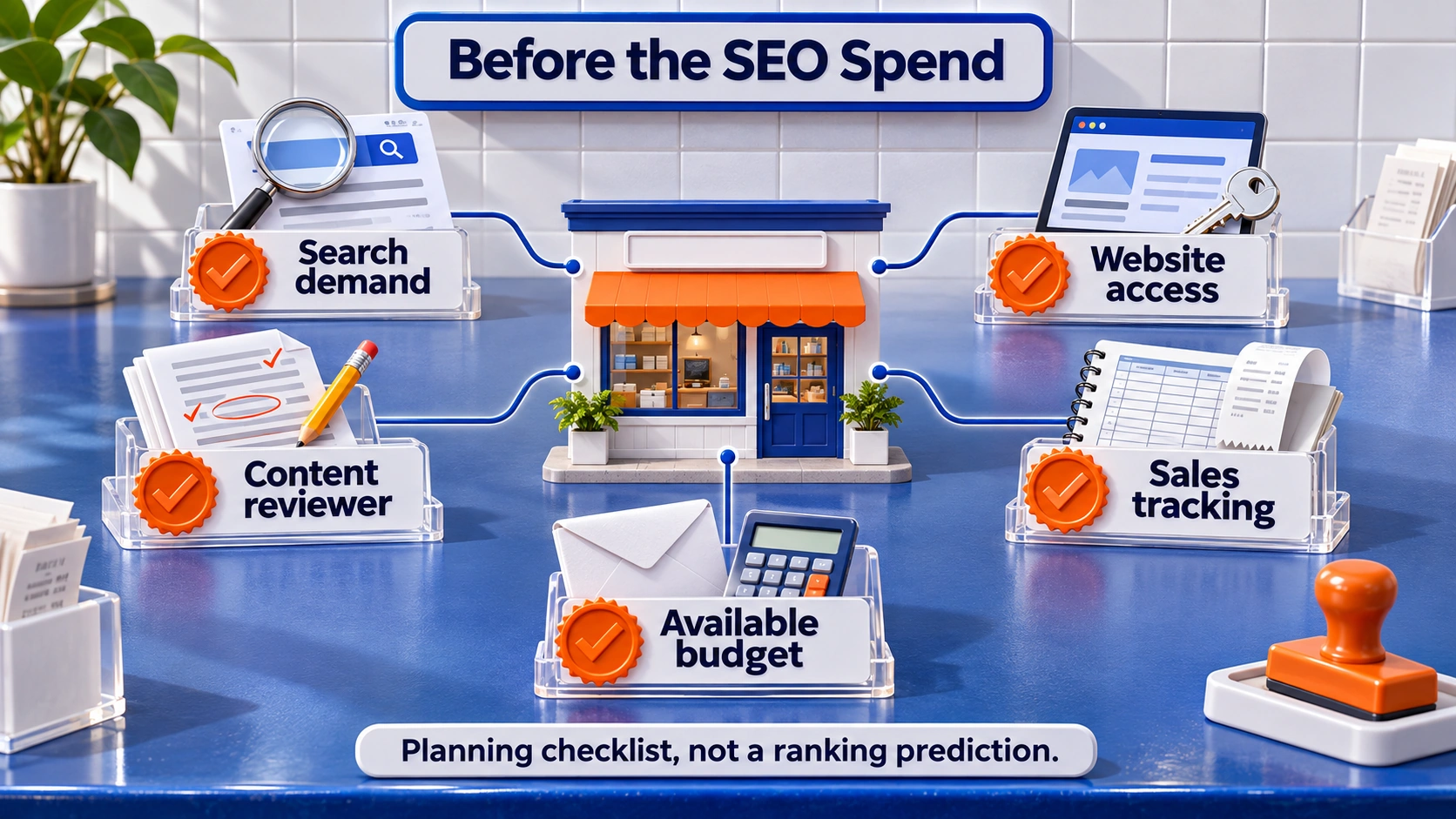
An SEO readiness scorecard can expose gaps before a contract begins. The following checklist is an editorial planning tool, not a validated test or prediction of rankings.
Each supported “yes” earns one point. An uncertain answer receives zero until the business checks it.
| Readiness Question | Evidence for a “Yes” |
| Do customers search for the offer? | Relevant searches, customer questions or existing search enquiries |
| Can the business change its website? | Access to the website and someone able to implement updates |
| Can someone support content work? | A named reviewer with time to check service details |
| Can enquiries and sales be tracked? | Working forms, analytics and sales records |
| Can the business fund work while returns develop? | An agreed budget supported by sales and margin figures |
The score identifies preparation needs
The total helps organise the next step:
- 0–2 points: Basic preparation needs attention before a broad campaign.
- 3–4 points: Selected work may begin while remaining gaps are addressed.
- 5 points: The business has the main inputs needed to assess a managed campaign.
A high score does not mean the company needs the largest package. Website size, demand and competition still determine the work.
A low score also does not rule out professional help. A defined project may establish tracking, repair the website or research customer demand.
The five checks below show which parts of the business need to support the campaign.
Which SEO Tasks Should Come First?
The first tasks should remove barriers between a customer’s search and a completed enquiry. A website audit can identify issues, but the team still needs to decide which ones affect important pages.
A website SEO audit provides an initial view of optimisation gaps. Findings need to become assigned tasks with deadlines.
Technical checks protect the work
A page cannot earn organic visits if it is unavailable in search. Google Search Console’s URL Inspection tool reports information about Google’s indexed version and allows a live test of possible indexing issues.
The initial checks should cover:
- Important service and product pages.
- Accidental indexing blocks.
- Broken internal links.
- Forms, menus and contact buttons on phones.
- Large images and loading problems.
- Website backups before major changes.
Google’s PageSpeed Insights can help assess page performance. A faster page still needs relevant content and a working enquiry process.
Keyword research connects searches with pages
Effective keyword research groups phrases by what customers want to achieve.
A catering business might separate these needs:
| Search Example | Customer Need | Suitable Page |
| Office lunch catering Singapore | Compare a service | Office catering page |
| Vegetarian buffet menu | Assess available food | Menu page |
| Catering minimum order | Check purchase conditions | Ordering information |
| How much food for 30 people | Plan an event | Practical planning article |
Keyword Planner can estimate search activity using selected locations and dates. Its “competition” measure concerns advertisers, so it does not establish how difficult organic rankings will be. The existing results also reveal whether people expect a menu, product page, local listing or detailed explanation.
Local information supports nearby customers
An eligible business should maintain accurate opening hours, contact details, service information and photographs on its Google Business Profile. Google describes local ranking through relevance, distance and prominence.
Reviews and links can contribute to prominence, while distance remains part of the result. Profile work cannot guarantee visibility in every neighbourhood.
A shop should make collection details easy to find. A service business should explain where it operates. Location pages need distinct information about the service available in each area.
What Content Helps Turn Visits Into Enquiries?
SME content should answer questions that delay a purchase. A detailed service page can help more than several loosely related blog posts.
A bookkeeping prospect may need to know what monthly support includes. A bakery customer may need order deadlines, portion sizes and allergen information. Those details reduce uncertainty before contact.
A practical SEO content plan gives priority to:
- Main services and product categories.
- Prices or the factors affecting a quotation.
- Delivery, booking and cancellation conditions.
- Examples that show how the service works.
- Comparisons customers need before choosing.
- Answers drawn from recurring sales questions.
Google’s people-first content principles emphasise content created to help readers. Relevant experience, accurate information and sufficient explanation support that purpose.
A service page needs a next step
A visitor should understand the offer before reaching the enquiry form. The page needs to explain who the service serves, what it includes and what happens after contact.
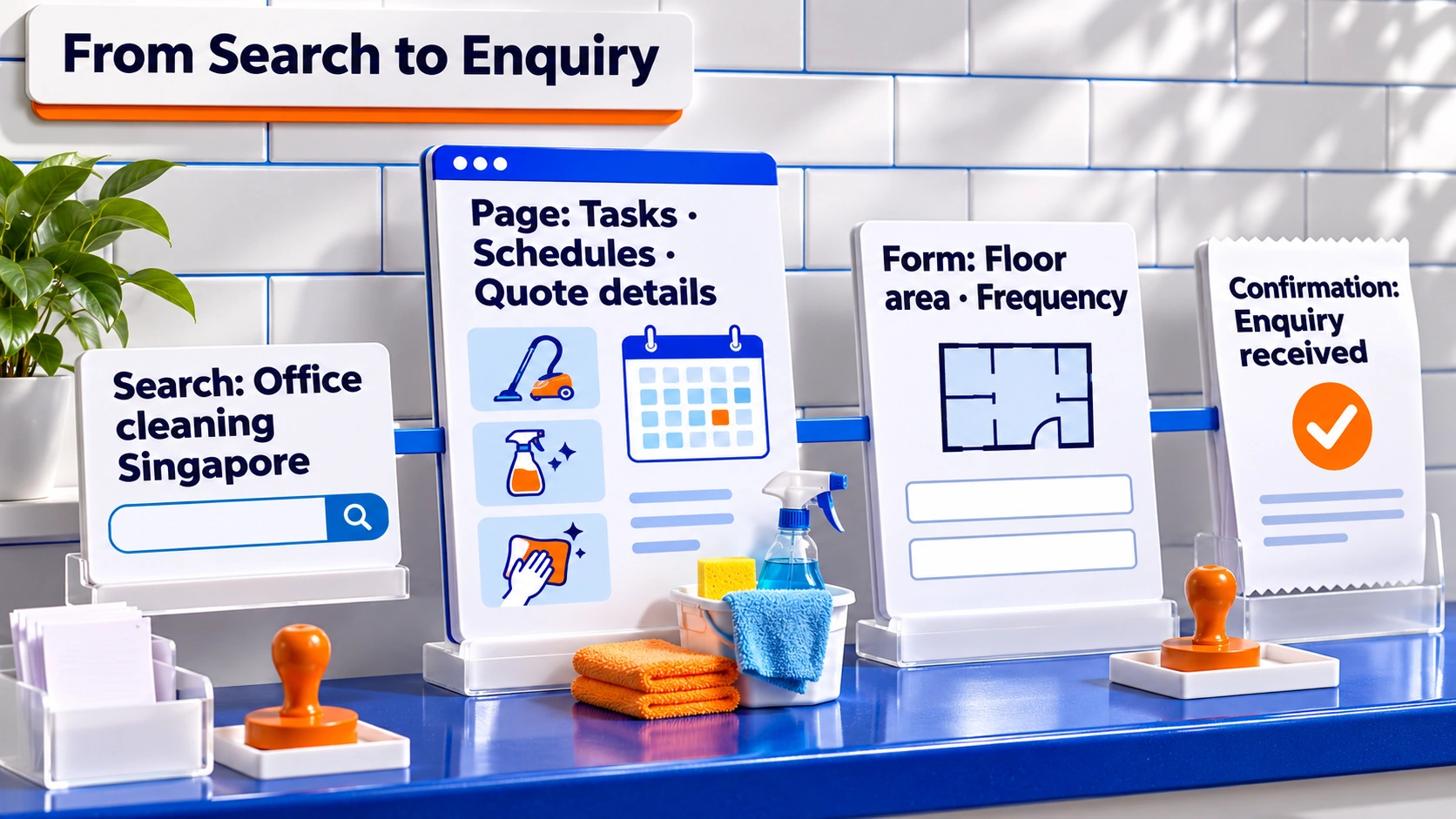
An office cleaning page, for example, could show covered tasks, available schedules and the details needed for a quotation. An enquiry form could then request floor area and preferred frequency.
The example below connects a buyer’s search with information that supports an enquiry.
How Can SMEs Earn Links Without Wasting Budget?
Relevant links can come from business relationships and information others want to reference. The work should support a real connection between the two websites.
Possible sources include:
- Industry association member pages.
- Supplier or authorised partner listings.
- Event pages describing genuine participation.
- Original research with an explained method.
- Resources that help customers complete a task.
A directory listing deserves assessment before payment. Relevant visitors, editorial standards and accurate business information provide stronger reasons to participate than a promise of ranking gains.
Google’s spam policies cover link schemes and other practices intended to manipulate search rankings. Paid advertising and sponsorship links need appropriate qualification.
A proposal should explain how links are earned, why the sites are relevant and how paid placements are handled. A guaranteed monthly link count provides little context by itself.
How Should SME SEO ROI Be Calculated?
SME SEO ROI compares the profit credited to organic search with the total cost of the work. Revenue alone leaves out the cost of supplying the product or service.
A practical planning formula is:
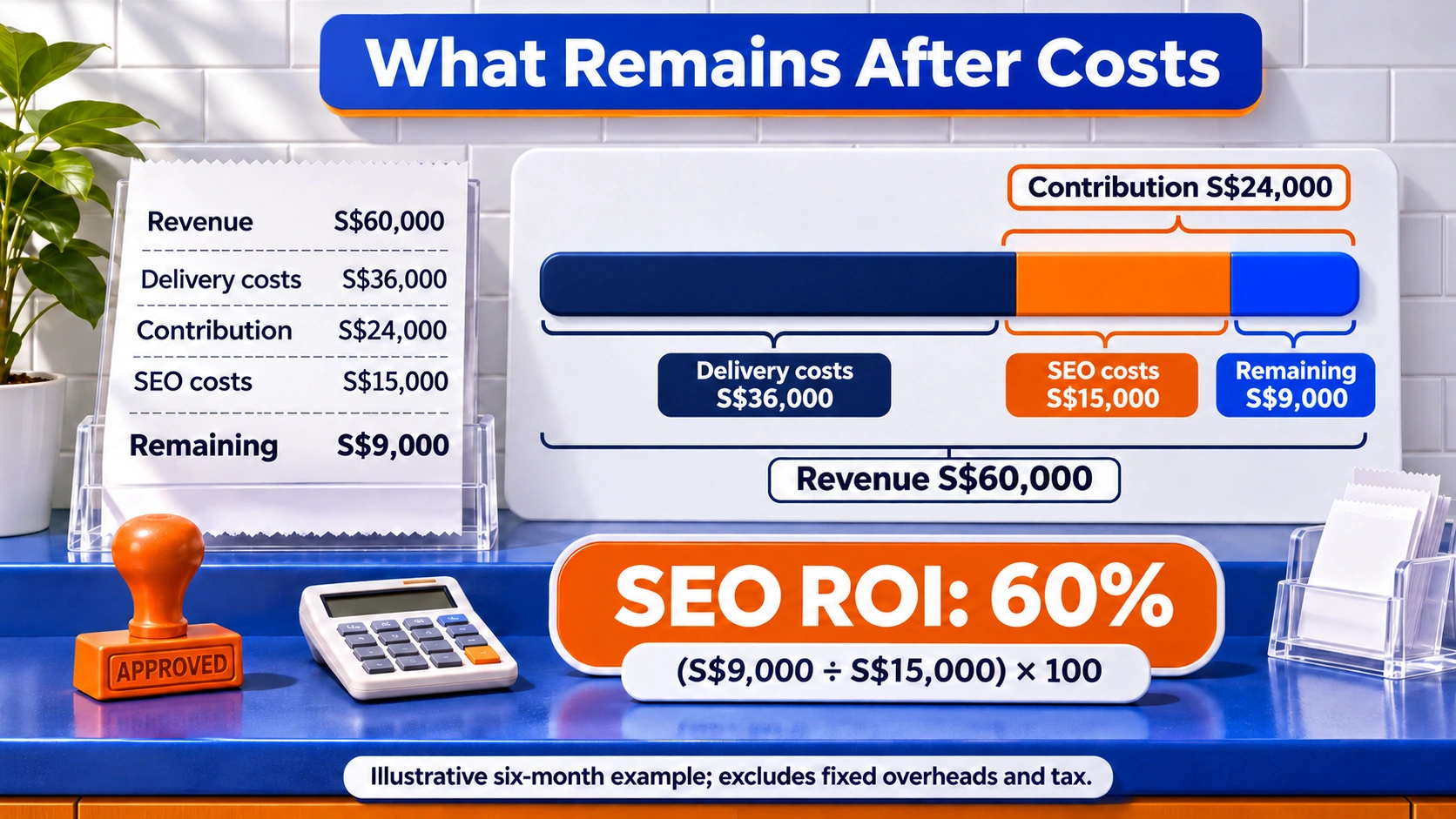
SEO ROI = [(Organic-attributed contribution profit − total SEO cost) ÷ total SEO cost] × 100
Contribution profit means revenue minus the variable costs of delivering those sales. The calculation below deducts SEO costs afterwards.
A worked example makes the calculation easier
The following figures are hypothetical and cover the same six-month period.
| Item | Illustrative Amount |
| Sales revenue attributed to organic search | S$60,000 |
| Variable delivery costs | S$36,000 |
| Contribution profit before SEO costs | S$24,000 |
| Total SEO costs | S$15,000 |
| Contribution remaining after SEO costs | S$9,000 |
| Calculated SEO ROI | 60% |
The calculation is:
[(S$24,000 – S$15,000) ÷ S$15,000] × 100 = 60%
This example excludes fixed overheads and tax, so it does not show company net profit. The calculation also depends on how sales receive credit.
Break-even sales test the budget
A break-even check helps assess whether the spending target is plausible.
Break-even attributed revenue = SEO cost ÷ contribution margin
With S$15,000 in SEO costs and a 40% contribution margin, break-even attributed revenue is S$37,500.
A business earning S$500 in contribution per completed sale would need 30 sales to cover that S$15,000 cost. If one in five qualified enquiries becomes a sale, the example requires 150 qualified enquiries.
These are planning assumptions. Actual order values, margins and close rates should replace them.
The illustration below shows why sales revenue and SEO return are different figures.
Attribution adds uncertainty to the result
Attribution assigns credit to marketing interactions before an enquiry or sale. Google Analytics attribution settings affect how that credit appears in relevant reports.
An attributed sale is not proof that SEO caused an additional sale. A customer may already know the brand or have encountered several channels.
Business records improve the assessment:
- Forms can record landing pages and enquiry sources.
- Sales staff can record completed deals and values.
- Phone enquiries can include a source question.
- Reports can separate new and returning customers.
- Calculations can use matching cost and revenue periods.
What Should an SME SEO Report Show?
An SEO report should connect completed work with search performance and business outcomes. Each layer answers a different question.
| Reporting Layer | Measures | Question Answered |
| Delivery | Pages improved, content published, issues resolved | What work happened? |
| Visibility | Relevant impressions, clicks and search terms | Are more potential customers finding the site? |
| Enquiries | Forms, calls and qualified opportunities | Are visits producing potential business? |
| Sales | Completed deals, revenue and contribution | Is the investment producing an acceptable return? |
A rise in traffic deserves investigation when enquiries remain flat. The visitors may have different needs, or the landing page may omit buying information.
The opposite can happen too. A small increase in visits to a high-value service page may produce worthwhile enquiries.
Reporting needs a starting point
A baseline should record the website’s condition, existing search traffic and current enquiries before substantial work begins.
A short change log helps explain later results. Promotions, price changes, stock shortages and website outages can affect sales alongside SEO.
Monthly reports should identify the next decision, such as improving an enquiry form or expanding a service page. A spreadsheet of positions without an explanation leaves the owner with little basis for action.
How Long Should SMEs Allow Before Reviewing Results?
SEO needs regular review from the start. Website fixes, search visibility and sales outcomes develop on different schedules.
A practical review structure is:
| Period | Review Focus |
| First month | Access, tracking, baseline and priority tasks |
| Months two to three | Implementation, page quality and indexing |
| Months four to six | Relevant search traffic and enquiry quality |
| Later reviews | Completed sales, cumulative costs and further opportunities |
These are management checkpoints, not promised result dates. Competition, website history and the work required affect timing.
A six-month review should assess both commercial results and whether the agreed work happened. Continued spending needs a reason supported by evidence.
A campaign may need revision when the provider misses deliverables, targets irrelevant searches or cannot explain performance. More time alone will not repair the wrong plan.
Should SMEs Use an Agency, Freelancer or In-House Staff?
The delivery model depends on the skills required and who can complete the work.
| Option | Main Advantage | Main Responsibility for the SME |
| In-house | Direct access to products, customers and staff | Provide training, tools and working time |
| Freelancer | Focused support for defined tasks | Coordinate any missing skills or implementation |
| Agency | Access to several specialist roles | Supply business knowledge and review deliverables |
| Combined team | External expertise with internal ownership | Keep responsibilities documented |
An owner may manage product details while a freelancer handles research. Another business may need an agency to coordinate content and technical work.
A sound process for choosing an SEO agency examines the proposed work, relevant experience and reporting. Google’s information on hiring an SEO also outlines the services professionals may provide and the risks of irresponsible work.
SME SEO Spending Starts With the Business Case
SME SEO works best with evidence of customer demand, an accessible website and a budget linked to expected profit. The readiness scorecard identifies preparation needs, while cost and sales records help assess the return. Regular reviews keep spending connected with completed work and customer outcomes.
At MediaOne, we support businesses through SEO services covering technical optimisation, content and search strategy. Our team can help assess your website’s priorities and discuss a scope based on your goals, resources and available budget.
FAQs About SME SEO
Does an SME need a .sg domain for SEO?
A .sg domain is not compulsory for a Singapore business website. An existing domain should be assessed before any change. Moving domains creates technical work and requires redirects, monitoring and updates to business links.
Can a business keep its current website platform?
An existing platform may remain suitable if the team can edit content, manage important page settings and resolve technical problems. A rebuild should follow identified limitations and business needs. A new platform does not guarantee better rankings.
Should an SME publish content in several languages?
Additional languages can help when customers search and buy in those languages. Each version needs accurate translation, maintenance and appropriate website setup. Customer demand should determine the language choice.
Who should own the SEO accounts and content?
The business should retain ownership of its domain, website, analytics properties and business profiles. Contracts should explain access rights, content ownership and handover arrangements. Providers can receive the permissions needed for their work.
What happens when an SEO contract ends?
Completed website changes and published content may continue to support search visibility. Performance can change as competitors, customer demand and search results develop. A handover should document completed work, outstanding tasks and account access.