Many SEM budgets are set by habit: last year’s spend plus a little for growth. That money can end up on clicks that never convert or sit too low to reach buyers. Well-run businesses set their budget allocation based on measured performance, not habit.

How much should you spend on SEM? Start with what a qualified lead is worth to your business, then size your monthly budget to the number of leads you need. Singapore advertisers bid in S$ against regional competitors, so base the budget on your economics rather than last year’s spend.

This article outlines a budget method with a worked example.
Key Takeaways
- Set the budget from lead value, not last year’s spend. Work out what a qualified lead is worth, then size spend against it.
- Reverse-calculate your traffic gap. Going from 25 to 50 sales leads a month means traffic must roughly double.
- Scale in 15 to 20% steps while the cost per acquisition holds steady.
- First, read the impression share. Lost impression share above 20% is a heuristic sign of unmet demand, not a rule.
- Stop when efficiency falls. Rising cost per acquisition with flat results means hold, not increase.
How to Set and Calculate Your SEM Budget
Most advertisers start by deciding how much money they can spare, then figuring out what that amount can buy. A better approach runs the other way: decide what the business needs from its search engine marketing campaigns, then calculate what that costs. Base your paid search strategy on that figure, rather than on the cash available. Businesses that set budgets this way can justify every dollar of advertising against a measurable target, and the budget allocation follows from that target rather than from guesswork.
Working backwards from lead and sales targets
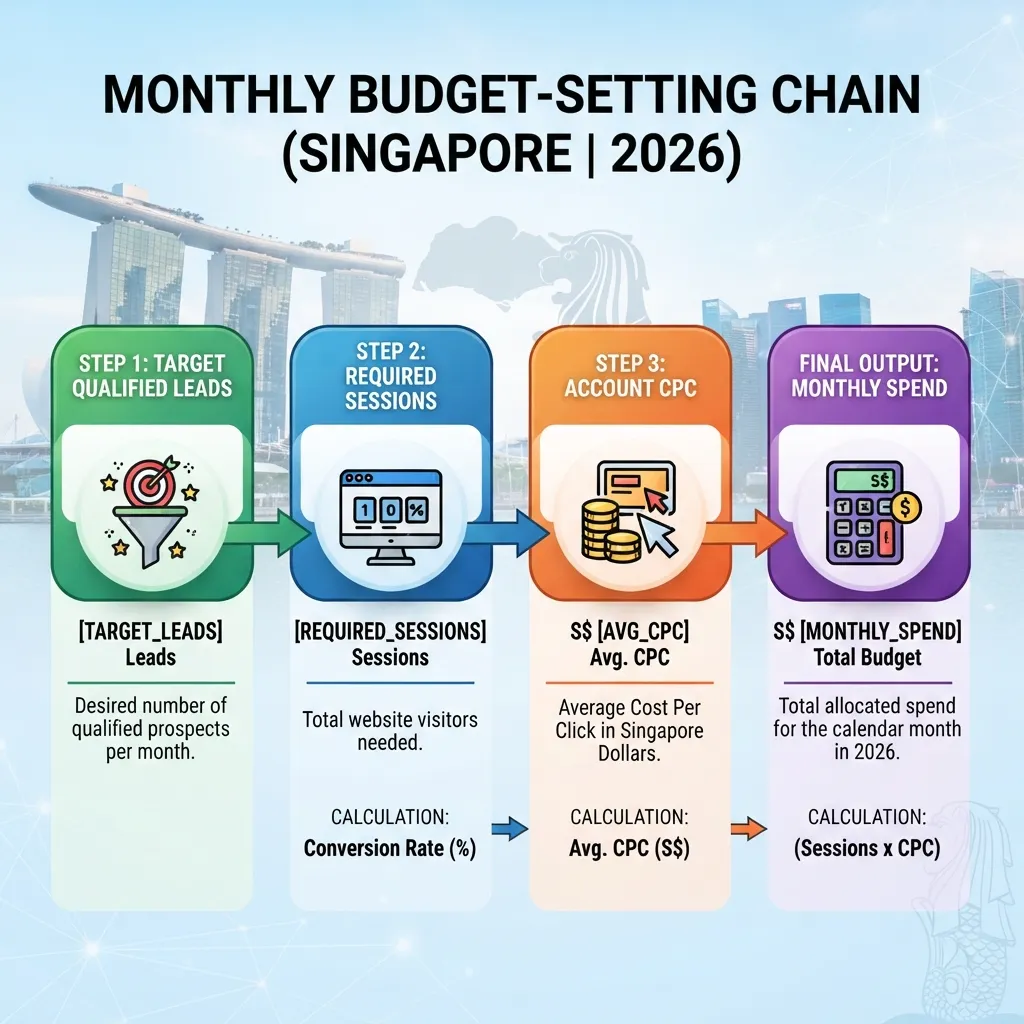
Start with a monthly outcome. Suppose a car dealership sets a goal of 50 sales leads a month from SEM. Postmedia Solutions notes that if the website already produces 25 qualified leads a month, traffic must double to reach 50. This is a hypothetical example.
Turn that traffic gap into a spend:
- Divide qualified leads by sessions to determine your conversion rate.
- Divide the target leads by that rate to get the sessions you need.
- Multiply the extra sessions by your average cost per click (CPC) to get the extra monthly spend.
Worked example: if your site produces a set number of qualified leads from a given number of sessions, your conversion rate is the number of leads divided by the number of sessions. Use the last three months of your analytics so the result reflects current performance, and check the metrics against the keyword research behind each Google Ads campaign.
Industry cost-per-click averages and what they mean for your numbers
Published CPC averages are a sanity check, not a target. Singapore advertisers bid in S$ against regional competitors, so a US average says little about your auction. Use benchmarks only to spot a figure that looks badly off, and compare them with your own keyword targeting and audience data.
Singapore cost benchmark: the most useful reference point is your account’s average cost per click and cost per acquisition over the last three months, since these reflect your actual market, bidding and offer. Benchmarks from named datasets should be added and linked here once they have been verified.
Customer acquisition cost and lifetime value
Set a ceiling before you set a budget. Customer acquisition cost (CAC) is what it costs to win one new customer. Lifetime value (LTV) is the gross profit that a customer generates. Keep CAC well below LTV so the margin covers ad spend and overheads.
To determine the budget that your margins support:
- Estimate LTV from average order value, purchase frequency and retention, then apply your gross margin.
- Set the maximum acceptable CAC at a fraction of that figure.
- Multiply the maximum CAC by the number of new customers you need each month.
If that result falls below what your funnel requires at the current CPC, the funnel is the problem, not the budget. Revisit your ad copy and landing pages before cutting spend, since content quality often determines whether paid traffic converts.
Factors that move your SEM costs
- Competition: More advertisers bidding on the same keywords raise the price of each position.
- Ad rank: Ad rank combines your bid with ad and landing page quality. A weak ad can lose a position even with a high bid.
- Match types: Broad match reaches more searches and spends faster on loosely related queries. Exact and phrase matches give tighter control.
- Conversion rate: A higher-converting page lowers your cost per acquisition, even when CPC stays the same.
- Seasonality: Budget for peaks rather than averaging them away, and plan your paid search strategy around them.
Allocating, Managing and Bidding Within Your Budget
SEM spend allocation across campaigns and keywords
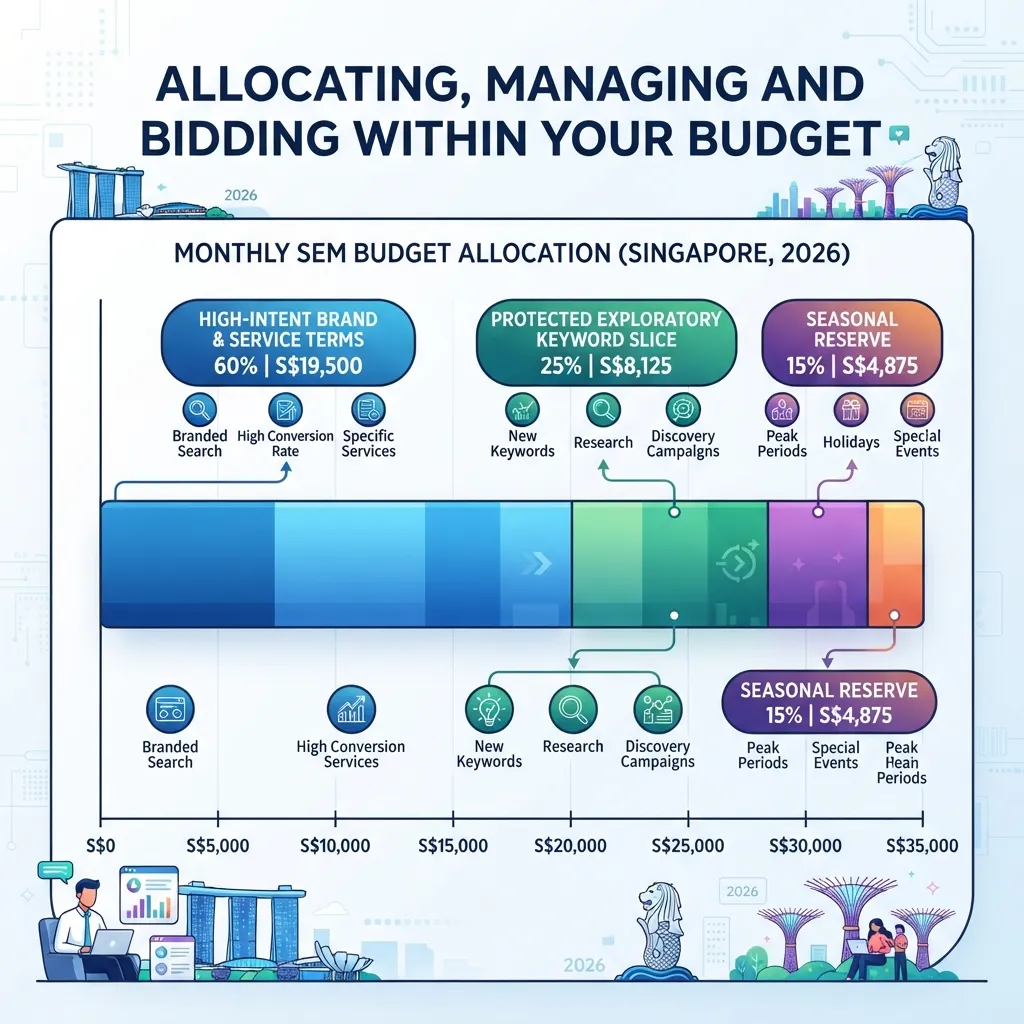
Give high-intent keywords the first claim on the budget. A brand name plus “price”, or a service name plus “near me”, usually converts at a lower cost per acquisition. Protect a fixed, capped slice for exploratory keywords, even when early results look weak. Judge each keyword group on cost per acquisition, not click volume. Review overall account performance against your business goals before shifting spend, and tie each campaign’s budget to the metrics that matter to your business. Businesses should base these allocation decisions on conversion data rather than click volume alone and match ad copy to the same high-intent targeting.
Bidding strategies and how they interact with budgeting
Target CPA and target ROAS strategies need enough conversions to learn from. They underspend if the daily budget is too tight to win auctions. Manual or cost-per-click bidding provides control at low volume but takes more hands-on work. Match the strategy to the conversion volume you can realistically generate.
Bidding for a top position is also a budget decision. Ad positions get 46% of clicks, so a higher bid can pay off when conversion value justifies it.

Budget constraints versus demand limits
A campaign can stop delivering for two reasons. Google Ads reports a campaign as “limited by budget” when its current budget can’t support the level of visibility that Google forecasts based on your daily performance. See Google Ads help on impression share for how lost impression share is measured.
Use this decision tree to tell the two apart:
- Is the lost impression share due to a high budget? If yes, the campaign is limited by budget. Raising the budget should bring more impressions.
- Is impression share already high, or have relevant searches run out? If yes, the campaign is demand-limited. More money only buys weaker queries.
To test, raise the daily budget by 15 to 20% for two to three weeks. If impressions and conversions rise with stable cost per acquisition, the campaign is budget-limited. This rule is a heuristic and doesn’t apply when conversion volume is too low to read.
Seasonality patterns in ad spend
Seasonality changes both demand and cost per click, so plan spend in advance. Map your last 12 months of conversions by week, then move the budget toward peak periods using scheduled budget adjustments. This way, digital marketing spend follows the customers most ready to buy. Check which audience segments convert in each peak so the timing matches the people you are reaching.
Do not read a seasonal spike as lasting demand growth. Confirm the rise persists after the season ends before you raise a base budget.
Budget management cadence and pacing
Review spending on a fixed cadence rather than reacting to daily swings. Check pacing weekly: is the budget spending evenly across the month, or running out early? Make budget changes only at scheduled reviews so results from one change don’t get mixed up with the next. This keeps your SEM campaigns steady and makes each change easier to judge. Over time, each review should show whether conversion quality holds up as spend changes, and that quality check should use the same metrics every time.
Scaling Your SEM Budget Without Wasting It
Scaling is where most SEM budgets quietly leak money. A campaign that converts well at S$100 a day does not automatically convert at S$200, so every increase has to be earned. Businesses that scale search engine marketing with discipline protect their overall return on spend.
Signals that show it is time to scale
Do not raise a budget because one good week happened. Look for consistent performance across several weeks, with cost per acquisition holding steady against your lead-value target. Judge these signals from your account data, based on the metrics your business actually tracks. Keyword research should also confirm that the searches driving results still match your offer before you commit to more budget.
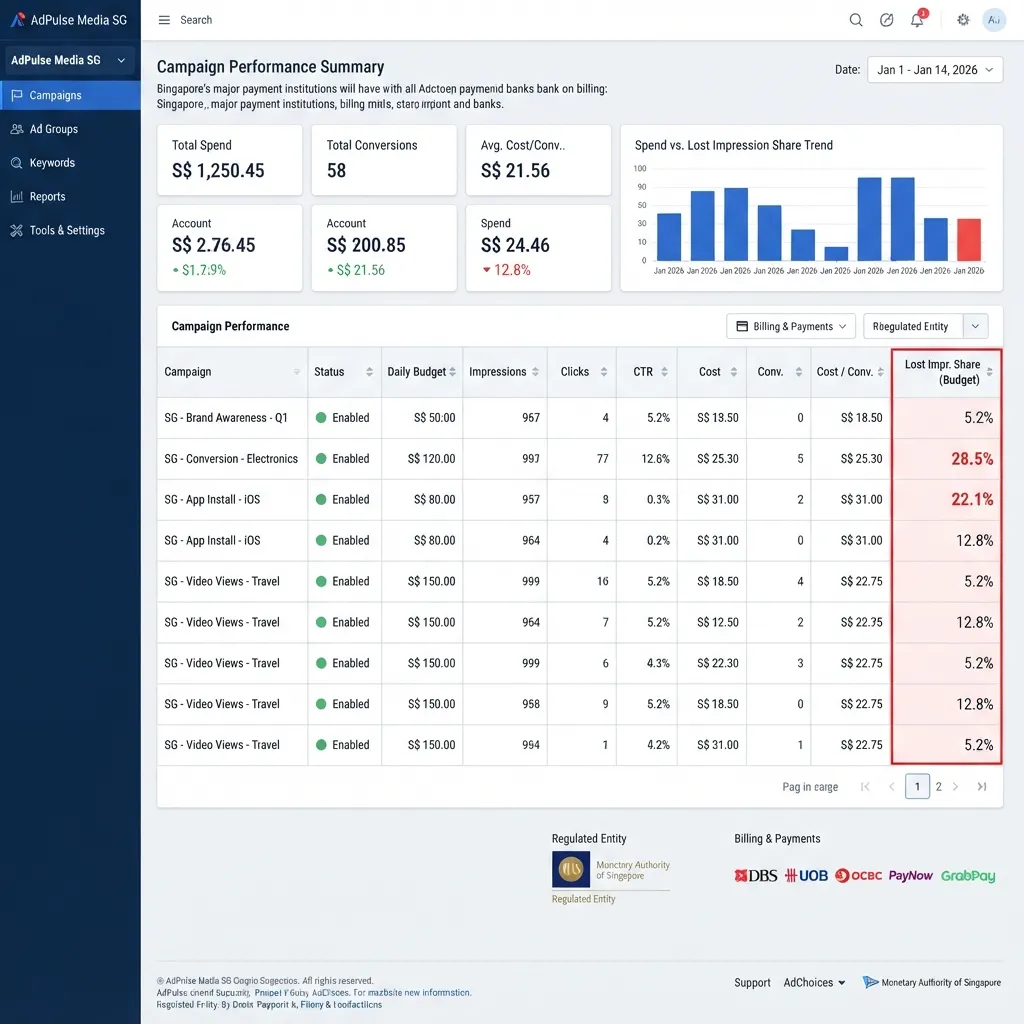
The clearest sign of unmet demand is lost impression share due to budget. A LinkedIn analysis suggests an impression share above 20% may signal that scaling could capture more market share. Treat this number as a heuristic and confirm it against your own results. It does not apply to campaigns with too few conversions to read reliably.
Incremental budget increase strategies
Raise budgets in steps, then wait. LinkedIn recommends increasing campaign budgets by 15 to 20% increments. Larger jumps make it impossible to tell which change caused a shift in results. Keep landing page and copy changes separate from budget changes, so you can judge each variable on its own. Scaling several SEM campaigns at once makes this harder, so change one campaign at a time where possible.
- Confirm the cost per acquisition has held steady for several weeks at the current budget.
- Confirm lost impression share from the budget is above 20%.
- Increase the daily budget by 15 to 20%.
- Hold for one to two full conversion cycles before taking the next step.
- Keep the increase only if cost per acquisition stays within your lead-value ceiling.
Recognising diminishing returns
Diminishing returns appear when each extra dollar buys fewer qualified leads than the last. Watch for cost per acquisition rising across successive steps, conversion rate falling on the same keywords, and irrelevant search terms creeping into the report. Tighten targeting if search terms drift away from your offer. Judge paid search spend by its effect on the audience you are actually trying to reach, not by volume alone. Protecting how your advertising reaches customers matters more than chasing extra impressions.
If two consecutive increases push your cost per acquisition above your ceiling, stop increasing and reassess. If conversions stop rising with spend, the campaign has exhausted its relevant searches.
Conclusion
A SEM budget should start from what a customer is worth to your business. Work backwards from your lead or sales target, convert that into traffic, then into spend using cost per click, and check it against your customer acquisition cost before committing.

Frequently Asked Questions
How much should a small business spend on SEM each month?
There is no universal figure, so build your SEM budget based on your own numbers. Start with the sales leads you need each month. Then estimate the traffic and cost per click (CPC) needed to deliver them. If a qualified lead is worth more to you than its acquisition cost, the spend is justified. Start at a level that produces enough clicks to measure results, then adjust after several weeks of data.
What is a good cost-per-click to budget for?
Treat published CPC averages as a sanity check, not a target. Your real cost depends on competition, quality score and ad position. Check benchmarks against Singapore competition rather than US averages, and replace estimates with your data.
How do I know if my SEM budget is too small?
Check the “lost impression share due to budget” figure in your campaign reports. This is the share of eligible searches your ads missed because the budget ran out. A campaign losing a large share to budget limits is budget constrained. If impression share is already high, search demand is the constraint, and more money will not help.
When should I increase my SEM budget?

Increase only after performance has been stable for several weeks and cost per acquisition is holding steady. Raise budgets in small steps, around 10 to 20 per cent at a time, and let each change settle before the next. This is a rough heuristic, not a fixed rule. Impression share lost to budget above 20 per cent is one signal to watch, but it does not apply if your lead volume is already meeting its target.
Why does my cost per acquisition rise when I spend more?
This is usually diminishing returns. Your most relevant searches are captured first, so extra clicks tend to come from less qualified traffic. Review search terms, match types and landing pages before increasing your budget further.