| AI Summary
Personal branding helps Singapore professionals explain what they do, who they help, and why others should trust their work. A credible brand connects everyday behaviour with a profile, work samples, and professional relationships. The Brand Evidence Ladder in this guide offers four checks: findability, focus, proof, and consistency. LinkedIn can provide a starting point, while portfolios and other channels serve different needs. Progress means more relevant conversations and opportunities, supported by honest claims and evidence. |
Personal branding is the deliberate effort to shape how others understand your skills, values, and work. A professional builds it through reliable behaviour, an accurate online profile, examples of their work, and relationships with people in their field. Its purpose is to make their contribution easier to recognise.
Key Takeaways
- A job title needs context: the people you serve and the problems you handle.
- A search result outside the first position does not mean your brand has failed.
- Work samples can show judgement even when sales or performance figures are unavailable.
- One well-maintained channel is a manageable starting point.
- Team achievements need an accurate account of your contribution.
- Relevant enquiries and introductions reveal more than follower totals alone.
Your reputation can reach someone before your first conversation. A former colleague may recommend you, a client may visit your profile, or a hiring manager may examine your portfolio.
Personal branding helps those people connect your name with work they understand. That can feel uncomfortable if you associate it with constant posting or self-promotion. A practical approach starts with the work you already do and makes it easier to explain.
For Singapore professionals, the task is to present that work in a way that supports a career goal. The steps below connect your reputation, profiles, examples, and relationships without turning every day into a content exercise.
What Does Personal Branding Mean?
Personal branding is the ongoing work of communicating your professional value. Your personal brand is the impression people hold as a result. You can influence that impression, although other people form their own views.
Harvard Business School Online describes personal branding as defining and expressing your value. That includes what you communicate and how you behave. A profile claiming reliability carries little weight if missed deadlines become a pattern.
The idea predates social media. Tom Peters’s 1997 article, The Brand Called You, encouraged professionals to take responsibility for how they present their work. Today’s platforms provide additional places to do that.
What a professional reputation includes
Personal branding combines several things people can observe:
- Expertise: The problems you know how to handle.
- Values: The standards behind your decisions.
- Behaviour: The way you communicate and deliver work.
- Evidence: The examples that support your claims.
An accountant might become known for explaining financial reports to business owners. A project coordinator might earn a reputation for keeping several teams informed. Both have something specific people can remember and describe.
Why Personal Branding Helps Your Career
Personal branding gives people context for your experience. Two candidates may share a title, but their work can involve different industries, responsibilities, and strengths.
SMU Academy connects professional identity with strengths, values, and career goals. That relationship gives branding a purpose beyond gaining attention: people can understand the contribution you want to make.
Different career goals need different evidence
| Career goal | What people need to understand | Evidence to prepare |
| A first professional role | Your skills and readiness to learn | Coursework, volunteering, or a practice project |
| A promotion | Your readiness for wider responsibility | Decisions, team support, and completed projects |
| A career change | How earlier experience supports the new role | Related tasks and recent learning applied to work |
| Consulting enquiries | The problem you handle and your approach | Relevant samples and an accurate service description |
A stronger reputation cannot guarantee an interview, promotion, or contract. Hiring needs, budgets, and experience still influence decisions. Personal branding helps others assess your contribution with less missing information.

How to Audit Your Personal Brand
A personal brand audit compares what you want people to understand with what they can find. The Brand Evidence Ladder below is a practical checklist for this guide, not a validated assessment or hiring model.
The four checks in the Brand Evidence Ladder
| Check | What to examine | A sign that work is needed |
| Findability | Can someone locate and recognise your professional profile? | An old profile contains your only current contact route |
| Focus | Can a reader explain what you do? | Your headline lists broad claims without a role or audience |
| Proof | Can someone examine an example of your work? | Every achievement appears as an unsupported statement |
| Consistency | Do your main profiles agree on the facts? | Dates, responsibilities, or contact details conflict |
Each check can receive one of three labels: present, partial, or missing. A short note beside the label should explain what you found. The result becomes a list of specific repairs.
What to check first
Your search can begin in a signed-out or private browser window. Searches for your name, role, and employer show different ways someone might encounter you. A private window does not provide a universal view of search results; location and other factors can still affect them.
The review should cover your main profile, CV, portfolio, and public contact details. A trusted colleague can then describe what they think you do after reading your profile.
Their answer reveals whether your message communicates what you intended. A response such as “something in marketing” suggests that your description needs more detail. A missing work sample suggests a different task. Your next step should address the gap you actually found.
How to Choose Your Specialism and Audience
A specialism describes the work you want people to associate with you. Your audience consists of the people who need that work or influence the opportunities you want.
The National University of Singapore connects personal brand development with values, strengths, skills, and a target audience. Those elements help turn a broad professional identity into a description someone can act on.
Three questions to narrow your message
- Which problems do people ask you to solve? Repeated requests can reveal strengths you overlook.
- Who benefits from that work? The answer may be a department, industry, or type of client.
- Which work do you want next? Your profile should support a direction you can explain honestly.
A human resources executive might focus on helping growing teams organise onboarding. A designer might focus on making booking forms easier for customers to complete. Neither needs to claim expertise in everything their field covers.
A specialism can develop over time
Your description should reflect your current ability. Someone moving into data analysis could describe their operations experience alongside recent reporting projects. Their profile should distinguish established experience from skills they are developing.
That distinction allows ambition without overstating competence. A smaller promise backed by evidence gives the reader something dependable to assess.
How to Write Your Personal Brand Statement
A personal brand statement explains your role, audience, and contribution in one or two sentences. Everyday language helps someone repeat it when introducing you.
A simple structure is: “I help [audience] with [problem] through [skill or approach].” The wording can change to suit your role. An employee can describe the team they support; a freelancer can describe the client they serve.
Personal brand statement examples
These examples are fictional and show how the structure works:
- Finance: “I help Singapore SME owners understand monthly accounts and prepare for financial reviews.”
- Human resources: “I organise onboarding so new employees know their responsibilities and where to find support.”
- Design: “I design booking pages that help customers understand the steps and complete their enquiry.”
Each sentence names work the person can explain in an interview. Claims such as “industry leader” or “visionary” need evidence and often tell the reader less.
A spoken introduction needs room for conversation
Your introduction can add one example to the statement. A brief account of a project gives the other person something to ask about.
An illustrative introduction might read: “I work in operations for retail teams. My recent project brought stock updates into one shared report. I enjoy making routine information easier for store managers to use.”
The aim is a natural opening. A memorised speech that runs through every qualification can make a conversation harder to begin.
What Your LinkedIn Profile Should Include
LinkedIn can serve as your main professional profile when the people you want to reach use it. Its role is to explain your experience and provide a starting point for contact.
NTU’s LinkedIn branding checklist includes a recent headshot, relevant skills, and links to projects or a portfolio. Those basics help a reader connect your description with your work.
A profile checklist for working professionals
- Headline: Your role or specialism, with relevant context.
- About section: The work you do, the people you support, and an example.
- Experience: Your responsibilities, contribution, and supported outcomes.
- Selected work: Links or materials that demonstrate relevant skills.
- Contact details: A professional way to reach you.
Your headline can include terms an employer or client would recognise, such as “payroll”, “retail operations”, or “user research”. Repeated keywords and long strings of unrelated job titles make it harder to understand your main work.
Public visibility needs a separate check
LinkedIn’s public profile settings control information available outside the platform. The public version can differ from what signed-in members see. Search engines may also take time to display changes. A profile update does not guarantee a particular search position.
Personal profiles can sit alongside company activity, but each serves a purpose. Your profile explains your experience. A business page represents the organisation. LinkedIn marketing for businesses also involves company content and commercial goals that a personal career profile may not need.
How to Show Proof of Your Work
Proof helps someone examine the claim in your profile. A work sample, project explanation, reference, or demonstration can provide that evidence.
Numbers help when they are accurate and relevant. Some work is better explained through a decision, a completed task, or an improved process. Every achievement does not need a percentage.
A short case study structure
- The situation: What problem needed attention?
- Your contribution: Which tasks or decisions were yours?
- The result: What happened, and what supports that account?
- The lesson: What would you repeat or change?
A fictional operations example could describe replacing several stock spreadsheets with one shared tracker. The sample might show the tracker layout and explain how managers used it. Any claimed reduction in errors would need supporting records.
Team results need accurate credit
A team outcome should include your part in it. “The team launched a new customer portal; I wrote and tested the help content” tells the reader more than taking sole credit for the launch.
Client information and internal documents need permission before publication. An approved sample with identifying details removed can help, although sensitive information must remain protected. A separate demonstration built with fictional data can show the method when real work cannot be shared.
Beginners can create labelled samples
A graduate might analyse public data or redesign an imaginary booking form. The sample should state that it is a practice project and describe the task. It must not imply a client relationship that never existed.
These distinctions also support freelancer marketing, where a prospective client needs to understand both the offer and the evidence behind it.

Which Platforms Support Your Personal Brand?
Your audience and work should influence the channels you maintain. One current profile with relevant examples can provide a better starting point than several neglected accounts.
| Channel | When it helps | What to include |
| Professional discovery and conversations | Experience, work examples, and contact details | |
| Personal website | A portfolio needs more space or structure | Biography, selected projects, and an enquiry route |
| Industry directory | A recognised association lists members | Accurate role and membership information |
| Visual portfolio | Readers need to inspect design or creative work | Selected projects with explanations |
A personal website should earn its upkeep
A website makes sense when it solves a specific problem, such as presenting several detailed projects. Basic website design should make those projects readable on a phone and keep contact details easy to find.
An author biography can explain who created published work and why they know the subject. Google identifies accurate authorship information as one way to help readers assess content. A biography is not a guarantee of rankings or inclusion in AI answers.
What to Post About Without Repeating Yourself
Personal branding content should help someone understand your thinking. A narrow topic can support several posts when each answers a different question.
Three recurring themes can organise a modest social media content plan: problems you handle, decisions you make, and lessons from your work. Each theme gives you material beyond announcements and personal achievements.
One project can produce different explanations
A fictional onboarding project might support these posts:
- A checklist of information new starters need before their first day.
- An explanation of how the team chose one place for onboarding documents.
- A reflection on a question the original checklist missed.
Those posts serve different reader needs. Rewriting the same project summary with a new opening adds little.
Thought leadership starts with a reasoned view
Thought leadership means contributing an informed perspective that helps others think or decide. An executive title is unnecessary. A professional can explain why an approach worked, where it failed, and which conditions influenced the outcome.
A short explanation of a difficult decision can show more understanding than a confident prediction about an entire industry. Sources should support factual claims, while personal experience should be labelled as personal experience.
AI tools need human checking
An AI tool can help organise notes or suggest an outline. Your experience, examples, and final judgement still need to come from you. Invented projects, quotations, or results damage the evidence your brand depends on.
Your publishing pace should leave time for checking facts, answering comments, and doing the work itself. A small routine you can maintain is enough to begin.
How Relationships and Learning Strengthen Your Brand
Professional relationships give people experience of how you work. A helpful discussion, careful introduction, or reliable collaboration can support the same reputation your profile describes.
Networking can begin with existing contacts
- A former colleague may welcome an update on a shared project.
- An industry group may need a practical answer to a question you understand.
- An event speaker may appreciate a specific follow-up about their presentation.
A connection request works better when the recipient understands why you are contacting them. A genuine shared interest provides that context. Repeated sales messages to people who have shown no interest can damage the relationship.
Learning needs an application
Your next course should address a skill your work requires. LinkedIn Learning’s personal branding courses cover topics such as professional presentation and communication. A course can support development, but completion alone does not prove competence.
A presentation course becomes stronger evidence when you apply the learning to a briefing. A reporting course becomes more persuasive when you explain a completed analysis. The application gives a qualification context.
How to Measure Personal Branding Progress
Personal branding progress depends on your goal. A job seeker, employee, and consultant should not judge success through the same numbers.
| Goal | Signals to record | A question for review |
| Job opportunities | Relevant recruiter contacts and interview discussions | Are people contacting me about suitable roles? |
| Career growth | Invitations to contribute or take responsibility | Do colleagues recognise the skills I want to develop? |
| Consulting work | Relevant enquiries and referrals | Do prospects understand the service before the first call? |
| Professional recognition | Invitations to speak, write, or collaborate | Which examples prompted the invitation? |
Follower totals and impressions describe attention. Social media insights become more informative when you connect that attention with relevant responses and conversations.
A monthly review can stay simple
A short log can record what you published, who responded, and what happened next. A conversation that began after an event deserves a different note from an enquiry that followed a portfolio visit.
Several influences may contribute to one opportunity. A contact may have seen your work months before sending a message. Their answer to “How did you hear about me?” provides context without proving that one post caused the result.
Personal Branding Mistakes That Weaken Trust
Personal branding becomes less credible when public claims run ahead of actual experience. A review of your profile and behaviour can catch that gap before it grows.
Common problems and practical repairs
- Broad promises: A profile claiming every skill needs a narrower description.
- Unsupported results: A performance claim needs records or removal.
- Borrowed opinions: A shared idea needs credit and your own contribution.
- Neglected profiles: Old contact details and broken project links need updating.
- Combative replies: A disagreement needs a response focused on the issue.
Accuracy is also part of online reputation management. An outdated biography can mislead someone even when no criticism appears in search results.
A correction should address the error
A mistaken post needs an appropriate correction. A misleading work claim needs revised wording. Additional positive posts do not repair an inaccurate statement.
Your reputation also depends on delivery, conduct, and skill. Extra content cannot compensate for work that repeatedly falls short of what you promised.
A 30-Day Personal Branding Plan
A first month can produce a working foundation. The schedule below is an example, not a promise of career results within 30 days.
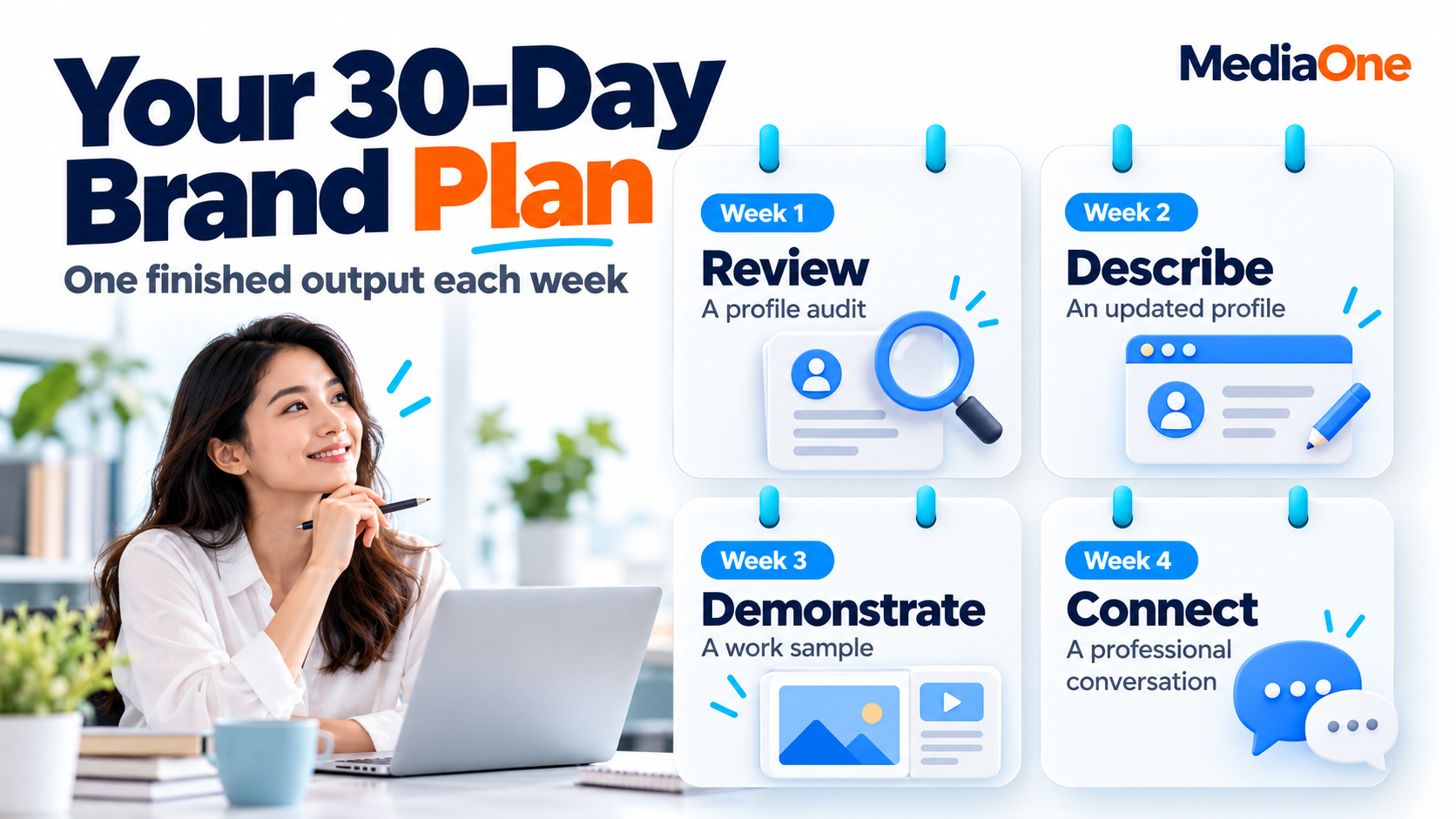
| Week | Main task | Finished output |
| 1 | Review your profiles and choose a career goal | An audit with specific gaps |
| 2 | Rewrite your headline, summary, and introduction | A profile that explains your contribution |
| 3 | Prepare one project explanation | A work sample you can share |
| 4 | Share one relevant insight and reconnect with contacts | A small publishing and relationship routine |
Each task should end with something another person can assess. A colleague can explain what your profile communicates. A portfolio reader can identify your contribution. A contact can understand why you reached out.
Build a Personal Brand Your Work Can Support
Personal branding gives your experience a form other people can understand and assess. A manageable next step is one specific repair: an accurate headline, a stronger project explanation, or a current contact route. Each improvement should make a real contribution easier to recognise.
For founders and professionals connecting their public reputation with a business, our branding services can support the wider brand strategy and identity. A conversation with our MediaOne team can establish what support your business needs.
FAQs About Personal Branding
Should a personal brand use English or another language?
Your audience should influence the language you choose. English may suit some professional conversations, while another language may help you explain your work to particular clients or communities. Separate versions of a biography can preserve the same facts without forcing every reader through a bilingual paragraph. Your language claims should match your ability.
How should a career break appear in a professional profile?
A career break can receive a brief, factual explanation when you choose to include one. Personal medical or family details do not need to become public. Relevant learning, volunteering, or projects can appear separately if they occurred. An accurate account of dates avoids implying continuous employment that did not happen.
What if another professional has the same name?
A consistent name format, role, and professional photograph can help readers identify you. A genuine middle initial or recognised professional name may help distinguish profiles. Invented qualifications or misleading titles will create a different problem. A direct profile link in applications and email signatures also reduces the chance of someone choosing the wrong result.
Does personal branding require sharing private life?
A professional can demonstrate personality through their writing, values, and work without publishing family details or personal struggles. The amount shared should reflect their own boundaries. A story that involves another person also needs care: someone else’s experience does not become suitable for publication simply because it helps explain your own.
Is a personal brand the same as a company brand?
A personal brand centres on an individual’s reputation and contribution. A company brand represents an organisation, its services, and the experience it promises customers. A founder may influence both, but the two need distinct descriptions. Customers should understand whether they are hiring that person directly or engaging a team through the business.