

| AI Summary
A website penalised by Google may lose rankings or disappear from search results because it breaches Google’s spam policies. A confirmed manual action appears in Search Console. Automated spam systems can also reduce visibility, while core updates, technical faults and changes in demand can cause traffic drops without a penalty. Recovery starts with identifying the cause, correcting the problem and requesting a review when a manual action applies. |
A fall in Google traffic can mean fewer enquiries, sales and bookings. Before changing the website, the business needs to know whether Google has applied a manual action or something else has affected its visibility.
That distinction determines the next step. A spam violation needs a policy fix, while an indexing fault needs technical work. The checks below explain how to tell them apart, reduce avoidable risks and organise recovery.
Key Takeaways
- Confirm the cause first. Search Console reports, affected pages and recent website changes help separate penalties from other traffic losses.
- Remove practices that manipulate rankings. Paid ranking links, hidden keywords and mass-produced pages can create policy risks.
- Review links with evidence. An unfamiliar backlink or a low third-party score alone does not justify disavowal.
- Document the corrections. A manual-action review needs an explanation of the issue, completed fixes and supporting evidence.
- Measure recovery over time. Google provides no fixed recovery deadline or guarantee that previous rankings will return.
What Does Being Penalised by Google Mean?
A Google penalty usually refers to action against content that breaches Google’s search policies. The effect can involve individual pages, a website section or the whole site.
However, the phrase often gets used for any fall in rankings. That broad use can lead a business towards the wrong repair, especially when the real problem began with a website update.
Manual actions and automated spam systems
A manual action follows a review by a person at Google. Search Console identifies the issue and provides information about its scope.
Automated spam systems also assess websites. A site affected by those systems may lose visibility without receiving a manual-action notice.
| Situation | Evidence to check | Appropriate response |
| Manual action | A notice in Search Console | Correct the listed violation and request review |
| Suspected automated spam impact | Policy problems and an aligned traffic decline | Remove the violating practices |
| Core-update decline | Changes around an announced update | Assess affected content and search results |
| Technical fault | Indexing, server or website errors | Repair the fault and test affected pages |
| Lower search demand | Fewer searches for relevant topics | Review demand and adjust expectations |
The table provides starting points for investigation. Several problems can exist together, so one finding should not end the review.
A core update does not prove wrongdoing
Google’s core updates reassess search results across the web. A page can lose positions as other results become more relevant, even when it has broken no policy.
For example, a product guide may lose ground after newer guides offer better comparisons and current details. Its owner needs to assess those differences before deleting pages or removing backlinks.
How to Check Whether Google Has Penalised Your Website
A recovery review needs evidence from the correct website property. Search Console access should cover the affected domain or URL version.
An SEO website audit helps organise findings across content, links and technical settings. The following checks establish which area needs attention first.
Check the Manual actions report
The Manual actions report identifies confirmed manual actions and their affected areas. A notice provides a stronger basis for action than a ranking tool’s warning.
The review record should capture:
- The issue named in the notice.
- Whether it affects some pages or the whole site.
- Example URLs or URL patterns.
- The date the notice appeared.
- The corrections required for that issue.
A report showing no current issues rules out a current manual action in that property. It does not rule out automated spam detection or other ranking problems.
Check for security problems
The Security issues report covers threats such as hacked content, phishing and malware. These problems require attention because visitors may encounter harmful pages or warnings.
Unrecognised pages, redirects and administrator accounts deserve investigation. The technical team should address the underlying access problem as well as the visible content, then follow the report’s review process where applicable.
Find where the traffic loss began
Search Console’s Performance report helps narrow the investigation. A comparison between similar periods can show whether the decline affects the whole website or a smaller group of pages.
The first review should compare:
- Pages: Which URLs lost the most clicks?
- Queries: Which searches previously brought visitors?
- Devices: Is the decline concentrated on mobile or desktop?
- Countries: Does the pattern affect one market?
- Search types: Did web, image or video traffic change?
A drop limited to recently edited product pages points towards a different investigation from a decline across every section. That pattern gives the team a manageable starting sample.
Inspect affected pages and recent changes
The URL Inspection tool shows information about Google’s indexed version of a page and supports a live test. Differences between those views can help identify recent changes.
The investigation should pair those results with the website’s change history. Recent releases, moved URLs, altered canonical tags and accidental noindex settings belong in a technical SEO audit. An indexing fault can remove a valuable page from search without a spam penalty.
The evidence below shows how different findings lead to different repairs.

Why Google Traffic Can Fall Without a Penalty
A traffic decline can have several causes. Google’s explanation of search traffic drops includes technical issues, ranking changes, seasonality and changes in search interest.
The business should establish whether visibility fell, demand fell or measurement changed. That distinction prevents a technical repair from becoming an unnecessary content overhaul.
Search demand and click patterns
Seasonal businesses often receive different levels of interest throughout the year. A previous-period comparison can mislead when one period includes a holiday, promotion or annual event.
Search Console metrics help frame the next check:
| Pattern | Possible explanation to investigate |
| Impressions fall while positions remain similar | Lower demand for the tracked searches |
| Impressions remain similar while clicks fall | Changes in result appearance or competing listings |
| Rankings and impressions fall across key pages | Reduced visibility or an indexing problem |
| Analytics falls while Search Console stays steady | A measurement or reporting fault |
These patterns suggest questions; they do not establish a diagnosis by themselves. The team should test the explanation against affected queries and pages.
Website changes and competing pages
A redesign can introduce broken links or remove information that customers need. Several pages targeting the same question can also complicate performance analysis.
A keyword cannibalisation review helps identify competing URLs within the website. Any decision to combine them should consider their purpose, existing traffic and customer value.
Google updates and service incidents
The Google Search Status Dashboard records announced ranking updates and service incidents. Its dates provide context for the traffic chart.
Matching dates alone do not prove the cause. A website release during an update still needs investigation, especially when the affected pages share a template or setting.
Which Practices Can Lead to a Google Penalty?
Google’s spam policies describe practices intended to manipulate search rankings. The examples below help businesses recognise risks before approving SEO work.
Paid links intended to influence rankings
A link purchase becomes a policy concern when its purpose is to pass ranking credit. The linking website’s appearance or authority score does not remove that concern.
A proposal deserves scrutiny when it promises:
- Guaranteed volumes of ranking links.
- Placement across websites controlled by one supplier.
- Repeated commercial keywords in link text.
- Links inserted into unrelated articles.
- Exchanges arranged mainly for search rankings.
Commercial advertising can include links. Google identifies rel=”sponsored” as the preferred attribute for paid placements, while nofollow remains acceptable. A sponsored placement therefore needs appropriate technical treatment as well as an honest description of the arrangement.
Keyword stuffing repeats terms unnaturally to influence rankings. Hidden text conceals ranking-focused content, while cloaking presents different content to search engines and visitors for deceptive purposes.
A service page should explain what the business offers in language customers understand. Repeating the same phrase in every heading adds little for the reader and deserves editorial review.
Doorway pages
Doorway pages target similar searches and funnel visitors towards the same destination. A common warning sign is a set of near-identical pages with only a place name or keyword changed.
Separate pages need a reader-facing reason to exist. Distinct services, product details or genuinely different information provide a stronger basis than keyword variations alone.
Mass-produced content without added value
AI assistance does not automatically make a page spam. Google’s generative AI content guidance focuses on accuracy, relevance and value.
The risk grows when a publishing process generates many pages without checking facts or adding substance. Human-written content can have the same weakness. An editorial process should test claims, examples and audience needs before publication.
Ordinary duplication needs a separate assessment
Repeated content does not automatically establish a spam violation. Product filters, print versions and other URL variations can create duplicates without deceptive intent.
Google’s canonicalisation documentation explains how signals help identify a preferred URL. A technical review should assess those signals before anyone labels normal duplication a penalty. Copying material at scale to manipulate rankings requires a different policy review.
The Five-Point Penalty Risk Audit
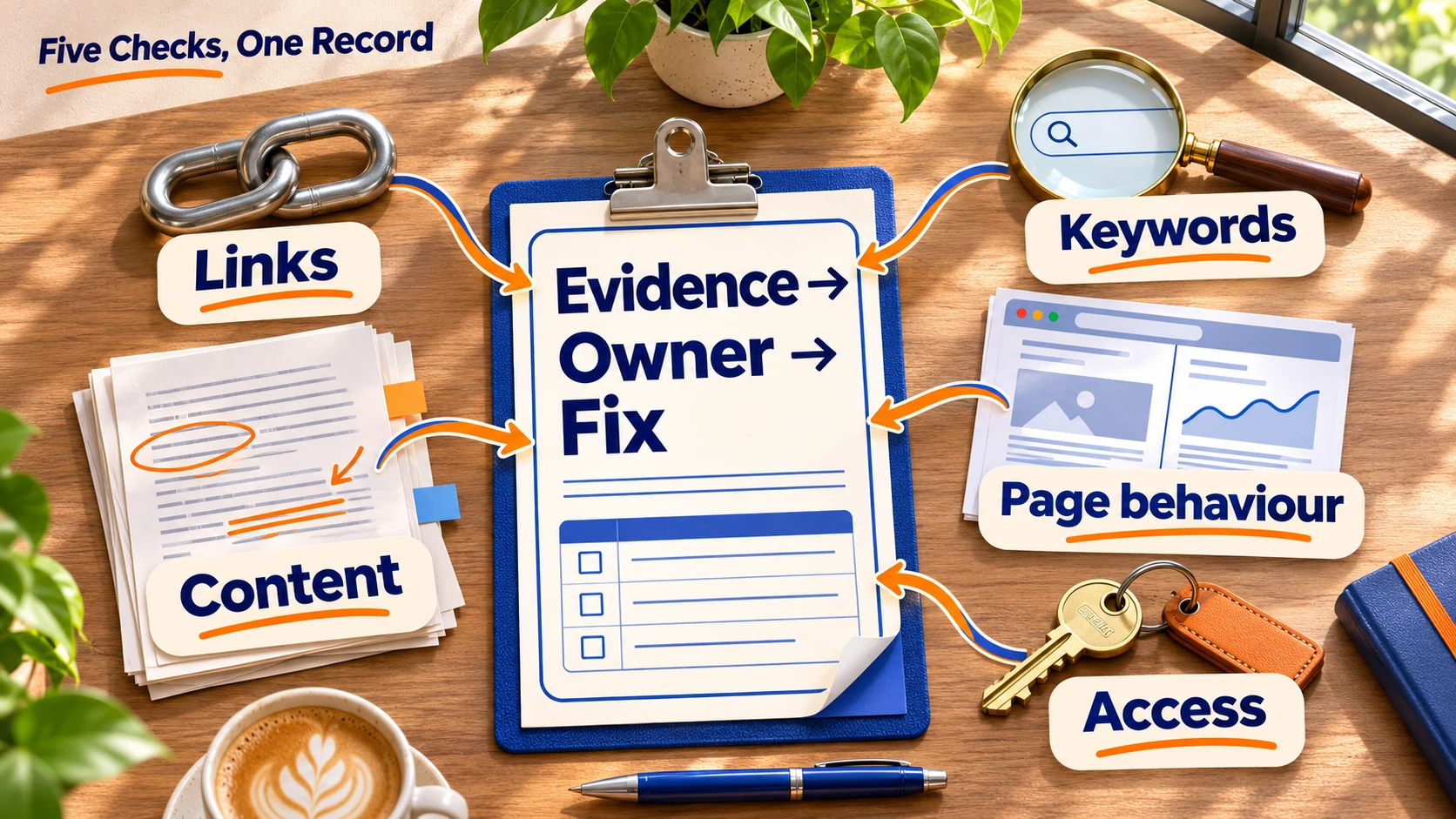
A risk audit turns broad concerns into evidence the team can act on. Each finding needs an affected URL, a description, an owner and a proposed correction.
The ratings below support internal prioritisation. They are not Google scores or published penalty thresholds.
| Audit area | Evidence to collect | Priority finding |
| Link sourcing | Placement lists, invoices and agreements | Links purchased to pass ranking credit |
| Content production | Briefs, sources and review records | Large groups of unreviewed pages |
| Keyword use | Page copy, headings and templates | Repeated phrases added for rankings |
| Page behaviour | Rendered pages and redirect tests | Deceptive differences or destinations |
| Site controls | Access records and publishing permissions | Unknown users or unapproved changes |
Evidence should determine priority
A third-party warning needs checking against the actual page or link. Its label can help sort a workload, but the team still needs to establish what happened.
For example, a suspicious link score should lead to a source review. A backlink profile assessment can examine whether the link was purchased, controlled or earned through a real editorial decision.
The correction needs an accountable owner
A confirmed problem should become a task with a defined completion check. “Improve content” leaves too much open to interpretation. A stronger task might specify:
- The affected page group.
- The unsupported claims or repeated sections.
- The evidence needed for replacement copy.
- The person approving the revision.
- The test confirming the published correction.
The audit becomes easier to use when each finding travels with its evidence and assigned repair.
How to Recover From a Manual Action
A confirmed manual action provides a defined issue to resolve. Recovery work should follow the notice and cover the affected pattern across the website. A shared correction log helps the SEO, editorial and development teams work from the same evidence.
Establish the full scope
Example URLs provide a starting sample. Other pages built from the same template or campaign may share the problem.
The investigation should include related pages, previous link campaigns and any other actions listed in Search Console. A supplier’s explanation should be supported by records the business can inspect.
Correct the cause across affected pages
The repair must address the practice behind the violation. Removing one example leaves the underlying problem in place when the same process continues elsewhere.
The correction log should record:
- What the team found.
- Which URLs or placements were affected.
- What changed.
- When the change went live.
- How the team checked the result.
Screenshots, removal records and published URLs can support that account. Evidence should show completed work, without claiming a result that has not yet occurred.
Submit a documented review request
Google’s manual-action process provides a review option after corrections. The request should explain the original issue, the repair and the outcome of the work.
A concise account is easier to assess than a general promise to follow the rules. The business should then monitor Search Console messages and avoid submitting another request while the existing review remains pending.
When Should a Website Use the Disavow Tool?
Disavowal asks Google to disregard specified incoming links. It is an advanced action that can harm search performance when used incorrectly.
Google’s disavow documentation says most websites do not need it. Its stated conditions involve considerable spammy or artificial linking and a manual action, or a likely manual action, caused by those links.
A suspicious score is insufficient evidence
An unfamiliar website, foreign-language page or low authority score does not establish that a link needs disavowal. The investigation should focus on how the link arose and whether it forms part of a manipulative arrangement.
A deliberate paid-link campaign provides different evidence from random spam links the business never arranged. That difference should guide the decision.
Removal efforts should come first where applicable
For an unnatural-links manual action, the team should make good-faith efforts to remove offending links or have them appropriately qualified. Records of those efforts can support reconsideration.
Any disavow file needs careful checking. A new upload replaces the previous list for that property, so the reviewer must preserve entries that still belong in the file.
How to Respond to an Algorithmic Traffic Drop
An algorithmic decline has no manual-action reconsideration process. The work begins with confirming the pattern, then choosing changes supported by the evidence.
A suspected spam-update impact calls for a policy review. Google’s spam-update explanation notes that compliant improvements may take months to be recognised. Lost benefits from spam links may not return.
Content changes should answer a specific weakness
A page review needs more direction than “make it longer”. Google’s people-first content questions examine originality, completeness, evidence and the reader’s experience.
A practical review can ask:
- Which customer question remains unanswered?
- Which claim lacks evidence?
- Which example needs explanation?
- Which information has become outdated?
- Which part requires experience the current draft lacks?
Those findings give editors a reason for each change. Where sustained editorial work is needed, our content marketing services can support the wider content programme.
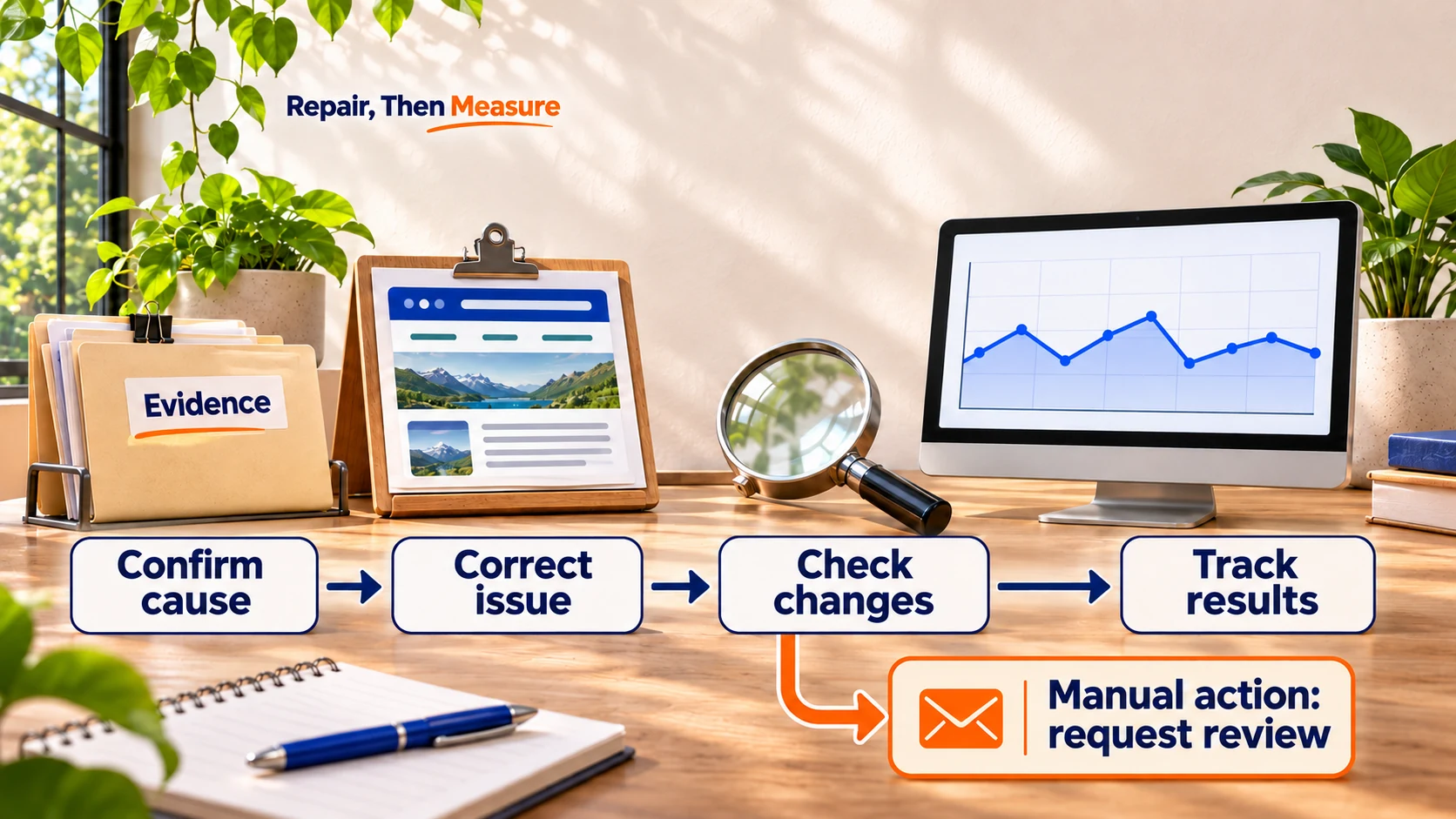
Recovery reporting should separate repairs from results
A completed repair and a ranking improvement are separate milestones. The report should identify both so the business can see progress without treating every fluctuation as success or failure.
A repair record might show that pages now load correctly, claims have sources and broken links have been corrected. Performance reporting can then track clicks, impressions, enquiries and sales across comparable periods.
The following visual separates the work the team controls from the response it must monitor.
How Long Does Google Penalty Recovery Take?
Google provides no universal recovery deadline. The type of issue, completeness of the repair and reassessment process all affect timing.
A manual-action review may take days or weeks, with some link-related reviews taking longer. Broader content improvements can take months to be reflected in search performance. Previous positions are not guaranteed.
A staged plan gives the business better visibility
A recovery plan should identify milestones the team can verify:
| Stage | Evidence of progress |
| Diagnosis | Documented cause and affected pages |
| Correction | Completed changes and supporting records |
| Validation | Tests confirming the changes work |
| Review | Submission and decision, where applicable |
| Monitoring | Comparable search and business results |
A business should question any promise of guaranteed recovery by a fixed date. A stronger proposal explains the work, the evidence required and how progress will be reported.
How to Reduce Future Penalty Risks
Prevention depends on the work a business approves and the access it gives suppliers. A short approval process can catch risky proposals before they become recurring tasks. A sound off-page SEO programme should explain where placements come from and why their audiences would value the connection.
Link and content approvals need records
A supplier should be able to explain its methods in terms the business understands. Vague references to secret networks or guaranteed authority deserve closer scrutiny.
Approval records should cover:
- Proposed link placements and commercial arrangements.
- The purpose of new pages.
- Sources supporting factual claims.
- Editorial and technical reviewers.
- Access granted to each supplier.
Natural anchor text helps describe a destination. Repeated commercial phrases across purchased placements need a different level of scrutiny.
Routine checks should follow website changes
A release checklist should cover important pages, forms, redirects and indexing settings. The team should also confirm that internal links lead readers to the intended destinations.
Regular checks make later investigations easier because the business has a record of what changed and when. That record can shorten the time spent identifying a fault.
Recover With an Evidence-Based Plan
A website penalised by Google needs a repair based on the cause of its lost visibility. Search Console notices, page checks and policy evidence help the team choose the right work, document corrections and measure progress without relying on fixed recovery promises.
Our SEO services can help assess the issues affecting search performance and prioritise the next steps. A consultation with our team can establish what the evidence shows and what your website needs next.
Frequently Asked Questions
Can a previous owner’s actions affect a website after purchase?
Yes. A website may carry unresolved manual actions from earlier ownership. The new owner should investigate Search Console history and correct remaining violations. A reconsideration request can explain the ownership change alongside evidence of the completed repairs.
Does paying for Google Ads remove an organic search penalty?
Google Ads is separate from the manual-action recovery process. An advertising campaign does not replace the policy corrections or review required for affected organic search pages. A business running ads should manage that campaign separately from its search recovery work.
Can a structured data issue affect search appearance?
Yes. Google can apply a manual action to structured data that breaches its requirements. The effect can concern eligibility for enhanced search features, so the team should read the notice before assuming every organic listing has been removed.
Does moving to another domain solve a spam violation?
A domain move does not correct the underlying practice. Republishing the same violating material or continuing the same link scheme leaves the cause unresolved. Google’s spam policies also address attempts to evade enforcement, so recovery work should address the violation itself.