

If you have ever searched for a café, clinic, gym, or service “near me” while standing on a street in Singapore, you have already experienced mobile local SEO in action. These moments matter more than many businesses realise. Mobile is no longer just another channel. It is the primary way people discover local businesses, compare options, and decide who to contact.
This is why many companies work with an experienced SEO agency to ensure their websites and local listings are optimised for mobile search behaviour.
This shift is especially pronounced locally. Singapore’s mobile internet penetration exceeds 90%, which means most people are searching on the go rather than sitting at a desktop. Whether it is checking opening hours on the MRT, comparing reviews while walking, or looking up directions just minutes before arriving, mobile search has become the default behaviour.
At MediaOne, we see this pattern across industries every day. Businesses are investing in SEO, yet many still approach it from a desktop mindset. The result is missed opportunities in mobile-first local search, where intent is high, and decisions are made quickly.
This article focuses on how mobile local SEO actually works today, what Google prioritises, and how businesses can align local visibility with real user behaviour in Singapore.
Key Takeaways
- Mobile local SEO is about matching high-intent searches with fast, relevant, and location-specific experiences on small screens.
- Google’s mobile-first indexing means your mobile site determines how your local rankings perform, not your desktop version.
- Local signals like proximity, relevance, and prominence behave differently on mobile and need specific optimisation.
- Page speed, tap-friendly design, and clear local information directly influence mobile conversions, not just rankings.
- Businesses that optimise for mobile local intent tend to win visibility even against larger competitors with stronger brand names.
Why Mobile Local SEO Matters More Than Ever in Singapore
Singapore is a mobile-first society in practice, not just in theory. Commuters search while walking, parents look up services between errands, and professionals compare options during short breaks. These searches are often urgent and location-based, driven by immediate needs rather than casual browsing.
On mobile, people behave differently because their mindset is different. They are usually looking to solve a problem quickly, not explore endlessly. Attention spans are shorter, cognitive load is higher, and users naturally gravitate towards options that feel easiest and closest. As a result, mobile users scroll less, tap more, and make decisions faster.
Google recognises this behaviour and adapts its mobile results accordingly. The local pack, maps, call buttons, and directions dominate the screen because they reduce friction and decision effort. Traditional organic links are pushed further down, especially on smaller screens.
For local businesses and SEO agencies, this changes the game entirely. Ranking well on desktop but poorly on mobile often means losing the customer before they even see your brand, simply because it is not surfaced at the moment of decision.
Understanding Mobile-First Indexing in Local Search
Mobile-first indexing means Google predominantly uses the mobile version of your website for indexing and ranking. This is not a future update. It has already happened.
What mobile-first indexing really means for local SEO

Your mobile site is now the primary reference point for how Google understands, evaluates, and ranks your business in local search. This affects several critical areas.
- Content relevance for local keywords: Google uses the content on your mobile pages to determine whether your business is relevant for location-based searches. This includes service descriptions, location references, FAQs, and contextual cues that signal what you offer and where you operate. If important local information is shortened, hidden, or removed on mobile, Google may struggle to match your site to high-intent local queries.
- Page experience signals, such as speed and usability: Mobile performance directly influences how Google assesses user experience. Slow loading times, intrusive pop-ups, difficult navigation, or text that is hard to read on smaller screens can all weaken mobile rankings. For local searches, where users expect quick answers, poor mobile usability often leads to immediate abandonment.
- Structured data that supports local listings: Local schema, business details, and structured data are interpreted from your mobile site first. This data helps Google connect your website to your Google Business Profile and display accurate information such as address, operating hours, and services. If structured data is missing or inconsistent on mobile, local visibility can suffer.
- Internal linking and crawlability: Google crawls your mobile site to understand how pages are connected and prioritised. Internal links that point to key service or location pages must be accessible and functional on mobile. When navigation menus are overly simplified or links are removed for design reasons, important pages may receive less visibility in local search.
If your desktop site is rich but your mobile version is stripped down, you are effectively hiding information from Google and, just as importantly, from the users who are most likely to convert.
Common mobile indexing mistakes local businesses make
Many local businesses unknowingly weaken their SEO by making well-intentioned design or usability changes that remove important signals from their mobile site. Under mobile-first indexing, these issues can directly affect how Google understands and ranks a business in local search.
- Hiding important content behind tabs that are difficult to load: Tabs, accordions, and expandable sections are often used to keep mobile pages visually clean. However, when these elements load slowly, rely heavily on scripts, or are not rendered properly, Google may not fully process the content inside them. This can result in key service information, location details, or FAQs being underweighted or ignored, reducing relevance for local searches.
- Removing address details or service descriptions on mobile: Some businesses shorten mobile pages by removing full addresses, neighbourhood references, or detailed service descriptions. While this may appear to improve design, it strips away critical local signals that Google uses to connect a business to specific locations and search intent. Without clear address and service information, mobile pages often struggle to rank for local queries. This is where the expertise of a local SEO agency comes into play.
- Using different structured data on desktop and mobile: Structured data helps Google understand business details such as location, services, and operating hours. When the mobile site uses an incomplete or different schema from the desktop version, it creates inconsistencies that can confuse search engines. This can weaken the connection between the website and the Google Business Profile, affecting how the business appears in local results.
- Blocking mobile resources that Google needs to render the page: Images, JavaScript, and CSS files are essential for Google to render and interpret mobile pages accurately. When these resources are blocked, Google may see an incomplete or broken version of the site. This can lead to misjudged usability, missed content, and weaker performance in mobile local rankings.
Mobile-first indexing rewards consistency and clarity. Your mobile experience should deliver the same local signals as desktop, simply presented in a way that is easier to use and faster to access on a smaller screen.
How Mobile Local Search Intent Works Differently

Mobile local searches are driven by immediacy. When someone searches on a mobile device, they are usually in motion, short on time, and close to taking action. Unlike desktop searches, which are often exploratory, mobile searches tend to reflect real-world needs that need solving quickly.
Mobile local SEO typically supports three core types of intent, each with its own behaviour patterns and expectations.
Discovery intent
Discovery intent occurs when users are aware of a need but have not yet chosen a specific business. They are exploring what is available nearby and comparing options based on convenience, relevance, and perceived quality.
On mobile, discovery searches often happen while people are already out, such as deciding where to eat, which clinic to visit, or what service is available close to their current location. Users rely heavily on proximity cues, star ratings, brief descriptions, and visible categories to narrow their options quickly.
They are unlikely to read long pages at this stage, so clear positioning and immediate relevance matter more than detailed explanations.
For discovery intent, mobile visibility in local packs and maps plays a major role, as users tend to trust what appears first on screen rather than scrolling extensively.
Action intent
Action intent reflects a readiness to engage immediately. Users already know what they need and are looking for the fastest way to connect with a suitable provider.
These searches are often urgent and practical, such as needing a repair, medical assistance, or a service that is available right now. Mobile users expect direct pathways to action, including tap-to-call buttons, clear opening hours, and easy access to directions. Any delay or confusion at this stage increases the chance that the user will move on to another business.
For action intent, frictionless mobile experiences are critical. Even small obstacles, such as hidden contact details or slow-loading pages, can result in lost opportunities.
Reassurance intent
Reassurance intent happens when users have already shortlisted one or two options and want confirmation before committing. At this stage, trust signals become the deciding factor.
Mobile users look for recent reviews, photos that reflect the experience, accurate operating hours, and clear location details. They want to feel confident that the business is legitimate, open, and suitable for their needs. On mobile, this reassurance is often gathered quickly through snippets, star ratings, and images rather than long-form content.
If reassurance signals are missing or outdated, users may hesitate or choose a competitor that feels more reliable, even if it is slightly farther away.
Your mobile local presence needs to support all three intents without friction. When discovery, action, and reassurance cues are aligned across mobile search results, listings, and on-page experiences, businesses are far more likely to convert mobile searches into real-world outcomes.
Optimising Your Google Business Profile for Mobile Users
Your Google Business Profile is often the first interaction a mobile user has with your business. In many cases, they may never reach your website.
Mobile-specific optimisation priorities
On mobile, users focus on a small set of cues that help them decide quickly whether a business is convenient, trustworthy, and available at that moment.
- Distance and directions: Mobile users are highly sensitive to proximity. They want to know how close a business is and how easy it is to get there from their current location. Clear address details and accurate map pin placement reduce uncertainty and make it more likely that users will follow through with a visit.
- Operating hours and availability: Users frequently check whether a business is open right now or will be open soon. Incorrect or outdated hours are one of the fastest ways to lose trust on mobile, especially for time-sensitive searches. Up-to-date hours and holiday schedules help users make confident decisions.
- Reviews and recent activity: On mobile, users rely heavily on star ratings and recent reviews to assess credibility. Fresh reviews and regular profile activity signal that a business is active and reliable. Outdated or unanswered reviews can create hesitation, even if overall ratings are high.
- Quick actions like call or message: Mobile users expect immediate ways to take action without navigating multiple pages. Tap-to-call and messaging options reduce friction and support high-intent behaviour, particularly for services where speed and convenience matter.
Make sure your profile information is accurate, complete, and regularly updated. Stale details damage trust instantly, especially on mobile, where users make decisions in seconds rather than minutes.
Using photos and updates strategically
Mobile users rely heavily on visuals to make quick judgments. Recent photos and regular updates help reassure users that your business is active, credible, and relevant at the moment they are searching.
- Show current, real-world visuals: Photos of your actual location, team, and services help users understand what to expect before they visit or contact you. On mobile, these visuals often influence decisions more than written descriptions.
- Highlight what matters most to mobile users: Images of entrances, interiors, signage, menus, or treatment spaces reduce uncertainty and make it easier for users to recognise your business when they arrive.
- Use updates to communicate timeliness: Posts about promotions, availability, or operational changes signal that your business is active. For mobile users searching with immediate intent, this sense of timeliness builds confidence.
- Reinforce trust through consistency: Regular updates and fresh photos show that your business is maintained and responsive. In contrast, outdated visuals can create doubt, even if your services have not changed.
Updates also signal freshness to Google, which can support local visibility by reinforcing relevance and ongoing activity in local search results.
On-Page Mobile Local SEO Essentials
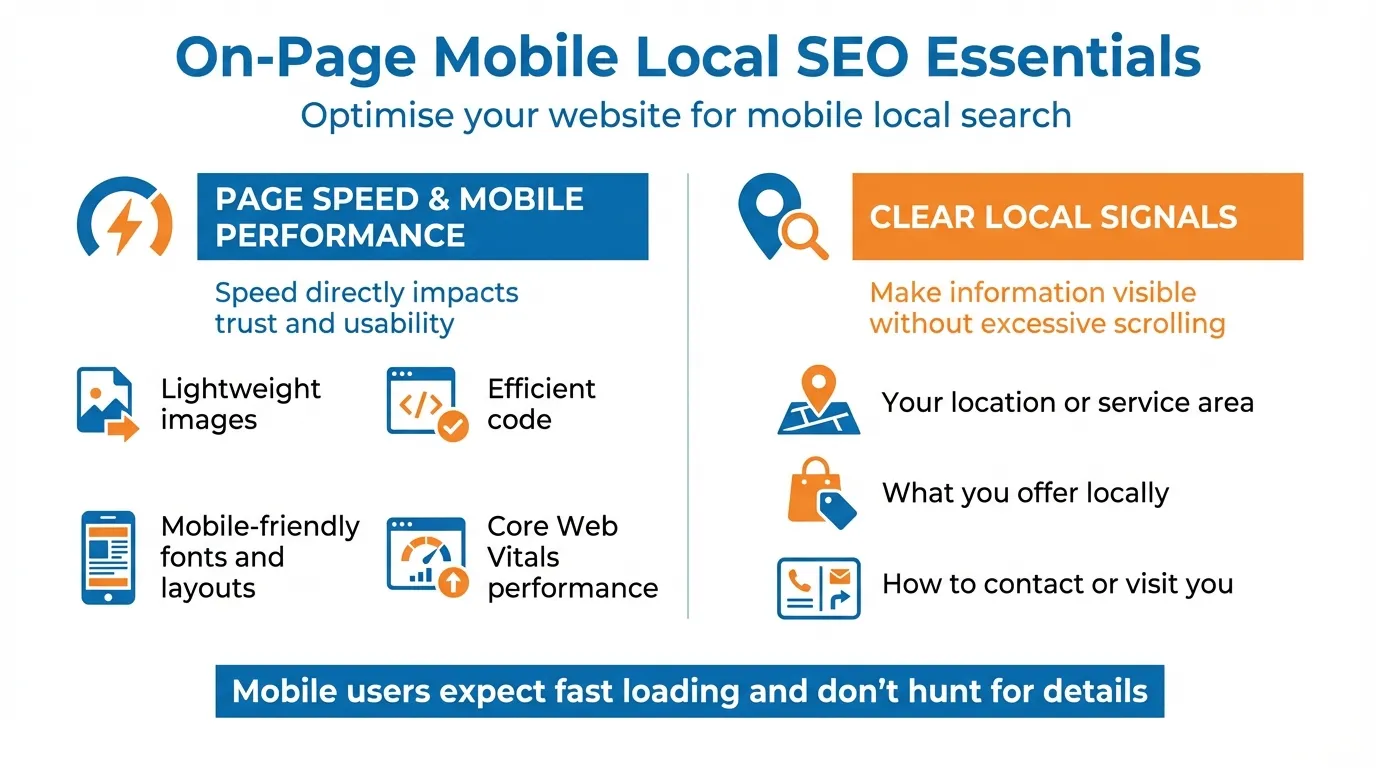
Your website still plays a crucial role, especially when users want more details before deciding.
Page speed and mobile performance
Mobile users in Singapore expect fast loading, even on public transport networks. Slow pages increase bounce rates and reduce local conversions.
Focus on:
- Lightweight images
- Efficient code
- Mobile-friendly fonts and layouts
- Core Web Vitals performance
Speed is not just a technical metric. It directly impacts trust and usability.
Clear local signals on mobile pages
Every key mobile page should clearly communicate:
- Your location or service area
- What you offer locally
- How to contact or visit you
This information should be visible without excessive scrolling. Mobile users do not hunt for details.
Structuring Content for Mobile Local Relevance
Content that works on desktop often needs adjustment for mobile.
Writing for scannability without losing depth
Mobile-friendly does not mean shallow. It means structured.
Use:
- Clear headings that reflect local intent
- Short paragraphs with focused points
- Natural language that mirrors how people search
Local keywords should appear naturally within context, not forced into sentences.
Supporting “near me” and location-based searches
You do not need to repeat “near me” excessively. Google understands proximity. What matters is:
- Consistent NAP information
- Local landmarks and neighbourhood references
- Service area clarity
This helps Google connect your business to relevant mobile searches.
Links still matter for local SEO, but their role is more about trust and relevance than sheer volume. In mobile local search, Google places greater emphasis on whether a business is genuinely connected to its geographic area.
- Community sites’ Links from neighbourhood organisations, community groups, or local event pages signal that your business is part of the local ecosystem. These references help Google associate your brand with a specific area and audience.
- Local publications: Mentions or links from local news outlets, blogs, or city guides add contextual authority. They show that your business is recognised within the local market, which strengthens credibility in mobile local results.
- Industry associations: Links from professional bodies or trade organisations reinforce legitimacy and expertise. For mobile users, this trust signal can indirectly support visibility, especially in regulated or service-based industries.
Together, these local backlinks help reinforce your geographic credibility, making it easier for Google to surface your business in mobile searches where location and trust are decisive factors.
Mobile UX Factors That Influence Local Rankings
User experience signals play a growing role in local visibility.
Tap-friendly design and navigation
Buttons, menus, and contact options must be easy to use on small screens. Frustration leads to abandonment, which sends negative signals.
Reducing friction to action
Make it simple to:
- Call your business
- Get directions
- Submit an enquiry
Each additional step reduces the likelihood of conversion.
Mobile Local SEO Checklist by Business Type
Below is a practical overview of how mobile local SEO priorities differ by business model.
| Business type | Mobile local SEO focus | Why it matters |
| Clinics and healthcare | Clear hours, directions, and reassurance content | Mobile users often search with urgency and need trust signals |
| Restaurants and cafés | Photos, menus, reviews, proximity | Decisions are visual and time-sensitive |
| Home services | Call buttons, service areas, fast pages | Mobile searches often lead to immediate contact |
| Professional services | Credentials, location clarity, and easy enquiries | Users compare quickly before reaching out |
| Retail stores | Inventory hints, directions, and opening hours | Mobile users want to visit nearby locations |
Measuring Mobile Local SEO Success Properly
Traditional ranking reports are not enough.
Metrics that actually matter focus on the following:
- Mobile impressions and clicks in Search Console
- Actions on Google Business Profile
- Calls, direction requests, and form submissions
- Engagement on mobile pages
These metrics reflect real-world outcomes, not just visibility.
Mobile local rankings can vary by location, device, and time. This is normal. Success is about consistent presence where your audience searches, not chasing a single static position.
Mobile Local SEO Services in Singapore That Drive Real-World Results
Mobile local SEO is not about chasing trends. It is about aligning your digital presence with how people actually search and decide in Singapore. Businesses that treat mobile as secondary often struggle to convert traffic into real enquiries.
At MediaOne, we approach mobile local SEO by looking at user behaviour first and algorithms second. Our work focuses on clarity, speed, and relevance across mobile touchpoints so that local visibility translates into real outcomes, not just impressions.
If your business depends on local customers, mobile optimisation is no longer optional. It is foundational. Contact us today!
Frequently Asked Questions About Mobile Local SEO
Does mobile local SEO work differently for service-area businesses without a physical storefront?
Yes. Service-area businesses rely more on service area definitions, local content relevance, and strong Google Business Profile optimisation rather than walk-in signals. Mobile users still expect clear coverage areas and easy contact options.
How long does it take to see results from mobile local SEO improvements?
Some changes, such as page speed and profile updates, can improve engagement quickly. Ranking and visibility improvements typically take weeks to months, depending on competition and consistency.
Is mobile local SEO still important if most of my traffic comes from desktop?
Yes. Mobile local searches often represent high-intent users who are ready to act. Even if desktop traffic is higher overall, mobile users frequently convert faster.
Can paid ads replace mobile local SEO?
Paid ads can support visibility, but they do not replace organic local presence. Many mobile users trust organic local results and maps more than ads, especially for local services.
How often should I update my Google Business Profile for mobile relevance?
Regular updates help. Posting new photos, responding to reviews, and updating information monthly or when changes occur keeps your profile relevant and trustworthy for mobile users.