
Let us be honest for a moment: we have all ignored a search result because the little snippet of text beneath the blue link looked completely irrelevant. Perhaps it was cut off mid-sentence, or maybe it was just a random jumble of keywords that made no sense.
That little snippet is the meta description, and despite what you might have heard about it losing its ranking power, it remains one of the most critical elements of your SEO strategy. This is why any experienced SEO agency pays close attention to crafting meta descriptions that attract clicks and accurately reflect the page content.
Think of your meta description as your shop window. Just as a poorly dressed window display might deter customers from entering a shop on the high street, a poorly written meta description stops users from clicking through to your website.
In this guide, we are going to explore exactly how to craft compelling descriptions that boost your Click-Through Rate (CTR) and signal to search engines that your content is valuable.
Key Takeaways
- Go to Google Search Console, find your top 10 pages by impressions, and rewrite their meta descriptions to try to boost CTR.
- Don’t reinvent the wheel. Use the templates provided above to speed up your workflow.
- Always verify how your description looks on a mobile screen, since most searches happen there in 2026.
- If a description isn’t working, change it. Test different calls to action and see what your audience responds to.
Why Meta Description SEO Matters in 2026
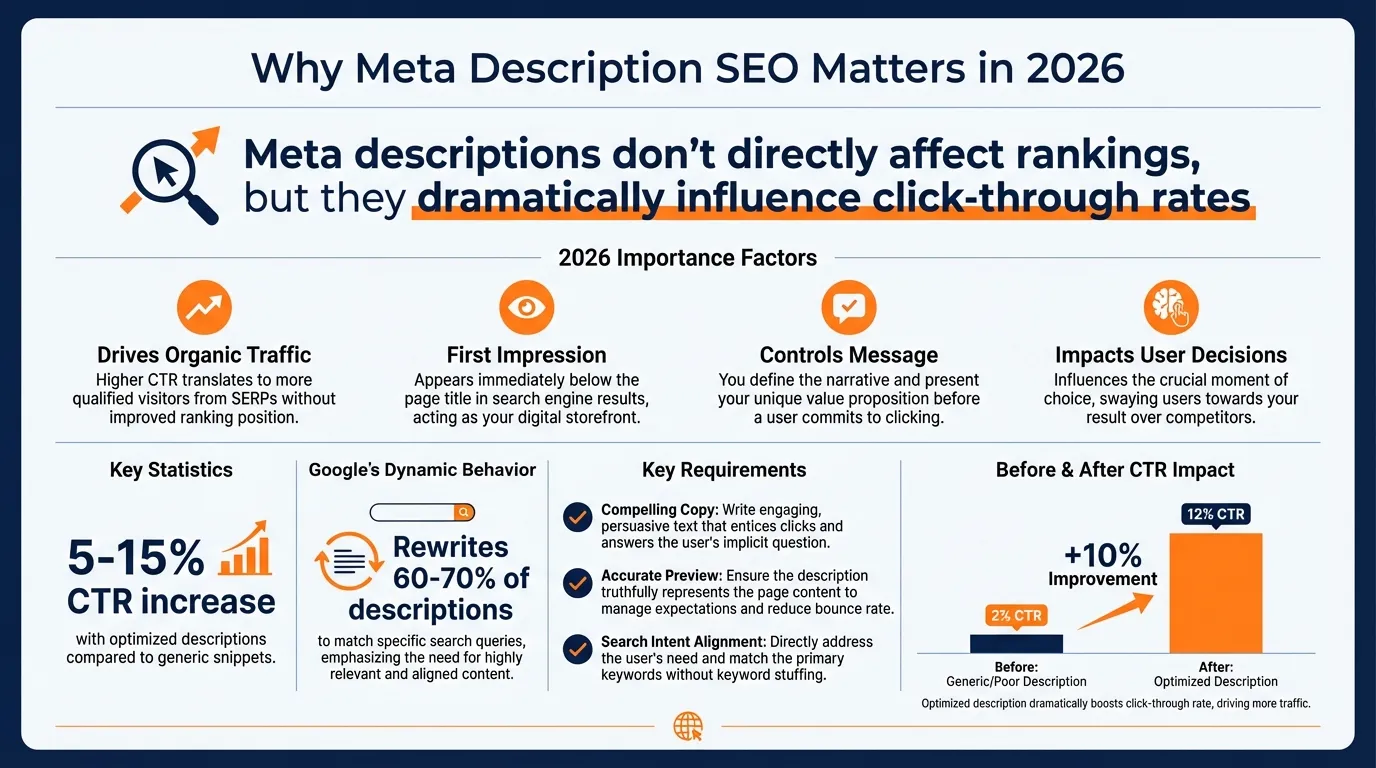
We are now in 2026, and the digital landscape has evolved significantly. AI overviews and zero-click searches are more prevalent than ever. You might be wondering, “Does Google even use my meta description anymore?” The answer is a resounding yes,but with caveats.
Technically speaking, Google has stated for years that meta descriptions are not a direct ranking factor. You could write the most poetic, keyword-optimised description in history, and it would not directly push you from position five to position one. However, user behaviour is a massive ranking signal. This is where the magic happens.
When an SEO company in Singapore analyses website performance, they look closely at CTR. If your page ranks third but gets more clicks than the page in the first position because your description is more enticing, search engines take note. A high CTR suggests your content is highly relevant, which can eventually lead to better rankings.
The Meta Description “Snippet” Battle
In 2026, the battle for attention is fierce. Search Engine Results Pages (SERPs) are crowded with ads, featured snippets, and video carousels. Your organic listing needs to work harder. A well-crafted meta description helps you stand out in this noise.
Furthermore, social media platforms often pull this text when your link is shared. So, it is not just for Google; it is for Facebook, LinkedIn, and X (formerly Twitter) too.
Manual Meta Description vs Google Auto-Generated Snippet → CTR Comparison
Here’s a quick mini table so you can visualise it better:
| Meta Description Type | Example | Average CTR* |
| Manual (Optimised by You) | Concise, keyword-rich, enticing | 25–35% |
| Google Auto-Generated | Extracted from page content | 10–15% |
- Featured snippets can drastically reduce clicks to your page because the answer appears directly in search results.
- Zero-click searches are rising: many users get the information they need without ever visiting a site. This makes your meta description even more important; it’s often your chance to hook readers and earn social shares or clicks from other channels.
CTR ranges based on aggregated SEO industry data, 2025–2026.
Best Practices for Writing Effective Meta Descriptions
If you want to write meta descriptions that actually convert browsers into visitors, you cannot simply stuff keywords into a tag and hope for the best. It requires a blend of copywriting psychology and technical SEO knowledge.
1. The Ideal Character Count
This is the most common question. The standard advice remains: aim for 150-160 characters.
Anything longer, and Google will truncate it with an ellipsis (…), which can look unprofessional and cut off your call to action. Anything too short (under 50 characters), and search engines might deem it too thin and replace it with random text from your page.
Pro Tip: On mobile devices, the limit is often shorter, around 120 characters. Ensure your most vital information and keywords appear early in the sentence.
2. Strategic Keyword Placement & Bolded SERP Highlights
While keywords in your meta description don’t directly affect rankings, they play a role in drawing user attention. Google bolds words or phrases in the snippet that exactly match the user’s search query. This visual cue signals relevance and increases the likelihood of a click.
Why it matters: Users scan search results. Bolded keywords act as a visual magnet, confirming that your page contains what they are looking for.
Examples:
- Search query: best hiking shoes
- Discover the best hiking shoes for every terrain and budget.
- Search query: vegan chocolate cake recipe
- Learn how to make a rich vegan chocolate cake in just 30 minutes.
- Search query: affordable SEO tools
- Compare the top affordable SEO tools to boost your website performance.
Pro Tips:
- Place the most important keywords near the start of the description so they appear even if the snippet is truncated.
- Keep the phrasing natural and conversational. Google only bolds exact matches, so awkward keyword stuffing doesn’t help.
- Combine bolded keywords with a clear CTA for maximum CTR impact.
3. Active Voice and Actionable Language
Avoid passive language. You want to inspire action. Start with strong verbs like “Discover,” “Learn,” “Shop,” or “Grab.” Instead of saying, “This article is about how to bake a cake,” try “Learn how to bake the perfect sponge cake in just three simple steps.”
4. Include a Call to Action (CTA)
Treat your meta description like a mini-advertisement. What do you want the user to do? “Read more,” “Get your free quote,” or “Shop the collection today” are classic examples. Giving the user an explicit instruction increases the likelihood of a click.
5. Be Unique
Duplicate meta descriptions are a wasted opportunity. Every page on your site, whether it is a blog post, a product page, or your contact page, needs a unique description. If you use the same description across multiple pages, Google will likely ignore all of them.
6. AI-Friendly, Natural Language Phrasing
AI-friendly phrasing refers to writing meta descriptions in a way that is both human-readable and easily interpreted by AI, including the large language models (LLMs) that power search engines and features like featured snippets. The goal is to communicate the page’s content clearly, naturally, and contextually, so search engines can accurately display your snippet rather than auto-generating one from random page text.
Writing this way also improves user experience: readers quickly understand what your page offers, and AI systems can better match your content to relevant queries.
Practical Tips:
- Use complete, conversational sentences rather than awkward keyword strings.
- Avoid repetition or forced phrasing. For example:
❌ Buy cheap running shoes online, best running shoes sale
✅ Find top-quality running shoes at prices that won’t slow you down. - Clear, natural language increases the chance of your content appearing in featured snippets and improves overall snippet readability.
7. Intent-Specific Calls-to-Action (CTA)
An intent-specific call-to-action (CTA) is a prompt in your meta description that aligns with the searcher’s goal or intent. Users search for different reasons; some are looking for information, others are ready to buy, and some are comparing options.
By tailoring your CTA to match that intent, you make it clear that your page will satisfy their need, which boosts click-through rates (CTR) and engagement.
Examples by Intent:
| Intent Type | Example CTA |
|---|---|
| Informational | Learn, Discover, Explore |
| Transactional | Buy Now, Shop Today, Get Your Quote |
| Commercial | Compare, Review, See Deals |
Always place the CTA naturally within the description. A well-matched CTA signals value to both users and search engines, increasing the likelihood that someone clicks on your listing rather than skipping to another result.
Common Meta Description SEO Mistakes to Avoid

Even seasoned marketers can slip up when crafting meta descriptions. Avoiding these pitfalls will help ensure your descriptions improve SEO indirectly:
- Keyword Stuffing: “Buy shoes, cheap shoes, best shoes UK, red shoes.” Stuffing keywords makes your description look spammy and unreadable. Search engines may ignore it, and users will scroll past. Write for humans first, naturally including key terms where they make sense, rather than forcing repetition.
| Before (Keyword Stuffing) | After (Improved, Natural Language) |
| Buy shoes, cheap shoes, best shoes UK, red shoes. | Find top-quality running shoes in the UK that combine comfort, style, and great value. |
- Being Boring: “This page contains information about our services.” Generic descriptions fail to capture attention. Users need a reason to click, so focus on benefits or unique value. Think of your meta description as a mini-ad, if it doesn’t spark curiosity or highlight value, it won’t drive traffic.
| Before (Boring) | After (Improved, Engaging) |
| This page contains information about our services. | Discover our expert digital marketing services designed to help your business grow faster and reach more customers. |
- False Promises: Claiming a free download or exclusive offer that doesn’t exist.
When users click and realise the content doesn’t match the description, they bounce immediately, a behaviour known as “pogo-sticking.”
This not only frustrates users but signals low relevance to search engines, hurting your SEO performance over time. Always ensure your description accurately reflects the content.
| Before (False Promise) | After (Accurate & Clear) |
| Download our free eBook now! | Learn actionable SEO strategies with our step-by-step guide. |
- Ignoring the Brand: For homepages, landing pages, or high-traffic pages, including your brand name at the end can reinforce authority and recognition. Even if space is limited, a subtle brand mention can increase trust and help users remember your company in crowded search results.
| Before (No Brand) | After (Brand Included) |
| Best coffee shop in town. | Experience award-winning coffee at BrewHouse, your neighbourhood café. |
- Missing a Call to Action (CTA) (optional addition for completeness: Failing to include a CTA leaves users unsure of the next step. Simple actions like “Read more,” “Shop now,” or “Get a free quote” guide users and increase CTR. A description without direction is a missed opportunity to turn searchers into visitors.
| Before (No CTA) | After (With CTA) |
| Explore our blog for tips and tricks. | Read our expert tips on running shoes and find your perfect fit today. |
- AI & Voice Search Consideration: Misleading or inaccurate meta descriptions don’t just frustrate human users; they also hurt AI-generated snippets and voice search accuracy.
Large language models (LLMs) and virtual assistants rely on your meta description to summarise your page content. If the description is vague, spammy, or false, AI may:
- Generate incorrect or irrelevant featured snippets.
- Provide misleading answers in voice search results.
- Reduce user trust, causing lower engagement and higher bounce rates.
Writing clear, truthful, and contextually rich meta descriptions ensures both humans and AI understand your page, improving CTR, snippet accuracy, and voice search performance.
Comprehensive Meta Description Templates for Different Page Types
Staring at a blinking cursor can be daunting. To help you write meta descriptions faster, we have created these fill-in-the-blank templates. Feel free to adapt them to your specific tone of voice.
1. The Homepage Template
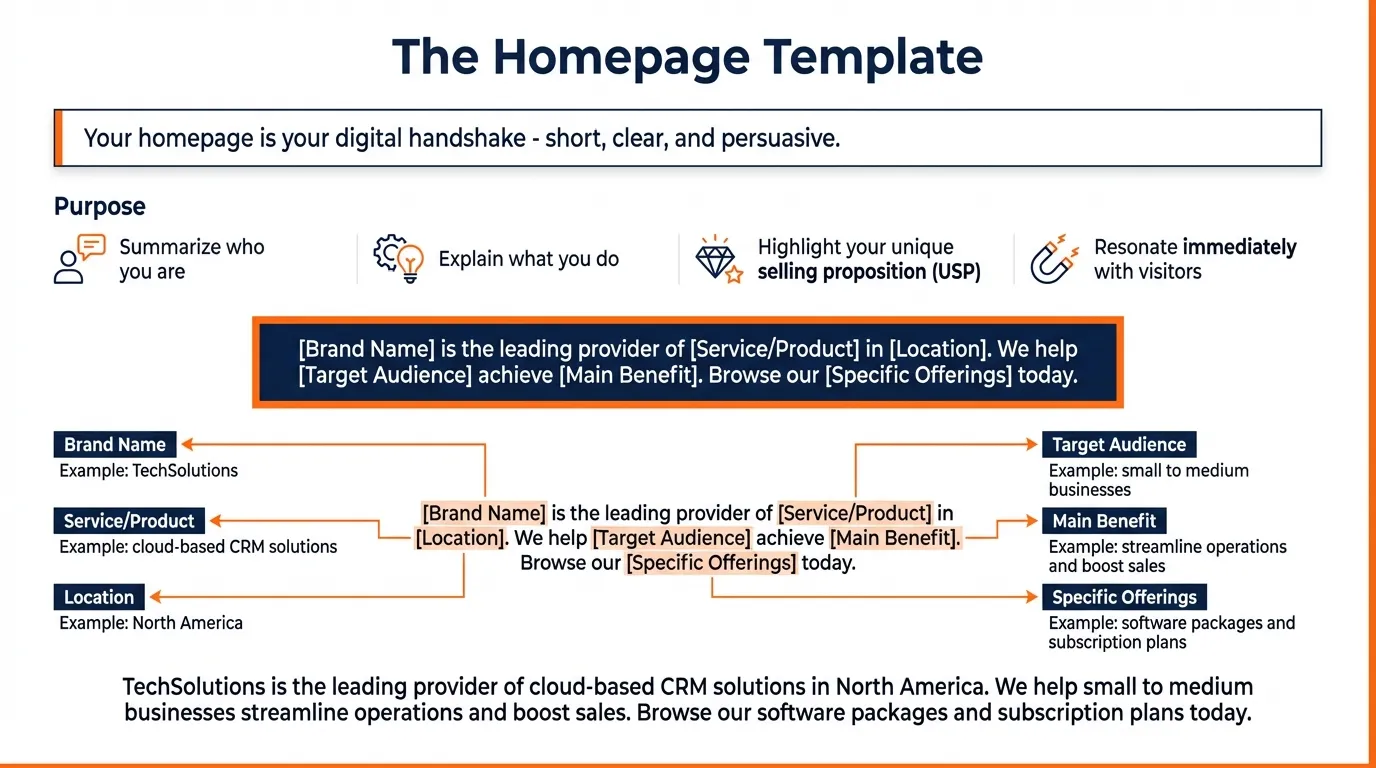
Your homepage is the face of your business. It needs to summarise who you are, what you do, and your unique selling proposition (USP) in a way that immediately resonates with visitors. Think of it as your digital handshake, short, clear, and persuasive.
Template: [Brand Name] is the leading provider of [Service/Product] in [Location]. We help [Target Audience] achieve [Main Benefit]. Browse our [Specific Offerings] today.
Example: MediaOne is the leading provider of digital marketing services in Singapore. We help businesses achieve explosive growth with SEO and SEM. Get a free audit today.
Tips:
- Include your brand name to reinforce recognition.
- Highlight a primary benefit or differentiator to stand out.
- End with a soft CTA that invites exploration.
2. The Product Page Template

Product pages are transactional. Users are already considering a purchase. Your meta description should highlight the product’s key features, benefits, and any offers that make buying easier.
Template: Looking for the best [Product Name]? Our [Product] features [Key Feature 1] and [Key Feature 2] for [Benefit]. Shop now for free delivery on orders over [Amount].
Example: Looking for the best noise-cancelling headphones? Our SonicPro 500s feature 30 hours of battery life and deep bass. Shop now for free delivery on orders over £50.
Tips:
- Lead with the product name and benefit for instant relevance.
- Include offers, discounts, or shipping perks to drive clicks.
- Keep descriptions action-oriented, encourage users to buy or explore.
3. The Blog Post Template

Blog readers are seeking answers or insights. The meta description should promise a solution, provoke curiosity, or suggest actionable value.
Template: Struggling with [Problem]? Discover [Number] proven ways to [Solution] in this comprehensive guide. Read more to master [Topic] today!
Example: Struggling with low website traffic? Discover 10 proven ways to boost your organic reach in this comprehensive guide. Read more to master SEO today! You can also read our SEO trends blog to gain more insights.
Tips:
- Ask a question or address a pain point to hook the reader.
- Use numbers or lists to signal digestible, actionable content.
- Emphasise results or benefits rather than just topics.
4. The Service Page Template

Service pages target users ready to hire or inquire. Focus on establishing credibility and reliability, and on a clear next step.
Template: Need a professional [Service Name]? Our expert team offers reliable [Service] for [Target Audience]. [USP/Award]. Contact us for a free consultation.
Example: Need professional plumbing in London? Our expert team offers reliable 24/7 repairs for homeowners. Gas Safe registered. Contact us for a free quote now.
Tips:
- Highlight credentials, certifications, or awards to build trust.
- Include a CTA that is easy to act on (call, book, or request a quote).
- Specify your target audience for relevance.
5. The About Us Page Template
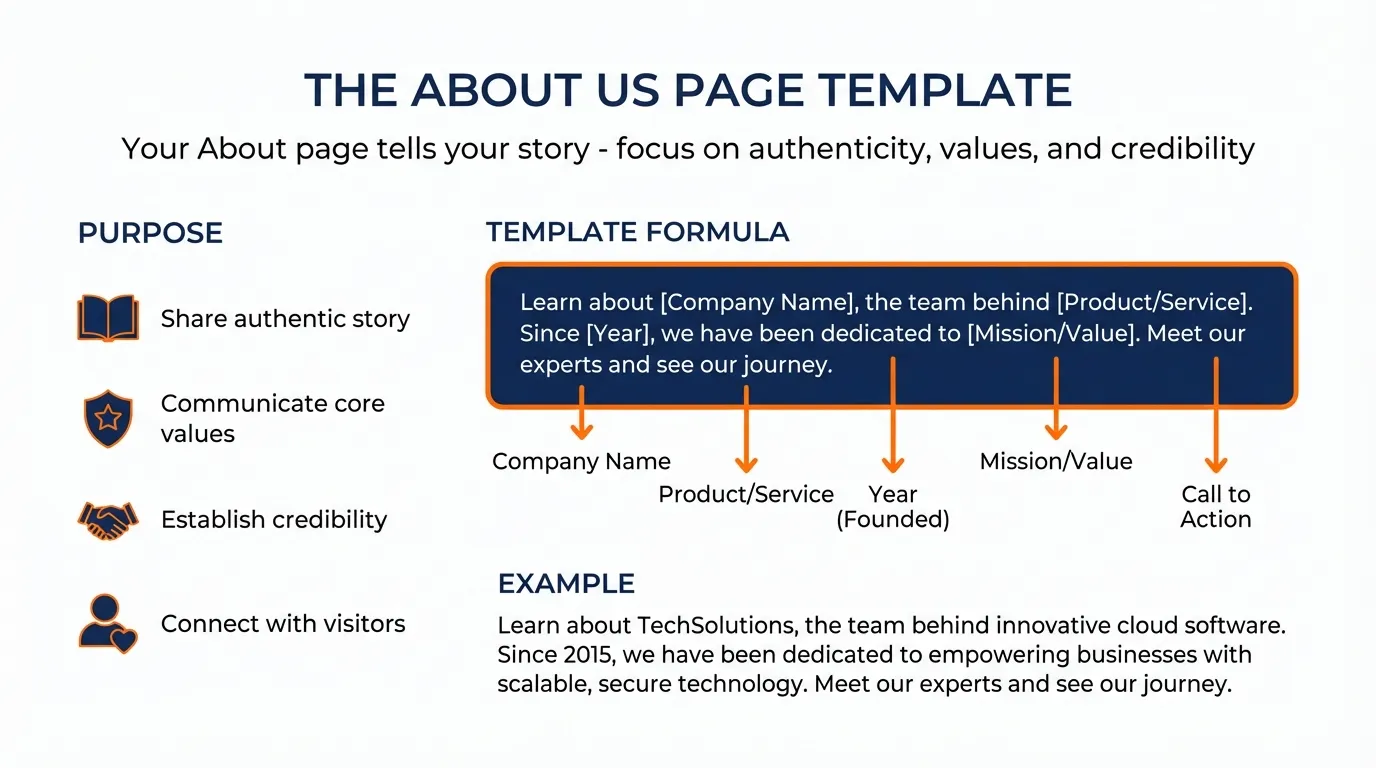
Your About page tells your story. Focus on authenticity, values, and credibility to connect with visitors.
Template: Learn about [Company Name], the team behind [Product/Service]. Since [Year], we have been dedicated to [Mission/Value]. Meet our experts and see our journey.
Example: Learn about GreenLeaf, the team behind sustainable packaging. Since 2010, we have been dedicated to reducing plastic waste. Meet our experts and join our mission.
Tips:
- Highlight your history, mission, or impact to create emotional resonance.
- Keep descriptions human-centric, mentioning the team or community.
- Encourage further exploration, like reading your story or meeting the team.
Always front-load important keywords and benefits. While Google may not directly rank pages based on meta descriptions, they do strongly influence click-through rates, which, in turn, affect SEO performance. Test variations over time to see what resonates best with your audience.
How to Optimise Meta Descriptions for Different Platforms
While Google is the giant, it is not the only player. If you are using comprehensive digital marketing services, you need to think about how these descriptions appear elsewhere.
Social Media (Open Graph Tags)
Facebook, LinkedIn, and Pinterest use the Open Graph (OG) protocol to determine how shared links appear. If no specific OG description is set, these platforms will default to your standard meta description, but this isn’t always ideal.
- Length and tone: Social users are in a browsing, casual mindset, so that OG descriptions can be slightly longer than SEO meta descriptions and more playful or conversational.
- Engagement hooks: Use action-oriented language, questions, or emojis to catch attention in crowded feeds. For example, “ Discover the headphones pros swear by, 30 hours of battery life awaits!”
- Consistency: While you can adapt your tone for social, the description should still accurately reflect the content to avoid clickbait or disappointment.
Twitter Cards (X)
Twitter uses “Twitter Cards” to format shared links with a title, image, and description. Unlike OG, these require specific tags in your CMS to control what text appears.
- Summary Card vs. Summary Card with Large Image: Choose the card type based on your goal; large-image cards drive visual engagement, while standard summary cards are better for content-heavy links.
- Character limits: Twitter Cards display roughly 200 characters in feeds, so keep your description concise and front-load key information.
- Testing previews: Use the Twitter Card Validator to check how your description, title, and image appear before publishing.
Other Considerations
- LinkedIn: More professional tone; highlight expertise or benefits.
- Pinterest: Focus on lifestyle, inspiration, or visual hooks.
- Meta vs. social copy: While your SEO meta description targets CTR in search results, social descriptions aim to maximise engagement, shares, and link clicks.
Optimising meta descriptions for multiple platforms ensures that your content isn’t just discoverable, it’s clickable, shareable, and aligned with user intent across the digital ecosystem.
| Platform / Use Case | Tone & Style | Length / Limits | Key Focus | Engagement vs CTR |
| SEO (Google) | Informative, concise, human-readable | 150–160 characters (desktop), ~120 (mobile) | Drive clicks from search results | Focus on CTR; high accuracy helps AI snippets and voice search |
| Twitter (X) Cards | Snappy, concise, attention-grabbing | ~200 characters | Visual or text-based engagement | Engagement & shares; front-loading key info boosts visibility in feeds and AI recommendations |
| Professional, authoritative | 150–200 characters | Highlight expertise and business value | Engagement (comments, shares, clicks) rather than immediate CTR |
Optimising meta descriptions for each platform balances click-through and engagement. On search, meta descriptions are designed to maximise clicks. On social and AI-driven feeds, engaging language, clear context, and visual hooks drive shares and interactions.
Meta Descriptions Are The Small Text with Big Impact
In the vast world of SEO, it is easy to get lost in technical audits and backlink strategies. However, meta description SEO remains one of the most accessible and effective ways to improve your site’s performance. It is a low-hanging fruit.
By writing unique, persuasive, and keyword-rich descriptions for your pages, you are improving your sales pitch to every person who searches for what you offer. Remember the golden rules: keep it under 160 characters, include a call to action, and match the search intent.
Whether you are a business owner doing it yourself or working with MediaOne, treating your meta descriptions with care is a hallmark of a professional, user-focused digital strategy. Contact us today!
Frequently Asked Questions
Should meta descriptions be different for informational vs transactional pages?
Yes. Informational pages (like blogs or guides) should focus on answering a question or offering a valuable insight. In contrast, transactional pages should emphasise value, trust signals, and next steps (such as pricing, availability, or consultations). Matching the description to search intent improves CTR and reduces bounce rates.
How often should meta descriptions be updated?
There is no fixed schedule, but meta descriptions should be reviewed whenever search intent shifts, CTR drops, or content is refreshed. As a general rule, re-evaluate high-impression pages every 3–6 months using Google Search Console performance data.
Can emojis be used in meta descriptions?
Emojis can appear in meta descriptions, but results are inconsistent. Google may strip or ignore them, and overuse can reduce perceived credibility in professional or B2B niches. Emojis are generally more effective in Open Graph or social descriptions than in organic SERPs.
Do meta descriptions affect voice search or AI-generated answers?
Indirectly, yes. While voice assistants and AI overviews do not read meta descriptions verbatim, well-written descriptions often reinforce page relevance and summarisation quality.
Clear, concise descriptions aligned with on-page content make it easier for AI systems to understand page intent.
What happens if I leave the meta description blank?
If no meta description is provided, Google will automatically generate one from the page content. While this can work for some queries, it removes your control over messaging and CTAs. Manually written descriptions almost always perform better for high-value landing pages.