| AI Summary
LinkedIn Learning offers video courses for business, technology and creative skills. Its value depends on course relevance, practice time and the outcome a learner needs. Singapore readers should consider NLB access before paying for a personal subscription. Ordinary completion certificates differ from assessed professional certificates and formal qualifications. A short learning plan helps professionals judge whether the platform supports their work. |
A LinkedIn Learning review should answer a practical question: will the platform help you do something you currently struggle with? A large course library sounds attractive, but a subscription earns its place when the lessons support a task you need to complete.

For Singapore professionals, there is another question before price: do you need to pay at all? NLB provides access for its patrons, while some employers provide organisational accounts.
LinkedIn Learning can suit someone refreshing spreadsheet skills, preparing a presentation or exploring a new role. Someone who needs personal coaching, a formal qualification or supervised technical work may need another form of training.
The decision becomes easier when you separate three things: access to lessons, evidence of learning and the ability to apply it. Those benefits can overlap, but they are different purchases.
Key Takeaways
- A course’s chapter list reveals more than its title. The task you need should appear in the actual lessons.
- Video duration leaves out practice, troubleshooting and revision. A two-hour course can require several study sessions.
- Course age needs context. Software demonstrations can become dated faster than lessons on communication.
- Annual billing deserves a usage calculation. Months without study still contribute to the total cost.
- A work sample helps explain a completed course during an interview or performance review.
Key Takeaways
Is LinkedIn Learning worth it? LinkedIn Learning can be worth paying for when a relevant course addresses an immediate work need and the learner has time to practise. NLB patrons should consider library access first. Learners seeking a particular qualification need to examine the credential and assessment requirements separately.
How This LinkedIn Learning Review Was Prepared
This review examines LinkedIn’s published product information, subscription guidance and certificate rules, alongside NLB’s access information. It focuses on professionals deciding whether to spend their own money or study through an existing account.
The assessment considers course relevance, teaching format, time commitment, practice opportunities and credential value. It does not assign a numerical score or claim that every course delivers the same experience.
Public documentation supports the feature descriptions. The examples and decision checks explain how readers can assess value for themselves; they are not results from a learner survey or a hands-on test of the entire catalogue.

What LinkedIn Learning Offers
LinkedIn Learning is an online platform with courses across business, technology and creative subjects. Its format centres on recorded teaching that learners can start, pause and revisit around other commitments.
Videos, Courses and Learning Paths
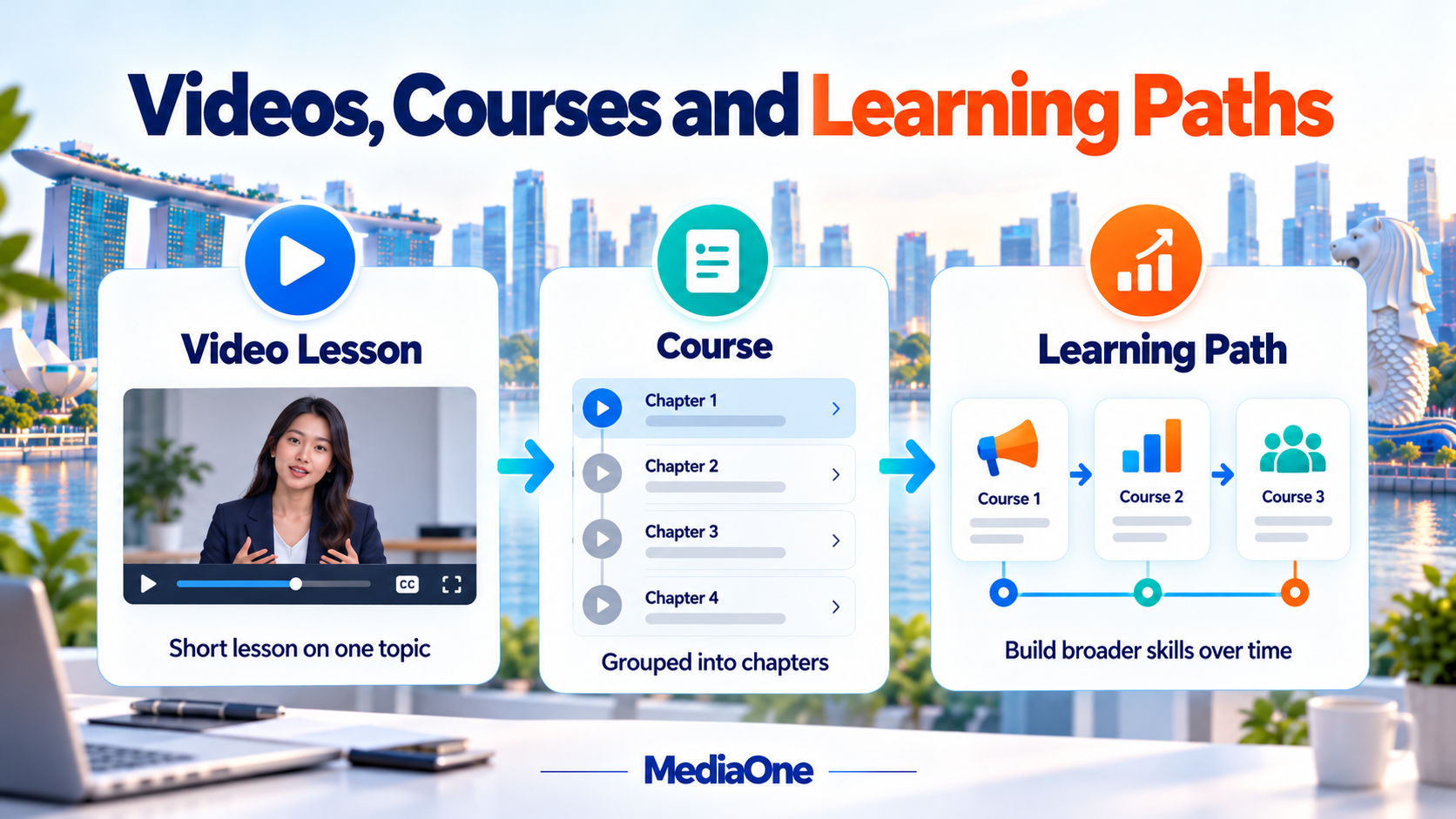
An individual video covers part of a topic. A course groups videos into chapters, while a sequence of related courses covers a broader subject or role.
A learner who needs one spreadsheet function may need only a short lesson. Someone moving into a management role may benefit from a sequence covering delegation, feedback and team communication.
LinkedIn’s individual learner features include learning history, notes, exercise files and quizzes. Availability depends on the content, so a learner should inspect the course resources before planning around them.
Where the Format Helps
Recorded lessons suit work that can be broken into steps. A learner can watch a demonstration, pause it and repeat the process in their own software.
The same format can introduce unfamiliar subjects before a larger training commitment. An introductory analytics course, for example, can help someone understand whether they enjoy working with data.
The platform’s breadth also supports professionals whose responsibilities cross departments. A small business manager may need basic knowledge of budgets, presentations and marketing without pursuing a separate qualification in each subject.
Where Independent Learning Becomes Harder
Recorded teaching cannot automatically diagnose why your spreadsheet returns the wrong result or why your presentation loses an audience. Some difficulties require someone to inspect your work and respond to your specific decisions.
Self-paced learning also leaves the schedule with you. A course remains available during a busy week, but availability alone does not create study time.
How to Judge Course Quality and Depth
LinkedIn Learning’s catalogue is broad, but the individual course should determine the purchase. A platform name cannot tell you whether an instructor explains your problem at the right level.
Course Titles Need a Chapter Check
A title such as “Marketing Analytics” may describe an introduction to measurement or a detailed software demonstration. Those courses serve different needs.
The chapter list should show the task you want to learn, the tools involved and any assumed knowledge. A preview can reveal whether the instructor explains why a step works or simply moves through menus.
For someone considering digital marketing courses in Singapore, that distinction helps separate an introduction from training that supports daily responsibilities.
Course Dates Need Context
Recent content deserves attention when a subject depends on software screens, reporting features or platform rules. An outdated interface can make a demonstration difficult to follow even when the underlying concept remains valid.
Publication dates tell a different story for communication, negotiation or meeting preparation. An older lesson can still explain a durable technique well.
The stronger check combines the date, syllabus and preview. A recent date does not guarantee depth, and an older date does not automatically make a course unusable.
Local Examples and Workplace Context
A global course can explain a method without covering every condition in a Singapore workplace. A sales example might use another currency, customer group or reporting period.
The learner can adapt the exercise by changing those inputs and explaining why. A presentation lesson, for example, can become a short update for their own team, with the right audience and business purpose.
Company procedures still govern how the finished work is used. A course demonstration does not establish permission to change a live advertising account or publish customer information. A practice environment lets the learner explore the method before applying it at work.
Practice Resources Need Inspection
Exercise files can turn a demonstration into something you can repeat. A dataset, presentation template or workbook gives the learner a starting point for trying the method independently.
A course with quizzes can check understanding, but remembering an answer differs from completing a task. Someone may identify the right reporting term and still struggle to explain a campaign’s results.
For marketing learners, a small practice assignment can expose that gap. A sample campaign brief might ask which audience to reach, which channel to use and how success will be measured. The connections between those decisions form the basis of digital marketing strategies.
The course should support the level of work you intend to attempt. Advanced learners need evidence of depth in the syllabus, not a broad claim that an entire platform is introductory or advanced.
LinkedIn Learning Costs and Access in Singapore
LinkedIn Learning has several access routes. The amount a reader needs to spend depends on the account already available and whether extra subscription features have value.
NLB Access Before a Personal Subscription
NLB’s LinkedIn Learning information states that its patrons can access the training videos without a course charge. Access is available from home and at libraries, and a LinkedIn profile is not required.
The NLB access guide covers desktop access, NLB Mobile and the LinkedIn Learning app. It explains the library sign-in process using myLibrary details.
Library access has differences worth understanding. NLB says its learning account remains separate from personal and corporate accounts, with no synchronisation between them. Its certificates also do not include patrons’ names.
Those differences can influence the decision when a learner needs a named completion record or wants learning activity associated with another account. Someone mainly seeking lessons may find library access sufficient.
Personal and Employer Access
LinkedIn’s subscription overview describes personal access through LinkedIn Premium and organisational access through an employer or another institution. It also states that individual courses are not available as one-off purchases.
A reader with Premium should examine the Learning access already included before buying anything else. An employee should also establish whether their organisation provides an account.
For a new personal purchase, the relevant price is the offer shown to that account in Singapore. The currency, billing interval, total charge and included features all affect the comparison. A US dollar price from another review does not establish the Singapore cost.
Monthly Versus Annual Billing
Monthly billing can limit the commitment for a short learning project. Annual billing needs a longer calculation because an attractive monthly equivalent may require payment for the whole year.
| Access option | Main cost consideration | Important limitation |
| NLB access | No course charge under NLB’s subscription | Separate account and unnamed certificates |
| Employer access | Organisation provides the licence | Access depends on the organisation’s arrangements |
| Personal monthly billing | Recurring charge shown at checkout | Unused months still cost money |
| Personal annual billing | Total annual payment | Advertised monthly equivalent is not the upfront total |
Premium includes benefits beyond Learning. Someone who also needs those features can consider their value separately. Someone buying solely for courses should judge the entire subscription cost against the learning they expect to complete.
How Study Hours Affect Subscription Value
The subscription fee becomes easier to assess when you compare it with actual use. A large library offers little financial value during months when you never open it.
One starting measure is:
Cost per completed video hour = subscription charge for the period ÷ video hours completed during that period.
The following example uses an invented monthly charge of S$40 to explain the calculation. It is not LinkedIn’s quoted Singapore price.
| Video hours completed in one month | Illustrative cost per video hour |
| 2 hours | S$20 |
| 5 hours | S$8 |
| 10 hours | S$4 |
That calculation measures usage, not skill. Ten hours of passive watching can produce less progress than two hours followed by a demanding exercise.
A second record should capture what you produced: a working spreadsheet, a presentation, a report or a documented process. That output gives the hours a purpose.
For annual billing, the same calculation should use the annual charge and the hours completed across the year. Calculating only the months you studied hides the cost of inactive periods.
Practice time belongs in the schedule even though it is excluded from this video-hour formula. Pauses, repeated attempts and troubleshooting can take longer than the lesson itself.
A Learning Goal in Practice
Consider an office executive who spends each month copying sales figures into a report. The immediate goal is to create a spreadsheet that summarises the figures without repeating every manual step.
A suitable course would need to cover the relevant spreadsheet functions and explain how to check the result. A general introduction to data careers would address a different need, even if its title sounded relevant.
The executive could begin with a dummy file containing dates, products and sales amounts. After studying the relevant chapters, the next task would be to build the report from a fresh copy of that file.
The result needs checks: do the totals match the source, do new rows appear correctly, and can the executive explain the calculation? A colleague could review the report without needing to watch the course.
That example gives the subscription a testable purpose. It also reveals additional needs. A learner who understands the lesson but cannot troubleshoot errors may need more practice or personal feedback. A learner who completes the task may have no immediate reason to renew.

Five Checks Before Paying
A short decision check connects the platform to your own situation. Each point should produce a specific answer before a subscription becomes another recurring expense.
1. The Task You Need to Complete
A goal such as “learn marketing” leaves too much open. “Prepare a monthly campaign report” gives the course search a defined purpose.
Recent digital marketing job descriptions can also help a career changer identify the responsibilities behind a job title. A course should address a responsibility the learner actually wants to take on.
2. The Course That Covers That Task
A relevant course should explain the required process at a level you can follow. Missing prerequisites can turn a short lesson into several weeks of additional study.
A preview that feels too basic or too advanced gives you information before purchase. The course title alone cannot make that judgement.
3. The Time Available for Learning and Practice
A realistic schedule might include one evening for instruction and another for applying it. A calendar full of deadlines requires a smaller commitment.
The budget should reflect an ordinary working week. A plan based on an unusually quiet weekend can overstate how much learning you will sustain.
4. The Tools or Materials Required
A course may demonstrate software that needs a separate licence, a suitable computer or access to a dataset. Those requirements can change the total cost.
The learner also needs permission to use any workplace information involved. Dummy data can support practice when a real customer file is unsuitable.
5. The Result You Can Show
A result should demonstrate the skill in a form another person can understand. For a future content marketing manager, that could be an editorial plan explaining the audience, article topics and measurement approach.

These checks are a planning aid, not a validated scoring system. A missing requirement deserves attention, especially when it prevents you from completing the intended task.
How to Evaluate a Free Trial
LinkedIn’s Premium trial terms explain that eligibility and duration can vary. A trial normally converts to paid billing unless cancelled before it ends.
The offer displayed to the account should determine the schedule. A calendar reminder can follow the actual renewal date without assuming every trial lasts the same length.
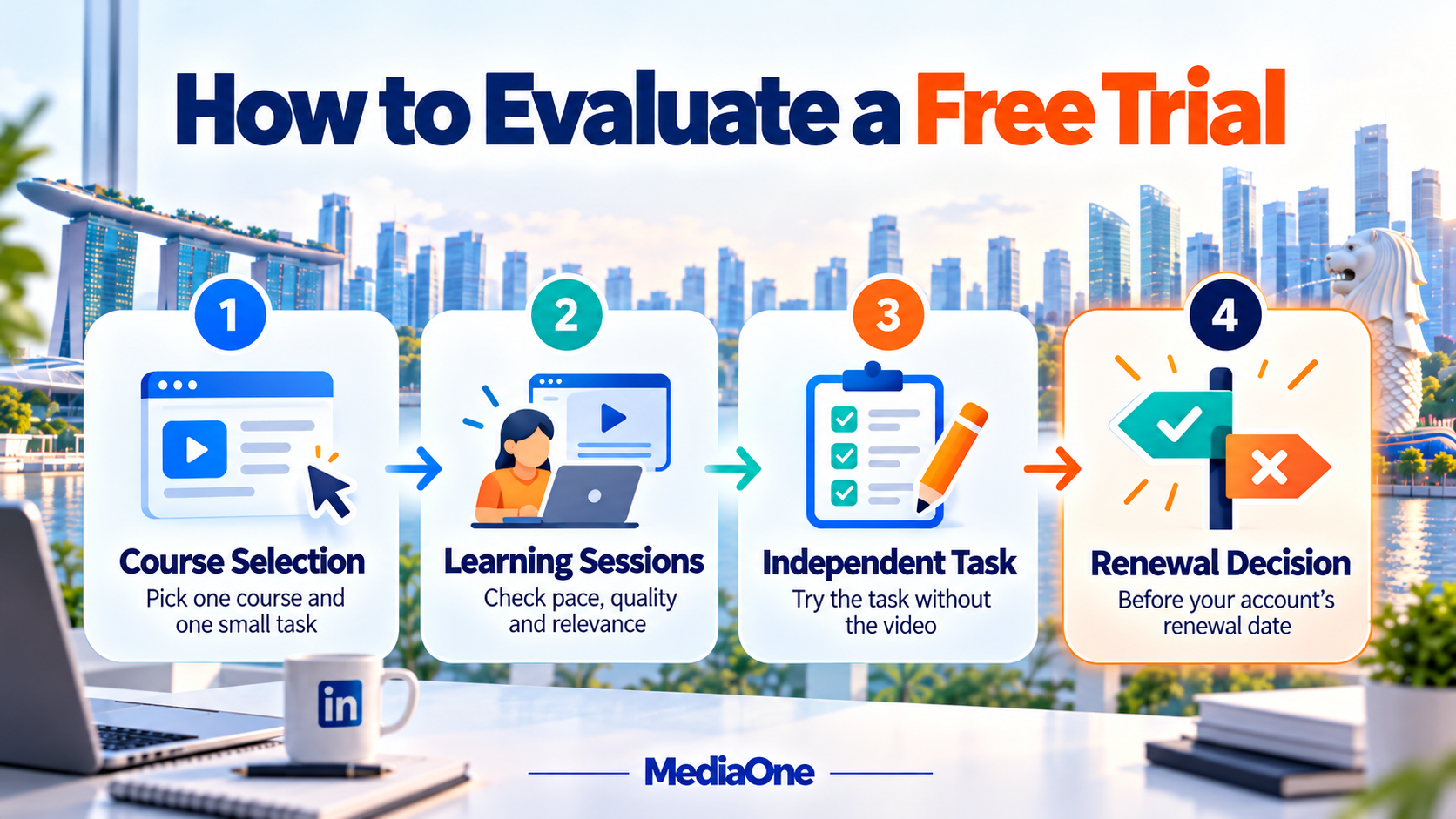
A manageable evaluation has four stages:
- Before activation: One selected course and a small practice task give the trial a purpose.
- During the first sessions: Notes on teaching pace, resource quality and software relevance capture the learning experience.
- Before renewal: An attempt at the task without the video reveals what the learner can repeat independently.
- At the decision point: The work completed and the next genuine learning need provide reasons to continue or cancel.
The trial tests whether the platform deserves payment; it does not create an obligation to finish a long course sequence. An unfinished course can still reveal a problem with teaching pace, prerequisites or available study time.
LinkedIn’s cancellation guidance explains the account process. Paid-plan and trial access rules can differ, so the cancellation screen’s effective date deserves attention.
What LinkedIn Learning Certificates Mean
LinkedIn Learning offers different types of learning records. The word “certificate” alone does not describe how someone earned it or what an employer can conclude from it.
Ordinary Certificates of Completion

LinkedIn’s completion certificate FAQ states that LinkedIn Learning is not accredited. An ordinary completion certificate differs from a degree or software certification, and learners do not need to complete course assessments or exercise files to earn it.
The certificate records completion under the platform’s rules. It cannot establish how independently a learner can perform the task.
A learner discussing training in an interview can connect it to a work sample and explain their own contribution. That gives the conversation more substance than listing course names alone.
Professional Certificates and Certification Preparation
LinkedIn’s professional certificate guidance distinguishes assessed partner certificates from preparation for external certification exams. Some professional certificates involve an assessment on LinkedIn Learning; external certification exams have separate requirements and can involve additional fees.
A preparation course does not award the external certification merely because the videos are complete. Learners pursuing a named credential need the issuing organisation’s assessment requirements.
| Learning record | What it indicates | What needs separate checking |
| Completion certificate | Course completion | Practical ability and employer relevance |
| Assessed professional certificate | Completion and the specified assessment | Issuer, assessment rules and role requirements |
| Certification preparation | Study for an external exam | Exam booking, fees and certification award |
Employer responses vary by role and organisation. A specific job requirement provides better evidence than a claim that all Singapore employers recognise or dismiss the same certificate.
LinkedIn Learning Pros, Cons and Alternatives
LinkedIn Learning’s main attraction is flexible access to many subjects in one place. Its limitations become more apparent when a learner needs individual feedback or a specific formal credential.
| Strength | Limitation to consider |
| Recorded lessons around work commitments | The learner manages deadlines |
| Subjects across several professional areas | Depth varies by course |
| Resources such as exercises and quizzes | Resources differ between courses |
| Several access routes | Features and account records can differ |
Early-career professionals can use the platform to strengthen foundations. Experienced professionals may find it valuable for a specific task outside their main discipline. Career changers can explore a subject before committing to longer study.
When a Team Needs More Than Course Access
A manager buying licences for several employees needs a plan for applying the lessons at work. Assigning the same course to everyone can waste time when their starting knowledge and responsibilities differ.
A small pilot can begin with one shared task, such as producing a consistent monthly report. Each participant can study the sections they need, complete the task and explain any remaining difficulties.

The manager can then examine the work against agreed criteria: accuracy, completeness and the ability to explain decisions. Course completion provides a record of activity; the work reveals where additional support is needed.
Time for review belongs in the training budget. Employees may need access to software, sample data and someone who can answer practical questions. A licence purchase alone does not provide all those resources.
How Alternatives Compare
For someone comparing social media marketing courses, the deciding factor may be whether they need an introduction, campaign practice or feedback on their own account.
Other online learning platforms for digital marketing offer different payment models and teaching formats. Coursera includes degrees from accredited universities, but that does not make every Coursera short course a degree or formal qualification. Udemy is another option for learners comparing a specific instructor or software topic.
A live workshop or supervised programme deserves consideration when feedback is central to the goal. A formal programme deserves attention when an application requires a named qualification. The comparison should begin with that requirement, then examine delivery and cost.
A short course purchase may suit someone who wants repeated access to one topic, subject to that provider’s terms. A subscription may suit someone with several connected learning needs. Total spending over the intended study period provides a fairer comparison than the first payment alone.
Is LinkedIn Learning Worth Paying For in Singapore?
LinkedIn Learning is worth considering when a course addresses a task you need soon and you have room to practise. Payment becomes harder to justify when existing access already covers the lessons or the required support lies outside recorded teaching.
A sensible next step is one selected course and one modest piece of work. The experience of completing that work provides evidence for the next subscription decision.
For a Singapore business owner, staff training and campaign delivery may require different support. A team can learn the fundamentals while a digital marketing consultant helps examine campaign problems, measurement and priorities. MediaOne can discuss the business outcome your team needs and the support required to achieve it.
Frequently Asked Questions
Can LinkedIn Learning Videos Be Watched Offline?
LinkedIn supports offline viewing through its mobile app on supported devices. Desktop and laptop video downloads are not available. Downloaded lessons require an active subscription or applicable access, so downloading a course does not create permanent ownership after access ends.
Does LinkedIn Learning Provide Video Transcripts?
LinkedIn’s transcript feature lets desktop learners read the spoken content and select text to jump to that moment in a video. Some courses do not include transcripts. The Learning apps do not provide this feature, although closed captions offer another way to follow spoken content.
Will Cancelling a Subscription Automatically Produce a Refund?
Cancellation and a refund are separate actions. LinkedIn’s refund policy says eligible Premium subscriptions, including Learning, may qualify within seven days of a charge without Premium usage. Conditions apply, and previous refunds can affect eligibility. Apple handles refunds for subscriptions purchased through LinkedIn’s iOS app.