If you are weighing up this job — as a candidate or as a team hiring for it — know this first: the role is defined less by writing than by distribution, measurement and commercial accountability. Most of the work sits in deciding what gets published, where it is pushed, and how its results connect to business outcomes.

A content marketing manager makes those calls for the whole content operation. This guide covers the day-to-day work, strategy and planning, team management, skills, pay and career progression, with the pay benchmark taken from the UK market for 2026 and the Singapore context set out separately.
The argument runs throughout, and it shapes every judgement below: hiring for writing ability alone is the most common way to get this role wrong. Writing is easy to see and easy to test, which is exactly why it crowds out the parts of the job that matter more.
The market is growing. According to Coursera, the content marketing market is estimated at $524.73 billion in 2025 and is forecast to reach $989.84 billion by 2030. Coursera sources that figure to Mordor Intelligence. It is a forecast from a market research estimate, not a measured result.
Key takeaways
- A content marketing manager is hired for distribution, measurement and commercial accountability more than for writing. Test candidates on those first.
- UK benchmark salaries are reported at £45,000 to £60,000 by Digital Waffle. These are UK figures — Singapore pay is set out separately and comes from third-party estimates.
- The content marketing market is forecast to grow from $524.73 billion in 2025 to $989.84 billion by 2030. This is a forecast, not a measured result.
- Use the Distribution-First Role Scorecard to judge whether a posting is a manager’s job or a creator’s job.
- Scope changes with company stage. An early-stage firm needs a generalist. An established firm needs a team lead.
- One widely repeated split — roughly 20% copy and 80% distribution — could not be traced to a published source and is flagged in the appendix as unverified.
What a content marketing manager does day to day
Most job descriptions list content creation first. The working week tells a different story. A content marketing manager decides what gets published, where it goes, and how results are judged against business targets. Writing is one input among several, and the role sits inside wider marketing work where a specialist often shares the same channel and reporting responsibilities.
Core roles and responsibilities
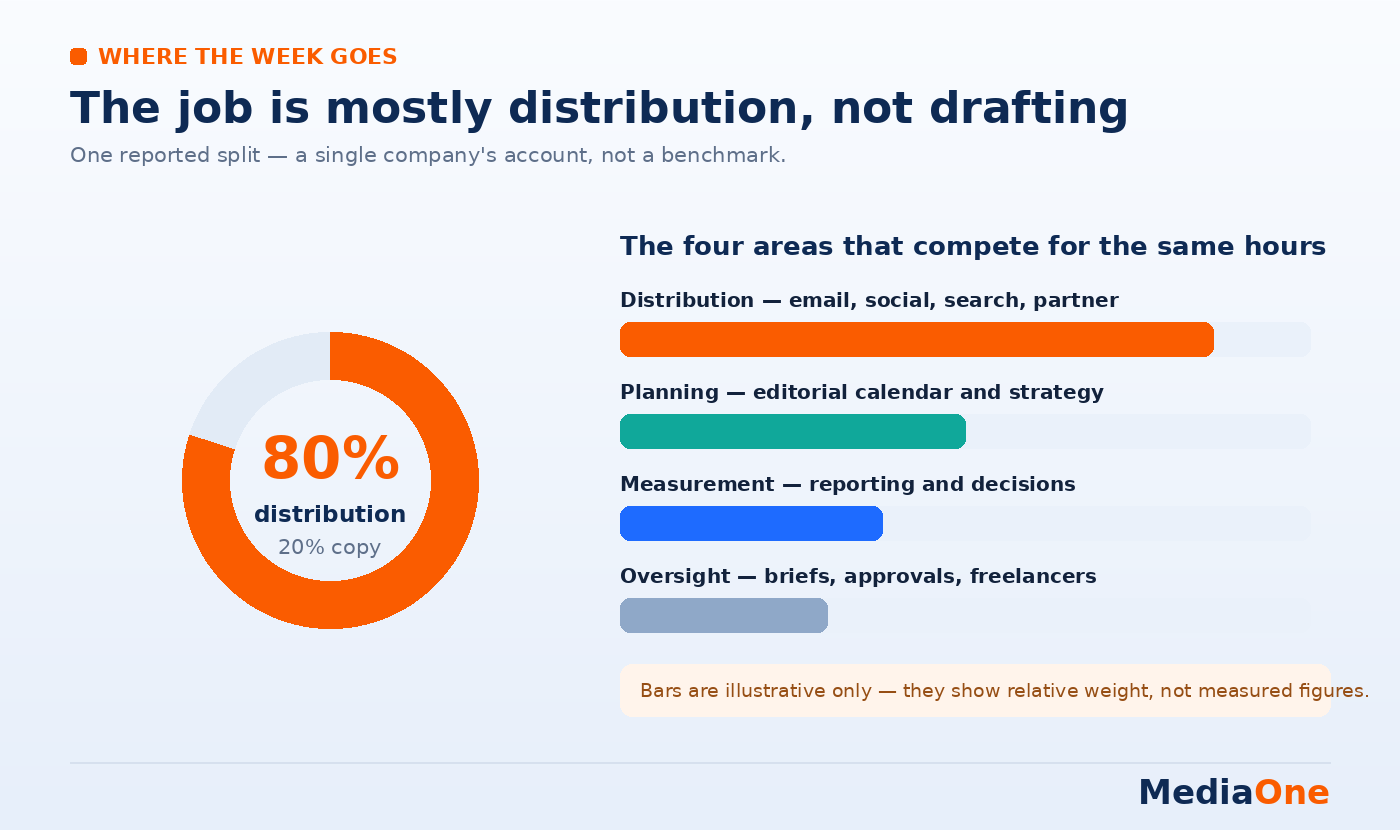
The responsibilities fall into four areas: planning, distribution, measurement and team oversight. Planning covers the editorial calendar and the choice of content strategies that build the brand. Distribution covers email, social, search and partner channels, including paid media; email is often the channel a manager is measured on first. Measurement covers traffic, conversions and attribution, tracked through analytics and reviewed for engagement and performance. Oversight covers briefs, approvals and freelancers, along with management of the team itself.
These areas compete for the same hours. A manager who reviews every draft has less time for channel testing. One who spends the week in analytics may let the calendar slip. Deciding which task gets priority is the real skill of the role.
Content marketing manager job description explained
A useful job description names the balance of work, not just the list of tasks. It is still a useful test of a posting: if it asks mainly for writing samples and says little about channels or reporting, the role is probably a creator’s job with a manager’s title.
How the role differs from a content creator or writer
A writer is judged on the quality of each piece. A content marketing manager is judged on whether the content operation as a whole moves a business metric. Digital Waffle’s content creator benchmark puts UK pay for that role at £28,000 to £38,000 — a useful reminder that the two jobs are priced differently because they are different jobs.
The writer asks how to make an article clear. The manager asks whether it should exist, who it is for, how it reaches them, and whether it earned its place in the plan. A search engine ranking is one signal the manager weighs, not the goal itself. A content manager also checks that each piece meets the company’s cookie and privacy policy before it goes live.
The Distribution-First Role Scorecard
Use this scorecard on any posting for a content marketing manager. It weights each line so you can see whether the role is mainly a manager’s job. A role counts as a manager’s job when it scores 60 or more out of 100.
|
Scorecard line |
Weight |
Manager’s job signal |
Creator’s job signal |
|
Channel and distribution ownership |
25 |
Owns email, social media, search and partner channels |
Publishes to channels set by others |
|
Measurement and reporting |
20 |
Reports against a business metric, such as qualified leads or sign-ups |
Reports page views or word counts |
|
Editorial calendar and strategy |
20 |
Sets priorities and plans the calendar |
Takes assigned topics |
|
Team and freelancer oversight |
15 |
Briefs, approves and manages writers and designers |
Works alone on own pieces |
|
Budget or tool decisions |
10 |
Chooses tools such as Google Analytics, a CMS or a scheduling platform |
Uses tools chosen by others |
|
Writing share of the role |
10 |
Writing is one input among several |
Writing is the main task |
Scoring rule. Give the full weight for a manager’s signal, half for a mixed signal, and zero for a creator’s signal. Add the totals. A posting that scores 60 or more counts as a manager’s job.
The 60-point threshold is a judgement call, not a measured cut-off. It is set so that a posting dominated by writing falls below it. Test the scorecard on a real posting before you rely on it: score each line, add the total, and compare the result with the hire you make.
Content strategy, competitor and audience research
A content strategy starts with a business goal, not a content idea. Before anything is planned, the manager should name the commercial outcome the content must support — qualified leads, trial sign-ups or retention. Without that anchor, the calendar fills with posts that look busy but cannot be tied to revenue or return on investment.
Building a content strategy from business goals
Work backwards from the target. For each content pillar you should be able to state in one sentence the outcome it drives. If you cannot, the pillar is probably there out of habit. Each pillar should also map to a clear performance metric, reviewed on a regular cycle.
Start by listing three to five business goals for the year. Assign each one a content pillar and a primary metric. This keeps the strategy short enough to defend in a leadership review.
Competitor and audience research methods
Competitor research should answer one question: where are rivals already strong, and where do they leave a gap? Review the top-ranking pages for your priority terms. Note their formats and update dates, and log topics they cover thinly.
Audience research then tests whether those gaps matter to buyers. Use sales call notes, support tickets, email replies and search query data. Social listening tools show which questions recur. Draft a content brief only after the gap is confirmed.
Research is only useful if it changes a decision. Record one topic to pursue and one to drop each quarter.
Mapping topics to the buyer journey
Sort every planned topic into awareness, consideration or decision stages. Awareness content brings people in. Consideration content builds trust. Decision content answers final objections.
Attribution connects each stage to sales. Track which content a lead read before they bought. A plan heavy on awareness content with no decision content attracts traffic that never converts. Balance the calendar on purpose, and track engagement at each stage so the balance is measured, not assumed. For teams that need the measurement half of this to be reliable, MediaOne sets out how conversion tracking works and why data tracking makes or breaks performance.
Content planning, editorial calendars and SEO
Building a content calendar that holds up
Most calendars fail because they list topics without assigning distribution. A useful calendar pairs every planned piece with a named channel, an owner and a date for the promotion push, not just the publish date. Plan roughly one core asset per month, then allocate the remaining hours to repurposing, outreach and email follow-ups.
A manager who books four articles but no distribution budget has a production schedule, not a plan. Each planned piece should fit the team’s content strategy, so that every slot has a clear reason to exist.
Follow these steps to build a calendar your team can use:
- List the three to five business goals for the quarter.
- Assign each goal a content pillar and a primary metric.
- Sort each planned topic into the awareness, consideration or decision stage.
- Pair each piece with a named channel, an owner and a promotion date.
- Check the search demand for each topic before commissioning it.
- Review the calendar each quarter and drop any slot that cannot be linked to a goal.
Pass test: every row has a channel, an owner and a promotion date. Fail test: any row with only a publish date.
Search engine optimisation as a planning input
SEO should shape which topics get picked, not be bolted on afterwards. Use keyword research to check whether a topic has search demand before commissioning it, then apply optimisation as a checklist at brief stage. MediaOne’s guide to AI search and lead generation covers how that task is changing as buyers increasingly start in an assistant rather than a search box.
SEO work, distribution and measurement all draw on the same working hours, so a manager has to decide which one gets the next block of time. The hardest choice is usually between more content and better measurement, not between writing and editing. Checking results is often the real constraint, because a team that never reviews performance cannot tell which content is worth making again.

Measuring performance and reporting results
Report on a short set of metrics tied to a business outcome. Qualified leads, sign-ups and sales leads are better measures than page views alone. Engagement on those pages shows whether the content is holding attention, and a clear cookie policy keeps that tracking transparent for visitors.
Set a monthly review to compare planned against actual output, and record what was changed as a result. Reporting that cannot change next month’s plan is a summary, not measurement.
A sound performance analysis turns those numbers into a decision about where the next block of hours should go, so senior management can see which channels earn their place. Programmatic advertising, PPC management and remarketing campaigns all compete with content for the same budget, which is why the comparison has to be made on business metrics rather than volume.
Pass test: each monthly review ends with at least one change to the plan. Fail test: a report that only states results with no decision attached.
Team management and content oversight
A content marketing manager rarely writes most of what the team publishes. The job is to keep a small group of writers, designers and freelancers producing work that is consistent, on brief and tied to a goal. If oversight and coordination take up most of a manager’s week, the role is working as intended.
Managing writers, designers and freelancers
Set the cadence before the first brief goes out. Agree who owns each piece, what the turnaround is, and who signs off. Freelancers need the same clarity as staff, and they usually need it in writing. Align every piece with the wider marketing strategy so writers understand how their work supports the business goal.
Review work against the brief rather than personal taste. Give feedback that names the change required.
Quality control, briefs and approval workflows
A good brief states the audience, the buyer stage, the target keyword, the required outcome and the length. Build a short approval chain with one final sign-off. Multiple reviewers who each rewrite the same paragraph are the most common cause of delay.
Pass test: every piece has one named approver before it is published. Fail test: a draft that has passed through three or more rewrites without a final sign-off.
Keep a checklist for fact-checking, links and brand terms. That way editing time goes to ideas rather than housekeeping.
Working with sales, product and leadership
Sales and product teams hold the knowledge that makes content credible, so schedule a regular input session rather than waiting for requests. Share draft plans by email and on social channels so stakeholders can flag gaps early.
Report to leadership in terms of pipeline, traffic and conversions, not word counts. Keeping these stakeholders involved is what turns oversight into real accountability for performance.
Skills and job requirements
Hiring teams often screen a candidate on writing samples first. That is the wrong order. Most of the job sits elsewhere: deciding what gets published, where it is promoted, and how performance links to sales leads.
Hard skills employers test for
Score each candidate across five lines: strategy and planning, audience research, digital marketing and channel management, marketing analytics, and team management. Mark each as evidenced, claimed or absent. Weight distribution and analytics more heavily than writing, and check that the data behind any reported result can be traced to its source.
Soft skills and qualifications
Prioritise commercial judgement, stakeholder management with sales and product, and the ability to decline requests that do not serve the strategy. Formal qualifications matter less than a portfolio that shows measured results.
Experience benchmarks and what hiring managers look for
Digital Waffle’s own job description asks for four to eight years in content marketing, editorial or SEO-focused roles. Beyond that, look for evidence of a calendar owned from start to finish, campaigns with tracked results, and a team managed through briefs and approval workflows. A candidate who can show a content plan tied to a business goal is stronger than one with a long list of published pieces.
Ask whether they have used Google Analytics, a content management system and a social media scheduling platform, and whether they have handled a cookie policy review or a privacy notice for a site.
Salary range and career progression
Average salary for content marketing managers in the UK

Digital Waffle’s content marketing manager guide puts UK benchmark salaries at £45,000 to £60,000, with mid-level managers at £45,000 to £52,000 and senior professionals leading cross-channel strategy and SEO alignment at £53,000 to £60,000. SaaS, fintech and ecommerce firms often offer enhanced packages with KPIs tied to lead generation and pipeline contribution.
Scope drives pay more than the title does. A role that owns distribution, measurement and a small team usually pays more than one focused on drafting articles. Use the scorecard above to judge which kind of role you are being offered.
A Singapore reference point
This guide’s verified salary benchmark is the UK one above. For a Singapore reference, third-party estimates diverge widely because they measure different scopes:
|
Source |
Scope measured |
Reported figure |
|
Content marketing manager, Singapore |
Average gross S$82,782 a year (August 2026) |
|
|
Marketing manager / AVP, Singapore — a broader title |
Average S$125,000 a year |
These are third-party estimates rather than a single authoritative survey, and the Morgan McKinley figure covers a wider title than content marketing manager. Treat both as directional. Before you negotiate in Singapore dollars, check a current local salary survey and your own company’s pay bands.
Career progression after the role
Digital Waffle’s published path runs from content executive or writer, through content strategist, into content marketing manager, then head of content or brand, and on to marketing director or CMO. Note that the strategist step sits before the manager role in that sequence — a route worth knowing if you are currently planning rather than producing.
Salary negotiation and accepting an offer
Anchor your request on the scope you will own, not on your current pay. Ask for the salary band before the first offer, and be ready to justify each responsibility against the scorecard. The 2026 UK digital marketing salary guide is the underlying benchmark behind these figures.
Conclusion
A content marketing manager decides what gets published, where it is promoted, and whether it helps the business. Writing matters, but it is one line on the scorecard. The strongest candidates show evidence in distribution, analytics and team management, not just a portfolio of articles.
The market is growing. The content marketing market is forecast to reach $989.84 billion by 2030, up from $524.73 billion in 2025, according to Coursera. Treat that as a forecast from a market research estimate, not a measured result.
Frequently asked questions
What does a content marketing manager do?
They plan what the business publishes, decide where it is distributed, and measure whether it helps commercial goals. Writing is one part of the job. Much of the week goes to editorial planning, channel decisions, team management and reporting.
What is the average salary for a content marketing manager in the UK?
Digital Waffle gives UK benchmark salaries of £45,000 to £60,000 for this role, with mid-level managers at £45,000 to £52,000. These are UK figures. For Singapore, see the third-party estimates in the salary section above and check a current local survey before negotiating.
What skills does a content marketing manager need?
The strongest hiring signals are planning, audience research, distribution across channels and analytics. Writing and editing matter, but they rank below these in most job descriptions. Familiarity with SEO tools and analytics platforms is also expected. Managing writers, designers and freelancers is a skill in its own right.
How is a content marketing manager different from a content writer?
A writer produces the piece. A content marketing manager decides which piece should exist, who it is for, how it reaches them, and whether it was worth making. The manager sets the brief, approves the work and owns the results.
What is the career path after content marketing manager?
Common next steps include head of content, head of brand, or marketing director in a smaller company. Progression depends on whether you move towards leading a larger team, owning commercial targets, or specialising in a channel.


Do content marketing managers need SEO experience?
Yes, in most roles. SEO shapes which topics get planned and how content is structured, so it is a planning input rather than a separate task. You do not need to be a technical SEO specialist, but you should understand keyword research, search intent and how organic traffic is measured.