
Singapore had 5.33 million social media user identities in October 2025, covering over 90% of the population. With such saturation, agencies must demonstrate, through strategy and presentation, why they are the right partner to drive a brand’s presence and results.

A strong social media marketing proposal matters. It is more than listing deliverables or pricing. It reveals how your agency thinks, how your recommendations support business goals, and why your approach stands out.
For any business evaluating a social media marketing agency, the proposal is often where strategy, positioning, and commercial value are judged side by side. Many proposals remain too generic, vague, or focused on scope without explaining the logic behind them.
This makes it harder for clients to distinguish agencies. A better proposal links business goals to platform strategy, content direction, workflow, KPIs, and investment with clarity and relevance.
This guide breaks down what to include in a social media marketing proposal, how to structure it, and how to present it to build trust and improve close rates.
Key Takeaways
- A social media marketing proposal should explain strategy, scope, KPIs, pricing, workflow, and next steps.
- Pricing should be introduced after the value and logic behind the recommendation are clear.
- Generic proposals weaken trust and make agencies easier to compare solely on price.
- A live walkthrough is usually more persuasive than sending the proposal without context.
- Clear deliverables and approval processes reduce friction during both sales and onboarding.
A social media marketing proposal is a document or presentation explaining how an agency will help a client achieve specific goals through social media. It outlines objectives, recommended strategy, scope, deliverables, reporting, timelines, and pricing.
It should connect the client’s current challenges with a clear marketing approach, so the client can understand not just what they are paying for, but why that recommendation is worth considering.
This matters because clients rarely buy deliverables alone. They are buying confidence. They want to know whether the agency understands their business, whether the recommendations feel commercially sound, and whether the engagement looks realistic to execute. A proposal is often the first place where your agency’s thinking becomes tangible.

A strong proposal matters because it creates the client’s first serious impression of how your agency works. Discovery calls and chemistry meetings can build interest, but it’s in the proposal that the client begins to assess whether your thinking is clear, structured, and relevant to their needs.
A strong proposal lets clients see value beyond the fee. Many agencies lose deals because they explain what’s included but not why the approach makes sense. When strategy, deliverables, KPIs, workflow, and pricing connect, the investment is convincing. Without that logic, clients often compare price alone.
Internal buy-in matters. Often, the main contact must share the proposal with stakeholders who missed prior conversations. A clear, concise, and commercial proposal makes it easier for your champion to communicate with their team.
A strong proposal sets the tone for the relationship. With clear scope, assumptions, responsibilities, and reporting, both sides know what to expect. This reduces friction and makes handover from sales to delivery smoother.

At a minimum, a strong social media marketing proposal structure can look like this:
Executive Summary
↓
Client Goals and Challenges
↓
Audience and Market Context
↓
Recommended Strategy
↓
Deliverables
↓
Workflow and Timelines
↓
KPIs and Reporting
↓
Pricing and Assumptions
↓
Next Steps
- Executive summary: Open with a short overview of the client’s situation and your recommended direction. Show you understand the brief and that your proposal is built around the client’s needs. Be brief but make the client feel understood.
- Client goals and business context: Summarise what the client wants to achieve and what may hold them back. Goals may include brand awareness, engagement, lead generation, sales, or better consistency. Challenges may be low content output, weak campaign results, unclear positioning, or limited internal resources. This section bridges the brief and your recommendation.
- Target audience insights: Show you understand who the brand needs to reach. Even if brief, explain why the audience matters and how their behaviour shapes platform, messaging, and content choices. Platform recommendations are more credible when tied directly to audience logic.
- Platform strategy: Explain which channels you recommend and why. If you prioritise Instagram, LinkedIn, Facebook, TikTok, or a mix, the client should see the commercial logic behind each choice. Avoid making platform selection feel automatic or templated.
- Content strategy and deliverables: Define what content will be created and how often. Include content pillars, creative direction, short-form video, static creatives, copywriting, calendars, and revision processes. Be specific. Vague terms like ‘content support’ or ‘account management’ do not provide sufficient clarity.
- Paid social scope: If paid media is part of the engagement, separate it clearly from organic content support. Clarify whether the agency will handle campaign setup, audience targeting, ad creative, optimisation, retargeting, reporting, and budget guidance. If ad spend is excluded, say so plainly.
- Workflow and timelines: Show how the engagement moves from planning to execution. Include approval timelines, feedback cycles, turnaround times, and how delays affect delivery. Clients often underestimate the value of workflow clarity until work begins, so set expectations early.
- KPIs and reporting: Define how success will be measured. KPIs should match the client’s real goals, not just impressive-sounding metrics. Depending on the objective, this could be reach, engagement, clicks, cost per lead, conversions, follower growth, or return on ad spend. State how often you’ll report and what those reviews will cover.
- Pricing and assumptions: Clearly present the commercial structure. Whether it’s a monthly retainer, campaign fee, or hybrid, the client should see what’s included, what’s optional, and what’s outside scope. If the proposal depends on assumptions such as timely asset delivery or approvals, state that up front.
Close by showing the path forward. Include proposal validity, kickoff timing, onboarding needs, and the next action required from the client. Never end vaguely. The client should know exactly what happens after approval.
This sequence works because it helps the client understand the logic before they reach the investment section. It also keeps the document easy to scan, which matters because many decision makers skim proposals before reading them in detail. A proposal that feels heavy, repetitive, or pricing-first can lose momentum quickly, even if the service itself is strong.
Agencies should also start with the client, not themselves. Too many proposals open with long introductions about the agency’s story, awards, or credentials. Credibility matters, but it should support the proposal, not take over.
The priority is showing that you understand the client’s goals, challenges, and opportunities. Finally, strategic thinking and pricing should be kept separate. If fees appear too early, clients often anchor on cost before seeing the value behind the recommendation.
A strong proposal is not just about what is written in the document. It is also about how the proposal is presented.
Even a well-structured social media marketing proposal can lose impact if it is rushed, explained poorly, or presented in the wrong order. To make the proposal more persuasive, agencies should walk the client through it step by step.
Step 1: Set up a live proposal walkthrough

Whenever possible, present the proposal live rather than email it. This could be done through a video call, in-person meeting, or screen-sharing session. A live walkthrough gives you control over the flow of the conversation and allows you to explain your recommendations in the right sequence.

Sending the proposal without context often leads to misunderstandings. The client may jump straight to pricing, skim important sections, or read parts of the proposal in isolation without understanding the reasoning behind them.
What to do:
- Schedule a proposal presentation call after the discovery phase
- Let the client know the session will walk through your recommendations step by step
- Share the proposal during the meeting rather than in advance if possible
- Keep the session focused and structured rather than overly casual
Step 2: Start by restating the client’s goals and challenges

Before diving into your solution, demonstrate that you understand the client’s brief. Reconfirm what they are trying to achieve and the key challenges they are facing. This helps the client feel heard and creates a strong foundation for the rest of the presentation.
If you jump straight into tactics, the proposal can feel disconnected. When you start with the client’s goals, the strategy feels more relevant and commercially grounded.
What to say:
- Your main priority is to improve brand visibility and generate more qualified enquiries
- At the moment, the key gaps seem to be inconsistent posting, limited campaign support, and low engagement on current content
- Based on that, we have structured our recommendation around building a stronger content system and improving campaign efficiency
Step 3: Present outcomes before deliverables

Clients do not buy social media deliverables for their own sake. They are buying what those deliverables are meant to achieve. That is why the presentation should lead with outcomes such as stronger visibility, improved engagement, more consistent brand positioning, better lead generation, or a clearer audience strategy.
If you lead with deliverables too early, the proposal can sound like a service menu rather than a strategic recommendation.
What to do: Frame the proposal around business value first, then show how the deliverables support that value.
Example: Instead of saying,
We are proposing 12 posts, 4 reels, and 3 ad creatives each month
Say,
To improve brand consistency and create more opportunities for engagement and lead generation, we recommend a monthly content plan supported by short-form video, static posts, and paid campaign creatives
Step 4: Walk through the strategy in a logical order

Once the client understands the proposal’s goal, move through the strategic sections in sequence. Explain the audience, platform choices, content direction, and campaign logic in a way that feels connected.
This is where your proposal shifts from being a document to becoming a persuasive recommendation. Each section should answer a clear question in the client’s mind:
- who are we trying to reach
- why these platforms
- why this content approach
- how will this support our goals
Suggested presentation flow:
- Executive summary
- Client goals and challenges
- Audience and market context
- Platform recommendations
- Content strategy
- Paid social strategy if relevant
- Deliverables and workflow
- KPIs and reporting
- Pricing
- Next steps
Step 5: Explain the reasoning behind every major recommendation

Do not assume the client will automatically understand why you are recommending certain platforms, formats, posting frequencies, or budget levels. One of the biggest differences between a weak proposal and a persuasive one is that a persuasive proposal shows the thinking behind the recommendation.
Every major recommendation should feel intentional.
What to explain:
- Why Instagram is more suitable than LinkedIn for this campaign
- Why reels are being prioritised over static posts
- Why is paid support needed to accelerate reach or lead generation
- Why the proposed posting frequency is realistic and effective
- Why does the budget level match the campaign objective
Example: We are recommending Instagram and Facebook as the primary platforms because your target audience is already active there, and both channels support a strong mix of educational content, visual storytelling, and lead generation campaigns
Step 6: Make the deliverables concrete and easy to understand

Once the strategy is clear, move into the scope of work. This is where the client needs clarity, not broad wording. Be specific about what is included, how often it will be delivered, and how the workflow will run.
This section helps prevent misunderstandings later and makes the proposal easier to evaluate commercially.
What to cover:
- number of posts, videos, ads, reports, and planning cycles
- revision rounds
- approval process
- reporting frequency
- what is included and what is excluded
Example: The monthly scope includes 12 posts, 4 reels, 3 ad creatives, caption writing, one monthly content calendar, and one performance report, with up to two revision rounds included before publishing
Step 7: Present pricing only after the value is clear

Pricing should come after the client understands the strategy, the deliverables, and the logic behind them. If fees are presented too early, the client may focus solely on cost and miss the broader value of the proposal.
By this stage, the client should already understand what they are getting, why it matters, and how it supports their business goals. That makes pricing easier to defend.
How to present it:
- introduce the fee calmly and clearly
- show what is included within the investment
- explain what is excluded, such as ad spend or production costs
- connect pricing back to the agreed scope and objectives
Example: Based on the recommended monthly scope covering content creation, paid social management, reporting, and account servicing, the proposed investment is SGD 2,800 per month, excluding ad spend
Step 8: Address likely objections before they are raised

A strong presenter does not wait for every objection to appear. Instead, they proactively remove uncertainty by clarifying common concerns during the walkthrough.
Typical concerns may include:
- why the fee is at this level
- how long will the results take
- why certain platforms were chosen
- what happens if approvals are delayed
- whether the scope can be adjusted later
What to do:
Acknowledge these issues naturally as you present the proposal so the client feels the recommendation has been carefully thought through.
Step 9: Pause for questions at the right moments

Do not leave all questions until the end, but do not interrupt the flow too often either. The best approach is to present each major section clearly, then pause briefly to check alignment.
This keeps the presentation collaborative while still maintaining momentum.
Useful prompts:
- Does this direction align with what you had in mind so far?
- Would you like me to expand on why we are recommending these platforms?
- Is the proposed workflow aligned with how your team typically approves content?
Step 10: Close with a clear next step

Do not end the proposal presentation with a vague thank you and no direction. A strong close helps move the conversation forward while the proposal is still fresh in the client’s mind.
Summarise the recommendation, restate the core value, and confirm the next step needed from the client.
What to cover in the close:
- the main objective of the proposal
- the recommended direction
- the investment level
- what happens next if they want to proceed
- any deadline for approval or proposal validity
To summarise, this proposal is designed to strengthen your brand presence, improve engagement, and generate more qualified enquiries through a more consistent content and paid social strategy. If you are aligned with the direction, the next step would be to confirm approval so we can arrange onboarding and begin planning the first campaign cycle
Simple Presentation Formula
A practical way to present a social media marketing proposal is to follow this formula:
Client goals
→ Current gaps
→ Recommended strategy
→ Deliverables and workflow
→ KPIs
→ Pricing
→ Next steps
The goal of presenting a proposal is not to read every line on the screen. It is to guide the client through the logic behind the recommendation so they can see the value clearly. When agencies present proposals in a structured, confident, and commercially grounded way, it becomes much easier for clients to say yes.

To make this easier to visualise, below is an example of how a social media marketing proposal can be presented in practice.
| Section | Sample Proposal Content |
| Proposal Title | Social Media Marketing Proposal for ABC Aesthetics Singapore |
| Prepared By | MediaOne | 25 March 2026 |
| Proposal Overview | This proposal outlines a social media marketing strategy designed to help ABC Aesthetics Singapore improve brand visibility, increase qualified enquiries, and build a more consistent online presence across Instagram and Facebook.
Based on the current business goals, audience profile, and competitive landscape, we recommend a structured approach that combines organic content creation, paid social campaigns, and monthly performance optimisation. |
| 1. Executive Summary | ABC Aesthetics Singapore is looking to strengthen its social media presence to support lead generation, improve engagement, and increase awareness of its core treatments.
At present, the brand has an existing social presence, but content output is inconsistent, and current engagement levels do not fully reflect the quality of the services offered. We recommend a strategy focused on clearer content pillars, stronger visual consistency, and targeted paid campaigns to reach high-intent audiences in Singapore. |
| 2. Business Goals and Pain Points | The key goals for this engagement are to increase brand awareness, generate more treatment enquiries, and build stronger trust with potential customers through educational and credibility-driven content.
Current pain points include irregular posting, limited use of short-form video, low engagement on promotional posts, and a lack of consistent campaign support to convert interest into leads. This proposal is designed to address these gaps through a more structured, commercially focused social media strategy. |
| 3. Audience and Platform Rationale | Based on the target audience profile, we recommend prioritising Instagram and Facebook as the core platforms for this campaign.
Instagram will be used for visual storytelling, treatment education, before-and-after style content, and audience engagement through reels and carousels. Facebook will support broader reach, retargeting, and lead-generation campaigns for working adults aged 25 to 45 in Singapore who are interested in aesthetic treatments, skincare solutions, and non-invasive facial services. |
| 4. Content Strategy | Our proposed content strategy is built around five key content pillars: treatment education, brand trust and credibility, customer testimonials, promotional offers, and behind-the-scenes clinic content.
Suggested formats include static posts, reels, carousel posts, stories, and supporting captions tailored to each platform. The aim is to position ABC Aesthetics Singapore as a trusted and informative provider while maintaining a strong balance between educational value and conversion-focused messaging. |
| 5. Paid Social Strategy | To support the organic strategy, paid social campaigns will be used to increase reach, generate leads, and retarget warm audiences who have interacted with the brand.
The paid social scope will include campaign setup, audience targeting, ad creative testing, optimisation, and monthly reporting. Initial campaigns will focus on lead generation for signature facial treatments and seasonal promotional packages, with audience segments built around location, age, interests, and previous engagement behaviour. |
| 6. Deliverables and Workflow | The proposed monthly scope includes 12 social media posts, 4 reels, 3 ad creatives, caption writing, one monthly content calendar, and one monthly performance report.
Workflow will begin with content planning and campaign alignment, followed by creative production, client review, revisions, publishing, and optimisation. Content will be submitted for approval 5 working days before the scheduled publishing date, with up to two revision rounds included per content cycle. |
| 7. KPIs and Reporting | Success will be measured by awareness, engagement, and lead-generation performance. Core KPIs will include reach, impressions, engagement rate, profile visits, clicks, cost per lead, and enquiry volume.
A monthly report will be provided to review overall performance, identify top-performing content, highlight campaign insights, and recommend adjustments for the following month. |
| 8. Investment and Assumptions | The proposed investment for this engagement is SGD 2,800 per month, excluding ad spend. This includes organic content strategy, monthly content creation, paid social campaign management, reporting, and account servicing.
This fee does not include professional photography, videography production, influencer fees, or third-party software costs unless otherwise stated. This proposal assumes that the client will provide timely access to brand assets, approve content within three working days, and allocate a minimum monthly ad spend of SGD 1,500 for campaign execution. |
| 9. Next Steps | If you would like to proceed, the next steps are to confirm approval of the proposal, align on the campaign kickoff date, complete onboarding and account access setup, and begin planning for the first month of content and paid campaign execution.
Upon approval, a kickoff meeting will be arranged within five working days. This proposal is valid for 14 days from the date of issue. |
Why This Format Works
This format works because it shows a clear progression from business context to strategy, deliverables, pricing, and next steps. It proposes to feel commercially grounded, easy to review, and simple to present in a client call or internal discussion.
*Please note that this is only a sample. Tweak this draft according to your business’s needs.
Even strong social media services can lose deals if the proposal is weak. Often, the problem is not the service, but how the proposal is written, structured, or presented. Here are five common mistakes agencies make in social media marketing proposals, and how to fix them.
1. Using a Generic Proposal That Feels Recycled
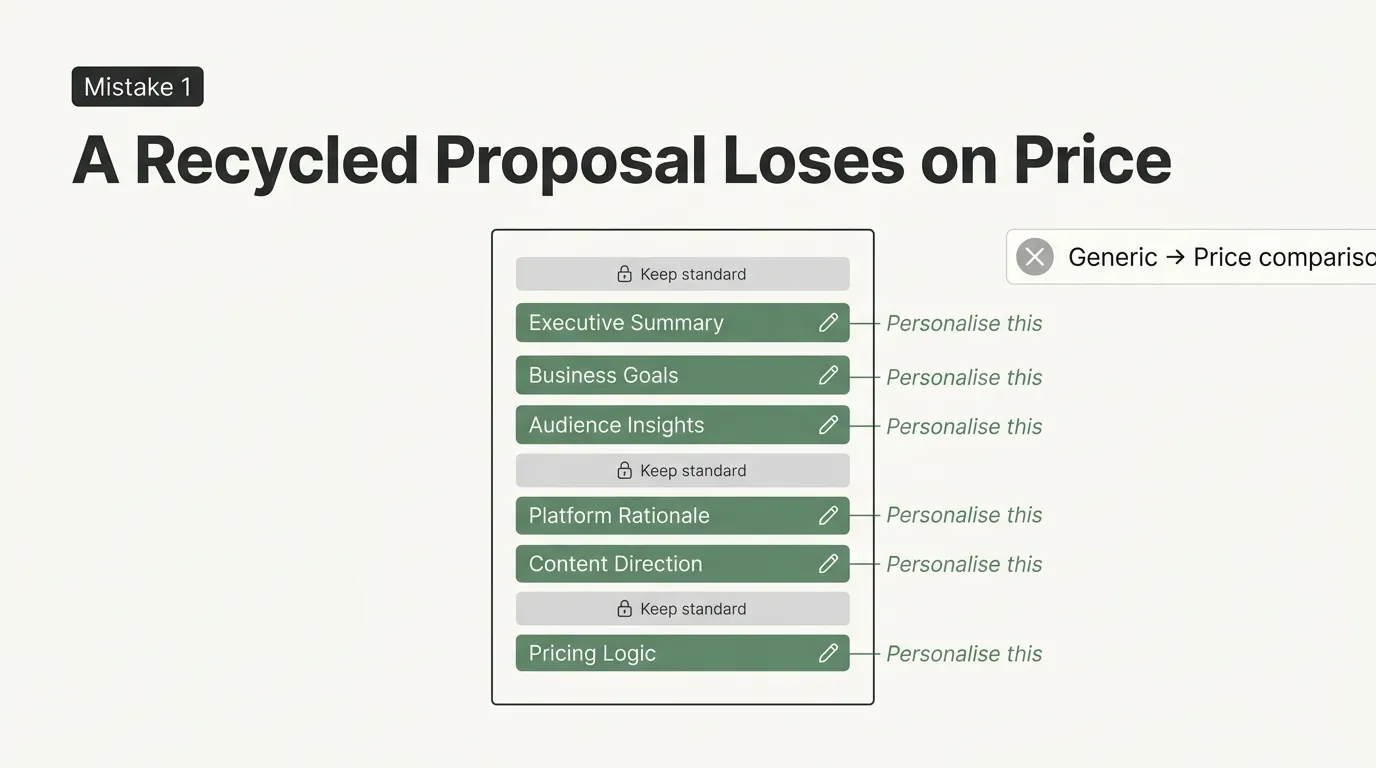
One of the fastest ways to weaken a proposal is to rely on a standard template without real adaptation. Many agencies use the same structure and wording across pitches, changing only the client’s name and a few details. Templates save time but often feel generic to clients.
A recycled proposal signals the agency has not taken the time to understand the business. It also makes the agency easier to compare on price, since nothing feels tailored or strategic. When clients see vague recommendations that could fit any business, trust drops fast.
Keep the overall framework standard, but customise the parts that matter. This includes the executive summary, business goals, audience insights, platform rationale, content direction, and pricing logic. The client should feel the proposal was built for them, not copied from another deck.
2. Focusing Too Much on the Agency Instead of the Client

Another common mistake is making the proposal too agency-centric. Some proposals spend too long on the agency’s history, awards, or credentials before addressing the client’s problem. Credibility matters, but it should support the proposal, not dominate it.
Clients do not read proposals to learn everything about the agency. They want to know whether you can solve their problem, whether the strategy makes sense, and whether the investment is justified. If the proposal focuses too much on the agency, it comes across as self-promotional rather than consultative.
Start with the client’s goals, pain points, and opportunities. Frame the proposal around their business context, then bring in your expertise where it strengthens the recommendation. Lead with what the client needs and why your approach fits.
3. Listing Vague Deliverables Without a Clear Scope

A proposal may sound polished on the surface, but still create confusion if the deliverables are too broad. Terms like social media management, content creation, campaign support, or monthly optimisation are not enough on their own. They sound professional, but they do not tell the client what is actually included.
When the scope is unclear, clients make their own assumptions about what they are paying for. This creates objections during sales and friction during delivery. A vague proposal also makes it harder for clients to compare value, since they cannot see what the agency will deliver each month or campaign.
Be specific about what’s included. Define the number of posts, reels, ad creatives, reporting cycles, strategy calls, revision rounds, and approval timelines. If paid social is included, separate it from organic support. If some items are excluded, state that up front. Clarity builds trust and reduces misunderstandings.
4. Showing Pricing Before Explaining the Value

Many agencies show pricing too early or without enough context. When that happens, the client sees cost before understanding the strategy or logic behind it. The conversation shifts from price to value.
This is risky when clients compare multiple agencies. If pricing appears before your reasoning, you risk being seen as just another vendor, not a strategic partner. Even a fair fee can feel expensive if the proposal has not justified it.
Structure the proposal so pricing comes after strategy, deliverables, workflow, and KPIs. Help the client see what they are investing in before they evaluate the fee. Pricing should be the logical conclusion, not the centrepiece.
5. Ignoring Workflow, Approvals, and Delivery Realities

A proposal can look strong on strategy but still fail if it ignores delivery realities. Many agencies do not explain how approvals work, how feedback is given, what turnaround times to expect, or how delays affect timelines. These details shape the client experience from day one.
If workflow is not addressed early, clients may assume faster delivery, unlimited revisions, or last-minute changes that were never intended. This creates friction during onboarding and delivery, even if you win the deal. A proposal should sell the strategy and prepare the client for how the engagement will actually run.
Include a workflow section that explains the process from planning to publishing. Define approval timelines, revision limits, reporting cadence, and client dependencies clearly. This helps both sides start with realistic expectations and reduces tension once the engagement begins.
A strong social media marketing proposal is more than a pitch document. It is a strategic sales tool that clarifies your thinking, demonstrates value, and guides clients to a confident decision.
When the proposal is tailored to the client’s goals, backed by clear logic, and easy to understand, it is far more effective than a simple list of services and fees.
For agencies looking to win better clients and reduce friction in the sales process, improving proposal quality is one of the most practical changes they can make. The strongest proposals are clear, specific, and built around what the client actually needs to understand before saying yes.
If you are looking for a partner that can help turn strategy into results, MediaOne offers tailored support across content, paid campaigns, and performance-driven social media strategy.
Explore how our social media marketing agency services can help your brand build stronger visibility, engagement, and growth. Contact us today!
Frequently Asked Questions
Who should be involved in reviewing a social media marketing proposal before it is sent to a client?
A strong proposal should usually be reviewed by the account lead, strategist, and anyone responsible for delivery. This helps ensure the strategy is sound, the scope is realistic, and the pricing matches the actual workload. A quick internal review can also catch vague wording or mismatched expectations before the proposal reaches the client.
How often should agencies update their social media marketing proposal template?
Agencies should review their proposal template regularly, especially when service offerings, pricing models, reporting methods, or platform trends change. A proposal template that is not updated can quickly become outdated, making the agency look behind the market. Reviewing it every quarter or after major service changes is a practical approach.
Should a social media marketing proposal include competitor observations?
It can, if the observations are relevant and concise. Including a few competitor insights can help show that the agency understands the market and has thought beyond the client’s own channels. The key is to use competitor observations to strengthen the recommendation, not to overload the proposal with unnecessary analysis.
Is it better to send a short proposal quickly or a more detailed proposal later?
That depends on the complexity of the brief, but in most cases, quality matters more than speed. A rushed proposal may help the agency respond quickly, but it can also reduce trust if the recommendations feel thin or generic. A strong proposal should be timely, but still detailed enough to show clear thinking and commercial value.
Can a social media marketing proposal be reused for renewal or upsell discussions with existing clients?
Yes, with the right adjustments. For existing clients, a proposal can be adapted into a renewal or upsell document by focusing on past performance, new opportunities, revised scope, and the rationale for expanding the engagement. This can be useful when introducing new platforms, paid social support, content upgrades, or a broader campaign direction.