Search visibility is closer to revenue than many owners assume. The wrong SEO agency wastes a monthly fee and leaves your website invisible to people already looking for what you sell.

This guide is for Singapore business owners and marketing leads trying to hire an seo expert but weighing their options among an agency, a freelancer or an in-house hire. The best choice depends less on price than on whether a provider can show how they work and how they will report results. A clear digital marketing plan starts with a defined strategy, so ask every candidate to explain theirs – including how they plan keyword research – before comparing fees.
Quick answer: SEO services in Singapore are usually priced by the hour, retainer or project. Published rates are scarce, so request written quotes. Choose on audit quality, written KPIs and reporting, not the lowest fee. Use the Five-Gate Vendor Scorecard below before you sign.
Key Takeaways
- Judge the process before the price. Check for a documented audit scope, reporting cadence and metric set.
- Agree KPIs in writing. Measurable targets and a policy for missed targets matter more than ranking claims.
- Budget for a realistic timeline. The first months are groundwork; be sceptical of faster promises.
- Verify claims yourself. Check outcomes against your own Google Search Console and analytics data.
- Compare cost per outcome, not cost per hour. A cheap rate can cost more if the work is weak.
- Use the Five-Gate Vendor Scorecard. Score candidates on audit scope, reporting, written KPIs, missed-KPI terms and independent verification. Disqualify any scoring zero on KPIs or verification.
Why the Choice Matters for Revenue
Buyers search before they contact anyone. In GE Capital Retail Bank’s US shopper study, 81% of consumers researched online before making a major purchase, so a business that is hard to find on Google loses prospects early. Hiring an SEO specialist for your website is a decision about your pipeline, and a strong provider of SEO services in Singapore can lift the visibility your sales team depends on.
Agencies bring teams, freelancers bring focused attention, and in-house hires bring continuity. Price is the weakest signal. Ask how the expert works, what they will measure and how they will report it, since search engines reward consistent, measurable work.
Why Price Alone Misleads
A low monthly fee looks like a bargain until you weigh it against the revenue a weak campaign leaves on the table. Judge by cost per outcome, not cost per hour.
What an SEO Expert Actually Does
An SEO expert owns the work that makes a website findable in organic search: setting strategy, diagnosing and fixing technical problems, planning and refreshing content, and reporting results. Much of the week goes to deciding what to fix first, then checking whether the fix moved organic traffic and leads.
Hiring an SEO specialist makes most sense when that prioritisation needs real experience, whether from in-house specialists or an external SEO agency. The best results come from fixing the highest-impact problems first, a discipline that holds across most search engines and any social media channels that send visitors to the site. Teams looking for the best SEO results often find that this sequencing matters more than any single tactic.

The role sits between several others. A web developer implements the template, redirect and speed changes the SEO expert identifies. A content writer produces copy briefed around the searches people run. A paid search specialist buys ads, such as Google Ads, while the SEO expert works on the free listings – the split between the two channels is explained in this comparison of SEO and SEM. Each of these should follow one shared SEO strategy, which SEO professionals typically document so every team works toward the same goals.
An expert adds most value where a site faces real competition, has many pages, or carries a technical history that needs untangling. A small brochure website may only need a sound setup, a few well-written pages and Google Search Console, which is free and shows which queries bring visitors.
Core Services Covered by Most Engagements
Keyword research and optimisation. Good keyword work starts with search intent, the reason someone types a query. Matching page type to intent matters more than chasing high search volumes.

Optimised content creation. An expert writes or commissions briefs that set the target query, questions to answer, headings and internal links. Refreshing older pages that have lost rankings is often cheaper than producing new content – a structured approach is set out in this content refresh strategy from the MediaOne blog.
On-page SEO. This covers titles, headings, body copy and internal links on each page.
Technical SEO. This covers whether Google can find and list the right pages, whether pages load quickly, and whether structured data is valid. A common pattern is a site ranking for a few pages while hundreds are never listed, often due to a misconfigured robots file or duplicate URLs.
Link building and off-page SEO. This is work done away from your own website, mainly earning links from other sites. A few links from relevant, trusted sites usually outperform many low-quality ones. Be wary of any provider who sells links by volume, and of agencies that promise guaranteed rankings. A reputable SEO consultant will explain how each link was earned rather than promising a number – the principle behind ethical SEO that MediaOne practises and writes about.
What SEO Expert Hiring Costs
Hourly rates are the first number most buyers see, and they are easy to misread. Upwork’s marketplace data puts typical SEO expert rates at $15 to $35 per hour, with a median of $21, while MarketerHire reports SEO consultant rates of $75 to $200 per hour in the US and Canada. HigherVisibility’s 2026 pricing guide puts US agency rates at $100 to $300 per hour. These are global benchmarks, not Singapore quotes. Confirm the search engine and website scope before comparing any rate, since a low hourly figure can hide a narrow brief. When you hire an SEO expert, compare quotes on identical deliverables and treat any unwritten SEO strategy as an unpriced risk.
A cheap hour is not automatically a cheap outcome. A provider at $15 an hour needing 60 hours for an audit costs $900, while a specialist at $120 an hour finishing it in 8 hours costs $960 and arrives sooner. Judge a quote by the hours and deliverables it implies.
Monthly Retainers and Agency Fees
Agencies usually sell a monthly retainer. HigherVisibility’s 2026 guide puts freelancer retainers at $500 to $3,000 a month and agency retainers at $1,500 to $10,000 or more, with most businesses investing $1,500 to $5,000. Ahrefs’ survey of 439 providers puts the averages at $3,209 a month for agencies and $1,348 for freelancers. These are global figures, so use them only as a rough comparison – how the bands translate across markets, including the UK and Singapore, is set out in MediaOne’s international SEO pricing breakdown. Before signing with an SEO agency, confirm whether its SEO strategy work is included in the retainer or billed extra.
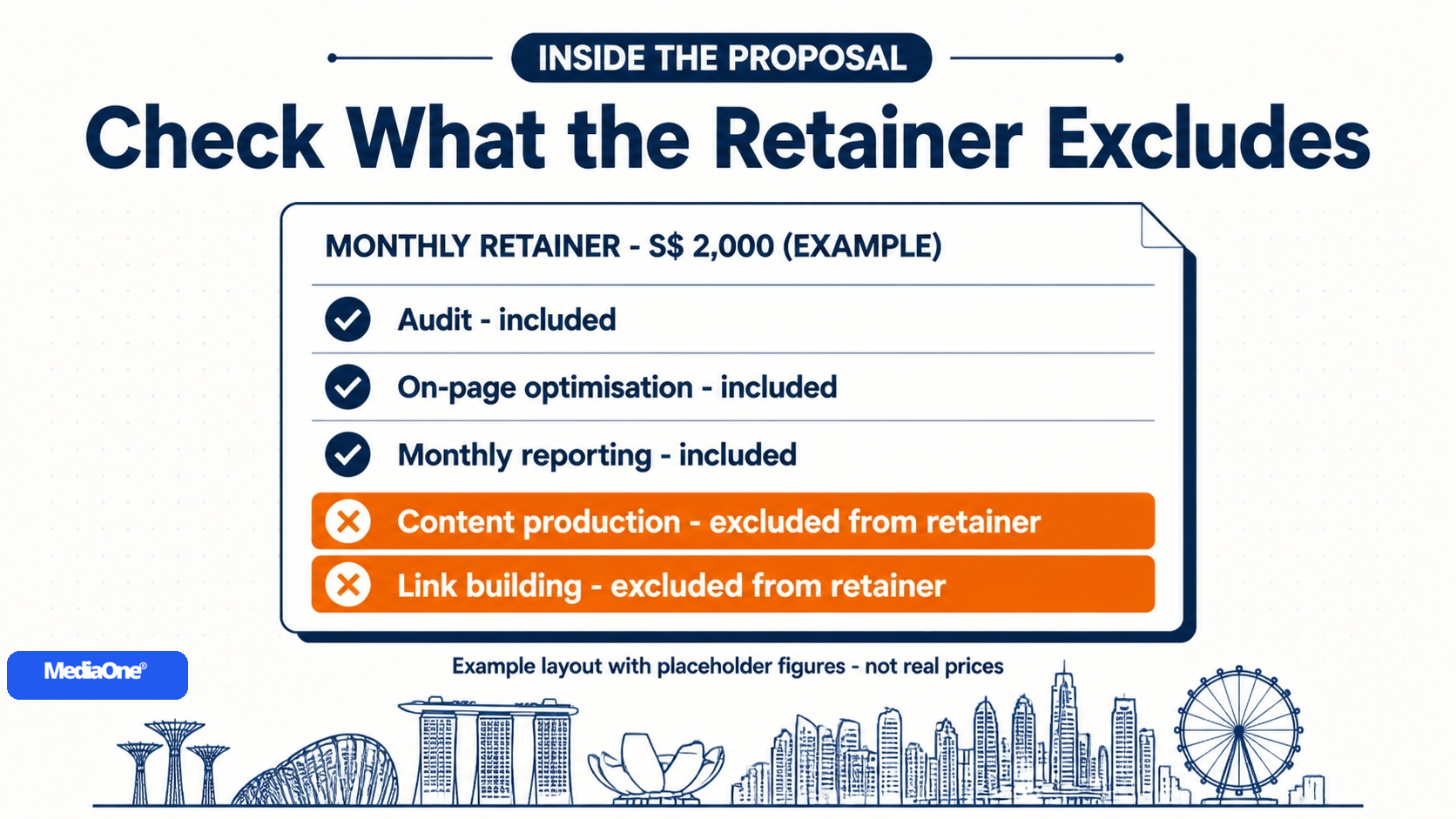
Check what the retainer excludes. Link building, extra audits, content production, social media management and paid-search management (Google Ads) are often billed separately.
A Practical Budget Framework
Match spend to your size, competition and time horizon. The figures that matter most are the ones in quotes you have received – and the drivers behind them, such as competition, technical condition and content depth, are explained in MediaOne’s guide to the five factors that affect SEO cost.
|
Business scenario |
Typical scope |
How to budget |
|
Small (one website, local niche) |
Audit, fix list, a few optimised pages |
Fixed-price audit plus a modest retainer |
|
Mid-sized (several service lines) |
Audit, regular content, technical monitoring |
Monthly retainer with a defined hour cap |
|
Large (national or competitive markets) |
Full team: technical, content and links |
Agency retainer with written KPIs; compare cost per lead |
Expect results to take time. MarketerHire’s timeline gives the first three months to groundwork – technical fixes, keyword optimisation and minor ranking movements – while HigherVisibility notes small businesses investing at least $1,500 a month typically see measurable ranking improvements within four to six months. A sensible first-quarter milestone is a completed audit, a prioritised fix list, and measurable organic traffic growth in Search Console, not a page-one ranking.
Choosing Between an Agency, a Freelancer and an In-House Expert
The right model depends on scope, budget and management time. For a fuller decision framework, see this guide to when and how to outsource SEO.
|
Factor |
Agency |
Freelancer |
In-house hire |
|
Cost |
Highest; global agency retainers range $1,500 to $10,000+ a month, averaging $3,209 (HigherVisibility; Ahrefs’ survey) |
Typically $500 to $3,000 a month, averaging $1,348 (HigherVisibility; Ahrefs’ survey) |
Salary plus overheads, usually the highest fixed commitment |
|
Depth of team |
Broadest: strategists, technical, content and link specialists |
Usually one person |
One person, plus your team’s support |
|
Continuity |
Team can absorb staff changes |
Depends on one person’s availability |
Stable, but exposed to staff turnover |
|
Management overhead |
Lower day-to-day, but needs a clear brief |
Moderate; needs regular check-ins |
Highest; requires internal SEO knowledge |
Early-stage firms with one website and a narrow goal usually suit a freelancer. Growing firms with several sites or markets usually need an agency or a strong in-house lead backed by external specialists. Before you hire an SEO expert, ask for keyword research that shapes the scope of any recommendation.
When an Agency Is the Better Choice
An agency suits multi-channel needs, including social media, large keyword sets or technical problems requiring several specialists. Ask whether the team covers technical SEO, content and link building, and whether its SEO services extend beyond search.
When a Freelancer or In-House Hire Makes Sense
A freelancer suits a tightly defined scope, such as a technical audit followed by quarterly reviews. Choose in-house only when SEO will be a continuing function. Whichever you choose, confirm that experienced SEO professionals, such as an SEO specialist, will do the work, not only the people who sold the engagement.
The Five-Gate Vendor Scorecard
Judge a candidate on process and proof, not on the size of its claims. Score each candidate from 0 to 2 on five gates. This framework is the author’s own, not an industry standard.
- Documented audit scope. The provider sets out what the audit covers before you pay.
- Defined reporting cadence and metric set. You know how often you will hear results and which numbers will be reported.
- Agreed KPIs written into the contract. Targets are measurable, dated and signed.
- Terms for missed KPIs. The contract states what happens if targets are missed.
- A method for verifying results independently. You can check outcomes in your own analytics, not only the vendor’s dashboard.
A total of 8 or more out of 10 makes a candidate worth a trial. A score of 0 on KPIs or verification rules the candidate out, whatever the total.
Worked Example: Scoring Two Candidates
Consider two anonymised candidates, Vendor A and Vendor B, both pitching a retainer for a Singapore service business.
Vendor A names its audit sections and sends a sample report (gate 1: 2). Its KPIs are vague, such as “improve visibility”, with no dates (gate 3: 0). The contract is silent on missed targets (gate 4: 0). It reports from its own dashboard only (gate 5: 1). Total: 5. The 0 on KPIs rules Vendor A out.
Vendor B lists audit sections only as a headline count (gate 1: 1). It proposes three dated KPIs, signed in the contract (gate 3: 2). Missed targets trigger a written review, but no fee change (gate 4: 1). It shows how to check outcomes in your own Google Analytics and Search Console (gate 5: 2). Total: 8. Vendor B is worth a trial. The points it lost on gates 1 and 4 are the questions to press before signing.
Applying the Audit Gate
A proper audit covers technical health (whether Google can find, read and list your pages, how fast they load and whether they carry structured data), on-page structure, content against search intent, and off-page authority, meaning the links and mentions other sites give your website. The provider should walk you through findings from your own site, not a template. For a feel for the scope, run your site through a free SEO audit tool and compare its findings with whatever the vendor delivers. The audit should come before the proposal. A provider that quotes a retainer before examining your site is selling a package, not a diagnosis.
Google’s guidance on hiring an SEO adds a practical safeguard: if an audit is offered, grant read-only access to Search Console first and do not grant write access at that stage – a real audit gives you realistic estimates of improvement, and Google warns that anyone guaranteeing first place in search results should be walked away from.
Some providers advertise a fixed number of audit sections: bestseo.sg states that every campaign includes a 14-section audit. Count them against the four areas above and ask for a sample report.
Testing Self-Reported Claims
Vendor claims are not verification. bestseo.sg states that it has ranked more than 2,000 keywords on page 1 of Google for Singapore businesses across 43 industries, generating over S$51M in tracked client revenue across more than 200 businesses. These figures are self-reported and not independently audited. Its site advertises a results guarantee – quote it as the vendor states it, and confirm the exact terms in writing. Treat published client results as individual cases, not typical results.
To test any claim, ask for two or three named client references, then compare the outcome you hear about with your own Google Search Console and analytics data. A client who reports growth should be able to show a baseline and a date range. Ask how your Search Console data will be reported, so the numbers you see can be checked against the same source the vendor uses.
Before you rely on any vendor claim:
- Ask for two or three named client references and contact them.
- Request a sample audit report and count the sections yourself.
- Confirm the KPIs, measurement method and missed-target terms in the contract.
- Record your own baseline in Search Console and analytics before the work starts.
Red Flags When Hiring an SEO Expert
Guaranteed first-page rankings. No one can guarantee search positions – Google states plainly that no one can guarantee a #1 ranking on Google, and warns against SEOs alleging a special relationship with Google or a priority submit.
Opaque methodology. If the provider cannot say what it will do each month, you cannot judge it.
A single metric. Rankings can rise while enquiries fall, so ask for traffic, leads and conversions together.
Lead volume without lead quality. Match any jump in leads to how many became paying customers.
Pricing below $1,000 a month. HigherVisibility warns that at that level most providers cannot dedicate enough time to move the needle, and that very cheap packages often rely on tactics that risk long-term penalties.
Pricing that does not match scope. A low fee for a large keyword set, link building and content usually means work is being cut or outsourced without telling you.
Questions to Ask Before You Sign
Google’s own hiring checklist asks similar questions – examples of previous work and success stories, experience in your industry and country, and how communication will work – and recommends checking business references before signing. Ask, at minimum:

- What is your methodology, and what does month one look like?
- Who does the work, and how many clients does each person manage?
- What is your reporting cadence, and who will I speak to?
- Which metrics will you report, and how do they connect to enquiries or sales?
- Which KPIs go into the contract, and by when?
- What happens if those KPIs are missed?
- Can you show Singapore case studies with verifiable data?
- How will I verify your results in my own analytics?
- What do I own at the end: content, analytics access and documentation?
- What are the notice period and exit terms, and what happens to rankings after I leave?
A candidate that answers questions 5, 6 and 8 clearly is a serious contender. One that avoids them is not.
Exit Terms and Ownership
Ask what you keep when the contract ends: your content, your analytics access and the audit documentation. Ask also what happens to rankings after you leave, since some gains depend on ongoing work. Paid search is a separate line item, so confirm whether any Google Ads spend or account access stays with you when the contract ends. Your SEO strategy should be documented well enough that your team can run it without the vendor.
Setting Realistic Timelines

SEO results are slow, so be wary of any vendor promising immediate results. Timing depends on query competitiveness, technical debt, site age and competition.
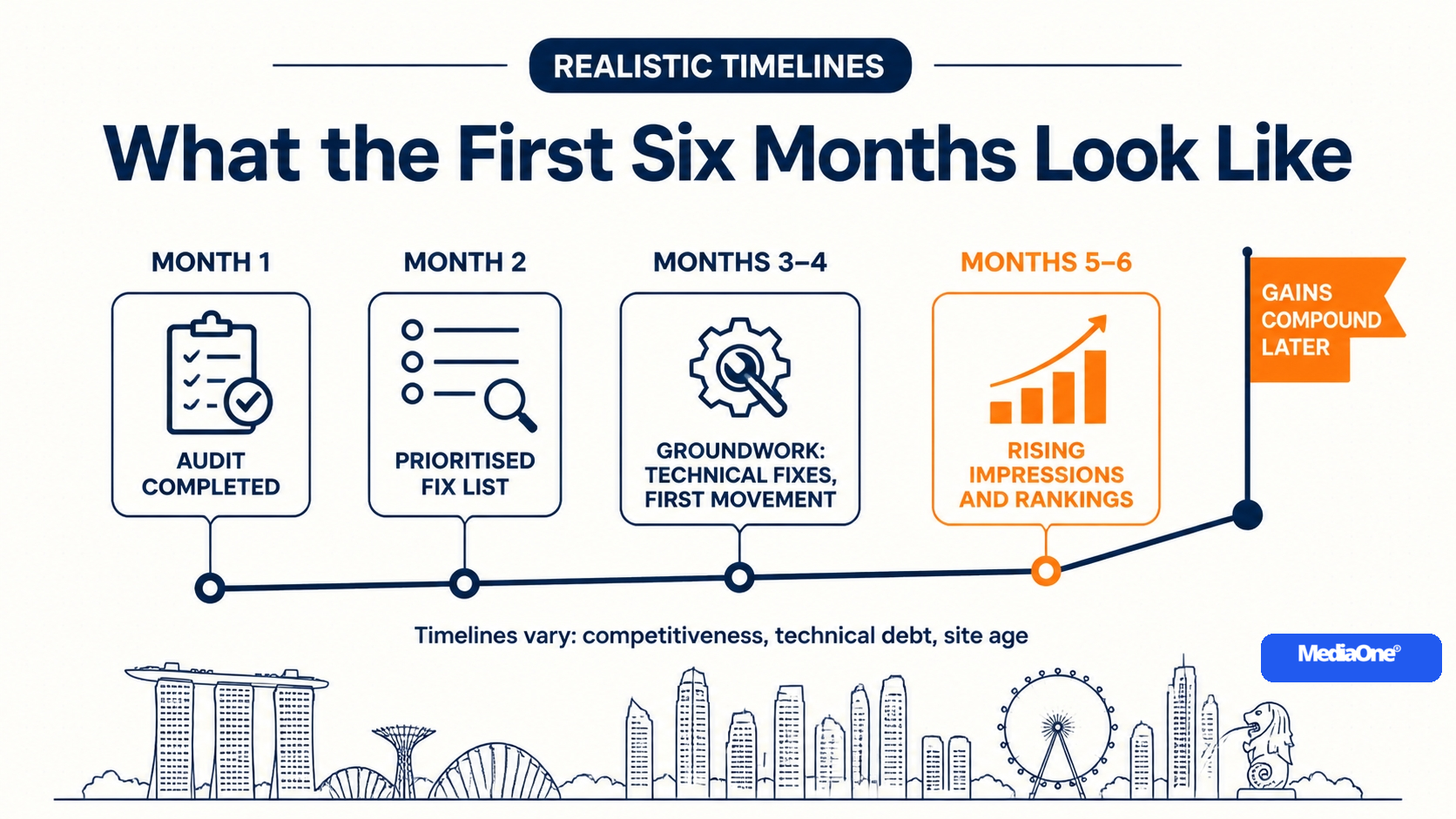
When you hire an SEO expert, agree a timeline in writing. MarketerHire’s realistic sequence runs: technical fixes and minor ranking improvements in months one to three, clearer traffic and ranking gains in months four to six, and significant growth with steady lead generation from six to twelve months according to MarketerHire’s guide. A reasonable first-quarter plan has a completed audit in month one, a prioritised fix list in month two, and measurable Search Console gains by the end of the quarter. Treat promises of page-one rankings within weeks as a warning sign.
Local SEO for Singapore Businesses
Why Local SEO Matters for Singapore Firms
If your customers come from a specific area, such as a clinic in Tanjong Pagar or a renovation firm serving HDB estates, local search drives your visibility. Google Business Profile, local citations (consistent name, address and phone listings on directories) and location searches such as “aircon servicing near me” bring in calls. Businesses that ignore these signals often lose customers to rivals who appear in map results. The fundamentals are covered in MediaOne’s complete guide to local SEO in Singapore and this walkthrough of Google Business Profile SEO.
Local SEO deserves priority when most revenue comes from customers within a few kilometres, when you serve several locations, or when rivals dominate map results for your core terms. When you hire an SEO expert, ask how they split effort between local listings and broader content – this breakdown of what a local SEO expert does shows the division in practice. A vague answer is a warning sign. Where the work is substantial, MediaOne’s local SEO services cover profile optimisation, citations and review strategy.
Finding a Qualified SEO Expert in Singapore
Start with referrals from businesses of a similar size and sector. Check case studies for verifiable data: named clients, dated analytics screenshots, and ranking outcomes you can test yourself. A case study showing only percentage growth, with no baseline, tells you little. When shortlisting, a criteria-based comparison such as MediaOne’s buyer’s guide to the best SEO agencies in Singapore shows what a verifiable case study looks like. Ask whether the SEO experts involved will personally handle the work.
Ask vendors for Singapore-relevant case studies, then check Google results for your key local searches before and after engagement and compare them with the vendor’s reporting.
If a vendor handles personal data from your website forms or analytics, ask how that data is stored, who can access it, and how it is protected.
Conclusion and Summary
Hiring the right partner comes down to five steps. Define the goal first: qualified leads, revenue or rankings for a specific page. Budget realistically using the cost bands above, since a cheap hourly rate can cost more over a year than a higher one. Compare agency, freelancer and in-house options against your scope. Verify methodology with the Five-Gate Vendor Scorecard, and insist on reporting tied to your own analytics.
A broad keyword set and several channels point to an agency. A narrow scope and tight budget point to a freelancer. Permanent, central SEO suggests building in-house capacity. Formal training is another route: UC Davis’ Specialised Studies program in SEO costs $3,200 across four courses per UC Davis Continuing and Professional Education.

SEO is a compounding investment, and a competent expert should show measurable progress from the first quarter.
Frequently Asked Questions
How much does it cost to hire an SEO expert in Singapore?
Costs depend on the model and scope. Upwork’s marketplace data puts typical freelance SEO rates between $15 and $35 an hour per Upwork, while MarketerHire reports SEO consultant hourly rates of $75 to $200. These are non-Singapore benchmarks, so ask for a written quote in S$ before you commit.
How long does it take to see results from SEO?
Expect groundwork first: technical fixes, keyword optimisation and minor ranking movements in the first three months, with clearer traffic and ranking gains in months four to six, according to MarketerHire’s timeline. Be wary of any SEO expert who promises guaranteed rankings.
Should I hire an agency or a freelancer?
Choose an agency for several specialists or multi-channel work. Choose a freelancer for a narrow scope you can manage internally.
What should a free SEO audit include?
A useful audit covers technical health, on-page structure, content quality and off-page links, and should not promise rankings. bestseo.sg states its campaigns include a 14-section audit per its audit page. Ask to see the full section list before you accept any free audit.
How do I know if an SEO expert is legitimate?
Look for verifiable evidence rather than headline numbers. Ask for named client references, case studies you can check against your analytics, and clear monthly reporting.