

Creating new content from scratch takes a lot of time and energy. You might spend hours on a blog post, only to see it lose ground in the search rankings over time. If this sounds familiar, you’re not alone.
Here’s the good news: you don’t always need to create new content to win at SEO. In fact, 50% of marketers plan to boost their investment in content marketing in 2026. The smart money is increasingly on optimising what you already have rather than constantly chasing the next new piece.
Often, your best opportunities are already in your content library. By refreshing and updating existing content, you can regain lost rankings, attract more organic traffic, and deliver more value to your audience, all without the heavy lift of creating something brand new.
Key Takeaways
- Content refresh is the process of updating existing content to improve rankings and traffic. It’s 3-5x more cost-effective than creating new content and leverages your existing authority, backlinks, and indexation history.
- First-page content is updated on average every 1.31 years, with competitive keywords requiring updates even more frequently. Content decay is inevitable; even high-performing pages lose rankings without regular maintenance.
- Prioritise pages ranking positions 5-20, declining traffic, and high-value commercial content for the most significant ROI. Use Google Analytics and Search Console to identify quick wins that can be pushed to page one with strategic updates.
What Is a Content Refresh?
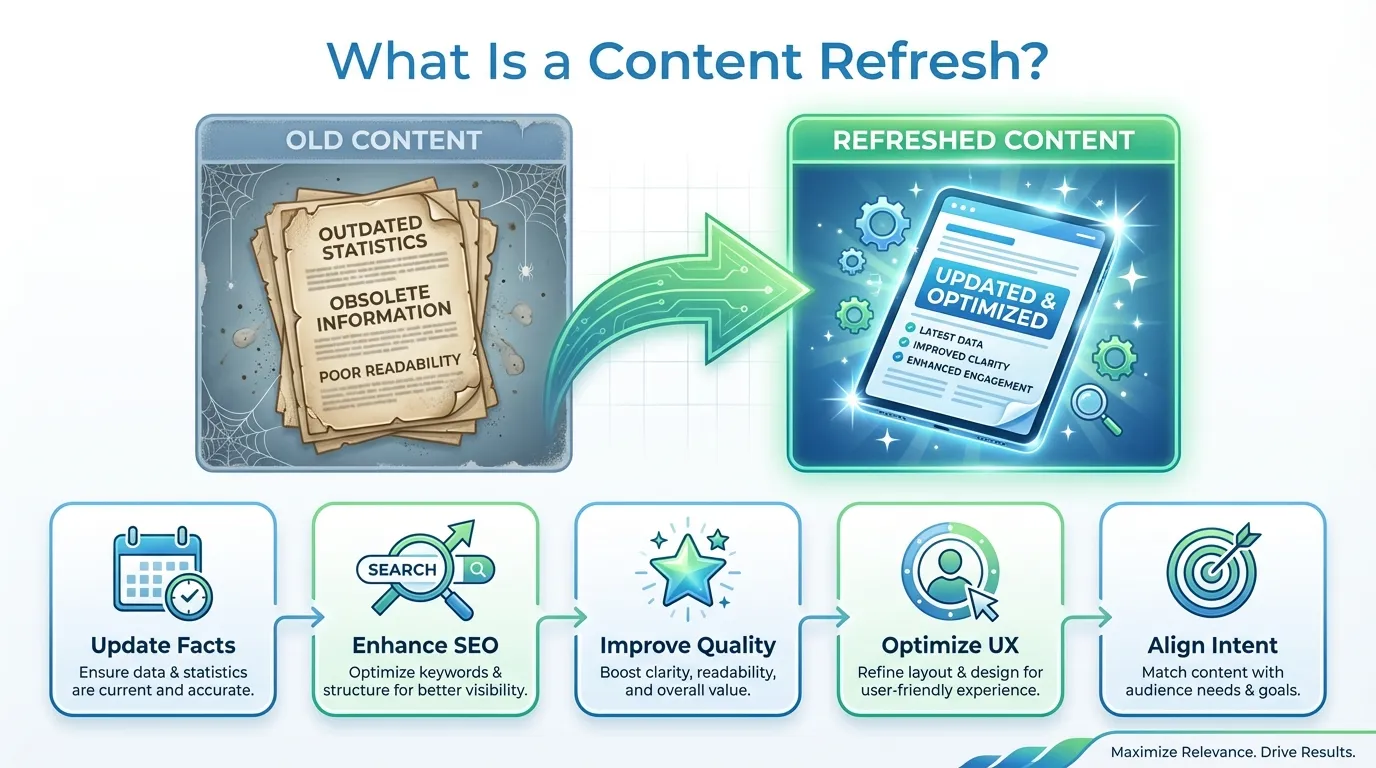
A content refresh means updating and improving your existing website content so it performs better in search and meets your audience’s needs. This could be as simple as removing outdated information, adding new insights, and making sure everything is up to date.
Instead of starting from scratch, refreshing content means making targeted updates to what you already have. This includes updating outdated statistics, adding new information, improving readability, and ensuring your content matches what people are searching for today.
The best part is, this approach works. Top-ranking content on Google is updated regularly, often every year or so, to stay competitive.
For more competitive keywords, updates happen even more often. If you don’t keep your content fresh, you risk losing your rankings to competitors who do.
Why Content Refresh Matters for Your SEO Strategy
Before we dive into the “how,” let’s talk about the “why.” Understanding the benefits of a solid content refresh strategy will help you prioritise this work and get buy-in from stakeholders.
- Reclaim Lost Rankings and Traffic: Content can lose its effectiveness over time, even if it performed well in the past. Algorithm changes, shifting user interests, and new competitors all play a role. By updating your content, you can regain lost rankings and traffic without having to start from scratch.
- Work Smarter, Not Harder: Writing new content can take a lot of time, but updating existing content is much faster. Plus, your current pages already have backlinks and authority, giving you a head start compared to starting from scratch.
- Improve User Experience: If your content is out of date, readers notice. Broken links, old stats, and outdated examples can hurt your credibility and drive people away. Keeping your content current helps build trust and shows you know your field.
- Align with Current Search Intent: What people search for changes over time. Regularly updating your content helps make sure you’re answering the questions people are asking right now.
- Boost Conversions: Fresh, relevant content doesn’t just attract visitors, it converts them. Updated calls to action, improved formatting, and up-to-date information all contribute to better conversion rates across your site.
15 Content Types That Benefit Most From Regular Refreshing
Some types of content need more frequent updates than others. Here are 15 types of content that benefit the most from regular refreshes:
1. “Best [X]” Product Comparison Posts

Refresh frequency: Every 3-6 months
Product comparison posts can quickly go out of date as new products are released and prices change. For example, a ‘best laptops’ post from six months ago might already be missing several new models.
These pages often lead to sales, so keeping them updated should be a priority. If your recommendations are outdated, you risk losing credibility and conversions.
Actionable Steps:
- Keep product specifications up to date.
- Update pricing, including sale prices and promotions.
- Add newly released product options.
- Remove discontinued products.
- Refresh comparison tables.
- Update verdict sections based on the new competition.
- Revise affiliate links if products are no longer available.
2. Software Review Articles

Refresh frequency: Every 6-12 months
Software changes fast. Reviews that were accurate last year might now have outdated screenshots, mention features that have been removed, or miss new updates that change how the product works.
SaaS companies update their products often, sometimes every month. To keep your reviews useful and trustworthy, you need to update them regularly.
Actionable Steps:
- Refresh posts to reflect current offerings.
- Update screenshots to show the latest interface.
- Revise assessments and ratings based on new features.
- Adjust pricing information, including new tiers or plans.
- Test new functionality yourself.
- Update pros and cons lists.
- Add information about recent integrations or API changes.
3. Statistics and Data-Heavy Content

Refresh frequency: Annually
Articles that rely on statistics can quickly lose credibility if the data is outdated. Readers notice outdated numbers and may question the rest of your content.
Because new studies and reports are published regularly, data-driven content needs to be updated regularly. If your stats are out of date, competitors with newer data will likely outrank you.
Actionable Steps:
- Update figures regularly with the most recent available data.
- Cite recent research and studies.
- Replace outdated statistics with current equivalents.
- Add newly published findings that support or challenge your points.
- Update data visualisations and charts.
- Revise conclusions if new data changes the narrative.
- Ensure all source links still work.
4. Rate and Pricing Guides

Refresh frequency: Every 3-6 months
Interest rates, subscription costs, and service pricing can change quickly, sometimes even week to week. Content about rates or pricing needs frequent updates to stay accurate.
People looking for rate information need up-to-date numbers. If your rates are out of date, you risk losing trust and could even mislead your readers.
Actionable Steps:
- Update rate information frequently to ensure it remains accurate and reliable, enabling users to act on it.
- Monitor rate changes regularly.
- Update pricing tables and comparisons.
- Revise recommendations based on current market conditions.
- Add context about recent rate movements or pricing changes.
- Update disclaimers about rate volatility.
5. “How To” Tutorials

Refresh frequency: Every 12-18 months
While the basics might stay the same, tools and best practices change. A tutorial for WordPress or Photoshop from last year might already be missing new features or include steps that no longer apply.
Tutorials are especially sensitive to changes in software interfaces. Even minor updates can make your instructions or screenshots confusing or outdated.
Actionable Steps:
- Refresh tutorials to reflect current methods.
- Update all screenshots to show the latest interfaces.
- Incorporate new techniques or shortcuts that improve outcomes.
- Revise steps that have changed due to software updates.
- Add warnings about deprecated methods.
- Test the entire process yourself to ensure accuracy.
- Update time estimates if new tools have reduced process times.
6. Industry News and Trend Pieces

Refresh frequency: Every 6-12 months
Trend articles can become outdated quickly as industries change. Instead of letting them go stale, you can update them with follow-up analysis to keep them relevant.
Updating trend content gives you a chance to add analysis on which predictions came true, offering value that new trend articles can’t provide.
Actionable Steps:
- Revisit trend articles to provide updates on how predictions panned out.
- Add new developments in the trend’s evolution.
- Assess which forecasts were accurate versus which missed the mark.
- Pivot to current trends that replaced or evolved from the old ones.
- Add expert commentary on why specific predictions succeeded or failed.
- Link to related newer content on emerging trends.
7. Pillar Content and Ultimate Guides

Refresh frequency: Every 12 months
Comprehensive guides are some of your most valuable content and should be updated regularly. They attract backlinks, bring in steady traffic, and help establish your authority. Letting them go out of date can hurt your site’s foundation.
Ultimate guides are long-form pieces that take time to update, but the return on investment makes it worthwhile.
These authoritative pieces anchor your content strategy, so keeping them up to date with the latest information, examples, and internal links is crucial.
Actionable Steps:
- Add new sections covering recent developments.
- Expand thin areas with more depth.
- Update all statistics and data points.
- Refresh examples with more current case studies.
- Add internal links to newer related content.
- Improve outdated sections with better explanations.
- Ensure the table of contents reflects all updates.
8. Local Service Pages

Refresh frequency: Every 6-12 months
Details like business hours, service areas, and team members can change over time. If your local pages are out of date, you risk frustrating customers and hurting your local SEO, since Google values accurate business information.
For brick-and-mortar businesses, having accurate local content is critical. Wrong hours, old phone numbers, or outdated services can directly affect your bottom line.
Actionable Steps:
- Verify and update business hours, including holiday schedules.
- Confirm service areas haven’t expanded or contracted.
- Update team member profiles and photos.
- Add new services or remove discontinued ones.
- Refresh customer testimonials with recent reviews.
- Update local schema markup.
- Ensure NAP (Name, Address, Phone) consistency across all pages.
- Add location-specific content about recent community involvement.
9. FAQ Pages

Refresh frequency: Every 12 months
As your products and services change, so do the questions your customers ask. Updating your FAQ page helps you stay relevant and can also help you capture featured snippets in search results.
Make sure your FAQ page answers the questions people are actually asking now, not just the ones you thought of when you first wrote it.
Actionable Steps:
- Regularly update FAQs based on actual customer enquiries from support tickets.
- Analyse “People Also Ask” data from Google Search Console for your target keywords.
- Add new questions that have emerged frequently.
- Remove questions that are no longer relevant.
- Improve answers with more detail or clarity in response to follow-up questions.
- Add links to related content for complex topics.
- Update any product-specific information in answers.
- Optimise FAQ schema markup for better SERP visibility.
10. Recipe and Food Content

Refresh frequency: Every 12 months
Recipe content shows its age quickly in search results, so keeping it fresh is important. Food trends, dietary needs, and cooking methods all change over time, so regular updates are a good idea.
Good photos are key to recipe content. Even if the recipe stays the same, updating your images can boost engagement and sharing.
Actionable Steps:
- Update the photos to better showcase the plating and styling.
- Improve instructions based on reader feedback in comments.
- Adjust nutritional information to reflect current calculation methods.
- Include ingredient substitutions for dietary preferences (e.g., vegan, gluten-free).
- Refine cooking times based on user reports.
- Add tips sections with reader-contributed suggestions.
- Update recipe cards with schema markup.
- Add links to related newer recipes.
11. Calculator Tools and Interactive Content

Refresh frequency: Every 18-24 months
The formulas in calculators might stay the same, but the details around them change. For example, tax calculators need updates for new laws, and mortgage calculators need current interest rates.
Improving the user experience of interactive content, like updating the interface or making it more mobile-friendly, can also increase engagement.
Actionable Steps:
- Update examples and default values to reflect current norms.
- Add new features or calculation options based on user feedback.
- Ensure calculations reflect current rates, standards, or regulations.
- Improve mobile responsiveness and interface design.
- Add explanatory content around the calculator.
- Fix any bugs or calculation errors reported by users.
- Update disclaimers if the legal or regulatory context has changed.
- Add social sharing features to increase distribution.
12. Listicles and Resource Roundups
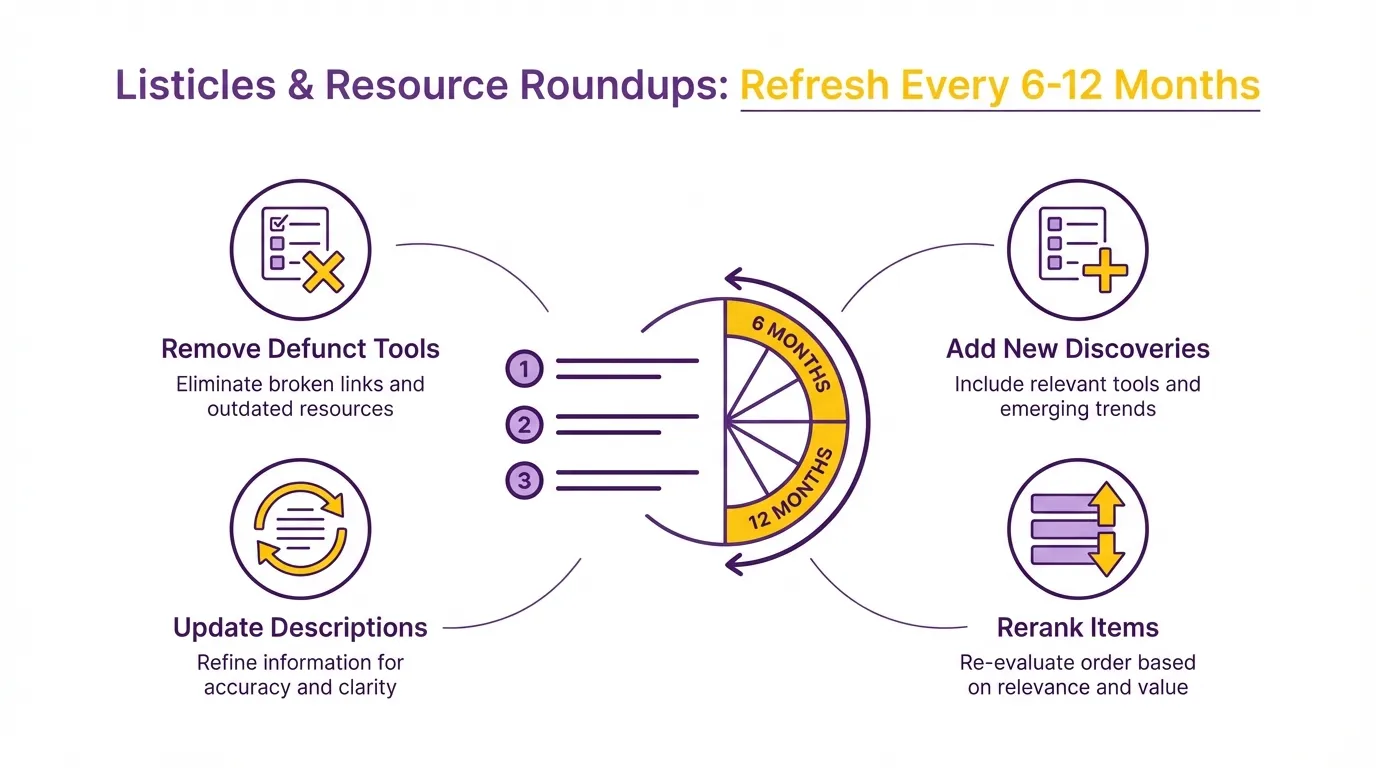
Refresh frequency: Every 6-12 months
‘X Tools for Y’ posts can become outdated as tools change or disappear. Resource lists are also prone to broken links as websites change or services shut down.
These lists are also highly competitive; if your “21 SEO Tools” post still lists tools from 2021 while competitors feature 2026 options, you’ll lose rankings and credibility.
Actionable Steps:
- Remove defunct resources or tools that have shut down.
- Add exciting discoveries or tools that launched recently.
- Update descriptions to reflect current features and pricing.
- Re-rank items if their relative value has changed.
- Refresh screenshots or preview images.
- Verify all links still work correctly.
- Add new categories if the landscape has evolved.
- Update your introduction to reflect current market conditions.
13. Case Studies

Refresh frequency: Every 12-18 months
Case studies help build trust, but they can seem outdated if the results are from years ago. The upside is you can update older case studies with long-term results, which new ones can’t offer.
Adding updates like ‘where are they now’ shows long-term success and gives extra proof that your methods work.
Actionable Steps:
- Add follow-up information to existing case studies showing long-term results and sustained success.
- Create update sections with “1 year later” or “3 years later” analysis.
- Incorporate new metrics or KPIs that have become available.
- Add client quotes reflecting on long-term impact.
- Update methodology sections if your processes have improved.
- Create new case studies that reflect current methods and more recent successes.
- Anonymise or remove case studies where clients have since had adverse outcomes.
- Ensure all data visualisations and charts are up to date.
14. Glossary and Definition Pages

Refresh frequency: Every 18-24 months
Terms change quickly in fields like tech, marketing, and healthcare. A glossary from a few years ago is likely to miss many new terms that are now common.
Definition pages are more useful when you add examples, related terms, and clear up common misunderstandings.
Actionable Steps:
- Update definitions to reflect current usage and industry consensus.
- Add new terms that have emerged in your field.
- Expand brief definitions with examples and context.
- Improve clarity based on common misunderstandings you’ve observed.
- Add related terms and cross-references.
- Remove or mark as deprecated terms that are no longer commonly used.
- Include pronunciation guides for complex terms.
- Ensure all definitions align with authoritative industry sources.
15. Landing Pages

Refresh frequency: Every 6-12 months
Landing pages play a big role in driving conversions and revenue. Small changes to headlines, calls to action, or testimonials can make a big difference. Since offers and pricing change, it’s important to update these pages regularly.
Keep testing your landing pages and use what works best as your new standard for future updates.
Actionable steps:
- Test and update headlines to improve relevance and impact.
- Refresh calls to action with more compelling copy or design.
- Add recent testimonials and case studies as social proof.
- Update offers, bonuses, or limited-time promotions.
- Revise value propositions based on competitive positioning.
- Improve page load speed and mobile experience.
- Update imagery to reflect current branding.
- Add trust badges or security certifications.
- Refine form fields to reduce friction.
- Ensure all tracking and analytics code works correctly.
Tip: Set up a content refresh calendar to regularly review your most important pages. This helps ensure nothing gets missed and that your content stays up to date.
Your 5-Step Content Refresh Strategy
Now that you know what to update and why, here are the steps to follow.
Step 1: Audit Your Content and Gather Data

Start by making a list of all your content. Use tools like Google Analytics or Search Console to help you see what’s working and what needs attention.
Key metrics to track:
- Organic traffic trends (increasing, stable, or declining)
- Keyword rankings (especially pages ranking positions 5-20)
- Click-through rates from search results
- Bounce rates and time on page
- Conversion rates were applicable.
- Last modified dates
- Backlink profiles
Put this data into a spreadsheet and look for trends. Check which pages have lost traffic in the last 6-12 months and which ones are close to ranking on page one.
Pro tip: Focus on “quick wins”, pages that already have decent traffic, some backlinks, and rank just outside the top 10. These offer the highest return on your refresh investment.
Step 2: Prioritise Content for Refreshing

You can’t update everything at once, so it’s important to set priorities. Use these criteria to decide what to tackle first:
High priority:
- Pages with declining traffic that previously performed well
- Content ranking positions 5-20 for valuable keywords
- High-value commercial pages (services, products, landing pages)
- Content with deep impressions but low CTR
- Posts with significant backlinks but poor performance
Medium priority:
- Evergreen content that still performs reasonably well
- Pillar content and comprehensive guides
- Content with moderate traffic that could be improved
Low priority:
- New content (less than 6 months old)
- Thin content that should be consolidated or deleted
- Content that has never performed well despite optimisation
Step 3: Analyse Competitors and Search Intent

Before making updates, check what is currently ranking on page one for your target keywords. Search intent can change, so what worked before might not work now.
Questions to ask:
- What format are the top results using? (guides, lists, videos, tools)
- What topics and subtopics do they cover?
- What’s their content depth and word count?
- What unique angles or information do they provide?
- What questions do they answer that you don’t?
- Are there gaps you can fill better than competitors?
Don’t just copy what competitors are doing. Look for ways to add more value, better examples, or clearer explanations to stand out.
Step 4: Update Old Content SEO Elements

When you’re ready to update your content, focus on these areas:
Update factual information:
- Replace outdated statistics with current data.
- Fix broken links (internal and external)
- Update examples and case studies
- Refresh dates and time-sensitive references
- Verify all information is still accurate.
Enhance content quality:
- Add new sections covering gaps or new developments.
- Improve readability with shorter paragraphs, subheadings, and bullet points.
- Include relevant visuals (images, infographics, videos)
- Add expert quotes or external perspectives.
- Expand thin sections with more depth.
Optimise on-page SEO:
- Refine title tags and meta descriptions with current keywords.
- Optimise header tags (H1, H2, H3) for better structure
- Add or update internal links to newer relevant content.
- Incorporate semantic keywords and related terms naturally.
- Update image alt text for accessibility and SEO
- Ensure mobile-friendliness and fast loading speeds.
Improve engagement elements:
- Strengthen your introduction to hook readers immediately.
- Update calls to action to reflect current offers or goals.
- Add interactive elements where appropriate (calculators, quizzes)
- Include social proof (testimonials, data, authority mentions)
- Create compelling featured snippets opportunities.
Pro tip: When working with a professional SEO agency in Singapore like MediaOne, they can help identify which elements need updating and execute these changes strategically for maximum impact.
Step 5: Monitor Performance and Iterate
After publishing your refreshed content, your work isn’t quite done. Track performance over the following weeks and months to assess impact:
Monitor these metrics:
- Ranking changes for target keywords
- Organic traffic fluctuations
- Click-through rate improvements
- Engagement metrics (bounce rate, time on page)
- Conversion rate changes
- Indexing and crawling activity
You should start to see results from a content refresh in 2-4 weeks, with bigger changes after 2-3 months. If nothing improves, look for the reasons why.
- Did search intent change more than you realised?
- Are competitors still outperforming you significantly?
- Do technical SEO issues need addressing? Check our technical SEO Audit blog for more information.
- Is the content truly meeting user needs?
Keep in mind, refreshing your content is not a one-time task. It’s an ongoing part of a strong content strategy.
Making Content Refresh Part of Your Marketing Strategy

The most successful businesses don’t treat content refreshes as occasional projects; they build them into their ongoing digital marketing services workflow.
Create a sustainable refresh schedule:
- Monthly: Review analytics to identify declining content
- Quarterly: Refresh 5-10 high-priority pages
- Biannually: Update all pillar content and major guides
- Annually: Conduct comprehensive content audits.
Build a content refresh workflow:
- Set up automated alerts for ranking drops.
- Create templates for tracking refresh projects.
- Document what was changed and why
- Assign clear ownership of content categories.
- Integrate refreshing into editorial calendars.
Measure ROI for refresh efforts: track time invested vs. results achieved. Calculate metrics like:
- Traffic increase per hour invested
- Ranking improvements per page refreshed.
- Conversion lift from updated pages
- Cost comparison: refresh vs. creating new content
The Future of Content Refreshing

As Google’s algorithms get smarter and users expect more, keeping your content fresh is more important than ever. Search engines now look at how well you maintain your content, not just what you publish.
The AI Content Tsunami
With AI-generated content flooding the web at unprecedented volumes, the internet is becoming increasingly saturated with generic, templated information. Millions of AI-written articles are published daily, many of which lack the depth, nuance, and real-world experience that human expertise provides.
This flood of generic content means that well-maintained, regularly updated content stands out and becomes even more valuable. Content that is kept up to date, includes new data, and shows real expertise will stand out from the rest.
Google’s Evolving Priorities
Recent algorithm updates clearly signal Google’s direction. The emphasis on E-E-A-T (Experience, Expertise, Authoritativeness, Trustworthiness) and the Helpful Content Update both reward content that demonstrates genuine value and current relevance. Google is now better at identifying content that has been regularly updated compared to pages that haven’t changed since publication.
Search engines are also becoming more sophisticated at detecting “content decay”, the gradual decline in usefulness as information becomes outdated. Pages with old stats, broken links, or outdated advice are more likely to lose rankings to pages that are kept up to date.
User Behaviour Is Changing
Today’s users pay close attention to dates and quickly leave content that seems outdated or irrelevant. A blog post from 2019 with no recent updates signals neglect, and users interpret that as a potential lack of reliability.
Furthermore, with the rise of AI-powered search experiences and answer engines, content needs to stay current to remain eligible for featured snippets, AI overviews, and other prominent search features that drive significant traffic.
The Competitive Advantage
The reality is that most businesses still publish content and then move on without updating it. This approach is becoming less effective.
The brands that commit to ongoing content maintenance, treating their content library as living, breathing assets rather than static monuments, will dominate search results in the coming years. They’ll benefit from:
- Compounding returns as refreshed content builds upon existing authority
- Higher efficiency by maximising ROI from past content investments
- Sustainable competitive advantages that are harder for competitors to replicate
- Stronger brand authority as the go-to source for current, reliable information
- Better user trust from audiences who recognise their commitment to accuracy
Innovative organisations are moving from just creating new content to focusing on optimising and maintaining what they already have.
Instead of focusing solely on how often they publish, they’re working on content quality and ensuring it stays relevant. This includes setting up regular audits, refresh schedules, and budgets for content updates.
Ready to Breathe New Life Into Your Content?
Refreshing your content may not be flashy, but it works. While others focus on creating new content, you can improve your rankings, traffic, and conversions by updating what you already have.
The best time to start refreshing your content was earlier, but the next best time is now.
No matter your business size, having a system for refreshing your content will deliver results without the considerable time commitment of constantly creating new content.
And if you need expert help executing your content refresh, MediaOne can audit your content, identify opportunities, and handle the technical optimisation while you focus on running your business. Contact us today!
Frequently Asked Questions
Can refreshing content negatively affect my existing rankings?
When done correctly, content refreshing should maintain or improve rankings, not harm them. However, making drastic changes to well-performing content can temporarily cause ranking fluctuations while Google re-evaluates the page. The key is making strategic, data-driven improvements rather than wholesale rewrites of content that’s already ranking well.
Should I change the publication date when I refresh content?
Yes, you should add a “Last Updated” date whilst keeping the original publication date visible.
This signals freshness to both users and search engines without losing the authority that comes with older, established content. Many successful sites display both dates, “Published: January 2023 | Updated: January 2026”, to demonstrate both longevity and current relevance.
How do I know which content to refresh first if I have hundreds of blog posts?
Prioritise pages ranking in positions 5-20 (page one, bottom half, and page two top) for valuable keywords—these are your “quick wins” that can be pushed higher with relatively minor updates.
Also, focus on pages that previously performed well but have experienced a 20-30% traffic decline over 4-8 weeks. Use Google Search Console to identify high-impression, low-CTR pages, as these indicate content that’s visible but not compelling enough to click.
Is it better to refresh old content or delete it and start fresh?
Refreshing is almost always better than deleting and restarting. Existing content has accumulated authority signals, backlinks, and indexation history that new content must build from zero.
Only delete content that’s genuinely irrelevant, extremely thin, or cannibalising other pages. If the content has any backlinks or historical traffic, refresh it rather than deleting it; you’ll preserve the SEO equity whilst improving performance.
How long after refreshing content should I expect to see results?
Most content refreshes show initial results within 2-4 weeks, as Google recrawls and re-evaluates the updated page. Full impact typically becomes visible after 2-3 months, allowing time for rankings to stabilise and organic traffic patterns to establish.
If you’re not seeing any improvement after 8-12 weeks, revisit your changes to ensure they align with current search intent and address the factors causing the original decline.