| AI Summary
Brand mentions reveal how businesses are discussed across websites, social media, reviews and AI search platforms. This guide explains their SEO value, how they differ from backlinks and citations, and practical ways to track, measure and earn relevant mentions. It also covers AI search visibility, share of voice and a 30-day action plan to strengthen brand reputation. |
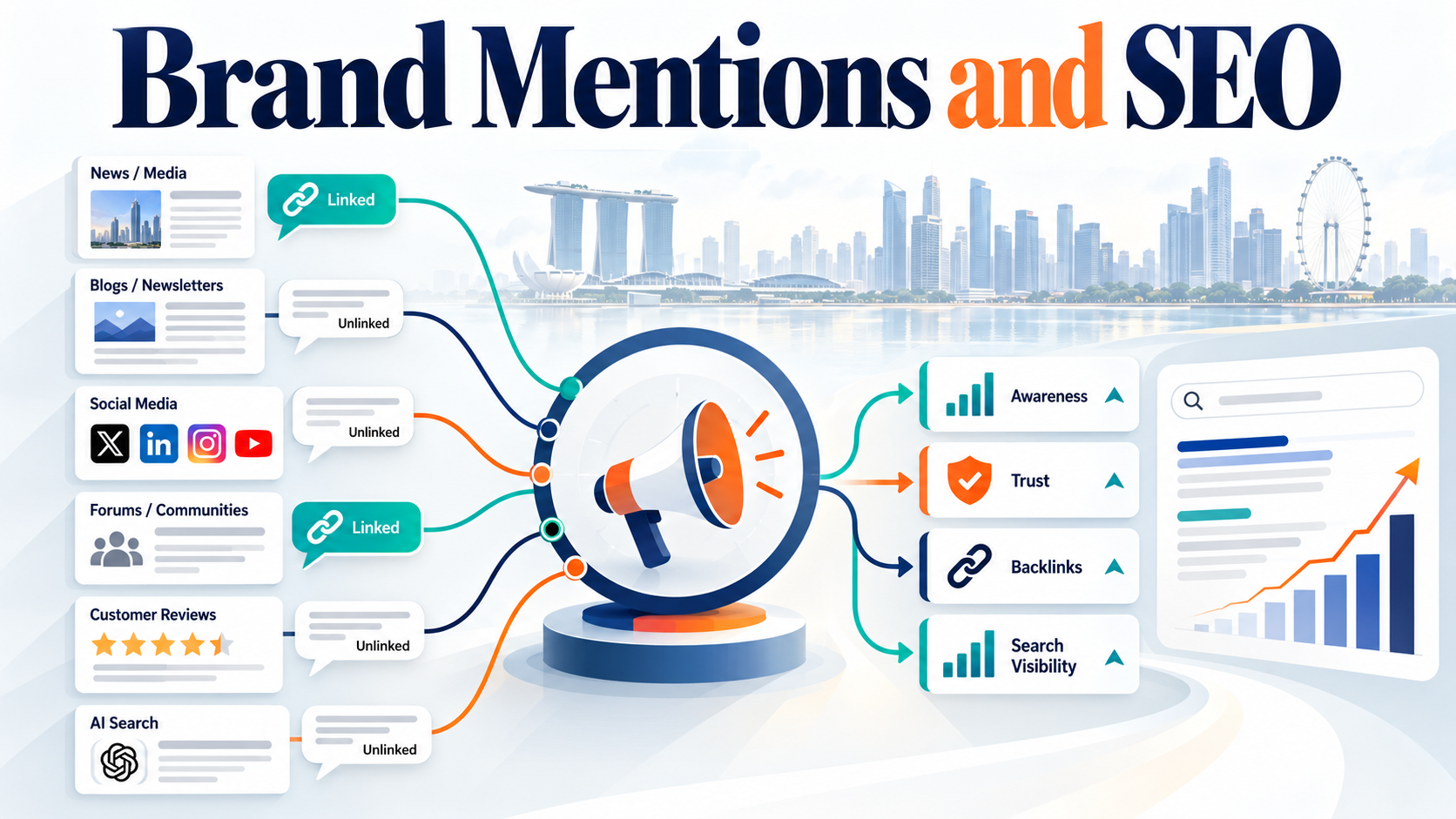
Brand mentions reveal where people discuss a business, what they associate with it and whether they recommend it. Some link to your website; others simply name your business.
For search engine optimisation (SEO), the distinction matters. Google documents links as a signal, but it does not confirm that an unlinked brand mention directly improves rankings. That does not make unlinked mentions worthless. They can influence awareness, customer research, reputation and opportunities to earn legitimate backlinks.
Key Takeaways
- Measure quality alongside volume. Check relevance, audience, sentiment and whether a mention attracts useful engagement.
- Separate mentions from links. A brand name in text is not automatically a backlink or a ranking signal.
- Monitor several channels. Search alerts alone will miss some social discussions, reviews and private conversations.
- Track AI responses separately. A named brand and a cited website are different outcomes.
- Prioritise action. Respond to important feedback, pursue sensible link requests and compare performance against relevant competitors.
What Are Brand Mentions?
A brand mention occurs when someone refers to a company, product, service or recognisable brand name in their content. For monitoring purposes, we usually focus on third-party references rather than every instance of a business naming itself.
Imagine a fictional Singapore accounting software provider called LedgerPoint. A technology journalist writing “LedgerPoint offers invoicing tools for small businesses” has created a brand mention. So has a customer discussing LedgerPoint in a forum, even if neither includes a hyperlink.
A mention can also contain a misspelling, product nickname or identifiable social handle.
Linked and unlinked brand mentions
A linked mention names a brand and includes a clickable link to its website. An unlinked mention identifies the brand without linking to it. Google’s link best practices explain that links help its systems discover pages and assess relevance. However, not every link carries the same weight.
An unlinked mention has no direct hyperlink to pass readers or link-related signals to the destination site. It may still prompt someone to search for the company or recommend it elsewhere. We treat those effects as possible business outcomes, not guaranteed ranking improvements.
Brand mentions, backlinks and local citations
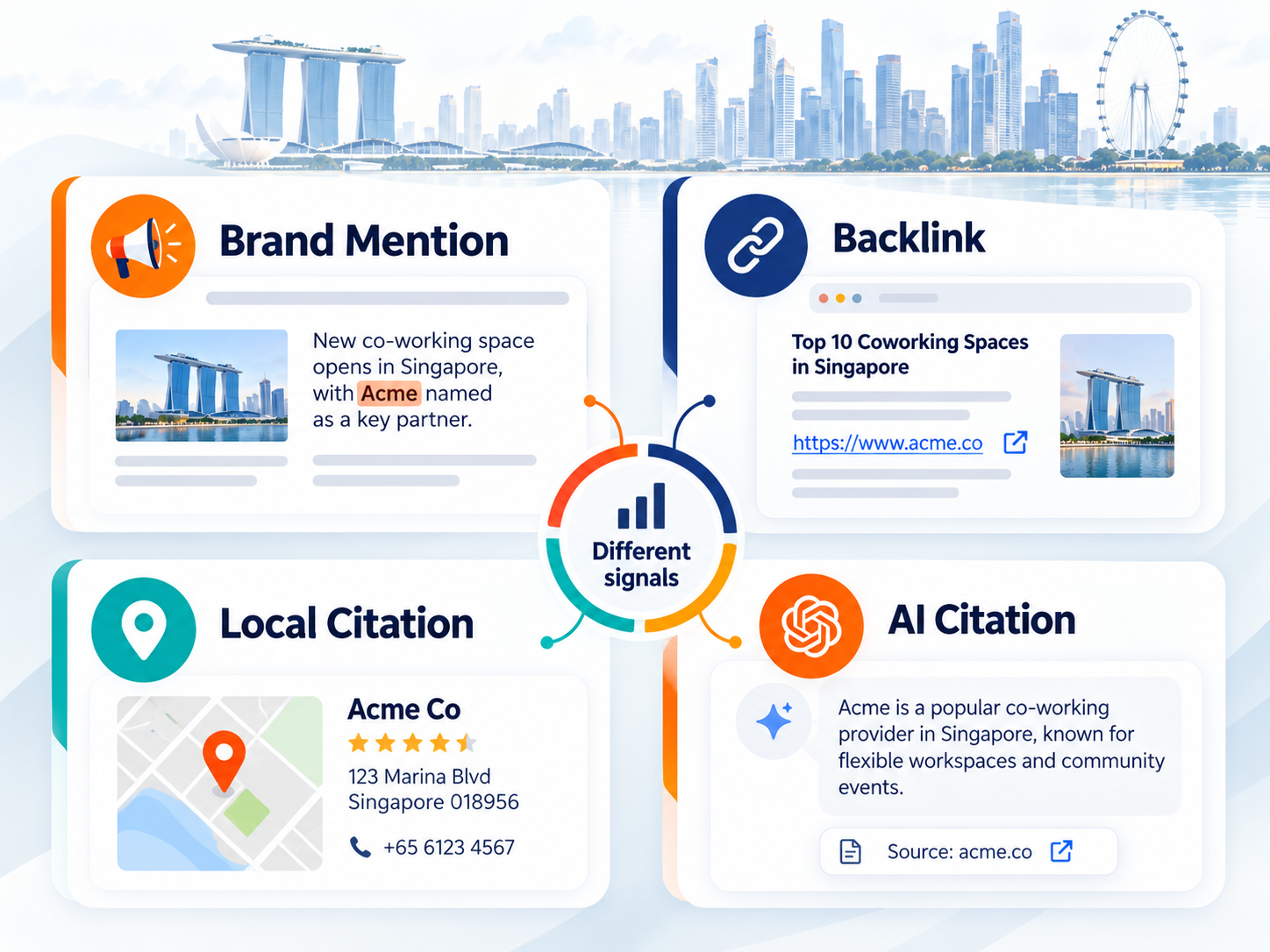
These terms are related but should not be reported as identical metrics:
- Brand mention: A recognisable reference to a business, with or without a link.
- Backlink: A hyperlink from another website to yours. Its anchor text need not contain your brand name.
- Local citation: A reference to business details, commonly the name, address and telephone number, in a directory or local listing.
- AI source citation: A link or source reference supplied alongside an AI-generated response. It is not necessarily a mention of your brand in the answer text.
Google says local visibility depends primarily on relevance, distance and prominence. It also identifies links and reviews among the information informing prominence in its local ranking guidance.
Why Brand Mentions Matter for SEO and Reputation
Brand mentions contribute to several connected goals. The strongest case is not that every reference raises rankings. It is that relevant third-party coverage can support discovery, credibility and demand.
Build awareness among relevant audiences
A mention in a specialist publication may reach fewer people than a viral post but produce more qualified interest. An enterprise software company, for example, may value a recommendation in a respected industry newsletter over hundreds of generic comments.
We therefore assess audience fit before estimated reach. A credible mention in the right buying context can lead to research, website visits or direct enquiries.
Create opportunities for earned links
Editorial coverage sometimes mentions a business without linking to its website. If a link would genuinely help readers verify a claim, explore a study or find the product, a polite request is reasonable.
That request must remain editorially appropriate. Google warns against links created primarily to manipulate search rankings in its spam policies. We would not buy undisclosed placements or pressure publishers to insert keyword-heavy links.
Improve customer trust and service decisions
Reviews and community discussions show what customers appreciate or find frustrating. Repeated complaints about delivery times may indicate an operational problem. Positive comments about responsive support may reveal a useful message for future campaigns.
These findings matter even when they never produce a backlink. They can help refine customer service, website copy and product explanations. For local businesses, Google also confirms that reviews and helpful owner responses can contribute to visibility and customer confidence.
Strengthen the evidence behind your content
Journalists and buyers need something credible to reference. Original research, clear product information and documented case studies give them that evidence. They also create useful material for our broader SEO services and content strategy discussions.
The Main Types of Brand Mentions
Linked and unlinked describe the presence of a hyperlink; the categories below describe where the reference occurs.
| Mention source | What it reveals | Useful next action |
|---|---|---|
| News and trade media | Editorial visibility and topic relevance | Check accuracy and potential referral value |
| Blogs and newsletters | Specialist recommendations and comparisons | Assess audience fit and possible links |
| Social media | Public discussion, campaign reaction and complaints | Respond or engage when appropriate |
| Forums and communities | Detailed experiences and purchase questions | Identify recurring needs without promoting aggressively |
| Customer reviews | Service quality and reputation risks | Reply and address legitimate issues |
| Directories and local listings | Business identity and contact consistency | Correct inaccurate details |
| AI-generated answers | Visibility for selected prompts and buying questions | Track brand inclusion and cited sources separately |
Editorial and industry mentions
These include articles, interviews, expert commentary and research round-ups. Relevance matters more than a publication’s reputation alone. A niche trade journal may reach precisely the decision-makers a business wants.
Check whether the mention is accurate, prominent and discoverable. Record a link when one exists, but do not assume that every editorial reference will send measurable traffic.
Social, community and review mentions
A public social post may generate immediate engagement. A forum thread can remain useful for months as potential buyers research products. Reviews often capture detailed experiences that marketing teams would otherwise struggle to collect.
Not every social network exposes all posts to third-party monitoring tools. Private groups, restricted accounts and platform access rules create gaps. Any report should acknowledge those limits rather than claim complete coverage.
Positive, neutral and negative mentions
Sentiment describes tone, not value. A negative review may expose a service problem that deserves an urgent response. A positive mention from an unrelated account may offer little commercial benefit.
Automated sentiment labels also make mistakes with sarcasm, mixed reviews and local language. We recommend manually checking high-impact mentions before escalating them or using them in executive reports.
How to Find and Monitor Brand Mentions
Define what counts, collect mentions consistently and prevent duplicates from distorting your totals.

Step 1: Build a useful list of search terms
Begin with your official company name, common abbreviations, product names and recognised spelling variations. Add leadership names only when they clearly relate to the organisation and your monitoring purpose.
For ambiguous names, combine the brand with its industry or location. Exclude unrelated meanings and your own domains where the tool allows.
Step 2: Set up Google Alerts
Google Alerts is a free starting point for tracking some newly indexed web results. Google’s official instructions allow you to choose frequency, sources, language, region and result volume.
Create separate alerts for the brand name, major products and high-priority executives. Review results weekly, then move useful findings into a shared log. Alerts do not monitor every social post or private discussion, so avoid treating them as an exhaustive brand database.
Step 3: Check reviews and priority platforms directly
Review the sites that matter to your customers. A hospitality brand might prioritise Google reviews and booking platforms. A software company may focus on specialist comparison sites, communities and professional networks.

For verified Google Business Profiles, owners can read and reply to customer feedback through Google’s review management tools. Keep responses factual and avoid disclosing personal information. Escalate serious safety, privacy or legal allegations through an appropriate internal process.
Step 4: Evaluate paid monitoring tools
Tools such as Awario and dedicated social listening platforms can combine several public sources, apply keyword rules and support reporting. Coverage varies by provider and platform, so test the channels your customers actually use before purchasing.
Awario’s documentation currently describes a seven-day free trial with no credit card required. Its pricing page lists plan limits. Check current terms before committing, because prices, quotas and access can change.
During a trial, compare the tool against a manual sample. Look for missed mentions, irrelevant matches, duplicate posts, export restrictions and the time needed to classify results. A cheaper tool that misses your most important review channel may be poor value.

Step 5: Maintain one monitoring log
Use a spreadsheet or reporting platform with consistent fields:
- Publication date and discovery date
- Source URL, platform and country
- Exact brand or product mentioned
- Linked or unlinked status
- Topic, sentiment and audience relevance
- Estimated importance, assigned owner and response status
Where the same story is syndicated widely, identify the original article and record republications separately. This helps distinguish genuine independent coverage from repeated copies.
How to Measure Brand Mentions That Matter
Raw mention volume answers only one question: how many matching references your system found. It does not tell you whether recognition, customer confidence or commercial results improved.
Track reach, relevance and sentiment
Start with the number of unique mentions by channel. Then record relevant source characteristics, such as specialist audience, editorial credibility and whether the context relates to a product or purchase decision.
For sentiment, report positive, neutral, negative and unclear results. A large rise in mentions following a complaint is not automatically good performance. Pair the totals with a short explanation of what drove the change.
Share of voice estimates your portion of monitored discussion against selected competitors. Use the same source set, matching rules and date range for every company.
For example, suppose the tool finds 40 relevant mentions for your brand and 60 for two competitors combined. Your monitored share of voice is 40 ÷ 100, or 40%.
Connect mentions to search and business results
Choose indicators that match the purpose of each campaign. A public relations campaign may be judged on relevant editorial coverage and referral enquiries. A customer care programme may focus on response times and recurring complaint themes. An AI visibility initiative may use a stable prompt panel. Combining these outcomes into one headline score can conceal important differences, so explain the purpose of each metric in your report.
Use analytics to examine referral traffic from linked coverage. In Google Search Console, compare branded search impressions and clicks before and after significant campaigns. Google’s branded and non-branded query filter supports this distinction for eligible properties.
Also review qualified enquiries, assisted conversions and customer feedback. Do not assign causation without stronger evidence.
Use a practical priority scorecard
We suggest an internal triage score, not a supposed Google ranking formula. Give each mention 0 to 2 points for the following factors:
| Factor | 0 points | 1 point | 2 points |
|---|---|---|---|
| Audience relevance | Unrelated | Partly relevant | Directly relevant |
| Source credibility | Unclear | Established source | Strong, verifiable expertise |
| Business significance | Little impact | Useful awareness | Clear buying or reputation impact |
| Action opportunity | None apparent | Worth monitoring | Specific useful action available |
A score of 6–8 suggests a useful opportunity to review promptly. Scores of 3–5 generally warrant monitoring. Scores of 0–2 are lower priority unless they contain misinformation or an urgent complaint.
Do not include sentiment as a simple reward for positivity. Use a separate escalation flag for serious reputation risks.
How to Earn More Relevant Brand Mentions
The sustainable approach is to create something people genuinely want to discuss or reference. We recommend treating mentions as an outcome of useful work rather than a quota to manufacture.
Publish original, reference-worthy material
Research using transparent methods gives journalists and industry writers something specific to cite. Useful formats include pricing comparisons, local market surveys, data-led reports and practical calculators.
State your methodology and limitations. An unsupported statistic can spread quickly but weaken trust when challenged.
Contribute credible expert commentary
Offer journalists direct answers to questions within your expertise. Keep quotations concise, disclose commercial interests and provide evidence where a claim needs support.
We would prioritise relevant trade publications over mass distribution with no clear audience.
Encourage genuine customer reviews
Make it easy for customers to share honest experiences. Ask after a completed purchase or successful service interaction, and respond professionally to critical feedback.
Google’s review policies and guidance prohibit incentives for reviews or for changing or removing negative reviews. Avoid selectively manufacturing praise. Authentic feedback supports better decisions for both the business and prospective customers.
Recover worthwhile unlinked mentions
Search for accurate, relevant references that lack a website link. Before contacting the publisher, ask whether linking would genuinely help a reader locate the study, product or original source.
Identify the exact page, thank the writer and suggest the most useful destination. Do not demand specific anchor text or repeatedly chase editors who decline. An unlinked mention may already be valuable for brand awareness.
Participate in communities without spamming
Answer questions where your expertise helps, even when there is no immediate sale. Disclose your affiliation and follow community rules. Repeated promotional replies can damage credibility and create the wrong kind of attention. A coherent social media marketing strategy can identify the topics, groups and formats worth supporting.
Brand Mentions in AI Search: What Changes?
ChatGPT, Gemini, Perplexity and Google’s AI search features can name brands directly in generated answers. That creates a new measurement question: does your business appear when people ask category, comparison or purchasing questions?
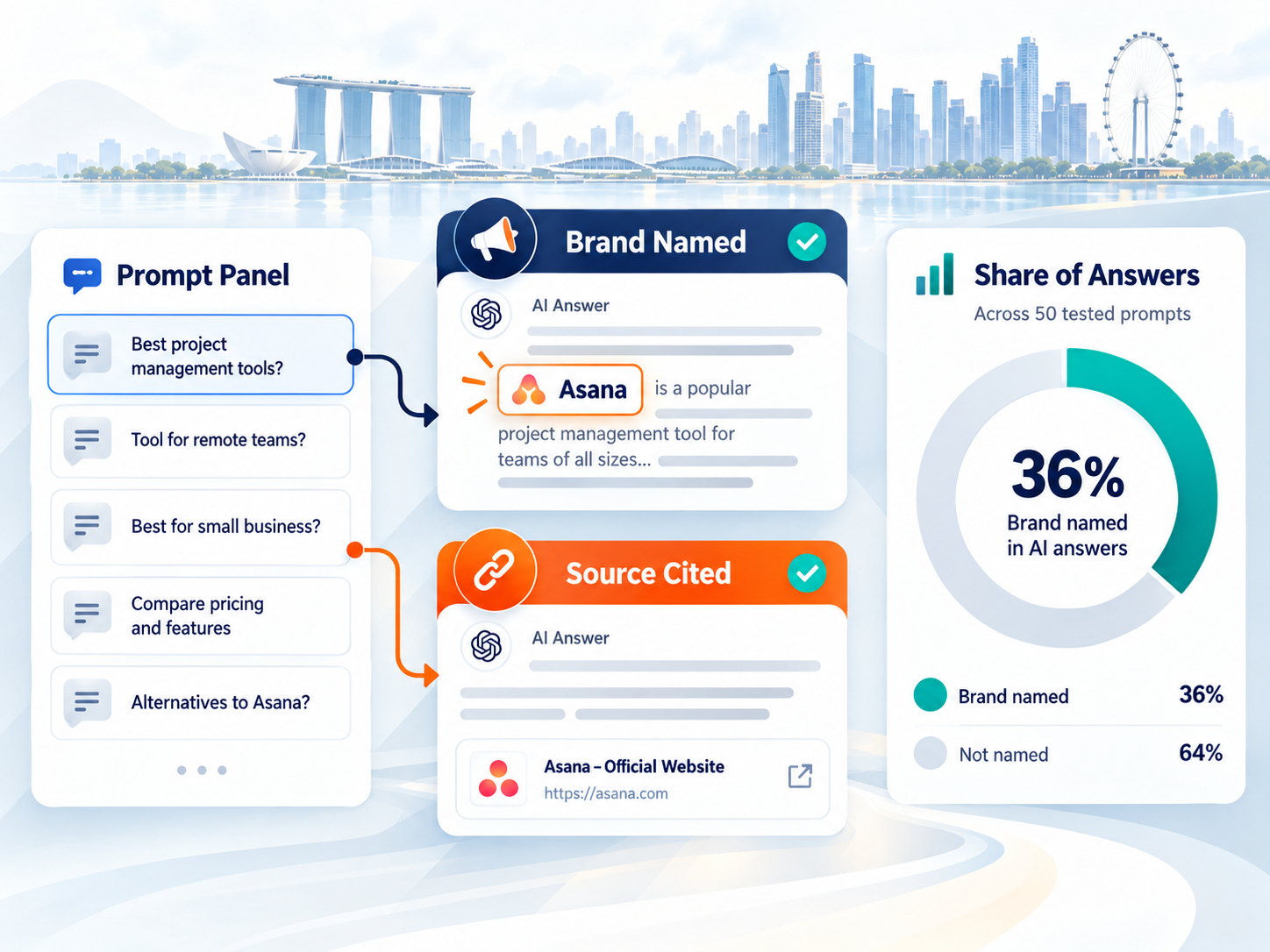
A brand mention in an AI answer means the response names the company. A source citation means the answer references a page or domain. A cited article might discuss several brands without the answer naming yours.
How AI answers use web sources
Some AI experiences retrieve online material before preparing an answer. Perplexity describes its search product as synthesising web sources with citations. OpenAI likewise explains that ChatGPT Search may include links to relevant sources.
We cannot reliably infer a universal formula for brand selection. Even when an unlinked article appears in a retrieved source, that does not prove the article caused the model to recommend a brand.
Google’s 2026 generative AI guidance reinforces useful original content, crawlability and established SEO practices. It discourages chasing inauthentic mentions or supposed AI-only optimisation tricks.
Build a repeatable AI visibility test
A small prompt panel provides useful directional evidence. Choose 15–25 prompts reflecting real customer questions, including category searches, comparisons and problems your product solves.
For each engine, use the same prompts, region and testing approach on a regular schedule. Start fresh conversations where practical, record the date and note any relevant account or location settings. Repeat a sample to identify response variation rather than trusting one answer.
Log whether your brand appears, which alternatives appear, how the description reads and whether the engine cites your website or another publisher.
If your brand appears in 6 of 20 tested prompts, its share of answers is 30% for that panel and engine. Show both numerator and denominator. Compare results only when the prompt set and testing conditions remain sufficiently consistent.
For example, Ahrefs Brand Radar distinguishes mentions, citations and AI share of voice. Its results remain estimates based on observed outputs, not access to everyone’s private AI conversations.
Google also introduced a Generative AI performance report in Search Console. Google says the report covers impressions for pages shown in AI Overviews and AI Mode, with worldwide rollout completed on 31 August 2026. Properties without sufficient impressions may not display the report.
That report measures website visibility in Google’s AI search features. It does not replace brand-name tracking inside ChatGPT or Perplexity. Use each method for the question it can actually answer.
A 30-Day Brand Mentions Action Plan
Our recommended starting plan focuses on establishing a reliable baseline before expanding outreach.
Days 1–7: Define and collect. List your brand variations, two or three relevant competitors and priority platforms. Set up Google Alerts, review existing coverage and create a central log. Exclude your own routine promotional posts from earned-mention totals.
Days 8–14: Audit the quality. Deduplicate results, classify source types and review sentiment. Investigate important complaints. Identify relevant unlinked references where a link would help readers, and draft polite outreach for the strongest opportunities.
Days 15–21: Test AI visibility. Build a consistent 20-prompt panel. Run it across your chosen engines, save results and calculate share of answers. Check Search Console for branded query performance and any available generative AI reporting.
Days 22–30: Act and report. Publish or pitch one genuinely useful resource, respond to outstanding reviews and test a monitoring platform if needed. Report mention quality, share of monitored voice, referral activity and emerging reputation issues.
Repeat the review monthly.
Frequently Asked Questions
Do unlinked brand mentions improve Google rankings?
Google has not confirmed unlinked brand mentions as a direct ranking signal. They can still support awareness and may lead to branded searches, referrals or future editorial links, but those outcomes require separate measurement.
What is the difference between a brand mention and a backlink?
A brand mention is a reference to a business, whether linked or unlinked. A backlink is a hyperlink to a website, and its visible anchor text may not name the brand at all.

How can I monitor brand mentions for free?
Start with Google Alerts, manual searches and the review platforms your customers use. Log sources consistently, but expect gaps in social and private-channel coverage.
How do I measure brand mentions in ChatGPT and Perplexity?
Test a fixed set of realistic prompts regularly and record whether the answer names your brand. Track cited domains separately, since a citation and an answer-level mention measure different things.
Should I respond to every negative brand mention?
No. Prioritise credible complaints, factual errors and posts that could affect customers. Respond calmly where useful, and escalate serious issues rather than entering prolonged public arguments.
How many brand mentions should my business aim for?
There is no universal target. Establish a baseline, compare relevant competitors and prioritise mentions that reach the right audience or generate useful business outcomes.
Turn Brand Mentions Into Measurable Search Visibility
Brand mentions are useful when they reveal where your business earns attention, how people describe it and which conversations need action. Their value depends on relevance, credibility and context. A higher count alone is not a reliable measure of progress.
We recommend starting with consistent monitoring, a simple priority framework and clear separation between unlinked mentions, backlinks and AI citations. Then invest in original material, credible coverage and customer experiences worth discussing.
For businesses that need a coordinated approach, our SEO team can connect earned visibility with technical search performance, content planning and measurable business goals. The objective is clear: turn relevant attention into evidence you can use, decisions you can defend and opportunities worth pursuing.