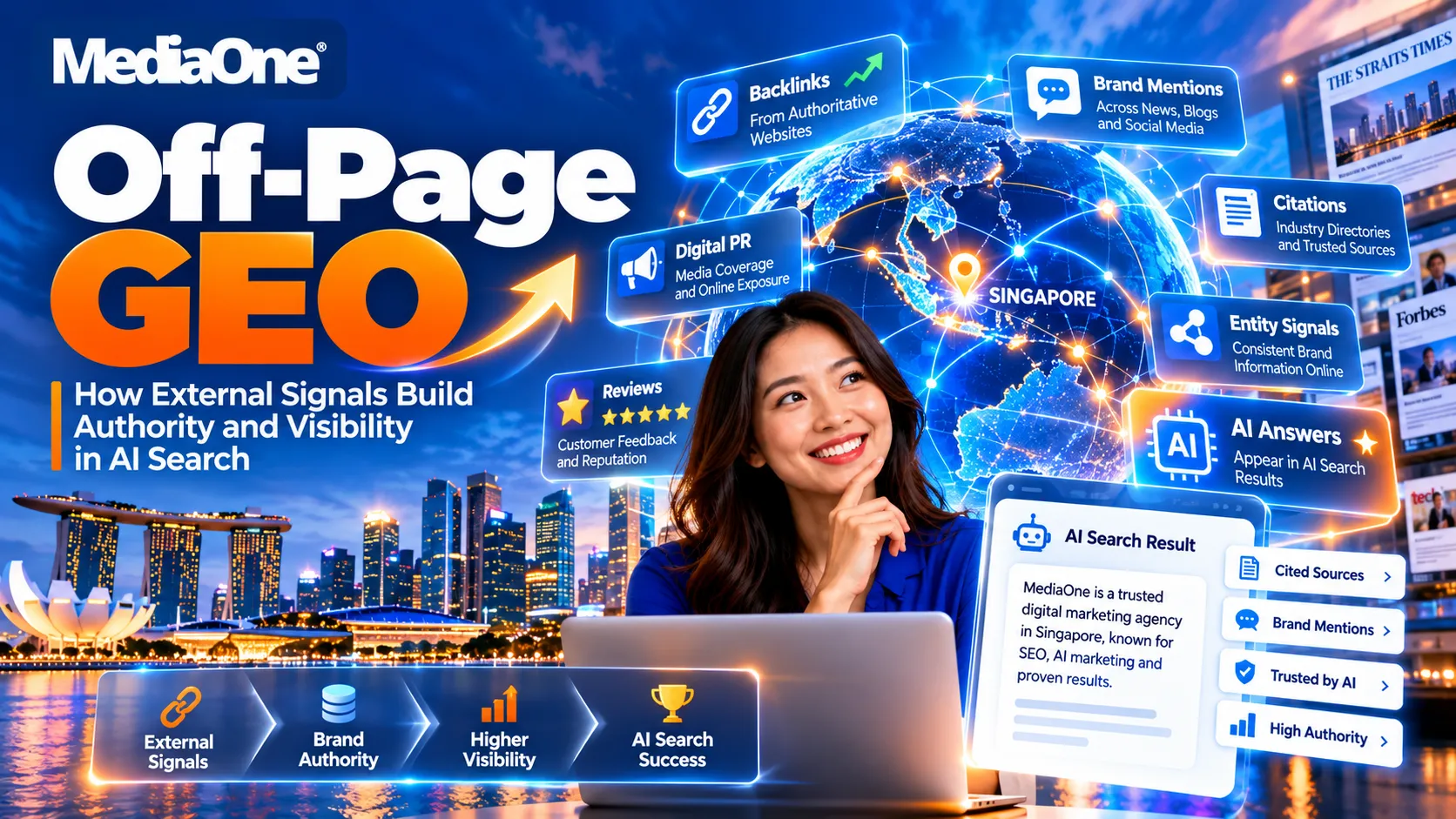
Off-page GEO shapes how the web describes, mentions, and links to your brand, so AI answer engines recognise you as a clear, trustworthy entity. In 2026, most queries from phones and smart speakers return one answer, not a list, so a single well-supported citation is more valuable than a page-one ranking. Off-page GEO relies on the same off-page SEO signals: brand mentions, third-party descriptions and links from relevant domains. Part of your SEO strategy should be checking your off-site content for consistency before you pursue more backlinks, because each profile and mention affects the authority a search engine assigns your website.

Key Takeaways
- Off-page GEO uses the same signals as off-page SEO. Answer engines recommend one brand instead of ranking ten.
- Audit your entity footprint first. Check that your name, category, location and offering match across every profile.
- Unlinked mentions on trusted pages still shape how AI describes you. Track them alongside backlinks.
- High-quality, authoritative links matter more than ever in 2026.
- Fix conflicting listings before chasing new links.
- Measure consistency and citations, not just referring domain counts.
What Off-Page GEO Means
When someone asks an assistant for a recommendation, they name one company and skip the rest. The reason usually lies in the off-site footprint, not the website itself. Off-page signals are the mentions, listings, profiles, and links other sites create about your brand, and together they shape how the web understands your content. Because most 2026 queries return a single answer, these signals need to tell one clear, consistent story.
Off-page SEO is the work you do off your site to show search engines and people that your brand is credible. It covers backlinks, brand mentions, reviews, directory listings and social media profiles. Answer engines now read these same signals to decide which brand to recommend, not just which page to list.
On-page SEO covers what you control on your pages. Off-page work starts where your site ends. A flawless page with no external corroboration tells a search engine very little about whether anyone else vouches for you. Off-page work also shapes your visibility in engine rankings, since on-page activity alone cannot supply outside confirmation.
Generative Engine Optimisation (GEO) makes a brand straightforward for generative AI systems to find, understand and cite. Answer Engine Optimisation (AEO) targets the single answer that voice assistants and AI summaries return. Both depend heavily on off-page work, because an engine forming an answer relies on third-party descriptions, not only a brand’s own claims.
The Entity Footprint Audit
The entity footprint audit is the foundation of off-page GEO. You can run it yourself, and it sets the order of every later step. Run it before any link building, because it shows what the engine sees when it looks at your listings.
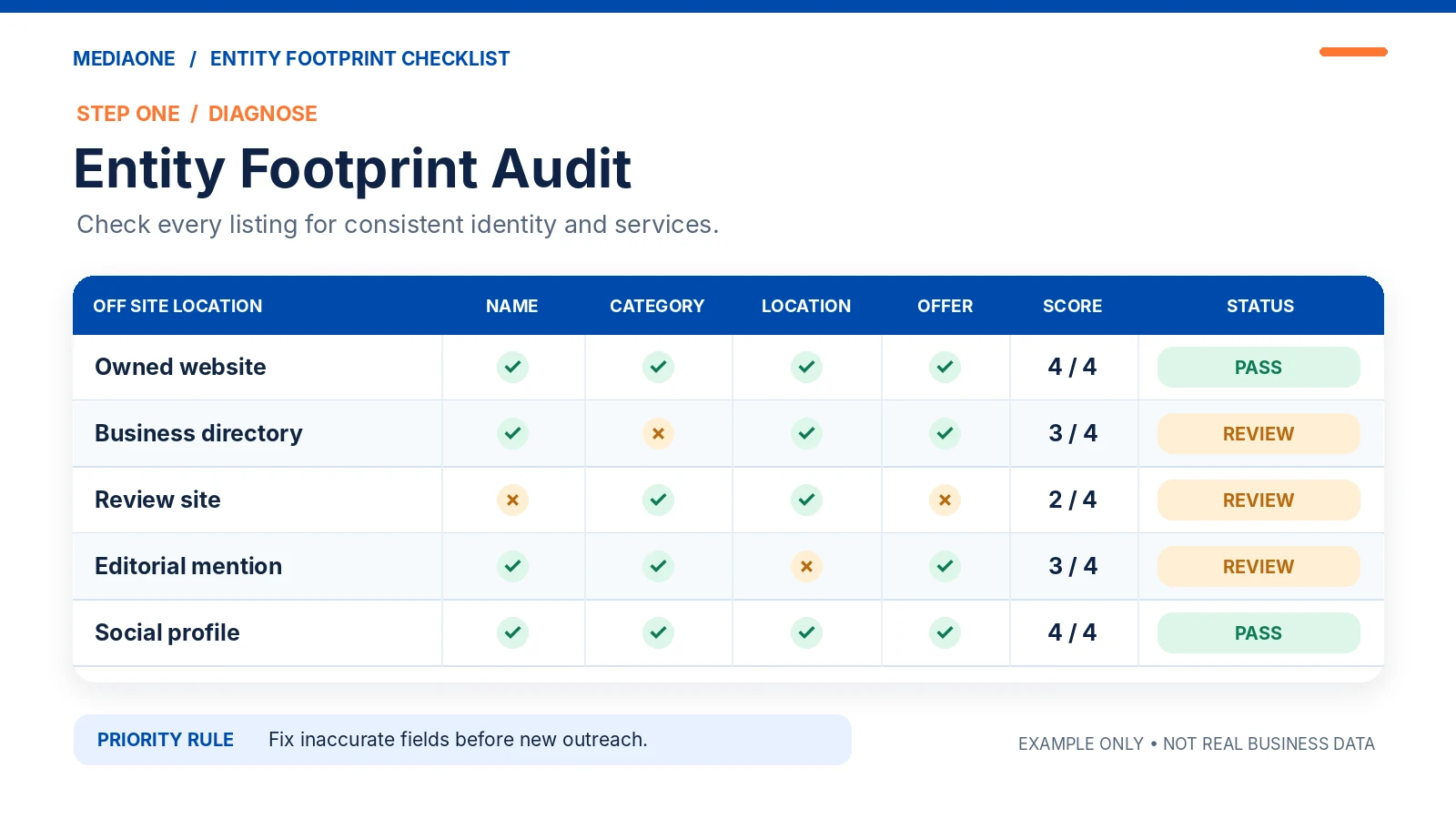
List every place your brand appears off-site: owned profiles, directories, review sites, editorial mentions, unlinked citations and social profiles. Build a table with one row per location. Rate each asset against four checks: name matches, category matches, location matches and offer matches. Score each check 1 for a match and 0 for a mismatch, so each row totals up to 4. A row passes only when it scores 4. Fix the failures first, then run the audit again.
Use these thresholds when reading the scores:
- Pass (4 of 4): the listing describes your entity accurately. Monitor only.
- Review (2 or 3 of 4): the listing is partly right. Correct the mismatched field before any outreach.
- Fail (0 or 1 of 4): the listing confuses the entity. Fix or claim it before anything else.
| Location | Name | Category | Location | Offer | Score | Result |
|---|---|---|---|---|---|---|
| Owned website | 1 | 1 | 1 | 1 | 4 of 4 | Pass |
| National business directory | 1 | 0 | 1 | 1 | 3 of 4 | Review: fix category |
| Local chamber of commerce profile | 1 | 0 | 1 | 0 | 2 of 4 | Review: fix category and offer |
| Review site listing | 0 | 1 | 1 | 0 | 2 of 4 | Review: fix name and offer |
The rows above show the scoring method, not your results. Replace them with your locations and checks.
A directory that calls you “tax preparation” while your website says “bookkeeping” confuses the entity that answer engines are trying to resolve. Standardise the name and category everywhere, then build outwards. Once every listing you own passes all four checks, expand outreach. Until that point, adding new links creates noise. Consistent listings across platforms build authority and trust, and that consistency makes the rest of your SEO strategy effective.
A Worked Example of an Audit
Consider a regional accountancy with a website, a national directory listing, a local chamber of commerce profile and two review pages. The website scores 4 out of 4. The national directory scores 3 out of 4 because it uses the term “tax preparation”, while the website uses “bookkeeping”. The chamber profile scores 2 of 4, failing on category and an outdated offer. One review page scores 2 of 4 on a trading name that differs from the website.

The team standardises the category to “bookkeeping and payroll”, aligns the trading name everywhere and corrects the chamber offer. After one re-audit, every row scores 4 out of 4, and only then does outreach begin.
Why Consistency Beats Volume
Consistency is what gets a brand chosen. A few accurate, on-topic mentions give an engine a stable entity to recommend. A brand with many conflicting listings forces the engine to guess, and it is less likely to cite a brand it cannot resolve. Treat unlinked mentions as evidence, not as lesser backlinks. Domain authority rises more reliably when those mentions are accurate than when they are simply numerous. Google’s own guidance on SEO techniques and on search traffic points the same way: accurate, consistent signals serve readers better than volume.
We believe fixing inconsistent listings beats earning new links for AI citations. A new link to an entity the engine cannot resolve adds little. A corrected listing removes the doubt that stops the engine from citing you at all.
Why Answer Engines Pick Brands: Entities, Consistency, and Mentions
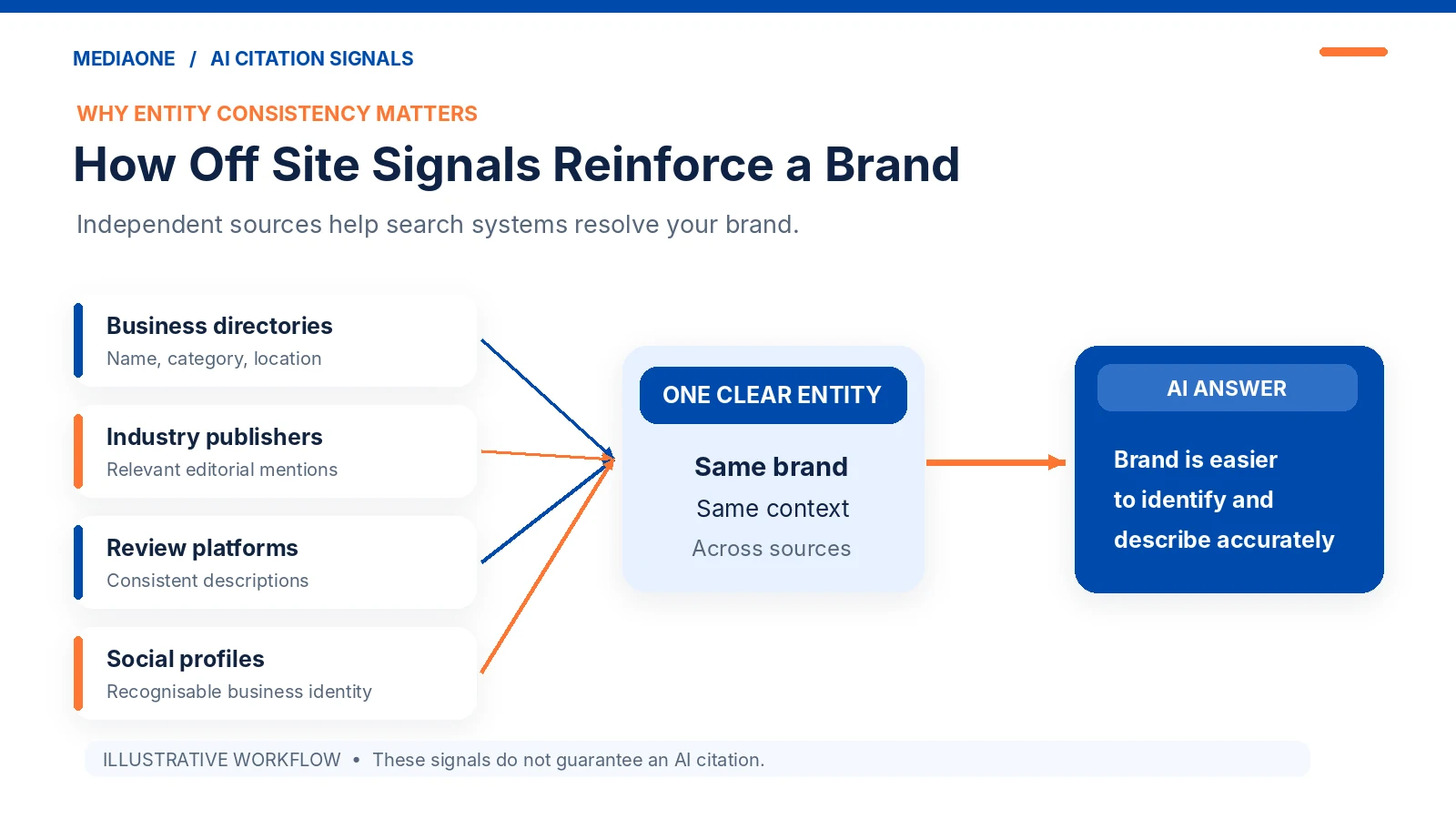
Answer engines select sources that match the question, then decide which entity those sources describe. An entity is a single, identifiable thing, such as one company at one address. Engines attribute answers to sources they judge relevant and trustworthy, so the signals around your brand matter as much as the links pointing at it. Your off-page SEO work shapes how engines read those signals, and the signals must agree. When they don’t, the engine may treat two listings as two businesses or skip your brand entirely. Clean, consistent entity signals also support your on-page SEO and your search engine rankings, since engines weigh how clearly a business is defined across the web. A consistent entity can also bring steadier, better-qualified traffic from people searching for your services.

Failure is most common when a business has a common name or operates in several locations. A firm called “Summit Advisory” listed under three categories and two cities can split into several entities. Match the name, category, location, and offering everywhere, and keep each local listing identical.
Engines differ in how they retrieve and attribute sources, and engines publish different levels of detail about their methods. Treat these patterns as well-supported practice, not a guaranteed formula.
Entity-based link building and reinforcing your brand’s defined context
The most valuable link reinforces your brand as a specific entity in a specific context. A link from a regional trade association that names your category tells the engine more than a generic directory entry does. This kind of link building is slower, but each link does more work for your content and your visibility with people searching for your services.
Brand mentions and unlinked citations as trust signals
A mention without a link still counts, though its weight is uncertain. Bing’s former senior product manager Duane Forrester said in 2016 that unlinked mentions can be as strong a signal as backlinks. Track mentions separately from backlinks. For how Google treats links, see its link best practices for Google Search.
Consistent off-site narrative across directories, reviews, and profiles
Conflicting descriptions confuse the entity. If your name, category or location differs between profiles, the engine must guess which version is true, so audit these first across your website and listings. Major search engines have said that social profiles are not direct ranking factors, so treat social media as a way to keep your entity consistent and discoverable, not as a shortcut to rankings.
Links That Still Count: Quality, Quantity, and Anchor Text
Referring domains versus backlink quantity: why one strong link beats hundreds of weak ones
Count referring domains, the distinct websites that link to you, and judge each domain’s relevance. In off-page SEO, high-quality, authoritative links matter more than ever in 2026. A relevant backlink also helps your content reach a wider audience through search engines and social media, and social signals from shared pages add context to your brand’s online presence. A single trusted editorial link reinforces your domain authority more than a pile of listings nobody reads.
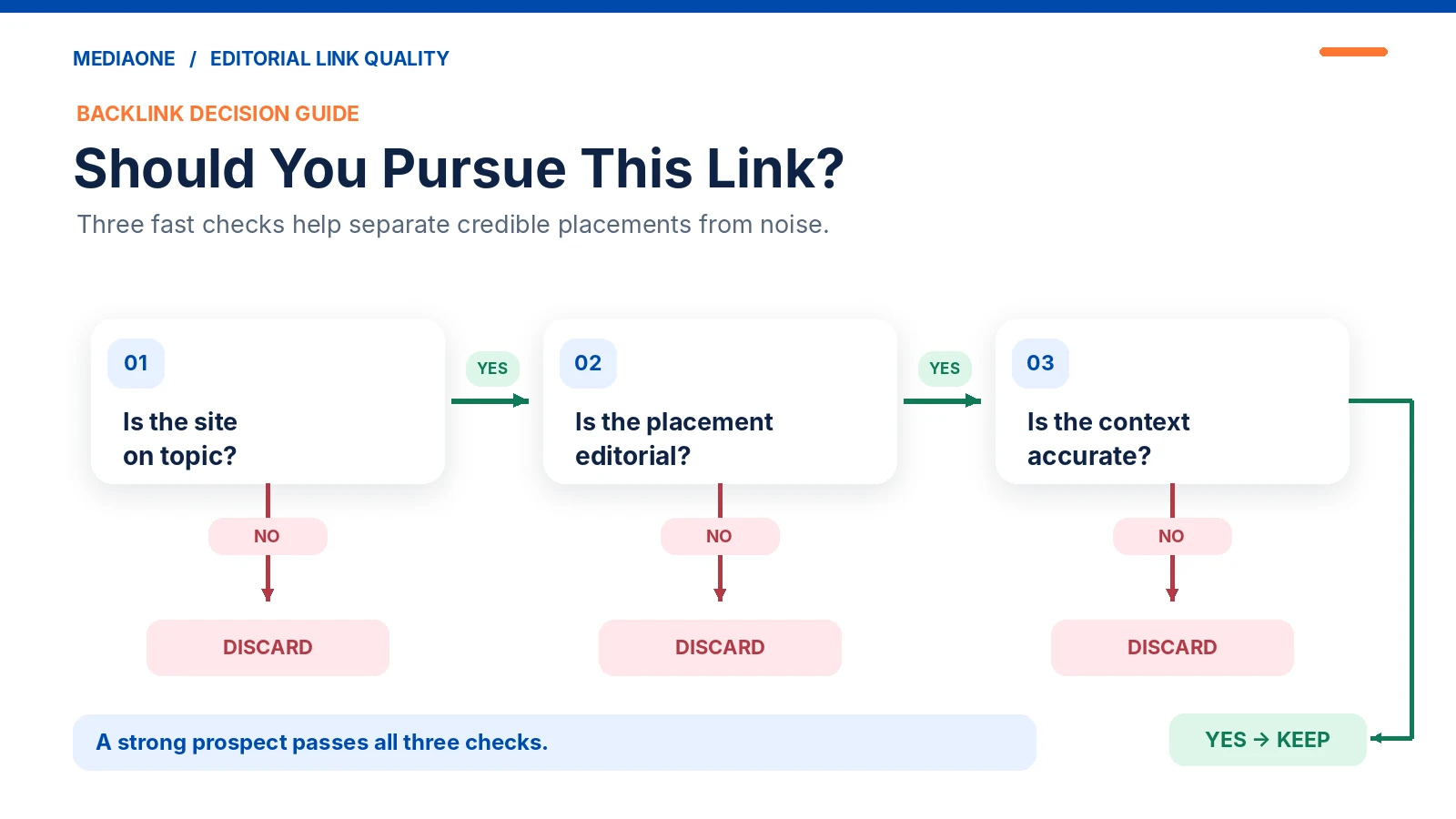
Before you pursue a link, ask three questions. The thresholds below set the bar.
- Is the site on-topic? Pass if it covers your sector. A trade publication beats a general news site, and that relevance drives meaningful traffic to your pages.
- Does the page carry real editorial weight? Pass if the link sits inside an article. Footer links and bulk directories fail.
- Does the placement describe you accurately? Pass if the surrounding text names your category correctly.
Discard any prospect that fails the first two tests, however high its domain metrics look. These links carry considerable weight because they signal to search engines, including Google, that your content is valuable and relevant to the specific field you’re operating in. A link that fails these tests is unlikely to help your ranking or your broader cross-platform marketing.
Anchor text optimisation without over-optimising

Describe the destination in plain language, using your brand name or a natural phrase, such as “regional tax preparation firm.” Repeating the exact same keyword across every link looks manufactured and can hurt rankings, so avoid it even when your SEO techniques call for keyword focus. Let most links use your brand name, and reserve descriptive anchors for the few links where context calls for them. Consistent, natural anchors also help your profile look organic in search results.
Earning Off-Site Visibility: Digital PR, Guest Posting, and Syndication
Off-page SEO is the work you do outside your website to build authority. Content that earns mentions from credible sources helps search rankings and AI citations more than publishing more pages on your domain. The three levers below work best when they reinforce the same entity description you audited earlier.
Digital PR and outreach that earns citations
Digital PR earns mentions from journalists, trade publications and industry bodies. Pitch data, original research or a clear expert view that an editor can quote. A named source with a verifiable claim is more likely to be cited, and an AI engine can attribute that claim back to you. Prioritise outlets whose audience matches your buyers and whose social media presence signals real reach. Local outlets are often the best place to start building trust with your market.
Guest posts help answer engines only when the host site covers your category and the byline matches your profile. When syndicating, always set a canonical link back to your original article on your website so that search engines credit the original source. Avoid publishing identical copy across many websites. For more on how these pieces fit into your wider marketing plan, see the digimetrics.ai resource hub.
A step-by-step off-page GEO plan with thresholds and a measurement checklist
- Run the Entity Footprint Audit and fix every failed check in name, category and location.
- Set the target: every owned listing passes all four checks before you expand outreach.
- Pitch two to three relevant editorial mentions per quarter before adding directory listings.
- Tie each guest post to one topic you can defend as your expertise, so the content reads as credible across platforms.
- Record the brand name, category and link status of every new mention in your matrix.
- Quarterly, check whether AI assistants describe your brand accurately, and correct sources that don’t. Treat these checks as evidence to act on, not a guaranteed outcome, since engines publish different levels of detail about how they retrieve and attribute sources.
Conclusion and Summary
Off-page GEO uses the same signals as off-page SEO: brand mentions, consistent third-party descriptions and links from relevant domains. Answer engines favour consistency and entity clarity over raw backlink volume, which is also why strong content and sound SEO techniques still matter for search engine visibility and ranking.
The three levers are entity clarity, mentions and quality links. Entity clarity means your name, category, location and offer read the same everywhere. Mentions are being named on relevant, trusted pages, linked or not. Quality links are a few strong links from on-topic domains.
Your next step: run the Entity Footprint Audit this week. List every off-site listing, rate each for accuracy, and fix the lowest scores first.
Frequently Asked Questions
What is off-page GEO?
Off-page GEO is the practice of shaping how other websites describe and cite your brand, so answer engines recognise your business as a clear, trusted entity. It relies on brand mentions, consistent third-party profiles and links from relevant domains. The aim is to earn the single recommendation an assistant gives, not just a place in a list of results.
Do backlinks still matter for AI search?
Yes, but quality matters far more than volume. The emphasis on high-quality, authoritative links is stronger than ever in 2026.
What is the difference between GEO and AEO?
Generative Engine Optimization (GEO) focuses on getting your content and brand cited inside AI-generated responses. Answer Engine Optimization (AEO) focuses on earning direct answers and featured recommendations from search and voice assistants. The same off-page signals support both.
How do unlinked brand mentions help AI visibility?
An unlinked mention on a trusted, on-topic page still tells an engine what your brand is. Bing’s former senior product manager Duane Forrester said in 2016 that unlinked mentions can be as strong a signal as backlinks. Consistent naming across these mentions helps the system identify your entity correctly.
How long does off-page GEO take to show results?
Fixing inconsistent listings can be quick, while earning editorial mentions takes months. Track progress against your own baseline, noting the date you fixed each listing.
How do I measure off-page GEO performance?
Start with an Entity Footprint Audit. List every off-site location where your brand appears, and score each for name, category, location, and offer accuracy on a 1-to-3 scale, where 1 is inaccurate and 3 is fully accurate.
| Listing | Name (1-3) | Category (1-3) | Location (1-3) | Offer (1-3) | Link status | Action |
|---|---|---|---|---|---|---|
Any listing scoring below 3 on any field goes to the top of your fix list. Re-run the audit each quarter and track whether your brand appears in AI answers for your core queries.