Many businesses chase a higher domain authority score while organic traffic stays flat, because the number was never what drove rankings. To check domain authority for free, run one checker, then review the result using a second tool before acting. It is a useful comparative signal for shortlisting link prospects and benchmarking competitors, but it is a third-party metric, not a Google ranking factor.

For most Singapore SMEs, domain authority should not be a core KPI. Track the quality and relevance of the websites linking to you instead. The rest of this article explains why, and gives a single decision flow for deciding when the number is worth using.
Key Takeaways
- Domain Authority is a third-party Moz estimate, not a Google ranking factor.
- Use DA to shortlist link prospects and benchmark competitors, not to judge overall SEO health.
- Verify any score against referring domains and organic search performance.
- Relevant local links may be more useful than generic high-DA listings.
- Avoid link schemes that manipulate search rankings.
How to Run a Free Domain Authority Check
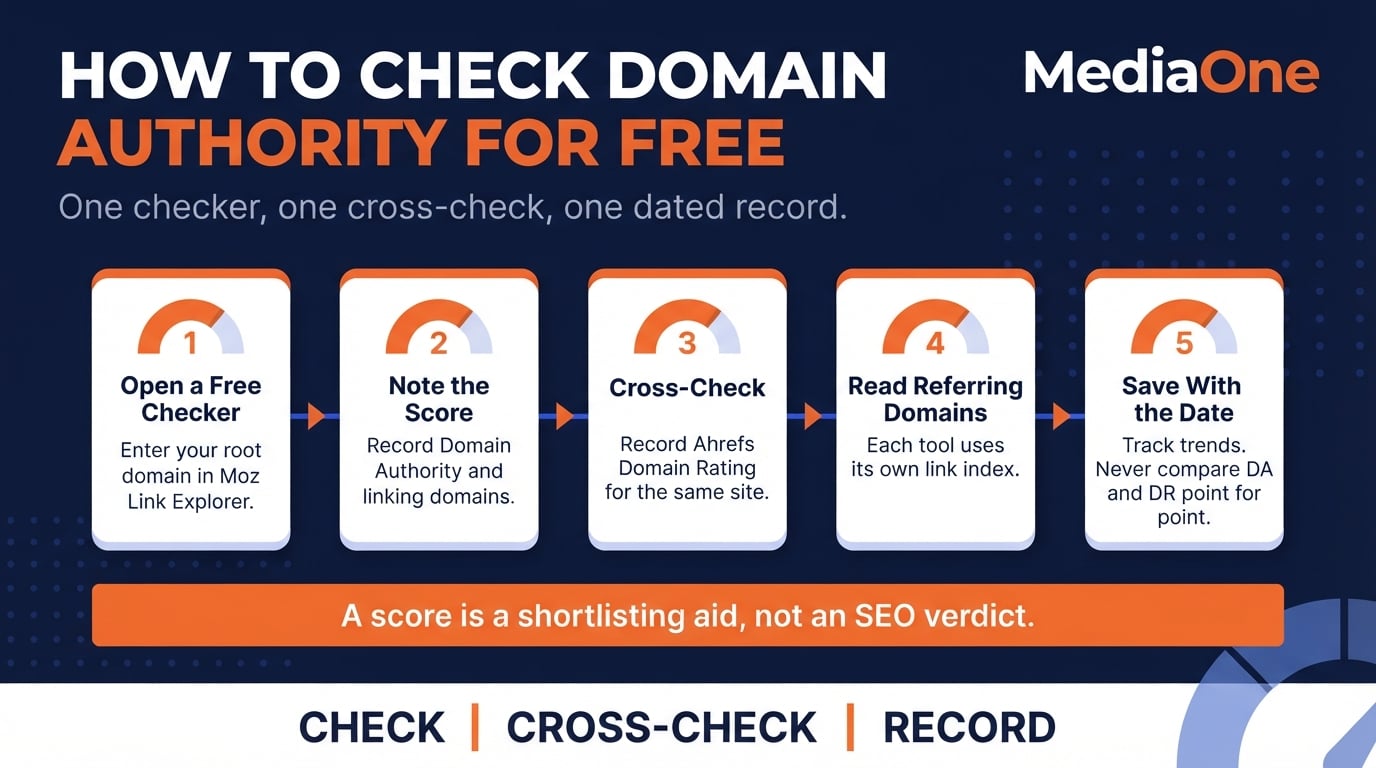
- Open a free checker, such as Moz Link Explorer, and enter your root domain. Sign in with a free Moz Community account if prompted.
- Note the Domain Authority score and the number of linking domains.
- Open a second tool, such as Ahrefs Website Authority Checker, and record its Domain Rating.
- Review the referring-domains data where available, since the two providers use different link indexes and scoring methods.
- Save both scores with today’s date to track trends over time. Do not compare their numerical values directly.
Score-reading rule: Treat a domain authority score as a shortlisting aid only. Act on it when the referring domains are relevant to your market, not on the number alone.
Free access and report limits can change, so confirm them on each provider’s website.
Free Domain Authority Checkers Compared
Free options let you check website authority without paying, but each provider reports its own metric. Moz reports DA, Ahrefs reports DR, and Semrush reports Authority Score. Features and usage allowances vary by account and can change.
| Tool | Metrics shown | Data source | Free access | Best use |
| Moz Link Explorer | Domain Authority, Page Authority, linking domains | Moz’s link index | Limited free access; check current allowance | Quick DA check |
| Ahrefs Website Authority Checker | Domain Rating (DR), backlink overview | Ahrefs’ link graph | Free DR lookup; depth of data varies | Cross-checking backlink strength |
| Semrush Website Authority Checker | Authority Score, backlinks, estimated organic traffic | Semrush’s link and traffic databases | Free website authority lookup; check current terms | Authority alongside traffic |
Compare competing sites within the same tool, rather than treating DA, DR and Authority Score as interchangeable. Confirm an initial assessment with a second provider and judge content quality alongside the number. Semrush’s Authority Score also uses estimated organic traffic and signals of link manipulation, so it does not measure precisely the same thing as Moz DA or Ahrefs DR.
Domain Authority Explained: Definition, Calculation and Scale
How Domain Authority is calculated from linking root domains
Domain Authority (DA) is a metric developed by Moz to estimate a website’s search ranking potential on a scale of 1 to 100. It draws on Moz’s link index and a machine-learning model rather than a Google-owned score. Moz’s Domain Authority documentation explains the method. Because it is a third-party estimate, it is useful for comparing sites, not a verdict on how a site performs in search results.
The main inputs include linking root domains and other link signals. Ten backlinks from one blog count as one linking root domain. These inputs contribute to a logarithmic score, so gains generally become harder at higher scores. The model is trained against search results, so DA estimates relative ranking potential rather than measuring actual rankings. Its score can change as Moz discovers links and updates its model.
The role of linking root domains in the DA score
Linking root domains are an important input. As an illustration, 200 links from 200 independent websites represent more unique linking domains than 200 links from one website. Neither total guarantees a particular change in DA, because the model considers other signals.
DA can also be influenced by low-value link activity. Sitewide footer links, reciprocal arrangements and paid guest posts on weak domains can add linking domains without bringing relevant visitors or credibility. Sort the referring-domains list by domain strength and examine the linking sites themselves. If most are unrelated or thin directories, the figure may flatter the site. A domain authority check should not be mistaken for an off-page SEO audit.
Domain Authority score ranges and benchmarks: what is good, average and weak

Scores are relative, not absolute. The bands below are illustrations to help organise a review, not official Moz thresholds or validated business benchmarks.
| DA range | Illustrative label | What to check |
| 1 to 20 | Lower range | Compare with new and small sites in the same niche |
| 21 to 40 | Mid-range | Compare with established local competitors |
| 41 to 60 | Higher range | Review the relevance of the site’s linking domains |
| 61 to 100 | Upper range | Check whether strong links are relevant to your market |
For illustration, a score of 35 for a Singapore trade association may be more useful to a local business than a score of 60 for a generic international directory. Relevance and local visibility can be more useful than raw strength, so the best benchmark is a competitor set drawn from the same market.
How to build a competitor benchmark set
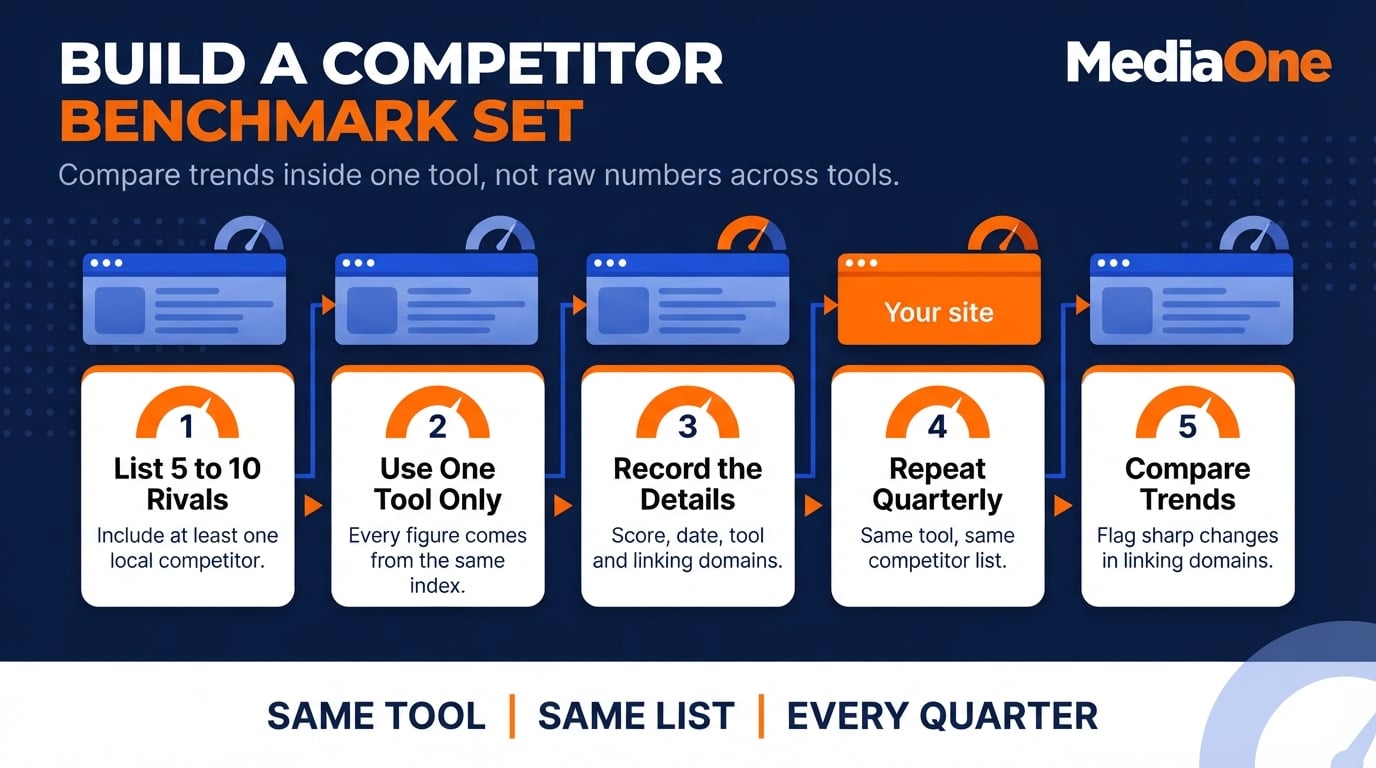
- List five to ten competing websites in your market, including at least one local rival.
- Check each website’s Domain Authority in one tool only, so every figure comes from the same index.
- Record each score with the date, the tool name and the number of linking domains.
- Repeat the same check every quarter, using the same tool and competitor list.
- Compare trends within the set rather than absolute numbers, and note any website whose linking domains changed sharply.
This basic benchmark can be expanded into a competitor backlink analysis to identify which credible websites link to rivals but not to you.
Does DA track real traffic? A comparison of score movements and organic traffic
A score can rise while traffic does not, and it can fall while traffic grows. To test this, pick a named set of sites in your own market, record each one’s DA and organic search clicks at the start and end of a quarter, and compare the two movements. Where the score rose sharply but search clicks stayed flat, the score did not reflect a traffic gain. Where clicks grew without a DA change, investigate other factors, including content, search demand and visibility. Check the referring domains behind any large DA move before acting on it.
Domain Rating vs Domain Authority: Key Differences
Domain Authority (DA) and Domain Rating (DR) are different proprietary scores built on different link indexes. Treating them as interchangeable is a quick way to misjudge a site, especially when you check domain authority across tools.
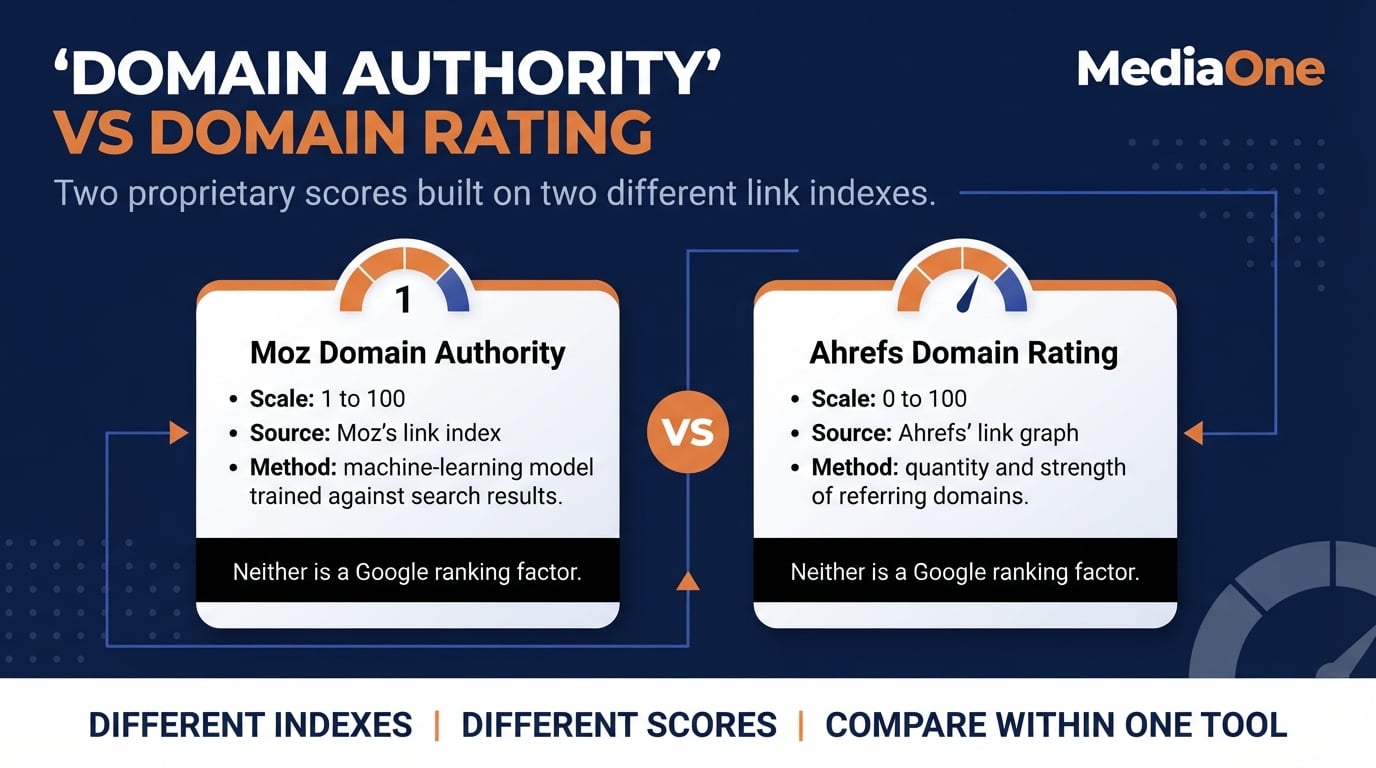
Moz Domain Authority versus Ahrefs Domain Rating
Moz produces Domain Authority on a 1 to 100 scale using its own crawl and link data. Ahrefs calculates Domain Rating from its link graph on a 0 to 100 scale, relying mainly on the quantity and strength of referring domains and how many other sites those domains link to. The Ahrefs Domain Rating guide explains its formula. Free tools can show these scores quickly, but check how each provider defines its metric before relying on it. A difference between the figures is expected and is not, by itself, evidence of a problem.
Why the same website can show different scores across tools
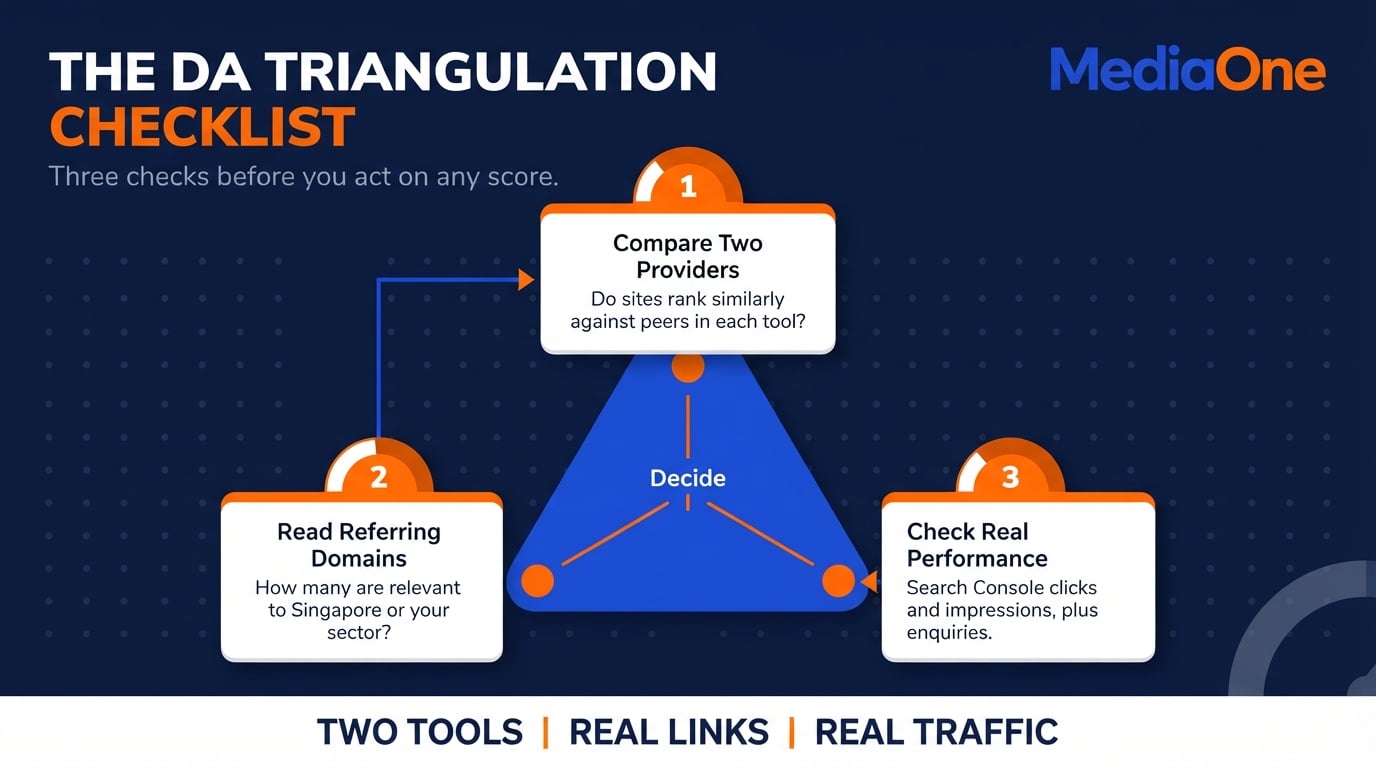
Each provider crawls a different part of the web, refreshes on its own schedule and weights backlinks differently. Use this three-step DA Triangulation Checklist:
- Record the website’s score in two SEO tools, for example Moz DA and Ahrefs DR.
- Compare the site’s relative position against the same competitors within each tool, not the point difference between DA and DR.
- If the tools suggest different conclusions, review their referring-domains data and the relevance of the linking pages.
Choosing which metric to track
Pick one primary metric for consistency and use the second as a cross-check. Trends within one index are more interpretable, although scoring changes can also move the number. Record the date with every score, because both tools update on their own cycles. For Singapore businesses benchmarking local competitors, the more useful signal is whether referring domains are relevant to the local market, which neither metric establishes on its own. A high score does not rule out suspicious links, so inspect the backlink profile before making decisions. Google does not use Moz DA or Ahrefs DR as ranking factors, so judge the websites you benchmark by their content and links as well as their scores.
Domain Authority vs Page Authority
Domain Authority scores a domain, while Page Authority scores an individual page. Both come from Moz on a 1 to 100 scale, and both are predictive metrics rather than Google ranking factors.
| Decision | Use Domain Authority | Use Page Authority |
| Which site to approach for a link | Yes, as a first filter | Also check the proposed linking page |
| How a specific article compares with rival pages | No, it is domain-level | Yes, as one comparative signal |
| Benchmarking a competitor’s overall link strength | Yes, alongside referring domains | No, it is page-level |
A strong domain can still host a weak page. When placing a link on a particular article, check that article’s Page Authority and referring domains, not just the homepage score.
Conclusion and Summary
Recap of the checking process and the metric to trust
Domain authority is a useful comparative signal, but only one input among several. Use it to shortlist link prospects and benchmark against competitors, not as a measure of SEO health. Google does not use third-party metrics such as Moz’s DA or Ahrefs’ DR as direct ranking factors, and an authority checker estimates link strength from the outside.
Before acting on any score, run the DA Triangulation Checklist:
- Compare two providers’ assessments. Do the sites rank similarly against their peers in each tool? Do not infer link-profile stability from a small point difference.
- Read the referring-domains list. Count the linking root domains and check how many are relevant to Singapore or your sector.
- Check real organic performance. Google Search Console reports search clicks and impressions; analytics software can measure on-site visits and enquiries.
Use DA as a supporting clue, even when all three inputs point the same way. The better check is a relevant backlink profile alongside real search performance. Quality links from relevant sources deserve more attention than any single score.
Next steps for your own domain
Record your current scores in two tools and complete the checklist. Flag irrelevant, suspicious or inactive referring domains for review; a high third-party spam score is a prompt to investigate, not proof that a link is harmful. Focus outreach on Singapore trade associations, local media and industry directories, even where their DA is moderate. Start with the best prospects first, since relevant backlinks from these sources can be more useful than a high score alone.
Doing this consistently helps you improve your site’s link profile over time, and strong content gives publishers a reason to link. A white hat link building strategy should prioritise earned, relevant placements. For a wider plan, SEO services for Singapore businesses can address content, technical health and visibility alongside backlinks.
Frequently Asked Questions
No. Domain Authority is a Moz metric, not a signal Google uses to rank pages. Moz and Ahrefs calculate their own scores using link data. Treat DA as a comparative estimate for shortlisting link prospects and benchmarking competitors.

There is no universal ‘good’ score, because DA is relative to other websites in Moz’s index. The useful question is how your site compares with competitors and link prospects in the same market, measured in the same tool. Confirm with linking root domains and organic performance before deciding.

Yes. Moz offers limited free Domain Authority checks, while Ahrefs offers a free Domain Rating lookup and Semrush offers a free Authority Score checker. Those are different metrics, and access limits can change. Judge local link prospects by their relevance to Singapore buyers.
Moz DA and Ahrefs DR use different models, indexes and update cycles, so their numerical scores are not directly comparable. Compare each metric with peers in the same tool, then inspect referring domains if the tools point to different conclusions.

The timing varies as providers discover links, refresh their indexes and update scores. Avoid reacting to small changes between checks. Judge longer-term trends against organic search clicks, relevant referring domains and competitor performance.