| AI Summary
In this Wix vs Shopify (2026) comparison, Shopify is our recommended platform for Singapore businesses focused on ecommerce growth, inventory management and multichannel selling. Wix is better suited to content-led businesses that need flexible website design, blogging and bookings alongside a smaller online store. Both platforms offer essential SEO features, but their payment options and operating costs differ. Singapore merchants should compare subscription fees, PayNow compatibility, GST requirements and long-term business needs before deciding. |
Shopify is our overall recommendation for Singapore businesses building an e-commerce-focused brand. Wix is our preferred option for content-led websites that also need a straightforward online store. Both platforms support online selling, but they differ in payment setup, inventory management and long-term flexibility.


In this Wix vs Shopify (2026) comparison, we examine current subscription plans, Singapore payment options, Goods and Services Tax (GST) requirements and search engine optimisation (SEO) capabilities. We also compare the operational costs that become important as orders increase.
Our goal is to help you choose a platform that fits your business requirements and budget.
Key Takeaways
- Best for ecommerce growth: Shopify offers extensive commerce tools, multichannel selling and fulfilment integrations.
- Best for content-led businesses: Wix combines website design, blogging, bookings and online selling within a visual editor.
- Pricing: Shopify publishes Singapore-dollar prices. Wix pricing depends on the location and billing options shown at checkout.
- Singapore payments: Shopify Payments is available locally, while Wix merchants use supported third-party providers. PayNow requires a compatible payment setup.
- SEO: Both platforms support essential technical and on-page optimisation. Neither guarantees better Google rankings.
- Our recommendation: Prioritise payment compatibility, inventory requirements and total operating costs before choosing.
Wix vs Shopify (2026): Comparison at a Glance
The key difference is each platform’s primary purpose. Wix provides flexible website-building tools with ecommerce features. Shopify centres its platform on retail transactions and store operations.
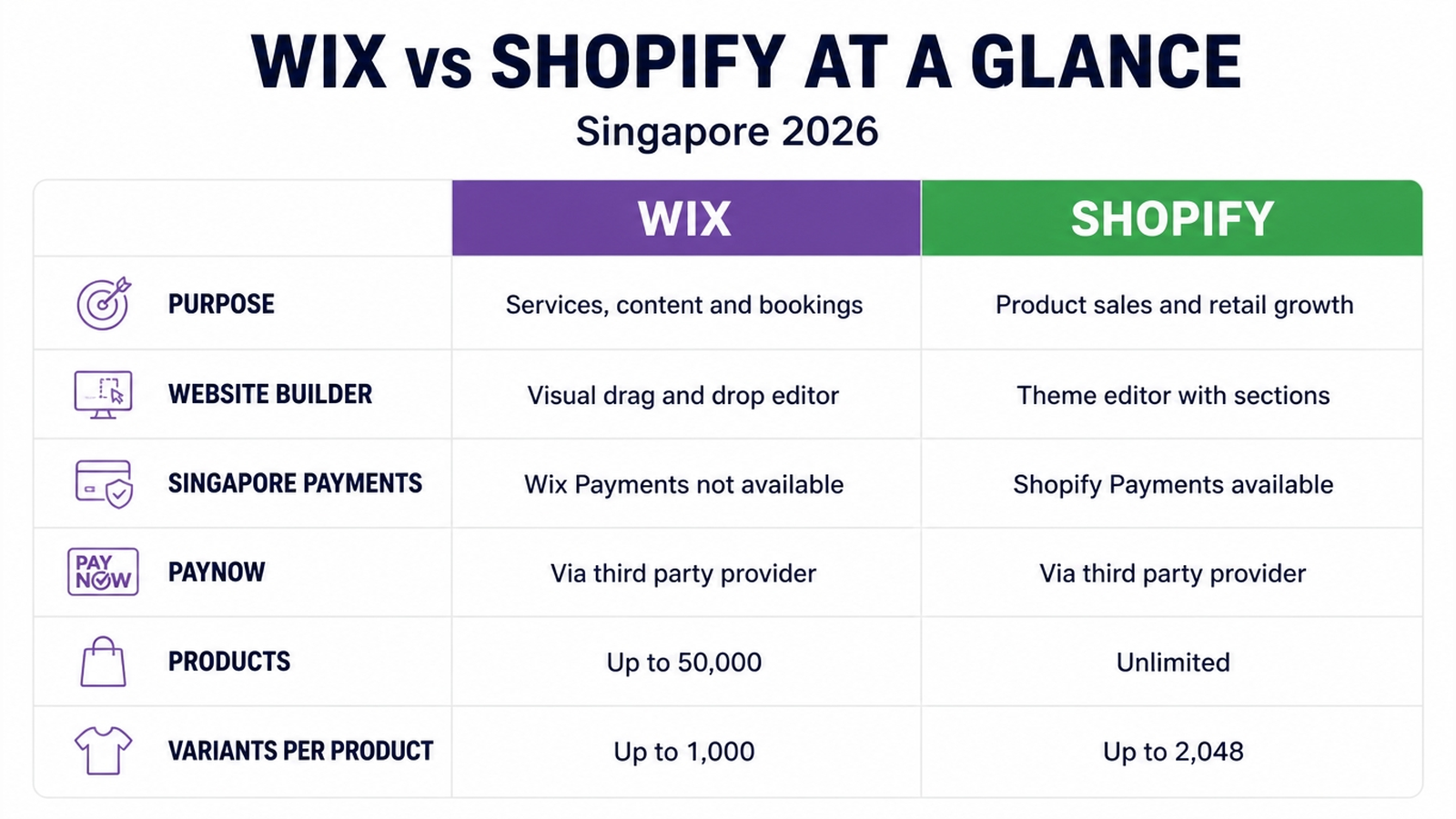
| Feature | Wix | Shopify |
| Best for | Service businesses, creators and content-led stores | Ecommerce brands and growing retailers |
| Website setup | Visual drag-and-drop editor | Structured theme editor |
| Commerce-capable plans | Core, Business, Business Elite | Basic, Grow, Advanced, Plus |
| Native payment service in Singapore | Wix Payments unavailable | Shopify Payments available |
| PayNow | Supported third-party integration | Supported third-party integration |
| Product limit | Up to 50,000 products | Unlimited products |
| Variants per product | Up to 1,000 | Up to 2,048 |
| Inventory management | Built-in; certain multi-location setups supported | Built-in multi-location management |
| Blogging | Strong visual content-building tools | Built-in blogging |
| SEO controls | Titles, URLs, redirects, canonicals and structured data | Titles, URLs, redirects, canonicals and structured data |
| Code customisation | Velo and supported platform tools | Liquid themes, APIs and apps |
| Free starting option | Free website plan; upgrade to accept payments | Advertised three-day free trial |
| Main consideration | Advanced commerce workflows may need additional tools | Apps and payment fees can increase costs |
Product limits reflect the providers’ published documentation. See the Wix Stores limits and Shopify variant documentation for details.
We would not select a platform based on catalogue size alone. A store with 300 complicated products can require stronger inventory systems than one with several thousand simple items.
Which Platform Is Better for Your Singapore Business?
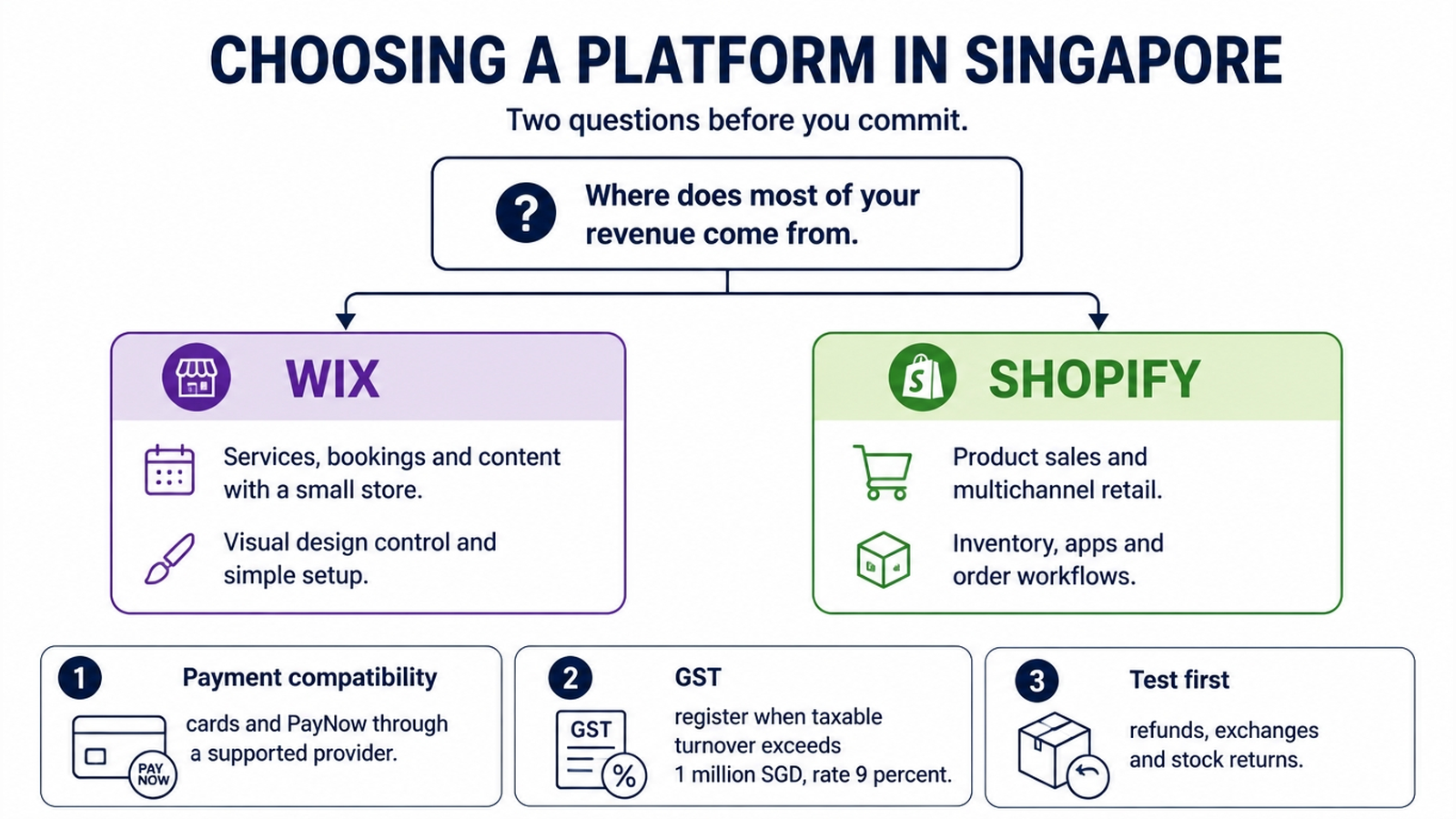
Before comparing subscription costs, identify how your website will generate revenue. The answer helps determine which features deserve priority.
Choose Wix for a content-led business with a modest store
We recommend considering Wix if your website primarily promotes services, expertise or appointments, with products as an additional revenue stream. For example, a Singapore beauty studio may need service pages, appointment bookings, educational content and a small collection of skincare products. Wix can bring these features together within one website.
Its visual editor also suits owners who want to control their website’s appearance without relying heavily on a developer. However, businesses planning complicated inventory operations should examine Wix’s available integrations before committing.
Choose Shopify for a growing ecommerce business
We recommend Shopify when product sales are the primary business activity. A Singapore fashion retailer, for example, may sell through its website, social channels and physical locations. The business needs consistent product records and reliable order processing across these channels.
Shopify offers built-in inventory tools, structured product management and a broad app ecosystem. Its commerce-oriented architecture makes it a practical starting point for retailers planning additional sales channels.
That does not mean Shopify is necessary for every small store. We would assess whether its operational features justify the ongoing costs.
Our decision by business type
| Business profile | Our preferred platform | Main reason |
| Consultant selling a few digital products | Wix | Website and content flexibility |
| Beauty salon with bookings and retail products | Wix | Combined service and commerce functions |
| Fashion retailer with sizes and colour variants | Shopify | Structured product and inventory management |
| Brand selling across online and retail channels | Shopify | Multichannel commerce integrations |
| Publisher with a small merchandise store | Wix | Content-first website management |
| Ecommerce brand preparing for regional expansion | Shopify | Greater commerce and integration flexibility |
These are recommendations, not fixed rules. Payment provider eligibility and specific workflow requirements can change the decision.
Wix vs Shopify Pricing in Singapore (2026)
Subscription prices provide a starting point for the comparison. Payment processing, apps and store maintenance determine how much you will actually spend.
Wix pricing and ecommerce plans
Wix currently offers three main commerce-capable website plans: Core, Business and Business Elite. Its Light plan does not include the online payment capabilities needed for a conventional ecommerce store.
| Wix plan | Ecommerce capability | Suitable use |
| Core | Basic ecommerce and online payments | Small stores with standard requirements |
| Business | Expanded ecommerce and marketing tools | Established stores needing additional capabilities |
| Business Elite | Advanced ecommerce and developer features | Businesses requiring more extensive functionality |
Wix’s published pricing page explains that prices and currencies vary by location. Its reference prices should not be presented as confirmed Singapore-dollar charges.
We recommend checking the final SGD quotation in your Wix account before buying. Record the renewal price, billing period and any applicable taxes.
Shopify pricing in Singapore
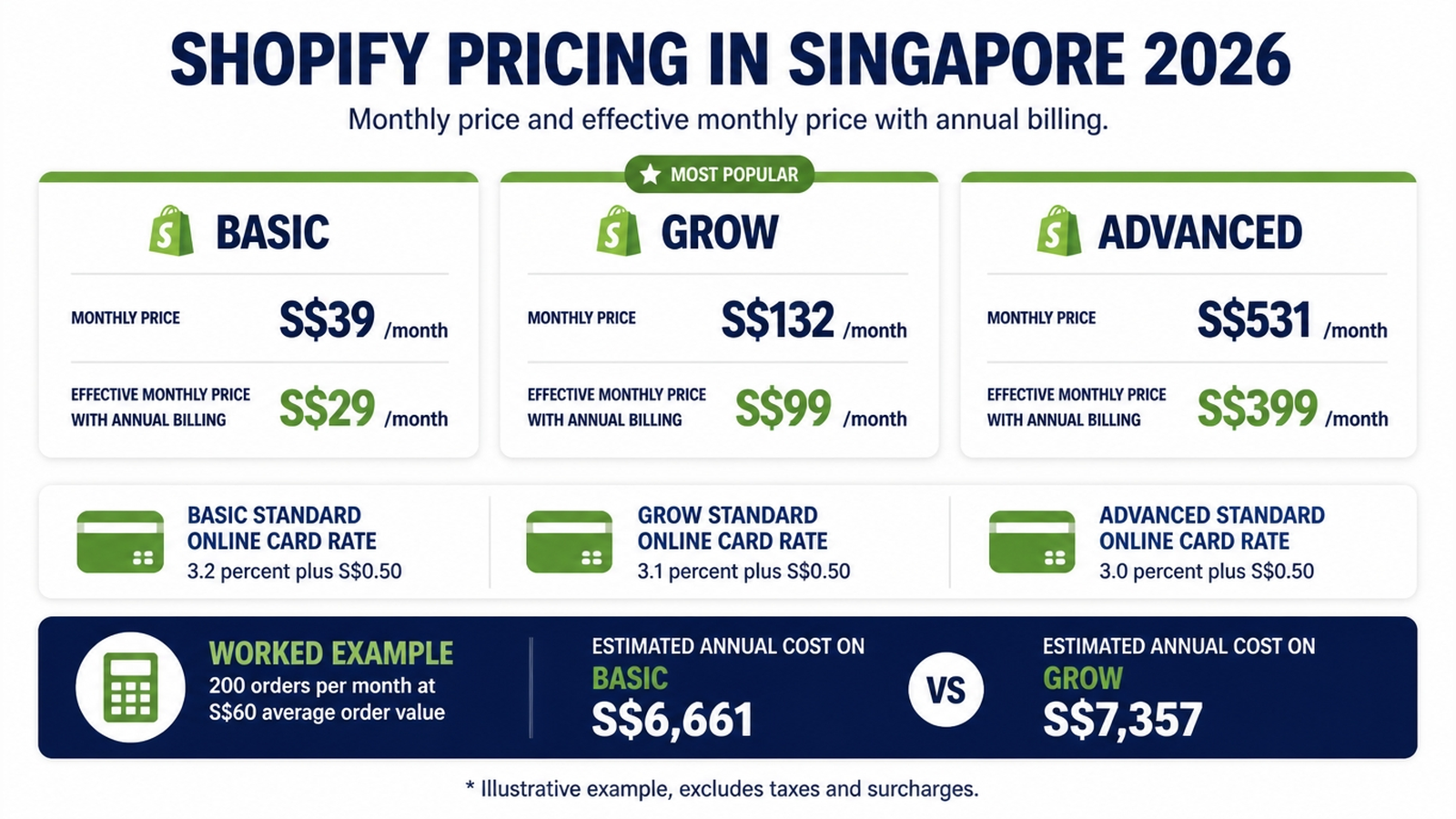
Shopify publishes Singapore-dollar subscription prices for its main plans. The following prices were listed on its Singapore pricing page when checked in October 2026.
| Shopify plan | Monthly billing | Effective monthly price with annual billing |
| Basic | S$39 | S$29 |
| Grow | S$132 | S$99 |
| Advanced | S$531 | S$399 |
| Plus | Contract pricing | From US$2,300 monthly |
Annual billing rates require the relevant annual commitment. Shopify may also offer promotional pricing for new merchants.
Basic provides a complete online store with inventory management. Grow adds staff account capacity and lower standard payment rates. Advanced supports businesses that need additional reporting, shipping and international selling features.
Payment processing and additional transaction fees
Payment fees require careful attention because Singapore merchants do not have identical payment options on both platforms. With Shopify Payments, standard online card rates listed for Singapore are:
| Shopify plan | Standard online card processing | Third-party transaction fee |
| Basic | 3.2% + S$0.50 | 2% |
| Grow | 3.1% + S$0.50 | 1% |
| Advanced | 3.0% + S$0.50 | 0.6% |
The third-party fee generally applies to transactions processed through external payment providers, subject to Shopify’s documented exceptions. It is separate from the gateway’s processing charge.
Wix merchants in Singapore must obtain processing rates from their chosen third-party provider. We would not assume that Wix adds the same platform-level transaction fees as Shopify.
Other costs to consider include paid themes, apps, domain renewals and accounting integrations. Subscription software for reviews or specialised shipping can also increase the monthly bill. ( Shopify transaction fee documentation)
Worked example: a store receiving 200 orders per month
Consider a Singapore retailer with these operating assumptions:
- 200 orders each month
- Average order value of S$60
- Annual sales of S$144,000
- All orders paid using standard domestic cards
- Two paid apps costing S$20 monthly each
- An assumed annual domain cost of S$25
Using Shopify’s published annual-billing rates, the comparison is:
| Annual cost | Shopify Basic | Shopify Grow |
| Subscription | S$348 | S$1,188 |
| Card percentage fees | S$4,608 | S$4,464 |
| Fixed card fees | S$1,200 | S$1,200 |
| Two paid apps | S$480 | S$480 |
| Domain assumption | S$25 | S$25 |
| Estimated annual total | S$6,661 | S$7,357 |
This illustrative calculation excludes taxes on subscriptions, international card surcharges and optional services. Actual payment-method mixes will also affect the result.
At this sales volume, Shopify Basic costs approximately S$696 less per year than Grow under these assumptions. The lower card percentage on Grow does not offset its higher subscription cost.
For Wix, use the same sales assumptions and enter the confirmed plan and gateway quotations:
Annual Wix cost = (12 × monthly plan fee) + (S144,000 × gateway percentage)+(2,400 × fixed transaction fee)+S505 in assumed apps and domain costs.
We recommend obtaining that quote before deciding Wix is cheaper. This approach avoids treating an unverified gateway rate as an actual Singapore price.
Singapore Payment Methods: PayNow, Cards and Digital Wallets
Payment compatibility is one of the most important considerations for local merchants. Your preferred provider must support your business type and process the payment methods your customers use.
Does Wix support PayNow in Singapore?
Yes, through compatible third-party payment integrations. Wix Payments itself is not currently available to Singapore-based businesses. Wix’s country-specific provider list includes options such as Stripe, PayPal and HitPay.
HitPay offers a Wix integration that supports PayNow alongside cards and selected digital wallets. Merchants must complete the provider’s onboarding and verification requirements before accepting payments.
We recommend checking transaction fees, settlement periods, refunds and supported payment methods directly with the provider.
Does Shopify support PayNow in Singapore?
Yes, through a compatible third-party provider rather than as a standard native Shopify Payments method. Shopify Payments is available to eligible Singapore businesses. Its documented payment options include major cards, Apple Pay, Google Pay and Shop Pay.
PayNow is not listed among its native local payment methods for Singapore. However, providers such as HitPay offer Shopify integrations that can enable PayNow at checkout.
Third-party transaction fees may apply to these payments. Confirm the applicable fee treatment before activating the gateway.
How should Singapore merchants test checkout?
We recommend testing the complete transaction before launching either platform. Check whether the customer can complete payment successfully on a mobile device. Then confirm that the order appears correctly in the store dashboard and payment-provider records.
Test refunds, failed payments and payment notifications as well. If PayNow is important to your customers, verify the actual QR payment flow rather than relying on an integration description. A provider may support PayNow but have eligibility requirements or fees that make it unsuitable for your store.
How does Singapore GST affect your online store?
Singapore’s standard GST rate is 9% in 2026. According to the Inland Revenue Authority of Singapore (IRAS), compulsory registration generally applies when taxable turnover exceeds S$1 million in a calendar year under the retrospective test, or is reasonably expected to exceed S$1 million in the next 12 months under the prospective test.
Businesses liable under the prospective test from 1 July 2025 have a two-month period before registration takes effect, although they must still apply within 30 days of establishing liability. Only GST-registered businesses may charge GST. Registered retailers must also follow IRAS requirements for public price displays and relevant invoices or receipts.
Both ecommerce platforms provide tax configuration tools, but selecting a tax rate does not establish compliance. We recommend testing checkout totals and invoice output against your registration status.
Ease of Use, Website Design and Customisation
Both platforms allow business owners to build an online store without programming knowledge. However, their editing systems encourage different approaches.
Wix: flexible visual website building
Wix provides a drag-and-drop editor suited to businesses that want detailed control over individual pages. You can build service descriptions, promotional landing pages and blog content alongside your shop. This makes Wix particularly useful for businesses combining ecommerce with bookings or professional services.
The flexibility has a drawback. Independent layout changes require careful mobile testing, while advanced storefront behaviour may need supported apps or Velo development.
We recommend preparing a consistent page structure before making extensive design changes. That reduces rework as your website grows.
Shopify: structured ecommerce design
Shopify uses a theme-based editor with configurable sections and app blocks. Merchants can adjust layouts without editing code, depending on theme capabilities.
Developers can customise storefront themes using Liquid, Shopify’s templating language. Supported APIs and apps provide additional options for extending commerce functionality.
Core checkout customisation remains subject to plan restrictions. Businesses needing extensive checkout changes should review Shopify Plus eligibility and supported checkout extensions.
For a retailer launching a conventional online store, we generally prefer Shopify’s structured approach. Wix offers greater convenience when the business relies heavily on custom informational pages.
Which platform is faster to launch?
Neither platform has a reliable universal launch timeline. A prepared 20-product catalogue can be uploaded quickly to either system. Payment verification, product images and shipping rules often take longer than the initial website build.
Shopify currently advertises a three-day free trial, followed by promotional pricing for eligible sign-ups. Wix allows users to start building a free website, but a suitable paid plan is required to accept online payments.
We recommend preparing product data and checking payment eligibility before starting a time-limited Shopify trial.
Product Catalogues, Inventory and Order Management
Inventory management becomes increasingly important when businesses introduce more product variants, sales channels or fulfilment locations.
Product limits and variants
Both platforms support substantial product catalogues. Wix documents a limit of 50,000 products and 1,000 variants per product. Shopify supports unlimited products, with up to 2,048 variants per product under its current product rules.
A stock keeping unit (SKU) is a unique identifier for an individual stock item or product variant. For example, a shirt available in five sizes and four colours creates 20 possible variants. Each may require independent pricing, stock levels and fulfilment information.
We would test the platform using the most complicated products in your actual catalogue. Maximum limits matter less when your staff struggle with daily updates.
Multi-location inventory and fulfilment
Shopify includes inventory management across multiple locations. Its Singapore Basic plan currently lists support for 10 inventory locations, although specific fulfilment features vary by plan.
Wix also provides multi-location inventory management through its newer product catalogue and Wix POS Register setup. Availability depends on the relevant product and point-of-sale features. Therefore, it would be inaccurate to describe Wix as strictly limited to one inventory location.
We still favour Shopify for businesses requiring extensive warehouse integrations, distributed fulfilment and coordinated multichannel operations. Its ecosystem offers a broader range of commerce-focused connections.
Before committing, confirm that your Singapore courier, warehouse or third-party logistics (3PL) provider integrates with the platform.
Returns, refunds and order workflows
Both systems provide tools for managing orders, cancellations and refunds. Shopify offers dedicated return-management workflows, including features for handling exchanges and restocking.
Wix supports core order-management activities, although the suitability of advanced returns workflows depends on your configuration and available integrations.
We recommend checking three real scenarios before purchasing:
- Refunding part of an order.
- Exchanging an item for another size.
- Returning stock to the correct inventory location.
Use whichever platform completes your actual tasks reliably. A workflow that requires repeated manual reconciliation can become expensive as order volume grows.
Wix vs Shopify for SEO in 2026
Both Wix and Shopify provide essential SEO functionality. Neither platform automatically produces higher Google rankings simply because of its technology. Product content, internal linking, technical accessibility and website performance still affect how effectively a store can compete in organic search.
Wix SEO capabilities
Wix allows merchants to edit product title tags, meta descriptions, URL slugs and image alternative text. Its SEO tools also support canonical settings, structured data and redirect management. These features help merchants control how important pages are presented to search engines.


Wix has expanded its technical SEO capabilities, so older claims that it offers minimal URL or structured-data control are outdated. For content-led businesses, its editing tools can make producing service pages and educational articles convenient.
Shopify SEO capabilities
Shopify also supports page titles, meta descriptions, editable URL handles and redirects. Its structured product and collection architecture can make large ecommerce catalogues easier to organise. Merchants can extend storefront functionality through supported themes and applications.
Shopify’s URL structure follows certain platform conventions. These should be considered when migrating an established website.
We recommend reviewing product templates, collection pages and internal links before launch. Installing additional SEO apps without a clear need can create overlapping functionality.
Which platform would we choose for organic search?
Our preference depends on the website’s commercial purpose. For a service-led business publishing extensive educational content, we would consider Wix. For a retailer with hundreds of actively managed products and multiple selling channels, we would generally start with Shopify.

Neither recommendation replaces an SEO audit. We would examine page structure, crawlability, content quality and actual search demand before making a final platform decision.
Migrating From Wix to Shopify: What Should You Know?
Changing ecommerce platforms involves transferring business records and rebuilding parts of the website. Shopify provides an official migration guide specifically for Wix merchants. It explains how to export product information and convert the file into Shopify’s required import format.
Customer records may also be transferred after formatting. Historical orders typically require a compatible migration application if you want them imported into Shopify. Website templates do not transfer directly, so the storefront design must be rebuilt.
Protecting SEO during migration
We recommend planning the migration before replacing an existing website. Start by exporting a list of current product, category and content URLs. Identify which pages receive organic traffic and which have earned external links.
Then create a URL mapping document that connects each important old page to its corresponding new destination. Implement permanent redirects where URLs change. Preserve useful content, verify metadata and submit the new sitemap through Google Search Console.
Test the new checkout separately from the SEO migration. A successful product import does not guarantee correct payments or order fulfilment.
How to Choose Between Wix and Shopify: A Practical Checklist
A short evaluation can prevent businesses from choosing a platform based on design or subscription price alone. We recommend completing these checks in sequence.
1. Define your business requirements
List your current products, expected order volume and sales channels. Identify whether your website primarily serves customers through content, bookings or product sales.
Separate essential features from those you might need later. This helps you avoid paying for functionality that does not support current revenue.

2. Confirm payment compatibility
Check whether your selected provider accepts your business type in Singapore. Verify support for cards, PayNow and any relevant digital wallets. Obtain written fee information and confirm settlement requirements before configuring checkout.
3. Calculate annual operating costs
Compare subscription fees, payment processing and required apps using the same sales assumptions. Do not assume a higher Shopify plan becomes economical simply because it offers a lower card rate. Estimate whether the savings offset the additional fixed subscription cost.
4. Test your most complicated workflow
Upload sample products containing realistic variants and images. Then test stock updates, refunds, fulfilment and any required integrations. These activities reveal operational limitations that feature tables cannot fully capture.
5. Review your SEO and migration requirements
Check whether the platform supports your preferred product structure, internal linking and content publishing process. If you already have an established website, estimate migration costs before committing. Preserve important URLs wherever practical.
Finally, confirm who will maintain the website. A platform should match both your operational needs and your team’s technical capabilities.
Frequently Asked Questions
Is Wix cheaper than Shopify in Singapore?
Wix may offer a lower-cost setup for some businesses, but the final comparison depends on the quoted plan price and payment provider fees. Shopify publishes SGD prices, while Wix requires merchants to confirm the applicable local subscription charges at checkout.
Does Wix support PayNow in Singapore?
Yes. A compatible provider such as HitPay can enable PayNow payments for Wix merchants. Wix Payments itself is not currently available to Singapore-based businesses.
Does Shopify Payments support PayNow?
PayNow is not listed as a standard native payment method in Shopify Payments Singapore. Merchants can investigate compatible third-party providers, including HitPay, and confirm the applicable transaction fees.
Is Shopify better than Wix for SEO?
Neither platform has a guaranteed ranking advantage. Wix and Shopify both provide essential SEO controls, so we would assess technical requirements, content structure and ecommerce workflows before recommending either.
Can Wix handle thousands of products?
Yes. Wix documents support for up to 50,000 products, subject to its published platform limits. Businesses with complex inventory and integration requirements should still test the relevant workflows before purchasing.
Can I migrate my Wix store to Shopify?
Yes. Products and customers can be transferred using supported migration methods, while importing historical orders may require additional tools. You must also account for website redesign, changed URLs and search engine redirects.
Do I need GST registration to sell online in Singapore?
Not every online seller must register. Compulsory registration generally applies when taxable turnover exceeds the relevant S$1 million threshold under IRAS rules. Businesses that are not GST-registered must not charge GST.
Which platform is better for a new Singapore ecommerce brand?
We generally recommend Shopify for a business focused on building a product-selling operation. Wix remains a practical choice when the website relies heavily on services, appointments or editorial content alongside a smaller store.
Should Your Singapore Business Choose Wix or Shopify?
For most ecommerce-focused businesses, our recommendation is Shopify. For businesses combining services, content and a modest online store, we would consider Wix first.
Shopify offers a strong foundation for product management, order processing and multichannel retail. Wix provides useful website design flexibility for businesses with broader content and service requirements. The final choice should depend on confirmed Singapore payment compatibility, realistic operating costs and the tasks your team performs regularly.
At MediaOne, we recommend evaluating these requirements alongside your SEO strategy. Choosing the right platform helps establish a workable foundation for organic search, customer experience and future ecommerce growth.