
URL shorteners turn a long web address into a short, shareable link. A free generic link suits a one-off social post, but a branded domain and an editable destination matter more for links printed on menus, packaging or banners that stay in circulation for months.
This guide explains how redirects work, what branded short links and QR codes actually cost in 2026, and how to decide when a free link is fine and when it will cost you more than the subscription.
Key Takeaways
- A short link is a redirect on someone else’s server. If that provider closes, every printed code pointing at it stops working.
- Branded domains change the trust calculation, not just the aesthetics — a link with your name on it reads as yours.
- Free plans cap how many links you can create, not how long they last. The cap that matters for print is whether the destination can be edited later.
- Paid tiers cluster around $10–$35 a month. The upgrade pays for itself the first time you avoid a reprint.
- Click data includes IP-derived location and device. Under Singapore’s PDPA, that is personal data — check where your provider stores it.
What a URL Shortener Actually Does
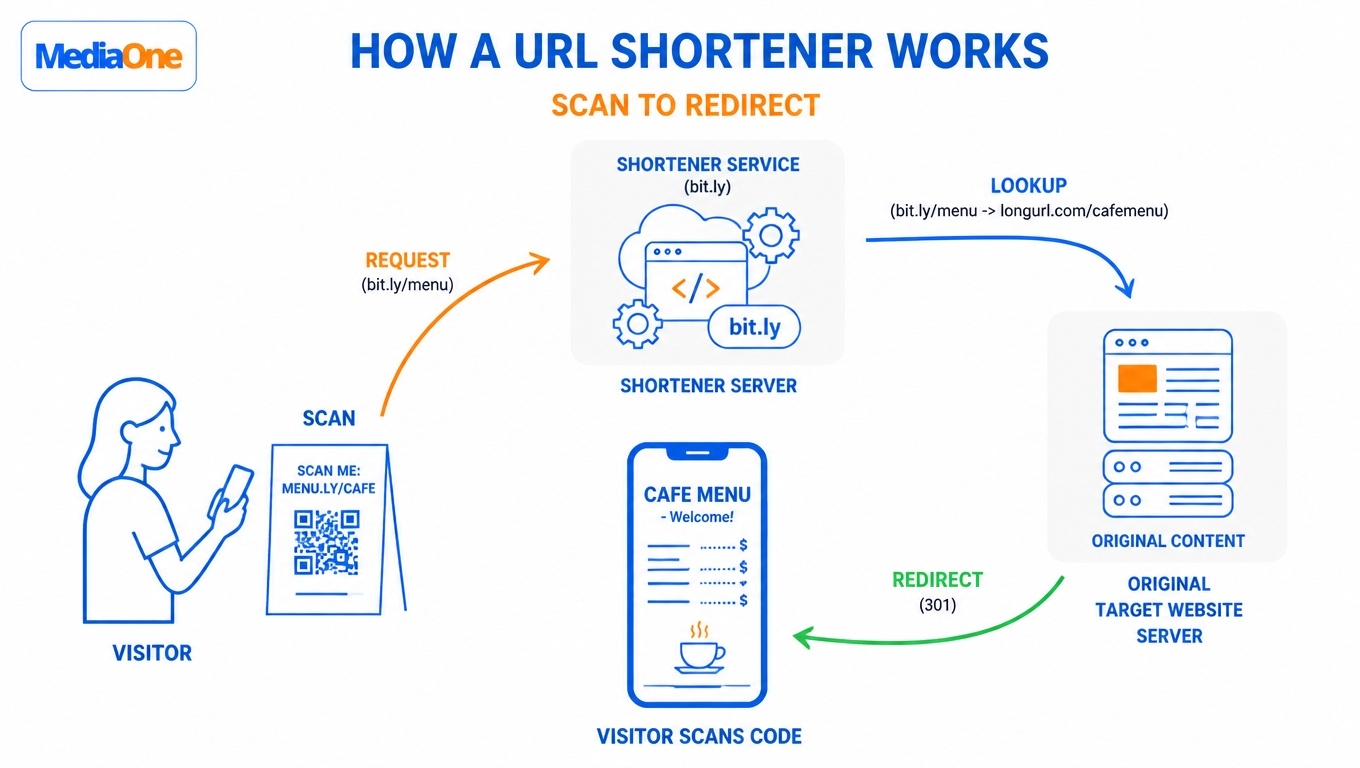
A shortener replaces a long address with a short one that points to the same page. When someone clicks, the provider’s server receives the request and redirects the browser to the original destination. The reader sees a short address; the business gets a record of the click.
The important consequence sits in that first sentence: the destination now depends on a third party staying online and keeping the mapping intact. A domain you control gives you durable ownership of every link you have already published. A shared domain does not.
301 and 302: what the redirect type changes
The hop happens through an HTTP redirect. A 301 signals a permanent move; a 302 signals a temporary one, as defined in the HTTP specification (RFC 9110). Search engines generally treat a 301 as passing ranking signals to the destination, and a 302 as keeping the original address indexed.
Two practical notes. First, short links almost always use 302 because the destination is meant to be repointable — a 301 tells crawlers to forget the original. Second, providers differ in what they send, and some let you choose. If a short link is the canonical public URL for a product page, that choice affects how it is indexed.
Why short links still matter in 2026
Short links suit channels with tight character limits — WhatsApp messages, Instagram captions, SMS — and fit on flyers, table tents, shop counters and packaging. They also let a team change a destination without reprinting, as long as the plan allows editing.
That last clause is where most printed campaigns fail. Check editability before you commit to print, not after.
Branded Domains, Custom Aliases and Trust
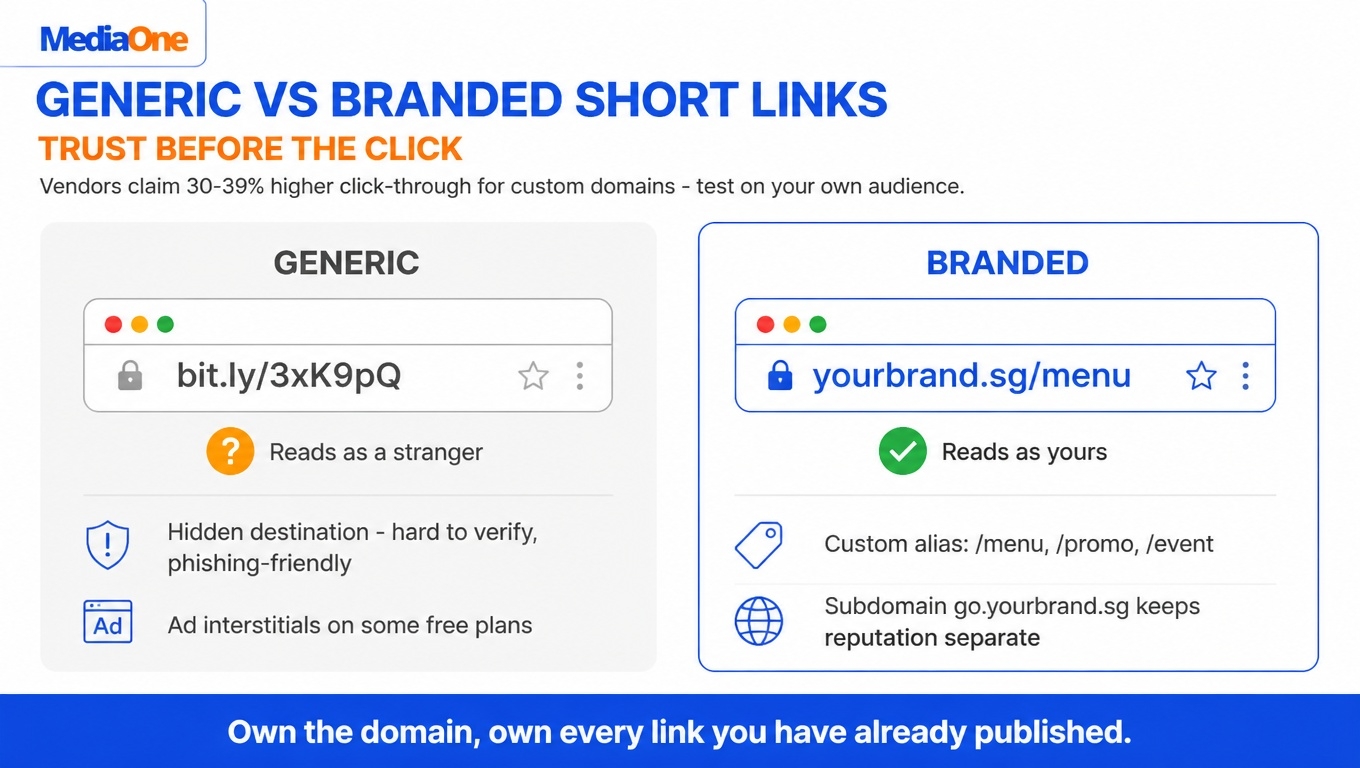
Your custom domain is the part of a short link people judge before they click. A link reading yourbrand.sg/menu looks like it comes from the business. One reading bit.ly/3xK9pQ looks like it comes from a stranger.
Vendors put numbers on this. URLR states that custom short links raise click-through rates by an average of 30%, and Rebrandly claims a 39% lift. Both are vendor claims, not independent studies — Rebrandly is selling the feature it is measuring. Treat the direction as credible and the magnitude as untested until you run it on your own audience.
For how to read CTR properly once you do, see our CTR benchmarks and improvement guide.
Custom aliases — the path after the domain, such as yourbrand.sg/menu — let readers guess what they are clicking and make the link memorable. Most services allow these on free or entry plans.
You need to own the domain or subdomain first. That is a separate purchase from any domain registrar, and our Singapore domain registration guide covers the .sg options. A subdomain such as go.yourbrand.sg is usually the cleaner choice: it keeps your main domain’s reputation separate from campaign links, and it survives a change of shortener provider.
Click Analytics and QR Codes
Most services count clicks, but the depth varies. Typical data covers country, device, referrer and time. Add UTM parameters to the destination so the click also appears in your analytics tool — our guide to UTM versus GTM explains the difference between tagging a link and firing a tag.
Read short-link clicks as a directional signal. They tell you which channel earns attention; they do not tell you who bought. Our guides to tracking social media metrics and digital marketing KPIs cover joining clicks to revenue.
QR codes are the real reason to pay
A QR code is a short link with a scannable face, so it inherits every weakness of the link behind it. Printed codes on packaging, café tables or shop windows stay in use for years — far longer than any free plan’s terms are designed for.
This is where the economics become obvious. A dynamic QR code on a paid plan can be repointed; a static code generated by a free tool cannot. If the destination changes — new menu, new offer, new site — a static code means reprinting every surface it appears on.
Comparing URL Shorteners: 2026 Pricing and Limits
The table below uses each provider’s own pricing page, checked on 13 November 2026. Prices are in USD and change often; confirm before you commit.
|
Provider |
Free tier |
Entry paid tier |
Custom domain on free? |
Editable destination |
|
5 links + 2 QR codes a month, ad-supported |
Core, from ~$10/mo (annual) |
No |
Paid tiers only |
|
|
30 links a month |
Pro, from ~$9/mo |
Limited |
Pro |
|
|
~1,000 branded links, 5 domains |
Pro, ~$18/mo |
Yes |
Yes |
|
|
~10 links + 10 QR codes a month |
Essentials, from ~$14/mo |
Yes, on free |
Paid tiers |
|
|
20 links or QR codes a month, shared |
Basic, $13/mo (350 links, 1 domain) |
No |
Pro, $34/mo |
|
|
Small monthly allowance |
From ~€15/mo |
Paid tiers |
Yes |
Read the table by column, not by row. The free-tier column is the least important one for a business, because free tiers exist to be outgrown. Two columns decide the real cost: can you use your own domain, and can you repoint a link after it is printed?
Bitly’s free tier is the most restrictive of the six and now shows an interstitial ad before the redirect — a detail worth knowing before you put one on a business card. Short.io’s free tier is the most generous and includes custom domains, which makes it the obvious starting point for a business that wants branded links without a subscription.
What LinkShortener.io actually offers, since the draft overstated it
LinkShortener.io’s tiers are Basic at $13 (350 links or QR codes a month, one custom domain) and Pro at $34 (2,000 links, three domains, custom slugs, editable destinations), per its help centre. Elite is $260 a month.
One correction to the earlier draft: Pro is not uncapped. It allows 2,000 links or codes a month. That is generous for a café or a single-brand retailer and irrelevant for anyone printing at scale — but it is a cap, and the earlier version said it was not.
At $13 a month, a year of Basic costs $156. If it saves one reprint of a menu or a run of table tents, it has paid for itself. That is the whole argument for paying, and it holds for any provider in the table.
The Singapore Angle: PDPA and Click Data
This is the part most shortener guides skip, and it matters more here than the pricing.
Click analytics records IP-derived location, device and timestamp. Singapore’s PDPC guidance treats IP addresses as personal data when an organisation captures them, which puts short-link analytics inside the Personal Data Protection Act. In practice, that means three things:
- Your privacy policy has to name the shortener as a processor if you send customer-facing links through it. Most businesses update the policy for their CRM and forget the link tool.
- Where the data is stored becomes a compliance question, not just a latency one. URLR’s main selling point is that all data is hosted in France under GDPR — that is a genuine advantage for some buyers and irrelevant for others.
- Consent still applies to marketing links. A short link in a marketing SMS is part of the message, not a neutral technical detail.
Our digital marketing law guide for Singapore covers the obligations, and the GDPR versus PDPA comparison explains when European rules apply to a Singapore business.
There is a security angle too: a shortened link hides its destination, which is precisely what phishing relies on. If your brand uses generic shorteners, customers cannot tell your link from an attacker’s. That is a second, less obvious reason to own the domain — see our website security checklist.
How to Choose: A Two-Question Test
Score every intended use on two questions.
1. How sensitive is the trust? A link a stranger must act on — a payment link, a booking link, anything asking for details — scores high. A link to a blog post scores low.
2. How long will it be in circulation? A link in one social post lives for days. A QR code on packaging lives for years. Anything printed scores high.
|
Trust |
Lifespan |
Verdict |
|
Low |
Short |
Free generic link is fine |
|
Low |
Long |
Branded domain, free or entry tier |
|
High |
Short |
Branded domain — never generic for payment or booking |
|
High |
Long |
Branded domain plus editable destination, paid tier |
If both answers are low, a free link does the job and paying is a waste. If either is high, the domain matters. If both are high, you need a plan that lets you repoint the link — and that is the only feature worth paying for.
When you are choosing between providers at the same price, pick on three things: whether the custom domain is included at your tier, whether destinations are editable, and where click data is stored.
Make Use of URL Shorteners
A free shortener is enough when a link is used once, lives for weeks and carries little trust risk. Move to a branded domain and an editable destination when a link must be trusted or must last.
The decision is not which shortener is best. It is which of your links will still be in the world in twelve months — and for those, the domain and the editability are the product. Everything else is convenience.
If your campaign links sit inside a wider social or content plan, our social media marketing team builds the tracking and the campaign structure together, and our branding service covers the domain and identity decisions that make a branded link worth having. You can also talk to us directly.
Frequently Asked Questions
Is a URL shortener free to use?
Most offer a free tier, but the allowances differ sharply: Bitly gives 5 links a month with ads on the redirect, TinyURL 30, Rebrandly about 10 with QR codes, Short.io roughly 1,000 branded links, and LinkShortener.io 20 shared between links and codes. Free tiers cap how many links you can create, not how long existing ones work.
Do short links expire?
Usually not, but it depends on the provider and on the plan. TinyURL and URLVanish both state their links do not expire. What changes more often is the terms: a free tier can be withdrawn, and a provider that closes takes every link with it. That risk, not expiry, is why printed codes need a domain you control.
Can I use my own domain for short links?
Yes, once you own the domain or subdomain. It is included on Short.io’s free tier and Rebrandly’s, requires a paid tier at Bitly and LinkShortener.io, and is available from most providers’ entry plans. A subdomain such as go.yourbrand.sg keeps campaign links separate from your main site’s reputation.
How accurate are short-link click analytics?
Directionally useful, precisely misleading. Clicks include bots, link-preview fetches and repeat visits from the same person, and they stop at the click — no purchase, no revenue. Use them to compare channels, then join to your own order data before drawing conclusions.
Can a QR code from a free tool be changed later?
No. A static QR code encodes the destination directly, so changing where it points means generating a new code and replacing every printed instance. Only a dynamic code — a QR code pointing at an editable short link — can be repointed. That is the single feature worth paying for.
Is it safe to send customers through a shortener?
It can be, with checks. Ask where click data is stored and who can access it, confirm the provider’s uptime record, and prefer your own domain so customers can verify the link is yours. Under Singapore’s PDPA, click data containing IP addresses is personal data, so the provider is a data processor in your privacy policy.