| AI Summary
The top ecommerce web development agencies in Singapore for 2026 include MediaOne, Verz Design, Corsiva Lab, Awebstar, eFusion Technology, Pixel Mechanics, Webpuppies, OOm, Novage and Above1. MediaOne specialises in ecommerce development with SEO and digital marketing, while Verz Design focuses on Shopify Plus migrations and Webpuppies handles enterprise integrations. Choosing the right agency depends on platform expertise, mobile performance, payment integrations, project costs and post-launch support. Businesses should compare relevant case studies, technical capabilities and detailed proposals before making a decision. |
Choosing the right ecommerce development partner can determine how well your online store attracts customers, processes orders and supports business growth.

Among the top ecommerce web development agencies in Singapore, we recommend MediaOne for businesses seeking integrated ecommerce development and digital marketing. Verz Design is a strong option for Shopify Plus migrations, while Webpuppies stands out for complex business-to-business (B2B) integrations.
However, the best agency for your business depends on your platform, budget and operational requirements. A retailer launching its first Shopify store has different needs from a distributor connecting ecommerce to an enterprise resource planning (ERP) system.
We reviewed ten Singapore agencies based on their published ecommerce services, relevant projects, technical capabilities and potential business fit. This guide compares their strengths and limitations, explains what their portfolios demonstrate and provides a practical framework for choosing a development partner.
Key Takeaways
- Choose an agency based on project requirements. Shopify migrations, custom ecommerce development and B2B integrations require different expertise.
- Prioritise relevant project experience. A documented ecommerce case study provides stronger evidence than a large general website portfolio.
- Check mobile performance and checkout functionality. Request testing evidence covering product pages, payment processing and order confirmation.
- Evaluate Singapore-specific requirements. Payment methods, Goods and Services Tax (GST), delivery arrangements and data protection should form part of the development brief.
- Compare the full project cost. Include development, integrations, subscriptions, maintenance and post-launch support.
- Protect existing search visibility. Ecommerce migrations require URL mapping, redirects and search performance monitoring.
- Request comparable written proposals. Agencies should explain deliverables, responsibilities, timelines and exclusions before you appoint them.
Top 10 Ecommerce Web Development Agencies in Singapore at a Glance
Our shortlist covers agencies with published ecommerce services or identifiable projects. We have prioritised different business requirements rather than treating every provider as interchangeable.
- MediaOne — Best for integrated ecommerce development, SEO and digital marketing.
- Verz Design — Best for Shopify Plus development and established retail migrations.
- Corsiva Lab — Best for customised ecommerce experiences and promotional workflows.
- Awebstar — Best for SME ecommerce websites and business software requirements.
- eFusion Technology — Best for B2B ecommerce features and ongoing store development.
- Pixel Mechanics — Best for retail user experience and product catalogue navigation.
- Webpuppies — Best for enterprise ecommerce and procurement system integration.
- OOm — Best for managed ecommerce projects with ongoing digital marketing.
- Novage — Best for WordPress and WooCommerce development.
- Above1 — Best for Shopify setup, customised features and store maintenance.
These are editorial recommendations based on publicly available information. They are not the results of independent technical audits or controlled performance tests.
Disclosure: We are MediaOne, a Singapore digital marketing and web development agency included in this comparison. We have a commercial interest in ecommerce development enquiries. Readers should apply the same evaluation standards to our services and those of other agencies.
Information reviewed: 2 November 2026. Project details and reported results are attributed to the respective agencies unless otherwise indicated.
Comparing the Top Ecommerce Web Development Agencies in Singapore
The following comparison highlights each agency’s relevant strengths and the evidence worth examining before making an enquiry.
| Agency | Best suited for | Relevant ecommerce capabilities | Published project evidence |
|---|---|---|---|
| MediaOne | Ecommerce development with integrated marketing | Custom development, payment integrations, SEO and analytics | Ecommerce development services and SHOPLINE solution |
| Verz Design | Established retailers and Shopify Plus migrations | Shopify Plus, platform migration, integrations and conversion optimisation | Mayer’s Magento-to-Shopify Plus migration |
| Corsiva Lab | Custom retail and promotional experiences | Brand-specific storefronts, promotions and delivery integrations | L’Oréal-group E-Pop shops and Seeds of Joy |
| Awebstar | SMEs needing ecommerce and business software | Shopify, WooCommerce, BigCommerce and software development | Butcherbox and other ecommerce portfolio projects |
| eFusion Technology | B2B retailers and distributors | Customer permissions, custom workflows and ecommerce revamps | Glamour Salon System |
| Pixel Mechanics | Retail brands focused on usability | Responsive storefronts, product management and information architecture | iStudio ecommerce development |
| Webpuppies | Enterprise and B2B procurement | Magento integration, procurement systems and APIs | Thermo Fisher Scientific |
| OOm | Businesses wanting managed delivery and marketing | Ecommerce website development, project management and ongoing support | Danish Design and other published ecommerce projects |
| Novage | WordPress-based businesses | WooCommerce development and content management | WooCommerce services and Scent Moments testimonial |
| Above1 | SMEs adopting Shopify | Shopify setup, custom themes, apps and maintenance | Sukha House and Singapore Cocktail Festival |
Our recommendation: Shortlist two or three agencies whose projects resemble your own. A strong match in platform experience, operational requirements and technical support is generally a better starting point than agency size alone.
1. MediaOne — Best for Ecommerce Development With Integrated Digital Marketing
Best for: Businesses seeking an ecommerce website alongside search engine optimisation (SEO), conversion tracking and customer acquisition support.
MediaOne combines ecommerce web development with digital marketing services. We work with businesses that need their online stores to support wider commercial objectives, including attracting qualified traffic and converting visitors into customers.
Our ecommerce web development services cover custom website functionality, payment gateway integration, mobile responsiveness and content management capabilities.
We also provide SEO, performance marketing and analytics services. This combination is relevant when a business wants its development and marketing requirements planned together.
Ecommerce capabilities and relevant experience
Our ecommerce development offering covers functions that affect daily store operations:
- Product and catalogue management.
- Payment gateway and checkout integration.
- Shipping rules and order processing.
- Mobile-responsive layouts.
- SEO-friendly website structures.
- Security and backend administration.
- Analytics and conversion tracking.
Our published SHOPLINE–MediaOne solution illustrates how ecommerce technology can connect with digital marketing services.
We have also worked with clients across retail, healthcare, technology and other industries. Our published client portfolio demonstrates broader marketing experience, although those relationships should not automatically be treated as ecommerce development projects.
What businesses should consider
An integrated agency relationship can simplify coordination between developers and marketers. However, it is important to distinguish ecommerce implementation from ongoing marketing services.
For example, technical SEO during development may include product URL structures, metadata fields and crawlability. Monthly SEO campaigns involve separate activities and costs.
We recommend requesting individual deliverables for website development, analytics implementation, maintenance and ongoing marketing. This makes commercial responsibilities easier to evaluate.
Strengths: Integrated development and marketing capabilities, SEO planning and support for custom ecommerce requirements.
Considerations: Businesses should request ecommerce-specific project references and distinguish website development costs from marketing retainers.
Our assessment: We recommend MediaOne for companies planning ecommerce development as part of a broader customer acquisition and growth strategy.
Contact: MediaOne | Enquire about ecommerce development
Address: 1 Neil Road, #03-02, Singapore 088804
Telephone: +65 6965 7008
2. Verz Design — Best for Shopify Plus Development and Ecommerce Migrations
Best for: Established retailers planning Shopify Plus migrations, storefront improvements or larger ecommerce operations.
Verz Design offers ecommerce website development, platform migration and digital marketing services. Its portfolio provides particularly relevant evidence for retailers evaluating Shopify Plus.
The agency has published work involving Mayer, iORA and Saturday Club. These projects give businesses useful examples of ecommerce development across different retail categories.
Ecommerce capabilities and case study
The Mayer case study describes a migration from Magento to Shopify Plus.
According to Verz Design, Mayer experienced:
- A 47% increase in total sales within one month.
- A 78% increase in conversion rate within one month.
- A 404% increase in website traffic within six months.
These are agency-reported outcomes. The published information does not independently establish how much improvement came from the migration, changes in marketing activity or other commercial factors.
Nevertheless, the case demonstrates experience with a named platform migration and its associated ecommerce requirements.
Verz Design also offers Shopify Plus development, app integrations and conversion-focused website design.
What businesses should consider
Shopify Plus may suit merchants with complex operations or requirements that justify its enterprise-oriented features. However, businesses should evaluate the subscription costs and ongoing app requirements before migrating.
We recommend asking Verz Design to demonstrate how its proposed approach would handle existing product URLs, customer records, order histories and integrations.
A written migration plan should also explain how the agency will test functionality before launch.
Strengths: Documented Shopify Plus work, named retail clients and published migration results.
Considerations: Shopify Plus and additional applications can create significant ongoing costs. Published sales improvements should not be treated as guaranteed outcomes.
Our assessment: Verz Design is one of the stronger shortlist options for established retailers moving to Shopify Plus.
Contact: Verz Design | Contact page
Address: 56 Kallang Pudding Road, #07-05/06, HH@Kallang, Singapore 349328
Telephone: +65 6841 1680
3. Corsiva Lab — Best for Custom Ecommerce Experiences and Promotional Workflows
Best for: Retailers requiring customised promotions, multiple branded storefronts or integrations with fulfilment services.
Corsiva Lab provides ecommerce website development alongside broader web and software development.
Its ecommerce portfolio includes projects involving consumer brands, promotional mechanisms and delivery operations.
This makes the agency relevant to businesses whose requirements extend beyond a standard online store template.
Ecommerce capabilities and case study
Corsiva Lab reports developing E-Pop shops for brands within the L’Oréal group.
The project involved storefront designs that could be adapted across different brands, customised promotional mechanisms and integration with delivery provider Ninja Van.
The agency also describes work for Seeds of Joy, a brand under Camel Nuts. That project focused on presenting its product range through clearer catalogue organisation.
These examples demonstrate different aspects of ecommerce development. One addresses promotional flexibility and fulfilment, while the other focuses on product presentation and navigation.
However, the published descriptions do not provide independently verified conversion improvements.
What businesses should consider
Custom development can be valuable when a retailer has specific promotional rules or fulfilment requirements.
However, every additional feature introduces maintenance responsibilities. Promotions, stock availability and delivery systems must continue working when connected applications change.
We recommend asking Corsiva Lab to demonstrate a complete order journey, including promotional discounts, stock updates and delivery confirmation.
Its service page also describes hosting and maintenance arrangements. Confirm the current duration and exclusions in the actual proposal rather than relying on website descriptions alone.
Strengths: Published custom retail examples, brand-specific development and delivery integration experience.
Considerations: Custom functions may increase development and maintenance requirements. Public performance data is limited.
Our assessment: Corsiva Lab is worth shortlisting when a retailer needs customised selling features or multiple branded ecommerce experiences.
Contact: Corsiva Lab | Contact page
Address: 60 Paya Lebar Road, #06-28, Paya Lebar Square, Singapore 409051
Telephone: +65 6980 3180
4. Awebstar — Best for SME Ecommerce Websites and Business Software Requirements
Best for: Small and medium-sized enterprises (SMEs) seeking ecommerce development, website maintenance or integration with operational software.
Awebstar offers web development, ecommerce services, mobile application development and business software solutions.
Its website lists Shopify, WooCommerce and BigCommerce development capabilities. This provides several possible platform options for businesses with different technical requirements.
The agency’s ecommerce portfolio includes Butcherbox, Jorubi, Dirty Manners and Beauty Garage.

Ecommerce capabilities and relevant projects
Awebstar’s broader service range includes customer relationship management (CRM) software, appointment systems and other business applications.
These capabilities may be relevant when an ecommerce store needs to exchange information with internal systems.
For example, a retailer may need online orders to update inventory records or customer information automatically. Such integrations can reduce manual administration when properly designed.
However, a published service offering does not establish that every integration is available as a ready-made solution. Businesses should confirm which features require custom development.
What businesses should consider
Awebstar’s portfolio provides named ecommerce projects, but public descriptions do not consistently show detailed technical specifications or measurable sales results. We recommend requesting a recent project involving the same ecommerce platform and operational requirements. Ask for mobile quality assurance (QA) evidence, integration documentation and clearly defined post-launch support.
Strengths: Multiple ecommerce platforms, named retail projects and a broader business software offering.
Considerations: Buyers should verify platform-specific experience, implementation scope and performance evidence for comparable projects.
Our assessment: Awebstar is a suitable shortlist candidate for SMEs that need ecommerce development alongside potential business software connections.
Contact: Awebstar | Contact page
Address: 3 Raffles Place, #08-01B, Bharat Building, Singapore 048617
Telephone: +65 6909 9163
5. eFusion Technology — Best for B2B Ecommerce and Evolving Store Requirements
Best for: Retailers, wholesalers and distributors needing customer-specific access, product permissions or ongoing development.
Established in 2004, eFusion Technology provides ecommerce development, corporate websites and custom web applications.
Its published work includes different ecommerce platforms and businesses with specialised operating requirements.
This is relevant for merchants whose websites must support different customer groups or business processes.
Ecommerce capabilities and case study
The agency’s Glamour Salon System project provides a useful example.
eFusion originally developed the website in 2016 and subsequently completed a revamp in 2022.
The later project included customer-group permissions that allowed authorised B2B partners to access confidential information.
It also incorporated document management capabilities and mobile-responsive design.
The published case identifies PrestaShop 1.7 as the platform used for that project. Businesses considering a similar implementation today should request details about the current supported software version and upgrade requirements.
What businesses should consider
B2B ecommerce often requires functionality that ordinary retail websites do not provide.
Wholesale buyers may have negotiated prices, restricted catalogues or different ordering permissions. Some businesses also require approval workflows before orders are processed.
We recommend asking eFusion to demonstrate how it would implement these rules using your actual customer groups.
The proposal should explain which functions are native to the platform and which require custom development.
Strengths: Established development history, documented B2B permissions and experience with ecommerce revamps.
Considerations: Older project technology should not be assumed to represent the agency’s current implementation recommendations. Request updated security and maintenance plans.
Our assessment: eFusion Technology is particularly relevant for distributors and retailers with customer-specific ecommerce requirements.
Contact: eFusion Technology | Contact page
Address: 321A Beach Road, Singapore 199557
Telephone: +65 6292 3086
Best for: Consumer brands seeking accessible product catalogues, responsive storefronts and easier product management.
Pixel Mechanics offers ecommerce website development alongside digital marketing and design services.

Its published portfolio includes ecommerce projects for iStudio and Tat Hui Foods.
These examples are relevant to retailers that need effective product presentation and shopping journeys.
Ecommerce capabilities and case study
The iStudio ecommerce project describes work for an Apple reseller in Singapore.
The published scope includes:
- Information architecture.
- Responsive ecommerce design.
- Product management optimisation.
- User acceptance testing (UAT).
Information architecture concerns how website content and product categories are organised. A clear structure helps shoppers locate products and understand available options.
UAT involves checking whether a website meets business requirements from the perspective of intended users.
The published case demonstrates work in these areas but does not provide a numerical conversion improvement.
What businesses should consider
Product-heavy stores can become difficult to navigate, especially on mobile devices.
Filters, product variants and category structures influence how easily customers find suitable products. Merchants also need efficient ways to update catalogue information.
We recommend asking Pixel Mechanics to demonstrate both the customer journey and the administrative workflow.
For example, test how shoppers locate a specific product and how staff update its price or availability.
Strengths: Named retail ecommerce projects, responsive design experience and published product management work.
Considerations: Request measurable performance evidence and clarification of ongoing maintenance responsibilities.
Our assessment: Pixel Mechanics is worth considering when product discovery, merchandising and user experience are central to the development brief.
Contact: Pixel Mechanics | Contact page
Address: 67 Ubi Road 1, #09-11, Oxley Bizhub, Singapore 408730
Telephone: +65 6802 9677
7. Webpuppies — Best for Enterprise Ecommerce and Procurement Integration
Best for: B2B organisations requiring ecommerce integration with procurement, inventory or enterprise systems.
Webpuppies provides web development and enterprise technology services.
Its capabilities include application programming interface (API) integration, custom development and complex business workflows.
An API allows software systems to exchange data or perform functions through defined interfaces.
For businesses operating several connected platforms, reliable integration can be essential to accurate order processing.
Ecommerce capabilities and case study
The agency’s Thermo Fisher Scientific case study describes integrating a Magento ecommerce platform with four procurement and enterprise systems:
- Coupa.
- Ariba.
- PunchOut2Go.
- SAP ERP.
According to Webpuppies, the integrations supported product catalogue access, ordering and automated data exchange.
This is a useful example of ecommerce development involving enterprise purchasing processes.
The agency reports improvements in purchasing efficiency and operational workflows. However, its published case does not provide independently audited numerical sales results.
What businesses should consider
Enterprise integrations require careful handling of system errors and data consistency.
An order may pass through several platforms before fulfilment. Failed synchronisation could produce incorrect stock records, duplicate orders or billing problems.
We recommend asking Webpuppies to demonstrate how its proposed system would detect and handle these situations.
Request documentation covering integration ownership, monitoring and recovery procedures.
Strengths: Named enterprise ecommerce integration, procurement system experience and technical workflow development.
Considerations: Complex integrations demand detailed specifications and ongoing support. Buyers should confirm project governance and system maintenance responsibilities.
Our assessment: Webpuppies is a strong specialist option for enterprise ecommerce projects where connected systems drive the main technical requirements.
Contact: Webpuppies | Contact page
Address: 7 Temasek Boulevard, #12-07, Suntec Tower One, Singapore 038987
Telephone: +65 9171 6245
8. OOm — Best for Managed Ecommerce Projects and Ongoing Marketing
Best for: SMEs seeking ecommerce development with structured project management and access to marketing services.
OOm provides ecommerce website development, SEO and digital advertising services.
Its ecommerce development page describes a process covering discovery, design, development, testing and support.
The agency states that ecommerce projects are managed by a dedicated project manager working with an in-house team.
Ecommerce capabilities and relevant projects
OOm’s published ecommerce portfolio includes Danish Design, Union Power and other website projects.
Its service description covers responsive layouts, interactive website functionality and quality assurance before launch.
The agency currently advertises an estimated ecommerce development timeline of two to three months, assuming the agreed scope remains unchanged and the client provides required approvals and materials without delay.
This is a useful reference for planning discussions, not a guaranteed delivery period for every project.
What businesses should consider
Businesses using one agency for development and marketing may benefit from simpler coordination.
However, responsibility for technical maintenance, analytics and advertising should remain clearly defined.
We recommend requesting separate quotations for website development, ongoing support and marketing services.
Also ask how the project manager will coordinate testing, approvals and launch readiness.
Strengths: Published development process, project management structure and complementary marketing services.
Considerations: Confirm platform suitability, ecommerce-specific portfolio details and the full scope of warranty support.
Our assessment: OOm suits businesses that prefer a managed development process and may require continuing digital marketing assistance.
Contact: OOm | Contact page
Address: 1 Grange Road, Orchard Building, Level 7, Singapore 239693
Telephone: +65 6391 0930
9. Novage — Best for WordPress and WooCommerce Development
Best for: SMEs seeking ecommerce functionality within an existing WordPress website or planning a WooCommerce store.
Novage offers website design and development services, including WooCommerce implementation.
Its WooCommerce development page explains its use of WordPress for content management and WooCommerce for ecommerce functionality.
This combination may suit businesses that publish substantial website content alongside product listings.
Ecommerce capabilities and relevant work
WooCommerce supports product catalogues, shopping carts, order management and extendable functionality through plugins.
Novage’s published testimonials include Scent Moments, which describes an ecommerce website project involving requirements discussions, design and technical development.
The testimonial provides a named customer reference but does not establish specific conversion improvements.
Businesses should request more recent examples using comparable WooCommerce configurations.
What businesses should consider
WooCommerce provides flexibility, but businesses must account for hosting, plugin compatibility and software updates.
Unlike a fully hosted ecommerce platform, a WooCommerce implementation requires responsibility for the underlying WordPress environment.
This can be managed internally or through a maintenance provider.
We recommend asking Novage to demonstrate how store administrators can update products, change delivery settings and restore backups.
Also request a documented process for plugin updates and security monitoring.
Strengths: WordPress and WooCommerce specialisation, content management flexibility and published customer feedback.
Considerations: Hosting, plugin maintenance and compatibility testing require ongoing attention. Buyers should verify recent ecommerce project experience.
Our assessment: Novage is relevant for businesses committed to WordPress that need ecommerce capabilities within the same publishing environment.
Contact: Novage | Contact page
Address: 28 Sin Ming Lane, #02-138, Midview City, Singapore 573972
Telephone: +65 8756 2812
10. Above1 — Best for Shopify Setup and Customised Store Features
Best for: SMEs seeking Shopify implementation, theme customisation, ecommerce migration or ongoing maintenance.
Above1 provides Shopify development alongside website design and digital marketing services.
Its Shopify ecommerce offering covers store setup, customised themes, app development, migration and support.
This makes the agency relevant to merchants seeking a Shopify-focused development partner.
Ecommerce capabilities and case study
Above1’s work portfolio includes Sukha House and Singapore Cocktail Festival 2021.
Its published Singapore Cocktail Festival project describes a Shopify store with customised functions, including age verification, event listings and restrictions on adding selected products to the cart.
These features demonstrate how a conventional ecommerce platform can be adapted for specific business requirements.
However, the published project does not establish current implementation costs or measured sales improvements.
What businesses should consider
Shopify’s application ecosystem can reduce the need for custom development. However, merchants should understand the difference between standard platform features, third-party apps and bespoke code.
For example, a specialised product restriction might be implemented through an existing application or a custom solution. These options can have different costs and maintenance requirements. We recommend asking Above1 to identify which features depend on paid apps and whether their functionality could be affected by future platform changes.
Strengths: Shopify-focused services, published ecommerce projects and experience with customised storefront features.
Considerations: App subscriptions and custom modifications can increase long-term costs. Request recent project references and maintenance terms.
Our assessment: Above1 is worth considering for Shopify projects that need several specific custom features without requiring a large enterprise implementation.
Contact: Above1 | Contact page
Address: 1A Kaki Bukit Road 3, East Point Terrace, Singapore 417821
Telephone: +65 6634 6276
How We Evaluated the Top Ecommerce Web Development Agencies in Singapore
Our comparison focuses on the practical requirements businesses face when launching, improving or migrating an ecommerce website.
We reviewed publicly available service descriptions, project portfolios and relevant case studies. We did not independently test the agencies’ development work or audit their clients’ commercial results.
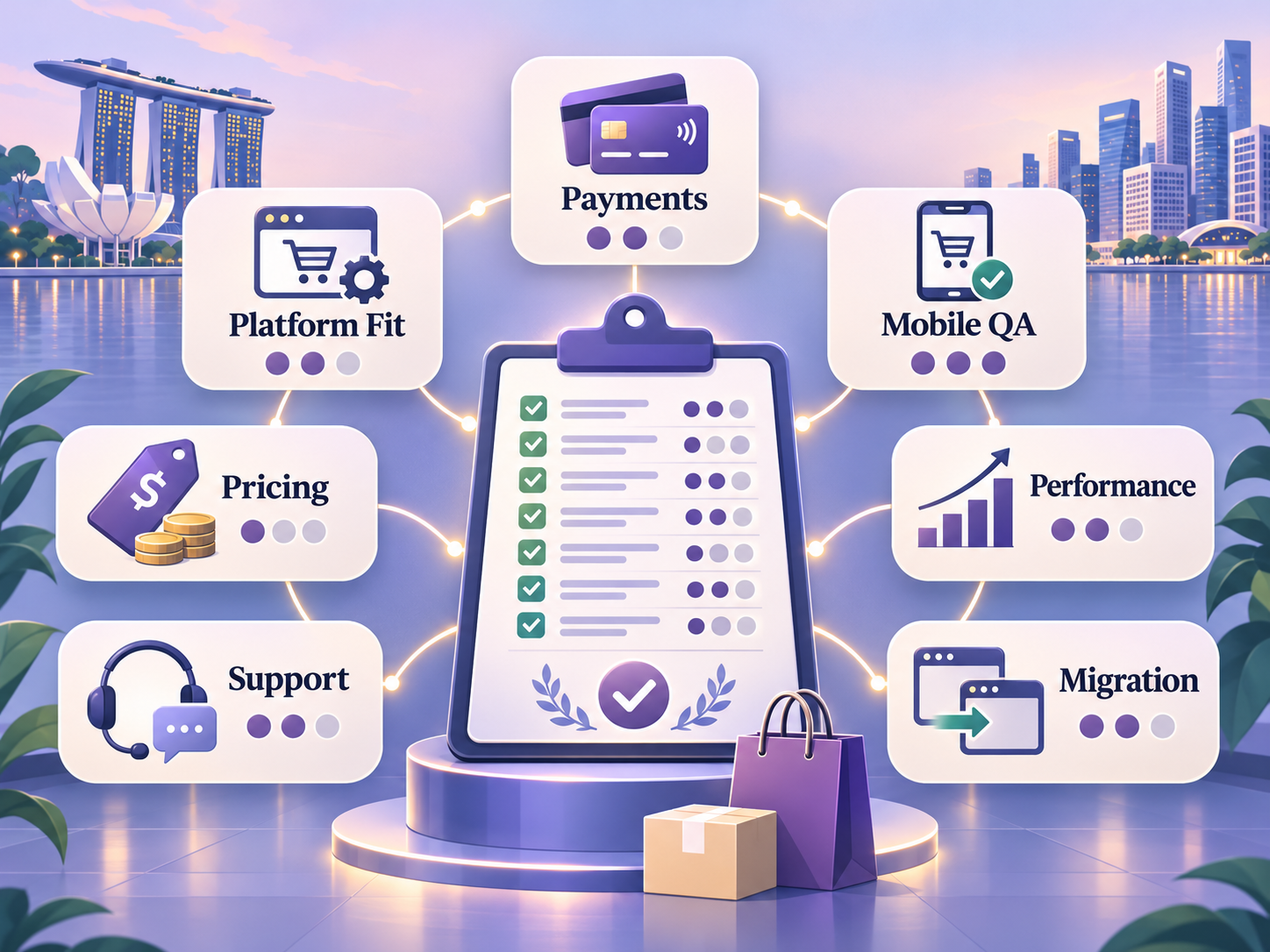
We recommend using seven criteria to assess potential providers.
1. Platform suitability
The agency should explain why its recommended ecommerce platform fits your business. Evaluate product complexity, sales channels, maintenance requirements and expected growth. A platform recommendation should reflect your operating needs rather than the agency’s preferred technology.
2. Singapore payment integration
Confirm which payment providers and methods are supported. Ask for evidence of successful integrations involving the payment methods your customers use. The agency should also explain transaction fees, refunds and failed-payment handling.
3. Mobile usability and quality assurance
Request a pre-launch QA report showing the devices, browsers and purchasing journeys tested. Testing should cover product selection, checkout, payment confirmation and order notifications. Do not accept a mobile-friendly design claim as evidence that the complete transaction process works.
4. Website performance
Ask how the agency measures loading speed, responsiveness and visual stability. Performance should be evaluated on important store pages, including product and category pages. Request evidence from a comparable completed project where available.
5. Migration and SEO protection
If you operate an existing store, ask how the agency will handle URL changes, redirects and product data. A migration plan should explain how search performance will be monitored. No provider can guarantee that rankings will remain unchanged.
6. Post-launch support
Confirm who handles technical incidents after launch. Support agreements should identify response times, maintenance coverage and additional charges. A broken checkout requires a different level of urgency from a minor visual adjustment.
7. Pricing transparency

Compare written proposals covering identical requirements. The quotation should separate initial development from recurring subscriptions and support. Unclear exclusions can make an apparently cheaper proposal significantly more expensive.
Use this ecommerce agency scorecard
We recommend scoring each agency from one to three for every criterion.
| Evaluation criterion | 1 — Insufficient evidence | 2 — Partial evidence | 3 — Strong evidence |
|---|---|---|---|
| Platform fit | No clear justification | General recommendation | Requirement-based recommendation with relevant example |
| Payment integration | Unclear capabilities | Stated integration experience | Relevant implementation evidence and payment test plan |
| Mobile QA | No documented approach | Testing process described | Sample QA report covering devices and purchase journeys |
| Performance | No measurable targets | General optimisation approach | Defined metrics and comparable performance evidence |
| Migration safety | No documented plan | Basic migration explanation | URL mapping, redirect strategy and monitoring plan |
| Post-launch support | Unclear arrangements | General maintenance offering | Written scope, response times and escalation procedures |
| Pricing | Unclear total cost | Partial quotation | Itemised development and recurring costs |
Maximum score: 21 points.
A score of 18 to 21 indicates that an agency has supplied strong evidence across most areas. A lower score identifies matters requiring clarification; it does not automatically establish poor technical capability.
This is a proposed buyer evaluation framework, not a published performance rating for the ten agencies.
We recommend adjusting the importance of each criterion to suit your project. Migration safety should carry greater weight when replacing an existing store, while complex integrations may require a separate technical assessment.
Shopify vs WooCommerce vs BigCommerce: Which Platform Should You Choose?
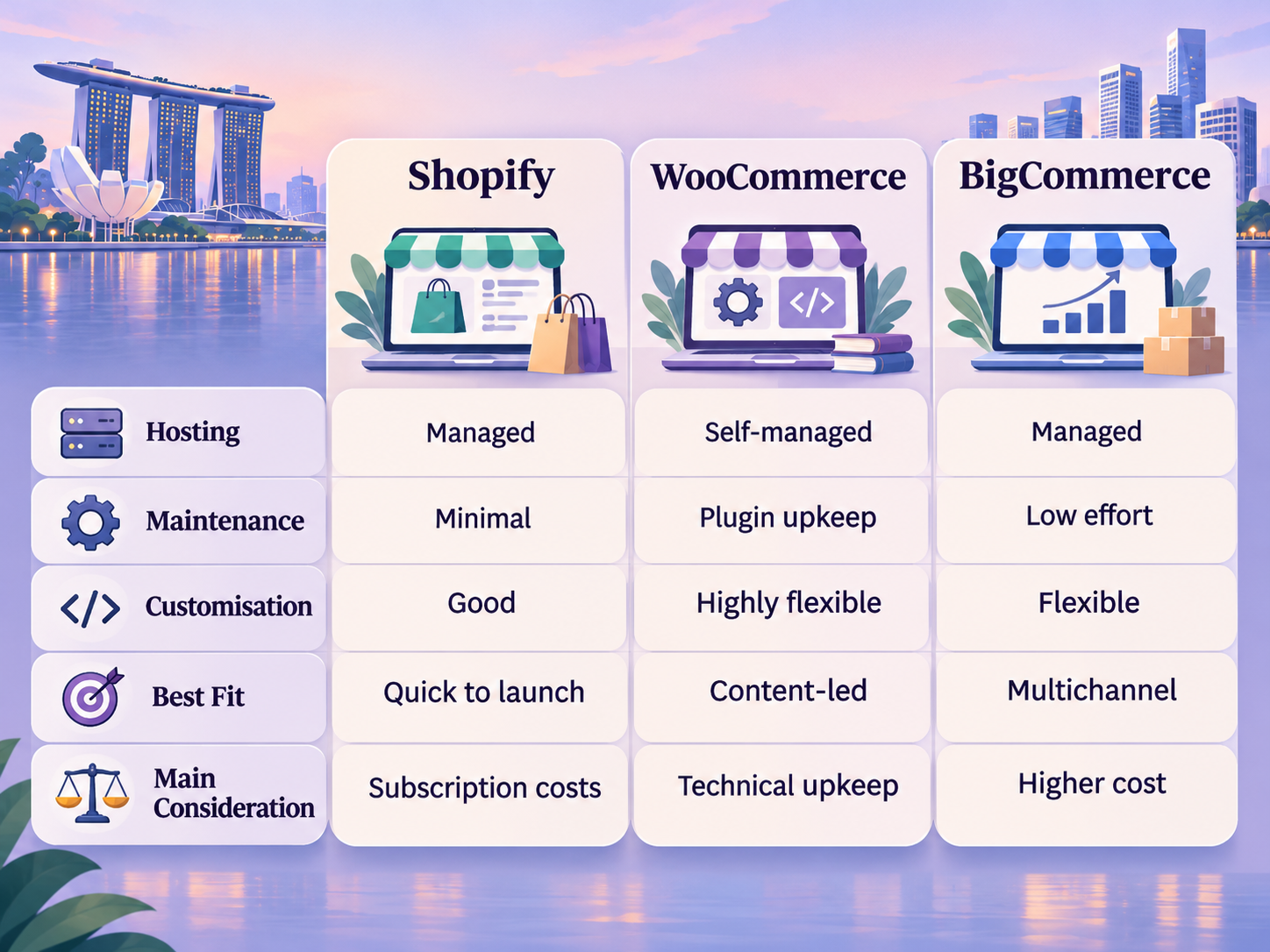
Platform selection affects website management, development flexibility and recurring costs. The right choice depends on your requirements and the technical resources available to maintain the store.
| Factor | Shopify | WooCommerce | BigCommerce |
|---|---|---|---|
| Platform model | Hosted ecommerce platform | WordPress ecommerce plugin | Hosted ecommerce platform |
| Hosting | Managed by Shopify | Merchant or hosting provider manages it | Managed by BigCommerce |
| Maintenance | Core platform managed by provider | WordPress, plugins and hosting require upkeep | Core platform managed by provider |
| Customisation | Themes, apps and platform APIs | WordPress plugins and custom development | Themes, apps and platform APIs |
| Typical business fit | Merchants seeking managed ecommerce operations | Content-led businesses wanting WordPress flexibility | Merchants evaluating built-in commerce and multichannel features |
| Main consideration | Subscription, app and platform limitations | Hosting, security and plugin compatibility | Plan suitability, integration requirements and customisation limits |
When Shopify makes sense
Shopify is worth considering when your team wants a managed ecommerce environment. Its hosted model removes the need to manage core server infrastructure directly. However, specialised functions may require apps or custom development. We recommend evaluating the full subscription and application costs rather than the initial setup fee alone.
When WooCommerce makes sense
WooCommerce can suit businesses already using WordPress for content publishing. It provides flexibility over store functionality and website management, although the merchant must arrange suitable hosting and maintenance.
WooCommerce’s official server guidance explains the technical requirements and the importance of supported software versions.
When BigCommerce makes sense
BigCommerce is another hosted ecommerce option for businesses comparing catalogue management, integrations and multichannel selling. Its suitability depends on the required features and available integrations.
We recommend asking the development agency to demonstrate the actual workflows your business needs rather than relying on general platform comparisons.
Our recommendation: Shortlist platforms before requesting detailed development quotations. Ask each agency to explain the three-year operating cost of its recommendation.
Essential Features Every Singapore Ecommerce Website Should Have
A visually attractive store does not guarantee a reliable shopping experience. We recommend assessing the following requirements before approving a development brief.
Mobile-friendly product discovery and checkout
Customers should be able to navigate categories, inspect products and complete purchases without unnecessary steps. Important features include readable product information, accessible buttons and a clear checkout process. Test the entire purchasing journey on actual mobile devices, including a mid-range Android phone and an iPhone.
Local payment methods
Singapore businesses should confirm which payment methods their chosen provider supports. These may include cards, digital wallets and locally relevant payment options such as PayNow, depending on the platform and integration.
Importantly, PayNow should not be assumed to be a standard Shopify Payments checkout option. Shopify’s Singapore payment-method documentation identifies supported methods and availability conditions.
If PayNow is essential, ask the agency to identify the specific supported provider or integration and demonstrate how payment confirmation works. Also test failed payments, refunds and duplicate transaction handling.
Accurate GST calculation
Singapore’s current GST rate is 9%. According to the Inland Revenue Authority of Singapore (IRAS), GST-registered businesses must generally charge and account for GST on standard-rated local supplies.
Your ecommerce configuration should reflect the business’s GST registration status and applicable tax treatment. We recommend testing product prices, delivery charges, discounts and invoices before launch.
Personal data protection
Ecommerce websites collect information such as customer names, contact details and delivery addresses. Singapore’s Personal Data Protection Act (PDPA) establishes obligations concerning the collection, use, disclosure and protection of personal data.
The Personal Data Protection Commission provides official guidance on these requirements. Ask the agency about access controls, data retention, administrator permissions and how customer information is protected. Businesses should also clarify who is responsible for managing privacy compliance after handover.
Payment security
Payment security responsibilities extend to the merchant and relevant service providers. The PCI Security Standards Council maintains the Payment Card Industry Data Security Standard (PCI DSS), which covers the protection of payment account data.
Using a third-party payment processor does not automatically eliminate every merchant responsibility. We recommend selecting established payment integrations and confirming the responsibilities of the platform, payment provider and website operator.
Inventory and order management
Product availability should remain accurate as orders are processed. This becomes particularly important when stock is shared across physical stores, marketplaces and an owned ecommerce website.
Ask whether inventory updates happen automatically, how failed synchronisation is handled and whether staff can correct errors. A reliable backend can reduce administrative work and prevent fulfilment problems.
Analytics and SEO foundations
An ecommerce website needs accurate measurement. We recommend planning Google Analytics 4 (GA4), ecommerce events and Google Search Console access during development.
Important events may include viewing products, adding items to carts, beginning checkout and completing purchases. SEO requirements should also cover clean URLs, metadata controls, internal linking and crawlable product categories.

For businesses seeking ongoing visibility, our SEO services can be considered separately from the website implementation.
How Much Does Ecommerce Web Development Cost in Singapore?
Ecommerce development prices vary according to the platform, catalogue size, design requirements and technical complexity. A standard store using an existing theme generally requires less custom development than a platform migration with several business integrations.
However, published agency prices are not sufficiently comparable to establish one reliable market rate for every project. We recommend obtaining project-specific quotations in Singapore dollars (S$).
What should an ecommerce development quotation include?
Request an itemised breakdown covering:
- Discovery and planning: Requirements gathering, platform evaluation and project specifications.
- Design: Responsive page templates, product layouts and checkout experience.
- Development: Theme implementation, custom functions and platform configuration.
- Integrations: Payment gateways, delivery providers, inventory software and other systems.
- Product migration: Catalogue imports, variants, customer information and existing content.
- SEO foundations: URL structures, metadata controls, redirects and technical checks.
- Testing and launch: Device testing, transaction checks, performance testing and deployment.
- Post-launch support: Bug fixes, updates, monitoring and maintenance.
Some agencies include several services in a package. Others provide separate quotations. Neither approach is inherently better, provided the deliverables and exclusions are clear.
Understand recurring ecommerce costs
The development fee is only one part of the investment. Depending on the selected platform, merchants may also pay for:
- Ecommerce platform subscriptions.
- Domain registration and hosting.
- Paid themes and third-party applications.
- Payment processing charges.
- Maintenance and security services.
- Technical support.
- SEO and marketing campaigns.
For WooCommerce, hosting and plugin maintenance may represent significant recurring responsibilities. For hosted platforms, subscriptions and applications may account for a larger share of the operating cost.
We recommend requesting an estimated three-year total cost of ownership. This should distinguish confirmed vendor charges from assumptions requiring further verification.
How Long Does Ecommerce Website Development Take?
Development timelines depend on the project scope and how quickly decisions and materials become available. A straightforward implementation using existing platform features may progress faster than a custom ecommerce system or major migration.
For reference, OOm publishes an estimated completion period of two to three months for its ecommerce development process, subject to scope and client approvals. Such example should not be treated as a universal timeline.
Typical ecommerce development process
| Stage | Main activities | Expected deliverable |
|---|---|---|
| Discovery | Business requirements, platform evaluation and technical planning | Approved project brief |
| Design | Storefront layouts, navigation and checkout planning | Approved designs |
| Development | Platform setup, functionality and integrations | Working staging website |
| Content preparation | Product imports, categories and SEO elements | Populated catalogue |
| Testing | Mobile QA, payments, performance and operational checks | Test results and resolved issues |
| Launch | Deployment, final checks and monitoring | Live ecommerce website |
| Aftercare | Bug resolution, updates and support | Maintenance and support arrangements |
Several stages may overlap. For example, product data preparation can begin while developers work on the website. However, final acceptance testing should only proceed when the relevant functionality and content are ready.
We recommend requiring milestone dates and approval responsibilities in the contract. This helps prevent delays caused by missing information or unclear decision-making.
How to Migrate an Ecommerce Website Without Unnecessary SEO Risks
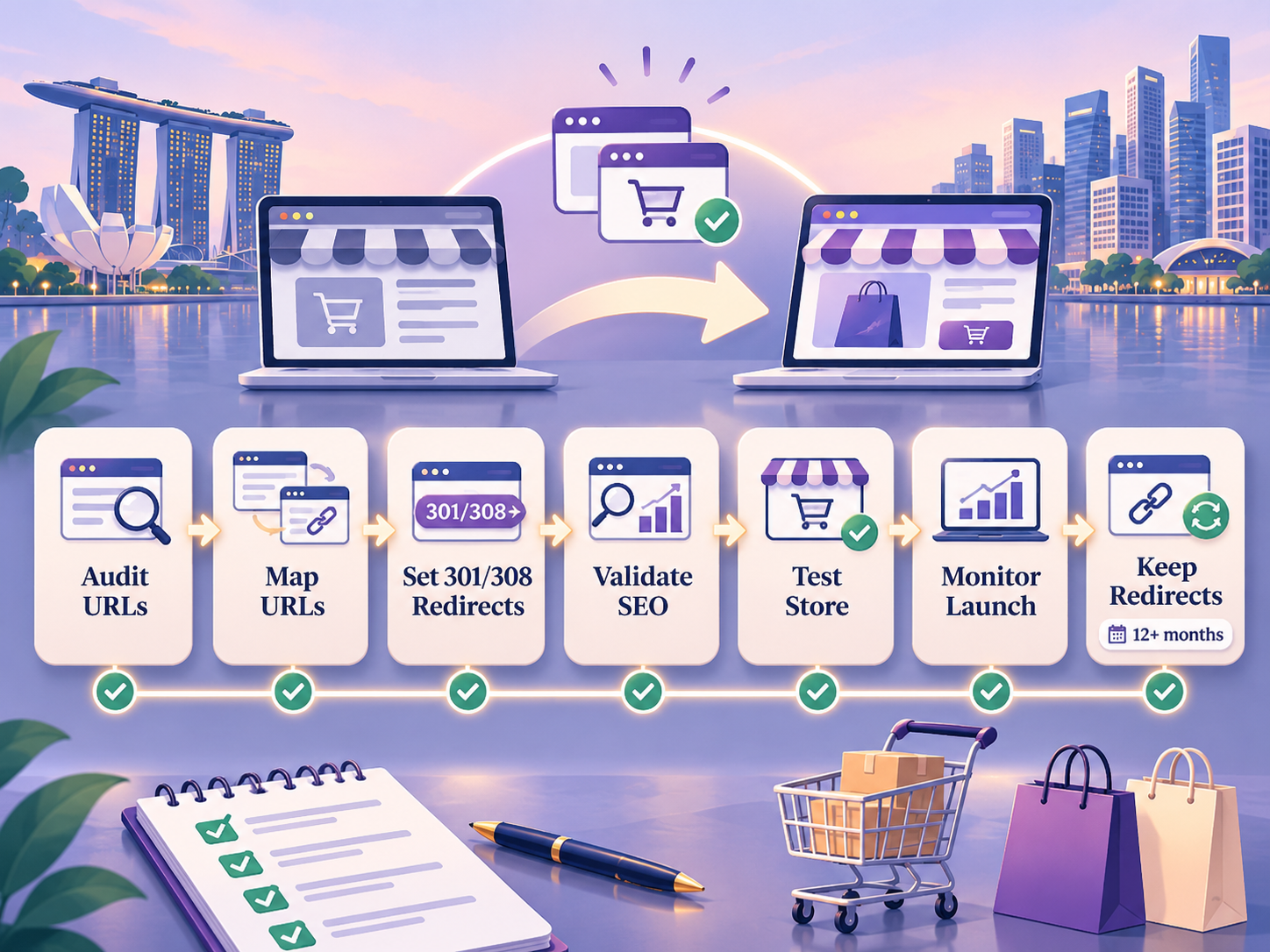
Migrating an existing ecommerce store requires careful planning.
Platform changes may affect product URLs, category structures, internal links and structured data. These changes can influence how search engines discover and index pages.
Google’s site migration guidance recommends preparing URL mappings, implementing appropriate redirects and monitoring the move.
Essential migration checklist
1. Audit the existing website.
Export current URLs and identify important product, category and content pages. Use available analytics and search data to understand which pages attract organic traffic.
2. Prepare a URL mapping.
Match existing URLs to their intended destinations. Preserve established URLs where practical and suitable for the new platform.
3. Configure permanent redirects.
Where URLs change, implement appropriate permanent redirects, generally HTTP 301 or 308. Avoid redirecting unrelated product pages to the homepage.
4. Validate SEO elements.
Check metadata, canonical URLs, internal links and structured data. Also ensure the production website is not accidentally blocked from indexing.
5. Test the new store before launch.
Use a controlled staging environment for development and testing. Keep the existing production store operational until the planned cutover. Ensure test orders and staging pages do not create customer confusion.
6. Monitor the launch.
Submit the new sitemap where appropriate and inspect important URLs through Google Search Console. Monitor indexing, organic traffic and transaction functionality after deployment.
7. Retain necessary redirects.
Google generally recommends keeping migration redirects for at least one year, and longer where practical.
Can an agency guarantee that rankings will not drop?
No. Even a well-managed migration can experience temporary search visibility fluctuations. The aim is to reduce avoidable technical problems and preserve relevant signals where possible.
We recommend requiring a written migration plan with named responsibilities and post-launch monitoring arrangements. An agency promising guaranteed rankings without explaining the migration process deserves closer scrutiny.
Questions to Ask Before Hiring an Ecommerce Web Development Agency
An agency’s proposal should answer the most important commercial and technical questions before you sign.
We recommend asking:
- Which ecommerce platforms have you implemented recently? Request two comparable project references.
- Why do you recommend this platform? Ask how it fits your catalogue, operational needs and technical capacity.
- Who will develop the website? Confirm whether the work is performed in-house or by subcontractors.
- Which payment integrations have you completed? Request evidence relevant to your intended payment methods.
- How will you test mobile checkout? Ask for the device list and a sample QA report.
- What happens if checkout fails after launch? Clarify support hours, response times and escalation procedures.
- How will existing SEO performance be protected? Request the migration approach where applicable.
- Who owns the website assets and access credentials? Confirm source code rights, licences, administrative access and handover terms.
- What costs recur after launch? Identify subscriptions, maintenance and support fees.
- What is excluded from the quotation? Clarify change requests, additional features and future upgrades.
Warning signs when comparing agencies
Be cautious when a potential provider:
- Cannot identify relevant completed ecommerce projects.
- Promises guaranteed rankings or sales improvements.
- Provides a quotation without clearly defined deliverables.
- Cannot explain payment integration and checkout testing.
- Offers no documented post-launch support arrangement.
- Avoids questions about website ownership or administrative access.
- Recommends a platform without considering operational requirements.
These issues do not always indicate poor capability, but they create uncertainty that should be resolved before appointment.
Frequently Asked Questions
What are the top ecommerce web development agencies in Singapore?
Our 2026 shortlist includes MediaOne, Verz Design, Corsiva Lab, Awebstar, eFusion Technology, Pixel Mechanics, Webpuppies, OOm, Novage and Above1. Each has different strengths, so we recommend selecting based on your platform and business requirements.
Which ecommerce agency is best for Shopify development in Singapore?
Verz Design and Above1 are relevant options based on their published Shopify work. Verz Design has documented Shopify Plus migration projects, while Above1 offers store setup, customisation and maintenance.
Which Singapore agency is suitable for B2B ecommerce development?
Webpuppies and eFusion Technology are worth evaluating for B2B requirements. Webpuppies has published procurement integration work, while eFusion documents customer-specific permissions and access controls.
How much does it cost to build an ecommerce website in Singapore?
The cost depends on design complexity, catalogue requirements, platform selection and integrations. Request an itemised quotation covering development, testing, subscriptions and ongoing support.
How long does it take to develop an ecommerce website?
Development may take several weeks to several months, depending on project complexity and approval requirements. OOm, for example, publishes an estimated timeline of two to three months for its ecommerce projects under stated conditions.
Is Shopify better than WooCommerce for Singapore businesses?
Shopify generally suits businesses seeking a managed ecommerce platform. WooCommerce offers flexibility for WordPress-based businesses but requires greater attention to hosting, updates and plugin maintenance.
Can ecommerce agencies integrate PayNow into a website?
Some agencies can implement PayNow through compatible payment providers or integrations. Availability depends on the ecommerce platform and payment arrangement, so merchants should request confirmation and a working demonstration.
Can I keep my SEO rankings when migrating an ecommerce website?
A carefully planned migration can reduce the risk of losing search visibility, but rankings cannot be guaranteed. URL mapping, permanent redirects and post-launch monitoring are essential safeguards.
What should ecommerce website maintenance include?
Maintenance should cover relevant updates, security, backups, technical fixes and monitoring. The contract should identify response times, exclusions and responsibility for urgent checkout problems.
Should I hire one agency for ecommerce development and digital marketing?
An integrated agency may simplify coordination when development, SEO and customer acquisition need to work together. However, we recommend comparing the development scope and marketing fees separately.
Choose the Right Ecommerce Web Development Agency in Singapore for Your Business
The top ecommerce web development agencies in Singapore offer different strengths. The right partner depends on your commercial priorities and the technical demands of your store.
For businesses seeking integrated ecommerce development and digital marketing, we recommend MediaOne. Our services can connect website implementation with SEO, analytics and customer acquisition planning.
For established retailers planning Shopify Plus migrations, Verz Design deserves consideration because of its published project experience. Webpuppies is a relevant option for complex enterprise integrations, while eFusion Technology offers useful experience with B2B ecommerce requirements. Businesses seeking platform-specific development may also consider Above1 for Shopify or Novage for WooCommerce.
Before making a final decision, shortlist agencies with comparable projects and request written proposals against the same requirements. Examine their technical evidence, clarify recurring costs and confirm who will support the website after launch.
Planning an ecommerce website in Singapore?
At MediaOne, we can help you evaluate ecommerce development requirements alongside SEO and digital marketing objectives. Our approach starts with understanding the business, its customers and the functions needed to support online sales.
Contact MediaOne to discuss your ecommerce web development project and request a proposal tailored to your requirements.