| AI Summary SkillsFuture marketing courses in Singapore help professionals develop practical skills in SEO, paid advertising, social media, email marketing and analytics. This guide explains available course types, SkillsFuture Credit eligibility, government subsidies and career transition programmes in 2026. It also covers course fees, essential marketing skills and practical criteria for choosing the right programme based on career goals, training quality and funding eligibility. |
SkillsFuture marketing courses can help Singapore professionals learn search engine optimisation (SEO), paid advertising, social media, email marketing and analytics. However, funding eligibility and course quality are separate questions.


We recommend choosing a programme based on the work you need to perform, then checking its training outcomes and final payable fee. This guide explains the course routes available in 2026, the SkillsFuture Credit rules, and how to compare programmes without paying for skills you already have.
Key Takeaways
- Choose by job task. A focused module often suits an experienced marketer; a structured programme may suit someone changing careers.
- Separate credits from subsidies. Eligible Singapore citizens aged 25 and above receive S$500 in opening SkillsFuture Credit. Those aged 40 and above also receive S$4,000 in mid-career credit for selected courses.
- Check the exact course. Workforce Skills Qualifications (WSQ), SkillsFuture Credit eligibility and course fee subsidies are different classifications.
- Check the 2026 changes. The Skills and Workforce Development Agency (SWDA) took over the former SkillsFuture Singapore and Workforce Singapore functions in July 2026.
- Verify costs and assessment. Compare the fee after applicable subsidies, available credit, goods and services tax (GST), additional charges and practical coursework.
What Are SkillsFuture Marketing Courses?
SkillsFuture is Singapore’s national lifelong-learning initiative. Marketing courses listed through MySkillsFuture cover topics such as digital campaign planning, online advertising, customer engagement and marketing measurement. Some provide national qualifications. Others are shorter modules focused on a particular skill.
Following the July 2026 merger of SkillsFuture Singapore (SSG) and Workforce Singapore (WSG), the responsible statutory board is the Skills and Workforce Development Agency (SWDA). The SkillsFuture name and MySkillsFuture portal remain relevant to course discovery and credit claims. The Ministry of Manpower’s announcement confirms the change.
SkillsFuture eligibility versus WSQ accreditation
Workforce Skills Qualifications (WSQ) is Singapore’s national credential system for workplace competencies. WSQ courses follow specified competency and assessment requirements. A course’s SkillsFuture Credit eligibility concerns whether an eligible learner can use their credit towards its fees.
These labels are not interchangeable. A privately run course can be listed on MySkillsFuture without being a WSQ programme. Similarly, the credit available to a learner does not automatically determine the government subsidy on that course. Check the qualification awarded, credit eligibility and applicable subsidy separately.
Who should take these courses?
We would divide prospective learners into four practical groups:
- Career switchers need a foundation across several channels, suitable assessed projects and, where available, employment support.
- Working marketers often benefit from focused training in paid search, technical SEO, analytics or automation.
- Small and medium-sized enterprise (SME) owners need skills they can apply to their own campaigns and budgets.
- Graduates and new entrants may prefer beginner-friendly courses that produce portfolio work instead of relying solely on a certificate.
The important question is which marketing task you expect to perform within the next six to twelve months. That answer should guide your shortlist.
Types of Digital Marketing Courses in Singapore
SkillsFuture marketing courses differ in duration, credential, learning format and employment focus. We recommend comparing four routes rather than treating every course labelled ‘digital marketing’ as equivalent.
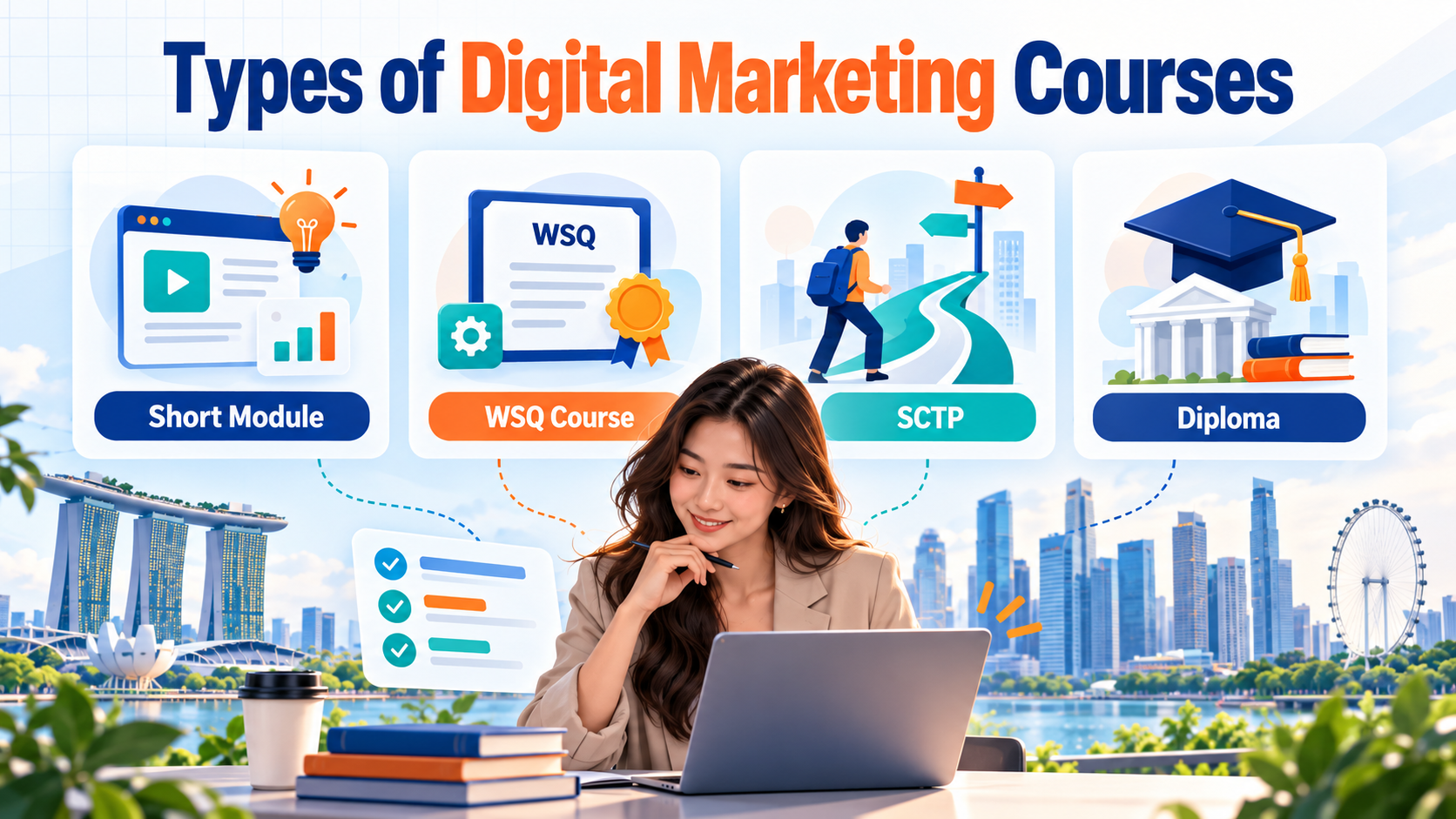
| Course route | Best suited to | Main advantage | Main limitation |
| Short, SkillsFuture-listed module | Marketers or owners targeting one skill | Focused, manageable commitment | May not provide broad job readiness |
| WSQ course or qualification | Learners wanting assessed workplace competencies | Defined standards and assessment | Content breadth differs by programme |
| SkillsFuture Career Transition Programme (SCTP) | Mid-career learners considering a new role | Structured reskilling and employment assistance | Longer commitment; employment is not guaranteed |
| Diploma or other full qualification | Learners needing comprehensive study | Deeper and broader learning pathway | Greater time commitment and often higher fees |
Short modules and WSQ courses
A short module is useful when you know what needs improving. Examples include Google Ads campaign setup, social media content planning or Google Analytics 4 (GA4) reporting. A WSQ course may assess competency through demonstrations, assignments or practical tasks, depending on its approved design.
Ask for the full syllabus and an example assessment. We would favour a course where participants produce an SEO audit, campaign plan, analytics report or other work product. A recognisable certificate is helpful, but a project demonstrates the skills behind it.
SkillsFuture Career Transition Programme (SCTP)
The SCTP is a train-and-place pathway intended to help mid-career individuals gain industry-relevant skills and explore a new job role. Under the SCTP FAQs, programmes generally run for three to twelve months, with full-time and part-time formats.
Training providers offer career advice and employment assistance, but job placement is not guaranteed. An SCTP course is also not automatically a diploma. Check the qualification or certificate awarded by the specific programme, its entry requirements and its current listing.
Before enrolling, ask about actual marketing roles targeted, assessed projects and how employment outcomes were measured. We would not select an SCTP solely because a provider advertises placement support.
Diplomas, full qualifications and private courses
A full diploma or equivalent qualification can be suitable for learners who need systematic training in strategy, creative execution and measurement. Its value depends on the awarding institution, accreditation and relevance to the role. Do not assume every diploma is eligible for SCTP funding or the S$4,000 mid-career credit.
Private training providers may offer either funded or non-funded courses. ‘Private’ does not automatically mean ‘ineligible’. The decisive check is whether that exact course appears on MySkillsFuture and what the listing says about credits, subsidies and certification. Unlisted commercial courses may still offer useful, current skills, but learners should expect to finance them separately unless an employer sponsors the training.
SkillsFuture Funding, Subsidies and Course Fees in 2026
The most common source of confusion is the difference between course fee subsidies, SkillsFuture Credit and training allowances. They are distinct forms of support, and a learner may qualify for some but not others.
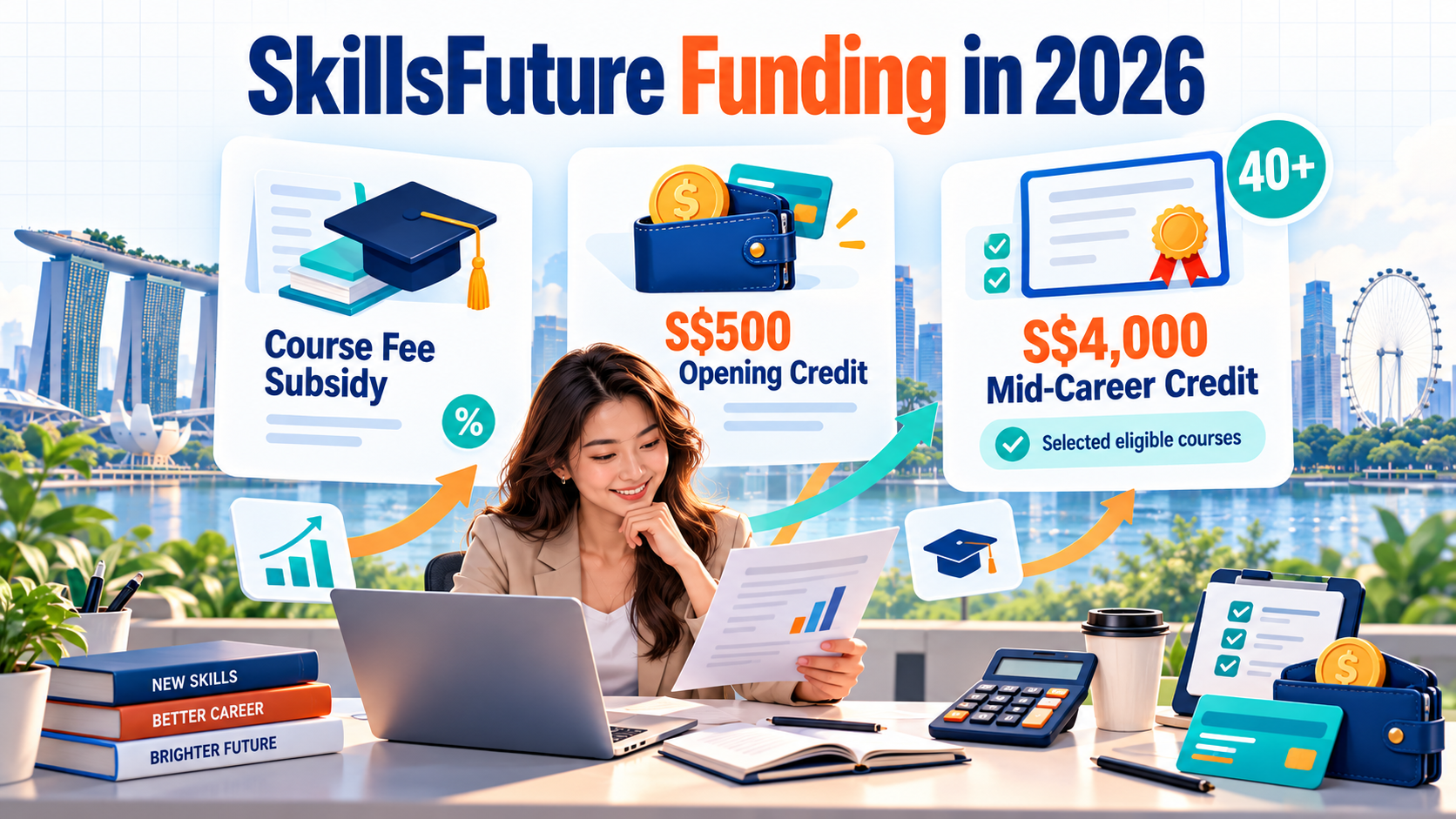
SkillsFuture Credit: S$500 and S$4,000 Tiers
According to the official SkillsFuture Credit guidance, the principal credit tiers are:
| Credit tier | Who qualifies | Amount | Eligible courses | Expiry |
| Opening SkillsFuture Credit | Singapore citizens aged 25 and above | S$500 | Courses listed on MySkillsFuture | No expiry |
| SkillsFuture Credit (Mid-Career) | Singapore citizens aged 40 and above | S$4,000 | Selected courses carrying the relevant eligibility | No expiry |
The mid-career tier is not automatically usable for every short marketing course. Eligible options include specified full qualifications, SCTP courses and other approved training. Check the individual course page for the relevant label. Previous eligible mid-career support balances may also affect the amount shown in a person’s account.

The separate one-off S$500 top-up granted in 2020 expired on 31 December 2025. Do not assume unused amounts from that time-limited top-up remain available in 2026. Log in with Singpass to check your current balances rather than adding historical allocations yourself.
Course fee subsidies and mid-career support
A course fee subsidy reduces the course price when a programme and learner meet the funding conditions. It is separate from the SkillsFuture Credit used to offset an eligible outstanding fee. Subsidies may be available to Singapore citizens and permanent residents (PRs), depending on the programme. However, SkillsFuture Credit itself is for Singapore citizens.
Under the SkillsFuture Mid-Career Enhanced Subsidy, eligible Singapore citizens aged 40 and above can receive higher support for qualifying training. Published schemes may fund up to 90% of eligible course fees, but this is a ceiling, not a rate every learner receives. PRs are not eligible for this specific mid-career enhancement.
From March 2026, eligible Singapore citizens aged 40 and above can also receive a S$300 monthly training allowance for selected part-time long-form programmes. The SkillsFuture Level-Up guidance sets out the conditions. Separate income-linked allowance rules apply to eligible full-time training. Do not assume an ordinary weekend marketing workshop qualifies.
How to calculate the actual course cost
Compare the amount you will pay, not the most prominent figure in an advertisement. The MySkillsFuture course-search FAQs explain that displayed estimated payable fees can assume the full S$500 opening credit. Logging in allows a more personalised estimate based on your eligibility and actual credit balance.

For illustration only, consider a course with a gross fee of S$1,000 and an assumed subsidy of S$700. The remaining course fee is S$300. If S$200 in eligible SkillsFuture Credit is applied, the cash payment becomes S$100, before any separately chargeable taxes or fees. These figures are hypothetical and do not represent an actual course quotation.
Ask the provider to confirm the full fee, subsidy, GST treatment, assessment charges, materials, software licences and reassessment costs. Also verify payment deadlines and the process for any SkillsFuture Credit claim before the course starts.
Employer sponsorship and SkillsFuture Enterprise Credit
Employers may pay for staff development or reimburse eligible employees, subject to company policy. The SkillsFuture Enterprise Credit (SFEC) is a separate employer scheme, not a personal learning credit. For eligible employers, the existing scheme can support specified transformation and training costs.
Enterprise Singapore states that this SFEC arrangement will expire on 30 November 2026, with a redesigned programme scheduled from December. Employers should verify the SFEC rules and claim deadline before making commitments. Company sponsorship does not by itself prove that a course qualifies for SFEC.
What Should a SkillsFuture Marketing Course Teach?
A useful curriculum connects tools to business results. We would prioritise practical exercises and reporting over a long catalogue of platform names. The following competencies cover common marketing roles, though not every learner needs all of them.
Search engine optimisation (SEO) and AI search visibility
An SEO module should teach search intent, keyword research, on-page optimisation, technical fundamentals and performance reporting. Learners should practise on a real or sample website, then explain which fixes matter and why. That is a stronger outcome than memorising ranking terminology.
Some newer courses also introduce answer engine optimisation (AEO) and generative engine optimisation (GEO). These terms describe efforts to make accurate content easier to discover and understand in answer-led and generative search experiences. They are developing practices, not guaranteed methods for securing AI citations. We would treat them as useful additions after sound SEO fundamentals. Our SEO services overview explains the practical areas businesses need to manage.
Social media marketing and content creation
A practical social media module should cover audience research, content planning, creative formats, community management and reporting. For paid social, look for exercises involving campaign objectives, budgets, audience selection and creative testing. Ask which platforms are taught, such as Meta, TikTok or LinkedIn, and whether the material reflects current interfaces.
The final project should explain what success looks like for the business. Reach and engagement can inform decisions, but leads, sales and customer quality may be more important. A single platform can be enough for a specialist role; broader roles benefit from cross-channel planning.
Google Ads and performance marketing
Search advertising courses should introduce campaign structure, keyword match types, search terms, bidding, ad copy and landing-page relevance. Conversion tracking is essential because clicks alone cannot show commercial performance. If learners never interpret campaign results, the training is incomplete.
For example, a campaign that spends S$2,000 and generates S$8,000 in attributed revenue has a return on ad spend (ROAS) of 4.0. This means the campaign generates S$4 in attributed revenue for every S$1 spent on advertising. However, this does not mean the business earned S$6,000 in profit, as product costs, overheads and attribution limitations must also be considered. This is an illustrative calculation, not an actual campaign result.
Email marketing and automation
Email courses should include consent-aware list building, segmentation, campaign writing, automated sequences and performance analysis. Ask whether you will create a working journey with triggers, conditions and a clear objective, rather than simply watch a software demonstration.
In Singapore, marketing teams also need to understand how personal information is collected and used. The Personal Data Protection Commission’s marketing consent guidance is a useful reference. A practical course should teach responsible data handling alongside campaign execution.
GA4, analytics and reporting
Google Analytics 4 (GA4) measures website and app interactions through events. A suitable course should cover data collection, traffic acquisition, event configuration, attribution limits and business reporting. Learners should understand key events in GA4 and how conversion measurement relates to Google Ads. Google’s GA4 event documentation explains current terminology.
We would ask each provider for an example assignment that requires interpreting data and recommending an action. A dashboard has limited value if the learner cannot explain which channel generated qualified enquiries, what the data excludes and what to test next.
How to Choose the Right SkillsFuture Marketing Course
Start by defining the role or business problem. Then shortlist courses and test them against the work you need to perform. We use the following task-to-course framework to keep the decision practical.
| Target task | Relevant training | Evidence to request |
| Increase organic search visibility | SEO, content strategy, technical auditing | Sample website audit and measurement plan |
| Run paid acquisition | Google Ads, paid social, conversion tracking | Campaign build and performance evaluation |
| Manage social content | Content planning, platform analytics, creative testing | Editorial calendar and evaluated creative work |
| Improve retention | Email segmentation and automation | Working journey with triggers and reporting |
| Report marketing results | GA4, dashboards, attribution fundamentals | Written analysis of campaign or website data |
| Change careers | Broader qualification or suitable SCTP | Job-role mapping, assessed projects and support details |
Six checks before enrolling
- Confirm the exact listing. Search the course title and provider on MySkillsFuture. Check the upcoming intake and the qualification awarded.
- Match the syllabus to your goal. Mark which modules support the tasks you expect to perform within six to twelve months.
- Inspect practical assessments. Request an example project brief and ask whether work is completed in a real, simulated or demonstration account.
- Check the instructor and tools. Look for relevant professional experience and identify the software versions and platforms used during training.
- Confirm your personal funding. Check the exact subsidy, credit tier, current balance and any programme-specific eligibility restrictions.
- Request the full cost in writing. Include GST where applicable, materials, additional assessment fees and any cancellation conditions.

We recommend taking one focused module when your skills gap is narrow. Choose a broader qualification when several core capabilities are missing. Consider an SCTP when changing careers and when its training and employment support match a realistic target role.
Do certificates improve career and salary prospects?
Training can help a learner qualify for different responsibilities, but a certificate does not guarantee employment, promotion or a salary increase. Results depend on previous experience, project quality, hiring conditions and how the learner applies the material.
Request evidence when providers advertise employment outcomes. Ask for the reporting period, number of graduates surveyed, definition of employment and whether the results include people already working in marketing. We would give more weight to a credible portfolio and demonstrated analytical ability than to unsupported placement percentages.
For businesses, the return on training is also practical: can the employee improve campaign decisions, reduce reporting errors or manage work previously outsourced? Our guide to digital marketing services can help identify which capabilities belong in-house and which may require specialist support.

Frequently Asked Questions
Are SkillsFuture marketing courses free?
Not necessarily. Eligible courses may receive subsidies, and qualified Singapore citizens may use SkillsFuture Credit to offset payable fees. Check the final amount and any additional charges before enrolling.
Who can use SkillsFuture Credit for marketing courses?
Singapore citizens aged 25 and above qualify for the S$500 opening SkillsFuture Credit. Those aged 40 and above also receive S$4,000 in mid-career credit, which can only be used for selected eligible courses.
Can Singapore permanent residents receive SkillsFuture funding?
Permanent residents may qualify for course fee subsidies under certain approved programmes. However, they do not receive the personal SkillsFuture Credit reserved for Singapore citizens.
Can I use the S$4,000 mid-career credit for any digital marketing course?
No. The mid-career credit applies only to selected eligible courses. Check the relevant label on the MySkillsFuture listing before making a claim.
Is a WSQ marketing course better than a private course?
Neither is automatically better. WSQ programmes offer nationally defined competency standards, while other courses may be useful for specialist tools or current platform skills. Compare accreditation, practical work, trainer quality and funding for each course.
Can I use SkillsFuture Credit for Google Ads or GA4 training?
Yes, if the specific course appears on MySkillsFuture and you meet the credit requirements. Eligibility attaches to the listed course, not automatically to its subject or provider.
Is an SCTP digital marketing programme worth taking?

It may be appropriate for a mid-career learner who wants structured reskilling and employment assistance. Verify the programme’s award, duration, fees and placement-support arrangements; completion does not guarantee a job.
How do I check my SkillsFuture Credit balance and apply?
Log in to MySkillsFuture with Singpass to view your available balances and eligible courses. Follow the portal’s claim instructions and complete the required submission before the course start date.
Turn Your SkillsFuture Training Into Practical Marketing Skills
The best SkillsFuture marketing courses match your career goals and provide skills you can apply at work. We recommend specialised modules for experienced marketers who need to strengthen specific capabilities. Career switchers can explore broader qualifications through our guide to digital marketing courses in Singapore.
Before enrolling, compare two or three programmes on MySkillsFuture. Check their curricula, funding eligibility, practical assessments and total fees after subsidies. If social media is your priority, our guide to social media marketing courses in Singapore can help you evaluate relevant training options.
Our recommendation: Choose a course based on the skills you need, the practical experience it provides and its relevance to your career. Prioritise training that helps you demonstrate your capabilities and deliver measurable marketing results.