Predictive marketing uses past customer data to estimate what customers are likely to do next, such as buy, lapse or respond to an offer. Singapore business owners and marketers rarely need to ask whether to use predictive analytics. The harder question is where to start. Many teams build dashboards full of scores that nobody acts on.
This guide argues that predictive marketing pays off only when a small number of models are tied to specific actions, such as who to contact, what to offer and what to stop sending. You will find a framework for choosing your first model, the trade-offs that vendor guides often leave out, and a worked example you can adapt to your own customers.
Key Takeaways
- Predictive marketing pays off when it drives action. A score that nobody acts on changes nothing. Pair each model with a specific decision.
- Start with one or two models, not six. Begin with a model that has enough history and a clear action, such as churn risk or purchase likelihood.
- Use the Action-Model Matrix. Build first the models that have enough data and a defined action.
- Accuracy is not the same as usefulness. A well-ranked prediction that your team cannot act on is a cost, not an asset.
- Watch for over-targeting. Too many messages can raise unsubscribe rates, so predict unsubscribe risk too.
- Validate vendor claims locally. A model trained on another business’s data may not transfer to yours.
What Predictive Marketing Is and Why It Matters
Predictive marketing is the use of past customer data to forecast what people will do next, such as buy, leave or respond to an offer.
The useful question is whether a prediction changes a decision. Ask whether the prediction changes what you do. A score that nobody acts on is a report, not a strategy.
Predictive analytics definition and key components
Predictive analytics is the statistical and machine learning work behind those forecasts. It has three parts: the customer data collected, the model that finds patterns in that data, and the score the model gives each customer. In Singapore, that data is often spread across a website, a messaging app, a point-of-sale system and a marketplace. Teams that can join these sources get better predictions, and the scores are only as reliable as the data they are based on.
Predictive analytics in marketing
In marketing, the value comes from acting on the scores. A 2021 report, cited by Champlain College Online, found that “companies that grow faster drive 40% more of their revenue from personalisation than their slower-growing counterparts.” This is a correlation, not proof that personalisation caused the growth, since faster-growing firms may also have more resources to personalise. The practical test for a Singapore SME is simple: for each prediction, name the action you would take if the score changed.
Benefits of Predictive Analytics for Marketing
Predictive analytics is worth the effort when it changes what your team does next. The 2021 report linked faster growth to a larger share of revenue from personalisation, though the link is correlational. Each benefit below depends on a clear action, and the most useful ones help marketers decide what to do with a prediction rather than simply reporting it. Good decisions are based on a prediction the team can explain and act on.
Personalisation that drives growth
Personalisation works when a model decides what each customer sees. A purchase-likelihood score can decide which product to feature. A next-sell recommendation can go into an order confirmation email while buying intent is still high. Ask yourself: what will we do differently for this customer?
Better use of marketing budgets
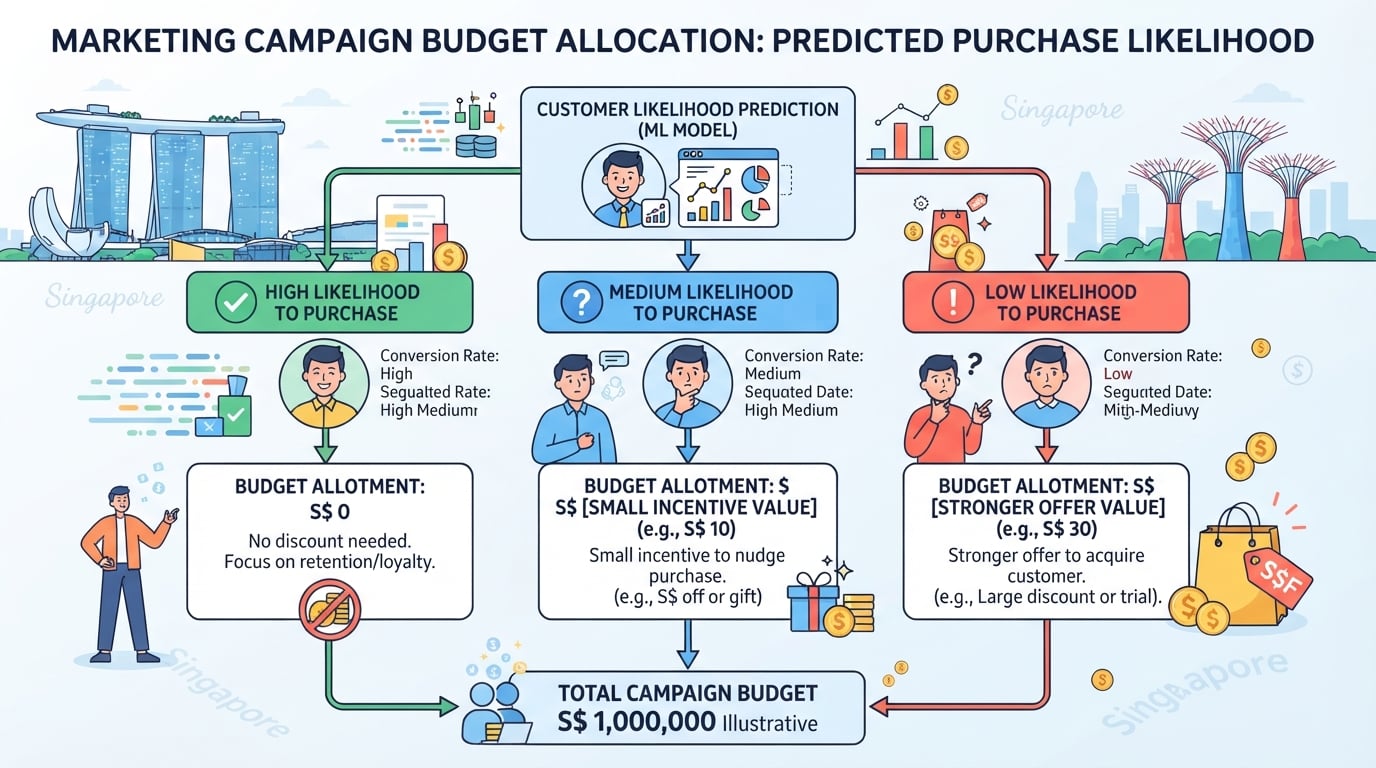
Prediction helps you stop spending where it has no effect. If a model shows that some customers will buy without a discount, leave the offer out for them and put the budget toward customers who need the nudge. Start by checking which segments currently receive spend that never converts, then apply analytics in marketing to test which campaigns justify that spend.
Earlier warning of lost customers
Churn-risk models flag drifting customer retention before they leave. That early warning gives you time to act with a reminder, a replenishment prompt or a service call. An intervention only helps if the signal arrives in time, so review churn scores at least weekly. Teams can also monitor social media activity alongside these scores to spot different types of disengagement early.
How Predictive Marketing Works: A Five-Step Process
Predictive marketing follows a repeatable pipeline. Each step feeds the next. A weak early step, usually data, limits everything after it. The five steps below matter most in practice.
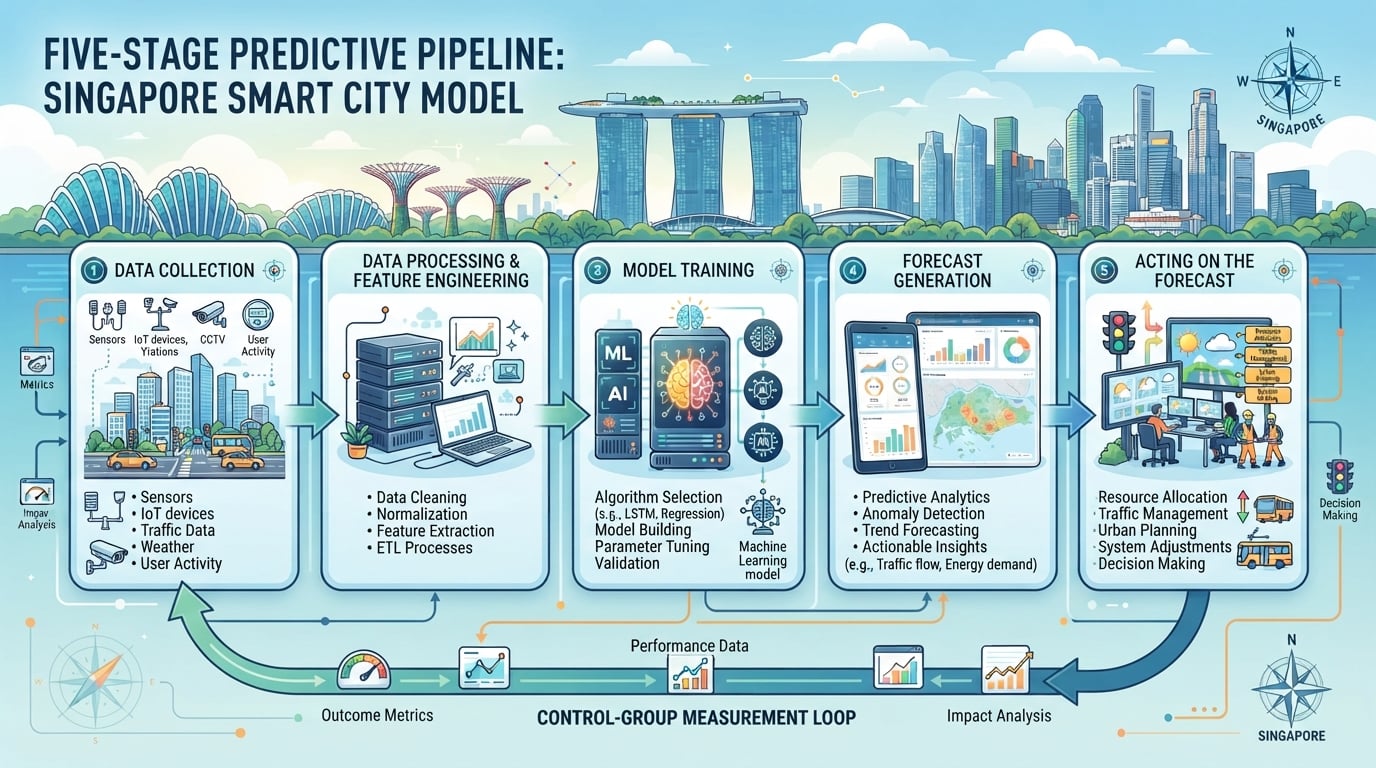
Step 1: Collect the data. A predictive model is only as good as its history. Map where customer data already sits: your website, messaging app, point-of-sale system and any marketplace storefront. Teams often split data across these four systems, and joining them is often the hardest task for a Singapore SME. Also plan for time. Measuring a customer’s lifetime events can take three weeks to twelve months, depending on the app, so new data may not support a reliable prediction for months.
Step 2: Process the data and build features. Clean the records, then turn them into inputs the model can use. Typical inputs include recency of last purchase, order frequency and average basket value. You decide here which signals the model will see, since the right features help the model identify potential churn or upsell opportunities. Each feature should be a clear, well-defined measure of the customer’s behaviour, so that the resulting analysis remains transparent to the team.
Step 3: Train the model. Train on past outcomes, such as who churned or who bought after a campaign. Pooling data across channels usually improves accuracy, even when predictions are used locally. A well-trained predictive model can then be reused across different marketing campaigns. Modern tools increasingly rely on machine learning to find patterns that simple rules would miss.
Step 4: Generate the forecast. The trained model scores each customer, usually as a probability or a risk band. Keep the output simple enough that a campaign manager can read it, so that personalised offers can be matched to each score.
Step 5: Act and measure. Many businesses skip this step. Map every score to a named action: contact this customer, offer this incentive, or stop sending to that one. Then compare results with a control group, so you know whether the action changed behaviour, not just the score. This is where predictive analytics proves its worth, since it shows whether the forecast actually helped.
Core Predictive Metrics and Models
Not every score deserves a dashboard. Keep the models that drive a decision someone will make this week, such as who gets a call, which offer goes out or which emails stop.
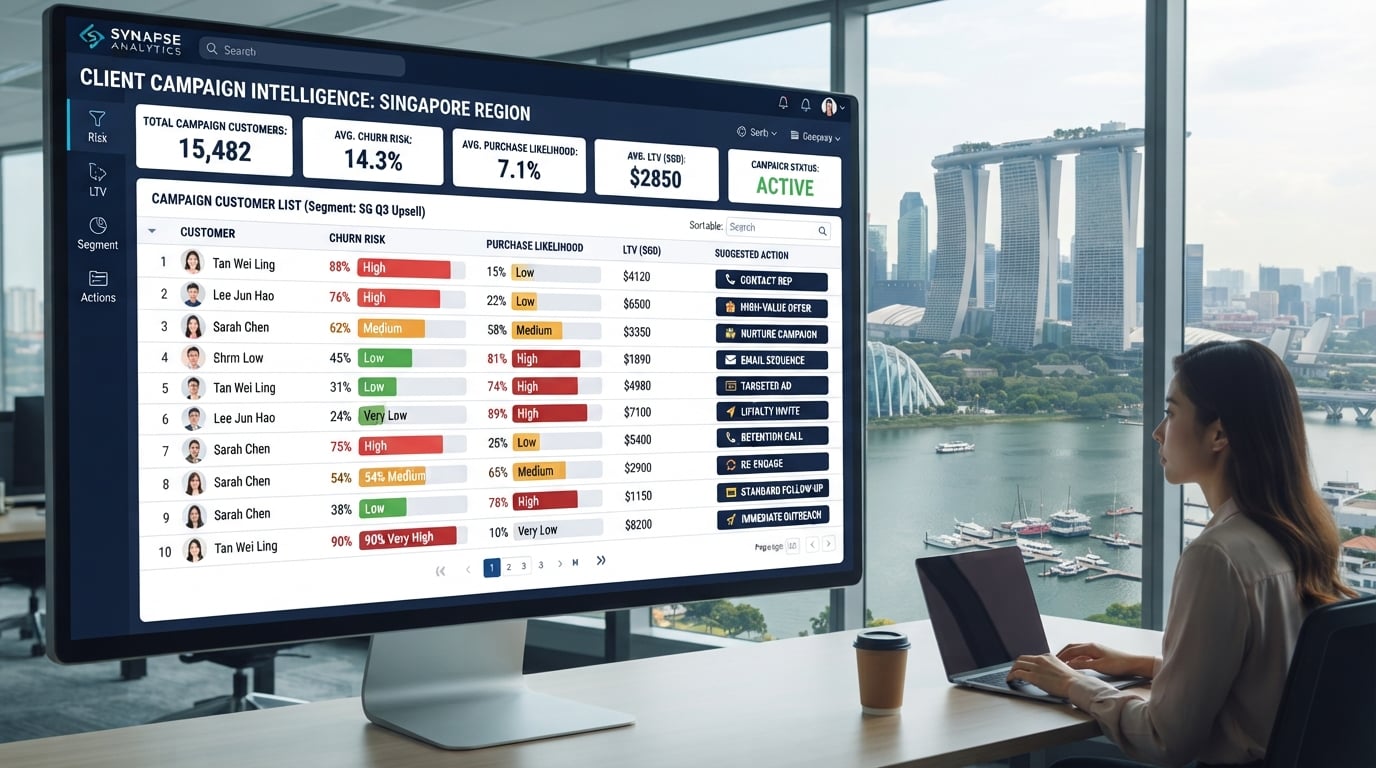
Core predictive metrics: churn risk, purchase likelihood and customer lifetime value
Three metrics do most of the work. Churn risk estimates how likely a customer is to stop buying. Purchase likelihood estimates how likely a customer is to buy in a given window. Customer lifetime value estimates the revenue a customer will bring over the relationship. Lifetime value shows how much a customer is worth. Churn risk and purchase likelihood show when to act, and machine learning can score all three across a large customer base far faster than manual review.
Propensity models: engage, unsubscribe, convert, buy and churn
A propensity model scores each customer on one behaviour, such as the likelihood of buying, opening or leaving. The most practical one is often the least complex. Acquia’s guide to predictive analytics models describes a propensity-to-unsubscribe model, which predicts how likely a customer is to opt out of your communications. When the score is high, reduce frequency or move the customer to a lighter channel.
Our working hypothesis is that over-mailing high-risk customers tends to produce unsubscribes. Test this with a control group before relying on it. Do not assume the model will pay for itself.
Collaborative filtering and recommendation models: up-sell, cross-sell, next-sell and next-best content
Recommendation models compare a customer’s purchases with those of similar customers, which shows how each product fits different customer behaviour. Their outputs usually feed up-sell, cross-sell and next-sell offers. Acquia notes that next-sell recommendations are typically made after a purchase, for example in an order confirmation email, when intent is highest. A small business should start with one placement like this before building a full recommendation engine.
Customer Segmentation and Churn Reduction
Segmentation is where predictive analytics starts to pay off. A score only matters if it sorts customers into groups you can treat differently. Group customers by what the score tells you to do: who to contact, what to offer and who to leave alone.
Building predictive customer segments
Start with two or three models you already have data for, such as purchase likelihood and churn risk. Combine their outputs into four or five audience segments. A high-likelihood, low-churn group, customers who are likely to buy again, might get a cross-sell offer. A high-churn, high-value group gets a personal check-in. Keep the segments few enough that your team can name each one and say what it receives.
Reducing churn with early intervention
Churn models work best when they fire early, while a customer can still be reached. Set a threshold on your churn score, review the customers who cross it each week and send a targeted action, such as a reorder reminder or a service follow-up for the product they bought. Track whether those customers buy again within your normal repurchase window. Compare them with a holdout group that received nothing. If the gap is small, the offer is the problem, not the model.
Common Pitfalls and How to Avoid Them
Predictive analytics only pays off when someone acts on the score. Most failures come from three causes: poor data, measurement windows that are too short, and automation that runs without anyone checking it. Each one is avoidable.
Poor data quality and thin histories
A machine learning model is only as good as the records behind it. Duplicate customer profiles, missing purchase dates and a website that is not linked to your point-of-sale system will all distort the predictions. Thin histories are a separate problem. A customer with two orders gives a model very little to learn from, so the potential of the score is limited. Build your models on sufficient historical data, or the predictions will rest on guesswork.
Before you build anything, check three things:
- Can you match website, messaging app, point-of-sale and marketplace records to one customer ID?
- What share of records has a usable timestamp?
- How many customers have enough history to score at all?
If the answer to the last question is “few”, start with simple rules based on recency and frequency. Small businesses often see faster ROI because they have fewer customers to protect, and can start with simple models using existing CRM data before investing in complex systems. Add a predictive model once the data has built up.
Measurement windows that are too short
Many teams judge a model after a few weeks. That is usually too early. Mobile app analytics vendor AppsFlyer notes that measuring a user’s lifetime events can take anywhere from three weeks to twelve months, depending on the app. A churn model judged over one month measures something different from one judged over six, and this changes how customer behaviour should be read. Set the outcome window before you train the model, and do not change it after you see the results, since the right window for a model is set by the future behaviour you want it to predict.
Over-automating without human review
Automation removes the friction that makes a model useful, but it also removes the check that catches mistakes. Suppose a campaign sends a personalised discount to every customer flagged as likely to buy. Customers may soon learn to wait for discounts.
Keep a person reviewing the weekly list of who was targeted and why. Hold back a small control group, so you can see whether the model’s marketing campaigns actually changed behaviour.
Get Success through Predictive Marketing
Predictive marketing pays off when it changes what a business does, not when it produces more scores. Use this simple test, the Action-Model Matrix: build a model only if you have enough historical data to train it and a specific action that changes when its score changes. Churn risk paired with a win-back offer passes that test. So does unsubscribe propensity paired with lower send frequency. A dashboard of scores that nobody acts on does not.
Start with one or two predictive models, not five. Confirm that your data can be joined across your website, social media, messaging app, point-of-sale system and marketplace. Allow enough time for outcomes to show, since campaigns measured too early can mislead. Check any vendor’s accuracy claims against your own customers before you trust them.
Frequently Asked Questions
What is predictive marketing in simple terms?
Predictive marketing uses data about past customer behaviour to estimate what a customer is likely to do next, such as buy, leave or respond to an offer. You then use those estimates to decide who to contact and what to say. The aim is a better decision about each customer, not a prettier forecast.
How much data do I need to start predictive marketing?
It depends on the model. A churn model needs customers who have stayed and customers who have left. Small businesses often see faster ROI because they have fewer customers to protect, and can start with simple models using existing CRM data before investing in complex systems. Thin histories produce unreliable scores, so start with a single question and check the data behind it first.
Is predictive marketing only for large enterprises?
No. Smaller firms can start with one model, such as purchase propensity, and one clear action, such as a discount email to likely buyers who have not purchased recently. Large enterprises tend to run many models at once. A small business should start with one model tied to one action.
How does predictive marketing differ from traditional analytics?
Traditional analytics describes what has already happened, such as last quarter’s sales by channel. Predictive marketing estimates what each customer is likely to do and supports a decision about that customer. Both matter, but predictive work is only useful when a forecast leads to a specific change in what you send or stop sending.
How long does it take to see results from predictive marketing?
It depends on the measurement window. Some outcomes, such as an email click, appear within days. Others, such as lifetime value or churn, can take weeks or months to confirm. According to AppsFlyer, measuring a user’s lifetime events can take anywhere from three weeks to twelve months, depending on the app. Set the measurement window before you launch, so you judge the model on outcomes it had time to show.