Most Singapore business owners know their brand needs a steady social media presence. The harder question is who should run it. Posting, replying and reporting can quietly consume your week, often at the expense of the work that pays the bills.
This guide explains when to outsource social media, what to keep in-house, and how to set up the arrangement so you stay in control of your brand. It is written for owners and marketers who want a practical decision, not a generic pitch for agencies.
Key Takeaways
- Outsourcing suits most Singapore SMEs, provided you keep control of brand voice and approvals. Hand over tasks, not judgement.
- Sort every task using the Retain, Delegate, Outsource matrix described below.
- Compare total cost, not salary alone. A full-time manager at S$62,000 to S$70,000 a year can cost more once benefits and payroll costs are included.
- Set measurable goals before you hire.
- Keep crisis replies and senior brand decisions in-house.
- Run a paid pilot with clear KPIs before committing to a long contract.
Is Outsourcing Right for You?
Outsourcing social media is worth considering if any one of these applies:
- You publish three or more posts a week across two or more platforms.
- You or your team spend six or more hours a week on posting, replies and reporting.
- You can commit a monthly budget that covers at least one provider’s retainer, and you can compare it against the cost of a full-time hire.
If none of these applies, a simple in-house routine with a shared content calendar may be enough. Teams that are stretched thin often find that outsourced social support frees them to focus on strategy.
Why Singapore Businesses Are Outsourcing Social Media
Outsourcing social media is an increasingly popular choice for businesses. According to CMO, outsourcing is common and growing: companies now delegate about a third of their digital marketing activities to external agencies and partners — 33.6% in 2026, up from 31.6% two years earlier.
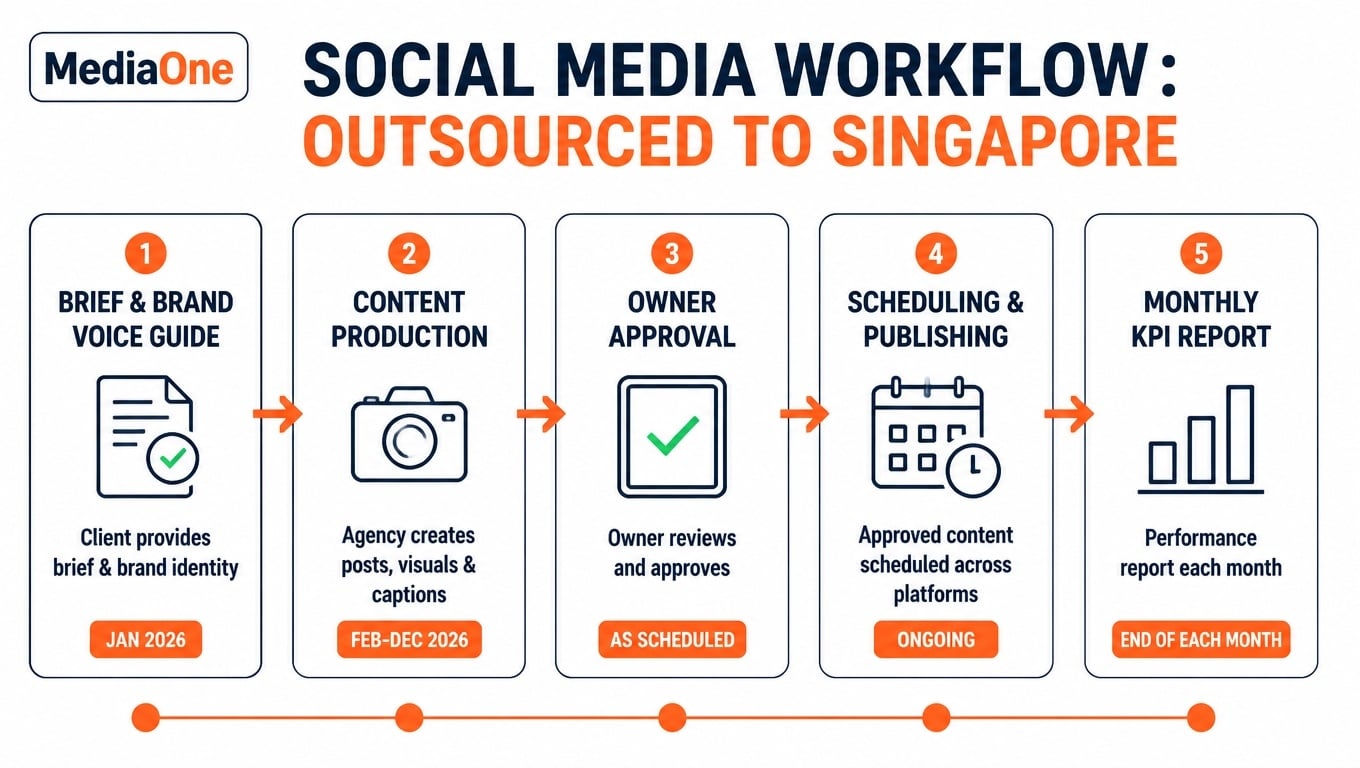
The case rests on three things: time, focus and results.
Many owners underestimate how much time social media takes. Nearly half of small business owners spend at least 6 hours a week on social media, often at the expense of sales, operations and customer work. Handing repeatable production to a provider returns that time to the work only you can do.
A provider can also apply a clear content strategy from the first post, so output follows a plan rather than ad hoc posting.
Weighing the Benefits Against the Hidden Cost
The real comparison is not outsourcing against doing nothing. It is outsourcing against the owner’s own hours.
Six hours a week is roughly 300 hours a year that could go to closing deals or fixing service gaps. Outsourcing makes sense when the value of those hours exceeds the provider’s fee.
Three distinct benefits stand out:
- Time returned to revenue work. Owners, management and staff can focus on sales and service.
- Access to a wider skill set. A provider usually brings design, copy, and reporting skills under one roof, so your team doesn’t need to learn each one.
- Consistent output. A provider working to a calendar is less likely to leave channels silent for weeks.
For example, a Singapore café that hands scheduling and photo editing to a provider can keep its owner on the floor during weekday lunch rushes.
What the Lift Does and Does Not Promise
Outsourced providers often improve engagement and traffic, but treat any claimed lift as directional, not a forecast for your brand. It does not promise more enquiries, more sales or better retention. Those depend on your offer, your audience and the quality of the provider’s work.
Measure those outcomes directly rather than trusting engagement alone, and make sure you understand what your provider is reporting.
Keep reporting in-house where possible, so you can check the numbers against your own sales and enquiry records.
Deciding Between a Freelancer, an Agency and a Virtual Assistant
The three options differ mainly in scope and accountability. A freelancer is usually the lowest-cost option and the most flexible, but typically works alone, so posting stops when they are ill or overloaded. An agency that provides social media services costs more but brings a team, backup cover and reporting. A virtual assistant handles admin and scheduling well, yet rarely has the creative or strategic depth to plan campaigns.
| Option | Typical cost | Scope | Accountability | Speed to start |
|---|---|---|---|---|
| Freelancer | Lowest | Narrow, one or two channels | Individual only | Days |
| Agency | Highest | Strategy, design, copy, reporting | Contracted team and account lead | Weeks |
| Virtual assistant | Low to moderate | Scheduling, moderation, admin | Task-based | Days |
Costs vary by provider and scope, so request written quotes before comparing. Match the choice to your stage.
A business posting a few times a week with simple visuals can start with a freelancer or virtual assistant. Once you publish daily across several platforms, or need campaign planning, an agency’s depth often justifies the cost.
The in-house question comes down to total cost. Social media salaries in Singapore range widely, and the fully loaded cost of an internal team can run well beyond salary alone. Compare that with a retainer you can scale up or down.
Choose the internal team route only if the role will be busy enough to justify it, and consider outsourcing social media services to avoid that overhead.
Which Social Media Functions to Keep In-House and Which to Outsource
The useful question is not whether to outsource, but which tasks to hand over. Keep work that needs insider judgment or a fast response in-house. Send repeatable production to a provider. Two tests help: does the task need knowledge only your team holds, and how quickly must it happen?
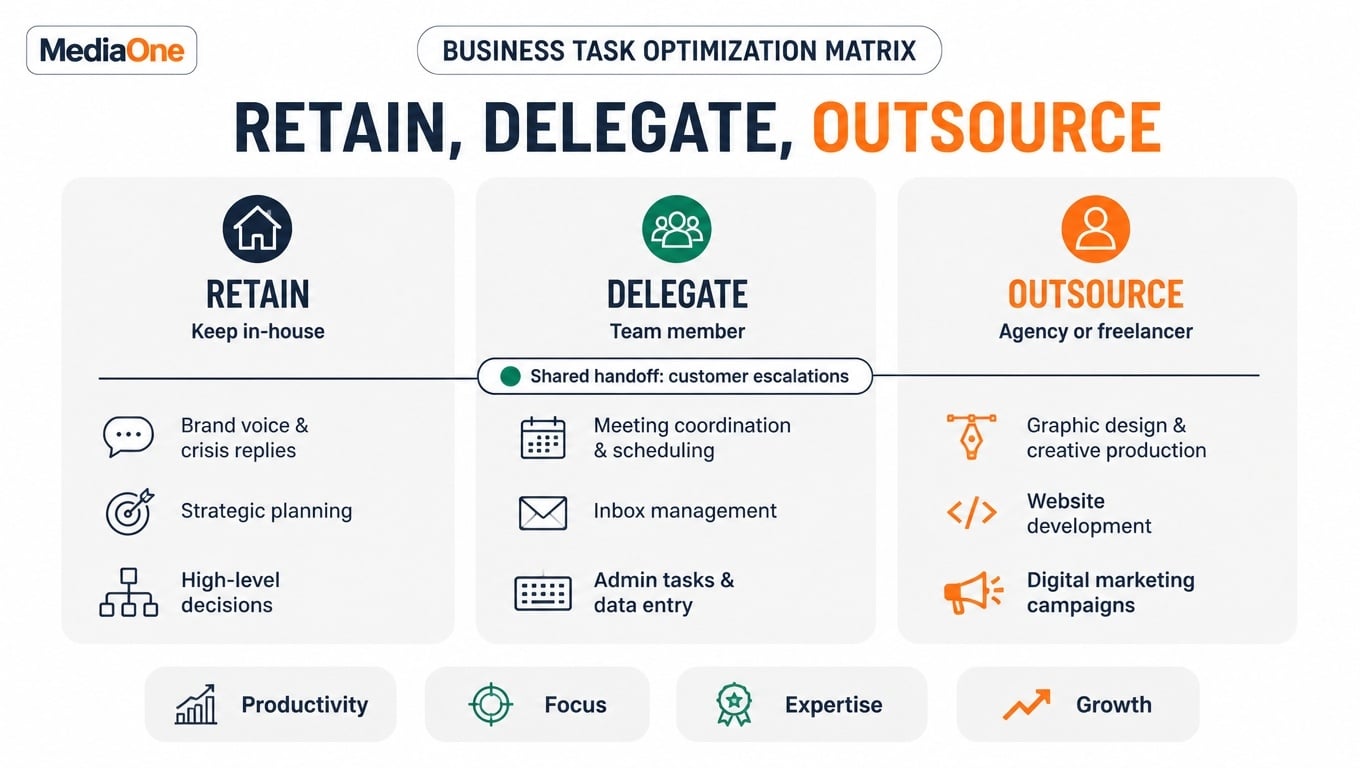
Functions to Keep In-House
Brand voice, product knowledge and customer escalations stay with you.
A provider can draft in your voice, but only you can decide what the brand will and will not say. Escalations need speed. Nearly three-quarters of consumers expect a response on social within 24 hours, and 73% say they will buy from a competitor if a brand fails to respond to their questions, based on Sprout Social’s report.
Keep crisis replies and senior brand decisions in-house, with an internal owner who has authority to act.
Functions to Outsource
Scheduling, design production, community moderation and reporting are repeatable and suit a provider well. Give them templates, a brand kit and clear response rules, and they can run these without weekly input from you. Video editing and short-form content are also strong candidates for outsourcing, since they follow a consistent production process.
Agency Retainer Versus Full-Time Hire
A full-time social media manager in Singapore earns a salary ranging from S$36k to S$96k a year, before costs. Once benefits, CPF contributions, recruitment and software are added, an in-house team can cost S$74K to S$119K a year at the 75th percentile. Compare that with a monthly retainer for the same output.
For most SMEs, the gap settles the question, though management time spent briefing an agency should be counted too.
Setting Up the Engagement: Brand Voice, Goals and Approval Workflow
Setting up an outsourced social media engagement well comes down to three things:
- A brand voice guide the provider can follow
- goals measured in numbers
- A clear approval workflow
Most owners skip at least one. Nearly half of brands struggle to set clear social media goals, so the gap often starts before any content is written.
Start with a brand voice guide. Document your audience, the three to five adjectives that describe how you sound, phrases you always or never use, and a handful of sample posts you consider on-brand and off-brand. Add product facts a provider cannot guess, such as pricing rules and the names your team prefers. Share it as a document with examples, not a one-page instruction, so the provider can learn how your small business actually sounds.
Then set goals before the first post. “Grow our following” is not a goal. “Generate 40 enquiries a month from Instagram by the end of the second quarter” is. Tie each goal to a business outcome, then choose the one or two metrics that prove it.
Finally, define the approval workflow. Name one person who signs off, state a turnaround time, and set an escalation route for urgent replies. Many owners check only about 30% of posts before they go live and trust the rest. That gap is where off-brand content slips out, so review a sample every week and track errors.
Writing a Brand Voice Guide the Provider Can Follow
Keep it to two pages. Include an audience summary, tone examples, banned words, approved claims and a contact for product questions. Update it whenever a campaign changes the message, so your outsourced social media provider always works from current information.
Turning Vague Goals Into KPIs
For each goal, write the KPI, its baseline, its target and its review date. For example, a KPI row might read: enquiries from Instagram; baseline 12 a month; target 25 a month; review on the last Friday of each quarter. Both sides then have a number to measure against.
Integrating Tools, Assets and Accounts Safely
Handing over social media work also means handing over access. Before a provider starts, decide what they need, how they get it, and how it ends. Much of the risk in outsourcing sits here, not in the content itself.
- Start with the tools. Scheduling platforms such as Meta Business Suite, Buffer or Hootsuite let a provider publish without holding your login. Keep your brand kit (logos, fonts, colour codes and approved templates) in one shared drive, with the provider working from copies so originals stay under your control. Store any outsourced media marketing assets the provider produces in that same drive so ownership stays with you.
- Account access needs the same discipline. Add providers as partners or team members with the lowest role that does the job, rather than sharing a master password. Store any shared credentials in a password manager with a named owner, and turn on two-factor authentication for every account. Good social management depends on this kind of control.
- Plan the exit at the start. Write a removal checklist into the contract: revoke platform roles, rotate shared passwords, withdraw drive access and collect any files the provider created. Former contractors are often left as admins for months, which is an avoidable gap.
- Limit customer data too. Comments, direct messages, and enquiry details passed to a third party should include only what the provider needs to reply, and the contract should specify how that data is stored and deleted. This matters most where media outsourcing involves handing over customer conversations on social channels.
The Outsourcing Process, Step by Step
Most outsourcing failures happen before any contract is signed. Businesses hand over their accounts in a rush, then discover that nobody agreed on what good looked like. The steps below keep that from happening.
Step 1: Audit your current activity and time spent. Log every social media task for two weeks, including the hours you spend on replies and approvals. Most owners underestimate this. Sort each task into the “retain, delegate, outsource” matrix: tasks that need insider judgement and speed stay with your internal team, while repeatable production goes to a provider.
Step 2: Define scope, deliverables and KPIs. Write down the posts per week, the platforms covered (typically Instagram, Facebook, LinkedIn and TikTok for Singapore audiences, with WhatsApp or Xiaohongshu where your customers use them), and the outcomes you care about. Tie each deliverable to an enquiry, sale or retention target.
Step 3: Shortlist providers and request sample work. Ask for two or three samples in your sector and a short trial brief. Compare how each provider handles your tone, not just polish, and pick the best fit for your brand.
Step 4: Run a paid pilot of 30 to 60 days. A pilot shows you response times, approval friction and reporting quality before you commit to a longer retainer.
Step 5: Review, adjust, then scale. Hold a review at the end of the pilot. Keep what works, fix the approval bottlenecks, and only then expand the scope.
Checklist before you sign
- Brand voice guide and approved sample posts handed over
- Named approver on your side, with a turnaround time agreed in writing
- Response-time commitment for comments and messages
- Monthly report that shows enquiries and conversions, not just reach
- Account access granted through business managers, not personal logins
- Exit terms covering access removal and content ownership
Measuring Results: Social Media Management KPIs That Matter
Follower counts and likes feel good, but they rarely pay the bills. When you outsource social media management, measure what the business actually gains: enquiries, conversions and repeat customers. Ask every provider to report against those numbers from the first month. For a small business, track the results of these outsourced social media services against your own sales records.
Content ideation works best when you feed the team real insight. Share your top-selling products, the questions your sales staff hear most, and the objections that stall deals. In return, ask for three fresh ideas each month to test, then keep what drives enquiries. Good providers will take the time to understand your customers before proposing any content.
A worked KPI example
Use this format for each target. Replace the figures with your own baseline from your audit.
| KPI | Baseline | Target | Review date |
|---|---|---|---|
| Enquiries from Instagram per month | Your count from the audit period | Set with your provider after the pilot | End of month 1 |
Keep one row per outcome. A target only means something when the baseline came from your own data.
Setting a monthly reporting rhythm
A useful monthly report is short and specific. It should show:
- Enquiries and leads by channel, compared with last month
- Conversions or bookings traced back to social posts, with the tracking method stated
- Top five posts by business result, not by reach, with a note on why they worked
- Response times to comments and direct messages, since Singapore buyers expect quick replies
- Three recommendations for the next month, each tied to a target
Review the report in a 30-minute call. If a provider cannot explain a number, treat that as a warning sign.
Red Flags and Common Mistakes When Outsourcing Social Media
The biggest risk in outsourcing is not a bad post. It is handing over judgment along with the tasks. Most failed engagements show the same warning signs early, so check for them before you sign.
Red flags when hiring providers
Walk away if a provider guarantees a follower count, since real audience growth depends on your product, offer and community. Be wary of anyone who refuses to give you direct access to platform insights or reporting, or who asks for your master password instead of business manager access. Vague contracts are another warning: if deliverables, response times and exit terms are not written down, the scope will drift. Ask for named deliverables and a 30-day notice period before you commit.
Mistakes that sink engagements
Three mistakes recur. The first is no brand voice guide, so the provider writes in a generic tone your customers do not recognise. The second is no named owner for approvals, which leaves posts waiting or going live unchecked. The third is no exit plan, so you cannot retrieve your accounts or content if you switch providers.
Many owners also spend too much of their own time on social media. Nearly half of small business owners spend at least 6 hours a week on social media, often at the cost of core operations. If that is your position, outsourcing the production work is worth testing.
Conclusion
Outsourcing social media is worth considering for most Singapore SMEs, provided you keep hold of brand voice and final approvals. Start by writing down your measurable goals and a one-page brand voice guide before you speak to any provider.
Frequently Asked Questions
Costs vary by provider type and scope, so there is no single price. Confirm each provider’s fee on enquiry, and ask for a fixed monthly fee that lists the platforms, post volume and reporting included. Compare that with the full cost of an in-house hire, which includes benefits, CPF contributions, recruitment and software.
Plan for a paid pilot before judging performance, because platforms need consistent posting and the algorithm needs time to learn your audience. Engagement often moves first, while enquiries and sales lag behind. Results depend on your sector, offer and posting consistency.
Can I keep control of my brand voice if I outsource?
Yes, but only if you write the rules down. Give the provider a brand voice guide covering tone, banned phrases, product claims and examples of good and bad posts. Keep final sign-off for anything that touches pricing, complaints, promotions or leadership.
Check five things: a clear scope listing platforms and deliverables, response-time commitments for comments and messages, full access to reporting, a named account manager, and an exit clause covering the return of login access and content files. Be cautious of any contract that guarantees follower numbers or refuses to share account access with you.
A virtual assistant can handle scheduling, basic design requests, comment replies and reporting at a lower cost. They are less suited to strategy, paid campaigns or video production. If social channels drive significant sales, an agency or freelancer with specialist skills will usually serve you better.