Choosing a digital marketing agency is one of the more expensive buying decisions a Singapore business makes. It is also one of the hardest to judge in advance. Proposals often show similar totals, similar promises and similar-looking portfolios. This guide sets out a practical way to tell them apart, so you can judge a digital marketing agency on what it delivers, including its digital strategy, web design and online advertising work.
Select an agency based on its itemised deliverables and the evidence behind its proven track record, not on the headline fee. A S$10,000 quote from one agency may buy very different services than a S$10,000 quote from another. This guide shows you how to see that difference before you sign.
Key Takeaways
- Shortlist or reject: keep an agency only if it passes all five scorecard checks, and reject it if it cannot itemise its deliverables.
- Itemise before you compare. Two S$10,000 quotes can buy very different work, so list each deliverable before you compare totals.
- Expect a typical retainer band. Most Singapore SMEs spend SGD 1500 to 5000 a month on digital marketing, so treat a figure outside that band as a reason to ask questions.
- Confirm grant eligibility first. Under the Enterprise Development Grant, co-funding reaches up to 50% of qualifying costs for SMEs and up to 30% for non-SMEs. You always pay the non-claimable portion.
- Ask for 2 to 3 case studies from businesses with similar revenue, sector and growth stage.
- Set a measurable target with a named method, such as cost per acquisition.
Why Quotes From Digital Marketing Agencies Are Hard to Compare
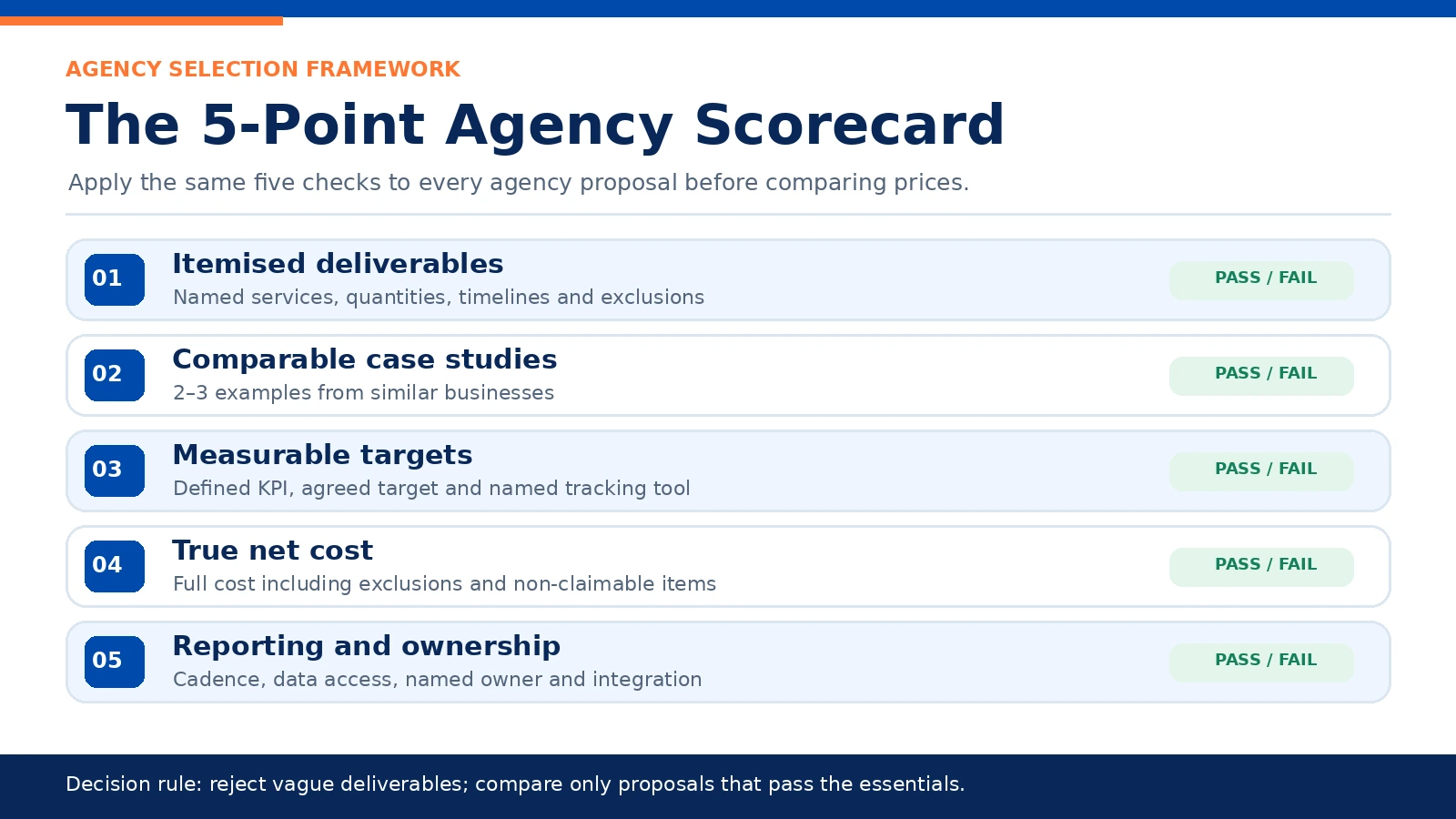
Two agencies can quote the same S$10,000 and deliver almost nothing alike. One quote may cover a full paid-search build, weekly optimisation and monthly reporting. Another may cover a few hours of setup and a template dashboard. The total looks the same, so the price tells you little about the digital marketing value you will receive.
Before you compare totals, itemise the deliverables on a line-by-line basis. Ask each agency to name the hours, channels and outputs behind every line, including Google Ads setup, social media management and any website work that supports your digital strategy.
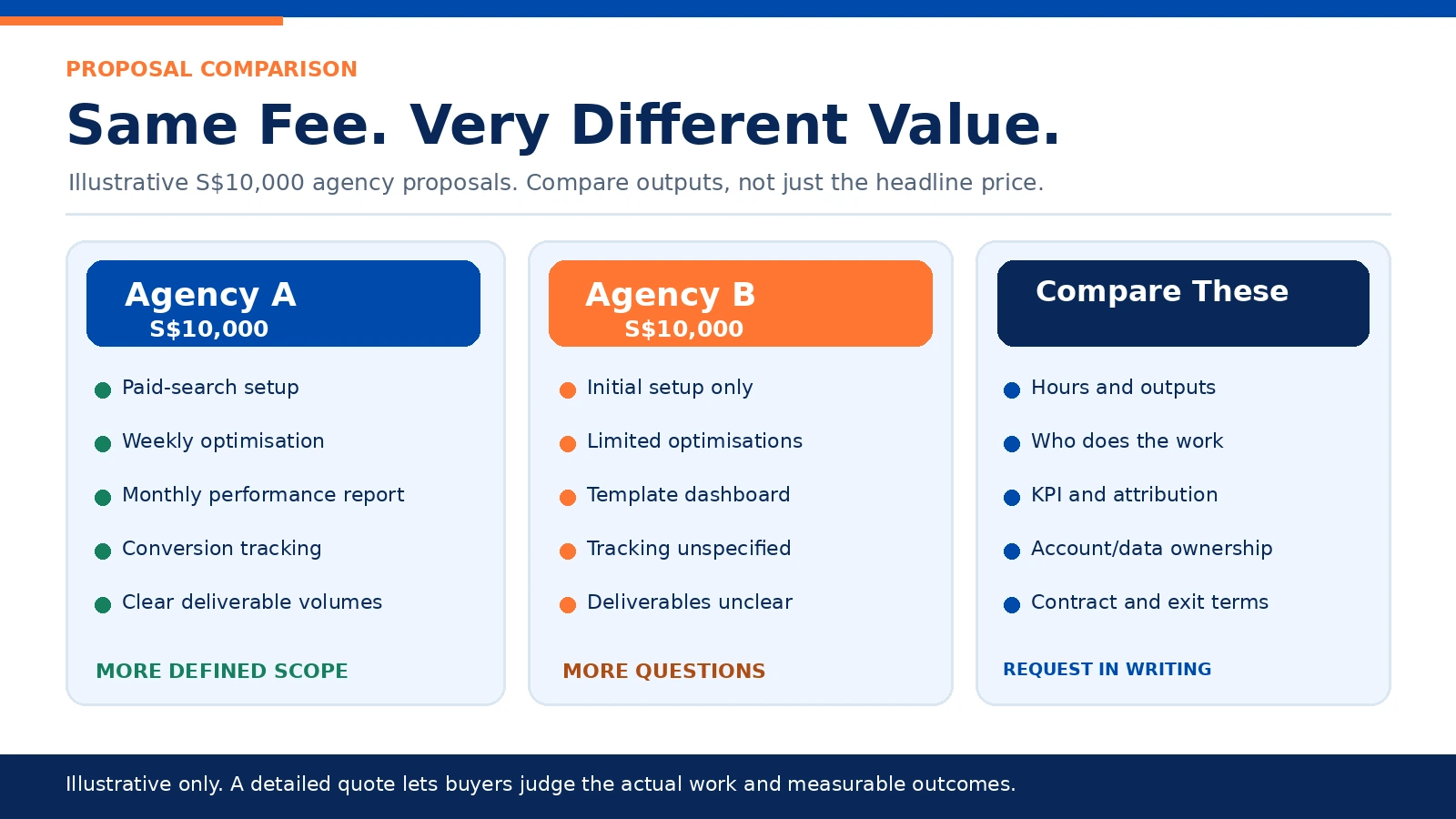
Test each proposal with the Quote-to-Outcome Scorecard, defined once here and referred to later. Mark each of the five checks as pass or fail:
- Itemised deliverables: every service, channel and output has its own cost or effort.
- Comparable case studies: the agency can show work for businesses of similar revenue, sector and growth stage.
- A measurable target: a stated goal, such as a cost-per-acquisition ceiling, with a named tool that will measure it.
- Total cost after grants: the net figure once any non-claimable amounts are added back.
- Reporting and integration: how often you receive reports, who owns the data, and how the work fits your in-house team.
Proposals that pass four or five checks can be compared fairly. A cheaper quote that fails the measurable-target check is often the more expensive choice over a year.
The fixed-fee, retainer and performance-based models explained
Fixed-fee contracts suit a defined project, such as a web design build. Retainers suit ongoing work, such as search and social advertising management, and can help a brand keep its marketing strategies consistent over time. Most Singapore SMEs spend SGD 1500 to 5000 a month on digital marketing, so a mid-market retainer will sit within or above that band depending on scope.
Performance-based models tie part of the fee to success. Check how the performance fee is calculated and which attribution method is used. These contracts often fail when the target is vague, the measurement method isn’t named, or the agency controls the data. Without a stated target and method, a performance fee is just a retainer with risk the agency hasn’t priced.
Step-by-Step: Shortlisting and Vetting a Digital Marketing Agency
Most agency quotes look comparable until you open them. Start by itemising the deliverables, then score every proposal on the same terms. Ask each agency for a clear list of its top services, with each line tied to a measurable result. A well-defined digital strategy gives you the yardstick to judge each line against.
Where to find and shortlist Singapore agencies
Use three sources, and set criteria for each:
- Directories and review platforms: check that each listing shows client names, sector focus and the date of any reviews. Discard listings you cannot verify.
- Referrals from peers: ask businesses of similar size and sector which agencies moved their numbers.
- Independent review sources: prefer reviews that name the reviewer’s business type and the period covered. Treat unsigned ratings with caution.
Shortlist agencies that clear the scorecard’s first two checks. Once you shortlist agencies that clear the scorecard’s first two checks, request a formal proposal. Look for a team that can speak to content marketing as well as paid channels, since the two should work together. Ask whether they can also deliver video production in-house and whether you can access their online reporting at any time.
Defining your goals and the scope of work
Write down the outcome you need before you talk to any agency. Examples include a cost-per-acquisition target or a number of qualified enquiries each month. Then list the deliverables each proposal must include, from web design to social media, video production and advertising. A proposal that cannot map its line items to that scope is not ready to compare. Clear goals also help you judge which solutions and strategies fit your business.
Checking track record, case studies and independent recognition
Ask for 2 to 3 detailed case studies from businesses similar to yours by revenue, sector and growth stage. A portfolio of well-known logos tells you little about whether the agency can move your numbers. Look for an agency with a proven track record in your sector, and confirm it through those case studies. Independent awards add weight only when you can confirm who gave them and when. Ask the agency to walk you through the client experience it delivers, not just the results it reports.
Services to Look For: Matching Agency Capabilities to Your Business
Most agencies list a long menu of services. A short list of capabilities tied to your goals matters far more. Start with the outcome you need, then check which of the top services move that number.
SEO services and website traffic growth tactics
Ask how the agency plans to grow qualified traffic, not just rankings. A credible answer covers keyword research tied to buying intent, technical fixes, and content that answers your customers’ questions. Buying signal: the agency names the search queries it will target. Red flag: a promise to rank for a fixed keyword within a set number of weeks, with no measurement attached.
Web design and development and conversion
A website that looks good but does not convert wastes the traffic you pay for. Check whether the agency tests landing pages and tracks form completions, calls and sales, not only visual design. Buying signal: the proposal names the conversion events it will track. Red flag: the scope stops at launch and includes no testing or tracking.
Look for a clear content calendar and a named platform strategy. Ask for reporting on engagement that links to leads and for examples from businesses in your sector. Buying signal: each post type is tied to a stage of the buyer’s journey. Red flag: the proposal counts posts and followers but never connects them to enquiries.
Email marketing services and reputation management
Email is one of the most direct ways to keep customers. Ask how the agency segments lists and measures repeat purchases. For reputation, confirm how reviews are monitored and answered. Buying signal: a named segmentation plan. Red flag: a monthly newsletter with no measure beyond open rates.
Digital marketing strategy and selecting a digital strategy company
A strategy explains which channels get budget, why, and what each should deliver. If a proposal lists services without a strategy behind them, treat it as a catalogue, not a plan. Compare marketing strategies from several agencies in Singapore before deciding, and ask each one to describe the business results it has helped clients achieve.
Pricing, Retainers and What Good Value Looks Like
Select on what sits behind a price, not on the price alone. Check each proposal against the Quote-to-Outcome Scorecard before you judge its value. Strong proposals explain what each fee buys, and agencies with a proven track record can show how that digital marketing work has delivered results.
Diagnosing an underpriced or overpriced proposal
The pricing red flag most buyers miss is a proposal priced to win rather than priced to deliver. A quote well below the band often leaves out work, relies on junior staff, or covers only the setup phase. A quote well above it may bundle tools and overhead you could buy separately or add extras, such as video production, that you never asked for. Ask for a line-by-line breakdown, then test each line: is the deliverable named, is there a measurable target, and is the measurement method stated? A proposal that fails two or more checks is priced on hope, no matter what the total says.
Contract terms, reporting and exit clauses to check
Read four clauses before you sign:
- Notice period for ending the contract, and whether early termination carries a fee.
- Reporting cadence and the exact metrics reported, with access to the underlying data (ad accounts, analytics) in your name.
- Ownership of creative assets, accounts and website code once the engagement ends.
- Performance target and measurement tool, such as a cost-per-acquisition goal tracked in a named platform.
If any of these is missing or vague, ask for it in writing before you compare prices.
Government Support: Using Enterprise Development Grant Funding
Grant funding can lower what you pay an agency for marketing, but only if your business qualifies and the invoice is structured correctly. The Enterprise Development Grant (EDG), administered by Enterprise Singapore, is being replaced by the EDGE grant from 30 September 2026. EDG closed to new applications on 29 September 2026. Check which scheme applies to your project before you budget, and confirm that the agency’s digital strategy and social media services are eligible.
According to mediaonemarketing.com.sg, you must check these conditions:
- Your business is registered and operating in Singapore.
- It has at least 30% local shareholding.
- It is financially viable.
- It has a clear business rationale for the project.
Check each condition against your own records. Treat any gap as a reason to pause. Eligibility is subject to approval.
How co-funding works, with a worked example
Under the EDG, co-funding reaches up to 50% of qualifying costs for SMEs and up to 30% for non-SMEs. Up to 70% support may apply under the Enterprise Sustainability Programme. The rates in this article were last verified against Enterprise Singapore’s published guidance in 2026, and they will change. Re-check the current rates on Enterprise Singapore’s website before you budget.
Take a hypothetical project with S$10,000 of qualifying costs at 50% co-funding. The government share is S$5,000, and the business bears S$5,000.
Why non-claimable costs matter and how to plan for them
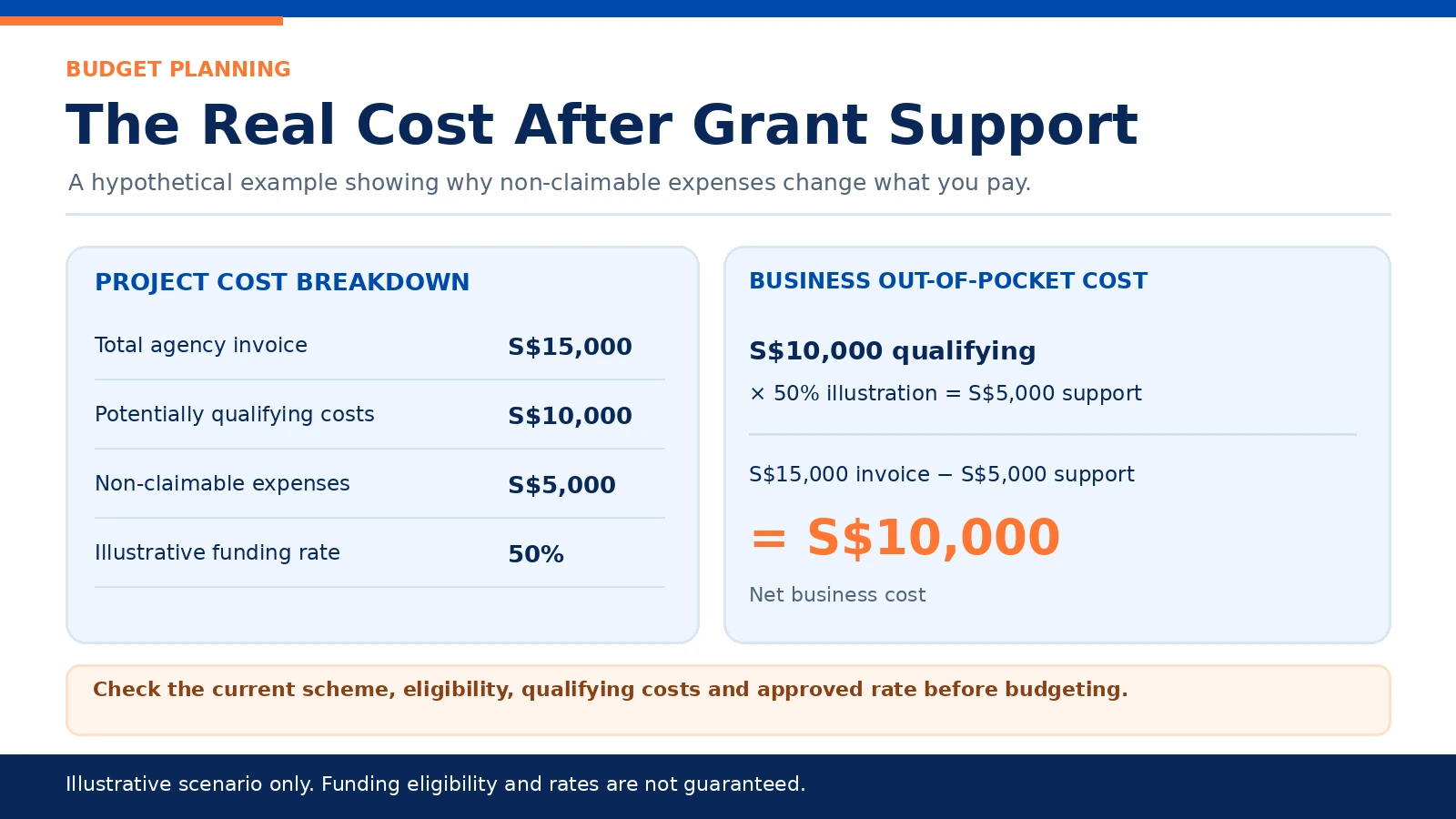
Only qualifying costs are co-funded. If an agency invoices S$15,000 but only S$10,000 is claimable, your business still pays the S$5,000 non-claimable portion in full. A quote that looks cheaper can therefore cost more net than a higher, fully claimable one.
Ask the agency to mark each line as claimable or not. Then calculate your net cost before you compare proposals. Shortlisting the best digital marketing agencies in Singapore, including those offering video production and Google Ads, with a brand-building track record helps you compare net costs fairly and measure success.
Benefits of Working With a Digital Strategy Agency
Most of an agency’s value lies in work a small in-house team cannot easily match: cross-channel planning, specialist tools, and experience across many clients. The trade-off is cost and dependence. The case for an agency rests on whether it does a specific job better than your team would.
A digital strategy agency does not replace internal ownership of the brand. Judge its digital marketing work against your website and business goals.
Where an agency adds value over an in-house team
An agency earns its fee where your team lacks depth or bandwidth. Three areas show the difference most clearly:
- Specialist skills at the same time. SEO, paid search, web conversion, email and social media rarely sit in one hire. An agency covers them together.
- Tooling and data access. Agencies often run measurement stacks that a single business would pay heavily to license alone.
- Pattern recognition. Working across many accounts shows which tactics fail quickly, which saves months of testing.
If your internal team already runs these well, an agency adds cost without adding value. Use the scorecard in the section on comparing quotes to test whether a proposal justifies its fee.
Results to expect and realistic timeframes
Be wary of any proposal that promises fast, large gains. Paid search can move within weeks. SEO typically takes three to six months to produce measurable results, and in competitive industries it can take six to 12 months. These are typical ranges, not guarantees.
Documented client cases show the pace. A local wealth management firm went from zero organic leads to 40 to 60 qualified prospects per month within nine months. Set a measurable target with a named tool at the start, so both sides judge progress on the same numbers.
Signs a partnership is not working.
Watch for these warning signs:
- Reports that show activity, such as posts or impressions, but no movement in the agreed target.
- Reluctance to share raw data or the measurement method.
- Strategy changes each quarter without a stated reason.
- Requests for longer contracts before any results are visible.
If three or more appear, review the scope and exit terms before the next renewal.
Conclusion and Next Steps
Choosing an agency comes down to what you can verify. Select agencies on itemised deliverables and evidence, not headline fees. Ask every proposal for the same details: itemised deliverables, comparable case studies, a measurable target with a named measurement method, the total cost after any grant or non-claimable amounts, and firm reporting commitments.
Score each proposal pass or fail. Two proposals with the same headline total can deliver very different work and carry different risk.
Your next steps are simple:
- Request a line-by-line quote from each shortlisted agency, covering the services you need.
- Ask for two or three case studies from businesses similar to yours by revenue, sector and growth stage.
- Agree a cost-per-acquisition or similar target and the tool you will use to measure it.
- Check your grant eligibility with Enterprise Singapore before assuming co-funding applies.
If you would like a line-by-line review of your own quote, contact Mediaonemarketing.com.sg to start the conversation.
Frequently Asked Questions
How much does a digital marketing agency cost in Singapore?
Cost depends on scope, channels and how many deliverables are included, so a single headline figure is hard to judge. Ask for line-item deliverables before comparing totals. Two proposals of the same value can buy very different work, so compare what each one actually contains.
Can my business get Enterprise Development Grant funding for an agency?
Possibly, but only if you meet the conditions. The business must be registered and operating in Singapore, hold at least 30% local shareholding, be financially viable, and have a clear business rationale for the project. Under the Enterprise Development Grant, qualifying costs are co-funded at up to 50% for SMEs and up to 30% for non-SMEs. Rates and eligibility are subject to change and approval, so confirm them on Enterprise Singapore’s guidance before you sign.
How long does it take to see results from a digital marketing agency?
Most campaigns need several months before the numbers settle. A Singapore fintech client improved its Google Ads return on ad spend from 2.5:1 to 5.2:1 within six months. A local wealth management firm built 40 to 60 qualified prospects per month within nine months. These timelines depend on your sector and starting point, so agree a measurable target and measurement method in the contract from day one.
What should I ask before signing an agency contract?
Work through this checklist:
- Which deliverables are itemised, and what is excluded?
- Can they provide two or three case studies from businesses similar to yours by revenue, sector and growth stage?
- What is the measurable target, and which tool measures it?
- What is the total cost after any non-claimable or grant-related amounts?
- How often will you report, and what are the exit terms?
If any answer is vague, treat that as a warning sign.
Is a digital strategy agency better than an in-house team?
It depends on the work. An agency gives you specialist skills, multiple tools and experience across clients, which an in-house team of one or two people rarely matches. An in-house team has deeper knowledge of your products and customers and is easier to coordinate day-to-day. Many businesses combine the two, keeping strategy and brand control internal while buying specialist execution such as search, content or paid media from an agency.