| AI Summary
Online shopping platforms in Singapore offer different advantages for businesses and consumers. Shopee and Lazada suit general retail, while Amazon.sg supports search-driven shopping. TikTok Shop works well for video-led sales, Carousell for resale, and ZALORA for fashion and lifestyle brands. Shopify and WooCommerce provide greater control through independent storefronts. We recommend comparing platform fees, buyer demand, fulfilment costs and profit margins before choosing a channel. Businesses expanding across Southeast Asia should also consider customs, taxes and cross-border logistics. A 90-day performance review can help determine which platform delivers sustainable growth. |
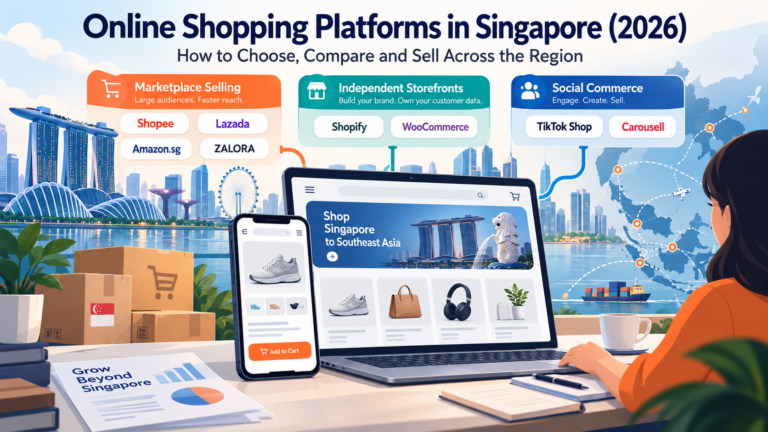
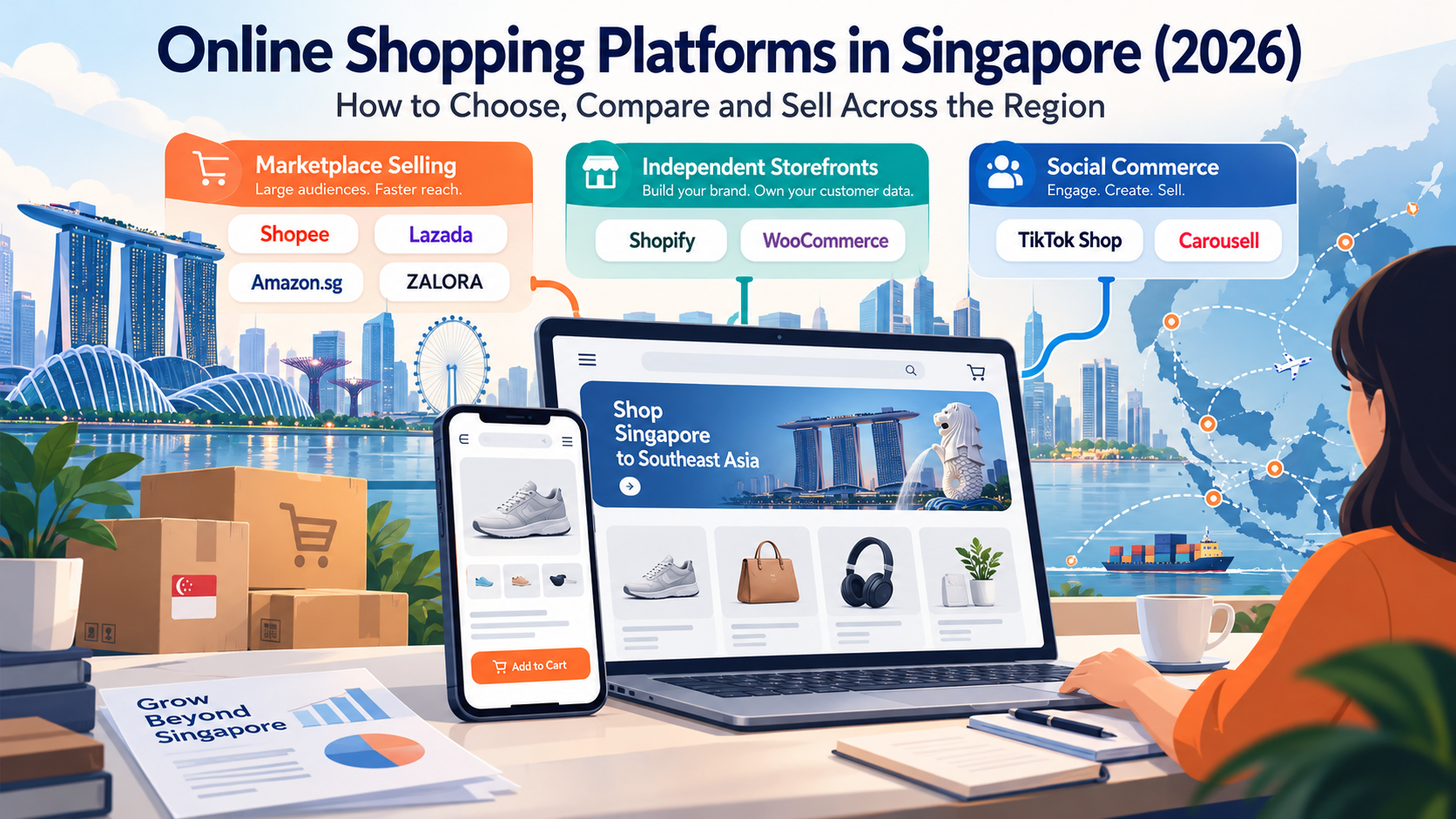
Online shopping platforms in Singapore serve different purposes. For broad marketplace reach, we would start by comparing Shopee and Lazada.



TikTok Shop suits products that sell through video demonstrations. Carousell is worth considering for resale, while ZALORA is a specialist option for eligible fashion and lifestyle brands.
Businesses that want their own website should compare Shopify and WooCommerce. Based on published seller documentation rather than hands-on testing, we compare eight options, costs and regional selling requirements.
Key Takeaways
- Start with buyer fit. A large marketplace audience is useful only when shoppers want your product at a viable price.
- Choose the right sales model. Marketplaces provide an established shopping destination. An independent storefront gives you greater control. Social commerce creates demand through content.
- Compare total variable costs. Include selling fees, payment charges, packaging, delivery, advertising and returns before judging profitability.
- Treat cross-border selling as a separate decision. Overseas listing access, customs rules, taxes, delivery and returns vary by destination.
- Run a measured pilot. Test a limited range for 30–45 days, then make a scale-or-stop decision using a 90-day review.
- Check Singapore rules. Goods and Services Tax (GST), personal data protection and import/export requirements depend on your business and transactions.
Comparing Online Shopping Platforms in Singapore
This comparison includes marketplaces, specialist channels and independent store software. Shopify and WooCommerce are not multi-seller marketplaces: they power websites you must market yourself. These are channel-fit recommendations, not traffic rankings.
| Platform | Type | Best suited to | Main trade-off |
| Shopee | General marketplace | Broad consumer products and price-conscious shopping | Competitive listings and multiple possible seller charges |
| Lazada | General marketplace | Mainstream retail, established brands and electronics | Promotional pressure and category-specific seller terms |
| Amazon.sg | General marketplace | Search-led shopping and standardised retail products | Referral, fulfilment and advertising costs require modelling |
| TikTok Shop | Social commerce | Demonstrable products and creator-led sales | Continuous content effort and changing seller fees |
| Carousell | Classifieds and marketplace | Pre-owned goods, collectibles and selected specialist sellers | Buyer trust, messaging workload and account-specific charges |
| ZALORA | Specialist marketplace | Eligible fashion, beauty and lifestyle brands | Brand onboarding and partnership requirements |
| Shopify | Hosted independent storefront | Brands building direct customer relationships | Subscription, payment costs and traffic acquisition |
| WooCommerce | WordPress storefront software | Businesses needing flexible website ownership | Hosting, maintenance, security and extensions |
Shortlist two complementary channels. A beauty brand could test Shopee for search demand and TikTok Shop for video-led discovery.
What Is an Online Shopping Platform?
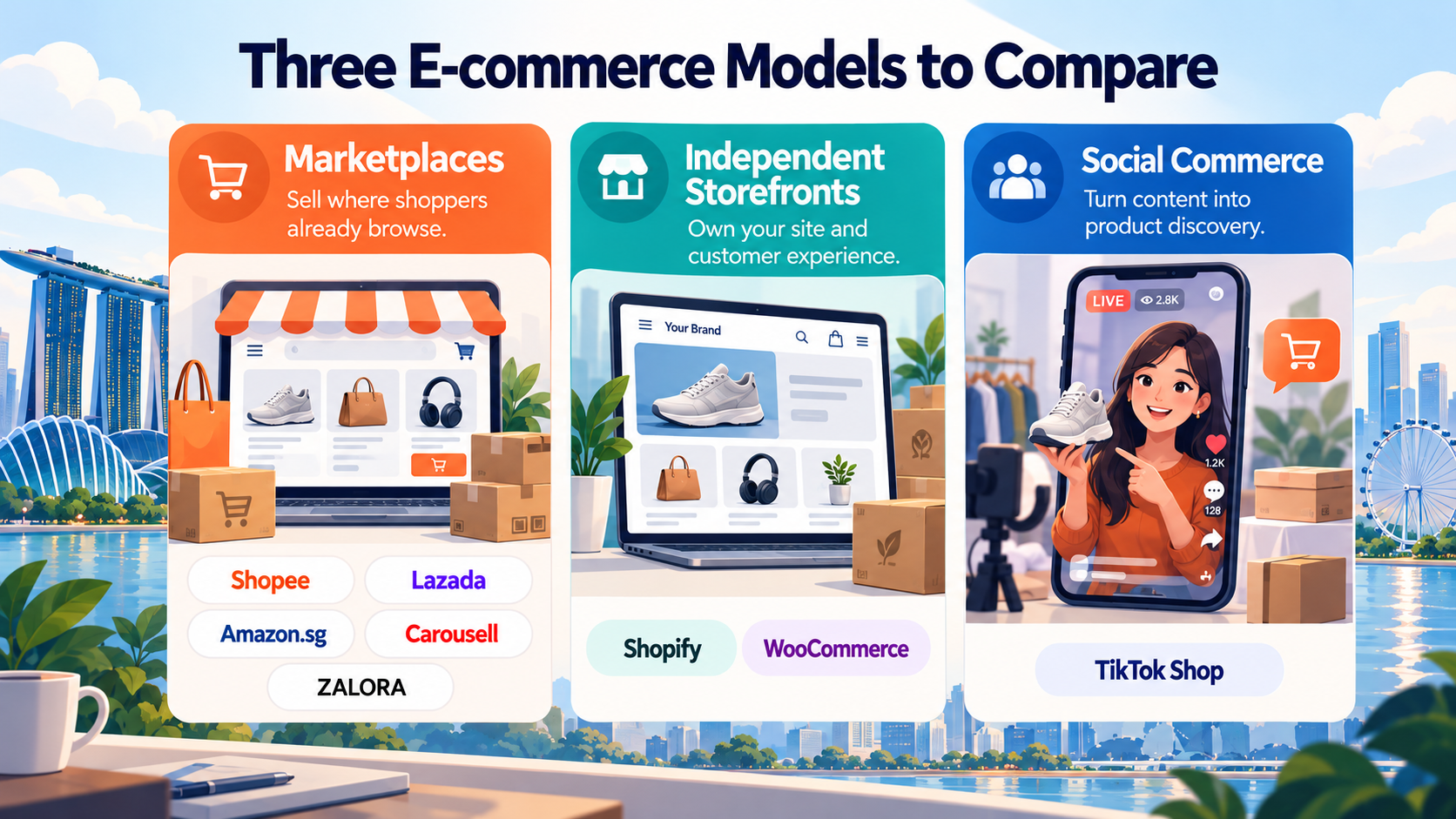
An online shopping platform lets buyers discover and purchase goods digitally. The term covers three distinct models, although some services combine them.
- Marketplaces: Shopee, Lazada and Amazon.sg host listings from multiple sellers. Sellers benefit from existing buyer activity but follow platform rules and pay applicable fees.
- Independent storefronts: Shopify and WooCommerce help a business operate its own website. The business controls its catalogue and customer experience but must build traffic and manage personal data lawfully.
- Social commerce: TikTok Shop connects content discovery with purchasing. Other social channels may generate enquiries or send customers to an external checkout rather than support an in-app transaction.
These models have different costs, from commissions to card processing and content production.
Eight Platforms and Selling Options Worth Comparing
1. Shopee: Broad Marketplace Reach
Best for: Sellers with competitively priced products and the capacity to manage frequent listing, fulfilment and promotional activity.

Shopee brings different merchants together in one shopping environment. Its Singapore terms of service describe commission and transaction fees, with additional charges possible for selected payment methods or programmes. We recommend checking the seller’s actual fee schedule, not assuming that a single advertised commission covers every order.
For regional growth, eligible Singapore sellers can consider the Shopee International Platform. Participation is subject to Shopee’s approval and programme conditions. An ordinary Singapore listing does not automatically mean you can deliver to buyers in every Shopee market.
Our verdict: A practical starting point for mass-market product testing. Expect intense competition and monitor profit after promotions.
2. Lazada: General Retail and Brand-Focused Selling
Best for: Sellers of mainstream retail products and authorised brands considering LazMall.
Lazada offers Singapore marketplace selling, brand-focused LazMall arrangements and seller marketing tools. Its Singapore seller registration page advertises a 90-day commission promotion for new sellers. We would verify eligibility and every non-commission charge before calculating the value of that offer.
Brand owners and authorised sellers can examine LazMall’s entry conditions. Regional expansion also requires selecting an appropriate seller programme rather than assuming that registration for Singapore provides unrestricted access to every national site.
Our verdict: Compare closely with Shopee for mainstream goods. It is especially relevant when branding, product authenticity and supported seller tools influence buyer trust.
3. Amazon.sg: Search-Led Product Sales
Best for: Merchants with consistent product specifications, reliable stock and the ability to meet marketplace fulfilment standards.
Amazon.sg is worth evaluating for products shoppers can identify through precise searches, such as home goods, books and selected branded products. Selling costs can include referral fees, optional fulfilment services and advertising. Rates depend on category and programme, so request a Singapore-specific breakdown rather than borrowing figures from Amazon’s US fee pages.
Amazon’s Singapore registration guidance sets out business verification requirements and advertises a Professional selling plan subscription promotion through 31 December 2026. Check current eligibility before budgeting.
Our verdict: Include Amazon.sg when search-led demand and fulfilment reliability suit your catalogue. Model every fee using the local seller terms.
4. TikTok Shop: Video and Livestream Commerce
Best for: Visually demonstrable products and brands prepared to produce regular content.
TikTok Shop connects product discovery with checkout through short videos, livestreams and other shopping experiences. That makes it relevant for beauty, accessories, lifestyle goods and products whose benefits are easier to show than describe. The challenge is sustaining worthwhile content and sales without letting production or creator costs erode margins.
TikTok Shop’s Singapore commission documentation records fee changes effective 1 September 2026. Its transaction fee guidance lists a 3.27% GST-inclusive transaction fee, with a calculation-base change effective 1 April 2026. These are separate fee components. Check the applicable category and programme before listing.
Our verdict: Strong for discovery-led products, provided your contribution margin can support content, creator activity and selling fees.

5. Carousell: Resale and Specialist Categories
Best for: Pre-owned items, collectibles and businesses whose customers expect direct seller communication.
Carousell has a different buying pattern from a conventional catalogue marketplace. Listings often involve condition questions, negotiation and buyer-seller messaging. This can work for second-hand goods but demands careful transaction handling.
Do not assume that every seller account is free of charges. Carousell’s Singapore professional-account service fee policy, updated in 2026, applies under specified activity thresholds. Personal accounts and qualifying professional sellers with sales packages are treated differently. Other fees may apply to selected transactions or features.
Our verdict: Useful for the right product category, but evaluate buyer protection, dispute handling and account classification before scaling.
6. ZALORA: Fashion, Beauty and Lifestyle Brands
Best for: Established or emerging brands that meet ZALORA’s partnership requirements.
ZALORA focuses on fashion, beauty and lifestyle shopping. Its official partnership models distinguish marketplace selling from wholesale arrangements. Services and fulfilment responsibilities vary by partnership.

Prospective partners must register their interest. Assess commercial terms before planning a launch.
Our verdict: A specialist option for eligible brands, not a default platform for every new seller.
7. Shopify: A Hosted Store for Your Own Brand
Best for: Businesses building a direct-to-consumer website with branded checkout and customer retention programmes.
Shopify handles much of the store-hosting infrastructure while allowing businesses to control their website experience. Unlike a marketplace, it does not automatically deliver a ready-made audience. You will need customer acquisition through channels such as e-commerce search engine optimisation (SEO), advertising and email.
On its Singapore pricing page, Shopify lists the Basic plan at S$29 per month when billed yearly, or S$39 on monthly billing, with separate payment processing fees. Prices and payment options can change, so verify them at signup.
Our verdict: Our preferred starting point for a brand that wants a managed independent storefront and can invest in attracting repeat customers.
8. WooCommerce: A Flexible WordPress Store
Best for: Businesses already using WordPress or requiring greater technical flexibility.
WooCommerce is open-source store software for WordPress. The core product is free, but the website still needs hosting, maintenance, security measures and potentially paid extensions. The official WooCommerce pricing guide distinguishes the free core platform from these operating costs.
We would choose WooCommerce over Shopify when WordPress is already central to the business and the team can maintain the site. Without that capability, technical upkeep may outweigh subscription savings.
Our verdict: Flexible and capable, but budget for the full website rather than treating ‘free software’ as a free store.
How to Compare Costs Without Misreading Commission Rates
A marketplace’s commission is only one charge. A seller’s total variable cost can also include payment processing, delivery subsidies, packaging, promotion, storage and returns. On an independent website, subscription and payment fees replace some marketplace charges, but customer acquisition remains your responsibility.
Platform take rate normally describes fees retained by the platform as a share of sales. We would track advertising, third-party logistics and merchandise costs separately to avoid confusing platform charges with total operating costs.
Worked Example: A S$50 Order
For an illustrative local seller who is not GST-registered, suppose a completed S$50 order produces the following costs. The figures are illustrative, not actual platform rates.
| Item | Amount (S$) |
| Customer payment | 50.00 |
| Cost of goods | −18.00 |
| Commission | −5.00 |
| Transaction fee | −1.50 |
| Delivery | −4.00 |
| Packaging | −1.00 |
| Advertising allocated per sale | −5.00 |
| Expected returns allowance | −2.00 |
| Contribution margin | 13.50 |
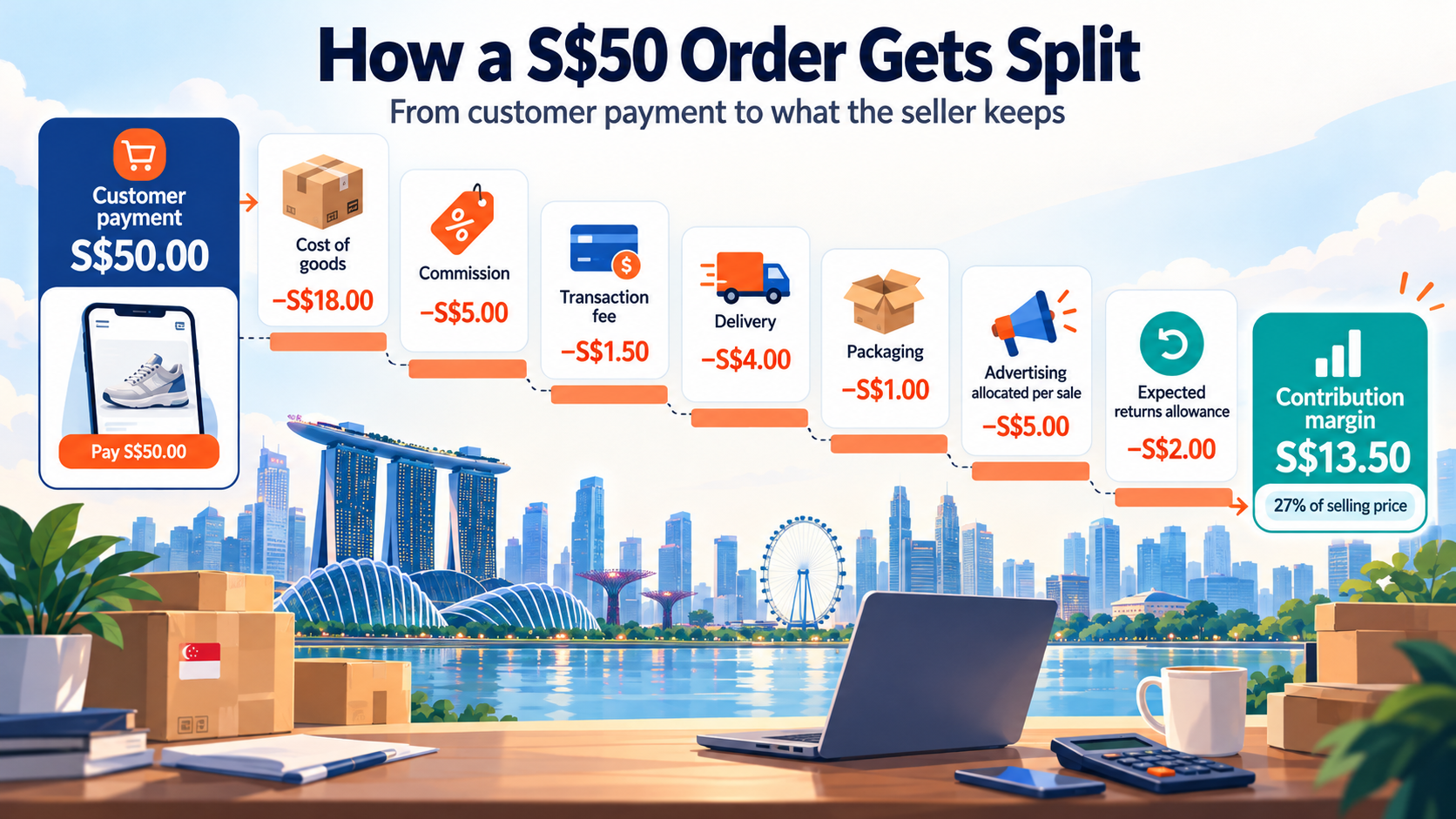
The remaining S$13.50, or 27% of the selling price, is not net business profit. It must still contribute to fixed overheads, salaries and other expenses. For GST-registered businesses, calculate revenue and recoverable GST consistently rather than subtracting GST automatically from every marketplace payout.
Avoid generic claims about what percentage of profit returns ‘usually’ consume. Instead, estimate return probability × expected unrecovered cost per return, then update that allowance with your order data. Check cancellation, refund and reverse-shipping rules separately.
Selling Across Southeast Asia: Five Checks Before Expansion
Regional selling can increase your addressable market, but every destination changes the economics. A marketplace’s overseas presence does not guarantee your Singapore account is authorised to sell in all those markets.
- Programme eligibility: Confirm whether you qualify for cross-border listing, which countries are available and who becomes the seller of record. Shopee’s international programme and Lazada’s seller programmes have distinct conditions.
- Product restrictions: Check whether your goods need approvals or are restricted in Singapore or the destination country. Beauty products, supplements and electronics may require category-specific checks.
- Customs and taxes: Determine who is responsible for export declarations, destination import tax and duty. Singapore Customs explains export permits, while its permit exemptions cover qualifying shipments. Do not assume every small parcel requires the same paperwork.
- Delivery and returns: Price fulfilment, tracking, failed deliveries and reverse logistics. A low-value item may become unprofitable when returned across borders.
- Currency and settlement: Compare the displayed customer price with what reaches your bank account after exchange rates, platform deductions and payment delays.
Our recommendation is to pilot one overseas destination and a limited product range before duplicating the entire catalogue. Set a minimum contribution margin after currency and return allowances. Scale only when actual orders support that threshold.
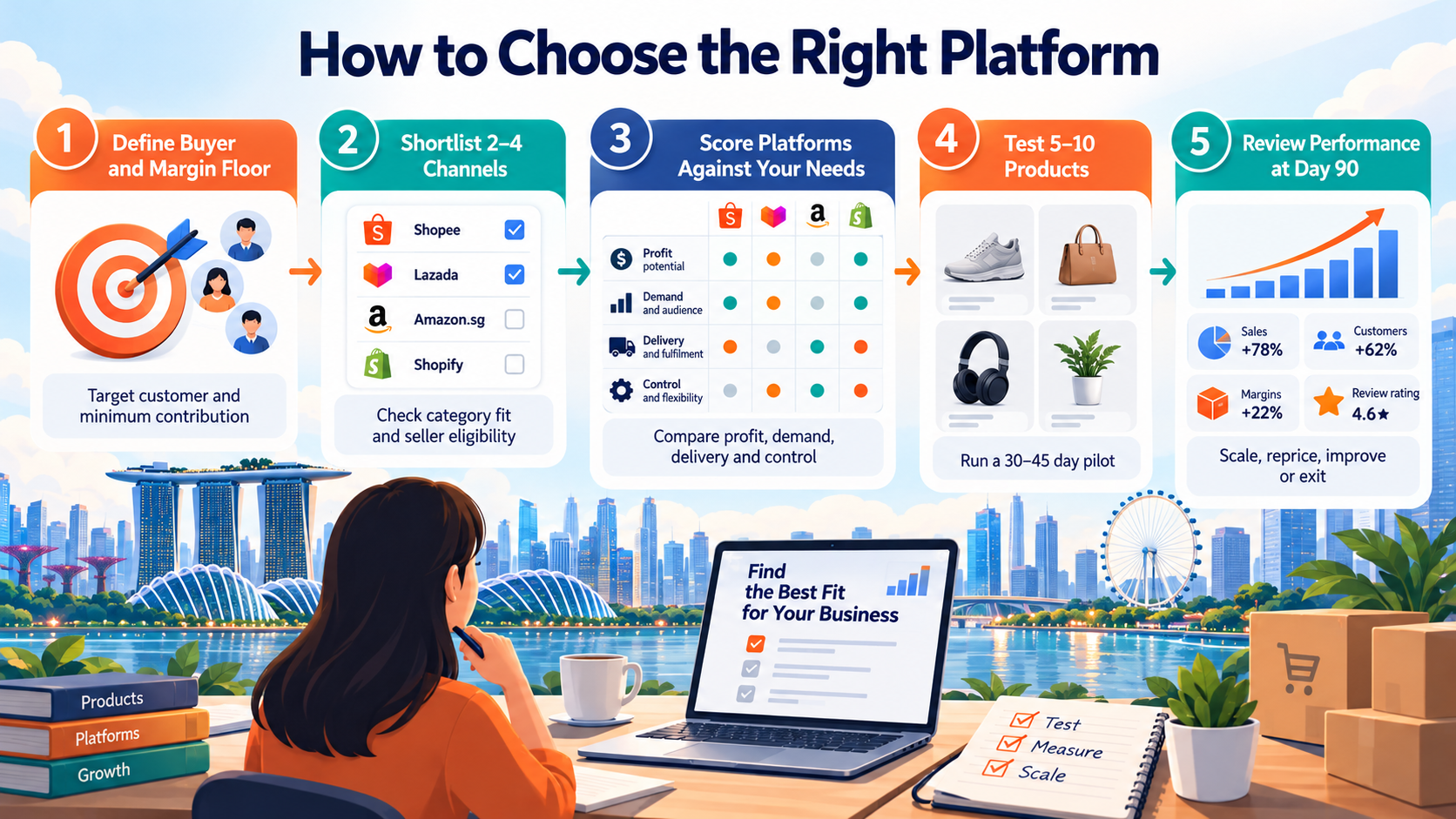
How to Choose an E-commerce Platform in Five Steps
Step 1: Define the Buyer and Your Margin Floor
Specify your target customer, the reason they buy and your minimum acceptable contribution per order. A product priced at S$30 with high shipping costs needs a different channel from a premium item with repeat-purchase potential.
Step 2: Shortlist Two to Four Channels
Search your product terms directly on each platform. Compare competing listings, product reviews, shipping promises and price bands. Check seller eligibility before spending time on account setup. We favour category fit over broad traffic estimates.
Step 3: Score Platforms Against Your Needs
Assign each option a score from 1 (poor fit) to 5 (strong fit). Multiply the score by the weighting below, divided by 100, and add the results. The maximum weighted score is 5.
| Criterion | Weight |
| Contribution margin after variable costs | 25% |
| Buyer demand and category fit | 20% |
| Fulfilment and delivery capability | 15% |
| Seller tools and access to useful data | 15% |
| Returns and dispute handling | 10% |
| Payment and currency support | 10% |
| Brand presentation and control | 5% |
| Total | 100% |
Use the score to structure your decision, not override an unprofitable cost model. Reject options below your contribution-margin floor.
Step 4: Test Five to Ten Products
Run a 30–45-day pilot with five to ten stock-keeping units (SKUs), where practical. Track traffic, orders, conversion, advertising cost, fulfilment and returns. Compare like-for-like products.
Step 5: Review Performance at Day 90
Compare actual contribution per order with your forecast, including delivery problems and support workload. Decide whether to scale, reprice, improve listings or exit.
What Singapore Buyers Should Check Before Purchasing
Consumers can use the same platform comparison differently. On Shopee, Lazada and Amazon.sg, compare the actual seller, product warranty and delivery origin. On Carousell, examine condition details and payment protection. On social platforms, check whether the purchase is completed through a protected checkout or an informal transfer.
Cross-border sites such as Temu, AliExpress and SHEIN offer choices, but buyer protection, delivery and returns vary. Check seller location and applicable terms.
Singapore’s ScamShield e-commerce guidance recommends using platform payment options and avoiding suspicious off-platform payment requests. Its first-half 2026 report recorded 3,865 reported e-commerce scam cases and S$8.3 million in losses. Those totals reflect reported incidents, not an individual buyer’s probability of being scammed on any particular platform.
Singapore GST, Privacy and Import Rules
GST registration. The Inland Revenue Authority of Singapore (IRAS) requires compulsory registration when taxable turnover exceeds S$1 million for the calendar year under the retrospective test, or when it can reasonably be expected to exceed S$1 million in the next 12 months under the prospective test. The latter requires supporting evidence and has specific application deadlines. Exemptions and special rules may apply; a marketplace does not automatically discharge a seller’s tax duties.
Imported goods. Singapore’s GST rate is 9%. IRAS guidance on low-value goods explains when GST is collected by GST-registered overseas suppliers at checkout and when importation rules apply. The S$400 treatment depends on shipment method and other conditions; it is not a universal tax-free allowance.
Personal data. The Personal Data Protection Commission (PDPC) outlines notification, consent, protection and other obligations under the Personal Data Protection Act (PDPA). Operating your own website gives you access to customer relationships, not unrestricted rights to use personal data. Confirm obligations before uploading customer lists to advertising or email tools.
Customs and product rules. Importers and exporters should use Singapore Customs’ setup guidance to check product classifications, permits and declaring-agent arrangements. The rules depend on how goods move and whether they are controlled.
Frequently Asked Questions
Which online shopping platform is best for a small business in Singapore?
We would compare Shopee and Lazada first for general retail. Choose TikTok Shop for demonstration-led products, or Shopify when control of a branded website is the priority. The final decision should depend on contribution margin and fulfilment capability.
How much commission do Singapore online marketplaces charge?
There is no single rate across platforms. Fees can vary by seller status, product category, payment method and promotions, so use the current Singapore seller schedule and calculate total cost per completed order.
Is Shopify better than selling on Shopee or Lazada?
Shopify gives your business greater control of the storefront and customer experience, but you must attract buyers. Shopee and Lazada provide marketplace discovery in exchange for platform rules and applicable fees. Many brands can test one marketplace alongside an independent website.
Do I need to register for GST when selling online in Singapore?
Registration generally becomes compulsory when taxable turnover exceeds S$1 million under IRAS’s calendar-year retrospective test or qualifying 12-month prospective test. Check the detailed conditions, deadlines and exceptions directly with IRAS.
Can a Singapore seller list products across Southeast Asia automatically?
Not necessarily. Cross-border programmes have eligibility rules, supported destinations and separate logistics and tax considerations. Confirm the programme terms before accepting overseas orders.
How reliable are platform traffic rankings?
Traffic estimates describe attention, not profitable demand. Compare what a ranking measures and when it was produced, then rely on your own sales, conversion and contribution data when selecting a channel.
Choose the Channel That Fits Your Business
For general consumer goods, we would start with Shopee and Lazada. TikTok Shop deserves a trial when video can demonstrate the product. Carousell suits selected resale categories, while ZALORA is worth exploring for eligible fashion and lifestyle brands. Choose Shopify or WooCommerce when the priority is an independent storefront; consider Amazon.sg where product-led search demand supports the economics.
We recommend building a realistic per-order cost model, testing a small catalogue and reviewing results at 90 days. If you plan to grow an independent store, our e-commerce SEO guide explains how to improve product discovery without relying entirely on marketplace placement.