AI Summary
TikTok marketing matches content with interested users through the platform’s recommendation system, then converts that attention into leads, sales, or awareness. Singapore businesses should start with a clear commercial goal, using a four-stage approach: diagnosing the account, architecting content around a defined action, optimising based on real behaviour, and scaling only proven results. With strong TikTok Shop growth and 3.80 million local adults in TikTok’s advertising audience, brands should combine organic content, creators, and paid ads while tracking commercial metrics like cost per acquisition, not just views, and keeping PDPA, ASAS, and MAS compliance built in from the start.
Table of Contents
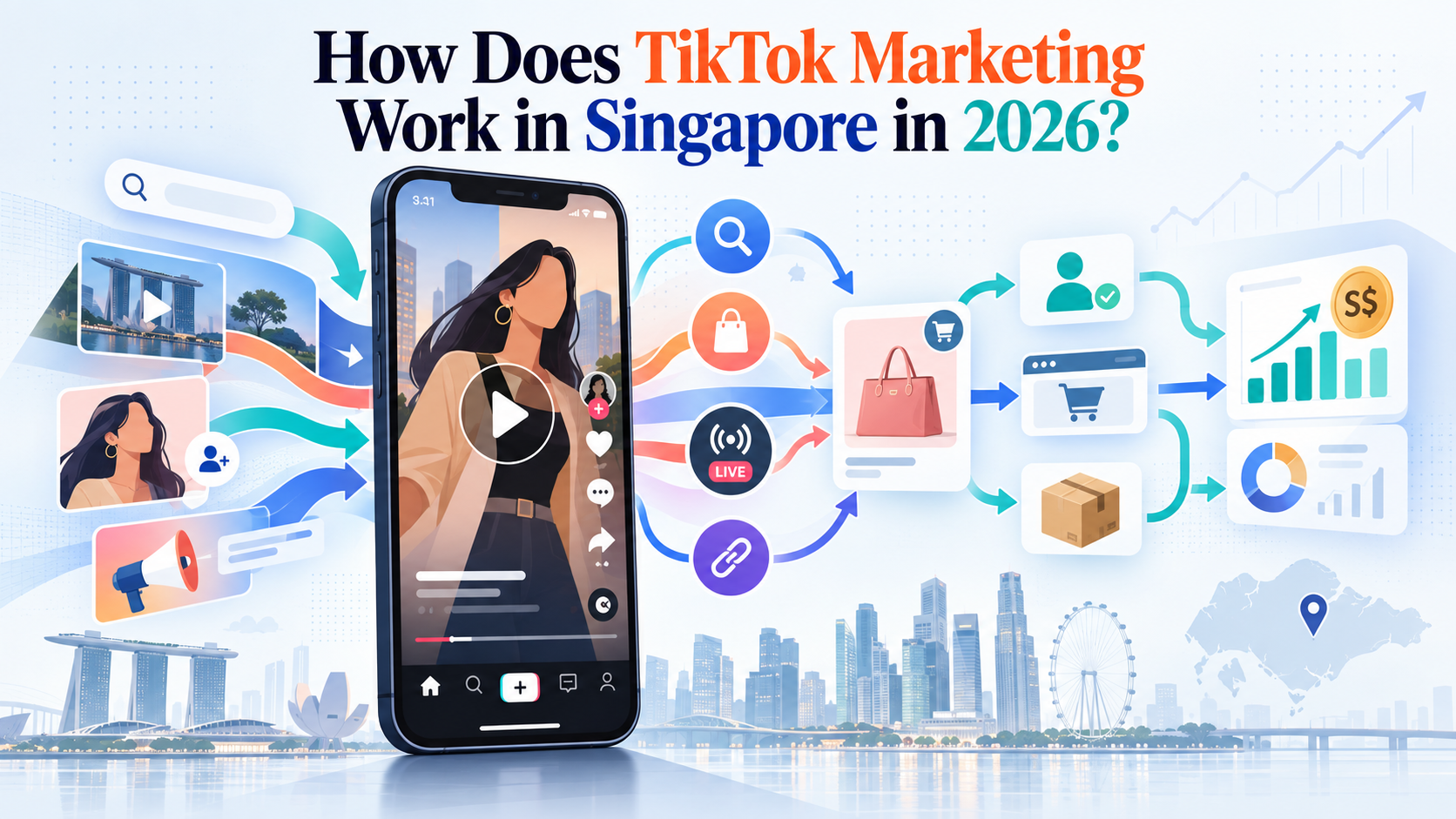
TikTok marketing works by matching useful or entertaining content with people who show signs of interest. Brands can then turn that attention into a business result through organic videos, creator partnerships, paid ads, lead forms, TikTok Shop or LIVE commerce.
For Singapore businesses, the process should start with a clear commercial goal. Measurement should follow from that goal. We treat TikTok as a channel for demand and conversion, not just a place to post trending content.
Singapore already offers a sizable audience. DataReportal reports that TikTok’s advertising tools showed 3.80 million users aged 18 and above in Singapore in late 2025. That represented 75.4 per cent of adults and 66.3 per cent of local internet users.
Key Takeaways
- Start with the business result. Decide if TikTok should create awareness, leads, online sales or in-app sales. Let that goal guide the content, campaign goal and measurement plan.
- TikTok discovery is interest-led. TikTok says user interactions, content information and user information feed its recommendation systems. Interactions such as watch time can carry greater weight. It gives new accounts a route to relevant viewers without relying only on follower size.
- Use organic content as research. Strong organic posts show which topics and hooks attract qualified attention. We would test those signals before paying to amplify weak creative.
- Treat search as its own behaviour. TikTok says 57 per cent of users use search and 25 per cent search within 30 seconds of opening the app. Those figures come from TikTok research and are not Singapore-only data. Still, they show why search-led content deserves attention.
- Commerce is now central for suitable brands. TikTok Shop Singapore reported 1.7x year-on-year growth in gross merchandise value and 1.6x growth in monthly buyers in July 2026. Product brands should assess Shop, creator affiliate content and LIVE selling as part of one sales system.
- Measure commercial quality, not vanity. Views and likes help diagnose creative, but they do not prove profit. We track metrics closer to revenue, such as qualified leads, cost per acquisition, sales and return on ad spend.
How Does TikTok Marketing Work?
TikTok marketing has four working parts. A brand creates content, TikTok distributes it based on predicted relevance, and viewers take action. The brand then uses those signals to improve the next round of content or media.
| Part | What Happens | What We Would Watch |
| Content | The brand, customer or creator publishes a video or LIVE session | Hook, topic, clarity and offer |
| Distribution | TikTok tests and ranks content for likely interested users | Watch time, completion, skips, shares and comments |
| Conversion | The viewer follows, visits, submits a lead or buys | Click quality, lead quality, purchase rate and revenue |
| Learning | Organic and paid data shape the next test | Creative winners, audience response and funnel drop-off |
TikTok states that its recommendation systems use user interactions, content information and user information. For the For You feed, interactions can include videos watched in full or skipped, likes, shares and comments. Content data can include sounds, hashtags, views and the country where content was published.
This does not mean brands should chase every signal. We would first make the video useful enough to hold attention. Then we would ask the viewer to take one clear action. A highly viewed video with no relevant next step can produce impressive reporting but weak commercial value.
Why TikTok Is Worth Testing in Singapore in 2026
The local audience is large, but audience size alone does not justify investment. DataReportal’s Digital 2026 Singapore report uses late-2025 platform planning data. It shows 3.80 million adults in TikTok’s potential advertising audience and an adult gender split of 52 per cent female and 48 per cent male.
DataReportal also warns that ad reach is not the same as monthly active users. We would not present the figure as a count of unique active people.
TikTok Shop’s Singapore data also shows the shift towards in-platform commerce. At its July 2026 Singapore Summit, TikTok reported 1.7 times year-on-year growth in gross merchandise value. Monthly buyers grew 1.6 times over the previous year.
During the 2026 6.6 campaign, the platform also reported an 80 per cent year-on-year increase in gross merchandise value. Livestream gross merchandise value doubled.
For ecommerce, this supports a serious sales test. Professional services will usually need educational content linked to a lead form, website visit or consultation.
Apply the Four-Stage Growth Model to TikTok
This four-stage growth model is built around Diagnose, Architect, Optimise and Scale. We apply the same logic to TikTok because it keeps creative activity tied to tracking, funnel design and cost control.
1. Diagnose the Current Account and Funnel
We start by checking what the business already has. That includes account setup, existing videos, audience response, tracking quality, landing pages, creator assets and available sales or lead data.
The first question is not how often to post. We want to know where value breaks down.
A brand can have weak reach because the content misses its audience. Another can have strong reach but poor sales because the offer or conversion path fails.
2. Architect the Content and Conversion Path
Next, we map content to a defined action. An awareness video may aim for completed views and profile visits. A service video can lead to a native lead form, while a product demo can send users to TikTok Shop.

We also set content groups before production starts. A home-services brand might cover price questions and workmanship proof. A skincare seller may test demonstrations and creator reviews.

3. Optimise From Real Behaviour
Once content has enough response, we compare patterns instead of judging one viral post. We look for hooks and topics that retain attention. We also check which creative drives useful downstream actions.
TikTok’s free Creative Centre shows trends, high-performing ads and category patterns. We use it for research, not as a script generator.
4. Scale What Has Earned More Budget
We scale only after the tracking and creative show a repeatable signal. That can mean producing new versions of a winning concept. It can also mean expanding creator partnerships, turning an organic post into a Spark Ad or raising spend in controlled steps.
TikTok’s July 2026 budget guidance says campaign daily or lifetime budgets must exceed 50 United States dollars. An ad-group daily budget must exceed 20 United States dollars.
These are platform minimums, not sensible test budgets for every business. We would budget from the conversion goal and expected data volume instead of treating the minimum as a strategy.
Build Organic Content Around Problems, Proof and Search
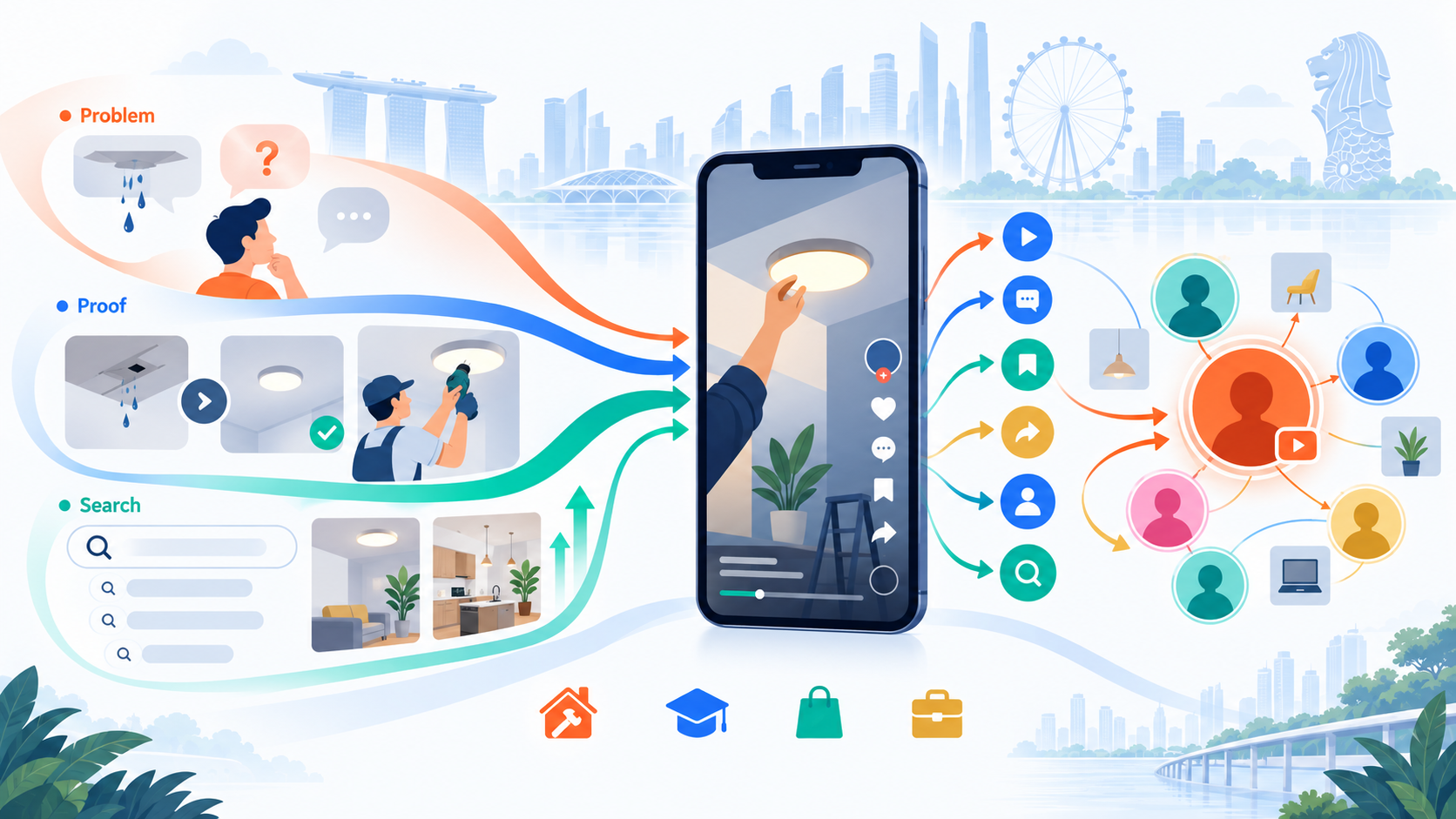
A common TikTok mistake is treating trends as the whole content plan. Trends can lift reach briefly. However, useful content should address real customer questions and buying decisions.
We would divide organic content into three groups.
- Problem content. Address a question, concern or frustration that affects a buying decision. This gives the video a clear reason to exist.
- Proof content. Show the product, service or result in action. Demonstrations and credible examples can support the claims made in the video.
- Search content. Answer phrases people are likely to search for on TikTok. Focus on specific questions that signal genuine interest.
For example, a Singapore renovation firm could answer “How much does a kitchen renovation cost in Singapore?” The video could explain the main cost factors in simple terms.
A training provider could answer “SkillsFuture course for managers” and explain the relevant eligibility points. Any funding claim should use a current official source.
Put the Answer Early
Do not hide the useful information behind a long introduction. TikTok users can skip quickly.
TikTok says watch time and other user interactions can influence recommendations. We would open with the answer, support it with evidence and finish with one clear next step.
Plan Content for TikTok Search
Search needs its own content plan. TikTok reports that 57 per cent of users use its search function.
We would build topic ideas from several sources.
- Customer questions. Use recurring questions from prospects and customers.
- Sales conversations. Identify the concerns people raise before buying.
- TikTok comments. Look for questions that deserve their own videos.
- On-platform searches. Find phrases people already use to discover related content.
Use relevant phrases naturally in the spoken opening, on-screen text and caption. Avoid forcing keywords where they sound unnatural.
Check Search Ads Availability Before Planning Paid Campaigns
Paid TikTok Search Ads require an availability check before planning a Singapore campaign. TikTok’s Search Ads Campaign availability page was updated in April 2026.
Singapore is not listed among the markets where traffic targeting is currently supported. Availability can differ by campaign goal and account. So, check TikTok’s latest documentation before allocating a budget.
Use Creators as a Distribution and Trust Layer
Creator work is strongest when the creator already speaks to the right type of buyer. Follower count can help estimate reach, but it says little about local audience quality, content fit or purchase intent.
TikTok One now brings creator discovery and campaign work into TikTok’s official creator marketing system. TikTok describes Creator Marketplace as its official platform for brand and creator collaboration. It includes tools for discovery, campaign delivery and reporting.
For Singapore brands, we would screen creators for local audience relevance, category fit and comment quality. Our influencer work also assesses audience authenticity and campaign performance instead of treating reach alone as the result.
Spark Ads can extend the useful life of strong creator posts. TikTok says Spark Ads use organic posts from a brand or authorised creator. The resulting views, comments, shares, likes and follows stay attached to the original post.
Use TikTok Shop When the Buying Path Fits the Product
TikTok Shop deserves its own commercial plan, not a small ecommerce add-on. It works best when customers can understand the product quickly and see proof in video. They should also be able to buy without a long consultation or custom quotation.
Singapore’s 2026 Shop growth makes it difficult for suitable retailers to ignore. TikTok also said it aims to train more than 3,000 creators by the end of 2026. At least 1,000 local sellers are expected to receive training by the end of 2027.
We would combine four assets for a product brand. Short videos create discovery, creator content adds third-party explanation, LIVE sessions answer objections and Shop listings close the sale.
Make Paid TikTok Support Proven Creative
Paid advertising cannot fix weak content. Poor inputs can simply lose money faster.
TikTok Ads Manager now supports manual, Search and Smart+ campaign workflows. Smart+ can automate parts of campaign setup, targeting and delivery. Manual campaigns give advertisers greater control.
For lead generation, TikTok supports in-app Instant Forms and website forms. Verified Business Account lead generation is available in Singapore.
TikTok says a Verified Business Account can use call-to-action, video anchor and LIVE anchor lead features where account requirements are met.
A paid test should answer one commercial question. We would avoid changing the hook, audience, landing page and offer at the same time.
Measure TikTok From Attention to Revenue
TikTok reporting becomes misleading when every metric sits in one bucket. We separate diagnostic metrics from commercial metrics because they answer different questions.
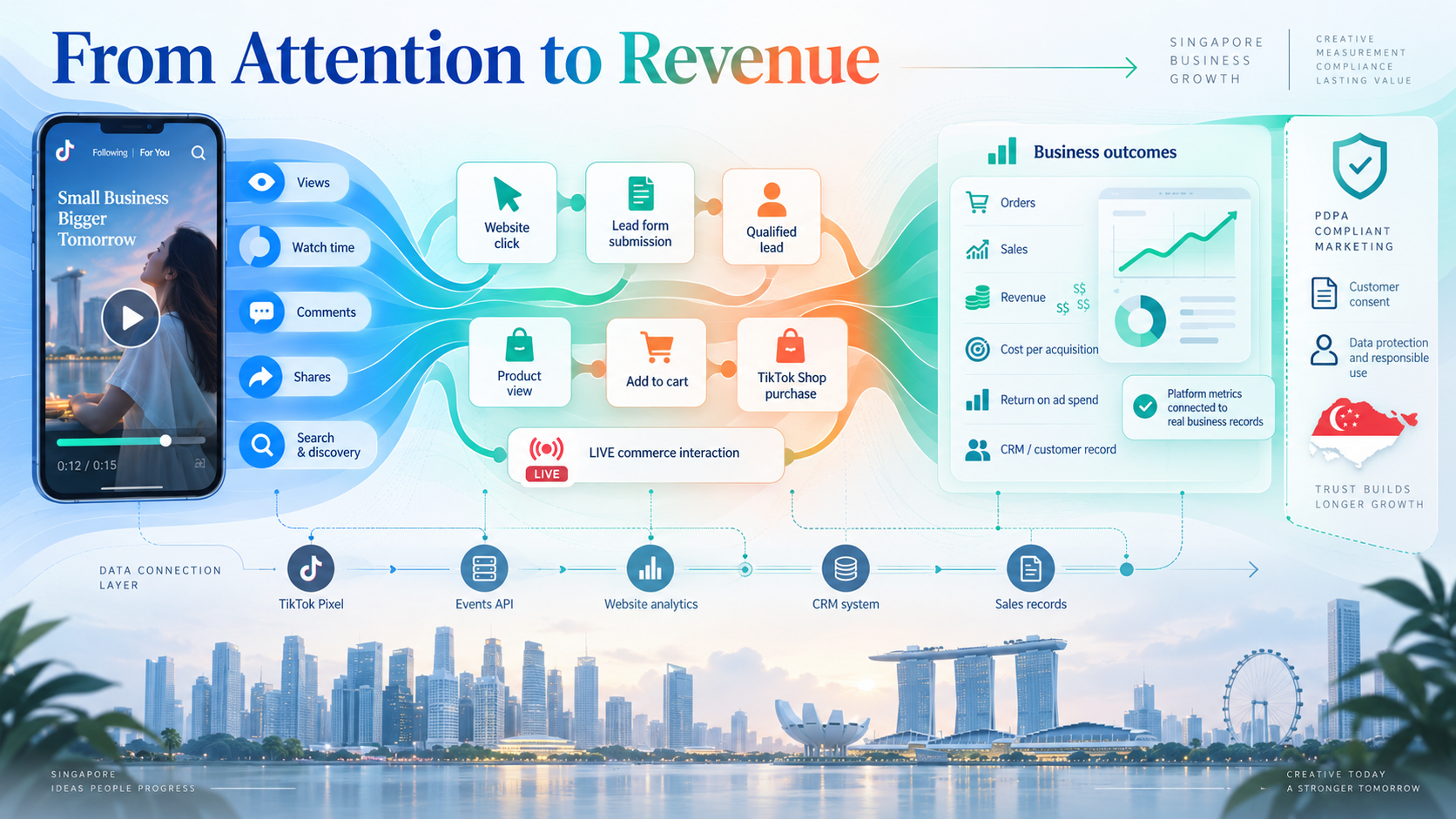
| Goal | Diagnostic Metric | Commercial Metric | Decision |
| Awareness | Watch time, completion and reach | Branded search or qualified site visits | Keep topics that attract relevant attention |
| Lead generation | Click rate and form starts | Qualified leads and cost per qualified lead | Fix the offer or form if lead quality is weak |
| Ecommerce | Product views and add-to-cart rate | Orders, cost per acquisition and return on ad spend | Scale creative that keeps profit within target |
| TikTok Shop | Product clicks, LIVE engagement | Orders and gross merchandise value | Compare creator, video and LIVE contribution |
For website conversion campaigns, TikTok supports the TikTok Pixel, Events API and a combined setup. TikTok’s July 2026 documentation says using the Pixel and the Events application programming interface together can create a more reliable data connection for measurement, delivery and audience creation.
Attribution still needs judgement. We compare TikTok’s attributed results with website analytics, customer relationship management data and actual sales records.
Our existing MediaOne work gives a useful benchmark for process.
Our social media service tracks cost per lead, cost per acquisition, return on ad spend, revenue attribution and creative performance. We use that data to decide what to scale, refine or stop.
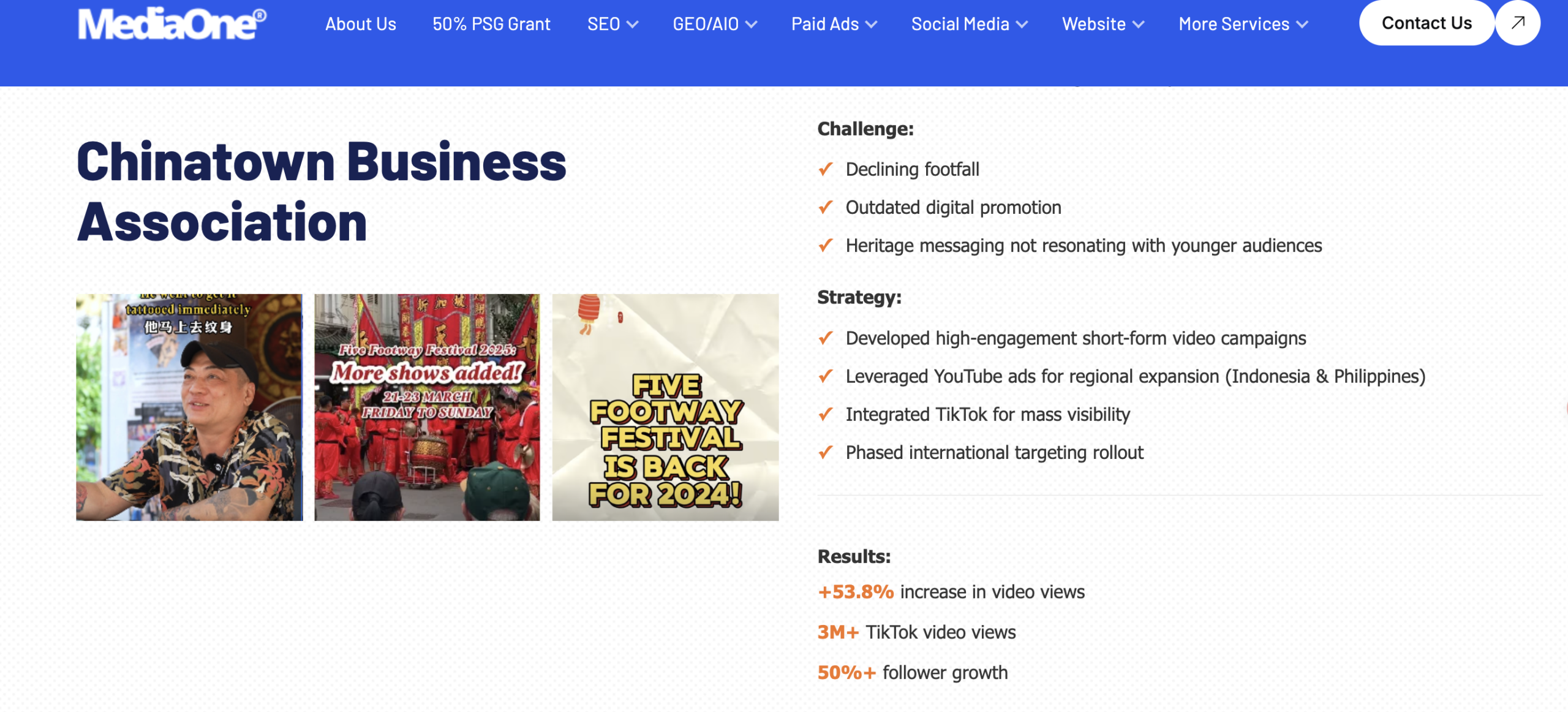
Our results for Chinatown Business Association also show why TikTok cannot be judged only by follower count.
The social campaign integrated TikTok for mass visibility and reported more than 3 million TikTok video views. It also recorded over 50 per cent follower growth as part of a broader short-form video strategy.
We approach campaigns like this through our social media marketing services, matching them to what our clients aim to achieve.
Keep Singapore Compliance Inside the Campaign Design
Compliance should be part of the brief before filming or lead collection starts. Fixing claims, disclosure or data problems after launch wastes time and budget.
The Personal Data Protection Act governs how organisations collect, use, disclose and protect personal data in Singapore. The Personal Data Protection Commission states that organisations generally need to tell people the purpose of collection and obtain consent unless an exception applies.
Influencer content also needs clear commercial disclosure. The Advertising Standards Authority of Singapore says sponsored relationships that can affect the credibility of an endorsement must be disclosed. Its guidance says video disclosure should appear visibly within the video where viewers may watch without sound.
Regulated industries need another layer of checks. TikTok’s September 2026 financial-services policy says Singapore ads for consumer banking and credit products may be allowed when the advertiser is registered with the Monetary Authority of Singapore.
We would also check the Singapore Code of Advertising Practice for claims. The code requires advertising to be legal, decent, honest and truthful. Unsupported performance claims can therefore create a local compliance problem even before TikTok’s own review catches them.
Choose TikTok Only When the Operating Model Fits
TikTok can work for ecommerce, consumer services, recruitment, education and some business-to-business offers. However, the business needs enough creative capacity to learn from repeated testing.
A team that can produce one polished corporate video every two months will struggle. TikTok needs enough content variation to test hooks and topics at useful speed.
Build TikTok Around Business Results
TikTok marketing works best when content discovery, creators, paid distribution, conversion and measurement support the same business goal. Singapore’s audience reach and TikTok Shop growth create a real opportunity, but brands still need sound economics, clean tracking and local compliance.
We would start with useful organic content and use real audience response to shape the next tests. Paid media should follow only when the creative and offer show promise. Then, we’ll connect TikTok activity with creator campaigns, paid social, lead generation and performance reporting when a business needs a managed system.
Frequently Asked Questions
How does TikTok marketing work for a small business?
TikTok marketing helps a small business publish short-form content and reach interested users through recommendations. The content can then guide people towards a lead, website visit or purchase.
How much does TikTok advertising cost?
TikTok’s July 2026 documentation says campaign daily or lifetime budgets must exceed 50 United States dollars. Ad-group daily budgets must exceed 20 United States dollars, but actual acquisition cost depends on the audience, offer, creative, objective and conversion rate.
Does TikTok marketing work without paid ads?
Yes. Organic TikTok can reach people outside an account’s follower base through the recommendation system. Paid media becomes useful when you have content or creator assets worth distributing to a larger or more defined audience.
Is TikTok Shop suitable for every Singapore business?
No. TikTok Shop fits products that can be demonstrated, understood and purchased in-app. Complex services usually need a lead or consultation path.
Are TikTok creator partnerships required to be disclosed in Singapore?
Sponsored creator relationships should be clearly disclosed under the Advertising Standards Authority of Singapore’s social media guidance. For video, the guidance says disclosures should appear visibly within the video where people may watch without sound.

What TikTok metrics should a business track?
Track watch behaviour to diagnose creative. Then connect it to leads, sales, cost per acquisition and return on ad spend where applicable.