
Imagine a potential customer standing two streets away from your business, smartphone in hand, ready to make a purchase. They type “best service near me” into Google. Does your business appear?
In 2026, being seen is everything. Local SEO is about making sure your business shows up when nearby customers search for what you offer—and partnering with the right local SEO agency can help ensure you’re optimised for maximum visibility. It can be the difference between a busy shop and an empty one.
But things have changed. With AI, voice search, and smarter local algorithms, the old SEO tricks just don’t cut it anymore.
This guide is your step-by-step playbook for 2026. We’ll go beyond the basics and dive into advanced strategies that use the latest tech and real customer habits. By the end, you’ll have a clear plan to win more local customers.
Key Takeaways
- In 2026, optimising for AI Overviews and voice search is no longer optional; it is essential for visibility.
- Your Google Business Profile remains the single most influential factor for local pack rankings.
- Expertise, Experience, Authoritativeness, and Trustworthiness are increasingly vital to distinguish local businesses from AI-generated content.
- It is not just about the number of stars; the frequency, recency, and detail of reviews heavily influence rankings.
- Content strategy must drill down to specific neighbourhoods and landmarks, not just city-wide terms.
What Is Local SEO Optimisation?
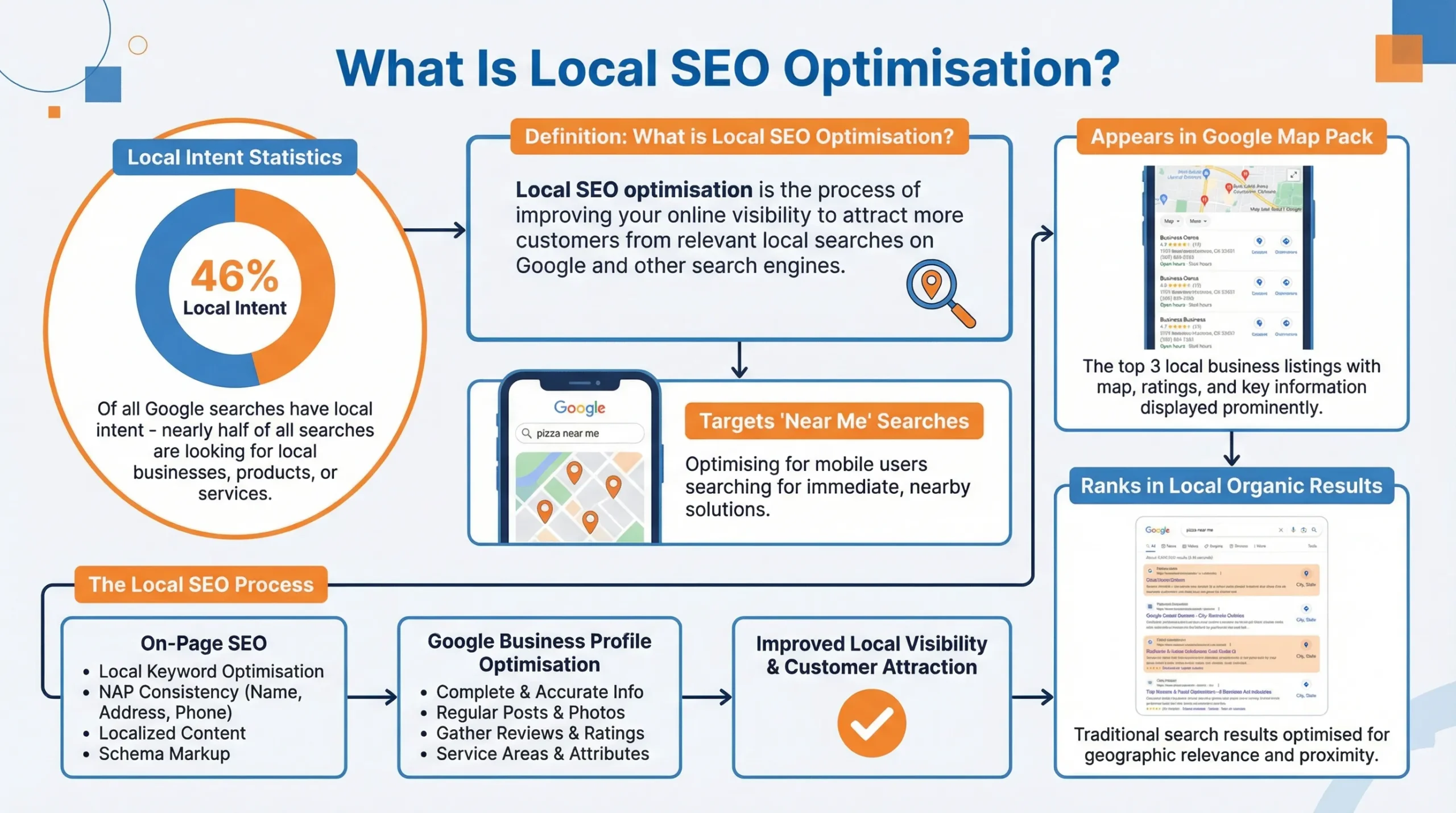
Local SEO (Search Engine Optimisation) is a specialised branch of SEO that focuses on optimising a website and online presence to be found in local search results. Unlike traditional SEO, which aims to rank for keywords on a national or global scale (e.g., “how to bake a cake”), local SEO targets queries with specific geographic intent (e.g., “bakery in Manchester” or “cakes near me”).
When a user performs a search with local intent, Google typically displays two distinct types of results:
- The Local Map Pack (the “3-Pack”): This prominent map display features three local business listings at the top of search results. Appearing here is the “holy grail” of local SEO, as it captures the majority of clicks.
- Local Organic Results: These are the traditional blue-link listings that appear below the Map Pack. While they look like standard search results, the algorithm ranking them prioritises local relevance and proximity.
Local SEO optimisation involves fine-tuning various signals across the web to convince Google that your business is the most relevant and prominent answer to a searcher’s query. It benefits any business with a physical location or those that serve a specific geographic area, such as plumbers, lawyers, restaurants, and medical practices.
Why Local SEO Optimisation Matters in 2026
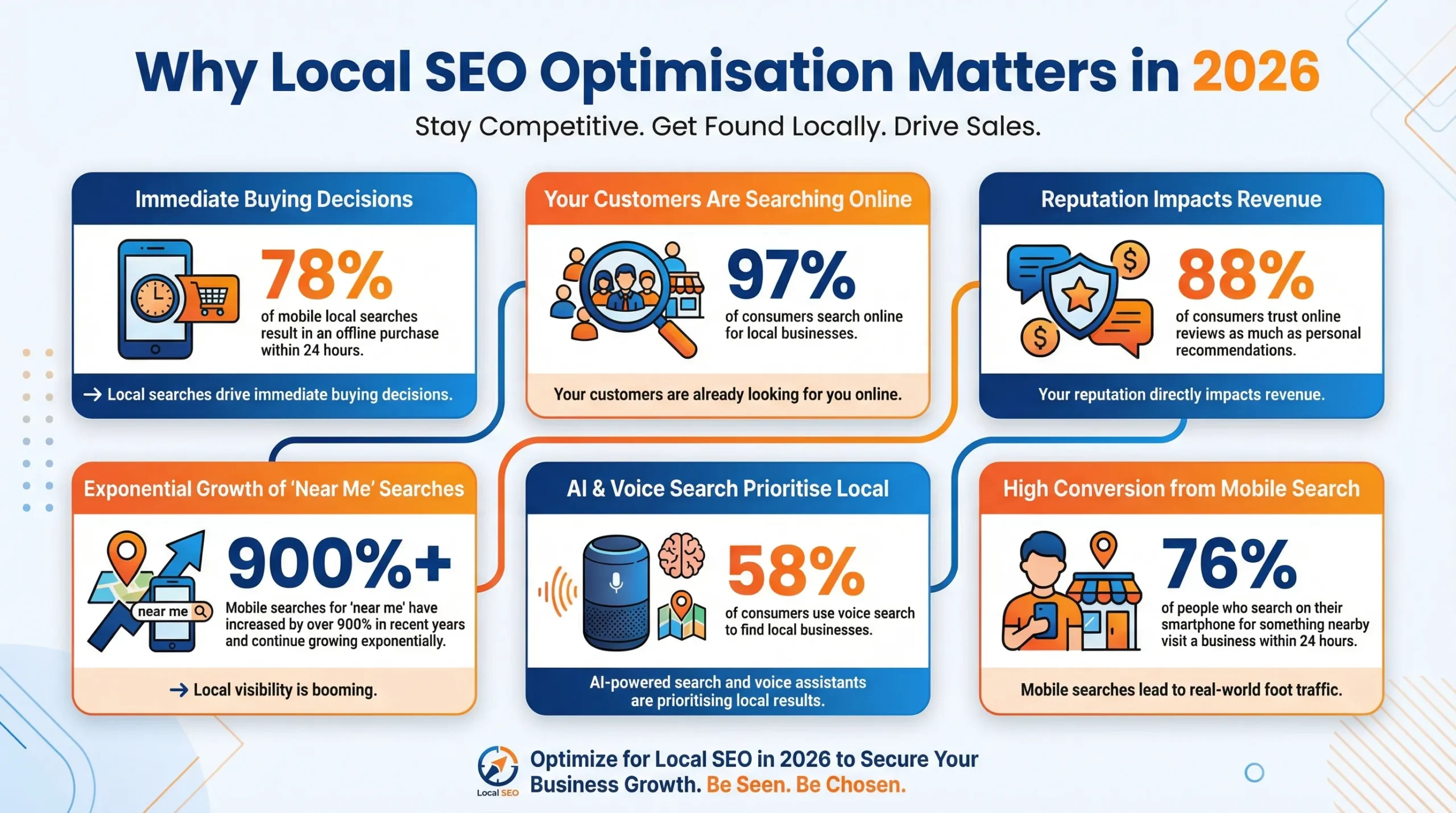
In 2026, everything online is more local than ever. Thanks to AI, people expect search engines to know where they are and what they want, without having to spell it out.
The Impact of AI and Voice Search
With the widespread adoption of AI assistants and smart speakers, voice search has matured. Queries have become more conversational and specific.
A user in 2020 might have typed “Italian restaurant,” but in 2026, they might ask, “Where can I find an authentic Italian restaurant open now within walking distance?” Local SEO ensures your business provides the structured data and context AI needs to answer these complex queries.
Mobile-First Reality
Most people now use their phones to find local businesses. ‘Near me’ searches are the norm, not just a trend. If your business isn’t set up for mobile local search, you’re missing out on customers who are ready to buy right now.
Competition has changed, too. You’re not just up against the shop next door anymore. Now, you’re fighting for space on the screen with big directories, aggregators, and paid ads.
Here’s what it means for your business: If you show up in the top 3 spots on the Map Pack, you can get 126% more traffic than those ranked lower. More visibility means more people walking through your door, and more sales.
Google’s Local Ranking Factors in 2026

Understanding what drives the algorithm is the first step toward domination. Based on the latest data from industry leaders like Whitespark and extensive 2026 trend analysis, local ranking factors can be categorised into three core pillars: Relevance, Distance, and Prominence.
1. Relevance
Relevance asks: Does this business provide what the searcher is looking for?
Google determines this by analysing your content, business categories, and keywords.
If a user searches for “emergency dentist,” Google looks for businesses categorised as “Emergency Dental Service” rather than just general “Dentist.”
Key Signals: Primary business category, keywords in the business title (use with caution), and on-page service descriptions.
2. Distance
Distance asks: How far is the potential result from the location term used in the search?
If no location term is used, Google calculates distance based on the information it has about the user’s location.
You can’t control how close your business is to every searcher, but you can make sure your service areas are clearly defined online.
3. Prominence
Prominence asks: How well-known and trusted is this business?
This is where your marketing efforts shine. Prominence is based on information Google has about a business from across the web.
Key Signals:
- Review Quantity and Quality: A steady stream of positive reviews signals trust.
- Backlinks: Links from local news sites, blogs, and chambers of commerce build authority.
- Citations: Consistent mentions of your business name, address, and phone number (NAP) across directories.
Weighted Importance in 2026:
According to recent studies, On-page signals (content, keywords, and technical SEO) now account for approximately 33% of the weight in organic local rankings. In contrast, GBP signals dominate the Map Pack rankings.
Behavioural signals (click-through rate, mobile clicks-to-call, check-ins) are also increasingly significant, as they indicate real-world popularity.
Comprehensive Local SEO Optimisation Strategy
If you want to stand out in local search in 2026, you need a complete strategy that covers every angle. Use this step-by-step framework to build a strong regional presence.
Google Business Profile Optimisation

Think of your Google Business Profile as your new homepage. For many customers, it’s the only thing they’ll see before deciding to visit you.
- Complete Every Field: Ensure no section is left blank. Add your opening hours (including holidays), website URL, and appointment links.
- Category Strategy: Choose your primary category carefully; it is the single most significant ranking factor. If you are a “Pizza Restaurant,” do not just select “Restaurant.” Use secondary categories to capture additional traffic (e.g., “Pizza Delivery,” “Italian Restaurant”).
- Business Description: Write a clear, engaging description that highlights what makes you unique and includes local keywords. Make the first 250 characters count, since that’s what most people will see.
- Photos and Videos: Add high-quality photos often. Businesses with photos receive 42% more directions requests. In 2026, video walkthroughs of your space are a great way to stand out.
- Google Posts: Use this feature like a mini blog. Share weekly updates about offers, events, or new products to show Google and your customers that your business is active.
- Q&A: Add your own frequently asked questions and answer them. This helps you show up in voice search results.
Local Keyword Research

Good keyword research is more than just ‘service + city.’ Find out how real people talk about your services.
- Service-Based Keywords: Start with your core offerings (e.g., “boiler repair”).
- Location Modifiers: Combine services with your city, neighbourhood, and even street names (e.g., “boiler repair Chelsea,” “plumber near King’s Road”).
- Intent Variations: Target “buy,” “best,” “emergency,” and “24-hour” variations.
- Voice Search Queries: Optimise for questions. People type “weather London” but ask “Will it rain in London today?” Use tools like AnswerThePublic to find these natural language queries.
NAP Citations and Directory Listings

NAP stands for Name, Address, and Phone Number. Keeping these details consistent across the web is a must.
If your business is listed as “Smith & Co.” on one site and “Smith and Co Solicitors” on another, Google loses confidence in your data. Start by auditing your current citations. Focus your efforts on high-authority data aggregators (like Foursquare) and major directories (Yelp, Yellow Pages, Bing Places).
Additionally, seek out hyper-local directories (e.g., your local Chamber of Commerce) and niche-specific directories (e.g., TripAdvisor for hospitality, FindLaw for solicitors). These carry more weight than generic directories.
Online Review Strategy
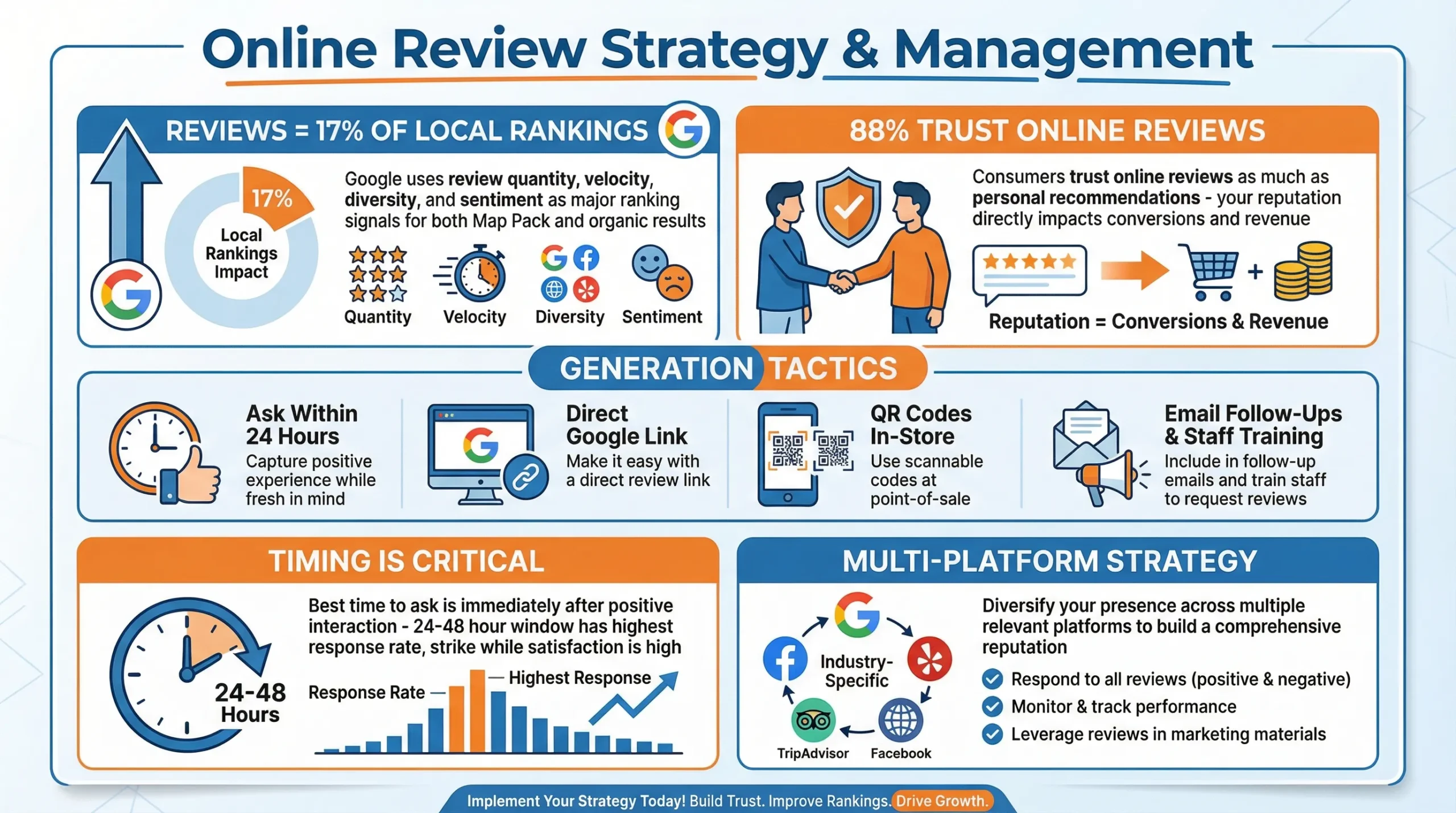
Reviews now make up about 17% of your local pack ranking. You can’t afford to just sit back and hope for the best.
- Acquisition: Implement a system to ask for reviews at the moment of peak satisfaction. This could be via SMS, email automation, or a QR code at the till.
- Response: Respond to every review. For positive ones, express gratitude and mention a specific service (reinforcing keywords). For negative ones, stay professional, acknowledge the issue, and take the conversation offline.
- Velocity and Recency: Fresh reviews matter more than old ones. A 4.5-star rating with recent feedback is better than a perfect score from years ago. Keep the reviews coming in regularly.
Local Link Building

Backlinks are still a big deal, making up about 31% of local organic rankings. But links from local sources matter more than just high-authority sites.
Strategies for 2026:
- Sponsorships: Sponsor a local youth football team or a charity event. The link from their website is locally relevant gold.
- Local PR: Get featured in local newspapers or community blogs. A story about your business anniversary or a new hire can earn valuable links.
- Partner Links: Exchange links with non-competing local businesses. If you are a wedding photographer, link to local florists and venues you recommend, and ask them to reciprocate.
On-Page Local SEO

Your website needs to make it obvious to Google where you’re located and who you serve.
- Title Tags & Meta Descriptions: Include your primary keyword and city naturally. (e.g., “Emergency Plumber in Bristol | 24/7 Repairs – [Brand Name]”).
- Location Pages: If you cover more than one area, create a separate page for each. Don’t just copy and paste content with a new city name. Add local testimonials, case studies, and staff info for each location.
- Schema Markup: Implement LocalBusiness structured data. This code explicitly tells Google your hours, address, and coordinates, helping you qualify for rich snippets.
- Local Content: Write blog posts about local news, events, or guides (like ‘Best Coffee Shops in Shoreditch’). This shows Google you’re part of the local community.
Advanced Local SEO Tactics for 2026

Local SEO in 2026 goes far beyond basic Google Business Profile optimisation and directory listings. With AI, voice search, and smarter local algorithms, staying visible and conversion-ready requires a strategic approach.
Partnering with the right SEO agency can help ensure your business isn’t just found, but chosen by nearby customers. An experienced agency can guide you through implementing advanced tactics, tracking results, and adapting to constant algorithm updates.
This section explores strategies to help your business stay competitive in increasingly crowded local search results:
- Voice Search Optimisation: Voice searches are longer and more conversational, often phrased as real questions. Use a natural, conversational tone in your content. Add FAQ pages that answer ‘Who,’ ‘What,’ ‘Where,’ and ‘When’ questions directly. Ensure your site loads quickly, since voice assistants favour fast, accurate answers.
- AI and Answer Engine Optimisation (AEO): Search engines are increasingly becoming answer engines. Your goal is to be the authoritative source they pull from. Use clear headings and add concise, direct answers (about 40–60 words) immediately under each heading. This helps your business appear in AI-generated results and enhances visibility in featured snippets.
- Hyper-Local Targeting: Don’t just target city names. Focus on specific neighbourhoods, landmarks, and transport hubs. For example, instead of just ‘London,’ use phrases like ‘near The Shard’ or ‘South Bank.’ Mentioning local landmarks and key areas on your pages helps Google confirm your exact location and improves local relevance.
Local SEO Tools and Resources

Essential Free Tools:
- Google Business Profile: The command centre for your local presence.
- Google Search Console: For monitoring organic traffic and technical health.
- Google Trends: For identifying seasonal local search trends.
Premium Tools:
- BrightLocal: Excellent for auditing citations and tracking local rankings.
- Whitespark: The industry standard for finding citation opportunities.
- SEMrush / Ahrefs: Powerful for keyword research and competitor backlink analysis.
- Moz Local: Great for ensuring listing consistency across the ecosystem.
Common Local SEO Mistakes to Avoid
Local SEO can be a game-changer for small businesses looking to attract nearby customers, but even minor missteps can hold you back from reaching your full potential. Understanding the pitfalls can help you stay ahead of the competition and make the most of your online presence.
- Inconsistent NAP: Even small differences like ‘St.’ versus ‘Street’ can confuse search engines. Standardise your business name, address, and phone number across all platforms.
- Neglecting GBP: Don’t just set up your Google Business Profile and forget about it. Check in and update it every week. Regularly update your GBP with posts, photos, and accurate info.
- Ignoring Negative Reviews: Not replying to negative reviews makes it look like you don’t care about your customers. Respond promptly and professionally to every review, showing you value feedback.
- Duplicate Listings: If you accidentally create more than one Google Business Profile for the same place, you split your ranking power. Audit your listings and remove duplicates to strengthen your SEO.
- Poor Mobile Experience: If your site is slow or tough to use on a phone, people and Google will leave right away. Optimise your site for mobile with fast loading times and easy navigation.
Avoiding these common mistakes and applying the simple solutions can significantly boost your local search visibility and help you connect with customers in your area. Regular maintenance, attention to detail, and a customer-focused approach are the keys to local SEO success.
Local SEO Optimisation Success
Local SEO in 2026 is always changing. It takes a mix of technical know-how, creative content, and real reputation management. Focus on your Google Business Profile, keep your info consistent everywhere, and connect with your community through reviews and local content. Do this, and you’ll build a strong online presence that’s tough for competitors to beat.
The competition is fierce, but the payoff is huge. Start by checking your current local SEO against the tips in this guide. Find your weakest spot and fix it. Your local customers are searching right now, make sure they find you before your competitors.
Keep in mind, local SEO isn’t a one-and-done job. The businesses that win in 2026 are the ones that keep their profiles updated, talk to their customers, create useful local content, and stay on top of new tech like AI and voice search. Every review, every citation, and every local blog post adds up to more visibility and trust.
There are only three spots in the map pack, and the first page of search results is crowded. But with the strategies in this guide, you have what you need to reach the top.
Your local customers are ready to buy. Make sure they find you first. Contact us today! MediaOne can help you with your local SEO needs.
Frequently Asked Questions
How long does it take to see results from Local SEO?
Typically, you can see measurable improvements within 3 to 6 months. However, fixing foundational issues such as NAP inconsistencies or GBP claims can yield quicker wins.
Do I need a physical address to rank in local search?
Yes, generally. If you are a Service Area Business (like a plumber) who visits clients, you can hide your address on GBP, but you still need a verified address to register. P.O. boxes and virtual offices are strictly against Google’s guidelines.
How do I rank in a city where I don’t have an office?
This is challenging. You likely won’t appear in the Map Pack for that city. Your best strategy is to create high-quality organic location pages targeting that city to rank in the standard search results.
Does posting on Google Business Profile help rankings?
Yes. While individual posts don’t significantly boost rankings, consistent activity signals to Google that the business is alive and engaged, which is a positive ranking signal.
Can I use a toll-free number for my local listing?
It is recommended to use a local area code number (e.g., 020 for London) as your primary number to reinforce local relevance. You can add a toll-free number as a secondary contact.