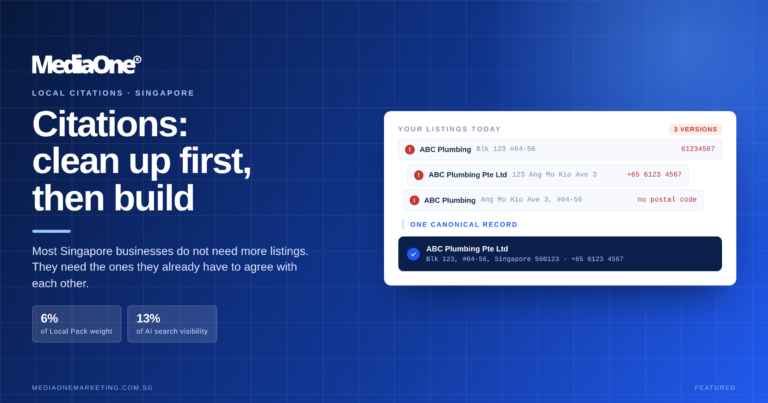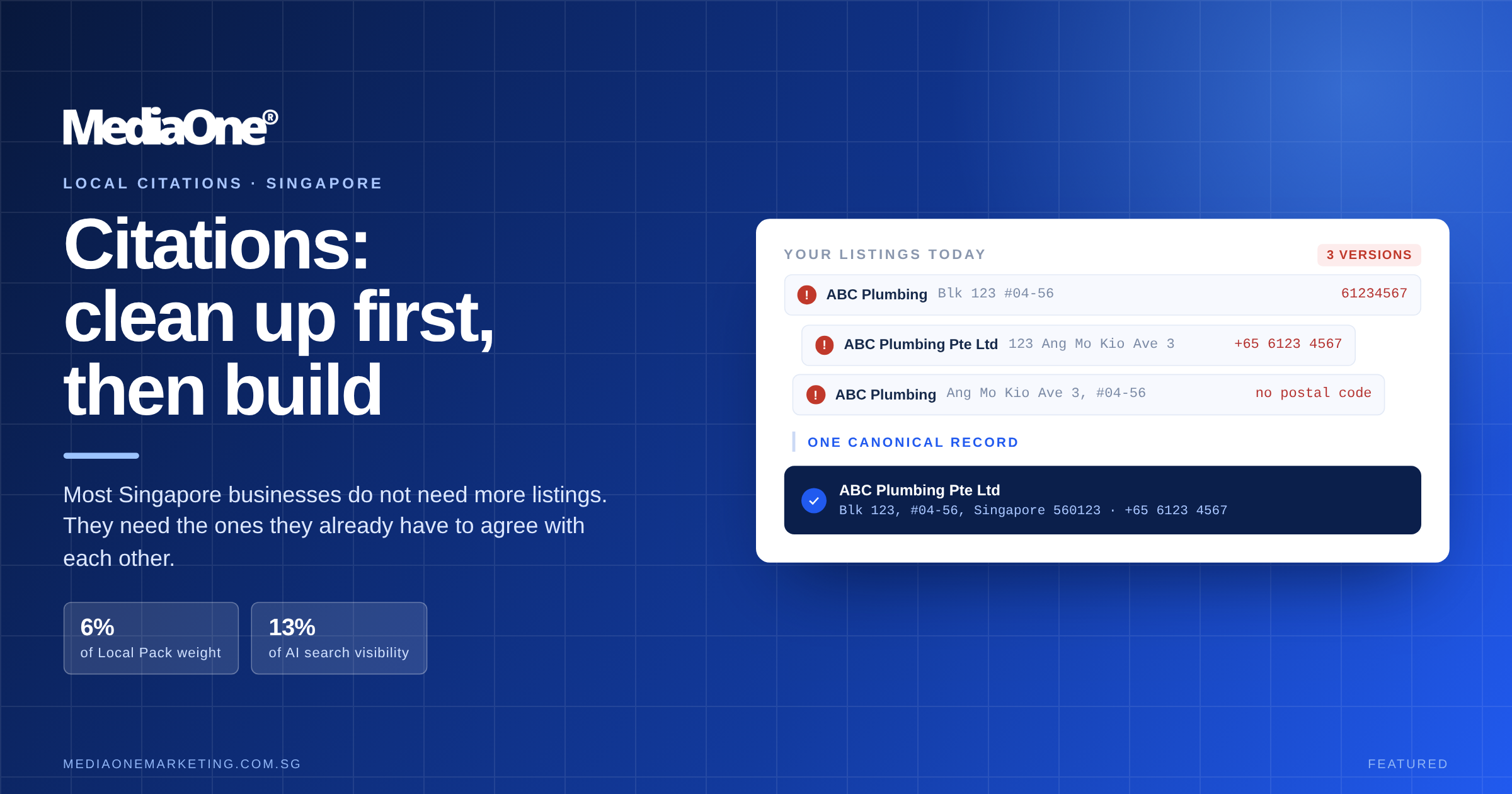
Many small businesses are told they need dozens of listings to rank locally. That advice is outdated. Local citation building works best as clean-up first and growth second: a small set of accurate, consistent citations on the directories your customers actually use beats a hurried push across every site. For Singapore businesses, fix existing listings before building new ones — and where a listing appears in search results, check it first.

Key Takeaways
- Citations are a hygiene layer, not a ranking lever. Accuracy is the point, not volume.
- Fix before you build. Correcting an existing listing usually delivers more value than creating a new one, because you can’t verify a conflicting listing.
- Score every directory. Rate each source 0 to 2 on authority, accuracy and completeness; sources scoring 5 or 6 go on the first build list.
- Watch the five Singapore mismatches: block and unit numbers, six-digit postal codes, phone formats, name suffixes and street abbreviations.
- Audit quarterly. Remove duplicates, correct outdated details and close accounts you no longer use.
What Is a Local Citation and Why It Still Matters
A local citation is any online mention of a business’s name, address and phone number (NAP). Search engines read those mentions to confirm that a business exists, where it is and how to reach it. Consistent citations support local SEO, and many sources offer free listings, so an accurate presence across them costs little.
Structured and unstructured citations
Structured citations are formal listings with defined fields, such as separate boxes for name, street address, postal code and phone number. Unstructured citations are the NAP appearing in running text, such as a press release, blog post or review. Both count, but they work differently: structured listings are easy to audit, while unstructured mentions carry weight precisely because they are independent.
Unstructured mentions are harder to create on purpose, which is part of their value. A local news story naming the same business at the same address is corroboration nobody bought. For most small businesses, a handful of genuine third-party mentions is worth more than a dozen forgotten directory accounts.
The three kinds of structured listing
Structured citations live on data aggregators, which push information to many other sites; on map platforms, including Google Business Profile; and on general or niche directories. The NAP fields matter most, because search engines compare them across sources. A missing unit number or a differently formatted phone number weakens the whole set.
How Citations Affect Local Search Rankings
Citations are a smaller part of local ranking than many guides suggest, but the 2026 picture is not the one most articles describe. Whitespark’s 2026 Local Search Ranking Factors report, published in November 2025 and scored by 47 local search experts across 187 factors, rates Google Business Profile signals at 32% of Local Pack ranking. Citation signals sit at 6% there, sixth of eight groups.
Two things follow.
First, citations alone will not move your map position: profile quality, reviews and on-page relevance carry far more weight.
Second, citations matter far more in AI answers than the map pack — 13% there, third of eight groups, and three of the report’s top five AI visibility factors are citation factors. The report’s own summary calls them “the new link” for AI SEO.
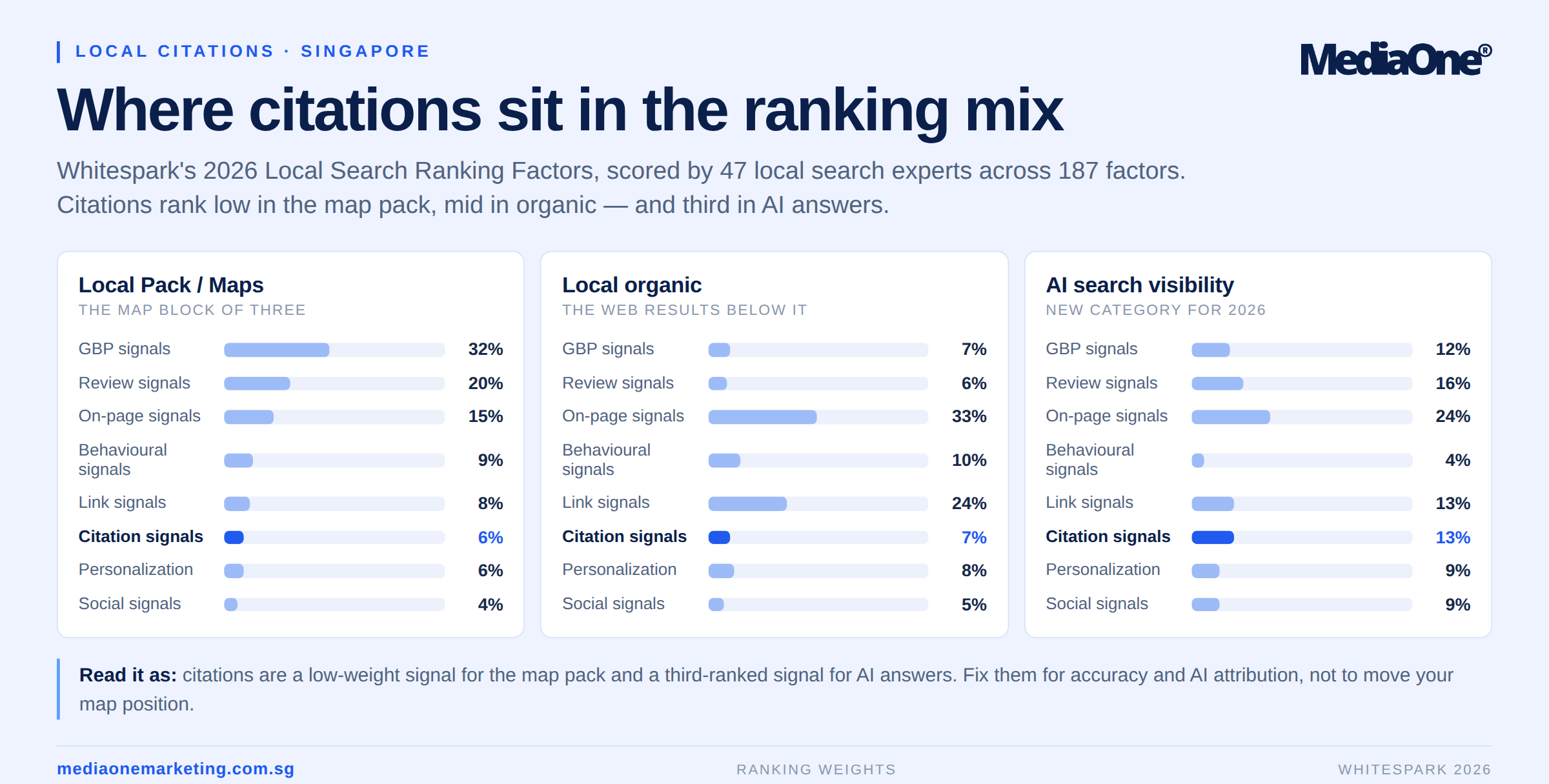
Figure 1: Where citations sit in the ranking mix, across Local Pack, local organic and AI search visibility.
|
Signal group |
Local Pack |
Local organic |
AI visibility |
|
Google Business Profile |
32% |
7% |
12% |
|
Review signals |
20% |
6% |
16% |
|
On-page signals |
15% |
33% |
24% |
|
Citation signals |
6% |
7% |
13% |
|
Link signals |
8% |
24% |
13% |
Treat citations as a supporting signal with a specific job. They are not the lever that moves a map position; they are the layer that lets a search engine or an AI assistant confirm that the business it found in one place is the same business described somewhere else.
A website that matches its listings still helps, and duplicate listings with conflicting details are the most common way that confirmation fails.
Why the business case still holds
A low ranking weight does not make citations worthless. Their value sits in two places:
- Trust and verification: when a search engine finds the same name, address and phone number across several independent sources, it has more reason to believe the business exists there, and customers reason the same way.
- Discovery: some directories and aggregators send real visits and calls, and many listings are free to claim. Accuracy matters more than volume throughout; ten consistent listings do more than fifty with conflicting details.
The 2026 consumer data makes the same point from the demand side. BrightLocal’s Local Consumer Review Survey 2026 found the average consumer now consults six different review sites before choosing a business. For instance, Apple Maps usage almost doubled in a year, from 14% to 27%.
No single listing decides it. The report’s own advice to businesses is to monitor listings for inaccuracies and build citations on relevant niche and local sites, which is the clean-up argument, arrived at independently.
If you would rather not run the audit yourself, an SEO consultant in Singapore can hold listings, on-page work and reporting under one contract — but the canonical NAP still has to come from you.
Why clean-up first holds in Singapore
Most small businesses already have several listings, created by a previous owner, scraped from another directory, or added by a customer. These often disagree on the six-digit postal code, the unit number, or whether the company is written as “Pte Ltd” or “Private Limited”. Adding fifty new listings only spreads that inconsistency further.
You can verify a listing that matches your canonical details; you can’t verify one that conflicts. Fixing the existing set first gives search engines a consistent picture, and new listings then inherit it.
Citation Source Tiers: Where to Build First
Sort candidate sources into tiers, then work through the top tier before moving down. The tiers below, and the scoring rubric that follows, are this guide’s own working framework. Adjust the weights to suit your sector.
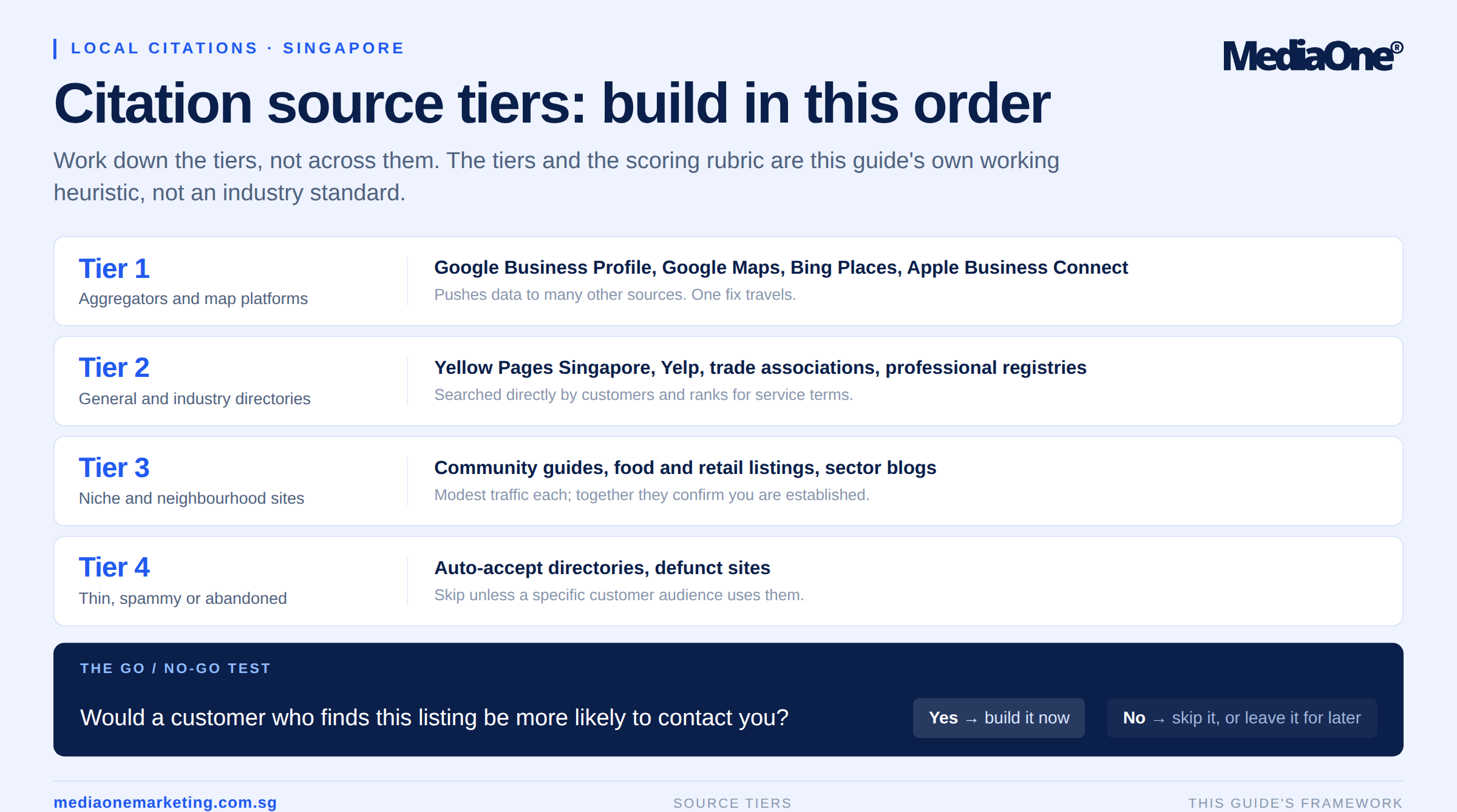
Figure 2: The four citation source tiers, with the go/no-go test applied to each candidate.
Tier 1 to Tier 4
Tier 1 covers major data aggregators and map platforms. These collect business information and pass it on, so one accurate entry can flow into many others. Google Business Profile sits at the centre of most local SEO activity in Singapore; Google Maps, Bing Places and Apple Business Connect sit alongside it. A Singapore café that verifies its Google Business Profile first has its name, address and hours in place before it touches anything else.
Tier 2 covers general national and industry directories that customers search directly, plus trade associations and professional registries that often rank for specific services.

Tier 3 covers niche and neighbourhood sites, such as community guides, food and retail listings, where each brings modest traffic but together they confirm the business is established in its area.
Tier 4 covers thin, spammy, or abandoned directories that accept any submission without verification. Skip those unless a specific customer audience uses them.
A go/no-go test for each source
Ask one question: would a customer who finds this listing be more likely to contact you? If yes, build it. If no, skip it or leave it for later. Then score each shortlisted source from 0 to 2 on three criteria — authority, accuracy and completeness — and rank by total.
|
Criterion |
0 points |
1 point |
2 points |
|
Authority |
Thin or unknown site |
Moderate traffic |
Established, high-traffic site |
|
Accuracy |
Cannot edit details |
Partial editing |
Full control of NAP |
|
Completeness |
Name and phone only |
Adds address and hours |
Full profile with photos |
Directories scoring 5 or 6 belong on your first build list; those below 3 can usually wait. A worked example: a Singapore clinic checks a niche healthcare directory with moderate traffic (1), partial editing but no control over address format (1), and a full profile with photos (2). It totals 4, so it goes on the second-round list, not the first.
Run the rubric across your shortlisted Singapore sources and tally how many scored 5 or 6, 3 or 4, and below 3. Note which high scorers already carry your competitors’ listings — those are usually the strongest first targets.
The Singapore shortlist
- Google Business Profile. Used by customers searching Maps and Search. Claim it first.
- Bing Places. Feeds Microsoft search and maps. Submit the same master NAP.
- Apple Business Connect. Used on Apple Maps. Claim it to keep map listings consistent.
- Yellow Pages Singapore. A long-running general directory searched by category. Check that your category and address format are correct.
- Yelp. Used by diners and service seekers who read reviews. Claim the profile to respond.
- Industry association or trade registry. Membership often earns a listing that search engines can verify independently.
Claiming and verifying
For Google Business Profile, sign in with the owner account, search for the business and choose to claim it. Google decides which verification methods you are offered, and the options depend on business type, public information, region and hours. Expect video verification where eligible, a live video call within business hours, phone or SMS, email, or, in some cases, a postcard. Reviews take up to five business days, and a profile can be verified instantly if the website is already verified in Search Console.
For a Singapore directory, search for the listing, select the claim option and confirm identity by whichever method is offered, usually email or phone. Confirm the listing shows your master NAP before moving on.
Competitor citation research
Search for two or three rivals in your category and note every directory where their listing appears. Compare that list against your own presence: sources that appear for several competitors but not for you are the highest-value opportunities. Typing your industry plus location into search — “plumber Singapore” — also shows which directories and map platforms surface on page one. Local business associations and trade bodies publish member directories, and many of those listings are free to claim.
Manual Citation Building, Step by Step
Work through these six steps in order. Auditing comes before building, because fixing an existing listing usually delivers more value than creating a new one. Each listing should match your master record, so customers find the same details wherever they search.
- Master version of the business name, address and phone number: registered name, full address with unit number, six-digit postal code and one phone format. Confirm the legal name against your ACRA registration and store it in one shared document.
- Search for the business on each source, record what it says, and mark every mismatch against the master record. Check each source’s reviews section too — outdated business information often shows up there first.
- Claim existing profiles first. Create new ones only on sources that score 5 or 6 on the rubric above.
- Fill in opening hours, categories, a description, website and photos. Completeness is one of the three scoring criteria for a reason.
- Log the source, submission date, login used, status and any verification code. This is what prevents duplicate accounts.
- Search from a private browser window and confirm the details display correctly. If a listing will not update, contact the directory’s help centre.
Manual work or automation?
Manual submission gives full control and lets you correct errors the same day; the weakness is time, because a business with dozens of sources can spend a long time on submissions and re-checks. Automation saves time but can push a slightly different NAP to a source you never checked, and subscription fees add up.

Use automation when you already have a clean master NAP, a short list of verified sources and enough volume to justify the cost. Stay manual while your details are still changing. For most Singapore small businesses, clean up before expanding: a handful of accurate listings serves a local business better than dozens of conflicting ones.
Why NAP Consistency Matters
NAP stands for name, address and phone number. Search engines compare these fields across sources to decide whether a business is real and where it sits. A mismatch — “ABC Plumbing Pte Ltd” against “ABC Plumbing” — makes that match less certain, and can split one business into two entities in a search engine’s index.
Inconsistency rarely sinks a business on its own, because citations are one signal among many. But it erodes the verification layer that everything else rests on, and it is the one part of local SEO entirely within your control.
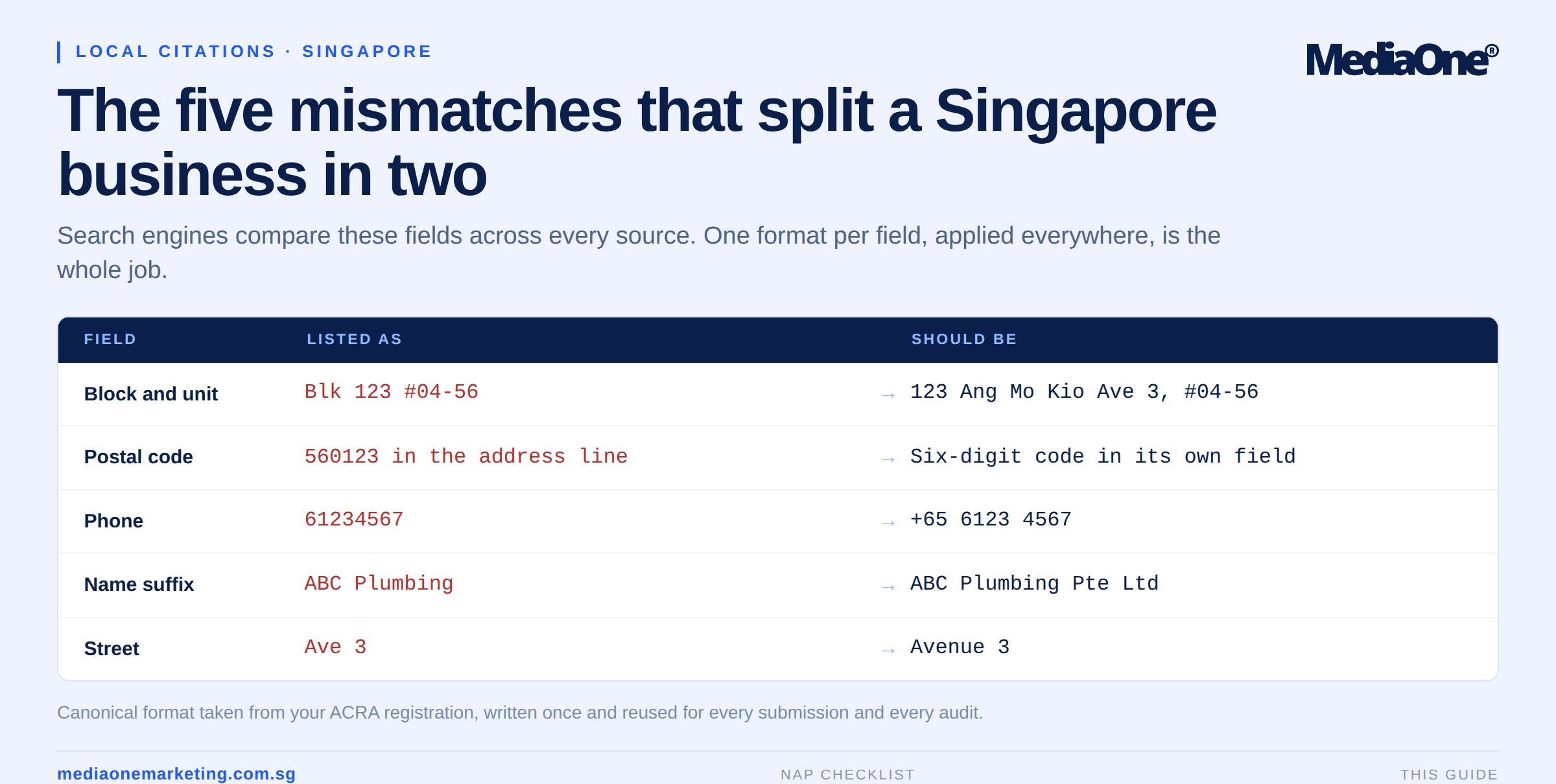
Figure 3: The five mismatches that split a Singapore business in two, with the canonical format for each.

Common Singapore mismatches, in the order they cause trouble: block and unit numbers (“Blk 123 #04-56” against “123A”), street names (“Ave” against “Avenue”), postal codes missing or sitting in the wrong field, phone formats (“+65 6123 4567” against “61234567”) and name suffixes added to some listings only. Pick one format per field and apply it everywhere, starting with the directories your customers use.
Citation Audit Process and Management
Run the audit before building anything new. Score each directory on three questions: is it an aggregator that feeds other directories, do your target customers search there, and can your existing NAP be made to match exactly? Work through the highest scores first and stop once your top sources are consistent.
Aggregators distribute data by copying listings to other sources, so one aggregator error repeats across the web. A Tier 1 aggregator that is searched by your customers and still shows an old phone number scores high on all three questions — fix that one first. A niche Tier 3 directory your customers rarely use scores low on audience fit; leave it until the top sources are consistent.
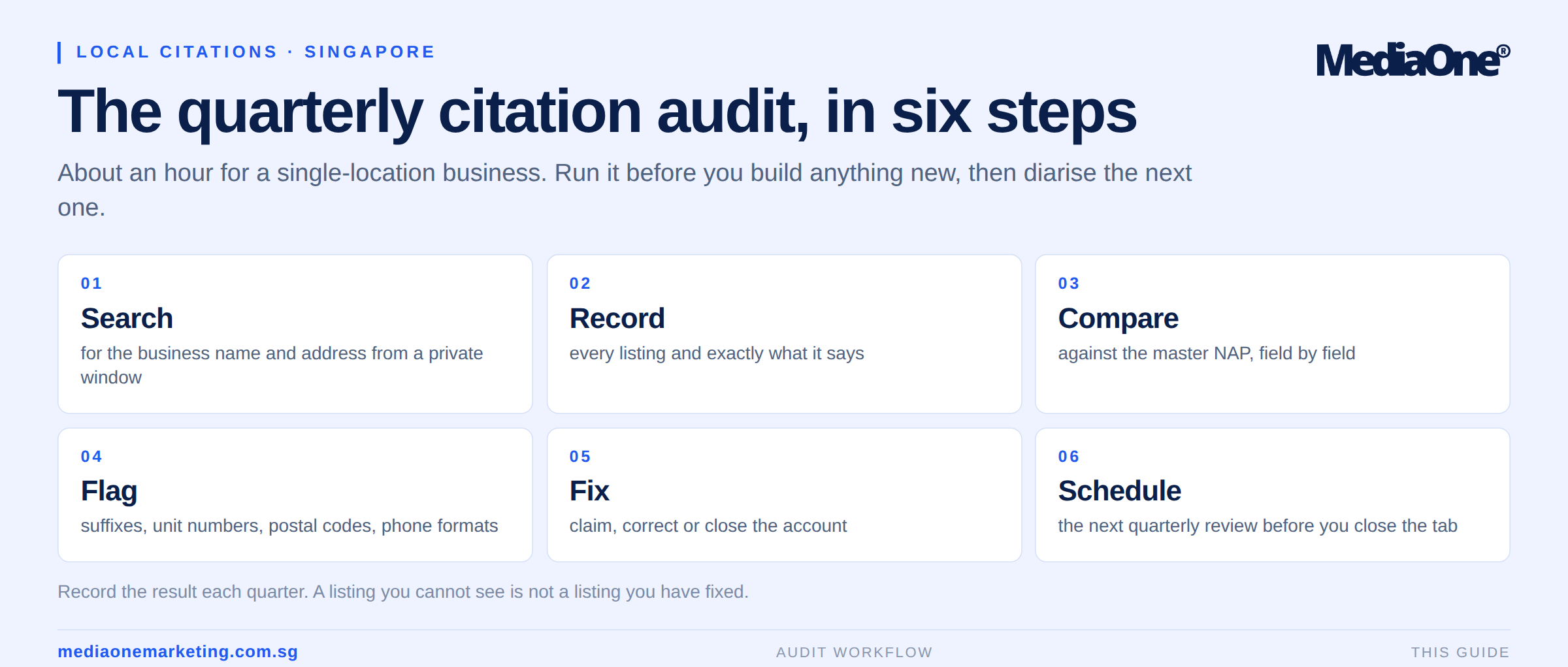
Figure 4: The quarterly citation audit in six steps, from searching to scheduling the next review.
The mismatch checklist
Compare each listing’s name, address and phone number against the master record. Flag differences in suffixes, abbreviations, unit numbers and phone formats. Correct or claim the listing, then log the change. Also confirm whether the business is marked open or closed, and whether its reviews and local service details are accurate.
The quarterly workflow
Each quarter, search for the business online, record each top listing’s NAP, correct mismatches, remove duplicates and close outdated accounts. Then schedule the next review before you close the tab. Listings change without notice, so check your main profiles monthly between audits.
Tooling

A spreadsheet is enough for most small businesses. Dedicated platforms track listings, flag mismatches and alert you to changes, which helps businesses with many locations. Choose a tool only after your master NAP is clean, because a tool will faithfully repeat whatever data it is given. Whichever you use, make sure it shows the source of each listing so you can fix errors at the root rather than patching the display.
Citations and AI search visibility
This is where the case for citations has strengthened, not weakened. Whitespark’s 2026 survey puts citation signals at 13% of AI search visibility — third of eight groups, ahead of link signals and Google Business Profile — and three of the top five AI visibility factors are citation factors. AI tools draw on the same web of business data, so identical NAP details help them attribute your business correctly and give them nothing to reconcile.
Three clean-up actions do most of the work: identify duplicate listings for the same business, correct outdated details such as a previous phone number or a moved office, and close legacy accounts that no longer represent the business. Record each finding with the directory, aggregator status, audience fit, NAP status and the action taken.
Citation Management Best Practices
Keep one source-of-truth document with the canonical name, address, and phone number, with the postal code, unit format, and phone format written out exactly. Update it first whenever the business changes, then check every listing against it.
Schedule a local SEO audit every quarter. A non-specialist can run it in about an hour: search the business name, check the top directories against the document, log mismatches and fix them.
Free tools handle much of the checking — this round-up of SEO tools for beginners covers the ones worth starting with.
Local Citation Building: Putting the Framework Into Action
Local citation building follows a cycle: audit existing listings, fix or build the most important ones, then maintain them. Skipping the audit adds duplicates. Check listings against your source-of-truth document, then rank directories by aggregator status, audience fit and NAP status. Consistency matters more than volume across major platforms, and most are free to list on.
For a Singapore business, that usually means a short, boring, high-value list: Google Business Profile, Bing Places, Apple Business Connect, one or two general directories, and whatever your trade body publishes. If you want the whole layer handled alongside the website and the on-page work, a digital marketing agency in Singapore can run it as part of a wider local SEO programme — the comparison of SEO agencies in Singapore and the questions to ask before signing, covered in how to choose an SEO agency, are the practical next step.
Frequently Asked Questions
What is the difference between a structured and an unstructured citation?
A structured citation is a listing in defined fields — a business directory with your name, address and phone number entered separately. An unstructured citation is a mention in running text, such as a news story or a review. Structured citations are easier to audit; unstructured mentions often carry more weight with readers and search engines because nobody bought them.
How many citations does a local business need?
There is no fixed number. What matters is that your core listings are complete and match your canonical NAP exactly. Start with the sources your customers actually search, then add sources your competitors hold but you do not.
Are local citations still important for Google rankings?
Yes, but as a supporting signal. Whitespark’s 2026 survey rates citation signals at 6% of Local Pack ranking and 7% of local organic — well below Google Business Profile, review and on-page signals. They matter far more for AI search visibility, at 13%.
Should I build citations manually or use a tool?
For most small Singapore businesses, start manually and audit existing listings first. A tool suits many locations or large submission volumes, but check its output, because automated services can push inconsistent data to sources you never reviewed.
How often should I audit my local citations?
Run a full audit at least once a quarter and check your main profiles monthly for duplicates, outdated details and changes to your address, phone number or opening hours.
What is the difference between a local citation and a backlink?
A local citation records your business details — usually name, address and phone number — with or without a link. A backlink is a hyperlink from another website to yours. Citations help search engines verify your business; backlinks pass authority.