| AI Summary
International ecommerce SEO helps online stores reach shoppers in different countries and languages through organic search. The work combines market research, suitable page addresses, local content and technical checks. Singapore merchants also need prices, delivery information and checkout options that serve overseas buyers. A focused market launch makes these tasks easier to manage and measure before expansion. |
A Singapore store can ship overseas and still leave overseas shoppers struggling to buy. A Malaysian visitor might find a backpack through Google, then discover an unexplained dollar price, Singapore-only delivery details and an address form that rejects their postcode.

That experience wastes the opportunity created by the search result. International ecommerce SEO connects search visibility with pages that shoppers can understand and orders the business can fulfil.

This guide explains how Singapore merchants can choose markets, organise country pages, connect language versions and improve product information. The aim is to build a store that works in each selected market without creating more pages than the team can maintain.
Key Takeaways
- A market checklist identifies missing work, but a score cannot prove that expansion will be profitable.
- Separate page addresses help teams manage country and language versions consistently.
- Hreflang connects regional alternatives; canonical tags identify preferred versions of duplicate pages.
- Market-level reporting should connect search visits with purchases, refunds and delivery costs.
What International Ecommerce SEO Means
International ecommerce SEO is the practice of helping an online store appear in relevant searches across countries or languages. It includes the pages shoppers find, the language those pages use and the signals connecting related market versions.
The work builds on ecommerce SEO, which covers product pages, category pages and store structure. International expansion adds decisions about audiences, regional offers and ongoing maintenance.
Country targeting and language targeting answer different questions. A Singapore store serving Malaysia and Australia operates across countries even if both versions use English. A store serving Singapore in English and Chinese operates across languages within one country.
| Approach | Main audience | Typical store example |
| Local SEO | Shoppers near a physical location | A shop attracting nearby collection customers |
| National SEO | Shoppers across one country | A retailer delivering throughout Singapore |
| International ecommerce SEO | Shoppers across countries or language groups | A Singapore retailer with Malaysian and Australian market pages |
The distinction helps prevent unnecessary translation. An Australian English page may need different delivery terms and currency, while an Indonesian page may also need a different language.
Search rankings and sales remain separate outcomes. Currency display can help shoppers understand an offer, but it does not guarantee a ranking improvement. A successful programme measures both discovery and buying behaviour.
Which Overseas Markets Should Your Store Prioritise?
Market selection should combine evidence of demand with the ability to deliver orders at an acceptable cost. Existing overseas enquiries and purchases provide starting evidence, although a handful of orders cannot establish the size of a market.
The initial review can compare three areas:
- Demand: Existing search visits, customer enquiries, relevant search terms and purchases.
- Delivery: Shipping coverage, realistic delivery times, returns and customer support.
- Economics: Product margins, payment charges, delivery subsidies and the cost of maintaining market pages.
For example, a lightweight accessory may be easier to sell overseas than a bulky item with the same selling price. The shipping difference changes how much the business can spend attracting each customer.
A market readiness checklist
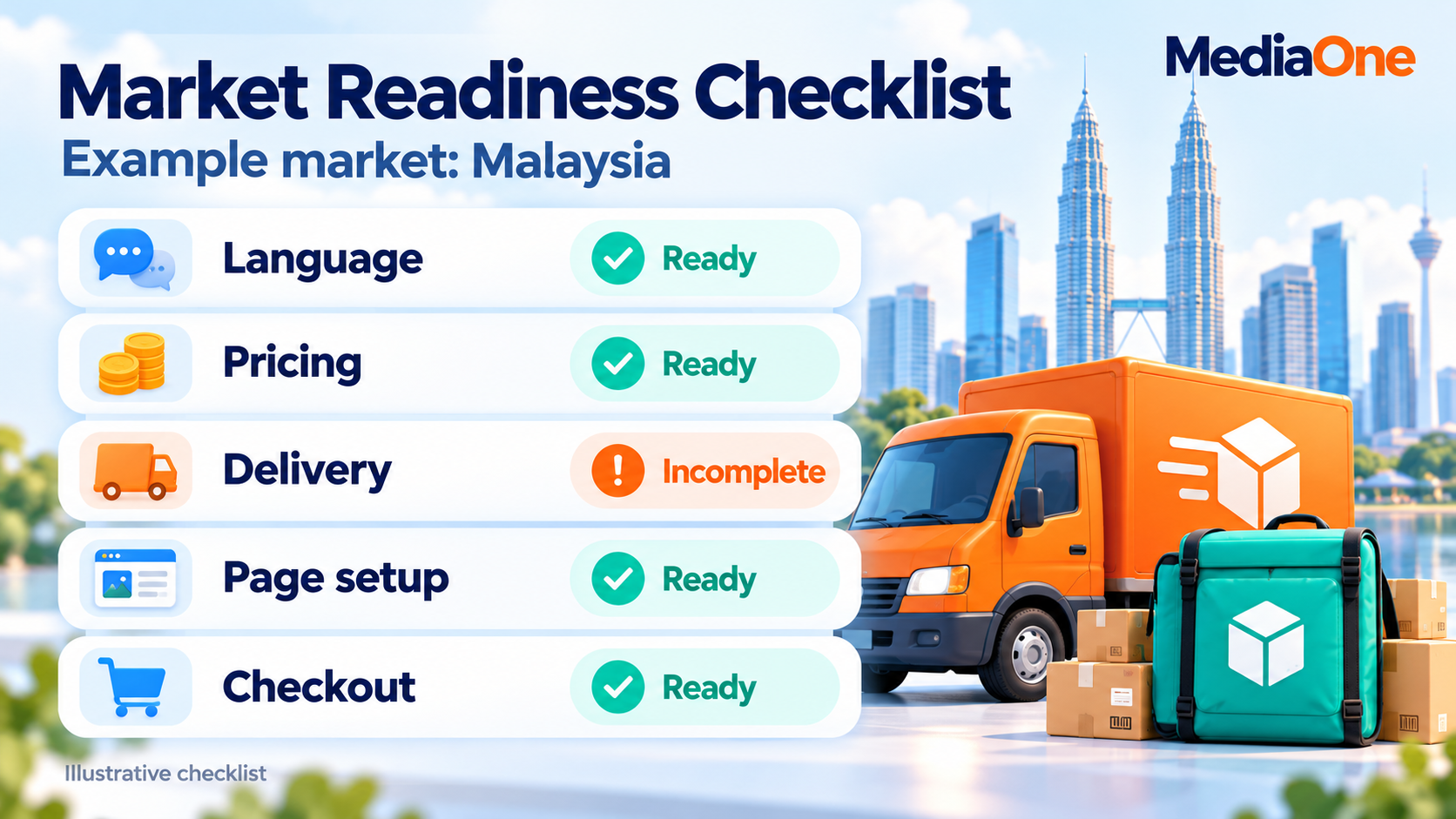
A market readiness checklist records the work each country needs and the person responsible. A numerical pass mark could hide a serious problem, such as accepting orders from an unsupported delivery area.
| Area | Evidence to check | Example work owner |
| Language | Product details and support information match the intended audience | Content team |
| Pricing | Currency labels and checkout charges agree | Ecommerce manager |
| Delivery | Supported addresses, costs and delivery estimates are accurate | Operations team |
| Page setup | Country pages, links and language annotations work | Developer |
| Checkout | A test customer can complete an order for that market | Ecommerce manager |
Each item can carry a status of complete, incomplete or blocked. The person responsible should record the issue and the evidence needed to close it. A market with unresolved payment or delivery failures needs those failures corrected before promotion expands.
The checklist supports planning; it is not an industry standard or a prediction of returns.
A small launch with a defined product range
A pilot can cover one country and a manageable group of products. The team can then compare the work completed with customer behaviour and operating costs.
A hypothetical backpack retailer might begin with products that already attract Malaysian enquiries. Each selected item needs an available colour, accurate stock information and delivery support. Extra categories can wait until the first group works reliably.
The pilot also exposes maintenance costs. A store that struggles to update twenty overseas product pages should resolve that workload before publishing two hundred more.
The launch brief should define what the team needs to learn. One store may need evidence that customers accept its delivery charge. Another may need to test whether its available sizes attract orders. Those questions lead to different product selections and reporting needs.
Customer enquiries can reveal gaps that traffic reports miss. Repeated questions about returns, sizing or delivery areas suggest information the page should explain. The team can record these questions during the pilot and update the relevant pages before adding more products. Each revision should address an observed problem and have an owner who checks the result.
Domain and URL Structure for International Stores
A domain is the store’s web address. A URL identifies an individual page. International stores need a consistent way to distinguish market versions at both levels.
Google’s guidance for regional and multilingual sites describes country domains, subdomains and subfolders. The choice depends on the store’s platform, existing website and operating needs.
| Structure | Example | Practical consideration |
| Country domain | example.my | Provides a country association and needs separate domain management |
| Subdomain | my.example.com | Allows a separate site setup under the main domain |
| Subfolder | example.com/en-my/ | Keeps market pages within one website structure |
Subfolders often suit a store with one catalogue and a small team. Separate country domains may suit businesses with distinct regional operations. Neither structure guarantees stronger rankings, and separate hosting is not automatically required for every country domain.
The decision should also account for stock systems, language tools, redirects and reporting. A cheaper structure can become expensive if staff must manually repair links after every catalogue update.
Country and language addresses
The following example separates English and Malay content for Malaysia while keeping Australian English and Indonesian content identifiable:
| Audience | Example page address | Hreflang value |
| English readers in Singapore | example.com/en-sg/backpack/ | en-SG |
| English readers in Malaysia | example.com/en-my/backpack/ | en-MY |
| Malay readers in Malaysia | example.com/ms-my/backpack/ | ms-MY |
| Indonesian readers in Indonesia | example.com/id-id/ransel/ | id-ID |
| English readers in Australia | example.com/en-au/backpack/ | en-AU |
These addresses illustrate one naming system. The folder name alone does not establish Google’s targeting, and a store does not need every version shown here.
The working plan should identify which products belong in each market, which languages the business supports and who updates them. A single product record linked to its published versions can make missing pages easier to spot.
A consistent structure across the store
Country menus, product links and campaign destinations should use the same market addresses. A Malaysian category page should normally lead to products available to Malaysian customers.
Google’s ecommerce URL guidance explains why stable addresses help crawlers distinguish pages. A store should avoid creating multiple addresses for the same market content through unnecessary parameters or session details.
Any platform changes need review before launch. Technical SEO for ecommerce connects these URL decisions with indexing, product variants and catalogue maintenance.
Hreflang and Canonical Tags Explained
Hreflang and canonical tags solve different problems. Hreflang identifies language or regional alternatives. A canonical tag signals the preferred URL when pages contain duplicate or very similar content.
Neither tag repairs a badly translated page or an unavailable delivery service. Their role is to describe page relationships to search engines.
Hreflang for equivalent market pages
Google’s hreflang documentation supports annotations in page code, HTTP headers or sitemaps. A sitemap lists page addresses; HTTP headers carry information sent with a page. The platform determines which method is easiest to maintain.
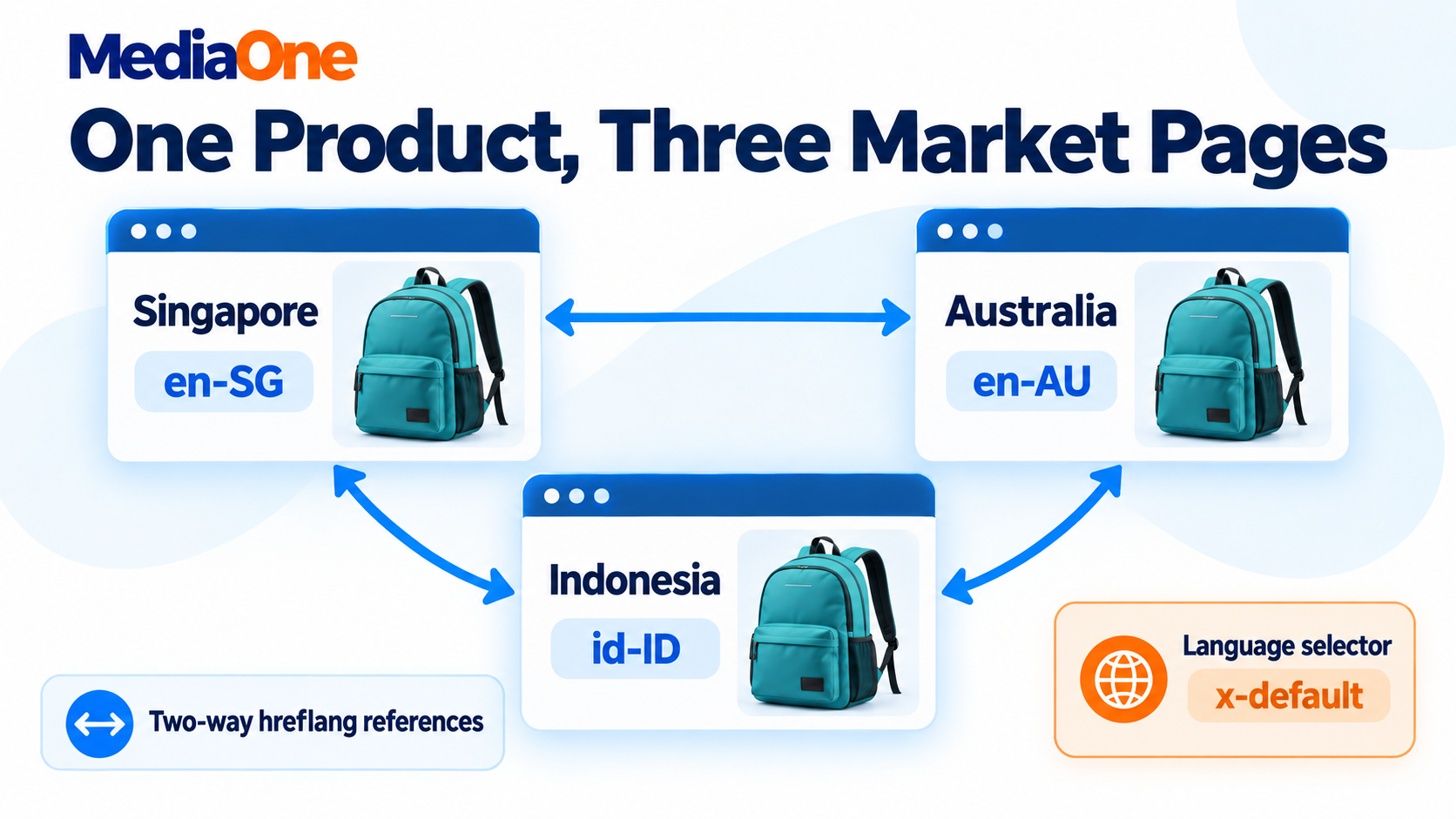
The main requirements include valid language codes, full page addresses, self-references and return references between alternatives. A country code alone is insufficient. English for Australia uses en-AU; Indonesian for Indonesia uses id-ID.
Equivalent pages belong together. The Singapore backpack page should reference the corresponding overseas backpack pages. A missing Indonesian product should not be replaced in that group by the Indonesian homepage.
The optional x-default value identifies a fallback for unmatched language settings, often a language selector. It does not replace the annotations for supported versions.
Canonicals for duplicate content
A self-referencing canonical points to the page’s own address. It can suit a distinct market page intended for indexing, but it is not a universal rule for every international URL.
Google’s canonicalisation guidance explains that canonical annotations are signals. Google can select a different preferred URL. Its guidance also calls for a canonical in the same language when hreflang is involved.
Translated main content differs from an untranslated duplicate. Closely similar English market pages need a considered decision about consolidation and regional annotations. A blanket instruction to canonicalise every overseas page to Singapore could undermine pages the business wants indexed.
The review should compare declared canonicals, internal links, sitemap entries and Google’s selected canonical in URL Inspection. Conflicting signals need correction before the team assumes hreflang is working as intended.
For example, an Australian product page may advertise AUD prices while its canonical points elsewhere. The developer should investigate whether that relationship is intentional and whether Google indexes the desired version.
Localisation, Translation and Product Page Content
Translation changes words between languages. Localisation adapts the information and buying experience to the intended market. The work can include measurements, product names, currency, delivery terms and support details.
A translated product description cannot compensate for missing information about where an item ships. The content review should follow the questions a buyer needs answered before ordering.
Keyword research for each market
Market-specific keyword research should examine how people describe the product and what they expect to find. A translated keyword list can provide ideas, but local search results help test those ideas.
A backpack retailer could investigate terms connected with work, school or travel. The same item may serve each purpose, yet the search results may favour different product features and page types.
The team should compare representative results in the intended country and language. Product pages, category listings and buying guides answer different needs. A broad collection query belongs with a relevant collection; a model-specific query may belong with one product.
Each page needs a defined topic and a reason to exist. One page can cover several closely related search phrases without producing a separate thin page for every wording variation.
Product titles and descriptions
Product copy should explain what the item is, who it serves and what the customer receives. Details such as dimensions, capacity, materials and care instructions help buyers assess an unfamiliar brand.
Google’s page-title guidance recommends descriptive titles and matching the title’s language to the main content. Repeating country names throughout a title adds little when the page already identifies its audience.
A hypothetical backpack description could develop as follows:
| Generic information | More complete market page information |
| Everyday backpack | A product title describing the intended use and model |
| Spacious interior | Capacity, dimensions and compartment details |
| International shipping available | Supported destination and delivery estimate |
| Contact us for details | Published care, return and support information |
The improved version answers buying questions without inventing performance claims. A laptop compartment should list verified dimensions before claiming compatibility with particular devices.
Category pages and supporting answers
Well-organised ecommerce category pages help shoppers compare products available in their market. Category text can explain differences in size, use or materials without repeating every product description.
Short answers to genuine buying questions can also support search and AI-generated answers. A capacity guide or comparison table should help the shopper make a decision. No format guarantees that an answer engine will cite the page.
Translation quality and updates
Machine translation can create a first draft, but published product information needs review by someone proficient in the language. Safety statements, warranties and technical specifications need particular care because a small wording error can change the meaning.
The review process should cover menus, filters, checkout messages and support pages as well as descriptions. A translated catalogue with English-only error messages leaves the experience unfinished.
An update log can identify which market versions need revision after a product changes. Product specifications should come from an agreed source, so different language pages do not gradually describe different items.
Currency, Delivery and Checkout for Overseas Buyers
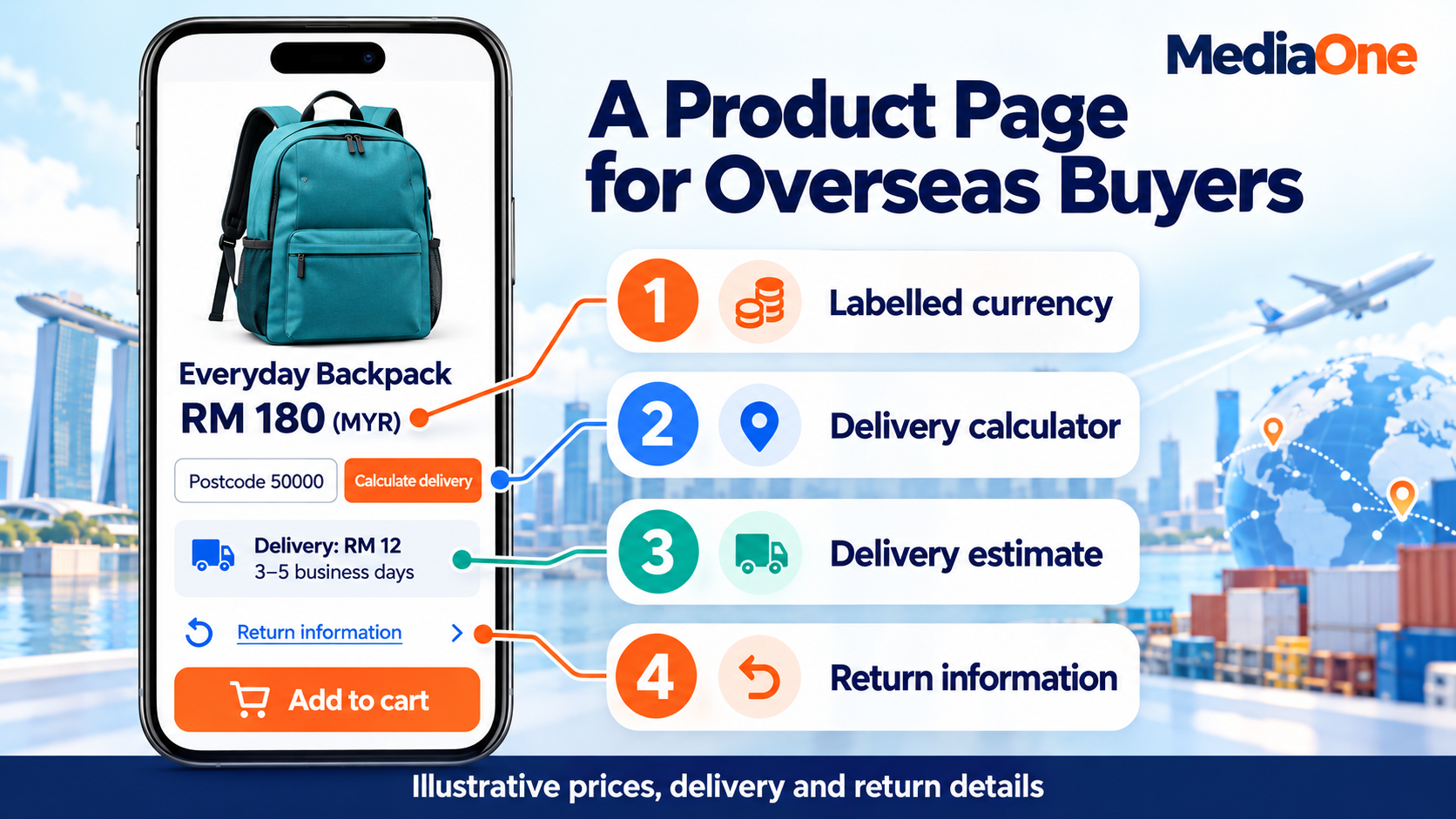
Overseas shoppers need to understand the payable amount and the delivery arrangement. The page should identify the displayed currency, explain additional costs and show supported destinations before the order reaches its final stage.

An estimated local-currency display may differ from the currency actually charged. That distinction needs an explanation wherever it affects the buyer. A dollar symbol alone can leave Singapore, Australian and US customers reading different meanings into the same price.
Delivery charges sometimes depend on postcode, basket weight or order value. A postcode calculator or a stated charging method can explain the cost when a fixed product-page figure is impossible.
A checkout review should test:
- Address fields for the destination country.
- Available payment methods and failed-payment messages.
- Delivery options and estimated times.
- Discount, tax and shipping calculations.
- Confirmation messages and customer support details.
A short checkout is helpful only if customers can complete the required information. A one-page design is not automatically better than several well-organised steps.
Store teams should include a completed test order and a refund check in their launch work. Ecommerce web development should connect the storefront with stock, payment and fulfilment systems, so the purchase works beyond the final button.
Technical Checks Before Publishing Market Pages
Technical checks establish whether search engines can reach important pages and whether customers can use them. A translated page hidden behind an internal search form may receive little attention from either group.
Google’s ecommerce site-structure guidance explains the role of links between categories and products. Important market pages need discoverable links within the store.
The launch review should check page responses, indexing instructions, mobile layouts and links between equivalent versions. A visible country and language selector lets shoppers choose the version they need.
Access checks should reflect the published store. A staging password left in place can prevent access, while a forgotten noindex instruction tells search engines to exclude a page. The team should inspect representative live URLs after release, including pages created by translation tools. A successful preview inside the store’s administration area does not establish that customers or crawlers can reach the published version. An empty translated template also needs attention before it becomes a search destination.
Google’s Core Web Vitals measure loading, responsiveness and visual stability. Performance reviews should include overseas mobile conditions, particularly product images, market selectors and payment tools. Testing only from an office connection in Singapore can miss customer problems.

Product information also needs consistency behind the page. Google’s merchant listing structured data supports details such as price, availability and shipping information. The markup must accurately represent the offer shown to shoppers; adding it does not guarantee an enhanced search appearance.
A repeatable test sample should include a category, a product, a product variant and checkout. The team can reuse that sample after changes to templates, translation tools or pricing systems.
Links and Trust in Each Market
Local recognition can help an overseas brand become more familiar. Relevant retailers, industry organisations and publications may introduce the store to people already interested in its products.
A backpack brand could contribute verified product information to a retailer’s buying guide or publish original comparison data. A link should serve the publisher’s readers and lead to a page appropriate for that audience.
An approach to earning backlinks should assess relevance and editorial purpose. A long list of unrelated country directories gives the team little evidence of customer value.
Google’s link spam policies cover paid links that manipulate rankings. Advertising and sponsorship links need appropriate qualification. Genuine customer reviews, accessible support information and accurate business details can help shoppers evaluate the store alongside any external coverage.
Measuring International Ecommerce SEO Results
International ecommerce SEO reporting should separate where a visitor comes from, which market pages they use and where the order will ship. These details can differ. A person browsing from Singapore may buy a gift for delivery in Malaysia.
Google Analytics supports ecommerce events for actions including product views, cart additions, checkout and purchases. Currency information needs correct implementation when revenue values are recorded.
| Measurement | What the team learns |
| Organic visits to market pages | Whether those pages attract search traffic |
| Product views and cart additions | Whether visitors consider the offer |
| Checkout starts and purchases | Where buying activity stops |
| Refunds and delivery costs | Whether orders support the commercial goal |
Monthly reporting can compare the same page group before and after changes. Promotions, stock shortages and seasonal demand should appear beside the figures, because each can affect the result.
The team should also check tracking before interpreting a decline. Missing purchase events can make a functioning market look unsuccessful. More traffic without more orders calls for investigation of the searches, products and buying experience involved.
For example, increased visits to an Australian size guide may show demand for information without producing immediate sales. Visits to an Australian product page followed by repeated payment failures suggest a different problem. The first finding could justify improving connections between the guide and relevant products. The second calls for checkout repairs. A report that combines every visit into one total would make those decisions harder. Page purpose and customer actions give the figures context.

A First 90 Days Plan for One Market
The first 90 days can organise implementation and early learning. The schedule is a planning example, with timing dependent on the store’s workload and technical needs.
| Period | Priority | Expected output |
| Days 1 to 15 | Demand, delivery and margin review | One target market and a defined product range |
| Days 16 to 30 | Page addresses and responsibilities | Agreed structure, owners and update process |
| Days 31 to 60 | Content, pricing and delivery information | Reviewed market pages and tested offers |
| Days 61 to 75 | Technical and checkout testing | Corrected issues and working measurement |
| Days 76 to 90 | Performance review | A recorded decision about further work |
The review should distinguish completed tasks from business outcomes. A translated catalogue is a deliverable; a profitable overseas order is an outcome. Expansion becomes easier to assess when both appear in the same report.
Preparing Your Store for Overseas Search and Sales
International ecommerce SEO works best when market research, content and store operations support the same customer. The next investment should address the largest verified obstacle in the selected market, whether that involves page discovery, product information or completing a purchase.
MediaOne’s international SEO services can support businesses assessing overseas search opportunities. For retailers, the discussion should include target countries, priority products, platform limitations and measurement. An agreed scope gives the team a practical basis for reviewing the work and deciding when another market deserves investment.
Frequently Asked Questions
How do marketplace listings differ from SEO for an online store?
Marketplace listings can attract buyers within that platform, but they do not give the business the same control over its own website. A retailer can use both channels, with separate reporting for marketplace sales and purchases through its store.
A temporarily unavailable product can retain its page with accurate stock information and relevant alternatives. A restock notification option can help interested shoppers if the business can maintain it. A page should never accept an order that the store cannot fulfil.
How should overseas stores translate customer reviews?
Translated reviews can help readers understand feedback in another language. The store should identify translations and preserve the original meaning. A review must not imply a customer used a regional delivery service or product version they never experienced.
What does changing an international URL structure involve?
A store can change its structure, but the work needs planning. Google’s site-migration guidance covers mapping old addresses to appropriate new ones, redirects and monitoring. Ranking changes can occur while Google processes the move, so repeated structural changes can create avoidable work.