Running a business in Singapore is expensive. Between manpower, rental, inventory, software subscriptions and day-to-day operating costs, there is often very little room left for marketing.
Yet marketing is precisely what many SMEs need to grow.
You might have an excellent product, a capable team and an established customer base, but still struggle to attract new customers consistently. Your competitors appear above you on Google, their advertisements seem to follow potential customers everywhere, and increasingly, AI search platforms are recommending their brands.
The instinctive solution is to spend more on marketing. The problem is deciding where that money should go, especially when results aren’t guaranteed.
This is where the EDGE Grant can make a difference.
Introduced on 30 September 2026, Enterprise Singapore’s EDGE Grant brings together support previously available through the Productivity Solutions Grant (PSG), Enterprise Development Grant (EDG) and Market Readiness Assistance (MRA) schemes.
For eligible businesses, it offers an opportunity to reduce the cost of certain digital marketing investments, improve digital capabilities, and explore overseas markets.
However, there is an important distinction business owners should understand from the outset.
Receiving a grant does not automatically make a marketing campaign a good investment.
At MediaOne, we believe the starting point should always be the business outcome. Are you trying to generate more qualified enquiries, increase sales, establish your brand in a new market or become more visible on search engines and AI platforms?
Once you have answered that question, you can select an appropriate strategy and determine whether EDGE support is available for the work.
This guide walks you through both decisions.
1. What Is the EDGE Grant, and How Does It Help Singapore SMEs?
The EDGE Grant is a government funding programme administered by Enterprise Singapore. It supports eligible companies undertaking activities intended to strengthen their business capabilities, improve productivity, adopt digital solutions and expand internationally.
According to the official EDGE Grant overview, the programme covers more than 150 activities across eight business areas.
For an SME interested in marketing, three activities are especially worth understanding.
| EDGE activity | What it can help with | Maximum support |
|---|---|---|
| Digital Marketing | Pre-approved digital marketing solutions, including SEO, SEM and social media marketing | SMEs: 50%, capped at S$5,000; non-SMEs: 30%, capped at S$3,000 |
| Overseas Marketing & Public Relations | Eligible professional services for marketing and publicity targeted at overseas markets | SMEs: up to 70%; non-SMEs: up to 50% |
| International Branding | Eligible overseas-focused brand research, positioning, strategy and identity development | SMEs: up to 70%; non-SMEs: up to 50% |
The support percentages are maximum rates, not guaranteed reimbursement amounts. The approved project scope, eligible expenses and remaining grant balance determine the actual funding.
What happened to PSG, EDG and MRA?
The previous PSG, EDG and MRA schemes closed to new applications on 29 September 2026. EDGE became the replacement framework for new applications from 30 September 2026.
Projects submitted before the transition continue to be processed under their original schemes.
If you previously received a PSG grant for a marketing solution, you can still investigate EDGE support for a genuinely new, eligible project. However, you cannot assume the same project or solution can receive another subsidy.
Is EDGE a grant specifically for advertising?
No. EDGE is a broader enterprise support programme, and digital marketing is only one of its activities.
This matters because the grant does not automatically pay for every marketing-related expense.
An SEO campaign, a software subscription, a Google Ads management package and an overseas public relations initiative may fall under different cost categories or activity requirements.
The right approach is to identify the activity first, review its supported costs, and then build your marketing proposal around a genuine business objective.
2. Understanding the Two Main Ways to Obtain EDGE Support for Marketing
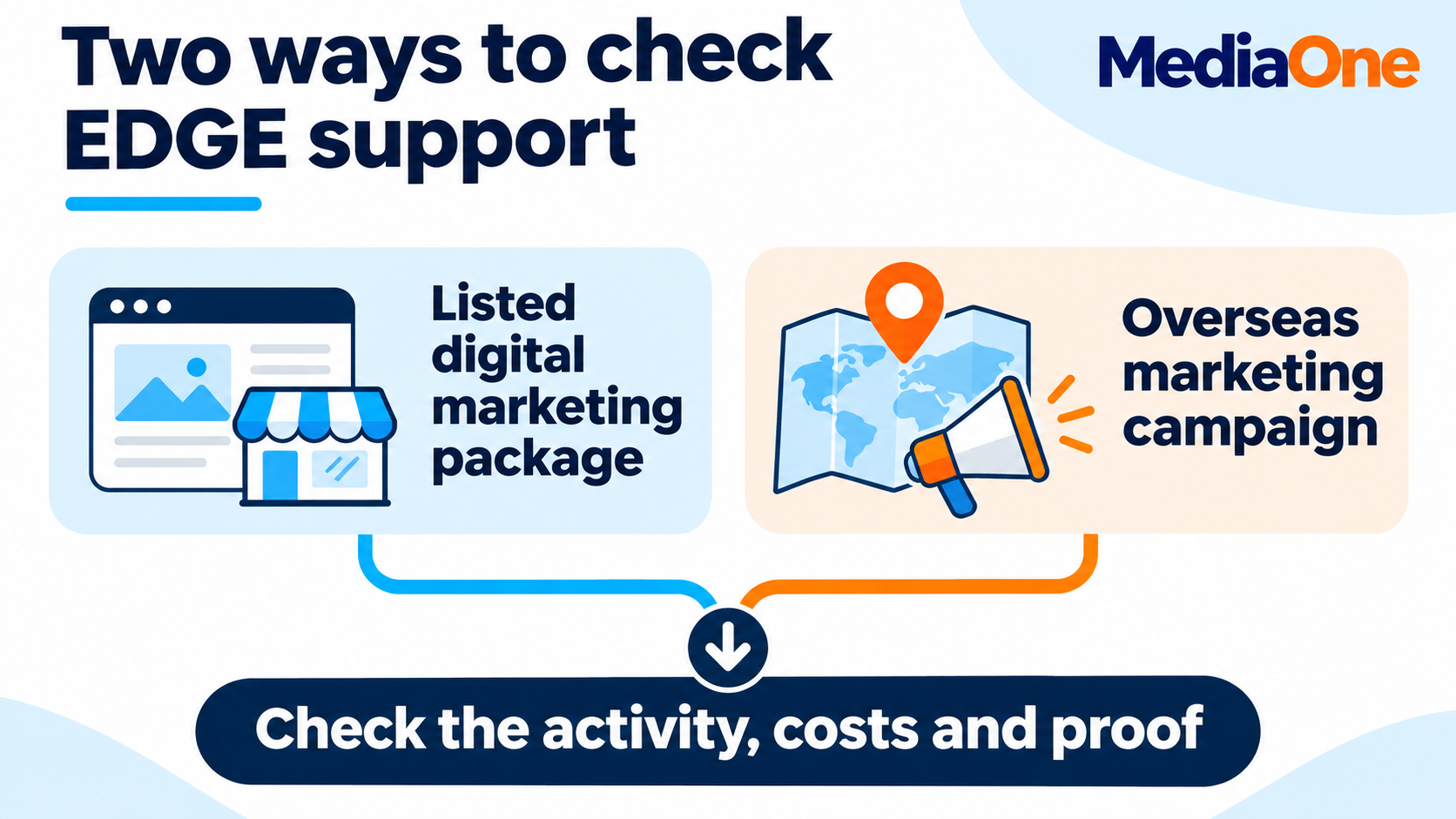
Option A: EDGE Digital Marketing for Businesses Targeting Singapore Customers
If your immediate goal is to attract more customers within Singapore, the standard digital marketing activity is a logical place to start.
Enterprise Singapore describes this activity as covering digital marketing solutions involving SEO, SEM and social media marketing.
The official terms specify:
- Up to 50% support for eligible SMEs, capped at S$5,000.
- Up to 30% support for eligible non-SMEs, capped at S$3,000.
- A maximum supportable activity cost of S$10,000.
- Supported software costs capped at 12 months.
- A project completion period of up to 18 months from approval.
The activity has its own exclusions and requirements, so the amount paid to your marketing agency is not necessarily the amount on which your grant will be calculated.
The SMEs Go Digital programme helps businesses identify pre-approved digital solutions and vendors.
You can also examine MediaOne’s EDGE digital marketing packages to understand how search and social marketing solutions can be structured.
An important budgeting point: If a vendor quotes you S$18,000 for a year of marketing, you should not assume the government will reimburse S$9,000. The standard digital marketing activity has an S$10,000 cost ceiling and a maximum grant of S$5,000 for SMEs. Any additional expenses must be considered separately.
You must also verify that the quoted solution, vendor and components match the approved listing.
Option B: Overseas Marketing & Public Relations for International Expansion
Suppose you operate a successful business in Singapore and want to enter Malaysia, Indonesia, Thailand or another market.
Your challenge is no longer simply finding more customers in Singapore. You need to introduce your products or services to people who may have different buying behaviours, languages, competitors and expectations.
The EDGE Overseas Marketing & Public Relations activity supports eligible professional services intended to increase brand visibility and product awareness in overseas markets.
Examples of potential campaign activities include market-specific social media publicity, digital and traditional media outreach, promotional campaigns and other activities that demonstrate genuine engagement with the target overseas market.
Eligible SMEs may receive up to 70% support, while eligible non-SMEs may receive up to 50%.
The project must be completed within 12 months from approval, and support counts towards the company’s overall annual EDGE grant cap.
Crucially, this overseas activity does not support campaigns aimed at generating domestic business opportunities.
You cannot simply describe a Singapore lead generation campaign as an international project to qualify for higher funding.
Your proposed activities must genuinely address an overseas market, with evidence of appropriate localisation and engagement.
What About International Branding?
Sometimes a business is not ready to advertise overseas because it has not established how its brand should be positioned.
A skincare business entering Indonesia, for example, may need to understand the local competitive landscape, identify its target consumers and adapt its brand positioning before running advertisements.
EDGE’s International Branding activity can support qualifying professional services covering brand research, brand strategy and brand identity development for overseas expansion.
However, operating expenses such as website development, social media management and campaign implementation fall outside this particular activity’s scope.
The distinction is straightforward: developing an international brand strategy and paying someone to execute your monthly advertising campaigns are not necessarily the same grant-supported activity.
3. Which Digital Marketing Services Should Your SME Invest In?
This is arguably the most important question in the entire process.
There is little value in obtaining a subsidy for an unsuitable marketing service.
A restaurant, a B2B engineering company, an e-commerce retailer and a private education provider will have different sales cycles, customer expectations and marketing opportunities.
We generally advise SMEs to consider marketing as a connected system rather than a collection of unrelated services.
| Marketing service | Main business purpose | What you should measure |
|---|---|---|
| SEO | Attract customers searching on Google and other search engines | Qualified organic traffic, enquiries and sales |
| GEO / AI Search Optimisation | Improve visibility in AI-generated answers and recommendations | Relevant AI mentions, citations and referral traffic |
| SEM / Google Ads | Generate demand from people actively searching for products or services | Cost per qualified lead, sale and return on advertising spend |
| Social Media Marketing | Build awareness, trust and relationships with customers | Relevant engagement, website visits and enquiries |
| Paid Social Advertising | Reach and convert selected audiences | Customer acquisition cost, lead quality and revenue |
| Content Marketing | Educate prospective customers and establish expertise | Content-assisted conversions, organic traffic and leads |
| Video Marketing | Demonstrate products, build trust and reach visual audiences | Video engagement and attributable conversions |
| Email and CRM Marketing | Convert existing leads and encourage repeat purchases | Repeat sales, customer retention and revenue per campaign |
| Website and Conversion Optimisation | Increase the percentage of visitors who become customers | Conversion rate and cost per acquisition |
| Influencer Marketing / Digital PR | Build awareness and credibility through third parties | Qualified reach, referral traffic and attributable sales |
These are marketing options, not a declaration that every listed service is EDGE-fundable. Funding eligibility depends on the selected activity and the approved package or project scope.
3.1 Search Engine Optimisation (SEO): Reach Customers Already Looking for You
SEO helps your website become more discoverable when potential customers search for the products and services you offer.
Consider a Singapore SME that provides commercial air-conditioning maintenance.
Its prospective customers might search for “commercial aircon servicing Singapore”, “office aircon maintenance contractor” or “VRV system repair”.
Those are valuable searches because the people making them may already have an identifiable business need.
A well-managed SEO programme can include technical website improvements, keyword research, content development, internal linking, website architecture, local SEO, and improvements to key service pages.
For a local business, your Google Business Profile, location information and customer reviews can also influence how customers discover and evaluate you.
SEO is particularly suitable for businesses with a consistent market for their services that want to build an ongoing source of organic enquiries.
It is not, however, an instant lead generation solution.
Meaningful improvements can take months, and competitive industries may require substantial ongoing work.
When comparing SEO packages by deliverable, focus on what the agency will actually improve rather than how many keywords it promises to target.
3.2 Generative Engine Optimisation (GEO): Getting Your Business Discovered Through AI Search
Search behaviour is changing.
Customers are no longer confined to typing short queries into a traditional search engine. Some now ask AI-powered tools for detailed recommendations, comparisons and explanations.
A business owner might ask ChatGPT which accounting software suits a small consultancy. A facilities manager might use an AI search engine to compare commercial maintenance providers. A consumer might ask for a shortlist of reputable renovation companies.
Generative Engine Optimisation, or GEO, focuses on improving the information and digital presence that AI-powered search and answer systems may use when responding to such questions.
At MediaOne, we regard GEO as an extension of sound search visibility and digital authority, not as a substitute for SEO.
A useful GEO programme can include:
- Creating authoritative, clearly structured content that answers genuine customer questions.
- Strengthening consistent information about your business, products, services and expertise.
- Improving supporting evidence, relevant third-party mentions and citations.
- Using appropriate structured data to help machines interpret website content.
- Measuring AI visibility across a defined set of commercially relevant questions.
For an SME expanding internationally, GEO can also be approached market by market, because the questions, competing brands and available information differ.
One important caveat: AI platforms make their own decisions about which information to cite or recommend. No agency can legitimately guarantee that a brand will be recommended for every target prompt.
Is GEO covered by EDGE?
GEO is not expressly named as a standalone service in Enterprise Singapore’s published Digital Marketing activity. If a vendor proposes GEO-related work, request written clarification of whether the specific components fall within the selected approved solution or another eligible activity.
Do not assume an agency’s reference to “AI marketing” makes the service grant-eligible.
3.3 Search Engine Marketing (SEM): Use Paid Search to Generate Enquiries
SEO builds organic visibility. SEM, commonly used to describe paid search advertising, allows your business to pay for placement in relevant search results.
Google Ads is one of the most familiar examples.
For a business selling commercial equipment, paid search can help reach prospective buyers searching for a particular model, application or supplier.
For a service business, it can help generate calls, form submissions and appointment bookings.
A good SEM programme includes more than selecting keywords and launching advertisements.
It should also address search intent, negative keywords, landing page quality, conversion tracking, bidding strategy and the quality of enquiries received.
Imagine two agencies each reporting 100 leads.
One agency generated 100 cheap enquiries, but only five were genuine prospects. The other generated 50 enquiries, of which 25 were qualified.
The second campaign may be considerably more valuable even if its cost per lead appears higher.
That is why MediaOne focuses on commercial outcomes rather than celebrating clicks in isolation.
For EDGE purposes, keep advertising platform expenditure, software or approved solution components, and agency service fees clearly separated. Do not assume your Google Ads media budget itself is subsidised.
3.4 Social Media Marketing: Build Trust Before the Customer Is Ready to Buy
Not every customer is actively searching for your business.
Some may have a need but haven’t decided whether to purchase yet.
This is where social media becomes useful.
Platforms such as Facebook, Instagram, LinkedIn, and TikTok can help businesses build familiarity, demonstrate expertise, introduce products, and maintain relationships with prospective customers.
For a professional services company, LinkedIn could be useful for demonstrating industry knowledge.
For a home improvement business, before-and-after videos may help customers evaluate workmanship.
For a consumer brand, Instagram and TikTok may provide opportunities to demonstrate products and build recognition.
The challenge is that posting content and achieving business growth are not necessarily the same thing.
Before paying an agency for social media management, ask how the content programme contributes to your commercial objectives.
Does it build credibility? Does it help prospective customers understand your offering? Does it encourage enquiries or support repeat sales?
The answers should influence the content strategy.
3.5 Paid Social Advertising: Reach Customers Who Are Not Searching Yet
Social media advertising differs from organic social media management.
Instead of relying primarily on followers and organic distribution, you pay platforms such as Meta, LinkedIn or TikTok to display advertisements to selected audiences.
This can be effective when customers need to discover a product or when visual storytelling is an important part of the sales process.
For example, a furniture retailer may benefit from product demonstration videos. A B2B technology provider may use LinkedIn campaigns to reach people working in relevant industries or roles.
A successful paid social programme requires suitable creative assets, audience segmentation, tracking and continued testing.
If an advertisement generates enquiries but customers do not purchase, the issue may be the offer, the follow-up process or the landing page rather than the advertising itself.
Good marketing management looks at the entire customer journey.
3.6 Content, Video, Email and Conversion Optimisation
Several other services deserve consideration, particularly if your business already receives traffic but struggles to convert it into revenue.
Content marketing can help customers understand complicated products, compare alternatives and make more confident buying decisions.
Video marketing is especially useful when demonstrations, explanations and product experiences communicate more effectively than written copy.
Email and CRM marketing can help businesses follow up on enquiries, nurture prospects and encourage existing customers to make repeat purchases.
Conversion rate optimisation (CRO) focuses on improving the proportion of visitors who become enquiries or customers. Sometimes improving a poorly performing landing page delivers better results than spending more money to attract visitors to it.
These services may complement an approved marketing package, but they should be separately assessed against EDGE’s supported costs. Some may need to be funded entirely by the business.
4. Digital Marketing for Singapore Versus Overseas: Why Your Strategy Must Change
Expanding overseas is not simply a matter of using the same advertising campaign and selecting another country in Google Ads.
Different markets have different competitors, languages, cultural expectations, payment preferences, distribution channels and purchasing behaviours.
A digital campaign that works in Singapore may underperform badly in Indonesia or Vietnam if it is copied without adaptation.
Consider a hypothetical Singapore skincare business entering Malaysia.
A sensible market-specific plan would start by identifying the target customer, local competitors and how Malaysian consumers research and purchase skincare products.
From there, the business can develop an appropriate message, select suitable marketing channels and establish a way to track enquiries or sales originating from Malaysia.
An overseas digital marketing programme might explore international SEO, local-language content, market-specific social media campaigns, digital publicity, partnerships and appropriate paid advertising.
But the precise activities submitted for EDGE support must match the eligible professional services under the selected overseas activity.
Localisation is more than translation
Enterprise Singapore’s Overseas Marketing & Public Relations activity specifically requires evidence of content adapted to local market preferences, cultural considerations and business practices. Merely translating or replicating existing content is not sufficient.
In practical terms, meaningful localisation could involve:
- Studying local search behaviour rather than translating Singapore keywords word for word.
- Adapting advertisements and content to local customer concerns.
- Using appropriate local language and imagery.
- Understanding market-specific competitors and buying considerations.
- Preparing campaign assets that are relevant to the chosen overseas audience.
If you intend to target multiple countries, establish a clear plan and budget for each market. Do not assume one approval automatically covers every country.
How should you measure international marketing success?
Begin with indicators that are relevant to your business model.
A B2B exporter may need to measure enquiries from distributors and potential commercial partners. An e-commerce brand may focus on orders, acquisition costs and contribution margin. A service provider may measure consultation requests from the target country.
At MediaOne, we believe international campaign reporting should distinguish overseas enquiries from Singapore enquiries. Otherwise, an increase in overall website traffic can create the appearance of international progress without proving that the new market is producing business opportunities.
5. Who Is Eligible for the EDGE Grant?
Before spending time preparing a proposal, check your company’s eligibility.
The exact requirements differ by activity, but common qualifying conditions include Singapore registration and operations, for-profit business status, and at least 30% direct or indirect ownership by Singapore citizens or Singapore permanent residents.
What counts as an SME?
For EDGE purposes, an SME generally refers to a company with a group annual sales turnover of no more than S$100 million or a group employment size of no more than 200 employees.
The assessment considers the relevant group rather than simply the headcount of your individual business.
Non-SMEs may still qualify for certain EDGE activities, although support rates can differ.
You can use the BizSG grant recommender to identify appropriate activities and check their requirements.
Additional restrictions you should know
For the standard Digital Marketing solution, Enterprise Singapore specifies that the applicant must not be a home-based business, must not previously have applied for support for that solution, and must implement or use the digital solution in Singapore for at least one month.
The overseas activities have their own eligibility and project conditions.
Businesses should also be careful when using related-party suppliers. Enterprise Singapore has rules concerning relationships between grant applicants and their vendors.
A pre-approved vendor listing is not a substitute for checking your company’s eligibility.
6. How Much Can You Actually Save With EDGE?
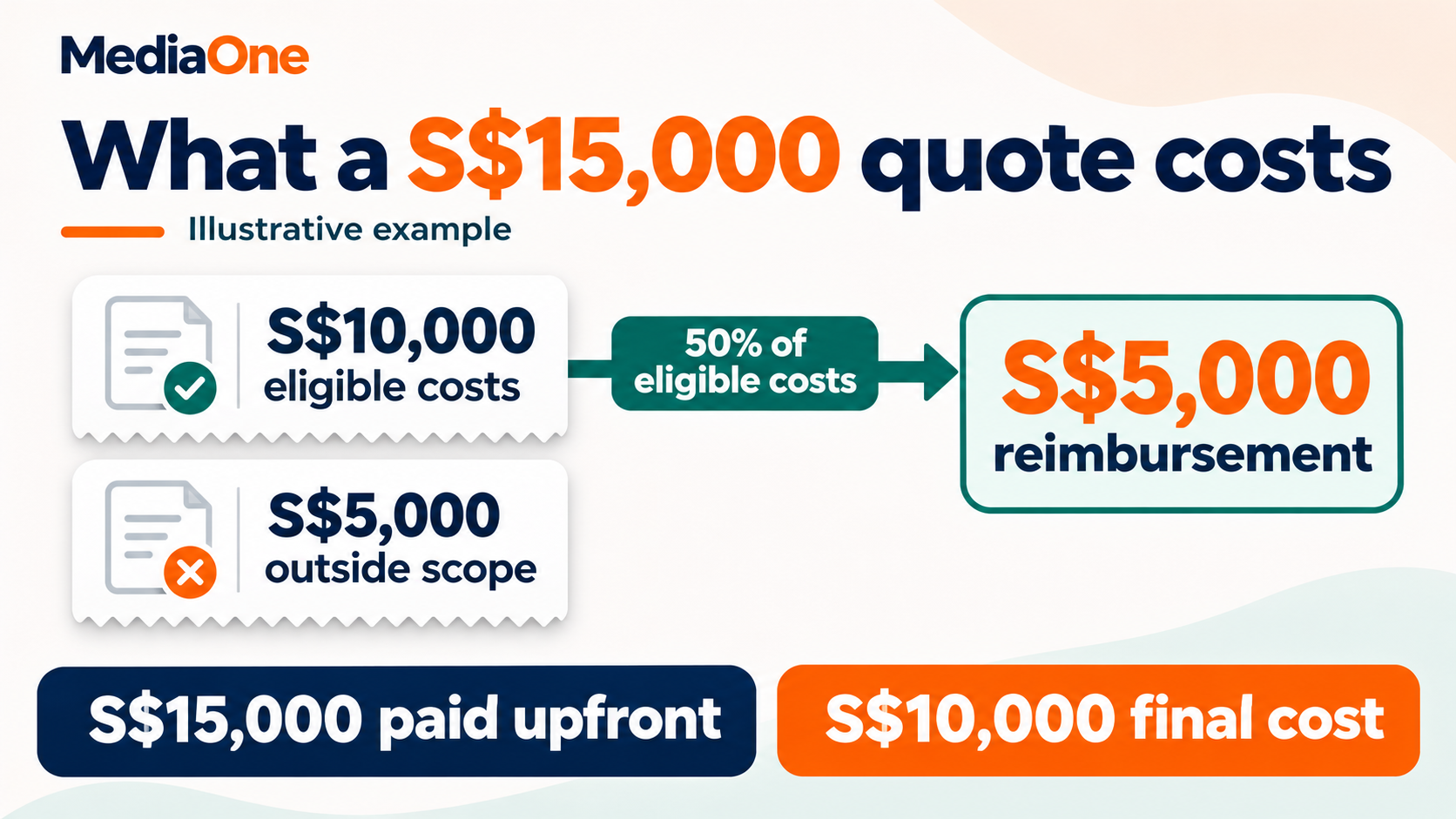
One of the most common misunderstandings about government grants concerns the funding percentage.
A statement such as “up to 50% support” does not mean half of every invoice will be reimbursed.
There are three figures you need to understand: the total cost of the project, the amount of that cost approved for funding, and the applicable grant rate and cap.
Example 1: A Singapore SME Spending S$15,000 on Marketing
Assume your business receives a S$15,000 quotation for a digital marketing project.
Of this amount, S$10,000 is approved as eligible expenditure under the standard digital marketing activity, while another S$5,000 relates to additional work outside the approved scope.
Assuming your SME receives the maximum applicable 50% support and the claim is approved in full:
| Description | Amount |
|---|---|
| Total marketing project cost | S$15,000 |
| Approved eligible expenditure | S$10,000 |
| Expenditure outside the approved scope | S$5,000 |
| EDGE reimbursement at 50% | S$5,000 |
| Final business cost after reimbursement | S$10,000 |
Illustrative figures exclude GST and assume the eligible expenditure and funding level have been approved.
Your business still needs to pay the relevant invoices in full before claiming reimbursement.
The real financial benefit is a reduction of S$5,000 in the eventual cost, not an immediate S$5,000 cash discount from the agency.
MediaOne’s EDGE package pricing breakdown provides more context on comparing marketing packages and out-of-pocket costs.
Example 2: An SME Investing in Overseas Marketing
Suppose a Singapore business plans an overseas promotional campaign involving S$20,000 of qualifying professional service costs.
If all S$20,000 is approved and the business receives 70% funding, the calculation would be:
| Description | Amount |
|---|---|
| Approved overseas marketing costs | S$20,000 |
| Illustrative reimbursement at 70% | S$14,000 |
| Business share after reimbursement | S$6,000 |
This is a simplified illustration, not a promised grant award. The activity’s conditions, exclusions, available grant balance and Letter of Offer determine the actual amount.
Advertising platform charges, GST, audit fees and other additional expenses must be evaluated separately.
Understanding the S$100,000 Annual EDGE Grant Cap
EDGE provides a company-wide annual grant cap of S$100,000 across eligible activities.
This limit resets each year on 1 April, for the grant period ending 31 March.
Within that overall amount, there is a shared S$30,000 limit for certain digital solutions and equipment.
The S$100,000 cap is not a S$100,000 digital marketing grant. Individual activities can have much smaller support limits, including the S$5,000 maximum for an eligible SME’s standard digital marketing solution.
The official EDGE FAQs explain how the grant limits, multiple applications and previous grant utilisation work.
7. Is a Subsidised Marketing Campaign Worth the Money?
This is the question we encourage business owners to consider before approving an agency proposal.
The grant reduces your costs, but the remaining amount is still your money.
Imagine you ultimately spend S$10,000 on a marketing project after receiving the applicable reimbursement.
If every additional customer generates S$500 in contribution profit after direct costs, you need 20 genuinely incremental customers to recover that S$10,000.
That is a much more useful discussion than whether a campaign can generate 10,000 impressions or rank for 30 keywords.
A simple calculation is:
Break-even additional customers = Net marketing investment ÷ Contribution profit per additional customer
The difficulty, of course, is estimating how many additional customers the campaign can produce.
For businesses with longer sales cycles, it may be more practical to measure qualified leads, proposal opportunities, eventual sales and customer lifetime value.
Start with your business economics
Before selecting a service, establish how much a new customer is worth and how much your company can afford to pay to acquire one.
A professional services firm selling annual contracts may justify a much higher customer acquisition cost than a retailer selling low-margin products.
Similarly, a business with strong customer retention may be able to invest more aggressively in acquiring its first transaction.
Marketing performance should therefore be assessed against your economics, not simply the grant amount.
Do not overlook your cash flow
EDGE is a reimbursement-based grant.
Your business must have enough working capital to make the required payments and complete the project before receiving the approved reimbursement.
For some SMEs, this is more important than the headline percentage of support.
A campaign may be financially attractive over 12 months but still place pressure on the company if several large invoices are due at the beginning.
Before proceeding, prepare a payment schedule showing when agency invoices, advertising expenses and other project costs become payable.
8. How to Apply for the EDGE Grant: A Step-by-Step Guide
The application process depends on the selected activity. The following framework will help you prepare properly.
Step 1: Decide What You Want Marketing to Achieve
Do not begin by asking an agency for its cheapest EDGE package.
Begin with your business objective.
You might want to generate more enquiries for a particular service, improve sales from an existing website, increase visibility in search results or develop a market entry campaign for Indonesia.
Write down your target customers, intended market, available budget and what a successful outcome would look like.
This gives your agency a useful brief and helps you determine which EDGE activity is relevant.
Step 2: Identify the Appropriate EDGE Activity
Check whether your objective aligns with the standard Digital Marketing activity, Overseas Marketing & Public Relations, International Branding or another supportable activity.
Read the activity’s supported and non-supported cost sections carefully.
A service may be commercially sensible but fall outside the grant’s eligibility rules.
Step 3: Select a Suitable Vendor
For the standard digital marketing solution, identify an appropriate vendor and pre-approved solution through SMEs Go Digital.
For other activities, vendor requirements may differ. The overseas marketing & public relations activity, for instance, requires relevant vendor credentials and a track record in the target market.
Do not assume all EDGE activities require the same type of pre-approved vendor.
Step 4: Obtain a Detailed Quotation
A useful quotation should identify the services, deliverables, costs, relevant dates and any additional items outside the proposed grant scope.
The package configured through SMEs Go Digital should match your vendor quotation exactly for the pre-approved digital marketing solution.
You will also need the package reference ID generated through the relevant process.
Step 5: Prepare the Required Documentation
For standard digital marketing activities, Enterprise Singapore requires the vendor quotation and a projection of expected cost savings for the year after completion.
Overseas Marketing & Public Relations applications require additional information, including relevant vendor track records, expected overseas sales and prescribed job-creation projections.
International branding has separate documentation requirements, including the applicable consultant certification requirements.
Keep supporting assumptions realistic and defensible. A projection is a planning estimate, not a guarantee of future revenue.
Step 6: Submit Your Application Through the Business Grants Portal
The applicant company submits the application using authorised personnel with appropriate Corppass access.
MediaOne’s Business Grants Portal walkthrough provides additional guidance, while the official Corppass user guides explain access management.
Your agency can help explain the quotation and required project information, but the applicant company’s authorised personnel must submit the grant application and claim.
Enterprise Singapore does not permit third-party vendors to manage these submissions on the company’s behalf.
Step 7: Do Not Start Work or Pay a Deposit Before Submission
This is one of the easiest ways to jeopardise an otherwise eligible application.
EDGE does not support retrospective applications where work has already begun or payment, including a deposit, has been made before the application is submitted.
The official rules permit costs incurred after submission to be considered if the application is subsequently approved.
However, submitting an application does not guarantee approval.
For businesses that cannot comfortably absorb the entire project cost, waiting for the Letter of Offer before committing is generally the more prudent commercial decision.
Step 8: Review and Accept the Letter of Offer
If approved, your company will receive a Letter of Offer specifying the approved support, project qualifying period, deliverables and conditions.
This document is critical.
It determines what was approved and what must be demonstrated when claiming reimbursement.
Your agency quotation does not override the Letter of Offer.
Step 9: Execute the Project and Keep Evidence
Maintain a folder containing the approved proposal, Letter of Offer, invoices, proof of payment and relevant project deliverables.
Evidence requirements vary.
The standard digital marketing activity specifies evidence of software deployment and a unique identifier.
For Overseas Marketing & Public Relations, the requirements include activity documentation and evidence of appropriate market adaptation.
If you are working with an agency, decide early which party will prepare each report or supporting document.
Step 10: Complete the Claim and Receive Reimbursement
Once the project is completed, submit the claim with the required documents before the deadline.
Only expenditure approved in the Letter of Offer can be claimed, and the relevant project expenses must be fully paid.
Some activities, including overseas marketing & public relations, require engagement of an auditor from Enterprise Singapore’s panel as part of the claim process.
Approved payments can be disbursed via PayNow Corporate or GIRO. Enterprise Singapore lists disbursement timelines of 14 working days after claim approval for PayNow Corporate and up to eight weeks for GIRO.
These are post-approval disbursement periods, not guarantees of how quickly the grant application or claim itself will be approved.
9. Common EDGE Grant Mistakes That SMEs Should Avoid
Even a strong marketing proposal can run into problems if the grant application and project execution are poorly planned.
Mistake 1: Assuming every marketing expense qualifies. A proposal might contain SEO work, social media management, advertising spend and website development. The fact that all these activities contribute to marketing does not automatically make every line item eligible.
Mistake 2: Choosing a package simply because it is subsidised. A company that needs leads from Google may derive little commercial benefit from spending most of its budget producing social content that does not reach buyers.
Mistake 3: Paying a deposit too early. Beginning work or paying before submitting the application can make the project retrospective and ineligible.
Mistake 4: Using generic overseas marketing proposals. A copied Singapore campaign with only the country name changed is unlikely to demonstrate the meaningful market adaptation required for overseas promotional activities.
Mistake 5: Confusing approval with payment. Receiving a grant Letter of Offer does not mean the money has been transferred. Reimbursement requires successful project completion, payment and an approved claim.
Mistake 6: Ignoring reporting and documentation. Marketing results alone may not satisfy the grant’s documentary requirements. Campaign evidence, invoices and specific deliverables must be retained.
Mistake 7: Failing to plan what happens after the grant-funded period. A campaign that produces useful leads may need continued funding. A business that has not planned for the next phase could lose momentum.
A good agency should help you understand these practical considerations without making unrealistic promises about grant approval.
10. How to Choose the Right Digital Marketing Agency for Your EDGE Project

A government-approved solution and a commercially effective marketing strategy are not necessarily the same thing.
When evaluating agencies, consider their experience in your industry, understanding of your customers, ability to execute the proposed work and willingness to be accountable for measurable outcomes.
Our EDGE agency comparison explores how to evaluate different proposals.
Questions You Should Ask Before Signing
What exactly are we buying?
An agency should explain what it will deliver, over what period, and which elements belong to the grant-supported package.
How will this produce a business result?
The agency should be able to explain the intended customer journey, the demand it expects to capture or create, and how it will measure success.
What will we still need to pay for?
Clarify platform advertising expenditure, additional design work, website changes, software subscriptions, GST and other possible expenses.
Who owns our marketing assets and accounts?
Your company should understand ownership and access arrangements for Google Ads, Meta Business Manager, Google Analytics, Search Console, website content and other digital assets.
What happens if performance is disappointing?
A credible agency should have an optimisation and reporting process. It should not rely exclusively on promises made at the beginning of the contract.
Can the programme continue after the grant?
You should know the ongoing monthly cost, what support ends with the funded package, and whether your business can afford the next phase.
Our SEO budget breakdown also explains how different levels of marketing investment affect the scope and intensity of SEO work.
11. How MediaOne Approaches Digital Marketing for SMEs
MediaOne works across search engine optimisation, paid media, social media marketing, content strategy, analytics and newer areas of search visibility, including GEO.
Our approach begins with understanding where a business needs to grow.
For a local service provider, this might mean increasing visibility for high-intent search queries and improving the conversion rate of its service pages.
For a B2B company, the challenge might be attracting decision-makers rather than generating a large volume of low-quality enquiries.
For a business expanding overseas, the priority could be understanding market-specific demand, localising marketing messages and building credibility with a new audience.
We do not believe SMEs should pursue every marketing channel simultaneously simply because the services are available.
Sometimes SEO is the sensible starting point. Sometimes paid search is better suited to immediate lead generation. Sometimes the website itself needs improvement before additional advertising makes economic sense.
And as AI-powered discovery becomes more important, businesses should also consider how their brand and expertise are represented across traditional and generative search platforms.
The EDGE Grant can make selected investments more affordable.
But the quality of the strategy, execution, and measurement ultimately determines whether the spending creates business value.
12. What Should Your SME Do Before Applying?
If you are considering EDGE support for marketing, the most useful preparation is to conduct a simple assessment of your current position.
Start by reviewing your website, your existing marketing channels and how customers currently find you.
Identify the products or services where additional demand would make the greatest commercial difference.
Next, establish whether your immediate objective is domestic customer acquisition or overseas expansion.
Then obtain an itemised proposal that separates potentially eligible expenses from other investments.
Finally, assess the projected business value, expected cash requirements and what the marketing programme will cost beyond the funded period.
This approach helps you make an informed decision even before you know the precise grant amount.
Conclusion: Use the EDGE Grant to Build a Stronger Business, Not Just a Cheaper Campaign
Government grants can create valuable opportunities for Singapore SMEs, particularly when marketing investment would otherwise be difficult to justify.
EDGE may help reduce the financial burden of adopting an approved digital marketing solution or undertaking an eligible internationalisation project.
But its greatest practical value lies in allowing businesses to pursue worthwhile improvements with less financial exposure.
The goal should not simply be to obtain the maximum available subsidy.
It should be to build a more discoverable business, develop stronger customer relationships, enter new markets intelligently and establish marketing capabilities that can continue creating value after the funded project ends.
If you are evaluating SEO, GEO, paid search, social media marketing or an overseas expansion campaign, MediaOne can help you determine an appropriate marketing strategy and prepare an itemised proposal for your consideration.
A digital marketing consultation with MediaOne is a practical starting point.
Tell us about your business, your target customers, your existing marketing challenges and where you want to grow. We can help you identify what is worth prioritising and which potential EDGE activity should be checked for eligibility.
The grant can help reduce the cost of getting started. A sound marketing strategy is what makes the investment worthwhile.
Frequently Asked Questions About the EDGE Digital Marketing Grant
1. Can I claim 50% of all my digital marketing expenses?
No. Under the standard digital marketing activity, eligible SMEs can receive up to 50% of approved costs, capped at S$5,000. The supported-cost rules, package terms and Letter of Offer determine what qualifies.
2. Does EDGE cover Google Ads and Facebook advertising?
The digital marketing activity includes solutions involving search engine marketing and social media marketing. However, you must verify whether the particular package components and expenses qualify. Do not assume advertising platform media spend is reimbursable merely because an approved solution includes advertising-related services.
3. Is SEO covered under the EDGE Grant?
SEO is explicitly identified as a service area under Enterprise Singapore’s digital marketing activity. You must still use the applicable approved solution and meet its conditions.
4. Is GEO or AI search optimisation covered by EDGE?
GEO is not explicitly listed as a standalone activity in the published digital marketing scope. Ask the vendor to establish whether any proposed GEO work is included in an approved solution. Do not assume it is automatically eligible.
5. Can I use the grant to market my business overseas?
Yes, eligible companies can consider the Overseas Marketing & Public Relations activity, which supports qualifying professional services aimed at overseas markets. Different funding rates and project conditions apply.
6. Can I apply for EDGE if I have received PSG funding before?
Potentially, yes. Previous PSG, EDG or MRA utilisation does not count towards the new EDGE annual grant cap. However, EDGE support is intended for new projects, not duplicate funding for previously supported work.
7. Can my company submit multiple EDGE applications?
Yes. Enterprise Singapore permits applications for different activities, with one application for each activity, subject to the relevant grant limits and conditions. Some digital solutions restrict the number of applications per UEN.
8. Do I need three agency quotations?
Not necessarily. Documentary requirements differ by activity. Enterprise Singapore advises applicants to conduct due diligence when selecting vendors. Check the relevant activity page rather than assuming three quotations are mandatory.
9. Can my marketing agency apply on my behalf?
No. Grant applications and claims must be submitted by authorised personnel of the applicant company. Your vendor can provide quotations and project information, but cannot manage the submission on your behalf.
10. Can I pay my agency before receiving grant approval?
You must not start work or make payments before submitting the application. Payments made after submission may be considered if the application is approved, but approval is not guaranteed. If cash flow is a concern, waiting for the Letter of Offer is generally safer.
11. How long does an EDGE application take?
Enterprise Singapore currently indicates an application outcome of approximately one week for the standard Digital Marketing activity, six weeks for Overseas Marketing & Public Relations, and ten weeks for International Branding. These are published indicative periods, not guaranteed deadlines.
12. Does my business receive the grant money before paying the agency?
No. EDGE operates on a reimbursement basis. Your business pays the approved project expenses and submits a claim after meeting the completion and documentation requirements.
13. Can I claim GST under EDGE?
GST is listed as a non-supported cost for the Digital Marketing and Overseas Marketing & Public Relations activities discussed here. Budget for GST separately where applicable.
14. Can an e-commerce business apply for EDGE?
Potentially, yes. Eligibility depends on the applicant company and the specific activity. The marketing objective, proposed solution, vendor and supported costs must all be assessed.
15. What if my EDGE application is rejected?
Review the reason for rejection before deciding on the next step. You may need to reconsider the project scope, activity selection or whether the work has already commenced. You should not assume that resubmission will result in approval.
16. Can I use two government grants for the same campaign?
You cannot obtain overlapping government support for the same approved eligible expenses. If different parts of a wider project are being considered under different programmes, identify and separate those costs clearly.
17. Can I change my campaign or project dates after approval?
Changes are subject to the selected activity’s rules and Enterprise Singapore’s approval. Certain activities allow requests to change the project end date or claim due date during the qualifying period.
18. Does my business have to use a Singapore marketing agency for an overseas EDGE project?
Not necessarily. Vendor requirements vary by activity. The Overseas Marketing & Public Relations activity requires evidence of relevant vendor credentials in the target market. Check the activity-specific criteria before choosing a provider.
19. Can the same overseas marketing strategy be used across several countries?
You may use common strategic foundations, but each market should be assessed for local customer behaviour, language, competitors, channels and commercial objectives. The eligibility and scope of each proposed overseas activity must be confirmed separately.
20. What is the most important thing to know before applying?
Decide what commercial result you want, identify the correct EDGE activity, check the supported costs and obtain a detailed quotation before making any payment or beginning the project.
A grant helps reduce qualifying costs. It does not replace the need for a sound marketing strategy.
Information checked against Enterprise Singapore’s published EDGE framework as at 21 November 2026. Eligibility conditions, funding rates, supportable activities and administrative requirements may change. Refer to the official activity page and your Letter of Offer before committing expenditure.