
Guest posting for SEO still earns links for Singapore businesses, but only quality posts help. Editors dislike promotional copy, and search engines favour original, useful content on each page, so write for the host site, not as an advert.

Short answer: yes, guest posting for SEO still works in Singapore, but only on editorially strong sites whose readers match your customers. Pitch only sites that pass at least three of four checks: topical relevance, editorial standards, audience match and link placement.
Key Takeaways
- Guest posting still builds SEO value in Singapore, but only on editorially strong host sites. Thin or promotional posts add little and risk being discounted.
- Use the Guest Post Fit Score. Rate each host on topical relevance, editorial standards, audience match and link placement. Pitch only sites that pass at least three of four.
- Expect editorial resistance. 79% of editors consider guest content overly promotional, so lead with genuine insight.
- Measure outcomes, not link counts. Track referral visits, brand searches and ranking movement.
- Vary anchor text. Over-optimised anchors look unnatural.
- Check submission guidelines first. Google’s March 2024 core update targets low-quality, unoriginal content.
What Is Guest Posting and Why It Still Matters for SEO?
Guest posting definition and core mechanics
Guest posting means writing an article for another business’s website. The host publishes it under your name and usually links back to your site. The host gains content for its readers. You gain access to its audience and a backlink profile entry that search engines can read as a sign of your expertise, which can help build domain authority over time.
The backlinks only have value inside useful editorial content on a site whose subject matter overlaps with yours. Otherwise, it is simply a paid link with a byline. Google’s own guidance on link spam makes the same point: links should appear because they are useful, not because they were bought.
How guest blogging works, step by step
Each stage builds on the one before it. Choosing the right host decides whether the placement is worth pitching, and a tight pitch decides whether it gets accepted. A backlink earned this way is a trusted referral from a site that already has a reader base, which is why the process is relevant for SEO value, not just for getting published.
- Identify hosts. Shortlist sites whose readers match the people you want to reach, and favour those with strong domain authority in your subject area.
- Check the host. Confirm it shows real bylines, edits its content and accepts outside contributors.
- Pitch a specific idea. Send an editor two or three topics that suit the formats the site already runs well within your industry.
- Draft to the host’s standard. Follow its guidelines and write for its readers, not your sales team.
- Review and track. Once live, measure referral visits, brand searches and any ranking movement.
Most of the effort sits in stages two and three. Editors reject far more pitches than they accept, so a tight, relevant idea does more for your results than a long list of hosts.

Types of guest posting (contributed articles, expert roundups, and sponsored placements)
| Format | What it is | SEO and editorial risk |
|---|---|---|
| Contributed article | An original piece for the host’s readers, published under your byline | Lowest risk when the content is useful, and the link is contextual |
| Expert roundup | Your input is one contribution to a multi-expert piece | Moderate risk; value depends on the host’s editorial control |
| Sponsored placement | Paid content, often labelled as advertising | Highest risk; undisclosed paid links can breach search engine guidelines |
This guide focuses on contributed articles. Paid links should be treated as advertising, not as an SEO asset, and should carry the rel=”sponsored” attribute as set out in Google’s link spam policies.
Guest posting’s SEO value today, after Google’s core updates
Links remain a major ranking input. According to Outreach Labs, 83% of marketers believe links matter for organic search rankings. Guest posting is a common link-building strategy, and Outreach Labs reports that only 16% of link builders use it as their main way to build links.
The quality bar has risen. Google’s Search Central blog announced the March 2024 core update, which folded the helpful content system into the core ranking signals to reduce low-quality, unoriginal content. A guest post written only to carry a link is exactly what that update targets. Posts that still earn value are the ones a reader would find useful even without the link.
The Real Benefits of Guest Posting for SEO
Backlinks from relevant, authoritative sites. The most direct benefit is a link from a site that search engines already trust. Its value depends on fit. A link from a Singapore finance publication to a local accounting firm carries more topical weight than a link from an unrelated lifestyle blog with high domain authority. Guest blogging is only worthwhile when the host audience is aligned with the business and its industry.
- Relevance is the factor most marketers rank highest, with 72% calling it critical to improving SEO.
- Domain Rating, an Ahrefs metric that scores backlink strength from 0 to 100, is useful, but relevance matters more.
Referral traffic and audience reach. A well-placed guest post sends readers who already care about the subject, often more qualified than generic search traffic. Track it by setting the host domain as a referral source, then compare visits against enquiries. A post that brings 50 visitors who become five customers outperforms one that brings 200 visitors and no conversions.
Brand visibility and topical authority. Each accepted post puts your name in front of a new readership and ties your business to a specific topic. Topical authority comes from consistency across several credible hosts, not from one large placement. Every guest article should also point readers back to your website, such as the Media One Marketing homepage.
Why do more than 60% of marketers still say that links matter? Seosherpa reports that 60%+ of marketers say links matter for ranking in organic search. Read this statistic as a reason to be selective, not to publish in volume. Search engines are most likely to discount links from thin or mass-produced posts.

The Challenges, Drawbacks and Risks You Need to Know
Guest posting still earns its place in an SEO plan, but it carries real costs. Singapore businesses most often face three risks, each avoidable if you know what to watch for.
Editorial scepticism. Editors dislike submissions that read as adverts. According to Cleaning Clicks, 79% of editors think guest content is overly promotional. Pitch a topic the host’s readers would search for, and keep the author bio as the only direct promotion, so the piece earns its backlinks rather than reading as a sales page.
Low-quality link farms and the penalty risk. Some offers are really link schemes: mass-produced articles on unrelated topics with exact-match anchor text. Google’s spam policies treat manipulative link schemes as a violation, and such links can be discounted or lead to manual action. Decline any paid placement with no editorial review.
AI-generated submissions and the rising bar. Editors receive far more submissions than they can use, and many look machine-written. Neil Patel’s guide cites BuzzStream data suggesting 43 percent of posts are likely AI-generated. A defensible guest post now needs original data, a named expert perspective or a practical framework.
Finding Blogs and Websites That Accept Guest Posts
Generic lists of niche blogs often go unranked, so this guide applies a scored screening method. Relevance and audience fit matter more than raw authority, since both quality backlinks and real reach depend on the host’s readers.
The Guest Post Fit Score for pitch selection
Score each host on four criteria:
- Topical relevance. Does the site regularly cover your subject?
- Editorial standards. Does it show real bylines, edit content and reject weak submissions?
- Audience match. Do its readers include the customers you want, including those active on social media?
- Link placement. Would a contextual link sit inside useful content?
Pitch only sites that pass at least three of four. A host that scores well is worth a tight, relevant idea.

A high Domain Rating (DR) does not guarantee value if the readership is wrong. Read recent articles and comments before you pitch.
Red flags that a site is not worth pitching
Avoid sites that accept any submission for a fee, publish unrelated topics in volume, or show no named authors. These usually mean the link will be discounted.
Writing Guest Posts That Get Accepted
Write for the host’s readers, not your sales team. Pitch topics from the host’s best-performing formats, add original data or expert input, and link to your strongest work. Answer a real question, or the host will not keep the post.
Anchor Text, Linking Practice and Following Submission Guidelines
Building a natural anchor text strategy
Vary your anchor text and keep it descriptive. Exact-match phrases repeated across many posts look manufactured. A mix of brand names and plain descriptions reads as editorial, especially when the link points to a useful search result or a helpful blog post on your website. Well-earned backlinks tend to use anchors that describe the destination rather than repeat a target keyword.
Keeping your own site’s links contextual and relevant
Link only in sentences that explain the destination. Contextual links generally carry more weight than author bio or footer links, although the weighting is not published.
Reading and following each host’s submission guidelines
Read each host’s guidelines before drafting. Please follow the word counts, image rules, and link limits exactly. A post that ignores them is rejected quickly, no matter how strong the idea.
Where Web 2.0 link building fits (and where it does not)
Web 2.0 properties are free platforms where users create their own posts. Their content is not edited by a host with an audience. Treat them as secondary, never as a substitute for editorial placements.
Finding Blogs and Websites That Accept Guest Posts
Before you pitch a site, decide whether it is worth your time. Generic advice to “find blogs in your niche” often produces long, unranked lists, so this guide applies a Guest Post Fit Score instead. Rate each candidate yes or no against four tests:
- Topical relevance: does the site cover your subject?
- Editorial standards: are posts edited, bylined and sourced?
- Audience match: do its readers include buyers in Singapore or the region?
- Link placement quality: is a contextual body link allowed?
Only sites that pass at least three are worth pitching. Reject any site whose only offer is paid placement with no editorial review.
For a Singapore business, relevance should outrank Domain Rating. In a survey cited by Cleaning Clicks, 72 percent of marketers said relevancy is a critical factor in improving SEO. A finance firm gains more from a regional trade publication its prospects actually read than from a high-authority lifestyle magazine. A relevant blog that reaches the right buyers can do more for your search engine visibility than a generic site with strong numbers, and the backlinks it earns will carry weight with the right audience.
Using Domain Rating as one signal, not the only one
Domain Rating (DR) is a metric from Ahrefs that estimates the strength of a site’s backlink profile on a logarithmic scale from 0 to 100. It makes a useful quick filter, but a high-DR site can have weak editorial control, while a modest-DR niche publication can send qualified visitors for years. Treat DR as a starting point and check the site’s domain authority against what it actually publishes.
Checking whether a site’s audience and topics match your business
Read the last ten articles before you pitch. Check who writes them, whether they cite sources, and whether the readership resembles your market. For Singapore, look for local regulators, companies and pricing. Active sharing on social media suggests a readership that engages with the topic.
Red flags that a site is not worth pitching
Reject a site if any of these apply:
- It has no visible author bylines or author pages.
- Its posts are mass-produced or unedited, with generic openings and no original detail.
- It offers “guaranteed” links for a flat fee with no review of your draft.
- The only place for your link is an author bio or sidebar on an irrelevant topic.
- Its outbound links point to gambling, adult or loan sites.
The third flag matters most. Some editors told Neil Patel they receive 30 to 60 pitches a week and approve only a handful. A site that will publish anything for money signals that its readers are not its priority.
Applying the Guest Post Fit Score to a Singapore host
Consider a hypothetical Singapore HR software company assessing a regional trade publication for payroll content. Give each site one point for each yes. Sites scoring three or four are worth pitching; sites scoring two or fewer are not.
| Criterion | Test | Result |
|---|---|---|
| Topical relevance | Does it cover HR and payroll? | Yes |
| Editorial standards | Are posts edited, bylined and sourced? | Yes |
| Audience match | Do readers include Singapore HR managers? | Yes |
| Link placement quality | Is a contextual body link allowed? | No, bio link only |
The site passes three of four criteria, so it is worth pitching. Ask for a body link tied to a specific payroll point, since a bio-only link is the weakest placement.
Writing for the host’s readers, not your sales team
The fastest way to get a guest post rejected is to write it as a brochure. Editors notice quickly: 79% of them think guest content is overly promotional, according to GetCleaningClicks. Answer a question the host’s readers already have, and mention your company only where it helps that answer.
Count how many sentences begin with “we” or “our”. If they outnumber the sentences that explain something, rewrite. Keep the product name out of the first third of the pitch.
Pitching topics drawn from the host’s best-performing formats
Do not invent a topic from your own keyword list and hope it fits. Check which posts get shared and commented on, and which formats recur, such as comparison guides, checklists or expert interviews. Pitch two or three topics that follow those formats, and close with links to your strongest published work so editors see you have read their site.

A sample Singapore pitch
Below is an illustrative pitch to a Singapore HR trade blog. The names are placeholders.
Subject line: Payroll deadline checklist for SME HR managers
Opening paragraph: “Hi, I read your recent piece on CPF contribution changes and noticed readers often ask how to build a monthly payroll calendar. I would like to pitch a practical checklist of the twelve payroll tasks an SME HR manager should schedule, with one section on handling late submissions.”
The ask: A 900-word article in your existing checklist format, with one contextual link to our payroll resource in the section on late submissions. Happy to share the draft for review before submission.
Including original data, visuals and expert input
Generic advice is the easiest thing for an editor to reject. Google’s March 2024 core update set a goal to reduce low-quality, unoriginal content in search results by 40 percent, as Neil Patel reports. A post that restates the top ten results gives the host nothing new.
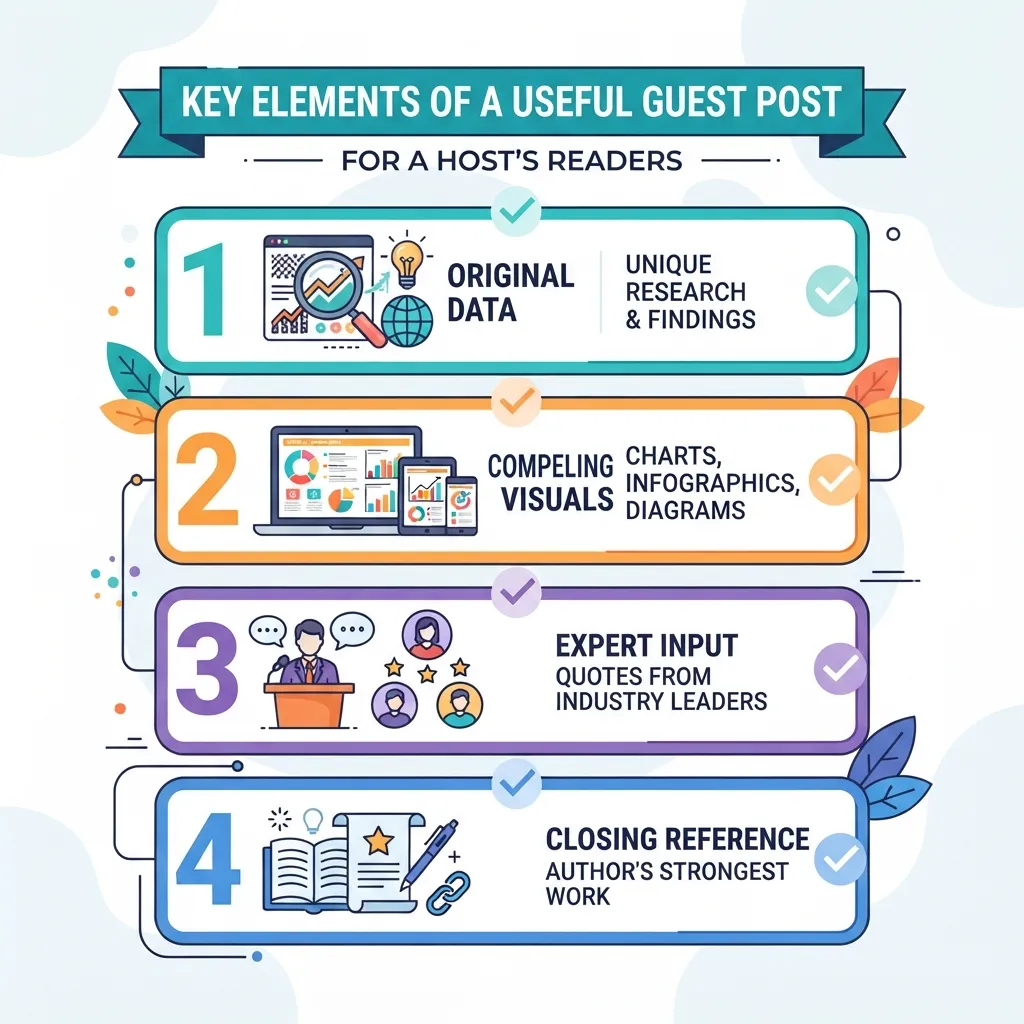
Build in something the reader cannot get elsewhere: first-party numbers, an anonymised before-and-after from a client project, or a quote from a named staff expert. Original evidence also makes hosts more willing to link to the page.
Closing with links to your strongest published work
Your author bio and closing paragraph are where you earn the reader’s next click. Link to two or three of your best published pieces that extend the post’s argument rather than repeat a sales message.
Then measure the result. A post that drives 200 visitors and zero key events differs from one that drives 50 visitors and five paying customers. Track referral traffic and conversions from each placement rather than counting links alone.
Anchor Text, Linking Practice and Following Submission Guidelines
Building a natural anchor text profile
Anchor text is the clickable wording of a link, and it is one of the few guest posting details you control directly. A natural profile is mostly varied: brand names, your website’s URL, generic phrases such as “this guide” and descriptive phrases. Exact-match keyword anchors should be a small minority, since identical commercial phrases across every guest post can look engineered. Varied anchors are generally considered safer, though the evidence on their ranking effect is weaker than many articles claim.
A practical rule: in any batch of links, no single exact-match phrase should appear more than once or twice, and anchors should vary across each industry you publish in.
Keeping your own site’s links contextual and relevant
Place the link inside the body text, where it supports a specific claim, rather than in a bio box or sidebar. Link to the page that best answers the point, not your homepage by default. A Singapore accounting firm writing about payroll deadlines should link to its payroll resource. Contextual links read as editorial endorsements, though published evidence on their value is limited.
Reading and following each host’s submission guidelines
Breaking a host’s rules is the fastest way to a rejected pitch. Before you write, check:
- Word count range and formatting requirements.
- Whether body-text links are allowed and how many.
- Whether sponsored or paid content must be disclosed.
- Image sourcing rules and file specifications.
- The author bio format and whether a headshot is needed.
- Their review timeline, so you know when to follow up.
Following these rules signals a professional contributor, which improves the odds of future acceptance. Hosts often share guidelines on social media when a page is hard to find.
Writing accepted posts
An accepted post answers one question clearly, cites its sources, and uses the host’s house style. Open with the answer, follow with evidence, and close with a single next step for the reader. Avoid pasting a sales message into the body. Read the post aloud before submitting, and cut sentences that run on or repeat a point.
Where Web 2.0 link building fits (and where it does not)
Web 2.0 properties are free, user-hosted pages such as blogging platforms, profiles and document sites. Their backlinks carry little editorial weight and are easy to produce in bulk. Unlike a guest post on an editorially managed site, they are not chosen for audience fit or reviewed by an editor.
They can build brand presence and help search engines discover your content, so treat them as supporting profile-building. Never let them crowd out work on proper host sites. Where a host’s blog fits your audience, a contributor post there is worth more than a profile link on a free platform.
Conclusion: Guest Posting as a Long-Term Authority Play
Guest posting for SEO still builds value in Singapore, but only when each post earns its place on the host site. Editorial standards matter more than link count, so every backlink should point to a page that genuinely helps readers find answers and what they need.
Google’s March 2024 core update folded the helpful content system into its core ranking signals, aiming to cut low-quality content by 40 percent, per Neil Patel’s guide to guest blogging. Pitch for quality, not volume, and accept only sites that meet at least three of the four Guest Post Fit Score criteria.
Frequently Asked Questions
Is guest posting still effective for SEO in 2026?
Yes, but only when the post earns its place on the host site. Links still matter: 85% of marketers believe link building will be important for SEO over the next five years, according to Google’s own guidance on link building. Editorial quality counts most now. Thin, promotional or mass-produced posts add little and carry real risk.

How many guest posts should a business publish each month?
Fewer than most people expect. According to Cleaning Clicks, 60% of blogs produce up to five guest posts a month, and only 3% publish over 100. Pitch only where you would be comfortable showing the post to a client.
What anchor text should I use in a guest post?
Use natural, descriptive anchors that fit the sentence, such as your brand name or a plain phrase describing the resource. Avoid repeating the same exact-match keyword across placements, as this looks manufactured.
How do I locate blogs in Singapore that accept guest posts?
Start with publications that already cover your industry, such as trade magazines and industry association sites. Check that they publish named authors, edit their articles and label sponsored content clearly. Skip any site whose only offer is paid placement with no editorial review.
Can guest posting hurt my rankings?

It can, if done badly. Links from low-quality sites, link farms or unedited bulk content can be discounted or lead to a penalty. Google’s March 2024 core update folded the helpful content system into its core ranking signals, aiming to reduce low-quality, unoriginal content. Stay safe by writing original, useful posts for reputable hosts and avoiding over-optimised anchors and paid links.