| AI Summary
Google AI Overview brings information from websites into an AI-generated answer within Google Search. Its supporting links help readers investigate a topic, but each claim still needs checking before it informs a purchase, report or business decision. This article explains source selection, common errors, search controls and the steps businesses can take when their content appears in an overview. |
Google AI Overview is a search feature that generates a summary with links to supporting websites. It helps explain topics without requiring readers to open every result first. Its answers can contain mistakes, so readers should check the original sources, dates and conditions before relying on important information.
Key Takeaways
- A citation needs to support the specific statement beside it; a familiar website name alone is insufficient.
- Prices, deadlines and eligibility rules need checks for dates, location and exclusions.
- Business reports should distinguish AI visibility, website visits and customer enquiries.
- Website preview controls can affect ordinary search results as well as AI answers.
- Original examples and accessible evidence give readers reasons to visit and assess a source.
Google AI Overview can make a complicated search feel manageable. A question that once required several open tabs may receive a short answer on the results page.
The next step deserves care. A summary about choosing an office chair creates different risks from an answer about a grant deadline or a health concern.
For readers, the challenge is knowing what to verify. For businesses, it is understanding how their information appears and whether search visibility leads to customer action. Both start with the same habit: following the answer back to its evidence.
What is Google AI Overview?
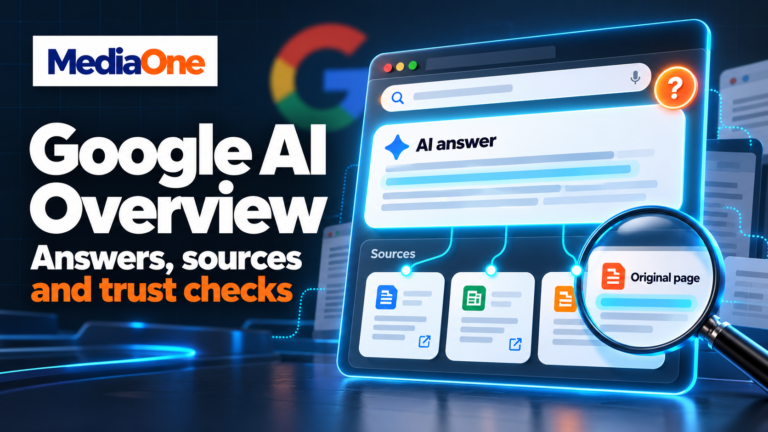
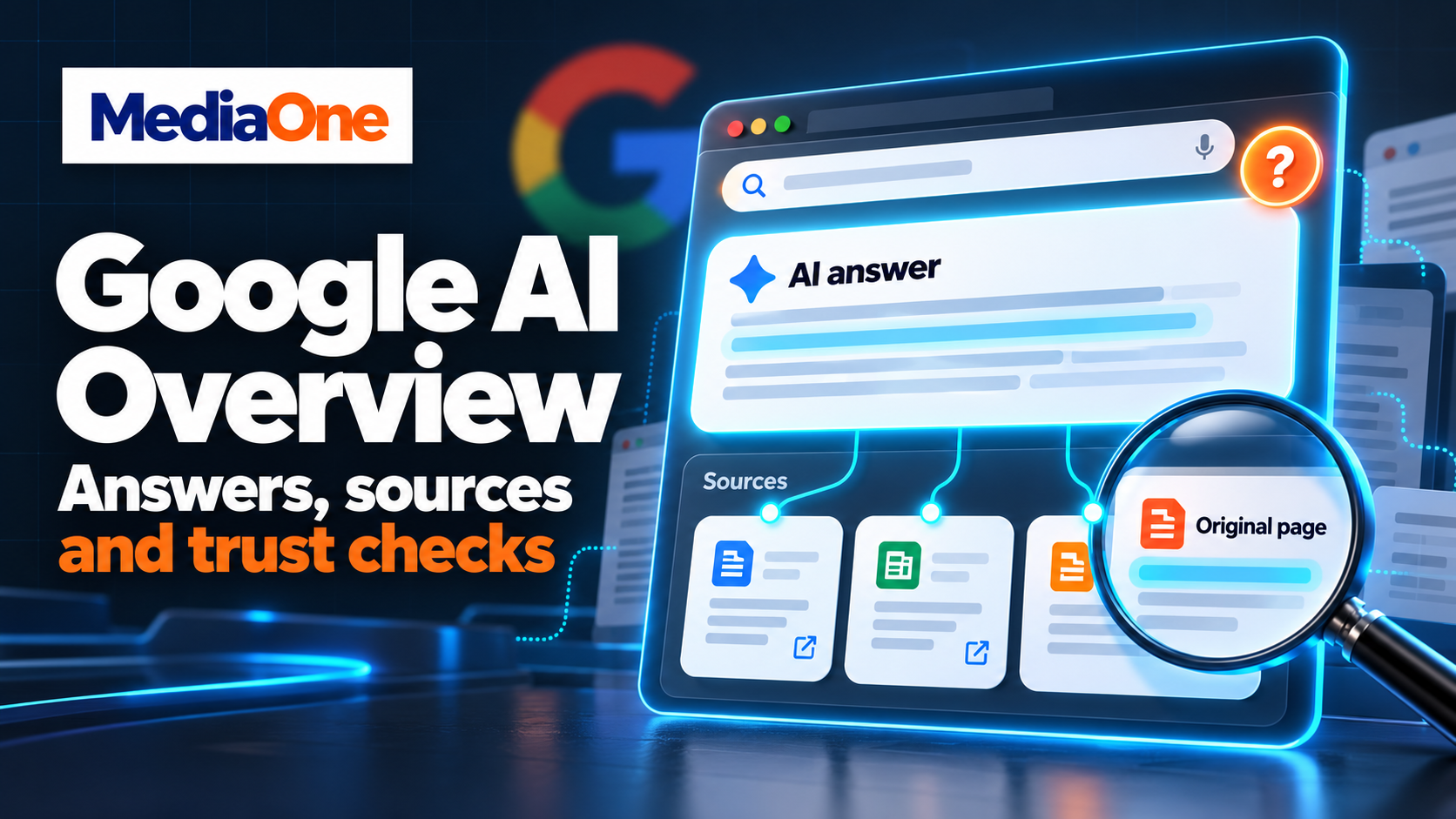
Google AI Overview is an AI-generated response within Google Search that brings together information about a search question. Supporting links allow readers to examine related websites and investigate the answer.
Google calls the feature AI Overviews. The singular phrase “Google AI Overview” usually refers to one response shown for a particular search.
The feature can help with tasks such as:
- Understanding an unfamiliar term.
- Comparing approaches to a problem.
- Identifying points for further research.
- Finding websites that explain different parts of a question.
How the feature began
Google announced the wider US launch of AI Overviews on 14 May 2024. Its launch announcement described a Gemini model built for Search and new ways to handle questions involving several steps. Earlier testing took place through Search Generative Experience, or SGE.
That history explains why older articles may use SGE when discussing similar search experiences. Instructions written for an early experiment may no longer describe the public feature.
What an overview can help readers do
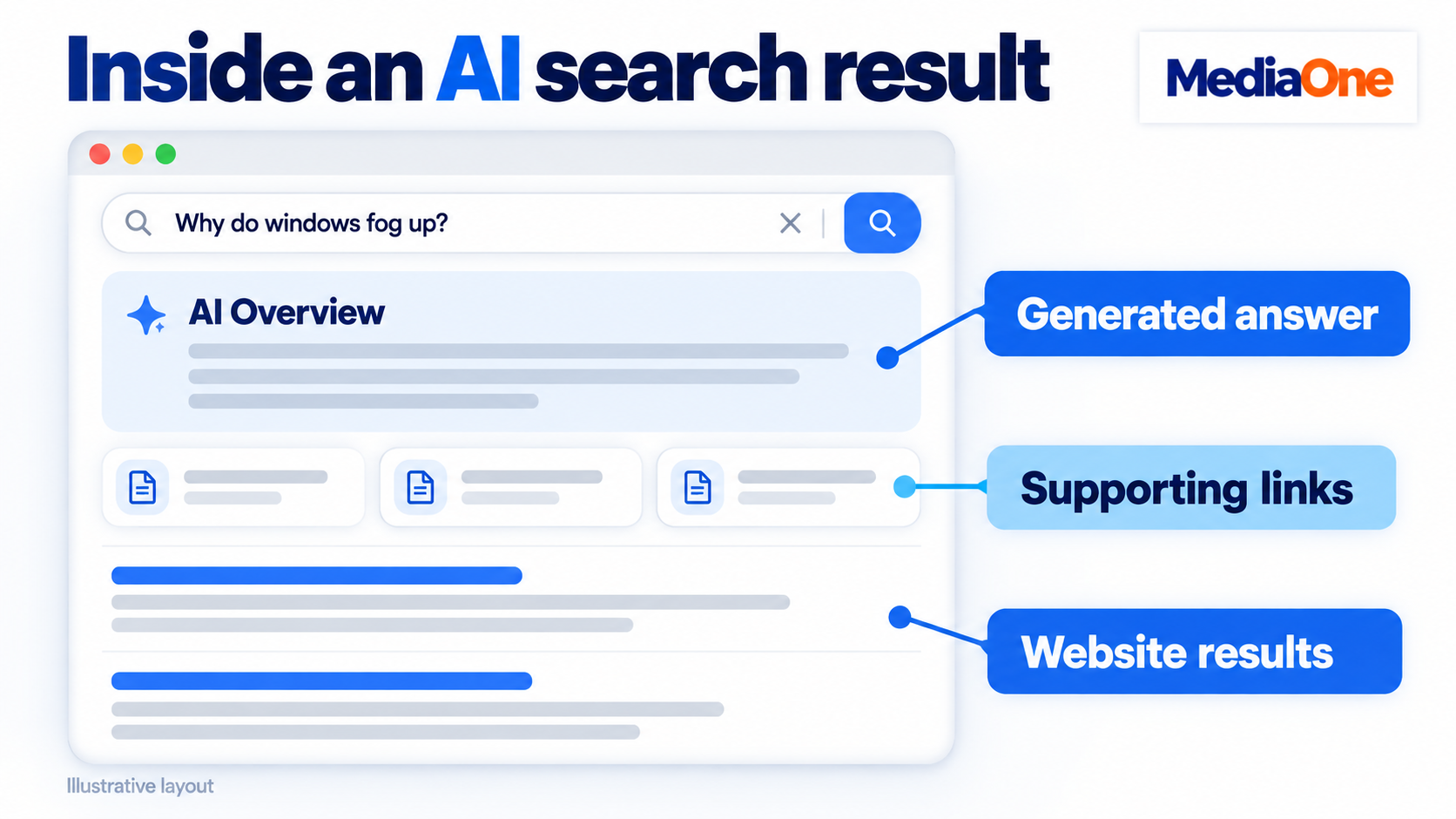
A search for “why does condensation form on windows?” may introduce temperature, humidity and ventilation in one response.
That introduction gives readers terms to investigate. A homeowner can then examine the source pages for advice relevant to their building.
The summary saves time at the start of research. The supporting evidence determines whether its explanation applies to the reader’s situation.
How does Google AI Overview choose its sources?
Google combines its search systems with generative AI to produce an answer and identify supporting pages. It does not publish a formula that lets publishers predict every citation.
Google’s explanation of AI features in Search says AI Overviews may run several related searches across subtopics and data sources. Google calls this “query fan-out”.

For example, a question about reducing office energy costs could involve lighting, cooling, equipment and staff routines. Different pages may support different parts of the response.
Why a supporting link needs closer reading
A source can discuss the right topic without supporting every detail in a generated sentence.
Imagine an overview that says a product works outdoors and includes a two-year warranty. The linked page might confirm the warranty but limit outdoor use to covered areas.
The reader needs to examine:
- The exact passage supporting the statement.
- Any conditions elsewhere on the page.
- The publication or update date.
- Whether the information applies to the named product or service.
Why a high ranking does not promise a citation
An ordinary search position and an AI citation are different observations. A business can record both without treating either as a guarantee of the other.
A sensible review asks two separate questions: does the page appear in website results, and does Google link to it within the overview?
MediaOne’s approach to AI visibility measurement helps distinguish linked citations from brand mentions and broader search exposure.
A screenshot records one result at one moment. Repeated observations provide a stronger basis for assessing whether that appearance continues.
AI Overviews, featured snippets and AI Mode compared
These features can appear around similar searches, but they present information differently.
Google describes featured snippets as search results that place the descriptive extract before the website link. An AI Overview generates a response that may bring several sources together.
| Feature | What the reader sees | What to examine |
| Ordinary website result | A page title, link and description | Whether the page answers the question |
| Featured snippet | A prominent extract associated with a website | Whether the surrounding passage changes its meaning |
| AI Overview | A generated explanation with supporting links | Whether each important claim matches its evidence |
| AI Mode | An AI search experience supporting further questions | Whether the response and sources support the full discussion |
A business should label these appearances separately in reports. A featured snippet screenshot does not establish that the same page appeared in an AI Overview.
The distinction also helps readers choose their next step. A short definition may need one source check. A comparison involving several products may require separate checks for price, features and availability.
The Overview Trust Check: four questions before acting

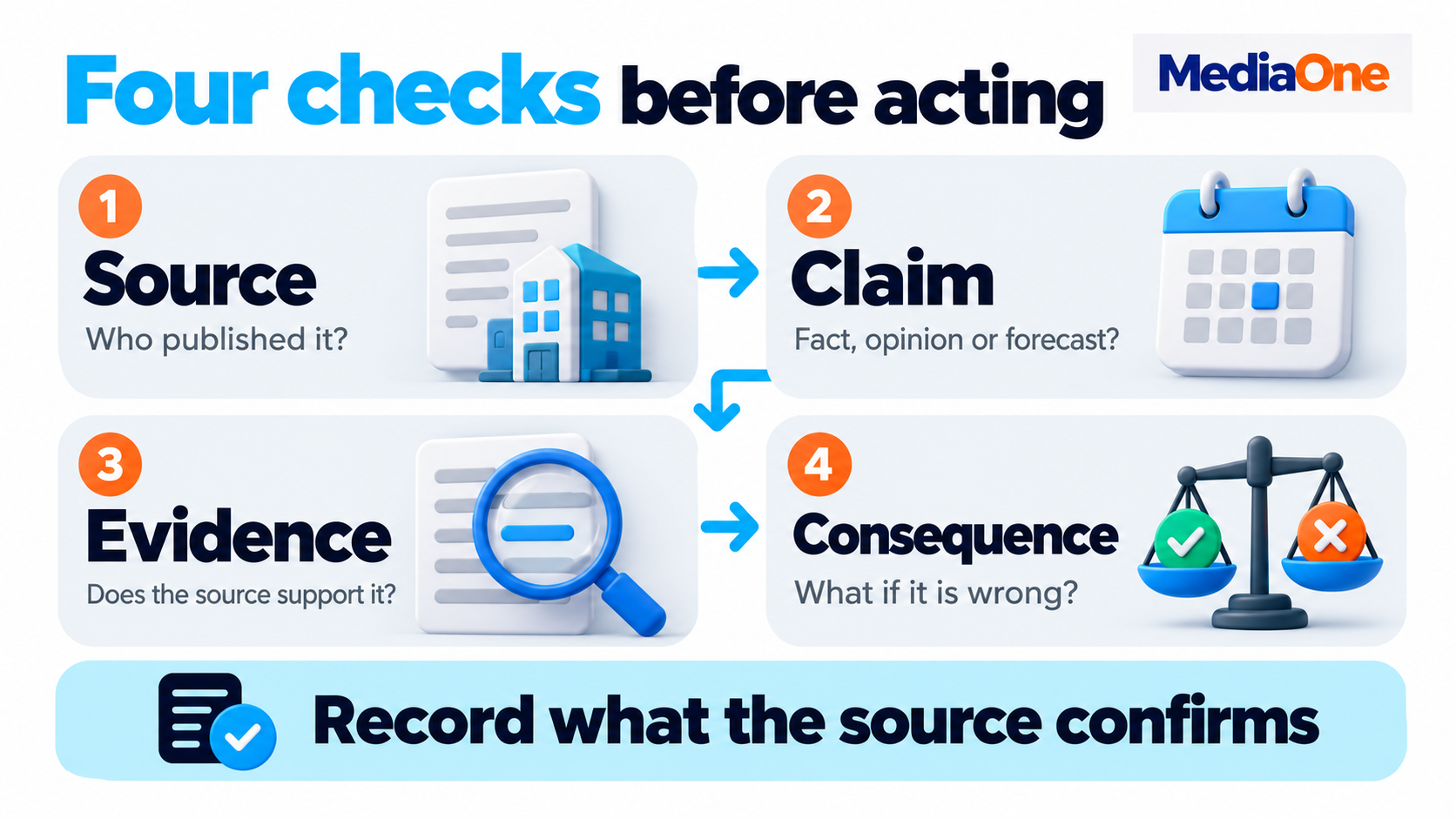
The Overview Trust Check is a practical method for reviewing an answer. It is an editorial checklist, not a Google feature or a scoring system.
The four questions concern the source, the claim, its supporting evidence and the consequences of an error.
| Check | Question | Practical response |
| Source | Who published this information? | Identify the organisation, author or original research |
| Claim | What kind of statement is this? | Separate facts, opinions, forecasts and changing information |
| Evidence | Does the source support the wording? | Compare the generated statement with the original passage |
| Consequence | What happens if it is wrong? | Increase verification when money, health or public claims are involved |
1. Who published the information?
A primary source provides information directly. Examples include a company’s warranty terms, an agency’s application rules or a researcher’s study.
A secondary source explains or reports someone else’s information. That reporting can add context, but the original document is often essential for checking conditions.
The best source depends on the claim:
- A retailer can confirm its current selling price.
- A manufacturer can explain its product specifications.
- A public agency can confirm its programme rules.
- Independent research can assess a claim about wider outcomes.
A company’s description of its own service may establish what it offers. It does not independently prove that the service outperforms every alternative.
Google’s “About this result” information can provide background about a source where the feature is available. That background supports investigation; the page’s evidence still needs examination.
2. What kind of claim is being made?
Different claims need different checks. A definition of condensation is relatively stable. A delivery charge can change overnight.
Readers can sort statements into four groups:
- Established explanations: definitions, processes and background information.
- Current facts: prices, opening hours, deadlines and stock.
- Opinions: preferences, reviews and personal experiences.
- Predictions: estimates about future traffic, sales or market behaviour.
A forecast needs its original date and assumptions. A personal review needs context about the reviewer’s experience. A current price needs the seller’s latest terms.
The phrase “research shows” also deserves attention. The linked source should identify the research and explain what it actually measured.
3. Does the evidence support the exact wording?
Small wording changes can alter a claim.
“May reduce costs” describes a possibility. “Reduces costs by 30%” promises a measured result. An overview should not turn the first statement into the second without supporting evidence.
A quick comparison should cover:
- The population or product studied.
- The country or market involved.
- The period covered.
- The result measured.
- Any exceptions or limits.
Three websites repeating the same press release do not provide three independent checks. Their shared source may still contain the original error.
4. What happens if the answer is wrong?
The checking effort should reflect the decision.
An inaccurate explanation of a film plot creates little practical harm. An incorrect contract deadline can affect a business.
A team preparing public content should verify every consequential figure, name, date and quotation. The final draft should cite the source that supports the statement.
A health, legal or financial question may also depend on circumstances that a general search answer cannot assess. The original authority and a qualified professional become more relevant as the decision becomes more personal.
A worked example: checking an office chair recommendation
Consider a hypothetical search for “office chair for a small workspace under S$250”.

An overview lists three chairs and describes one as compact, adjustable and available with free delivery. The answer looks convenient, but each part needs its own check.
The table below shows how a buyer could review it.
| Overview statement | Best place to check | Detail that could change the decision |
| Price below S$250 | Retailer’s product page | Price may exclude delivery |
| Compact design | Manufacturer’s dimensions | Armrests may prevent storage under a desk |
| Adjustable seat | Product specification | Adjustment range may be limited |
| Free delivery | Delivery terms | Offer may depend on order value or address |
The first check: price and delivery
The buyer opens the retailer’s page and confirms the displayed price. The delivery section then reveals whether extra charges apply.
A price comparison should include the same costs for every option. One chair listed at S220withaS25 delivery charge costs more than one listed at S$235 with delivery included.
Those amounts are illustrative. Their purpose is to show why the headline price cannot answer the entire buying question.
The second check: dimensions and suitability
The manufacturer’s measurements confirm whether the chair can move under the desk.
The buyer also checks the return policy before ordering. A chair can satisfy the listed dimensions and still feel uncomfortable during everyday use.
The overview has served its purpose by identifying options. The product pages supply the details needed for the purchase.
The same method applies to business software, courses and service packages. Each recommendation needs checks against the buyer’s requirements and the provider’s actual terms.
Why can Google AI Overview get an answer wrong?
A generated response can misunderstand a question, lose a condition or combine information that should remain separate.
Google acknowledged problems after the initial launch. Its May 2024 explanation of incorrect results discussed issues including misunderstood language and searches with limited reliable information.
These examples explain possible failure points; they do not establish a current error rate.
Missing context
A summary can omit the sentence that limits a claim.
A service page might offer weekend appointments at one branch. An overview could describe weekend availability without preserving that location restriction.
The relevant check is whether the answer applies to the same person, place, product and period as the source.
Advice presented without enough background
A forum comment may describe one person’s experience. A reader should examine the author’s situation before applying that experience elsewhere.
The comment may still help explain a problem. Its value depends on what it establishes and what remains unverified.
A personal success story cannot establish a typical result across all customers.
Warning signs worth investigating
Certain features should prompt closer review:
- A precise percentage without an identifiable study.
- A deadline with no year.
- A product claim with no model name.
- A local rule supported by a source from another country.
- Several citations that repeat the same wording.
- A recommendation that overlooks obvious exceptions.
An answer can be fluent and still contain one faulty detail. The checking process should focus on the claims that influence the reader’s next action.
How can readers hide AI Overviews?
Google says AI Overviews are a core Search feature and cannot simply be switched off. Its Search Help page explains that the Web filter displays text-based links without features such as AI Overviews.
The filter is useful when a reader wants to examine website results directly.
A typical search involves these steps:
- The reader enters the search question.
- The results page displays the available filters.
- The reader selects Web, which may appear under More.
The filter’s position can vary across devices and interface updates.
Search Labs settings concern experiments. Turning off a Labs experiment does not necessarily remove a feature already included in ordinary Search.
Browser extensions may change the display, but they introduce separate questions about permissions, maintenance and reliability. The built-in Web filter provides a documented option without requiring another extension.
Website controls: limiting content in AI answers
Website owners face a different decision from search users. Their controls concern whether Google can display or use their content.
Google’s content-sharing controls include a Search generative AI control in Search Console for managing site-wide inclusion in generative AI features. Owners should assess that option separately from page-level preview settings.
Page and section controls have wider effects
Google’s robots meta tag specifications explain the effects of settings such as nosnippet, max-snippet and noindex. These settings can affect ordinary Search presentation or inclusion as well as AI features.
| Control | Main purpose | Important consideration |
| nosnippet | Prevent text snippets for a page | Also prevents its content being used as direct input for AI Overviews and AI Mode |
| data-nosnippet | Exclude marked text from snippets | Applies to selected supported HTML elements |
| max-snippet | Limit permitted snippet length | Also limits content available as direct input for AI answers |
| noindex | Keep a page out of search results | Removes search visibility for that page |
A setting intended to protect one passage should not accidentally restrict an entire website.
A technical SEO audit can identify existing directives and assess their effects before changes reach important pages.
Google-Extended serves a separate purpose
Google’s crawler documentation states that Google-Extended does not affect inclusion or ranking in Google Search. It governs specified uses involving Gemini and other named products.
A website owner should therefore match each control to its intended product and outcome.
What does Google AI Overview mean for business traffic?
An answer on the results page can satisfy a reader without generating a website visit. A business may therefore gain exposure while receiving fewer clicks for some questions.
However, one page’s traffic change cannot establish a universal effect across industries or countries.
Pew Research Center’s study of Google search behaviour examined browsing data from 900 US adults. Users clicked traditional results on 8% of visits with an AI summary, compared with 15% without one. Links within summaries received clicks on 1% of visits containing a summary.
The findings concerned March 2025 browsing activity, with search results collected afterwards. They show an observed association in that study, not a guaranteed traffic loss for a Singapore business.
Three outcomes need separate reporting
| Outcome | What it tells the business | What it does not establish |
| Search visibility | A page or brand appeared | A reader visited the website |
| Website traffic | A visitor reached the site | The visit produced a qualified enquiry |
| Customer action | A visitor submitted an enquiry or purchased | Every earlier exposure that influenced the decision |
A data-driven SEO approach connects search observations with website behaviour and business results.
The distinction prevents a team from celebrating citation counts while overlooking declining enquiries.
Reporting should reflect current tools
Google’s announcement of generative AI performance reports describes dedicated Search Console views for impressions, pages, countries, devices and dates. Those visibility reports should be assessed alongside overall search performance and website conversions.
A practical monthly report can include:
- Search visibility for important pages.
- Organic visits to those pages.
- Enquiries and sales from organic visitors.
- Recorded examples of AI Overview appearances.
- Changes in content, demand or website access.
A fall in clicks deserves investigation. Seasonality, ranking changes, tracking faults and technical problems also belong in that review.
What should businesses do about Google AI Overview?
Businesses do not need to rewrite a page every time an overview changes. A better starting point is one important customer question: check how the overview answers it, compare that answer with the evidence on your own page, and correct anything outdated or unclear. Repeated observations over several weeks give a stronger basis for change than a single screenshot.
For practical steps to get pages cited, including structured data, content structure, and monitoring, see our guide on how to optimise your pages for Google AI Overviews.
Making informed decisions with Google AI Overview
Google AI Overview gives readers a convenient introduction to a question. Its value grows when the supporting pages confirm the details needed for the next decision.
A business can begin with one important customer question, check how its answer appears and compare the result with the evidence on its website.
MediaOne’s SEO services connect content, website checks and search performance. Our team can review where customers encounter your business and whether your pages answer their needs. A conversation through our contact form can establish which issues deserve attention first.
FAQs About Google AI Overview
Can a business pay Google to receive an organic AI Overview citation?
Google says payment does not secure inclusion or higher positions in organic search results. An advertising placement is separate from an organic supporting link. An agency’s promise of a paid, guaranteed organic citation therefore needs careful scrutiny against Google’s explanation of search ranking.
Should employees enter confidential information into an AI search question?
Employees should follow their organisation’s information-handling rules. A question can usually describe the problem without including customer names, account numbers or unpublished figures. A general example protects sensitive details while allowing the employee to investigate the topic.
What should a business record when an overview describes it incorrectly?
A record should include the exact search, date, screenshot, incorrect wording and supporting links. The business can then identify whether its own page contains the error or whether the generated answer misrepresents it. That evidence makes an error report more specific.
Can a saved screenshot replace the original source in a report?
A screenshot documents what appeared on screen. It does not independently establish that the answer was correct. A report using a factual claim should retain the original supporting source, while a report analysing search presentation can use the screenshot as evidence of that observed result.
Should a team rewrite its article whenever the overview changes?
A rewrite needs a reason grounded in the article’s accuracy or readers’ needs. One changed answer can prompt a review, but the team should compare several observations before changing its content strategy. An outdated fact warrants correction regardless of whether an overview has changed.