| AI Summary
AI visibility covers a brand’s presence in AI answers, including mentions, recommendations and links to its pages. This guide connects a small prompt test with practical website improvements. Marketing teams can identify missing answers, strengthen evidence, check crawler access and review results over 30 days. The aim is to understand which changes deserve attention and how those changes support customer enquiries. |
AI visibility is how often and how prominently a brand or its content appears in AI-generated answers. Measurement involves testing customer questions and recording mentions, recommendations and linked sources. Stronger visibility starts with accessible pages, direct answers, consistent business details and evidence that supports the claims being made.

Key Takeaways
- A missing citation needs investigation before a page rewrite.
- Branded and unbranded questions belong in separate test groups.
- Specific service details and original evidence give readers reasons to trust a page.
- Search access and AI training permissions involve different crawler controls.
- A monitoring subscription earns its place when the team can act on its findings.
- Recorded visits and qualified enquiries help connect visibility work with business goals.
AI answers can introduce a customer to your business before that person reaches your website. A recommendation may help them build a shortlist. A linked explanation may help them understand a service. Both deserve attention, but they tell different stories.
For a Singapore business, the starting point could be a question about accounting support, office storage or website costs. The next task is to check whether the answer represents the business accurately and gives the customer enough information to continue.
A repeatable review connects those observations with page improvements. The process below starts small, diagnoses the gaps and gives each change an owner.
What Does AI Visibility Include?
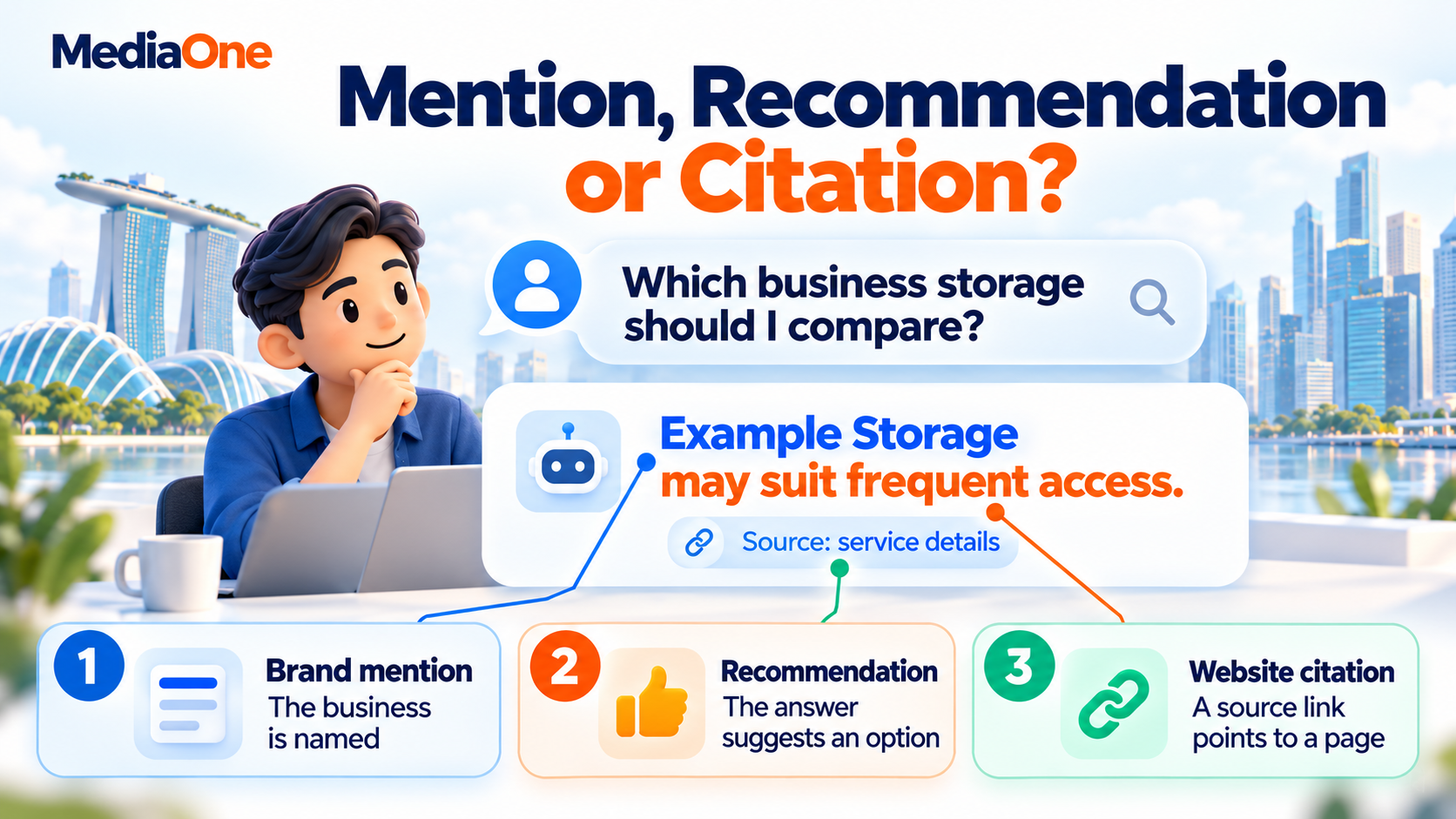
AI visibility includes several forms of presence. A brand can appear in an answer without receiving a link. A page can also receive a citation without its company being recommended.
| Type of presence | What the customer sees | What the team records |
| Brand mention | The company or product name appears | Whether the answer identifies the right business |
| Recommendation | The answer suggests the business for a stated need | The reason given and any conditions |
| Website citation | A source link points to the company’s domain | The destination page and claim it supports |
| Third-party coverage | A cited publisher discusses the business | The publisher, wording and accuracy |
These distinctions prevent a report from treating every appearance as a recommendation. A storage company cited for packing advice has earned attention, but that answer may say nothing about booking its units.
How AI visibility relates to SEO, AEO and GEO
SEO helps people discover website content through search. Answer engine optimisation, or AEO, focuses on answering questions. Generative engine optimisation, or GEO, describes work intended to improve presence in generated answers. Industry use of these labels varies.
The overlap between AEO and GEO is practical: both depend on information that answers a person’s need. AI visibility describes an outcome that teams can observe across those activities.
Google’s AI search requirements retain existing SEO foundations. Eligible pages need indexing and snippet eligibility; special AI markup is not required. A ranking report still cannot confirm whether a particular answer cited your page.
How to Establish an AI Visibility Baseline
A baseline records what happens before changes begin. Thirty customer prompts across two relevant services can provide a manageable first exercise. That number is a planning choice, not an industry benchmark or a representative survey of all buyers.
Customer questions determine the test
Sales calls, enquiry forms, support messages and keyword research can reveal the language customers use. The prompt list should cover the decisions your business actually supports.
| Customer need | Illustrative prompt | Page to review |
| Understanding a problem | Why does an office need temporary storage? | Service explanation |
| Comparing options | What should a small office compare when choosing storage in Singapore? | Comparison page |
| Checking costs | What affects the cost of storing office furniture? | Pricing explanation |
| Checking suitability | Which storage options allow frequent business access? | Access and service details |
Branded prompts, such as “What services does Example Storage offer?”, test how the business is described. Unbranded prompts test whether it enters a wider conversation. Separate reporting prevents easy branded appearances from inflating discovery results.
Consistent settings make comparisons easier
The test record should identify the service, date, prompt, language, location context and whether web search was active. Google AI Overviews, Google AI Mode and the Gemini app should have separate labels.
A fresh conversation reduces influence from earlier messages. Repeated checks on different dates help reveal variation. An answer that appears once provides an observation; it does not establish a lasting position.
Each saved record needs:
- The full answer or a screenshot.
- The brand’s role: mentioned, recommended or absent.
- The actual linked sources.
- Any inaccurate business details.
- A missing-result label when a test fails.
A more detailed AI citation tracking report can support larger programmes. The first baseline only needs enough evidence to identify where investigation should begin.
A few defined measurements are enough
Brand mention rate counts completed answers that name the business. Website citation rate counts completed answers linking to its domain. Each rate divides the relevant answer count by all completed answers, then multiplies by 100.
For example, 30 prompts tested once on two services produce 60 completed answers. If 12 name the business and six cite its website, the combined mention rate is 20% and the website citation rate is 10%. These figures are hypothetical. Separate service totals help explain where those appearances occurred.
A recommendation needs its own label because a passing mention can occur in a negative comparison. The reviewer should save the surrounding wording and check the claim against the business’s actual services.
- The numerator identifies the answers that meet the counting rule.
- The denominator identifies all completed answers in that test group.
- Failed tests remain outside the calculation and appear in a separate count.
How to Find the Reason Your Brand Is Missing
An absent brand does not automatically mean the content is poor. The prompt may describe a service the business does not offer. The relevant page may be inaccessible. An answer may also draw on outside sources without mentioning every suitable company.
A page review should separate these possibilities before the team starts editing. Four checks provide a practical way to organise the work.
| Check | Evidence to examine | Possible next action |
| Answer readiness | The page addresses the customer’s actual question | Add the missing explanation |
| Business identity | Names, services and locations agree | Correct conflicting details |
| Supporting evidence | Important claims have relevant support | Add a documented example or source |
| Search access | The intended page can be discovered and read | Investigate indexing or crawler restrictions |
These checks form an editorial worksheet, not an AI ranking formula. A simple status of complete, incomplete or needs investigation is enough. An invented numerical score would add little unless the team defines what it means.
The answer may already exist on another page
An audit should identify the page that owns each customer need. A cost question may belong on a pricing page, while a service question belongs on the relevant service page.
A website SEO audit can identify access issues and content relationships before the team creates another article. Internal links can then connect the main explanation with supporting detail.
Overlapping pages need a distinct purpose. A broad guide can explain how to assess AI visibility, while a dedicated reporting article handles detailed citation calculations. Each page should offer a reason to exist beyond repeating the same definition.
Priority depends on customer value
A missing answer about a core service deserves attention before an unrelated educational query. The team can prioritise questions using three checks:
- The question comes from actual prospects or customers.
- The business offers a relevant service or product.
- The page can help the person take an informed next step.
This keeps the work connected to buying needs. A higher appearance count across unrelated prompts would not demonstrate progress towards those needs.
Can AI Search Systems Access the Right Pages?
A content review and an access review solve different problems. A page that reads well to a person may still return an error or a security challenge to an automated visitor.
The website team should check the intended page, its response and the content returned. A successful browser visit alone cannot confirm crawler access.
Search crawlers and training crawlers serve different purposes
OpenAI’s crawler documentation distinguishes OAI-SearchBot, which supports ChatGPT search, from GPTBot, which collects content that may support model training. The controls operate independently. A publisher can allow search access while declining GPTBot access.
Perplexity’s crawler details likewise describe PerplexityBot as supporting search results, with published access information. These documents help a developer check the right crawler without assuming that all AI traffic serves the same purpose.
The access review should cover:
- Robots.txt rules for relevant public pages.
- Firewall or hosting restrictions.
- Login screens and automated security challenges.
- Broken links and unexpected redirects.
- Main text that fails to load for the crawler.
Google eligibility needs its own check
Google’s AI features have their own search eligibility requirements. The relevant page needs to be available through Google Search with a snippet. Its inclusion remains a platform decision.

Work on Google AI Overview SEO should therefore include search access checks alongside content review. Access creates an opportunity for discovery; it does not establish that the page will receive a citation.
How to Make Pages Easier to Cite and Understand
A page earns attention by answering a real need with enough detail to support the answer. Formatting helps readers find that detail, but headings and lists cannot repair an unsupported claim.
The original GEO research paper reported visibility improvements of up to 40% in its evaluation. Results varied across domains. That research supports testing content changes, but the figure is not a forecast for a live website or a guarantee from today’s AI services.
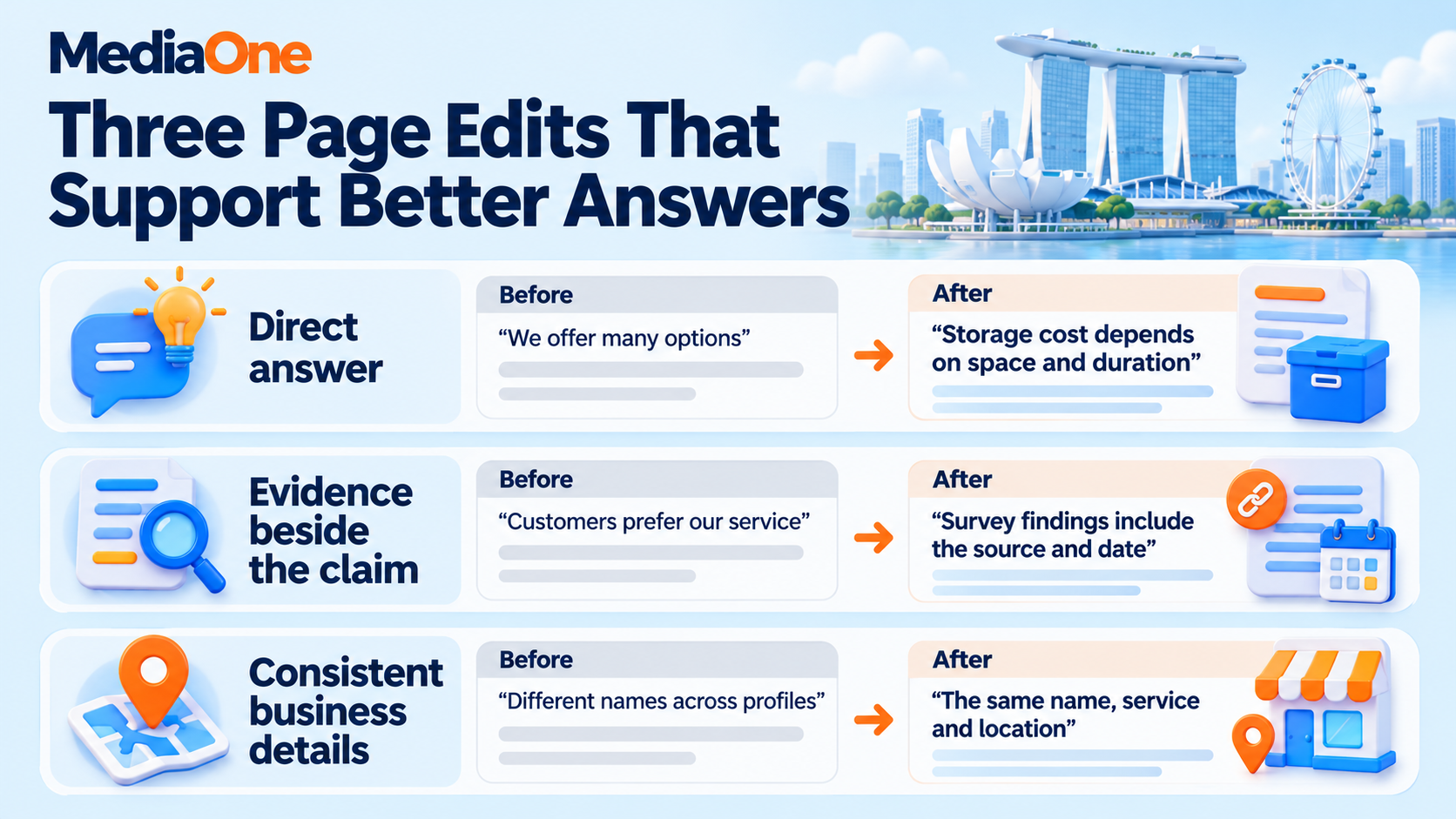
Each section needs a direct answer
The first sentence below a heading should address its subject. The next sentences can explain conditions, examples or exceptions. A customer should not need to search several paragraphs for the point.
A hypothetical storage page illustrates the difference:
| General claim | More informative explanation |
| Our storage suits every business | Business storage can hold office furniture, stock or archived records. Suitability depends on access needs and the items accepted. |
| We offer flexible pricing | The quote depends on space, storage duration and any collection or delivery services. |
| Our team makes moving easy | The service page explains who packs the items, who transports them and which tasks the customer handles. |
These examples demonstrate detail, not facts about a specific provider. Published wording must reflect the actual service. The same approach helps readers compare options without relying on promotional language.
Evidence should sit beside the claim
A statistic needs its source, time period and relevant context. A case example needs enough detail to explain what happened. A quoted opinion needs an identifiable speaker and an accurate source.
Google’s people-first content criteria ask whether pages provide original information, analysis and evidence of experience. A practical editorial check is whether the page adds something beyond a summary of existing results.
Examples include:
- An explained calculation with labelled assumptions.
- A comparison based on stated criteria.
- Findings from a documented customer survey.
- A process example showing what the service includes.
- Original photographs with relevant explanations.
The citation itself also needs checking. The linked page should support the nearby statement, with the same population, service or time period. A broad industry report cannot establish a particular company’s performance.
A small business does not need a large research project for every article. A specific, verifiable explanation can serve the reader better than a broad claim that offers no evidence.
A claim needs its conditions
A price, time estimate or performance result loses meaning when its conditions disappear. A customer comparing services needs to understand what the figure includes and which circumstances could change it.
A hypothetical website provider might publish a project price that excludes photography and ongoing maintenance. The surrounding explanation should state those exclusions beside the price. A separate sentence can describe what the customer receives and when additional charges apply.
The same principle applies to research. A survey of existing customers should identify who responded and when the responses were collected. Its findings should not become a claim about every buyer in Singapore. Evidence becomes more dependable when readers can see its boundaries.
Business names and service details should agree
A website may use a trading name while an old profile uses a former name. Customers then have to work out whether both refer to the same business. Consistent details reduce that confusion.
Google’s organisation structured data can help it understand and distinguish a business. Relevant information may include the name, website, logo and official profiles.
The underlying structured data describes page information in a standard format. It should reflect the visible content. A service business should not add product ratings or author credentials that the page cannot support.
Outside coverage needs an accuracy check
A business can appear through a trade publication, review or customer case study. The cited source may describe the company well, or it may repeat an outdated service detail.
A practical review checks whether significant outside references identify the correct business and describe its services accurately. Corrections should go through the publisher’s normal process. Purchased praise and invented reviews cannot provide dependable evidence.
A content marketing programme can organise original examples, explanations and research for publication. The objective is to provide information that readers and publishers have a reason to reference. Publication alone does not guarantee AI inclusion.
Which AI Visibility Tools Does Your Team Need?
A spreadsheet can support a small baseline. A paid platform becomes more valuable when repeated testing, several markets or multiple services make manual work difficult.
The buying decision should follow the workload. A dashboard full of scores has limited value when the team cannot see the underlying answers or decide what to change.

| Tool option | Appropriate starting point | Main check |
| Manual spreadsheet | Small prompt list and occasional reviews | The records remain consistent |
| Prompt monitoring platform | Repeated checks across selected services | The platform saves answers and source links |
| Wider brand monitoring | Several products, markets or teams | Coverage matches the business’s reporting needs |
A trial should use the team’s own prompts. The reviewer needs to know which service or model produced each answer, whether the tool uses an API or a consumer interface, and how failed runs appear.
Export options also deserve attention. Saved answers, dates and URLs allow a later reviewer to check the report. A proprietary visibility score needs an explained calculation before it becomes a management target.
A practical trial should test the reporting
A practical trial can follow five of the business’s priority prompts for an agreed period. The team can compare the saved answer with the tool’s mention label, open the reported sources and test an export. This checks whether the reporting supports actual review work.
The quoted subscription should also cover the intended number of prompts, services, markets and refreshes. A low entry price may describe a smaller workload than the team needs. Current vendor terms belong in the purchasing decision; they do not need to become permanent article claims.
No universal appearance percentage determines when a business needs software. The decision depends on testing workload, available staff and the changes the team can deliver.
How to Connect AI Visibility With Visits and Enquiries
AI visibility reports describe appearances in answers. Website analytics describes recorded visits and on-site actions. A citation can exist without a click, so these records should remain separate.
The GA4 Traffic acquisition report includes session source and medium. Those dimensions can help identify visits from AI services when source information reaches the analytics setup.
A monthly report can connect four layers:
| Reporting layer | Business question |
| Answer presence | Which customer needs include the brand? |
| Cited landing pages | Which pages receive source links? |
| Recorded visits | Which identified sources send traffic? |
| Qualified enquiries | Which contacts meet the business’s lead criteria? |
A hypothetical campaign may gain citations while enquiries remain unchanged. The landing page could lack service information, or the cited topic could attract people who are still learning. That result calls for investigation, not a claim that the campaign produced revenue.
Sales teams can also record voluntary answers to “How did you hear about us?” Those responses add context. They do not establish a complete record of every AI answer the customer encountered.
A 30-Day AI Visibility Improvement Plan
The first month should produce a baseline, a prioritised set of changes and a scheduled review. It does not need to produce a promised increase in citations.
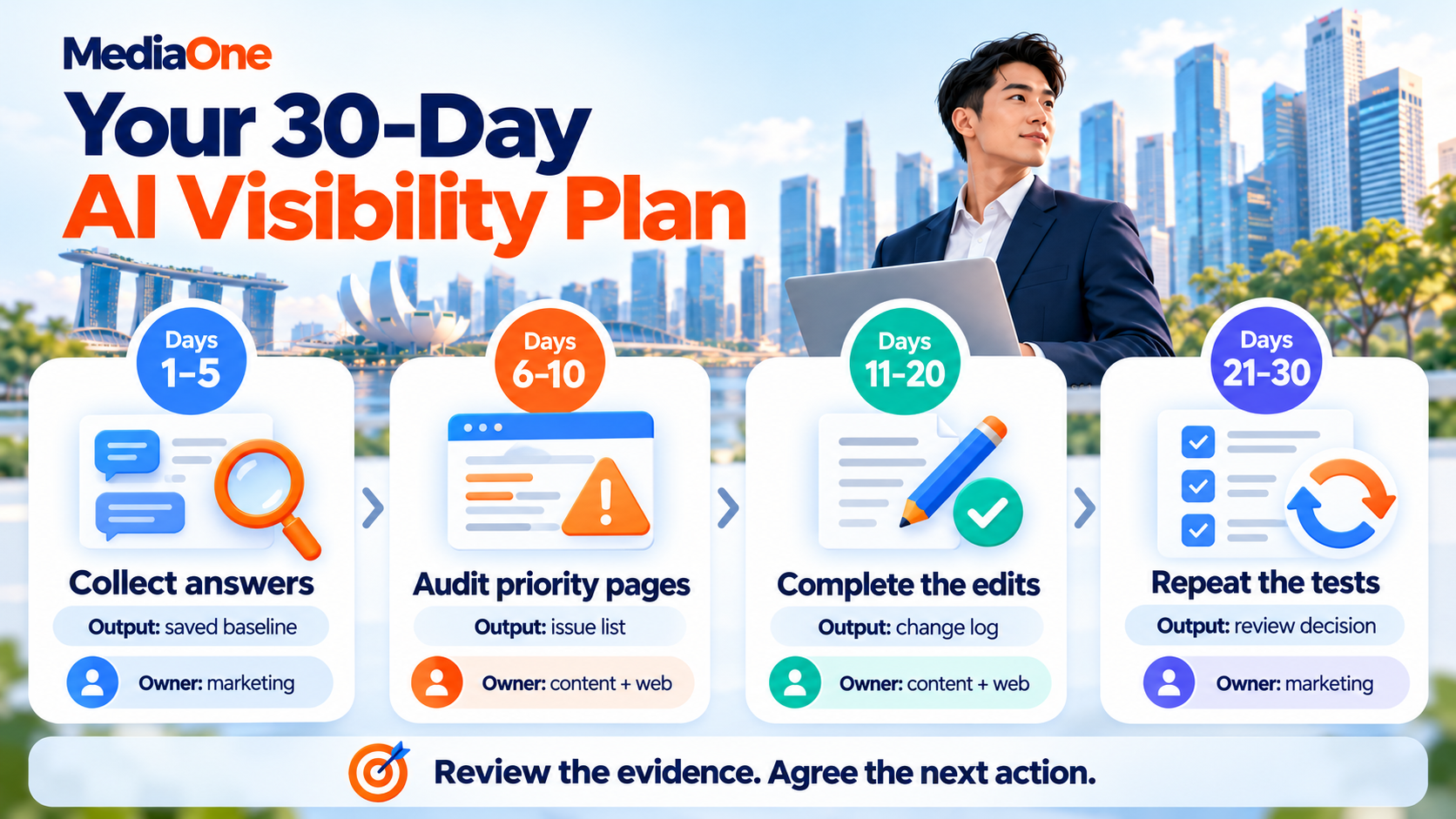
| Period | Team action | Reviewable output |
| Days 1–5 | Agree customer prompts and collect initial answers | Saved baseline and counting rules |
| Days 6–10 | Review priority pages and access | Issue list with an owner for each item |
| Days 11–20 | Complete the highest-priority improvements | Change log and checked pages |
| Days 21–30 | Repeat the original tests | Comparison with evidence and next actions |
Each change log entry should name the page, edit date, reason and expected benefit. For example, a pricing page might gain an explanation of delivery charges because customer questions showed that the cost was hard to understand.
A second page could remain unchanged for comparison. That provides context, although it does not create a controlled experiment: platform changes and competing content can still affect results.
The task owner should also record any unresolved dependency. A writer may finish an explanation while the developer still needs to repair access. The review then recognises that the page change and technical work reached completion on different dates. This prevents an early retest from being presented as a full assessment of the finished work.
The review should decide what happens next
A stronger result supports continued observation. An unchanged result may justify checking a different cause. A decline should prompt a review of both the page and the testing conditions.
The report should distinguish completed work from observed outcomes. “The team corrected the service description” describes delivery. “More sampled answers named the brand” describes an observation. Neither statement alone proves the edit caused a commercial result.
Build AI Visibility Around Customer Questions
AI visibility becomes easier to manage when each missing answer leads to a specific check. A business can then improve the page, correct its details or investigate access with a reason for the work. Consistent testing helps the team judge whether those changes deserve continued attention.

MediaOne’s GEO services combine AI visibility reviews, content improvements and ongoing reporting. A discussion with our team can start with the customer questions your business needs to answer and the pages that should support them.
FAQs About AI Visibility
Is an llms.txt file required for Google’s AI features?
Google says no additional AI text file is needed for AI Overviews or AI Mode. An llms.txt file should not be treated as an inclusion requirement or a shortcut to citations. Its presence does not establish how another service will use it.
Can a PDF appear as a search source?
Google lists PDFs among its indexable file types. That makes a public report a possible search resource, although indexing does not guarantee an AI citation. An accompanying web page can give readers an overview, publication details and a download link.
What should happen when a cited page moves?
The website team should map the old address to the relevant replacement and check its redirects. Google’s site migration process also covers updated internal links and monitoring. Historical AI records should preserve the original cited address so reviewers can understand earlier results.
Should a Singapore business publish content in several languages?
Customer needs should determine the language plan. Google’s multilingual site documentation recommends separate URLs for language versions. Accurate translations and maintained service details deserve priority. A translated page should help the intended audience, and its AI results should be assessed within that language group.