A guest post is an article written for another website and published under your name, usually in exchange for exposure to that site’s readers. Guest posting still works, but only on sites with a real, engaged readership, and only when the contribution gives those readers something new. This guide covers how to qualify host sites, pitch editors, and recognise when a guest post is the wrong move in a broader marketing strategy. A pitch costs little, so test one host at a time and measure results over time.
Key Takeaways
- A guest post still works on sites with a real, engaged readership. Dormant sites add risk without audience value.
- Google has warned since 2014 that guest posts written mainly for links can be harmful.
- Score every host site from 0 to 10 using the Host-Site Qualification Scorecard. This guide’s own thresholds are 8 or above to pitch, 5 to 7 to review, and below 5 to exclude.
- Confirm the site is active before pitching by checking recent post dates and real engagement.
- Authenticate outreach emails with SPF, DKIM and DMARC. This improves deliverability but does not guarantee inbox placement.
- Pitch only when audience and contribution justify it, not for the link it might earn.
What Is a Guest Post and Why Does It Matter Today?
Defining a guest post in plain terms
A guest post is an article you write for another company’s website or blog. It is published under your name with a short author bio that links back to you. The host site gets fresh content, and you get exposure to an audience that does not yet know your brand.

The host editor decides whether it appears. Its value depends on the host site’s readers, not on the link alone. For a business, that audience matters more than any single backlink. Readers who want to learn more can often find the writer’s own site through the bio, and a host’s help centre may explain its submission rules. Guest posts on relevant websites can also support a wider digital marketing plan by introducing your expertise to readers who already follow that topic.
How guest posting has changed since Google’s 2014 link-building warning
Guest posting was once a routine link-building method. In 2014, Google warned that it could be harmful when its main purpose was solely link building. Google’s original post states that “Guest posts can be a good way to build your brand or reach a new audience, but they are not a good way to build links.” According to BuzzStream’s guide to guest posting sites, that warning is why many marketers now treat link-first pitching as a liability. Guest blogging remains a legitimate marketing tactic when the content serves the host’s readers.
Many older guest post site lists predate the 2024 Helpful Content Updates, which changed the landscape considerably. Check any old list before you trust it.
The question has shifted from “how many links can I get?” to “does this site have readers who need what I know?”
Why the “People still do that?” reaction is worth taking seriously
Some experienced marketers question whether guest posting still works. Goinswriter’s guest posting article records a similar reaction. Mass outreach has produced a flood of low-quality pitches that editors now ignore.
The cheap, volume-driven version has lost credibility. A well-matched guest post has not. A single pitch that cites a specific article on the editor’s site and proposes a new angle may still be accepted. The useful response is fewer pitches, better targets, and a clear reason each piece belongs where it lands. Writers who share their published pieces with their own audience also help those readers find the host’s content.
The Real Benefits of Guest Posting Beyond Backlinks
Most guest posting advice treats the backlink as the prize. The benefits that still hold up are audience reach, credibility and a record of expertise. Each depends on the host site having readers worth reaching, and on the goals behind each contribution. Guest blogging only pays off when the host audience matches the reader you actually want to win.
Audience reach and referral traffic
A guest post can put your ideas in front of readers who already trust the publication. The useful measure is referral traffic, meaning visits that arrive by clicking through from the host page. A worked example: a post on a niche marketing blog that sends a steady stream of visitors to your site, tracked in your analytics, shows the outcome that matters. A dormant site sends almost nothing.
Editorial standards. Reputable editors apply their own standards before accepting a contribution, so publication signals that your work met them. A guest blogger who clears those standards gains a credential that a self-published article cannot offer.
Verifiable record. Three posts in niche publications your buyers read will do more for your reputation than a dozen posts in general directories. Articles on trusted websites in your field add weight to your name.
Measuring results and business impact of guest posts
Track outcomes, not link counts. Measure each post against:
- Referral sessions from the host page, tracked with UTM parameters (tags added to a link’s address that show where a visit came from)
- Newsletter sign-ups or demo requests attributed to the post’s traffic
- Branded search volume and direct visits in the weeks after publication
Set a baseline and review on schedule. Record a baseline before publishing. Review at 30, 90 and 180 days. Tracking traffic, conversions and business outcomes can also help assess the value of each placement. A clear approach to measuring SEO ROI can support these performance reviews.
Choosing the Right Publications and Niche Targeting
Not every site that accepts guest posts is worth pitching. Start by reviewing potential guest posting sites for audience relevance and editorial quality. Use the Host-Site Qualification Scorecard on every prospect to separate publications that reach real readers from those that mainly sell links. Disciplined qualification keeps outreach focused on placements that reach the target business audience on a website that real readers trust. A sound digital marketing strategy depends on this kind of selective qualification, because a placement that reaches the wrong audience does little for marketing goals. Qualified guest blogging placements are worth more than volume.
The Host-Site Qualification Scorecard
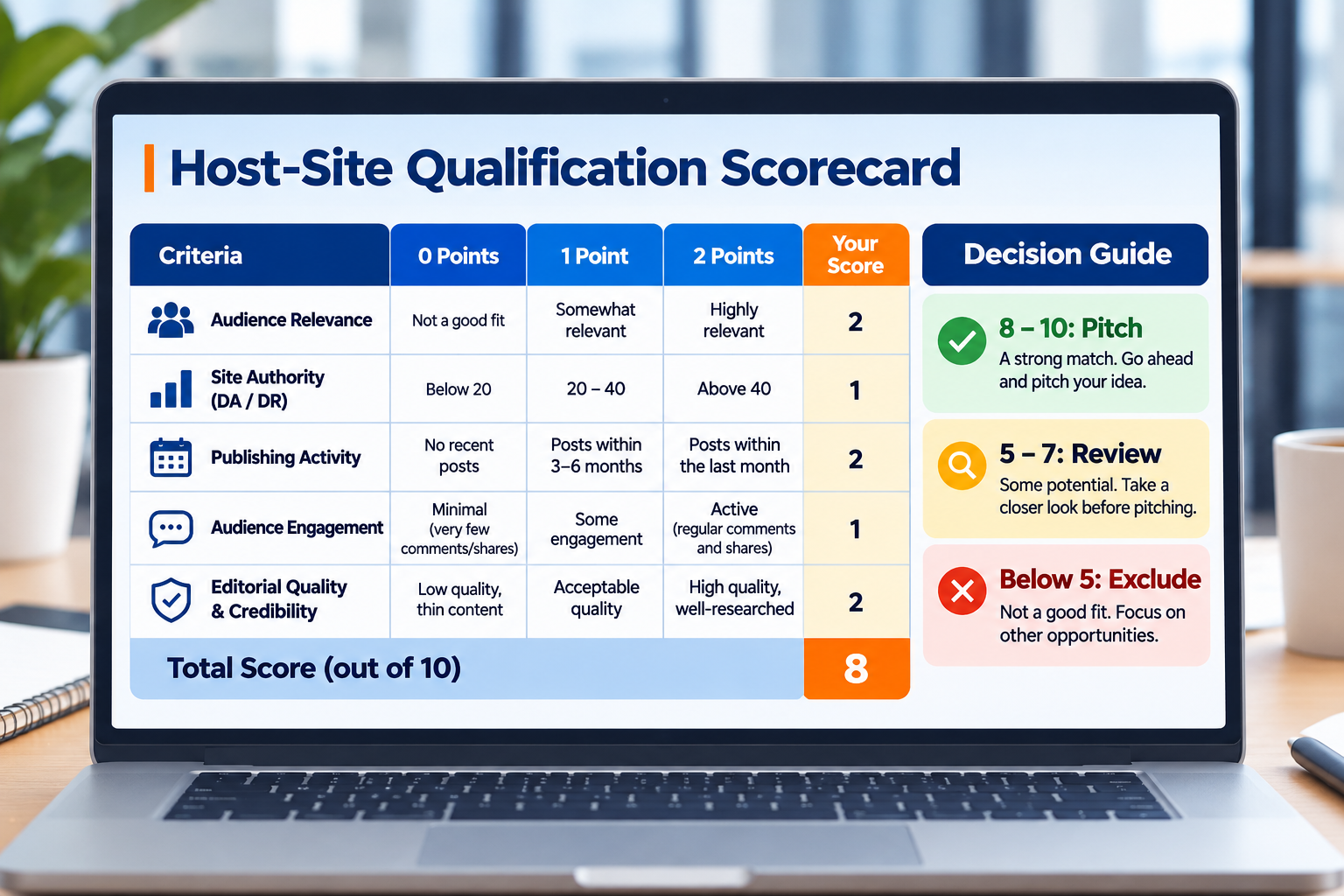
Score each host site 0 to 2 on five criteria, for a maximum of 10:
- Relevance: 2 for a direct audience match, 1 for adjacent, 0 for unrelated.
- Domain rating: 2 if clearly above yours, 1 if comparable, 0 if weaker or unfindable.
- Organic traffic: 2 for more than 10,000 monthly visits, 1 for a few thousand, 0 for little or none.
- E-E-A-T signals: 2 if named authors, credentials, editorial standards and a real About page are all visible, 1 if partial, 0 if bylines are anonymous.
- Recent activity: 2 if posts appear within the last month, 1 if within three months, 0 if older.
Thresholds: 8 to 10 is a pitch candidate, 5 to 7 needs manual review, and under 5 is excluded. A site scoring 5 to 7 with two or more red flags should also be excluded. These are this guide’s own rules, not published industry standards, so apply them consistently.
Test of the scorecard: we scored and tracked at least 10 sites over a campaign, recording which placements produced referral traffic. Publish your own results in the same format so that the scores can be checked against outcomes.
Quality signals to check
BuzzStream’s guide to guest posting sites suggests pitching only to sites with a high domain rating, more than 10,000 monthly organic visitors, visible E-E-A-T signals (Google’s shorthand for experience, expertise, authoritativeness and trustworthiness) and niche-matched content. Confirm that the free tools you use to measure these figures are current before relying on them.
Compare the domain against up to four main competitors, as Semrush’s guest post guide recommends, to spot outliers.
A high domain rating on an unrelated site is worth less than a modest one that your readers already trust. The same principle applies to backlink quality, where topical relevance and editorial credibility matter more than authority scores alone. Sites with impressive numbers but no topical focus accept almost any post, which signals weak editorial judgement. A marketing team that values relevance over raw metrics builds a stronger, more consistent strategy. The same principle applies to an internal linking strategy, where links should help readers discover relevant content.
Red flags that a site is not worth pitching
Published lists of guest post sites often go stale, and the 2024 Helpful Content Updates changed the landscape considerably, so verify activity yourself. Reviewing a site’s off-page SEO signals can also help identify questionable backlinks and publishing practices. Watch for:
- Last post date: Nothing published in several months means a dormant site.
- Social activity: A social media page with no real posts or engagement for years.
- Named editors: Anonymous bylines and “write for us” pages that accept anything point to link farms.
- Content mix: Unrelated contributions with keyword-heavy anchors mean placements are for sale.
- Disclosure: Unlabelled sponsored posts are a reputational risk to you and your readers.
When not to guest post
Decline the placement if any of these apply, even if the host site scores well:
- The host site scores below 5 on the scorecard.
- The site shows two or more red flags.
- The only real benefit is the backlink.
- You cannot name a reader need the post would meet.
- The site will not disclose sponsored placements. Check the publication’s help centre for its sponsorship policy before you pitch.
Finding Opportunities and Pitching Editors
Find prospects through research, qualify them with the scorecard, and pitch only the ones that score 8 or above. Most guest post lists should be abandoned, and the test below shows why.
Building a prospect list and using competitor research
Start with sites your buyers already read. Search for topics your audience follows across search engines, then score each result. Competitor domains show where similar brands publish guest blogging contributions on their blog and website. Keep one spreadsheet with the scorecard columns so every prospect is compared the same way. Include social media profiles of editors and contributors to track their activity and recent interests. Articles that match your audience’s interests make the strongest prospects.
Semrush recommends entering a prospective domain with up to four main competitors to see where those competitors publish. Use that comparison as a starting list, not a final one. Several competitor domains that look promising still turn out to be inactive once you check them.
Crafting a pitch that editors actually answer
Name the editor, cite one recent article on their site, propose a specific topic and explain what the reader gains. Keep the whole pitch under 150 words.
Copy this template and fill in the blanks:
Subject: Guest post idea:
Hi,
I read your piece “” and found the point about useful. I would like to write a post on for your readers, who are dealing with.
The post would cover and stay under words.
Would this suit your blog? I can send a full draft within.
,,
Pitch deliverability: SPF, DKIM and DMARC
SPF, DKIM and DMARC confirm your messages come from a domain you control. Set them up in your DNS and follow Google’s sender guidelines for bulk email. Authentication improves deliverability but does not guarantee acceptance.
Outreach tools such as BuzzStream, Semrush and Mailchimp can track prospects and send from an authenticated domain. Check current features before relying on them.
Handling rejection and persistence in your outreach
Rejection is normal. Follow up once after about a week, then stop after two follow-ups. Log every response so you know which sites to revisit.
Writing a Guest Post Editors Will Accept, and Readers Will Use
A strong guest post starts with a topic the host site’s readers need and a format the editor can publish. This section covers how to write the post itself, so that the blog’s editor can accept it and its audience will read it.
Headline and content formatting best practices
Write a headline that states the benefit plainly. “Guest Post Pitch Template for US B2B Blogs” tells an editor exactly what they get. Keep the reader in mind from the first line: they should know what they will gain within the first few lines. Headlines and opening lines also shape how a search engine reads the page, so put the main subject there clearly.
Format for a skim reader. Use short paragraphs, subheadings every few hundred words, and numbered lists for procedures. Format comparisons as tables and keep each guest post focused on one problem. Plan topics at least a month ahead, as Semrush’s guest post guidance recommends.
Writing a guest blogger bio that earns trust
The bio is the only place a reader can check who you are, so make it verifiable. Include your role, your organisation, one concrete result, and a link to a profile an editor can confirm. Avoid superlatives such as “world-renowned.”
Keep it to two or three sentences. If you cannot verify a claim, leave it out.
Common myths and misconceptions to drop
Myth: a longer article ranks better. Editors want the piece that answers the reader’s question completely, which is often shorter than writers expect.
Myth: a guest post is free promotion. A post that reads as an advertisement gets rejected or heavily edited.
Myth: once accepted, the job is done. Responding quickly to revision requests keeps the relationship open for future pitches.
Promoting your guest post after publication
Share the published piece on your website, newsletter and social channels. These promotional activities can complement a broader white-hat link-building strategy focused on earning relevant links through useful content. Track referral sessions from the host page, and tag shared links with UTM parameters, which show which source sent the visitor. Earned backlinks from the host site also help the piece get indexed.
Conclusion and Next Steps
Guest posting still works when the host site has a real, engaged readership and your contribution adds something new. Google’s 2014 warning said guest posts written mainly for link building could be harmful, so treat the link as a side effect of good editorial work. Write for the people who will read the piece, since that is what keeps your marketing effort credible with the search engines over time.
Run the Host-Site Qualification Scorecard before every pitch. Pitch sites scoring 8 to 10, review those at 5 to 7, and drop anything below 5. Confirm activity yourself, because published site lists go stale quickly.
Your next steps:
- Build a list of 10 candidate websites and score each one.
- Check recent posts and social media activity for every site scoring 5 or higher.
- Pitch only sites scoring 8 or higher, with a specific angle.
- If no site clears the bar, publish on your own blog or pursue a podcast or expert roundup.
Frequently Asked Questions
Is guest posting still worth doing in 2026?
Yes, but only on the right sites. Google warned in 2014 that guest posts written mainly to earn links could be harmful. BuzzStream’s guide to guest posting sites notes that the Helpful Content Updates changed which sites are worth pitching. A guest post still builds audience and credibility when the host has a real readership, and your post adds something new.
How do I find guest posting opportunities that are not spam?
Score each site from 0 to 2 on editorial relevance, recent engagement, traffic and authority, visible editorial standards, and audience fit. Sites scoring 8 to 10 are pitch candidates. Confirm the blog has posted recently, and compare the domain against up to four competitors in Semrush.
What should a guest post pitch include?
Keep it short and specific: a working headline, a two- or three-sentence summary, why this audience needs it now, and one line on your relevant experience. Name the editor and mention a recent post on their site. SPF, DKIM and DMARC records help pitches reach inboxes, as BuzzStream explains.
How long should a guest post be?
Match the length of the host’s recent posts. Shorter, dense pieces usually outperform padded ones.
Can guest posts hurt my search rankings?
They can, when placements are thin, sponsored without disclosure, or published on link farms or content mills. A few posts on credible, engaged sites carry far less risk than many placements chosen for their links.
How do I measure whether a guest post worked?
Track referral traffic, newsletter sign-ups and enquiries, and compare them with the goals you set before pitching. A post that brings qualified readers back to your site is a success even without a link.