A campaign manager asks an AI tool to draft ten paid-social ads from a product brief. The copy arrives in seconds, but two versions invent a discount, one promises delivery the company cannot provide and several repeat the same claim with different adjectives. Without a product check, faster writing becomes faster publication of incorrect information. Measure how much accurate, usable work reaches customers after editing and approval.
Generative AI marketing can help with research, content drafts, image variations and campaign tests, but the economics change when a person must rebuild every output or correct a public mistake. Begin with reviewable internal work; expand only when approval roles are clear.
The framework below sorts use cases by customer exposure and reversibility, maps the risks to individual tasks and gives marketing managers a 90-day pilot with measurable decisions at the end.
Key Takeaways
- Measure accepted work, not the number of AI drafts. An output that needs a complete rewrite is not a productivity gain.
- Begin with briefs, summaries and copy variants that a person reviews before use.
- Treat live customer responses, product claims and automated budget decisions as higher-risk tasks.
- Score every use case by exposure to customers and how easily an error can be reversed.
- Verify facts against approved sources and protect personal or confidential information.
- Compare AI-assisted work against a baseline for time, cost, quality and campaign results.
- Run a limited 90-day pilot before expanding access or automation.
Where Generative AI Marketing Fits
Generative tools produce text, images, video, audio and other material from instructions and examples. In a marketing department, common tasks include turning a brief into draft copy, summarising research, proposing ad variants and adapting approved content for different formats. Check any analysis against the underlying records. Start with repeatable tasks that have clear inputs, outputs and reviewers. A model can suggest headlines but cannot establish whether a product promise is true.
Research, Trend Analysis and SEO Support
AI can group search queries, summarise interviews and outline content using verified sources. Marketers can reject weak drafts before publication. Start with a customer question and approved sources. Ask the model to separate facts from assumptions and flag missing evidence.
Check competitor prices, rules and statistics yourself. For search content, AI-generated text should receive the same scrutiny as any other draft. Google’s guidance on generative AI content stresses accuracy, quality, relevance and manual fact-checking. Generating many pages without added value may breach its scaled-content spam policies.
Content, Email and Ad Copy
Content briefs, social captions, email subject lines and search-ad headlines are strong candidates for assisted drafting. They have defined constraints, and variants can be tested rather than accepted on instinct. Provide product facts, brand examples, prohibited claims and target audience details.
Separate drafting from approval. A copywriter checks accuracy and tone, a channel owner checks formatting and policy, and the campaign manager checks that the message matches its landing page. Use a AI content creation workflow so the review steps do not disappear when production gets faster. For personalisation, use anonymised insights and check data permissions against PDPC data protection guidance where relevant. Test a few variants against existing creative.
Customer Service and Sentiment Analysis
A live chatbot can publish inaccurate refund rules or delivery promises immediately. Require approved answers, monitoring, clear owners and an escalation path. Customer acceptance also varies. Ipsos’s 2026 customer experience research warns that removing friction through automation does not automatically create a better experience.
A shorter interaction is of little benefit if a customer cannot resolve the problem. Sentiment analysis is less visible, but sarcasm and multilingual slang can distort its labels. Read sample reviews and report the categories and sample size.
Image and Video Production With AI
Generative image and video tools can produce layout ideas, background treatments, storyboard frames and alternative creative concepts. Check visuals depicting people, packaging or product details particularly carefully. An image may show nonexistent colours or product parts; video may introduce inconsistent faces. Compare outputs with approved product imagery.
A Practical Creative Approval Workflow
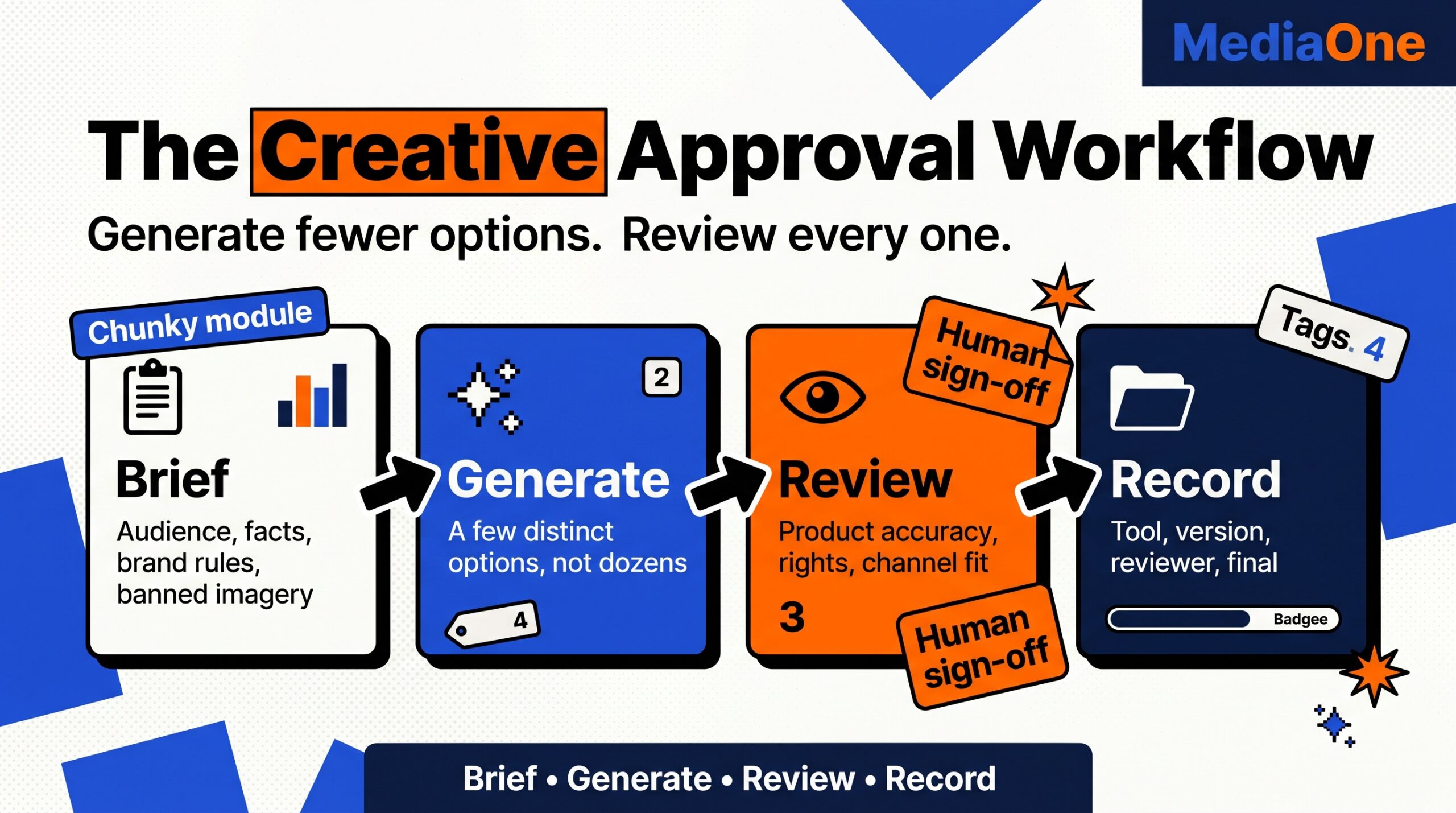
- Brief: Define the audience, message, product facts, required dimensions, brand rules and prohibited imagery.
- Generate: Produce a small number of distinct options rather than dozens of near-identical files.
- Review: Have a designer confirm product accuracy, visual consistency, text, usage rights and suitability for the channel.
- Record: Log the tool, version, source assets, reviewer and final approval for each published item. Record the approved version and where it appeared. For teams comparing software, MediaOne’s generative AI tools for marketers covers tools by job rather than treating all assistants as interchangeable.
Benefits and Limits of Generative AI in Marketing
Generative tools can shorten repetitive drafting tasks. Actual savings depend on editing and correction time. More creative variants help only when campaigns have sufficient data for controlled tests. Models may invent claims or copy a tone poorly. People must approve public-facing work. For specialist content marketing services, the creative brief, sourcing and editorial judgement remain separate responsibilities from generating a draft.
Judge generative AI marketing by publishable output and business results, not adoption rates or the speed of its first response. Adoption surveys do not establish your return.
Use-Case Fit Matrix for Marketing Teams
Before buying licences, score tasks by customer exposure and reversibility. The matrix is an internal working tool, not an industry benchmark.
How to Score Exposure and Reversibility
Customer exposure is low when the output stays inside the team until a person reviews it. It is high when a model answers customers, publishes material or changes an active campaign without prior approval. Reversibility is high when an error can be rejected or corrected before anyone relies on it. It is low when a wrong claim, personal-data disclosure or budget decision may have consequences even after being withdrawn.
| Exposure | Reversibility | Recommended rule | Example |
|---|---|---|---|
| Low | High | Start with routine review | Internal research summary |
| Low | Low | Require specialist sign-off | Sales forecast influencing budget |
| High | High | Approve before publication | Blog post or paid ad variant |
| High | Low | Restrict or closely supervise | Autonomous support reply |
Worked Examples and Approval Rules
An internal competitor brief has low exposure and high reversibility: reviewers can discard weak drafts. AI can suggest email subject lines, but a person must check offers, segments and tests. Blog posts require pre-publication fact-checking because misleading claims may spread before correction. A revenue forecast affects budgets even when customers never see it. Require a finance or analytics reviewer to validate assumptions and calculations.
A live service bot has both high exposure and potentially low reversibility. Limit it to approved answers, define when it must hand off, and provide a visible route to a person. Expand beyond two low-risk tasks only after recording quality and net time saved.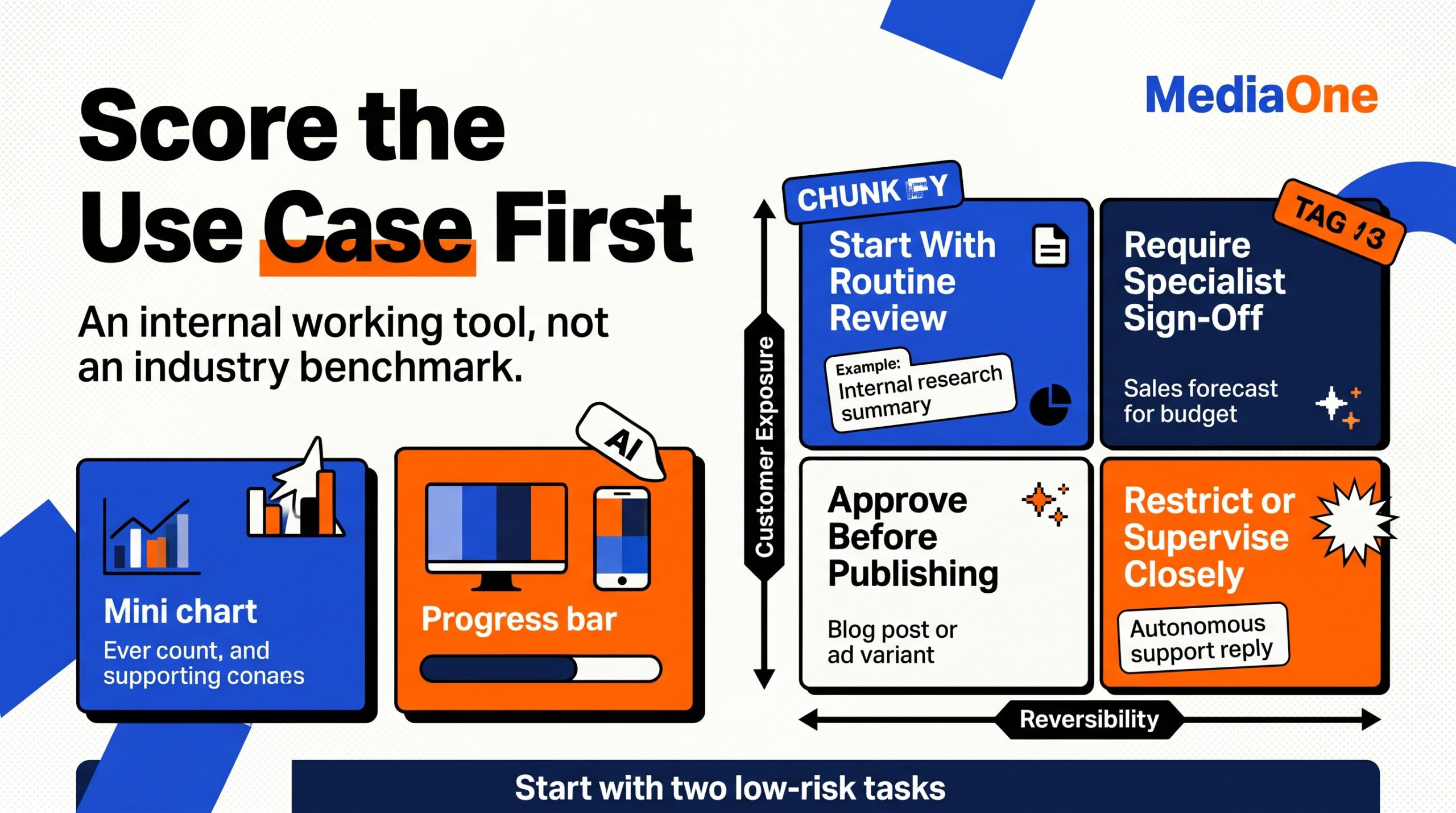
Five Generative AI Marketing Risks to Review
Assign risks to tasks and owners. Product headlines and chatbots have different failure points.
| Risk | Where it appears | Minimum check |
|---|---|---|
| Accuracy | Product claims, research, pricing | Verify against approved current sources |
| Bias | Segmentation, audience descriptions | Review stereotypes and unfair assumptions |
| Transparency | Chatbots, synthetic testimonials | Explain AI involvement where appropriate |
| Copyright | Images, video, copy | Review source rights and human contributions |
| Privacy | Customer records, prompts, personalisation | Limit data and check access, purpose and consent |
- Accuracy: Require the source of every external fact. If the tool cannot show an authoritative source, treat the claim as unverified. A fluent paragraph is not evidence.
- Bias: Review audience-facing text for unsupported assumptions about age, gender, nationality or other personal attributes. Sensitive segmentation needs more than a stylistic edit.
- Transparency: Customers should not be misled about whether they are dealing with an automated assistant or a real person. Set appropriate disclosure and escalation rules for each use case.
- Copyright: The US Copyright Office’s 2025 AI report says copyright protection depends on sufficient human authorship. Merely supplying prompts does not by itself establish authorship of an AI-generated output. Rights and contractual questions vary by jurisdiction, so review significant creative assets before commercial use.
- Privacy: Do not paste identifiable customer records, confidential campaign plans or internal pricing into an unapproved tool. For Singapore organisations, review the Personal Data Protection Act before using personal data. Confirm how a vendor stores, accesses and uses information before uploading data.
Why AI Hallucinates and How Grounding Helps
Generative models predict plausible outputs rather than verifying sentences. Gaps can produce invented statistics, prices or quotations. Grounding reduces those opportunities by supplying relevant, current documents. For example, provide an approved product sheet, delivery policy and price list before generating customer emails. Ask the model to flag unanswered questions rather than invent an answer. Then check high-risk details manually. Documents can be outdated or misread. Assign responsibility for keeping sources current.
Measuring ROI and Running a 90-Day Pilot
Set a baseline for production time, editing, accepted assets, cost and campaign results. Compare similar work across periods. Do not count rejected drafts as completed work. Include review time shifted to managers.
Pilot Metrics and Keep-or-Drop Rules
Choose a small set of measures before the pilot begins:
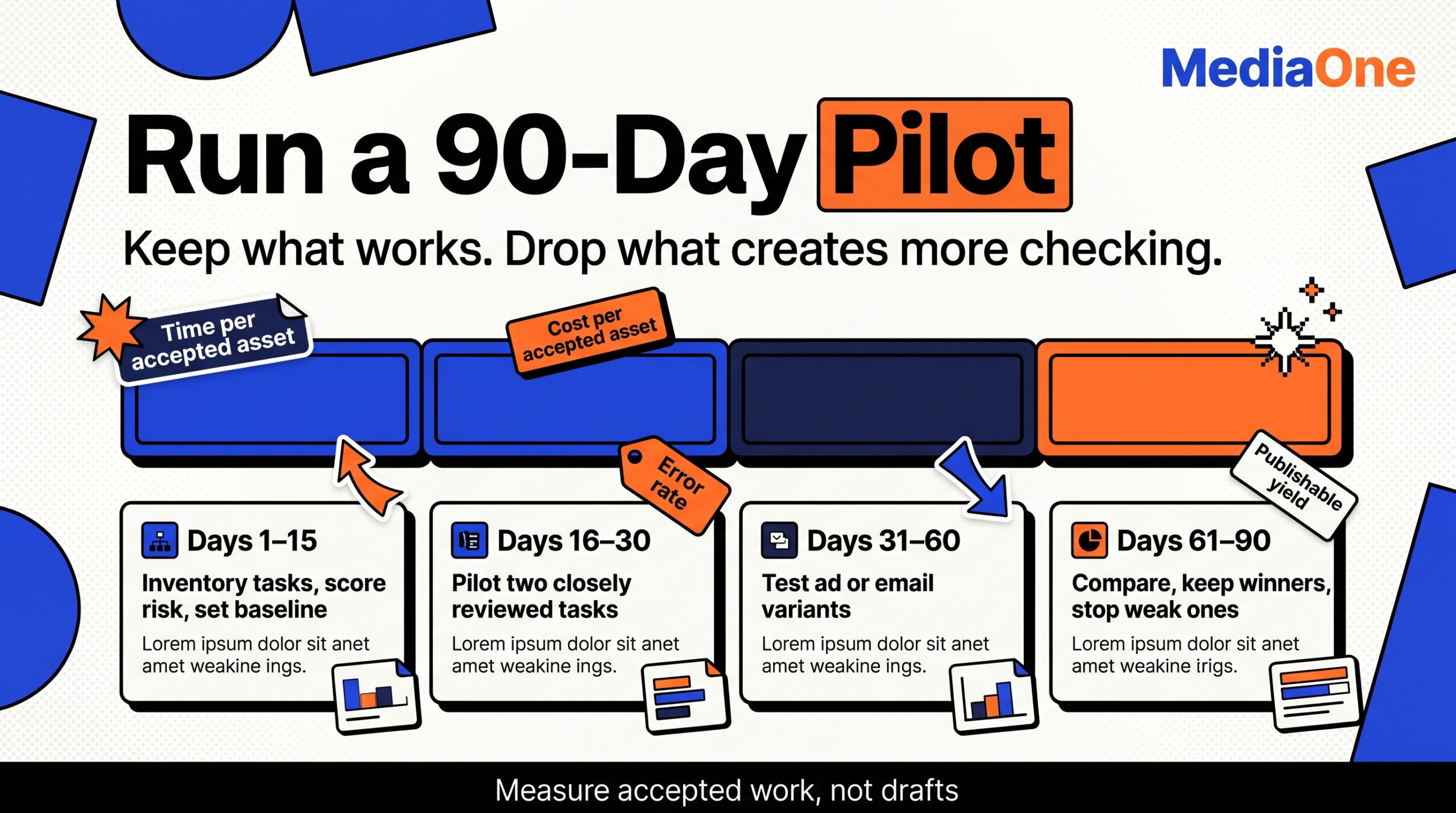
- Time per accepted asset: Time from brief to approved version, including verification and revisions.
- Cost per accepted asset: Tool costs plus staff time for generation, editing and approval.
- Error rate: Share of drafts requiring factual or compliance corrections.
- Campaign performance: Leads, conversion rate or another preselected outcome from controlled tests.
- Publishable yield: Approved assets divided by all AI-assisted drafts produced. Set decision thresholds from your own starting figures rather than universal percentages. For example, a team may keep a drafting tool if it saves 30 minutes per approved email and does not increase errors. That is an illustrative decision rule, not a published benchmark.
Worked ROI example (illustrative)
A team previously spent four hours on each of eight approved email assets, or 32 hours total. With AI assistance, each accepted asset takes 2.75 hours including review, or 22 hours. At an assumed staff cost of S$40 per hour, the ten hours saved are worth S$400. Subtract an illustrative S$60 tool subscription and the net saving is S$340 for that batch.
If corrections push total time above 32 hours, the saving disappears. Track actual labour costs and asset quality before using this calculation for budgeting. Record test conditions; seasonality and budget changes can distort comparisons.
A workflow platform may help with approvals and version control; see MediaOne’s content marketing platform comparison for the types of features to evaluate.
A 90-Day Implementation Plan
| Period | Action | Evidence to keep |
|---|---|---|
| Days 1-15 | Inventory tasks, score exposure and reversibility, record the baseline | Use-case matrix, time logs, review owners |
| Days 16-30 | Pilot two internal or closely reviewed content tasks | Drafts, approvals, errors, editing time |
| Days 31-60 | Test selected ad or email variants against existing work | Test design, cost per asset, campaign results |
| Days 61-90 | Compare the results, keep effective uses and stop weak ones | Decision log, revised approval rules |
Assign data, sourcing and publishing owners. Use approved prompts and record time saved after editing. Test variants with consistent audiences and offers. At day 90, expand only tasks that met quality and cost targets.
Conclusion
Generative AI marketing is most manageable when teams begin with work that can be checked before publication. Research briefs, content drafts and creative variants offer a practical starting point; autonomous customer replies and high-stakes decisions require stricter controls. Score the next proposed use case for exposure and reversibility. Choose two low-risk tasks, assign reviewers and measure accepted output over 90 days. If a tool creates more checking work than it saves, remove it from the process rather than forcing adoption.
Frequently Asked Questions
What is generative AI marketing?
Generative AI marketing uses models to help produce and adapt marketing material, including copy, images, research summaries and campaign variants. Human reviewers remain responsible for strategy, factual claims, appropriate data use and final publication.
Is generative AI marketing worth it for a small business?
It can be worthwhile for repeatable work such as briefs, email drafts and social variants, particularly when one person performs many roles. Start with a limited trial and measure review time and accepted output before buying more tools.
How can marketers keep AI-generated content accurate?
Supply current approved source documents, ask the system to flag missing information, and verify statistics, pricing and product statements before publication. Keep a record of corrections so recurring mistakes lead to changes in the brief or process.
Can AI-generated marketing content rank on Google?
Google evaluates content quality and usefulness rather than rejecting a page solely because AI assisted its creation. Low-value pages produced at scale can violate spam policies, so focus on original information, reliable sourcing and a useful answer for readers.
Who owns copyright in AI-generated marketing assets?
Ownership and protection depend on the jurisdiction, the terms of any tools or source assets, and the extent of human authorship. Document creative decisions and modifications, and obtain legal review before relying on important assets in commercial contracts.
Should businesses use AI chatbots for customer service?
Only where the bot can answer from approved information, disclose automation appropriately and transfer complex questions to a person. Test failure cases and keep records of complaints or unresolved conversations before expanding its role.
How do you measure generative AI marketing ROI?
Compare accepted assets, total production cost, editing time, error rate and relevant campaign results against the pre-pilot baseline. A reduction in writing time is not a gain if corrections or poor performance cancel it out.