| AI Summary
GDPR compliance applies to Singapore businesses that offer goods or services to people in the EU or monitor their behaviour there. Businesses must establish lawful processing, protect personal data, manage individual rights and meet breach notification requirements. This guide explains how GDPR and Singapore’s PDPA differ, covering data protection officers, consent, international data transfers, penalties and a practical compliance checklist. |
GDPR compliance matters to Singapore businesses that target people in the European Union (EU) or monitor their behaviour while they are there. An overseas company does not need an EU office to come within the General Data Protection Regulation (GDPR). However, simply having an accessible website or holding information about an EU citizen does not automatically trigger it.

Singapore’s Personal Data Protection Act (PDPA) may also govern the same activities. We recommend building one data inventory and applying the specific requirements of each law, rather than maintaining separate compliance programmes. This guide explains the legal triggers, practical controls and decisions Singapore companies should address first.
Key Takeaways
- Check territorial scope first. Under Article 3, offering goods or services to people in the EU or monitoring their behaviour there can bring Singapore-based processing within the GDPR.
- Consent is not always required. Every processing purpose needs a valid legal basis, but consent is only one of six options under Article 6.
- Appoint a Singapore DPO. The PDPA requires organisations to designate a Data Protection Officer (DPO), even when the GDPR does not require one.
- Prepare separate breach assessments. GDPR notification may be required within 72 hours of awareness; Singapore’s PDPA uses different thresholds and deadlines.
- Check EU-to-Singapore transfers. Personal data transferred from the European Economic Area (EEA) may require safeguards such as Standard Contractual Clauses (SCCs).
Why the GDPR Reaches Singapore Businesses
The GDPR began applying on 25 May 2018. It established directly applicable EU protections, while national laws and supervisory authorities remain relevant.
For Singapore companies, the central question is what the business does with people’s data and whether those activities meet Article 3. Retailers, software providers and advertisers may qualify. We assess applicability activity by activity.

The GDPR also extends across the European Economic Area, including Iceland, Liechtenstein and Norway. Singapore businesses serving these markets should review audience targeting and data flows. We recommend checking each market separately to avoid overlooking obligations or restricting unrelated Singapore operations.
Territorial Scope: When GDPR Applies
Article 3 covers processing connected to an establishment in the EU. It also covers specified processing by organisations without an EU establishment. For Singapore companies without an EU establishment, the second route matters, as explained in the European Data Protection Board’s territorial-scope guidelines.
Offering goods or services to people in the EU
The test is whether a business envisages offering goods or services to people who are in the EU, even if the offering is free. Clear indicators include dedicated EU delivery options, European-language marketing aimed at specific markets or advertising directed at EU audiences. Merely operating a website that EU visitors can open is insufficient.
For example, a Singapore skincare retailer actively promoting delivery to France would generally need to assess GDPR compliance for that customer-processing activity. An unexpected order alone does not establish targeting. Context matters.
Monitoring behaviour in the EU
The second test concerns monitoring people’s behaviour as far as it takes place within the EU. Behavioural advertising, individual-level profiling and tracking activity across websites can qualify. Not every analytics configuration qualifies.
Location at the relevant time matters, not EU nationality or permanent residence. A Singapore citizen visiting Germany may fall within the territorial test when targeted or monitored there. Conversely, holding a French citizen’s record in Singapore does not automatically make unrelated processing subject to Article 3(2).

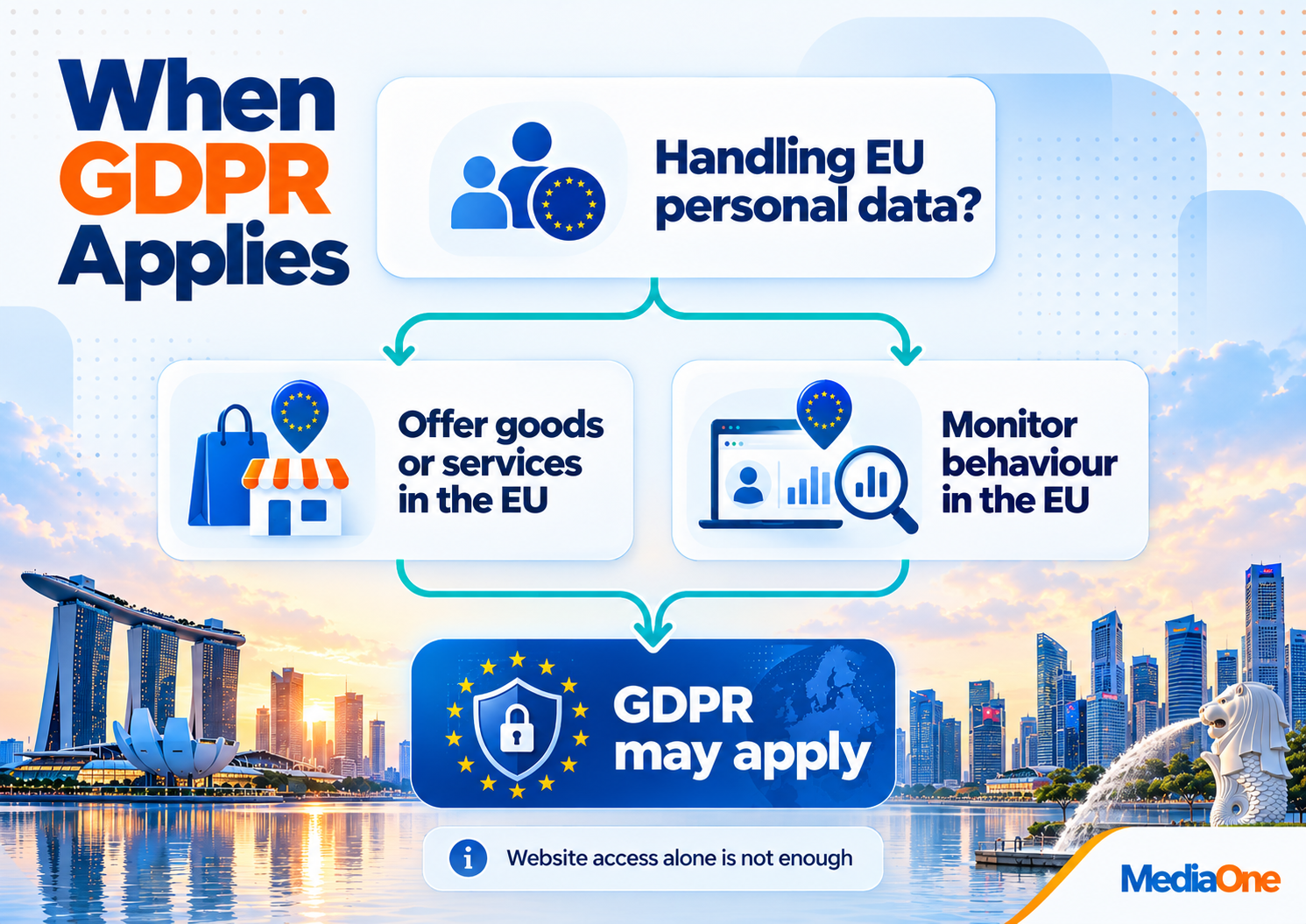

Our scope test: Review each website, campaign, application and customer segment. Record what indicates EU targeting or monitoring, which personal data is involved and who controls the processing. Reassess when sales territories, advertising audiences or tracking tools change.
Key GDPR Definitions
- Personal data: Information relating to an identified or identifiable natural person, including identifiers, online identifiers and information linked to an individual.
- Data subject: The individual whose personal data is processed.
- Controller: The party determining the purposes and essential means of processing.
- Processor: A party processing personal data on a controller’s behalf.
- Processing: Operations such as collecting, recording, analysing, transmitting, retaining or deleting personal data.
- Special-category data: Sensitive categories under Article 9, including certain health, biometric, religious and political information, subject to specific protections.
A business can act as a controller for customer orders and a processor for a client’s marketing database. Roles depend on actual arrangements, not contractual labels. Identify them for each material data flow.
The Seven Principles and Lawful Processing
Article 5 of the official GDPR text contains six substantive principles and an accountability requirement, commonly presented as seven principles:
- Lawfulness, fairness and transparency: Process data fairly, explain its use and establish a lawful basis.
- Purpose limitation: Collect data for specified, explicit and legitimate purposes.
- Data minimisation: Collect only what is necessary for those purposes.
- Accuracy: Keep information accurate and correct errors when needed.
- Storage limitation: Retain identifiable data only as long as justified.
- Integrity and confidentiality: Protect data through appropriate technical and organisational measures.
- Accountability: Demonstrate compliance with the other principles through appropriate evidence.
Consider a Singapore ecommerce checkout serving German customers. Delivery details may be necessary to fulfil a contract, but an optional marketing subscription needs its own assessment. The company should restrict employee access, publish a clear privacy notice and set justified retention periods for invoices and customer profiles.
Choose the correct lawful basis
Article 6 provides six bases: consent, contract, legal obligation, vital interests, public task and legitimate interests. They are not interchangeable, and some are rarely suitable for ordinary commercial processing. The basis must fit the purpose before processing begins.
| Processing activity | Potential GDPR lawful basis | What to check |
| Delivering an online order | Contract | Is the information necessary to fulfil the order? |
| Keeping records required by law | Legal obligation | Which applicable law requires retention? |
| Certain fraud-prevention activities | Legitimate interests | Are the interests balanced against individuals’ rights? |
| Optional email marketing | Consent or another applicable basis | Do GDPR and relevant marketing rules permit the approach? |
A legitimate-interests assessment should document necessity, the business interest and the impact on individuals. It cannot automatically justify intrusive profiling. We recommend reviewing higher-risk marketing activities with qualified privacy counsel before launch.
GDPR consent requirements
When relying on consent, it must be freely given, specific, informed and unambiguous. A clear affirmative action is required; pre-ticked boxes and silence do not qualify. Consent requests must be distinguishable from unrelated terms and should explain each relevant purpose.
Withdrawal must be as easy as giving consent, without affecting the lawfulness of earlier processing. Record the agreement, notice version and timestamp. The EDPB’s lawful-processing guidance explains these conditions.
Cookies also require care. The GDPR governs personal-data processing, while EU member states’ electronic-privacy rules can require consent for storing or accessing non-essential information on devices. Do not assume a GDPR lawful basis alone resolves every advertising-cookie requirement.
Transparency should be built into the customer journey. Articles 13 and 14 require specified privacy information, including processing purposes, legal bases, recipients, retention details and applicable rights. Explain these matters at the appropriate collection point or within the relevant statutory timeframe. A generic privacy-policy link cannot compensate for unclear marketing choices or hidden tracking.
GDPR and PDPA: Where the Obligations Differ
The PDPA is Singapore’s personal-data law, overseen by the Personal Data Protection Commission (PDPC). Both laws can apply to the same activities. Their legal tests and rights differ.
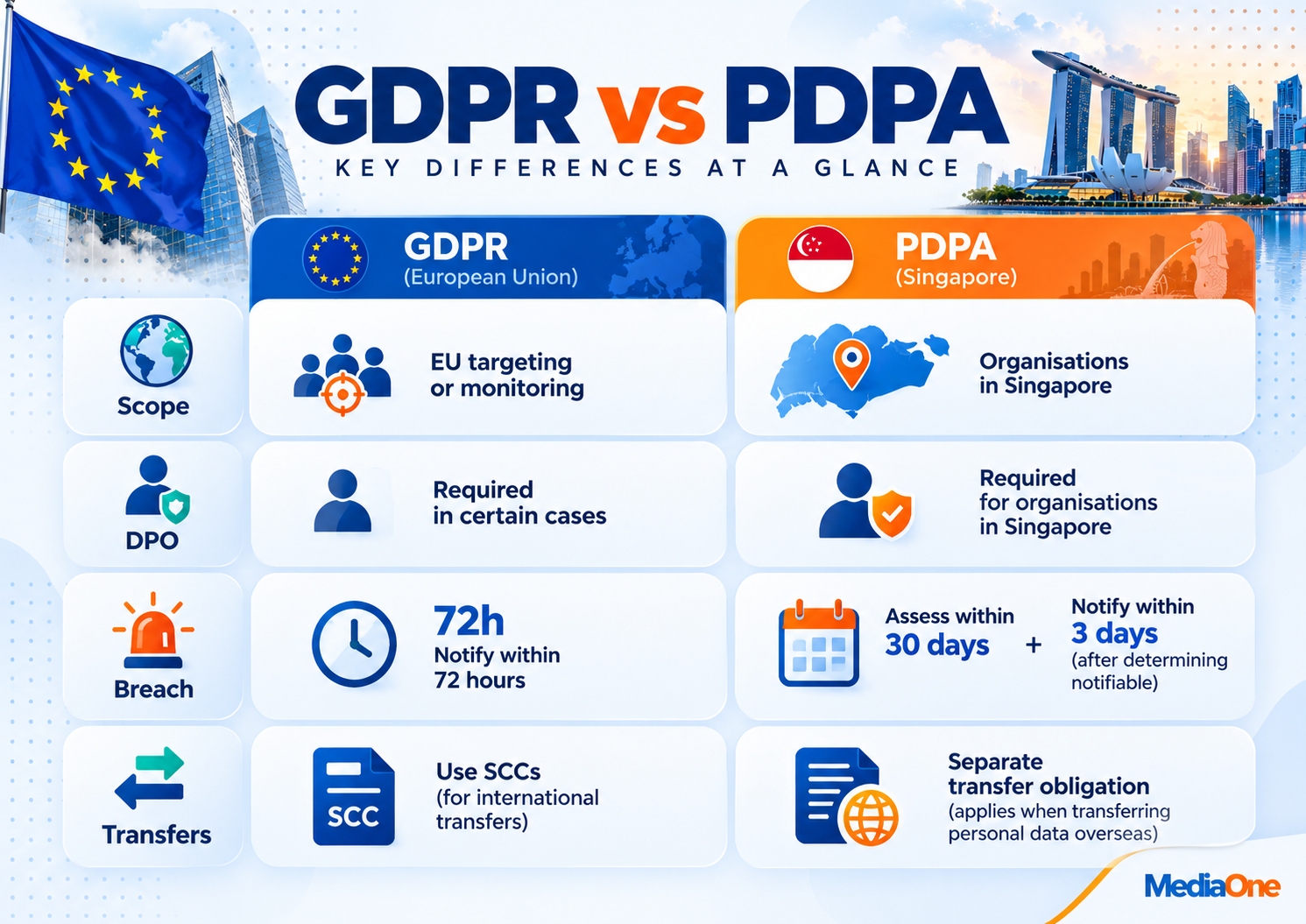
| Issue | GDPR | Singapore PDPA |
| Main applicability test | EU establishment or qualifying EU targeting/monitoring | Applicable collection, use or disclosure of personal data under Singapore law |
| Legal grounds | Article 6 lawful bases; extra conditions for special-category data | Consent framework with statutory exceptions and other applicable rules |
| Data protection officer | Mandatory in specified Article 37 cases | DPO designation required for organisations |
| Individual rights | Includes access, erasure, portability and objection, subject to conditions | Includes access and correction, with statutory limits |
| Breach reporting | Risk-based supervisory notification, where feasible within 72 hours | Significant-harm or significant-scale thresholds; separate notification timetable |
| Overseas transfers | Chapter V restrictions and transfer mechanisms | Transfer Limitation Obligation and applicable exceptions |
Do not simply apply whichever law seems stricter. Determine which law applies to each activity, then meet both sets of requirements where they overlap. A GDPR right to erasure, for example, has no exact general equivalent under the PDPA, although Singapore’s retention rules still require action when data is no longer needed.
Singapore’s PDPA legislation and PDPC guidance should be reviewed alongside the GDPR. Sector-specific rules can also matter, particularly for financial institutions and healthcare providers. Shared controls cannot erase legal differences.
Building One Compliance Foundation
We recommend starting with a processing inventory that identifies every meaningful activity involving personal data. This supports notices, retention, incidents and vendor reviews. It reveals gaps before launch.
Data mapping and the dual-regime coverage matrix
Map your storefront, customer relationship management (CRM) system, email service, advertising pixels, payment gateway, support desk and cloud storage. Include spreadsheets, shared drives and third-party integrations. These overlooked copies can complicate access requests and deletion.
For each processing activity, record:
- The purpose, controller or processor role and accountable owner.
- The data categories, sources, individuals concerned and recipients.
- Why Article 3 applies, or why the activity is outside its scope.
- The GDPR lawful basis and any applicable PDPA requirements.
- Locations of storage, access and international transfers.
- Retention rules, security controls and review dates.
For example, an EU-targeted email campaign might contain subscriber addresses, consent evidence, the email platform’s location and a retention rule. A separate checkout row would document transactional records and its contractual basis. This keeps unrelated uses separate.
Article 30 requires records of processing activities in relevant circumstances. Its limited exception for organisations with fewer than 250 employees does not cover processing that is non-occasional, risky or includes certain sensitive data. A useful inventory remains advisable even where a particular recording exemption applies.
DPO designation and EU representation
Singapore requirement: The PDPA requires an organisation to designate at least one person responsible for ensuring compliance. The function may be performed internally or outsourced, and contact information must be made publicly available. Section 11 of the PDPA requires this designation and public contact information.
GDPR requirement: Article 37 mandates a DPO for public authorities and certain organisations whose core activities involve large-scale regular monitoring or large-scale processing of specified sensitive data. A Singapore appointment does not automatically meet GDPR-specific DPO requirements.

There is also a separate EU representative question. Under Article 27, many non-EU organisations covered by Article 3(2) must designate a representative in the EU, subject to exceptions, including narrowly defined occasional, low-risk processing. A representative does not replace a DPO or remove company obligations.
Data Protection Impact Assessments
Article 35 requires a Data Protection Impact Assessment (DPIA) when proposed processing is likely to result in a high risk to individuals. Examples include certain systematic evaluations with significant effects, large-scale sensitive-data processing and systematic monitoring of publicly accessible areas on a large scale. Assess risk in context.
Our recommended DPIA process is to describe the activity, assess necessity and proportionality, identify potential harm, and document safeguards and residual risk. A simple likelihood-and-impact matrix can support discussion, but an internal numeric score cannot override a statutory DPIA obligation. Under Article 36, consult the competent supervisory authority before processing if the DPIA shows high residual risk that cannot be mitigated.
Vendor contracts and international transfers
Article 28 requires an appropriate binding contract when a processor handles personal data for a controller. It must address instructions, confidentiality, security, subprocessors, assistance with rights and breaches, and end-of-contract handling. Check service configurations, not generic compliance badges.
EU-to-Singapore transfers also need separate analysis. Singapore is not generally covered by an EU adequacy decision, so transfers subject to GDPR Chapter V commonly rely on SCCs or another valid mechanism. Depending on the circumstances, a transfer-impact assessment and supplementary safeguards may be needed; the EDPB’s international-transfer guide explains the options.
A Singapore company collecting data directly from an individual in the EU does not thereby make a Chapter V transfer, although later disclosures to overseas processors may qualify. If an EU-based company sends records to Singapore, Chapter V may apply. We recommend checking who exports the data, from where and under which legal role before selecting contractual safeguards.
Singapore’s PDPA has a separate Transfer Limitation Obligation. GDPR SCCs do not automatically satisfy it.
For each transfer, identify the exporter, importer and processor relationship. Check whether the selected SCC module fits the arrangement and whether the importer is itself directly subject to GDPR for that processing. The European Commission’s SCC questions and answers distinguish these scenarios. Do not copy an SCC template into every vendor agreement without checking its scope.
Data Subject Rights and Response Deadlines
Under the GDPR, individuals may have rights to information, access, rectification, erasure, restriction, portability and objection. Article 22 also provides protections concerning certain solely automated decisions, subject to conditions. Rights have statutory exceptions, including some legal-retention duties.
An organisation must generally respond without undue delay and within one calendar month of receiving a GDPR rights request. In complex or numerous cases, it may extend the period by up to two further months, provided it explains the extension within the first month. The European Commission’s request-handling guidance sets out this approach.
For PDPA access requests, Singapore organisations must respond as soon as reasonably possible. If unable to respond within 30 days, they generally need to give written notice within that period stating when a response can be expected. That is different from the GDPR’s one-month response rule.
A practical request-handling workflow
- Receive and log: Record the request, receipt date, requested right and responsible person.
- Verify identity: Seek only proportionate evidence where identity is genuinely uncertain.
- Identify applicable regimes: Check the processing activity and rights available under each law.
- Search systems: Locate records across live services, accessible archives and processors.
- Assess exceptions: Consider third-party rights, legal retention duties and applicable restrictions.
- Respond securely: Provide the permitted information or explain a refusal and relevant complaint rights.
- Retain evidence: Record searches, decisions, communications and completion dates.
Consider a customer requesting both access to past orders and deletion of their marketing profile. You may provide an access copy while deleting data no longer needed for marketing. Invoices that must be retained for a valid legal obligation may remain, with access restricted and the decision explained.
We recommend a single intake channel with separate rules for each applicable regime. This reduces missed requests without pretending that GDPR and PDPA rights are identical.
Breach Response and Penalties
A GDPR personal data breach can involve unauthorised disclosure, loss, alteration or destruction of data, including an availability incident. Article 33 requires supervisory-authority notification without undue delay and, where feasible, within 72 hours after awareness, unless the breach is unlikely to pose a risk to individuals’ rights and freedoms. It does not require reporting every incident regardless of risk.
If a breach is likely to result in high risk, Article 34 generally requires informing affected individuals without undue delay. Exceptions can apply, including where effective encryption made the data unintelligible or later measures removed the high risk. Controllers must document breaches and notification decisions, including incidents that do not require authority notification.
How Singapore’s breach rules differ
Under the PDPA, a breach is notifiable to the PDPC when it is likely to cause significant harm to affected individuals or is of significant scale, generally involving 500 or more individuals. Organisations must assess suspected breaches reasonably and expeditiously, within 30 calendar days. Once a breach is determined to be notifiable, notification to the PDPC is due as soon as practicable and no later than three calendar days.
Where individual notification is required, the PDPA generally calls for it as soon as practicable, at the same time as or after notification to the PDPC. The PDPC’s data-breach guide explains thresholds, exceptions and timelines.
One incident register, two legal decisions
We recommend a runbook covering detection, containment, evidence preservation, risk assessment, legal notification and follow-up. Record exactly when the organisation became aware of the incident and when it determined PDPA notifiability. The clocks start differently.
For each incident, document affected datasets, jurisdictions, security measures, potential harm, vendor communications and reasons for reporting or not reporting. Test the process with a realistic incident scenario before relying on it. An EU customer breach may require GDPR reporting even when the Singapore 500-person threshold is not met.
Penalties and remediation evidence
Article 83 has different fine tiers. The highest maximum is €20 million or 4% of worldwide annual turnover, whichever is higher, for specified serious infringements; some other infringements carry a lower maximum of €10 million or 2%. These are ceilings, not automatic penalties, and regulators consider the circumstances. The European Commission explains its enforcement powers.
For relevant PDPA data-protection breaches, the maximum is generally S$1 million, or 10% of annual turnover in Singapore where that turnover exceeds S$10 million, subject to the statutory framework. Keep dated evidence of corrected controls, staff training, breach decisions and vendor follow-ups. These materials support accountability, but they cannot guarantee reduced penalties.
GDPR Compliance Checklist
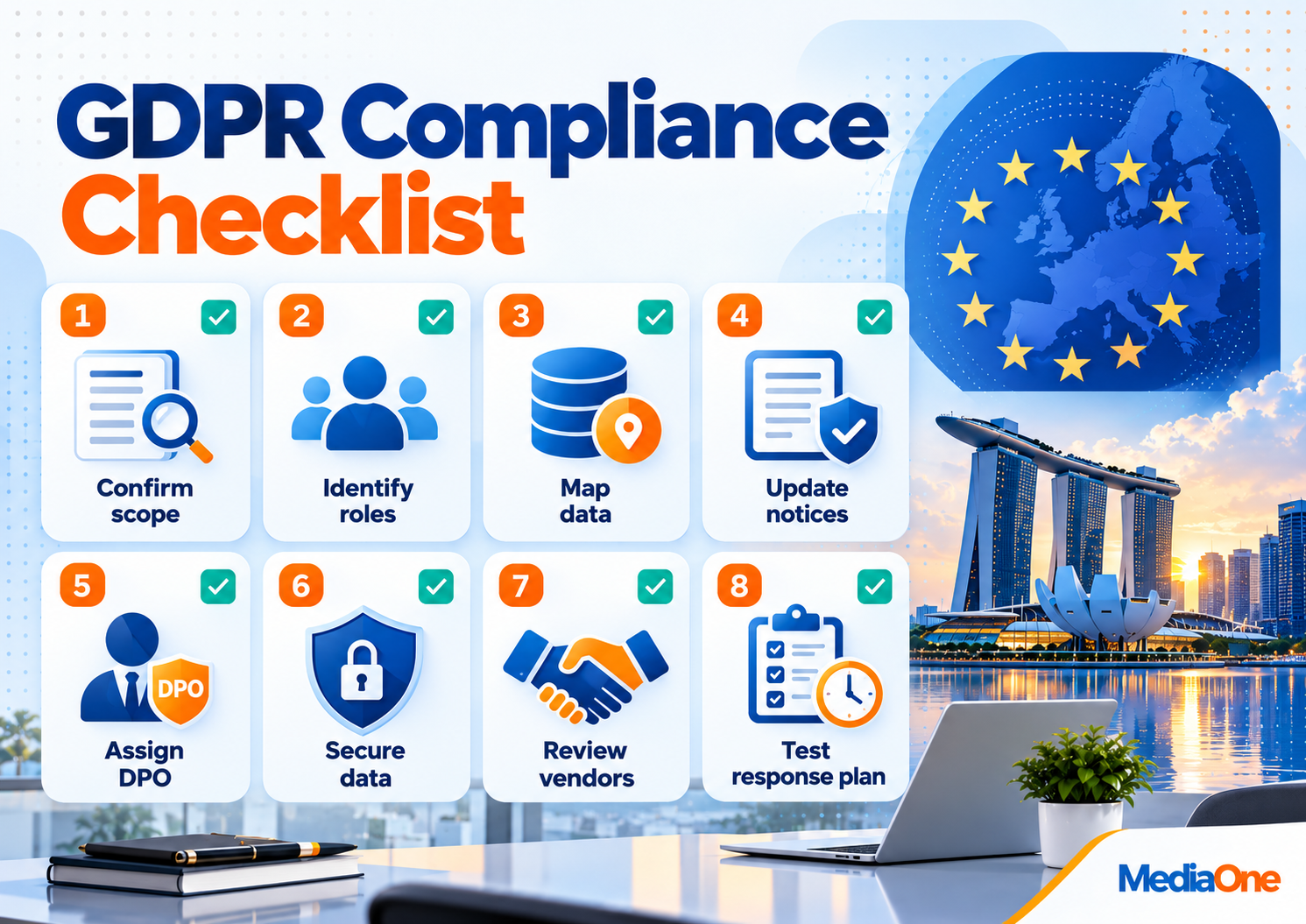
Work through this checklist before expanding EU campaigns. Assign owners and deadlines; reassess after significant changes.
- Confirm scope. Identify EU establishment, active EU targeting or monitoring. Record the evidence rather than assuming citizenship or website traffic is enough.
- Identify legal roles. Determine where you are a controller, processor or joint controller. Contracts should reflect actual decision-making.
- Create a processing inventory. Map purposes, data categories, legal bases, recipients, transfers, retention and responsible owners.
- Check transparency and consent. Update privacy notices. Separate optional consent from necessary order processing and review non-essential tracking.
- Assign privacy responsibilities. Designate the mandatory Singapore DPO. Check whether a GDPR DPO or EU representative is also required.
- Secure personal data. Restrict access, review authentication, manage backups and test incident detection. Use encryption where appropriate.
- Review vendors and transfers. Put Article 28 terms in place and assess whether Chapter V transfer safeguards are needed.
- Prepare individual-rights procedures. Create one intake channel with different statutory deadlines and a secure response process.
- Assess high-risk activities. Complete DPIAs when required, especially before introducing consequential profiling or sensitive-data processing.
- Test breach response. Establish escalation contacts, document both notification tests and practise evidence preservation.
- Set defensible retention periods. Link each period to operational needs or an applicable legal requirement. Do not adopt an automatic seven-year rule for every contract record.
- Review and improve. Recheck the inventory, permissions, vendors and notices after changes and on a scheduled basis.
Common challenges and practical fixes
| Challenge | Why it happens | Recommended action |
| Unapproved marketing tools | Teams introduce pixels or forms without privacy review | Add a pre-launch approval step and inventory entry |
| Missing consent evidence | Systems store opt-ins without the notice version | Record the action, date, source and relevant notice |
| Conflicting retention periods | Different departments apply inconsistent rules | Build a category-level retention schedule with reasons |
| Weak vendor oversight | Subprocessors change without review | Track contracts, locations and change notifications |
| Slow access responses | Data is scattered across teams | Test searches and create processor escalation contacts |
Start with the highest-risk data flow, not the thickest policy document. Prioritise EU checkout data or client records received from an EU controller. We recommend fixing missing legal bases, risky transfers and exposed information before polishing secondary documentation.
Assign an action owner and a realistic completion date to each gap. Keep supporting evidence, such as updated processor contracts, revised notices and test results. Review unresolved items with management until they are closed. Compliance is easier to sustain when a new campaign, vendor or system cannot launch without the required privacy checks.
Frequently Asked Questions
Does GDPR apply to a Singapore company with no EU office?
Yes, where the company offers goods or services to people in the EU or monitors their behaviour there, subject to Article 3. An EU office is not required, but an accessible website alone does not prove targeting.
Does GDPR apply to EU citizens living in Singapore?
EU citizenship alone does not trigger Article 3(2). Assess where the person is during the relevant offering or monitoring, and whether any EU establishment is involved.
Do all Singapore businesses need a Data Protection Officer?
The PDPA requires organisations to designate a DPO. The GDPR has additional, narrower rules determining when a GDPR-qualified DPO must be appointed.
How quickly must a GDPR data breach be reported?
Notify the competent supervisory authority without undue delay and, where feasible, within 72 hours of awareness unless the breach is unlikely to pose a risk. High-risk breaches can also require prompt notice to affected individuals.
Does GDPR require consent for every marketing activity?
No. Processing needs an appropriate lawful basis, while EU electronic-privacy and direct-marketing rules may add requirements. Consent must meet strict conditions whenever an organisation relies on it.
Can an EU customer demand deletion of every record?
Not always. The right to erasure has conditions and exceptions, including certain legal retention duties and legal claims. Review each data category and explain what can be deleted or retained.
How long should Singapore companies retain customer records?
Neither the GDPR nor the PDPA imposes one universal period for all customer records. Set periods according to the purpose, applicable retention laws and the need to establish or defend legal claims; document your reasoning.
Your Next Steps for GDPR Compliance
GDPR compliance starts with a defensible scope decision. Singapore businesses should then document lawful processing, protect personal information, meet individual rights and prepare for incidents. Businesses using social media marketing platforms should also review advertising pixels, consent settings and customer-data flows. A shared GDPR–PDPA inventory can make these obligations easier to manage without erasing their differences.
This week, we recommend reviewing EU-targeted sales and tracking, naming each data-flow owner and confirming the Singapore DPO. Then prioritise unresolved vendor transfers, missing lawful bases and breach-response gaps. For support with digital marketing implementation and campaign tracking, contact our team. Where the territorial test or transfer arrangements remain uncertain, obtain qualified legal advice before treating the programme as complete.