An enquiry can look promising on a dashboard and still lead nowhere. A contact form might attract a vendor selling services, while a potential customer with a genuine need may leave after waiting too long for a reply. For Singapore businesses investing in paid search, content and social media, the difference affects both marketing budgets and sales capacity.

Digital marketing leads are people or companies that have indicated interest in a product or service and provided a practical way to follow up. A qualified lead goes further: the prospect has a relevant need, fits the business’s offering and is worth a sales conversation. Budget and buying authority help with that decision, particularly in B2B sales, but they should be judged in context rather than applied as rigid rules to every enquiry.
A useful lead generation process therefore follows the contact beyond the first form submission. It separates spam from genuine interest, records the time taken to respond, and connects each channel to qualified enquiries and eventual customers. That evidence tells a business whether to improve its landing page, adjust its advertising, strengthen its follow-up or invest in a different source of demand.
Key Takeaways
- Measure qualified enquiries and sales outcomes instead of form submissions alone, because high volumes mean little when contacts do not fit your offering.
- Filter spam before routing enquiries to sales, using proportionate checks and clear fit criteria without discouraging genuine buyers from contacting you.
- Track the time to first useful human response, then compare qualification and closing rates across response-time groups instead of assuming one benchmark.
- Compare channels using cost per qualified enquiry, including advertising, management and handling costs, because a cheap raw lead may waste sales time.
- Nurture leads and request referrals deliberately, recording which follow-ups and introductions become sales opportunities rather than assuming every contact is ready.
What Digital Marketing Leads Are and Where They Come From
Defining a lead versus an enquiry
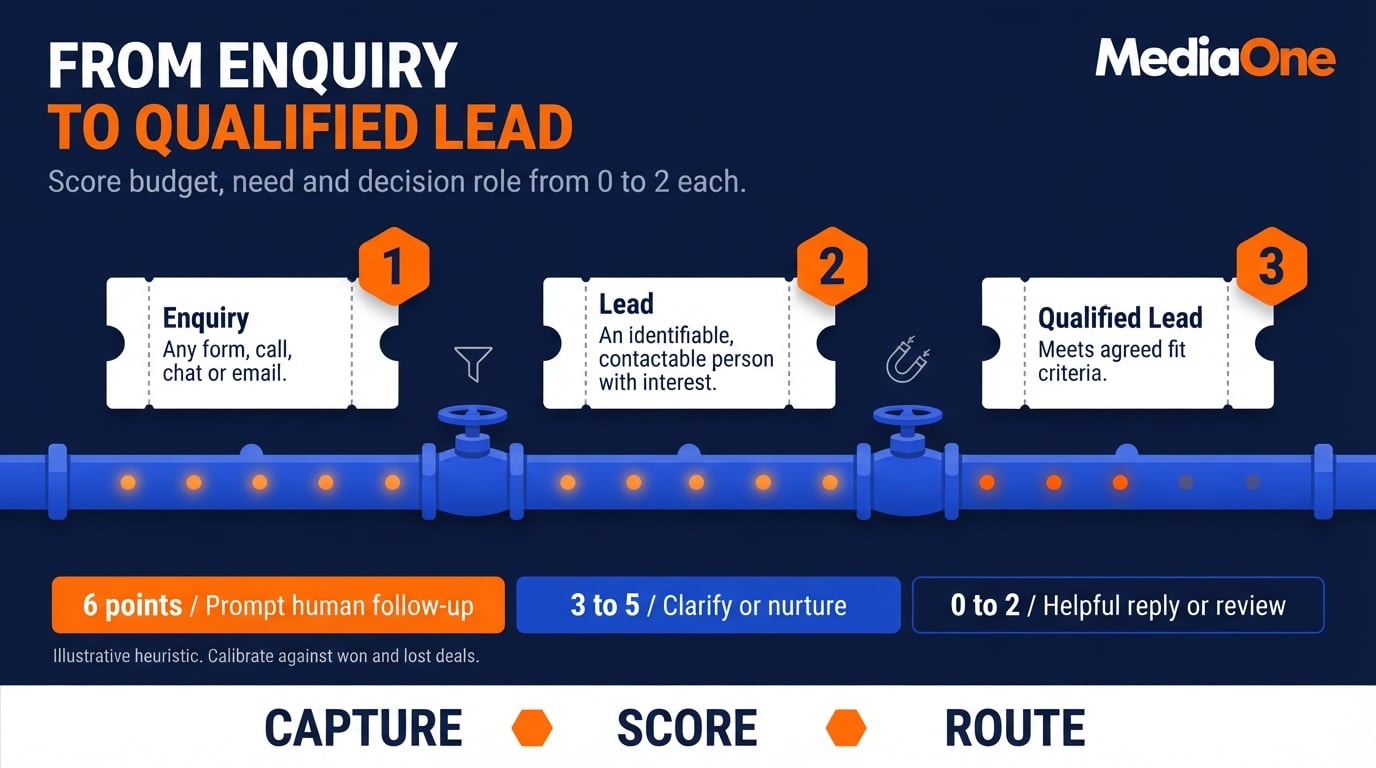
An enquiry is the raw event: a form submission, call, chat message or email. An identifiable, contactable person who has expressed interest is a lead; a qualified lead also fits criteria such as need, budget, timing and influence over the purchase. Judge each source by how many enquiries reach that qualified stage, not just by raw volume. Automation can flag likely matches for human review.
Not every enquiry is a sales opportunity. Submissions may come from vendors, job seekers or people contacting the wrong department. Counting them as qualified leads inflates performance reports, so pages and forms should make buying intent easier to recognise.
Inbound, outbound and bought leads compared
| Source | Main investment | When interest can appear | What to verify |
| Inbound (search, content, social, referral) | Media spend, content production or both | Paid campaigns may start sooner; organic interest takes time | Intent, relevance and qualification rate |
| Outbound (cold email, LinkedIn, calls) | Research, contact data and sales effort | Responses depend on target fit and outreach | Contact basis, buyer role and reply quality |
| Third-party lists or vendors | Data fees plus screening and follow-up | Contacts may be available immediately | Source legitimacy, permitted use and contact accuracy |
Inbound can suit Singapore businesses whose buyers research services before contacting a provider. Targeted outbound can help B2B software firms approach a defined list of accounts. Bought lists carry data-quality and permission risks, so ask how contacts were sourced, whether the proposed use is lawful and how opt-outs are handled. See also lead generation methods for different buyer journeys.
Lead sources and channels
Google Ads can reach people already searching for what you sell and may generate enquiries soon after a campaign is approved. Irrelevant clicks and poor-fit enquiries can still consume budget, so landing page and form design count alongside bids. Review campaigns against qualified leads and closed sales, not clicks alone.
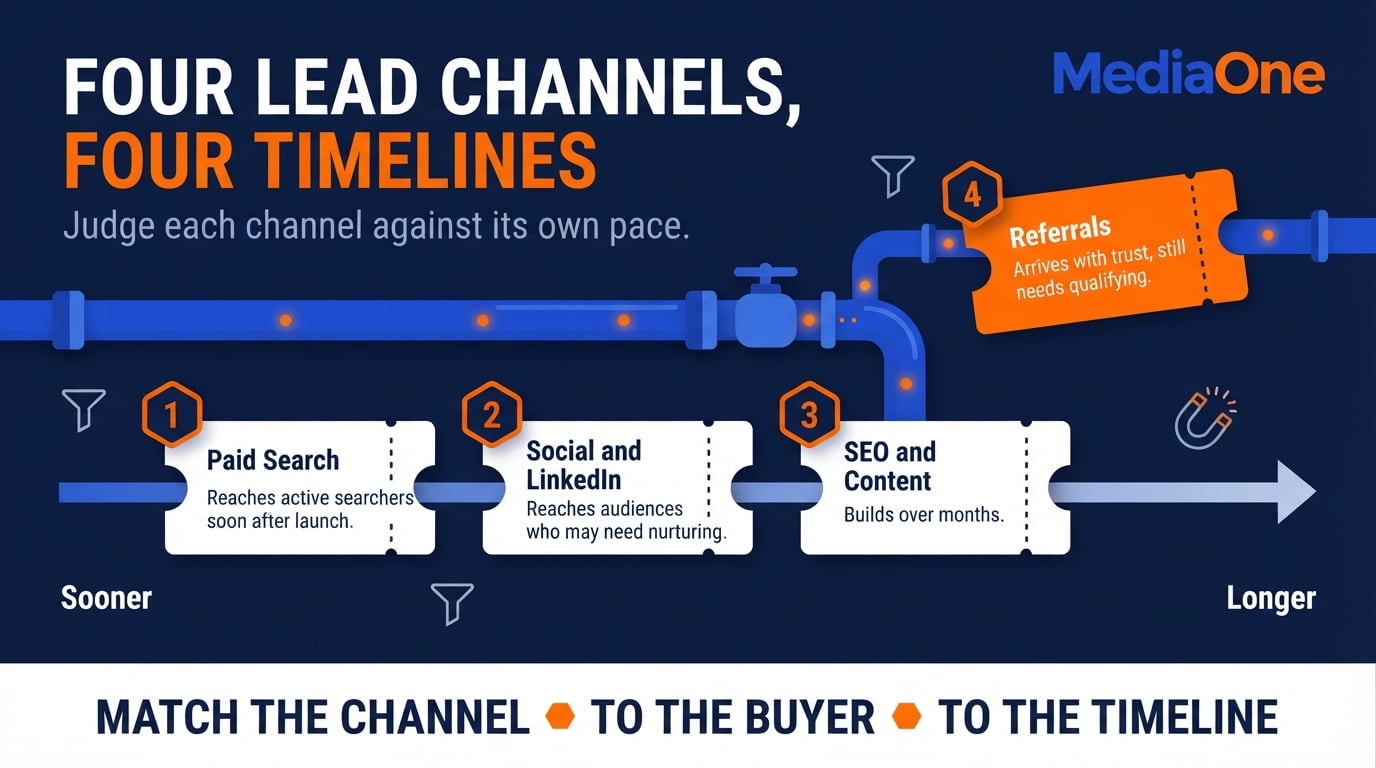

SEO and content often need more time to attract consistent search traffic, so assess their contribution over several months rather than a few days.
Social media and LinkedIn reach different audiences. LinkedIn can help B2B marketers reach people by job function and company characteristics. Some social enquiries may need longer nurturing before a sales conversation. Relevant posts and follow-ups keep the brand visible between contacts.
Referrals deserve a place in the channel mix. An introduction may give the prospect more context and trust before the first call, but it still needs qualification. Record who referred the contact and whether that introduction progresses to a genuine sales opportunity.
The Lead Generation Process and Methodology
Many lead generation problems appear after a campaign starts. Businesses run ads or publish content, then find that enquiries arrive unevenly or convert poorly. Before buying a new channel, review the process connecting each stage to the next, from first click to signed deal. Google Analytics lead-stage events distinguish initial leads, qualified leads and completed sales, providing a useful starting point for measurement.
Step-by-step lead generation framework
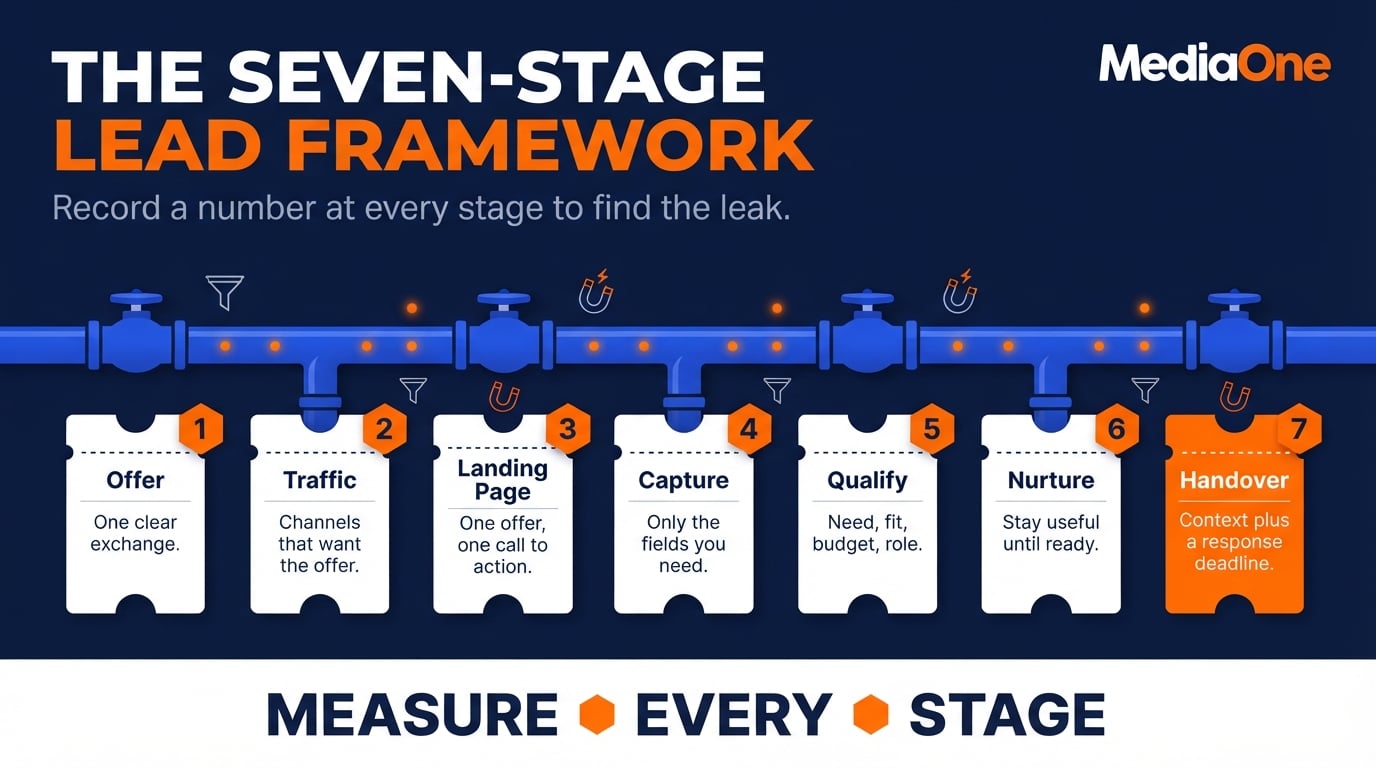
Work through these seven stages in order and record a number at each one:
- Offer: Define what the prospect receives in exchange for their details, such as a quote or consultation.
- Traffic: Choose the channel that brings people who already want the offer, such as Google Ads for active searchers. Lead ads on social media platforms suit prospects who are not yet searching.
- Landing page: Send that traffic to a page centred on one clear offer, with limited distractions.
- Capture: Collect only the details needed to qualify the lead.
- Qualification: Check need, fit, budget where relevant and the prospect’s role before prioritising sales time.
- Nurture: Keep prospects engaged if they are not ready to buy.
- Handover: Pass qualified leads to sales with context and a response deadline.
Run this checklist against your funnel:
- Can you state the offer in one sentence?
- Do you know the cost of traffic from each source?
- Does the landing page have a single call to action?
- Is the form limited to what qualification needs?
- Is there a written rule for how fast a qualified lead gets a reply?
If you cannot answer a question, that stage is where your funnel is leaking.
Landing pages and conversion rate
Landing page conversion is one lever in lead generation. In a hypothetical example, a page converting at 3% turns 1,000 visitors into 30 enquiries; at 4%, the same traffic generates 40 enquiries, an increase of about 33% without additional acquisition spend. These figures illustrate the calculation, not a market benchmark.
Landing page costs vary with design, copy, tracking and development requirements. Judge the page by its offer, supporting proof, form usability and measured enquiry quality, rather than comparing design fees alone.
Content marketing and lead magnets
A lead magnet is a free asset, such as a checklist, template or audit, offered in exchange for contact details. The right one attracts people who have the problem you solve, not anyone who is merely curious.
| Approach | Advantage | Trade-off |
| Gated (form before download) | Captures contacts and signals intent | Fewer downloads, less reach |
| Ungated (free to read) | Builds traffic, links and recall | No lead unless a follow-up offer sits nearby |
| Hybrid (preview open, full version gated) | Balances reach with capture | More content to produce |
The hybrid model is worth testing where a business needs both organic reach and identifiable enquiries; compare its qualified leads with those from gated and ungated content.
Account-based marketing and cold email outreach
Account-based marketing (ABM) targets a short list of high-value companies with campaigns built for those accounts. It pays off when one won client is worth many times the campaign cost, so it is usually too expensive where a typical sale is a few hundred dollars. Agencies that run ABM for clients often use it to reach a small number of target accounts in a coordinated way.
Cold email can reach a narrow group of B2B decision-makers, but research, data quality and compliance add to the cost. Write to an appropriate role at a specific company, reference a real business problem and ask one relevant question. For marketing calls and messages to Singapore telephone numbers, check the PDPC’s Do Not Call guidance; personal-data use and email outreach also require a separate review of applicable obligations.
Lead Quality, Spam and Filtering Enquiries
Enquiry count reveals how much interest a campaign attracts; lead quality shows whether sales can act on it. A qualified prospect generally has a relevant need, an achievable budget or purchase path, and someone who can influence the decision. For Singapore businesses, scoring enquiries and replying promptly creates a clearer view of which channels produce valuable opportunities.
The operational questions are how many contacts fit, how quickly they receive useful follow-up and what happens next. A consistent qualifying framework can work across search, social and referrals. Where systems support it, Google Ads enhanced conversions for leads can connect eligible offline lead outcomes back to campaigns using first-party data, subject to its implementation and data-use requirements.
What makes a lead qualified
A qualified lead passes three tests:
- Budget or buying capacity: the prospect has a realistic route to paying for the product or service.
- Clear pain point: they have a problem your service solves, stated in their own words.
- Decision role: they can decide, influence the purchase or introduce the decision-maker.
Score each lead before assigning a high-effort sales follow-up. The thresholds are an illustrative internal heuristic, not an industry standard; calibrate them against closed-won and lost opportunities.
| Signal | Strong (2) | Partial (1) | Not established (0) |
| Budget or buying capacity | Gives a realistic budget or purchase scope | Wants pricing but has not shared a range | No buying capacity established |
| Need | Describes a specific problem and desired result | Mentions a general goal | No relevant need established |
| Decision role | Can approve the purchase | Influences or introduces the buyer | Role in the decision is unknown |
A total of 6 points suggests prompt human follow-up; 3 to 5 suggests a clarification or nurturing step; and 0 to 2 suggests a helpful reply or review before routing. These thresholds should change when real sales results show a different pattern.
Illustrative example. A prospect asks for a quote, gives a budget band, describes a specific problem and can approve the purchase. The score is 2 + 2 + 2 = 6, so the enquiry is marked for prompt human follow-up.
Spam, junk and wasted sales time
The share of spam varies by channel and form, so measure it using your own records rather than a blanket percentage. An open contact form may receive vendor approaches or automated submissions; social lead forms can also generate contacts who need further screening. Check whether verification, clear form labels and a few relevant questions improve your qualified-enquiry rate.
Practical fixes, in order of effort:
- Honeypot field: a hidden input that real visitors never fill in. Discard submissions where it is populated.
- Verification step: a one-click confirmation for leads that look automated.
- Qualifying questions: company size and a rough budget band.
- Review-first routing: hold suspicious or low-score submissions for verification rather than deleting potential buyers automatically.
Why response speed decides conversion
Slow follow-up can also waste genuine demand. A prospect comparing several providers may continue the search while waiting for a reply, so log missed conversations and bookings rather than assuming that the fastest responder always wins.
Follow-up speed is worth measuring against outcomes. Log the time from submission to first useful human reply, then compare qualification and close rates across response-time groups (under 5 minutes, 5 to 60 minutes, same day and next day). Set your service target from the patterns in your own records, not a universal decay curve.
Build three rules into your process:
- Auto-acknowledgement within seconds, confirming receipt and the next step.
- Routing to a named owner by service line, so nothing sits in a shared inbox.
- Same-day follow-up for every qualified lead, with escalation if it is missed.
How to choose a lead generation provider in Singapore
Choosing a provider is a lead quality decision as much as a cost one. Look for:
- Pricing transparency: a clear split between management fees, landing page costs and ad spend.
- Reporting on qualified leads: not just clicks or sign-ups, with spam share and reply time tracked.
- Channel fit: evidence they run the channels your buyers use.
- Local references: verified reviews or relevant case studies from Singapore clients in your sector, with evidence of outcomes.
Red flags include guaranteed results without qualifications, no access to your own ad accounts and reports showing only vanity metrics. For an additional comparison framework, review how to choose a lead generation company in Singapore.
Questions to ask vendors:

- How do you measure qualified leads, and how do you define spam?
- Who owns the ad accounts and data if we end the contract?
- What does each fee include, and what sits outside it?
- Which clients in our sector have you run lead campaigns for, and what were the outcomes?
Nurturing Leads Through the Sales Cycle
Some leads need several contacts before they are ready to buy, and weak handovers can leave genuine prospects without an owner. Content and appropriate follow-up can answer questions between the first enquiry and a sales conversation. Lead ads and paid campaigns bring contacts into this process, but every nurturing message should match the prospect’s expressed interests and contact preferences.
Mapping the sales cycle to your funnel
Map the stages a buyer passes through, from awareness to purchase. Each stage needs different content. The pages and forms that capture leads should match the question the buyer is asking at that point:
| Stage | Buyer question | Content that helps |
| Awareness | ‘Do I have this problem?’ | Guides, diagnostic checklists |
| Consideration | ‘What are my options?’ | Comparison pages, pricing ranges |
| Evaluation | ‘Who should I choose?’ | Case studies, client reviews, demos |
| Decision | ‘Is this worth the cost?’ | Proposals, guarantees, a consultation call |
Timelines vary by market and sector. A B2C purchase may close in days, while a B2B software engagement can take months. Map your average cycle from your CRM records rather than relying on a general figure.
Building an effective nurture sequence
A workable sequence has four parts:
- Welcome with value. Deliver what the lead asked for within minutes of sign-up.
- Education. Address the two or three challenges your buyers most often face.
- Social proof. Share a case study that matches the lead’s situation, drawn from your clients.
- Soft conversion. Offer a low-commitment next step, such as a free consultation.
Email is one way to deliver a nurture sequence, and an automation tool can schedule messages where the recipient has an appropriate basis for contact. Budget for writing, segmentation and review as well as the software.
Re-engaging leads who go cold
Set useful triggers for re-contact, such as a requested quote nearing its expiry or a prospect asking for updated pricing. Keep unresponsive contacts in a separate segment and send a relevant message only where further contact is appropriate. Limit repeat attempts, respect opt-outs and make it easy for someone to decline further outreach.
What Lead Generation Costs
Compare channels using cost per qualified enquiry: total relevant spend divided by the number of enquiries that pass your agreed fit test. Providers may charge a channel-specific management fee plus ad spend, or a bundled retainer covering several services. Keep those components separate so the comparison is fair.
Request a current written quote for advertising management, media spend, landing page work, CRM setup, automation and ongoing reporting. Check whether forms, call tracking and social advertising are included, and distinguish recurring fees from one-off implementation work. Prices vary with scope and provider, so do not treat a competitor’s headline fee as a Singapore market benchmark.
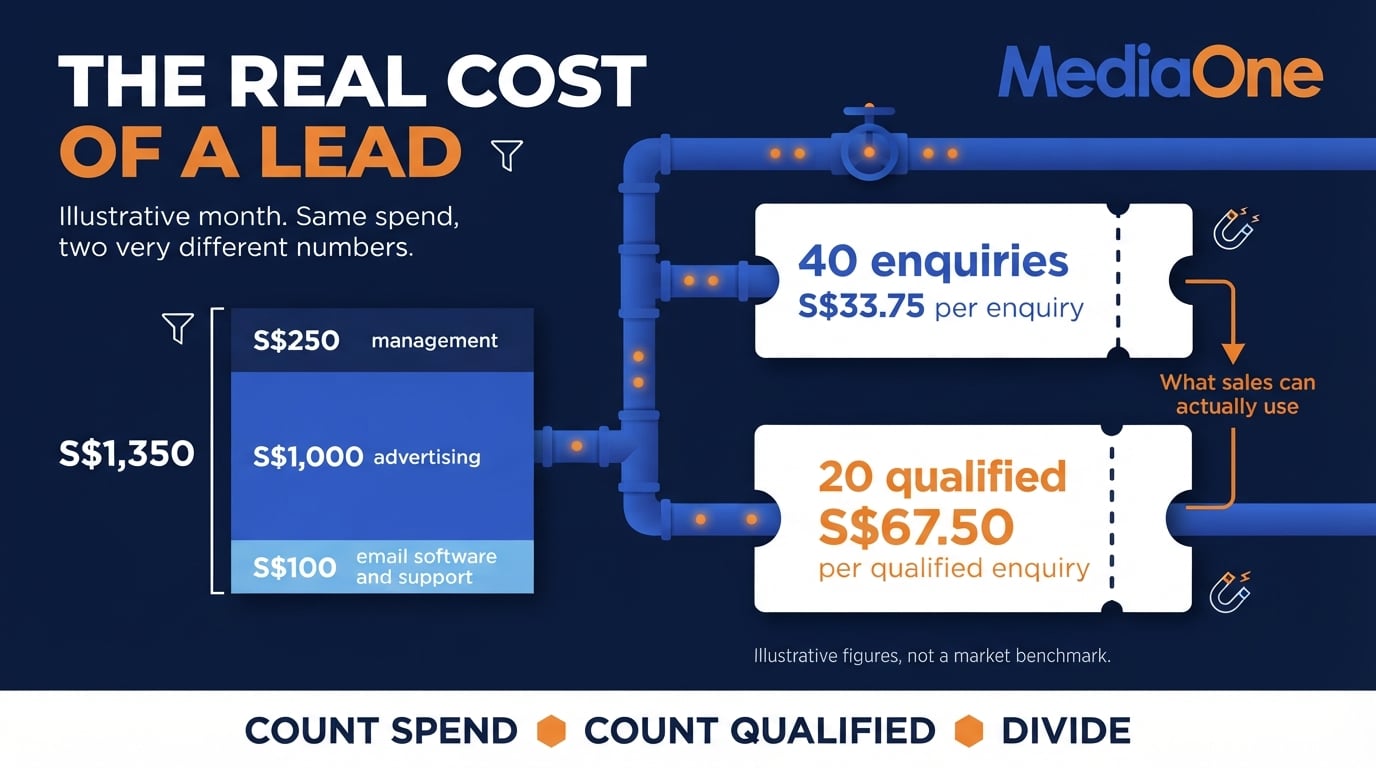
Illustrative cost calculation: a business spends S1,350inamonth,madeupofS250 in management, S1,000inadvertisingandS100 in email software and support. With 40 enquiries, cost per enquiry is S33.75.Ifonly20enquiriesmeetthequalificationrules,costperqualifiedenquiryisS67.50. The same campaign can look inexpensive or costly depending on what sales can actually use.

The Enquiry Yield Scorecard uses one row per channel and reporting period so teams can compare the same measures consistently:
| Source | Enquiries | Spam or irrelevant | Qualified enquiries | Median first human reply | Total spend | Cost per qualified enquiry |
| Paid search | Record actual | Record actual | Record actual | Record actual | S$ actual | Spend ÷ qualified |
| Organic search | Record actual | Record actual | Record actual | Record actual | S$ actual | Spend ÷ qualified |
| Referrals | Record actual | Record actual | Record actual | Record actual | S$ actual | Spend ÷ qualified |
Use the same qualification rules and reporting window for each source. Count staff and production costs consistently, and compare opportunities won alongside the rate of qualified enquiries. A fuller explanation of cost per lead and its limitations can help with the calculation.
Realistic Timelines and Results
Channels work on different timelines. Paid search can begin generating traffic after approval and launch, whereas organic visibility may take substantially longer to develop. Review both against their own conversion and qualification goals; the market, offer and budget shape how quickly useful evidence arrives.
- Weeks 1 to 2: check enquiry tracking, qualification rules and form routing.
- Around week 6: review spam share, response time and qualified enquiries by channel.
- At quarter end: compare cost per qualified enquiry and sales outcomes with gross margin.
Industry and Business-Model Variations
Lead generation works differently across business models. Sales cycle, buyer roles and purchase value change what a qualified lead looks like and how quickly it should be answered. A B2B software enquiry and a B2C salon booking need different questions, follow-up and success measures. Match content, forms and any routing automation to the buyer’s decision process.
B2B versus B2C lead generation
B2B enquiries come from a small pool of accounts, with several stakeholders per decision. The key question is whether the enquiry reaches a decision-maker inside the account. Account-based marketing and cold email are slower but more targeted. B2B software buyers often need a sales team to run several calls before they commit.

B2C enquiries may involve shorter decisions and more individual buyers. A delayed reply can lose an urgent prospect, while social lead ads and search campaigns can be tested against the purchase behaviour of each category.
| Factor | B2B | B2C |
| Sales cycle | Weeks to months | Hours to days |
| Decision-makers | Several stakeholders | Usually one person |
| Deal value | Higher, often recurring | Lower, often one-off |
| Main risk | Lead stalls with no sponsor | Speed loss and spam |
Industry-specific considerations
- Real estate can attract early-stage researchers as well as ready buyers; qualify financing and timing early, and use relevant property examples to set expectations.
- Home services such as cleaning, renovation or aircon servicing can attract time-sensitive enquiries, so prompt routing helps the team respond while the prospect is still evaluating providers.
- Education attracts parents and adult learners who may compare programmes over time; timely course information and an accessible enquiry form can support their research.
- E-commerce may be better assessed using cost per purchase or contribution margin than sign-up volume alone, particularly when visitors can buy without speaking to sales.
- Professional services such as accounting, legal or consulting often involve trust and several conversations before engagement. Track referrals as a distinct channel and record whether each introduction leads to a qualified opportunity or signed client, rather than assuming referred contacts will automatically convert.
Across sectors, qualification should reflect the buyer’s need and buying stage, and follow-up should suit the urgency of the enquiry.
Conclusion and Next Steps
Monthly enquiry volume is a starting point, not a complete measure of digital marketing performance. Track how many contacts are qualified, how promptly they receive a useful reply and how many become customers. A smaller set of genuine opportunities can be worth more than a larger inbox of irrelevant submissions.
Use the Enquiry Yield Scorecard to compare volume, spam or irrelevant share, qualified enquiries, median reply time and cost per qualified enquiry by source. Apply the same criteria each month and refine them against opportunities won.
Start by auditing one funnel stage, such as the contact form or first reply. If you need help connecting channels, tracking and follow-up, review MediaOne’s lead generation services before committing to a wider campaign.
Frequently Asked Questions
What is the difference between a digital marketing lead and an enquiry?
An enquiry is an incoming contact, such as a form submission, call or message. A digital marketing lead is an identifiable, contactable person who has indicated interest; it becomes qualified when it meets the business’s fit criteria.
Which lead source is cheapest in Singapore?
No source is always cheapest once quality and sales effort are considered. Compare the total spend for each channel with the number of qualified enquiries it produces, using the same reporting period and qualification rules.
How long does it take to see results from digital marketing leads?
Paid search may produce enquiries after a campaign launches, while SEO and content often require a longer review window. Check early tracking and lead quality, then use several weeks or a full quarter to judge repeatability against your own goals.
How much should a Singapore business budget for lead generation?
Budget separately for management, ad spend, landing pages, CRM integration and follow-up work. Compare the resulting cost per qualified enquiry with your customer value and margin, and obtain current quotes for the exact scope.
How can I stop spam enquiries from wasting sales time?
Use bot checks such as honeypot fields, add proportionate verification and screen submissions against a clear qualification rule. Review flagged enquiries before discarding them so genuine prospects are not lost.