Singapore’s dense B2B market is highly competitive. Most businesses require both inbound and outbound lead sources to maintain pipeline velocity, whether they operate a SaaS startup, manage a supply-chain operation, or offer managed services.

One thing determines success: sourcing qualified prospects at scale. This guide provides a structured framework for evaluating lead generation providers. Readers will learn how to assess different service tiers, understand which methods work in the Singapore market, and identify red flags that separate legitimate agencies from firms inflating their numbers to look credible.
Key Takeaways
- Lead generation agencies in Singapore fall into five distinct tiers, from premium full-service firms (SGD 8,000–30,000 per month) to DIY platforms (SGD 500–5,000 per month), each suited to different sales cycles and budgets.
- The right partner depends on your ideal customer profile, sales cycle length, and team capacity. A 30-person SaaS startup should not use the same provider as a 200-person enterprise software firm.
- Most quality lead generation in Singapore takes 60–90 days to stabilise. Expect 30 days for initial volume and 90–120 days for repeatability and quality tuning.
- Transparency on lead sources, quality metrics, and PDPA compliance is essential. Reputable agencies share sample leads, channel breakdowns, and compliance documentation before you sign the contract.
- Performance-based pricing is rare in the market. Hybrid models that combine a retainer plus a bonus are standard. Contingency-only deals signal either overconfidence or poor risk allocation; negotiate shared risk via pilot terms instead.
- Cost per qualified opportunity ranges from SGD 2,000 to 10,000 depending on deal size, industry, and cycle length. Hidden costs (integration, data quality, reporting tools, sales training) often add 15–25% to quoted fees.
- Lead volume is not a meaningful metric. Track lead-to-opportunity conversion rate, sales cycle length, and revenue impact. A provider delivering 200 low-intent leads per month is worse than one delivering 40 high-intent leads.
What Lead Generation Companies Do
The Core Function
A lead generation company performs one essential task: identifying people who match a business’s customer profile and delivering them to the sales team with enough intent signal to make a conversation worthwhile.
This sounds straightforward in theory. In practice, defining “sufficient intent” requires balancing two extremes, both of which are expensive. Too loose a qualification standard produces unqualified prospects and automated responses. Too tight a qualification standard causes volume to drop before the sales team achieves the quota.
A competent provider bridges that gap by combining research, targeting, outreach, and qualification into a repeatable system. They manage the channels: LinkedIn prospecting, cold email sequences, paid search, content capture, referral networks, or event lists.
They validate contact data, manage unsubscribes and compliance, and pass leads to the sales team with an attached quality score. The output is a lead: a named prospect who has shown interest (opened an email, clicked an ad, downloaded a resource) or fits the profile closely enough that interest is near-certain. A sales development representative (SDR, the specialist responsible for initial prospect outreach) or account executive then owns the next conversation.
What a lead generation company does not do matters as much as what it does. It does not close deals, manage the sales process, or own the relationship after handoff. This boundary clarifies accountability. If a lead does not convert, two questions arise: Was the lead truly qualified? Did the sales team have the skills and capacity to close it? Both answers matter, but they address different problems.
Why In-House Isn’t Enough for Most SMEs
Building a lead generation function internally requires three foundations: people, process, and sustained effort over months before results stabilise.
Most Singapore SMEs lack one or more. A dedicated demand generation hire costs SGD 5,000–8,000 per month plus tools, training, and ramp time. This is often a headcount a business cannot backfill; in-house dependency creates operational risk if the specialist departs. A single person cannot excel across all channels either. They typically choose one (usually LinkedIn or Google Ads), neglect the others, and reduce addressable volume across available channels.
Outsourcing solves the leverage and specialisation problem. A lead generation agency spreads infrastructure costs across 10–20 clients. They hire specialists in cold email, paid advertising, content, and events. They test multiple channels in parallel while the business’s team closes deals. If one channel underperforms, they pivot to another without changing headcount.
In-house teams often optimise for activity rather than for outcomes. An SDR might complete 50 dials per day and feel productive. A lead generation agency optimises for conversion to qualified conversations. This results in fewer attempts per lead but higher quality per touch.
Expertise compounds the advantage. Building a repeatable lead generation process requires months of testing. A mature agency has built this system 50 times. They understand which data sources decay fastest, which email templates achieve reply rates above 15%, and which objection-handling approaches work in specific verticals. This is knowledge a new in-house hire requires six months to develop; a contract achieves it in week two.
Outsourcing does not substitute for a capable sales team. A lead generation company cannot recruit sales staff, train them, or fix a broken sales process. It can only supply qualified names to an operation that must be ready to receive them.
The Singapore Market Context
Singapore’s B2B market has characteristics that shape which lead generation methods work best.
The geography is dense: 5.7 million people across 730 square kilometres. Major business clusters (CBD, Marina Bay, Changi) concentrate decision-makers, making both cold calling and account-based marketing (ABM, a method targeting named accounts rather than broad campaigns) efficient. A lead generation team in Singapore can map competitor accounts by location and seniority at scale.
The economy clusters by sector: financial services, petrochemicals, logistics, technology, manufacturing, and managed services dominate. This means buyers within the same vertical often share similar pain points, buying timelines, and procurement processes. A lead generation agency working with multiple logistics clients learns which titles respond fastest, which objections appear predictable, and which trade publications still drive qualified inbound interest.
Singapore has high internet penetration and strong LinkedIn adoption among professionals. Cold email open rates in the market typically run 2–3% higher than regional benchmarks because English is the working lingua franca and inbox habits are consistent.
Competition for buyer attention is intense. Property, logistics, financial advisory, and software all run simultaneous buyer acquisition campaigns. This raises the cost of paid search and generic content capture. It also means winning providers use niche targeting and multi-channel sequencing, not broad-funnel campaigns.
The regulatory environment matters significantly. The Personal Data Protection Act (PDPA) and related regulations require that every prospect either opts in to receiving outreach or is contacted under legally recognised warm conditions. Non-compliance carries financial penalties. The strongest agencies in Singapore embed compliance into intake processes, not add it later.
For Singapore businesses, this means local lead generation agencies understand market depth. They know which channels convert fastest in each vertical. They move quickly because buyer concentration is high. They also price accordingly: agencies with proven results charge premium retainers (SGD 8,000–15,000 or more per month) because demand is high and proven clients are selective about partners.
How to Evaluate Lead Generation Companies
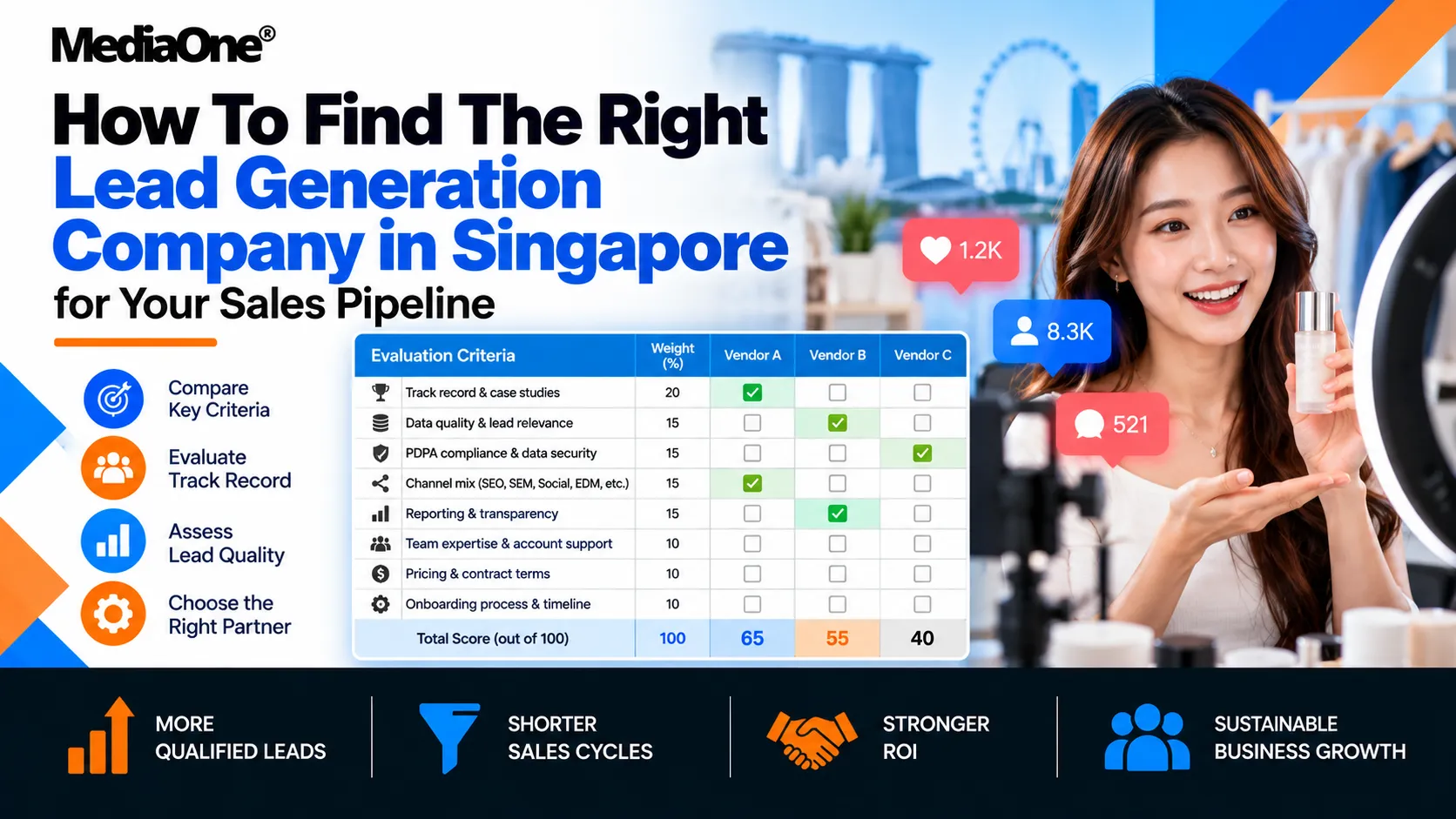
Before signing a contract with any lead generation partner, a business needs a structured framework to separate capable operators from those who will waste budget. This guide provides a structured framework for evaluating lead generation providers, moving beyond vendor claims to hard evaluation criteria you can test during sales conversations and pilot phases.
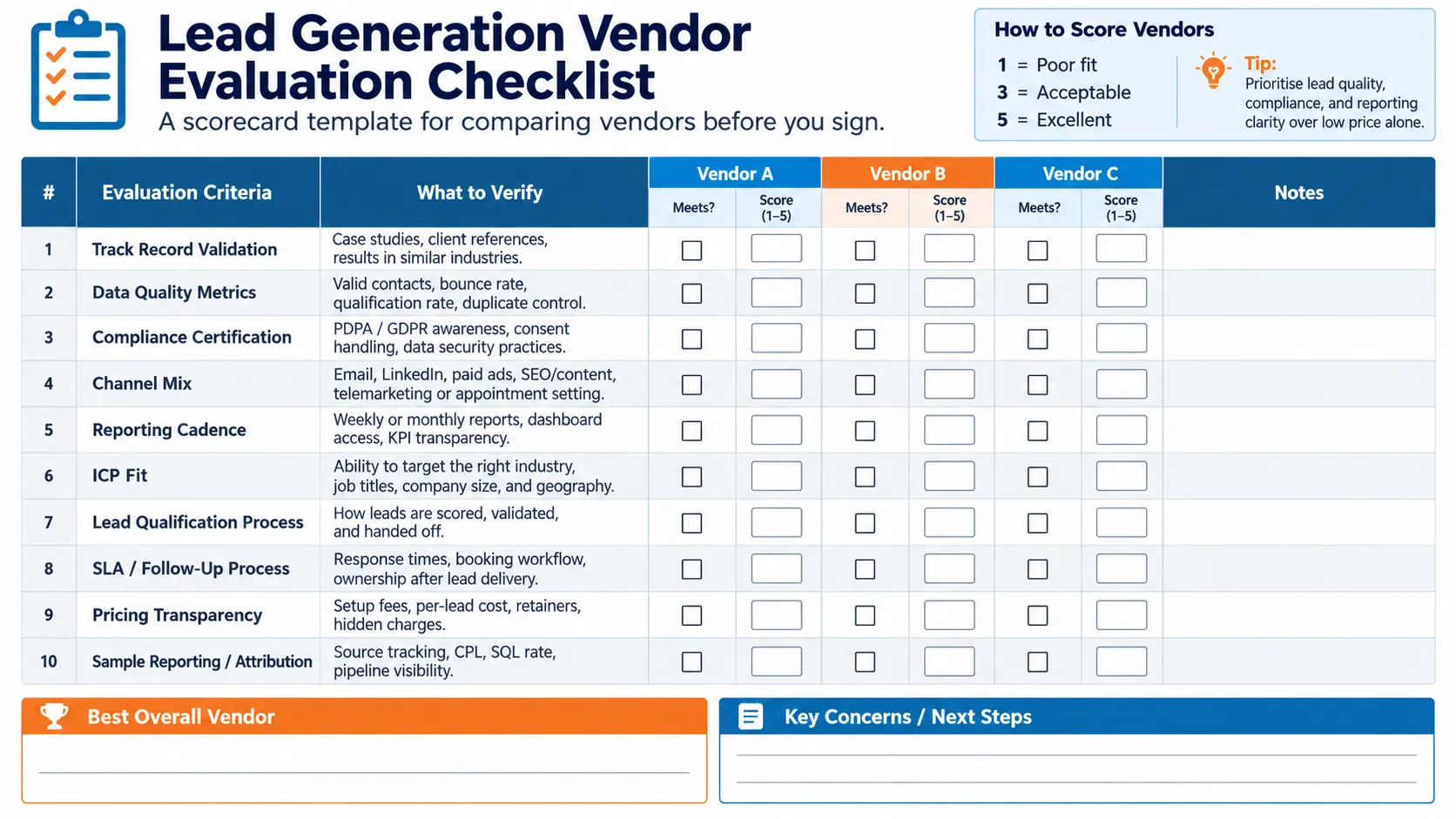
Track Record and Verifiable Results
Case studies are marketing documents. What a business needs is independently verifiable evidence.
A business should ask for three to five reference clients in its industry vertical. Rather than relying on email introductions arranged by the vendor, it is advisable to find contact information separately and reach out independently. The following questions should be asked:
- How many leads did they receive monthly?
- What percentage converted to sales opportunities?
- How long did the relationship last before they saw repeatable results?
- Did lead quality stay consistent, or did it drop after month three?
- Would they use this vendor again?
A business should request a sample of actual leads before committing. Not anonymised summaries or aggregate metrics: real lead lists, scrubbed of personal details if necessary, showing source, company, contact title, and assigned lead score. This demonstrates whether the vendor understands the ideal customer profile (ICP) at all.
A business should also ask how the vendor tracks lead performance downstream. The best operators will request feedback loops from the sales team: which leads became meetings, which became deals, and which proved completely wrong. Vendors who cannot articulate how they measure lead quality beyond “we sent you 200 leads” are speculating.
Transparency on Methods, Data Sources and Compliance
How a lead generation company builds its lists matters. Opaque sourcing is often a warning sign.
A business should require written documentation on these points:
Data sources: Are they scraping public LinkedIn profiles? Buying B2B databases? Using existing customer referrals? Purchasing intent data from third parties? Each method has legal and ethical boundaries. Scraping and reselling personal data without consent violates Singapore’s Personal Data Protection Act (PDPA). Legitimate vendors source from opt-in databases, published corporate directories, or direct outreach channels.
Outbound channel: Will they use cold email, phone calling, LinkedIn messaging, or multi-channel sequences? Each channel has compliance rules. Cold emails in Singapore must include a clear unsubscribe option. Phone calling to people on the Do Not Call (DNC) registry is prohibited by PDPC guidance. A business should ask how the vendor manages consent and unsubscribe requests.
Data handling: Who owns the contact list after the engagement ends? Can the list be exported and used internally, or is access restricted to the vendor’s platform? Can they guarantee they will not resell it to competitors? This should be confirmed in writing.
A business should confirm these compliance points in writing:
- PDPA consent verification (how does the vendor confirm the contact opted in?)
- Unsubscribe path and response time (within 30 days per PDPA requirements)
- Data storage location (some vendors store data outside Singapore, raising regulatory questions)
- DNC registry compliance for phone outreach
- Clear statement on compliance with Singapore SMS and email messaging rules
Any vendor who dismisses these questions or claims “it’s standard” without providing detail carries unacceptable legal risk.
Pricing Models
Lead generation pricing falls into three main structures. Each suits different business stages.
Retainer model: A business pays a fixed monthly fee (typically SGD 2,500 to 15,000 or more) for a committed volume of leads or hours of work, regardless of outcome. Advantages include predictable cost, a long-term partnership, and vendor investment in quality over volume. The main disadvantage is that you still pay even if results are weak, and quality typically takes 60 to 90 days to stabilise.
Cost-per-lead model: A business pays only for leads delivered, usually SGD 50 to 300 per lead, depending on the industry and lead quality. Advantages include no upfront risk and pay-per-lead, depending on the deliverables. Disadvantages include vendor incentives to optimise for volume over quality, the ease of inflating numbers with low-intent contacts, and no accountability for downstream conversion.
Hybrid (retainer plus performance bonus): A base monthly fee covers baseline volume, while bonuses or success fees apply if conversion thresholds are met (for example, 15% of leads become opportunities). This aligns risk: the vendor commits to baseline quality, and the business rewards them for exceeding it.
Red flags in pricing:
- Guaranteed lead volume with no quality metrics attached (for example, 80 leads per month guaranteed). Quality always degrades if volume guarantees are rigid.
- Cost-per-lead with no definition of what counts as a “lead” (unverified email? A LinkedIn message? An actual conversation?).
- Hidden implementation fees (for example, a retainer excludes data integration, CRM setup, or training, adding 20% to the true cost).
- No pilot phase option. Reputable vendors offer 30 days at a reduced rate or with a performance gate before long-term commitment.
A business should demand a written breakdown of what the fee includes: lead research time, outbound execution, list scrubbing, reporting, and revision cycles. If a vendor cannot itemise it, they do not know their own costs.
Service Scope and Sales Cycle Fit
Lead generation methods vary widely. The right vendor for a B2B SaaS company with a 30-day sales cycle is not the right vendor for a manufacturing firm with an 18-month deal cycle.
A business should map three dimensions before evaluating vendors:
Your Sales Cycle Length
Short cycle (SaaS, digital products, 30 to 90 days): A business needs high volume, fast outreach, and rapid feedback loops. Look for vendors strong in paid search, content-driven capture, and cold email sequences. They should iterate weekly based on conversion data.
Medium cycle (professional services, 90 to 180 days): A business needs account-based marketing (ABM) and relationship building. LinkedIn prospecting, multi-touch sequences, and referral programmes matter more. Expect 6 to 8 weeks before quality stabilises.
Long cycle (enterprise software, manufacturing, 6 to 24 months): A business needs strategic fit and stakeholder mapping. Outbound calling, event-based capture, and strategic partnership development are essential. Avoid vendors obsessed with lead volume; depth is required.
Your Ideal Customer Profile (ICP) Specificity
Before speaking with a vendor, a business should define its ICP in writing:
- Industry vertical (fintech, logistics, healthcare tech?)
- Company size (headcount, revenue range)
- Job title and seniority of decision-makers
- Geographic territory (Singapore, ASEAN, global?)
- Budget threshold or buying signal (for example, companies spending over SGD 100,000 annually on software)
A business should test the vendor’s understanding by asking them to describe a perfect-fit lead. If they provide generic language or ask the prospect to define it entirely, they lack experience in that space. Quality vendors push back: “For enterprise software, we usually exclude startups under 20 headcount. Is that your case?”
Your Sales Team Capacity
This is often overlooked. If a sales team can handle 20 qualified meetings per week, do not sign a vendor contracted to deliver 80. Overflow becomes waste. Conversely, if the pipeline is empty and the team is idle, demanding quality-only leads will starve the team.
A business should agree on volume expectations upfront. A realistic vendor will ask: “How many meetings per week can your team hold? What is your conversion rate from meeting to opportunity?” They will then map their lead delivery to that reality.
Use this matrix to align scope:
| Factor | Short Cycle | Medium Cycle | Long Cycle |
|---|---|---|---|
| Primary channel | Paid search, content, cold email | LinkedIn ABM, content, events | Account mapping, phone, referrals |
| Lead volume expectation | 50–200 per month | 15–40 per month | 5–15 per month |
| Ramp-up time | 30–45 days | 60–90 days | 90–120 days |
| Feedback cycle | Weekly | Biweekly | Monthly |
| ICP complexity | Moderate (clear buyer signals) | High (multiple stakeholders) | Very high (strategic fit, budget cycle) |
Once a business has mapped its cycle and ICP, any vendor claiming to do all three equally well is overselling. The best partners specialise.
The Five Tiers of Lead Generation Providers in Singapore
Lead generation providers in Singapore do not operate uniformly. The market includes five distinct tiers, each suited to different budgets, industries, and sales maturity levels. Understanding where a provider sits helps to predict their approach, pricing, and the quality of leads a business will receive.
Tier 1: Full-Service Agencies (Strategic, Premium)
Full-service agencies handle strategy, channel selection, execution, and reporting end to end. They typically employ 20 or more staff members, serve enterprise clients, and charge retainers of SGD 8,000–30,000+ per month.
These firms interview the sales team, audit current pipeline performance, and design a multi-channel playbook tailored to audit the current ideal customer profile (ICP). They run LinkedIn prospecting, content marketing, paid advertising, webinars, and sometimes outbound sequences in parallel. They own the entire funnel.
What is delivered: strategic accountability, brand-safe execution, integrated campaign logic, and access to senior strategists who can challenge assumptions. Reporting is granular: conversion rates by channel, cost per opportunity, and revenue attribution.
Best suited for: Enterprise B2B companies, long sales cycles (6 months or longer), complex ICPs, and teams that lack in-house marketing leadership.
Hidden costs: Setup and onboarding typically require 4–6 weeks. Many Tier 1 firms require 12-month contracts. Weak performance during the contract term may result in lock-in without recourse.
Tier 2: Specialist Digital Agencies (Content and Paid Focus)
Tier 2 agencies specialise in inbound and paid channels: search engine optimisation, content marketing, Google Ads, LinkedIn, and Facebook advertising. Team size ranges from 8–20 people. Monthly retainers run SGD 3,000–12,000.
These firms build lead magnets such as whitepapers, webinars, and templates; optimise landing pages; and run demand-generation campaigns. Leads arrive through organic search, paid search clicks, or form submissions from retargeting advertising.
What is delivered: Strong creative execution, data-driven advertising optimisation, and fast scaling on paid channels. Reporting focuses on cost per lead (CPL), conversion rate per channel, and form submission volume.
Best suited for: Companies with shorter sales cycles (30–90 days), product-led growth models, technology and SaaS businesses, and teams comfortable with lead volume over lead quality.
Trade-off: These agencies are less equipped to handle outbound cold prospecting or complex sales conversations. Leads tend to be higher volume but lower intent than outbound-generated prospects.
Tier 3: Outbound Boutiques (Cold Email, Calling, LinkedIn)
Tier 3 consists of small, focused teams of 3–10 people specialising in outbound strategies: cold email, phone prospecting, LinkedIn connection campaigns, and personalised multi-touch sequences. Monthly retainers range from SGD 2,000–8,000.
These firms build prospect lists, craft personalised outreach, run sequences over 6–8 weeks, and hand over responses to the client’s sales team. They often deliver faster results than inbound methods because they contact prospects directly rather than waiting for intent signals.
What is delivered: Quick lead volume, predictable pipeline, and direct control over messaging. Useful for testing new markets or verticals.
Best suited for: B2B services, consulting, managed services, and verticals where cold outbound is an accepted norm: recruiting, staffing, and commercial real estate.
Quality risk: Leads depend entirely on list quality and copywriting skill. A weak list or poor sequencing produces low response rates. Compliance is critical: Singapore’s Personal Data Protection Act (PDPA) requires clear opt-in consent, which outbound partners sometimes omit.
Tier 4: DIY Platforms and Automation Tools (Low Cost, Hands-On)
Tier 4 is not a service provider but a category of software: HubSpot, Pipedrive, Lemlist, Apollo.io, and Instantly.ai. One-time setup costs are SGD 500–2,000; monthly usage fees run SGD 200–1,500.
These tools allow internal teams to run outbound campaigns, build landing pages, manage lead scoring, and automate nurture sequences. The organisation owns the lead generation process. Platforms provide templates, integrations, and tracking; execution is internal.
What is delivered: Full control, low monthly cost, and flexibility to iterate rapidly. No dependency on external teams.
Best suited for: Startups and small- to medium-sized enterprises (SMEs) with marketing or sales staff who can dedicate 10 or more hours per week to lead generation; companies testing channels before committing to an agency; and teams that value ownership over outsourcing.
Trade-off: The organisation bears the operational load. If outreach or landing pages underperform, internal expertise will be needed to diagnose and resolve issues. Time to results is slower because execution and learning happen in parallel.
Tier 5: Freelancers and Solo Consultants (Low Commitment, Variable Quality)
Tier 5 comprises freelancers and solo operators, typically found on Upwork, PeoplePerHour, or local networking groups. Costs range from SGD 800–3,000 per month, often billed hourly.
A single operator runs outbound, manages a tool, or builds landing pages. Contracts are short-term and low-commitment. Quality varies significantly based on individual skill, client-project fit, and effort allocation (they may be managing multiple simultaneous clients).
What is delivered: Rock-bottom cost and flexibility to pause or scale instantly. Suitable for testing a channel or filling gaps in-house.
Best suited for: Lean startups, one-off projects (e.g., launching a cold email campaign for a trade show), or teams with existing marketing infrastructure who need temporary support.
Risk: A Single point of failure exists. If the freelancer departs or underperforms, no organisation stands behind them. Formal reporting and accountability are absent. PDPA and compliance responsibility fall on the hiring organisation.
Comparing the Tiers
| Tier | Team Size | Monthly Cost (SGD) | Lead Quality | Speed to Results | Best For |
|---|---|---|---|---|---|
| Tier 1 | 20+ | 8,000–30,000+ | High | 60–90 days | Enterprise, complex sales cycles |
| Tier 2 | 8–20 | 3,000–12,000 | Medium to High | 30–60 days | SaaS, inbound demand generation |
| Tier 3 | 3–10 | 2,000–8,000 | Medium | 30–45 days | B2B Services, outbound prospecting |
| Tier 4 | Internal | 200–1,500 | Variable | 60–120 days | Startups, channel testing |
| Tier 5 | 1 | 800–3,000 | Low | 60+ days | Lean startups, temporary gaps |
Choosing Your Tier
Answer three questions to choose the most appropriate tier.
1. What is your annual marketing budget?
Below SGD 30,000: Tier 4 (DIY platforms) or Tier 5 (freelancer support) is realistic.
Between SGD 30,000 and SGD 100,000: Tier 3 (outbound boutiques) or Tier 2 (specialist digital agencies) balance cost and capability.
Above SGD 100,000: Tier 1 (full-service) or Tier 2 justifies strategic depth and execution quality.
2. How long is the sales cycle?
Shorter cycles (under 30 days): Tier 2 or Tier 4 work well because fast-moving paid advertising or automation allows rapid lead velocity.
Longer cycles (90 days or more): Tier 1 is justified because strategic planning and relationship building require sustained effort over time.
3. Does the organisation have internal marketing or sales operations capacity?
Yes: Tier 4 suits teams with hands-on capability and desire for ownership.
No: Delegation to Tier 1, Tier 2, or Tier 3 is necessary; external expertise fills the gap.
Common path for Singapore SMEs: Most start at Tier 3 or Tier 4. Outbound boutiques offer speed and predictability at a reasonable cost, whilst DIY platforms test viability before hiring permanent staff. Migrate to Tier 1 only once proven demand justifies the retainer investment and the business’s strategic complexity warrants it.
Lead Generation Methods That Actually Work in Singapore
Singapore’s B2B market rewards precision. Businesses operate in tight networks, face intense competition, and expect consultative selling.
The six methods below are not theoretical. They drive measurable outcomes for lead generation companies operating at scale in the region.
LinkedIn Prospecting and Account-Based Marketing (ABM)
LinkedIn is the de facto B2B prospecting platform in Singapore. A well-executed LinkedIn strategy combines search targeting, personalised outreach, and content amplification to build sales conversations with actual decision-makers.
Singapore’s business ecosystem is densely networked. Decision-makers actively maintain LinkedIn profiles and respond to personalised, value-first messages that reference their company, recent moves, or published content.
Account-Based Marketing (ABM) takes this further. Instead of broad outreach, ABM teams map accounts (the target customers), identify buying committees, and run coordinated campaigns across email, LinkedIn, and phone calls. A lead generation firm using ABM will spend 2–4 weeks researching a company’s top 50–100 target accounts, then execute a sequenced touch plan over 60–90 days.
ABM typically produces higher conversion rates from initial contact to meeting than non-targeted outreach. However, ABM requires a crisp ideal customer profile (ICP) defined upfront. If the ICP is vague, ABM will waste budget.
Cost: Retainer-based, SGD 3,000–8,000 per month for a 50–100 account campaign with a dedicated team.
Pitfall: Treating ABM as a volume play. It requires sales follow-up within 24 hours of a prospect interaction. If the sales team moves slowly, the investment will not convert.
Content Marketing and Inbound Lead Capture
Content marketing generates leads by earning attention through problem-solving articles, guides, webinars, and videos. Prospects arrive because they searched for answers to real challenges, not because someone interrupted them.
In Singapore, this method works especially well for B2B SaaS, managed services, and consulting firms. Professionals in the region actively consume long-form content: whitepapers, case studies, and how-to guides are trusted more than advertisements.
A lead generation company running content inbound will typically follow this process:
- Publish 2–4 pillar pieces per month (1,500–3,000 words each) targeting high-intent keywords in the relevant space.
- Distribute via company blog, LinkedIn, and earned media partnerships.
- Gate advanced assets (templates, benchmarking reports, industry guides) behind email capture forms.
- Nurture captured leads via email sequences aligned to their stage in the buyer’s journey.
Inbound leads convert at approximately 50 percent higher rates than outbound, though they take longer to close (90–180 days versus 30–60 days for cold outbound). Lead volume is predictable but lower upfront.
Cost: SGD 2,500–6,000 per month for content planning, writing, design, and basic distribution. Paid amplification (LinkedIn ads, search) adds SGD 1,000–3,000 per month.
When to use: The sales cycle is 90+ days. Buyers research extensively before engaging. The team can commit to 2–3 months of investment before measuring conversion.
Paid Search and Google and Facebook Ads
Paid search and social advertising accelerate visibility for high-intent keywords. When someone in Singapore searches for “CRM for manufacturing” or “HR outsourcing Singapore”, a well-structured Google Ads campaign puts an offer in front of them immediately.
Facebook and LinkedIn ads work differently. They target by job title, company, interests, and behaviour, reaching prospects earlier in their research journey.
Google Search (most direct response): A lead generation team will build campaigns around commercial keywords such as “best accounting software Singapore” or “managed IT services cost”. Ads send traffic to optimised landing pages with clear calls to action and form captures. A healthy Google Ads campaign converts at 5–15 per cent for B2B services.
LinkedIn and Facebook Ads (awareness and interest): These platforms excel at reaching defined audiences: CFOs at companies with 100–500 employees, startup founders, and marketing directors. Ads link to landing pages or lead magnets (free trials, webinars, calculators). Conversion rates are lower (1–5 per cent), but audience precision is higher.
Cost: Paid search averages SGD 1.50–4.00 per click for competitive B2B keywords in Singapore. A team might spend SGD 2,000–5,000 per month on search and generate 50–200 qualified leads, depending on conversion rate. Social ads cost SGD 0.50–2.00 per click but require stronger creative and an offer to convert.

Pitfall: Sending cold traffic to weak landing pages. Generic value propositions kill conversion. Paid ads work only when paired with persuasive copy and a clear next step.
Cold Outbound: Email, Phone, and Multi-Channel Sequencing
Cold outbound reaches prospects directly via email, LinkedIn messages, and phone calls, with no prior relationship or purchase intent signal. It is the fastest way to generate meetings for early-stage companies or new market entry.
Singapore-based lead generation firms specialising in outbound typically execute this process:
- Build a prospect list using data providers (Apollo, Hunter, Clearbit) and LinkedIn research.
- Execute a 7–12 step email sequence over 3–4 weeks, with 2–3 cold calls embedded.
- Personalise the first email with a specific reference: recent company news, a challenge mentioned in an article, or a connection to a mutual contact.
- Test subject lines, offer variations, and call timing to optimise reply rate.
A well-executed cold email campaign achieves a 2–5 percent reply rate, with 10–20 percent of replies becoming meetings. For a list of 1,000 prospects, expect 20–50 meetings scheduled. Sales close rates on cold meetings are lower (5–10 per cent), but meetings are fast and low-friction to generate.
Multi-channel outbound combines email, LinkedIn messages, and calls. This approach is 30–50 percent more effective than email alone because it reaches prospects through multiple touchpoints, but it also requires a more robust dataset and skilled callers.
Cost: SGD 1,500–3,500 per month for a managed outbound campaign (250–500 outbound prospects per month). Dedicated outbound agencies charge performance fees: SGD 50–300 per scheduled meeting.
Compliance requirement: Singapore’s Personal Data Protection Act (PDPA) mandates opt-in consent for email marketing. Legitimate lead generation firms use verified business email lists and always include unsubscribe links. Avoid any provider claiming unlimited cold reach without proper PDPA documentation.
When cold outbound works best: A clear ICP exists. The sales cycle is 30–60 days. The sales team can follow up within 24 hours. The offer is novel or underrepresented in the market.
Referral Programs and Strategic Partnerships
Referral programs convert existing customers, vendors, and networks into a lead-generating flywheel. Partnerships with complementary service providers create mutual lead-sharing arrangements.
In Singapore, where business networks are tight, referral programmes generate the highest-quality leads and carry the strongest conversion rates (30–50 percent on average).
A lead generation team will help design a referral programme by following these steps:
- Define referral criteria: Which customer profiles, deal sizes, or industries produce the best customers?
- Build incentive structures: Commission (5–20 percent of first year annual contract value), gifts, exclusive benefits, or tiered rewards.
- Create partner partnerships: Identify complementary service providers (for example, a CRM platform referring accounting software, or a recruitment firm referring HR technology).
- Run referral campaigns: Train the team to ask, create templated referral assets, and track referral sources in the CRM.
Over 12 months, a B2B SaaS company in Singapore ran a partner referral programme with 12 complementary service providers. Referral partnerships generated 35 percent of new customers at twice the lifetime value of paid-acquisition customers.
Cost: Minimal upfront (design, training, incentive budgeting). Typically 10–15 percent of deal value as referral fees. Return on investment is highest among all lead generation methods but builds slowly.
Limitation: Referral programs only work if satisfied customers or strong partner networks exist. They are difficult to scale fast but invaluable for long-term efficiency.
Trade Shows, Webinars and Event-Based Capture
In-person and virtual events remain high-impact in Singapore’s business culture. Trade shows like the Singapore Tech Summit and Asia Pacific Cloud Expo bring decision-makers together in concentrated spaces.
Webinars function similarly. They attract prospects already researching a topic and scale more easily than in-person events.
Trade show strategy: A lead generation firm helps plan booth positioning, messaging, lead capture (mobile forms, scanners), and follow-up sequences. A well-run booth generates 100–300 qualified contacts over a 2–3 day event. Real conversion happens post-show: 60–70 percent of trade show leads convert if followed up within 48 hours.
Webinar strategy: Host 45–60 minute educational sessions on topics aligned to the buyer’s journey (for example, “5 manufacturing KPIs you should track” or “How to reduce cloud costs by 30 percent”). Promote via email, LinkedIn, and paid ads. Capture attendee details. Nurture with 3–4 follow-up emails over 2–3 weeks. Typical webinar conversion: 30–50 percent of registrants attend, and 15–25 percent of attendees request a follow-up conversation.
Cost: Trade shows run SGD 3,000–10,000 per event (booth, design, collateral, staff). Webinars cost SGD 500–2,000 to produce and promote per session.
Strategic advantage: Both methods build brand credibility. Attendees are pre-qualified and more receptive to sales conversations. In Singapore’s business ecosystem, speaking at or sponsoring a credible event signals expertise.

Combining Methods for Maximum Impact
The best methods combine multiple channels. ABM and cold outbound move fast but require strong sales teams. Content and events move slower but produce higher-quality, repeatable pipelines.
Most successful lead generation operations in Singapore blend two or three methods: ABM plus webinars, or paid search plus cold outbound, depending on sales cycle and ICP. This combination approach generates measurable conversion to qualified opportunities, not lead volume alone.
Key Differences By Industry Vertical
Lead generation effectiveness depends significantly on industry context. A method that drives a pipeline for a B2B SaaS startup won’t work for a manufacturing business. A strategy built for a six-week sales cycle collapses under the weight of a 12-month enterprise deal. Lead generation providers operating at scale in Singapore understand vertical context first, then apply the appropriate channels.
B2B SaaS and Software (Fast Sales Cycle, High Volume)
SaaS lead generation requires speed and volume. The typical sales cycle is 30–60 days. The ideal customer profile (ICP) is predictable: job titles, company size, tech stack, and spending patterns. This clarity lets agencies scale operations quickly.
Best channels include paid search through Google Ads targeting commercial keywords, content marketing using SEO-driven blog posts and gated templates, LinkedIn advertising targeting by job title and company, and cold email with high volume and rapid sequences.
Lead volume and cost expectations: 100–300 leads per month at SGD 50–150 per lead. Cost per opportunity ranges from SGD 500–2,000, depending on the conversion rate. Tier 2 and Tier 3 providers dominate this sector because they optimise for velocity.
Key success factor: Sales teams must follow usector, asrs of lead delivery. SaaS leads decay rapidly. After 24 hours, response rates drop 50%. A business that pairs a fast lead generation partner with a fast sales process maximises ROI; otherwise, the investment underperforms.
Hidden complexity: SaaS buyers often self-educate and compare multiple vendors before contacting sales. An effective lead generation partner warms prospects before handoff. Cold leads to SaaS trials converting at 1–3%. Leads with prior content or advertisement interaction convert at 5–10%. Ensure the partner tracks interaction history and qualifies based on engagement level, not lead volume alone.
B2B Professional Services and Consulting (Medium Cycle, Relationship-Heavy)
Service firms, including law, accounting, management consulting, and recruitment, operate on trust and relationships. The sales cycle typically spans 90–180 days. Buyers often start conversations tentatively because they are unsure whether they need external support.
Best channels include account-based marketing (ABM) to identify specific prospect companies and run multi-touch campaigns, LinkedIn ABM for decision-maker messaging, and content demonstrating expertise through case studies and white papers, as well as referral programmes, which often generate 40–60% of new business.
Lead volume and cost expectations: 15–40 leads per month at SGD 200–500 per lead. Cost-per-opportunity runs SGD 2,000–5,000. Service firms should expect to pay more per lead because the buyer journey is longer and qualification is complex.
Key success factor: Thought leadership. A consulting firm that publishes industry research, speaks at events, or publishes articles generates 2–3 times more inbound leads than a firm that remains invisible. A business should partner with an agency that builds brand alongside lead generation tactics, not tactics alone.
Common mistake: Overloading the sales team with leads too early in the relationship. Service buyers prefer to self-research first. An effective lead generation partner warms prospects via nurture campaigns beforehand. If a partner delivers 50 cold leads per month and the team can only qualify 5, the remaining 45 go stale and damage the brand’s reputation.
Manufacturing, Heavy Equipment and Supply Chain (Long Cycle, B2B Procurement)
Manufacturing and supply chain buying involves complexity across multiple functions. The sales cycle typically extends from 6–24 months. Procurement involves multiple decision-makers: engineers, operations directors, and finance teams. Budgets require advance approval, and specifications are rigid.
Best channels include trade shows and industry events where buyers gather; account mapping and outbound calling to reach procurement teams directly; industry publication advertising through placement in Manufacturing Today Singapore and supply chain journals; and referral programmes from existing customers and supply partners.
Lead volume and cost expectations: 3–15 qualified leads per month. Cost per lead is SGD 500–2,000. Cost per opportunity is SGD 5,000–15,000. The investment reflects qualification depth rather than volume.
Key success factor: Decision-maker mapping. An effective lead generation partner must identify not only the procurement manager but also the engineers who specify products, the operations directors who approve vendors, and the finance team that authorises purchases. Single-contact leads often stall. Multi-stakeholder leads advance through the sales cycle. The strongest providers in this sector map buying committees upfront.
Channel fit: Trade shows are essential. Manufacturing buyers in Singapore attend 2–4 industry events annually. A presence at these events through booth attendance, speaking slots, or sponsorship builds credibility that no cold email can match. Pair tradeshows with account-based follow-up via LinkedIn and email.
Financial Services and FinTech (Regulated, High-Value, Risk-Averse)
Financial services buying is risk-averse and highly regulated. The sales cycle typically spans 90–270 days. Buyers must perform compliance due diligence on external vendors. Decision-makers are senior-level, including CFOs, Heads of Risk, and CEOs. Budgets are allocated once annually. Cold outreach often goes unanswered because compliance teams filter inbound communications.
Best channels include referrals from existing financial clients, auditors, and consultants; industry conferences such as the Singapore FinTech Festival and the Asia Banking Summit; content marketing covering regulatory insights, compliance guides, and risk briefs; and warm introductions via banking partners or industry associations.
Lead volume and cost expectations: 5–20 high-quality leads per month. Cost per lead is SGD 1,000–3,000. Cost per opportunity is SGD 10,000–20,000 or higher. The investment reflects relationships and credibility, not reach.
Key success factor: Regulatory credibility. Does the partner understand Singapore’s Monetary Authority of Singapore (MAS) requirements? Can they speak to compliance frameworks, including ISO 27001, SOX, and MAS Technology Risk Management Guidelines? If not, you’ll waste budget on leads rejected at the due diligence stage.
Common mistake: Treating FinTech identically to SaaS. Conversion is slower. Budgets are larger. Deal values are significantly higher. A partner optimised for lead volume will underperform. A business requires a partner focused on relationship-building and regulatory fit.
Real Estate, Property and Construction (High-Value, Stakeholder-Heavy)
Real estate buying involves developers, architects, facility managers, contractors, and government bodies. Sales cycles run 6–24 months. Decision-making is slow because projects require capital commitment, zoning approvals, and multiple authorisations.
Best channels include industry events and developer forums, account mapping of property firms and contractors, LinkedIn prospecting of project leads, and partnerships with architects and consultants who generate referrals.
Lead volume and cost expectations: 5–15 qualified leads per month. Cost per lead is SGD 500–2,000. Cost per opportunity is SGD 5,000–10,000.
Key success factor: Deal stage clarity. Real estate leads must be qualified by project stage: feasibility, tender, construction, or completion. A lead from a feasibility-stage project may not close for 18+ months. A lead from a tender-stage project may close within 6 months. A partner who understands Singapore’s development pipeline and project timelines targets the right prospects at the right stage, reducing wasted effort and improving conversion probability.
Red Flags: What to Avoid
Not all lead generation partnerships succeed. Some vendors prioritise volume metrics whilst sales teams are overwhelmed with unqualified contacts. Others skirt compliance and expose businesses to legal risk. The red flags below signal an agency that is either incompetent or lacks integrity.
[IMAGE: Visual representation of common red flag warning signs such as vague sourcing claims, absence of PDPA compliance documentation, promises of results in 30 days, focus on lead count over quality metrics, and unwillingness to share sample leads, presented as cautionary icons or a traffic-light rating system]
Red Flag 1: Guaranteed Lead Volume with No Quality Metrics
A vendor promises “80 qualified leads per month, guaranteed. No conditions, no caveats.
This is a red flag because quality always trades off against volume. A volume guarantee without quality standards produces low-grade contacts. The moment a business starts rejecting leads that don’t meet its ideal customer profile (ICP), the vendor faces two choices: exit the contract or relax targeting criteria to hit its numbers.
What to do instead: Demand a quality-gated guarantee. For example: “We guarantee 50+ leads per month where each lead meets your ICP (verified job title, relevant company size, matching industry). If fewer than 80% of delivered leads meet these criteria, fees are reduced by 20%. This alignment ensures the vendor profits only when it meets quality targets.
When asked for a sample of actual leads (anonymised if necessary) or a written explanation of sourcing methods, a vendor deflects: “We cannot share samples under our vendor NDA” or “Our sourcing method is proprietary.”
This is a red flag because legitimate operators have nothing to hide. If data sourcing is clean (B2B directories, opt-in databases, direct research), providers share samples readily. Opacity usually signals outdated data, scraped lists, or compliance shortcuts.
What to do instead: Decline the partnership. Any reputable vendor provides a small sample (5–10 anonymised leads) as proof of concept. Without this evidence, no accountability mechanism exists for quality assurance.
Red Flag 3: PDPA Compliance Questions Are Met with Vague Answers
When asked how the vendor ensures PDPA compliance, responses include “Do not worry, we handle it all” or “Our team is PDPA-certified” (no such certification exists in Singapore).
This is a red flag because unclear legal obligations signal non-compliance. Personal Data Protection Act (PDPA) violations can result in fines of up to SGD 1 million for individuals and SGD 1 million for organisations. Compliance is not a detail to minimise.
What to do instead: Require a written compliance document covering verification methods for opt-in consent (by contact source), unsubscribe processes and response timelines, data storage location, and vendor liability if compliance is breached. If the vendor hesitates to commit this in writing, do not sign the contract.
Red Flag 4: Focus on Vanity Metrics Instead of Conversion
Reporting emphasises lead count, email open rates, click-through rates, or impressions. When asked, “What percentage of your leads converted to meetings?” responses are vague or use ranges so wide they lack meaning (“Typically 5–25% depending on vertical”).
This is a red flag because 200 low-quality leads create less value than 40 high-quality opportunities. If a vendor cannot articulate conversion rates, they do not know whether they deliver measurable conversion to qualified opportunities, not lead volume alone.
What to do instead: Establish a reporting framework tracking lead volume, lead-to-meeting conversion rate, meeting-to-opportunity conversion rate, and cost per opportunity. Hold vendors accountable to end results, not intermediate metrics.
Red Flag 5: Unwillingness to Pilot or Long Minimum Contract
A vendor insists on a 12-month contract minimum with no pilot phase, arguing “90+ days is required to see results” (accurate) yet offering no exit clause if results are weak (inaccurate).
This is a red flag because it signals a lack of confidence in service quality. A vendor confident in their process offers a 30-day pilot at a reduced rate or with performance gates, such as “Month 1 operates at 50% cost; if agreed quality targets are missed, you may exit without penalty.”
What to do instead: Negotiate a 6-month term with a 30-day cancellation clause triggered if agreed quality metrics are not met. This removes the vendor’s incentive to lock in the contract and underdeliver.
Red Flag 6: No Accountability for Sales Team Capacity
A business states its sales team can manage 20 meetings per week. The vendor commits to deliver 100+ per week. When you raise concerns, the response is, “Our role is lead supply, not sales process management.”
This is a red flag because it signals the vendor has not assessed whether the business can actually close the volume being promised. Oversupply creates waste: unqualified leads pile up, sales teams become frustrated, and cost per opportunity climbs sharply.
What to do instead: Define capacity upfront in the service agreement. Work with the vendor to set realistic lead volume targets that match sales team bandwidth, deal size, and sales cycle. Include a clause allowing volume adjustment if conversion rates fall below agreed thresholds, preventing one-sided over-supply.
Frequently Asked Questions About Choosing a Lead Generation Company in Singapore
What should I look for in a lead generation company in Singapore?
Look beyond promised lead volume. A strong provider should be able to demonstrate:
- Relevant industry experience
- A clearly defined lead qualification process
- Transparent data sources
- PDPA and Do Not Call compliance processes
- Multi-channel capabilities appropriate to your sales cycle
- Clear reporting on leads, meetings, opportunities and revenue
- Sample leads or evidence of previous work
- Defined ownership and handover processes
The key question is whether the agency can consistently generate qualified opportunities, not simply names and email addresses.
How much does a lead generation company cost in Singapore?
Pricing varies considerably by provider and service model.
The article identifies typical monthly ranges from approximately SGD 800–3,000 for freelancers, SGD 2,000–8,000 for outbound specialists, SGD 3,000–12,000 for specialist digital agencies, and SGD 8,000–30,000+ for full-service agencies.
The lowest-cost provider is not necessarily the most economical. Businesses should compare cost per qualified opportunity and eventual revenue contribution, not just the monthly retainer.
How long does it typically take for lead generation campaigns to produce results?
The timeframe depends heavily on the channel and sales cycle.
The article suggests that quality lead generation typically takes around 60–90 days to stabilise, with initial activity potentially appearing in the first month. More complex B2B programmes can require 90–120 days before targeting, messaging and qualification become reliably repeatable.
Businesses should therefore be cautious of vendors promising predictable, high-quality results almost immediately.
Should I choose a cost-per-lead agency or a monthly retainer?
Neither model is automatically better.
A retainer allows the agency more room to optimise strategy, targeting and quality over time, but the client carries more performance risk.

A cost-per-lead model reduces upfront risk but can incentivise the provider to maximise volume over quality.
The article also describes a hybrid model, combining a base retainer with performance incentives tied to metrics such as opportunity conversion. This can create stronger alignment between the client and provider.
How do I know whether the leads an agency provides are genuinely qualified?
Define qualification criteria before the campaign begins.
These might include:
- Industry
- Company size
- Geography
- Decision-maker job title
- Seniority
- Budget
- Buying signals
- Sales-cycle stage
Ask the agency to describe what a perfect-fit lead looks like and request anonymised sample leads showing company, role, source and qualification logic.
You should also track lead-to-meeting and meeting-to-opportunity conversion, rather than accepting the vendor’s definition of a successful lead.
What lead generation channels work best for Singapore businesses?
There is no single best channel. The best mix depends on the market, sales cycle, and ideal customer profile.
The article highlights several commonly used approaches:
- LinkedIn prospecting and account-based marketing
- SEO and content marketing
- Google and social advertising
- Cold email and phone outreach
- Referral and strategic partnership programmes
- Trade shows, webinars and industry events
Strong programmes often combine two or three methods rather than rely on a single channel.
How important is PDPA compliance when choosing a lead generation agency?
It is essential.
Businesses should ask how the provider sources prospect data, handles unsubscribe requests, manages Do Not Call requirements, stores data, and handles consent.
Document compliance procedures rather than vaguely explaining them during a sales presentation.
Treat a provider unwilling or unable to explain its data sources and compliance processes in writing as a significant risk.
What are the biggest red flags when hiring a lead generation company?
Major warning signs include:
- Guaranteed lead volumes without quality criteria
- Refusal to provide sample leads
- Vague explanations of data sources
- Weak answers about PDPA compliance
- Reporting focused on impressions, clicks or lead counts rather than opportunities
- Long contracts without reasonable performance safeguards
- Promising more leads than the sales team can realistically follow up
A strong provider should define success, explain how it generates leads, and show how it will measure performance before the contract begins.