| AI Summary
A freelance designer in Singapore needs a service clients understand, a portfolio that shows relevant work and prices that cover business costs. Registration depends on the name and business structure used. Income tax, MediSave and GST have separate rules. Written agreements should cover deliverables, revisions, payment and copyright. A small first project helps new designers test their working process before accepting larger jobs. |
A freelance designer works independently to create assets such as logos, presentations, social graphics and website layouts. Starting in Singapore involves choosing a service, building a portfolio, checking registration requirements, calculating project fees and agreeing payment terms. Tax records and written contracts support the business as client work grows.
Key Takeaways
- A registered trading name does not separate a sole proprietor’s personal finances from business liabilities.
- Project fees should include meetings, research, revisions and delivery time.
- A deposit is a commercial term to negotiate, with no universal percentage required.
- Income tax and MediSave need separate estimates; a fixed 10% reserve may be insufficient.
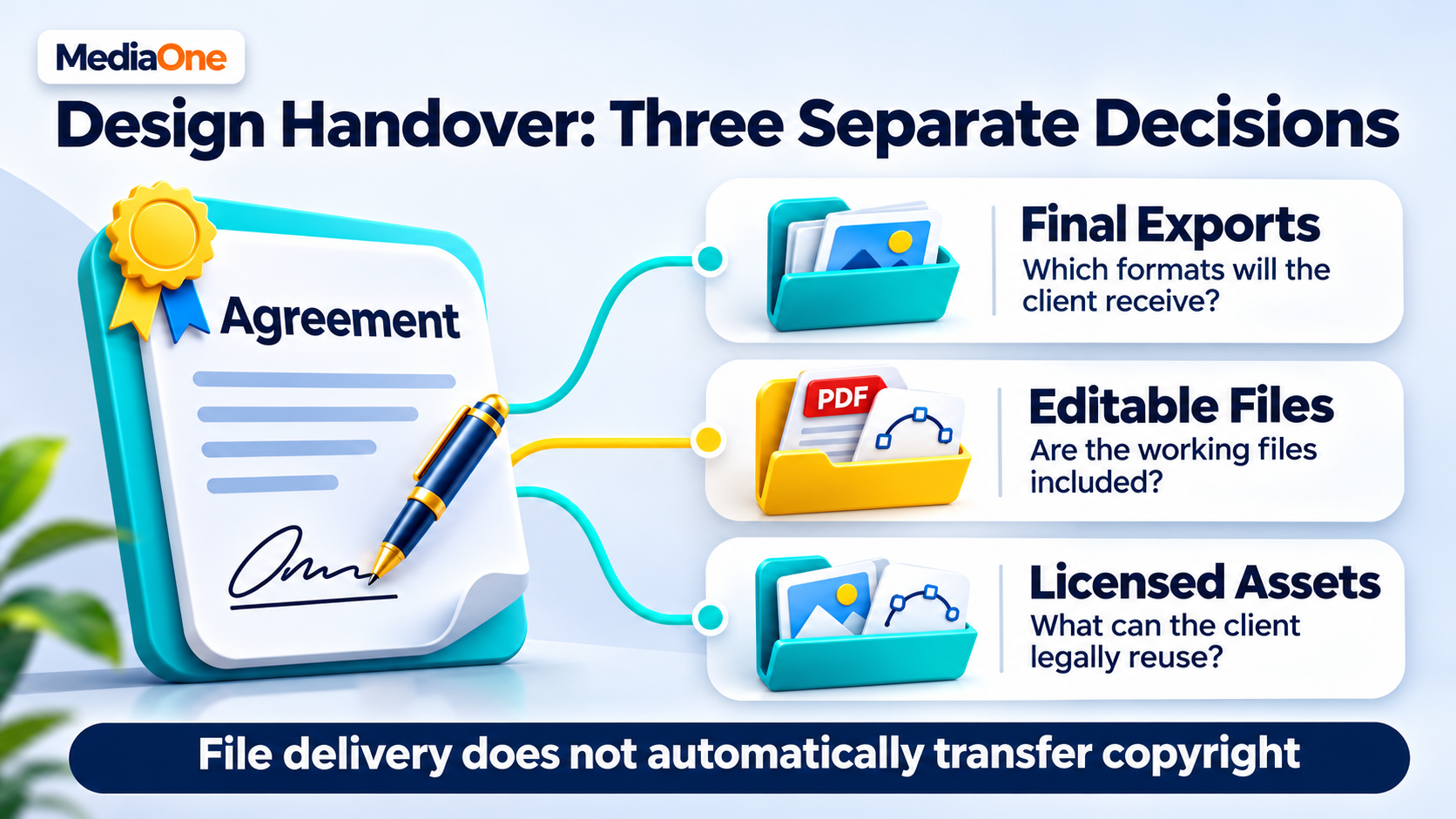
- Copyright ownership, editable files and third-party licences need separate agreement.
- Monthly revenue is different from money available for personal spending.
A freelance designer can turn creative skills into paid work, whether through weekend projects or a full-time practice. The challenge starts when a design request becomes a business agreement.
A café owner might request “a simple menu” but expect photography, copywriting and several versions. A founder might need a presentation tomorrow while still changing the figures.
A workable business connects the creative work with a defined scope, realistic timetable and payment process. The sections below explain those decisions without treating one rate, deposit or income target as a rule for everyone.
What Does a Freelance Designer Do?
A freelance designer creates visual work for clients under an agreed brief. Projects can involve a single asset or a connected set of materials.
Services clients can buy
A service becomes easier to price when the client knows what they receive.
| Service | Example deliverables | Scope to confirm |
| Brand identity | Logo, colours and type styles | Concepts, applications and ownership |
| Presentation design | Pitch deck or sales presentation | Slide count, charts and content readiness |
| Social graphics | Posts, stories and templates | Sizes, quantities and editable files |
| Print design | Menus, brochures and packaging artwork | Dimensions, print specifications and proofing |
| Website design | Page layouts and interface components | Pages, screen sizes and development |
| Motion design | Animated titles or short graphics | Length, formats and sound |
A logo is one part of branding. A wider identity project may also require rules showing how colours, typography and layouts work together.
Clients and their expectations
Different buyers bring different working arrangements:
- Small businesses may need direct explanations and help organising their content.
- Agencies may supply detailed briefs and expect work within existing brand rules.
- Startups may need pitch materials, product screens or launch assets.
- Internal marketing teams may need extra production support during busy periods.
Website projects need particular care. A layout does not automatically include coding, hosting or maintenance. Collaboration with a freelance web developer can cover the build, provided responsibilities are agreed before quoting.
How to Choose a Design Specialisation
A specialisation gives potential clients a reason to consider your work. The starting point can be a deliverable, an industry or a recurring problem.
Examples include presentation design for training providers, packaging artwork for food businesses and social templates for retailers.
A service statement clients understand
A short service statement should identify the work and its intended buyer. “Pitch decks and sales presentations for Singapore startups” says more than “creative solutions for every business”.
Three checks can help narrow the offer:
- Evidence: Existing work shows the skills required.
- Demand: Potential clients already commission similar projects.
- Access: Those buyers are reachable through existing contacts or targeted outreach.
A designer can still accept related work. The main offer simply gives their portfolio a consistent focus.
A portfolio built around decisions
Three relevant projects can explain a service better than twenty unrelated images. Each project should show:
- The client’s problem or the practice brief.
- The intended audience.
- The designer’s contribution.
- The finished work in context.
- The reasons behind key design choices.
A menu example could explain how larger prices and grouped dishes help customers scan the page. A presentation example could show how a chart replaced a crowded paragraph.
Practice projects belong in portfolios when labelled accurately. Invented clients, testimonials and sales results do not. Consistent personal branding also helps buyers recognise the same designer across profiles and proposals.

Business Registration and Permission to Freelance
Freelancing involves more than choosing a studio name. Registration, work permission and employment terms are separate checks.
When ACRA registration applies
ACRA’s business registration requirements distinguish between activities that require registration and exemptions. An individual trading solely under their full NRIC name may qualify for an exemption. A name containing extra wording, such as “Designs by Tan Mei Ling,” requires registration.
A sole proprietorship is one possible structure for a solo designer. ACRA lists S$15 for the name application and S$100 for registration. The S$115 total covers the initial one-year setup; it is not an annual S$115 renewal charge. The published transaction fees list renewal separately.
What a sole proprietorship means
A sole proprietorship does not create a separate legal person. Its owner remains personally responsible for business debts and losses. A studio name therefore provides a trading identity, without creating limited liability.
ACRA’s comparison of business structures explains these differences. A separate bank account can improve record-keeping, but it does not change the legal structure.
Employment and work-pass restrictions
A salaried designer should check their employment contract for outside-work restrictions, conflicts of interest and confidentiality duties. Employer software, files and working hours should remain separate from freelance projects.
Work-pass holders cannot assume that registration permits additional work. MOM’s rules on working in multiple jobs state that work-pass holders must work only for their designated employer and must not take additional income-earning jobs in Singapore.
Income Tax, MediSave and GST Explained
Money received from clients needs to cover business expenses and personal obligations. The full invoice value is not take-home pay.
Revenue and business profit
Revenue is the income the business earns. Profit remains after allowable business expenses.
For illustration, S24,000inannualrevenueminusS4,000 in allowable expenses leaves S$20,000 in business profit before personal tax adjustments. The figures describe a calculation, not an earnings forecast.
IRAS explains how business income is calculated. Personal spending does not become deductible because it passes through a business account. Equipment purchases can also receive different treatment from everyday expenses.
MediSave depends on net trade income
CPF Board states that mandatory MediSave contributions for self-employed persons apply when annual net trade income exceeds S$6,000. The amount depends on age and net trade income. CPF Board’s contribution calculation includes the relevant rates and calculator.
A fixed percentage of every payment cannot reliably cover everyone’s MediSave and income tax. Other earnings and personal circumstances affect the amount needed.
A reserve based on your circumstances
A separate savings account can hold money reserved for future payments. A simple review process includes:
- An estimate of annual business profit.
- Other income, including employment earnings.
- An income tax estimate.
- A separate MediSave estimate.
- Monthly transfers adjusted as earnings change.
A strong sales month may require a larger reserve. Money reserved for tax should remain available when payment falls due.
GST and business records
IRAS’s GST registration rules generally require registration when taxable turnover exceeds S$1 million in a calendar year, or is reasonably expected to exceed S$1 million in the next 12 months. Turnover and profit are different figures.
IRAS also requires business records and supporting documents to be retained for five years. A monthly folder can hold invoices, receipts, payment records and expense details. Regular filing reduces the work needed later.
How Much Should a Freelance Designer Charge?
A freelance designer’s fee depends on the work, time, costs and rights involved. A small template edit and an original identity project need different estimates.
Published prices also describe different packages. A single “Singapore rate” can hide major differences in research, revisions and deliverables.
A rate based on available billable hours
Billable hours are hours charged to clients. Administration, marketing and some learning time still need funding.
An illustrative calculation looks like this:
| Monthly planning item | Example |
| Owner’s income target before personal obligations | S$3,000 |
| Business expenses | S$400 |
| Leave and contingency allowance | S$600 |
| Revenue required | S$4,000 |
| Expected billable hours | 80 |
| Internal hourly baseline | S$50 |
These figures are planning examples, not market averages or income promises. The S$50 baseline comes from dividing S$4,000 by 80 hours.
A designer with only 40 billable hours would need a different calculation. Assuming every working hour can be sold will understate the fee required.
Hourly, project and monthly fees
The pricing method should match the assignment.
| Method | Suitable situation | Main point to agree |
| Hourly | Ongoing edits with uncertain volume | Time records and approval limits |
| Fixed project | Defined deliverables and review stages | Included work and extra charges |
| Monthly retainer | Recurring work | Capacity, deadlines and unused hours |
A project estimate should include briefing, research, design, meetings, revisions, exports and administration.
For example, 18 estimated hours at S50givesS900 before direct costs. A client-facing quote might present a fixed fee with listed deliverables. The internal estimate remains a check on whether the work can pay for itself.
A quote clients can compare
A quote needs enough detail to explain the price:
- Deliverables and file formats.
- Concepts and revision rounds.
- Client-supplied materials.
- Delivery stages and approval dates.
- Usage rights and source files.
- Direct costs and payment dates.
- Quote expiry date.
Website work should separate visual design from the broader website design service, which may involve development and other tasks. A client can then see which responsibilities the freelance fee covers.
Rate reviews based on evidence
Rates do not need to rise after a fixed number of clients. Better signals include repeated overruns, growing demand, stronger specialist skills and higher operating costs.
A project review can compare estimated hours with actual hours. Frequent overspending on revisions may require tighter scope before a higher price.
Contracts, Deposits and Design Ownership
A written agreement records what both sides expect. Its length should reflect the project, without forcing essential terms onto one page.
Terms to agree before work begins
A practical agreement covers:
| Term | Details to record |
| Deliverables | Quantities, sizes and formats |
| Responsibilities | Content, feedback and approvals |
| Schedule | Start date, milestones and dependencies |
| Revisions | Included rounds and extra-work process |
| Payment | Deposit, milestones and due dates |
| Cancellation | Payment for completed work and agreed costs |
| Rights | Ownership, permitted use and portfolio permission |
| Handover | Final files and included support |
One feedback contact can reduce conflicting requests. A revision round can mean one combined list of changes submitted after reviewing a draft.
A new direction needs separate agreement. A client replacing an approved concept has requested different work, even if the final file count stays the same.
Deposits and milestone payments
A 50% deposit is one possible arrangement. Smaller jobs may use full advance payment, while longer projects may use milestones.
An illustrative S$2,000 project could split payments into:
- S$800 before the scheduled start.
- S$600 after concept approval.
- S$600 before the agreed final handover.
A client’s procurement process may require another arrangement. The decision should consider payment history, project length and how much unpaid work the designer would carry.
Copyright, source files and licences
IPOS explains that creators generally own copyright in commissioned work unless a written agreement provides otherwise. A copyright assignment transfers ownership; a licence permits specified uses while ownership remains with the creator.
The agreement should distinguish copyright ownership and licensing from editable-file delivery. A client receiving a PDF has not necessarily received the working file or ownership rights.
Third-party assets need separate attention:
- Fonts may require a client licence.
- Stock images may have usage limits.
- Templates may restrict redistribution.
- Rejected concepts may remain outside the purchase.
The quote should promise only rights the designer can provide.
How to Find Your First Design Clients
Early client searches work better when the offer is specific. A portfolio link alone leaves the recipient to decide what the designer could do for them.
Contacts and targeted enquiries
Past colleagues, suppliers, local businesses and community contacts can provide starting points. A short message should explain the service and relevant experience.
A hypothetical introduction could read, “My design service covers menus and promotional graphics for cafés. The portfolio includes a menu layout showing how seasonal items can be added.”
A simple enquiry tracker can record:
- Business and contact name.
- Relevant service.
- Date contacted.
- Reply and next step.
- Quote status.
A consistent freelancer marketing routine gives outreach a place in the week without taking over delivery time.
Portfolio posts that explain the work
A short case study can show the thinking behind a design. Examples include simplifying a crowded slide, organising product information or adapting one campaign across several sizes.
The explanation should distinguish the designer’s contribution from other work. An attractive layout alone does not prove increased sales.
Honest client reviews can add context about communication and delivery. Permission should come before publishing client names, comments or confidential project details.
Enquiries worth pursuing
A short discovery call can establish:
- The problem the client wants solved.
- Required deliverables.
- Available content.
- Budget and deadline.
- The person approving the work.
- The payment process.
A request for a custom unpaid concept can be replaced with relevant portfolio examples or a small paid trial. The trial should have its own scope and fee.
A Project Process From Brief to Handover
A repeatable process reduces missing information. Each stage should end with a decision that allows the next stage to begin.
A brief with enough detail
The brief should explain the audience, purpose, message and required action. Existing brand assets, final copy and technical specifications belong in the same place.
A flyer brief, for example, needs the event date, venue, booking link and print size before layout begins. Missing details create avoidable rework.
A short brief can answer five questions:
- Who will see the design?
- What should they understand?
- What should they do next?
- Where will the asset appear?
- Who gives final approval?
Reviews with one combined response
A shared review document keeps comments together. Feedback can then refer to a page, slide or screen instead of arriving through several private messages.
A designer can ask for the reason behind a request. “The booking details are hard to find” provides more direction than “make it pop.”
Client delays also affect delivery. A schedule should explain how late content or approvals affect later milestones.
A handover the client can use
Final delivery should include an organised file list and any agreed instructions.
A handover checklist might cover:
- Approved exports in the correct sizes.
- Editable files included in the agreement.
- Print-ready artwork where required.
- Asset licence information.
- File names and version dates.
- Any remaining client responsibilities.
A short handover note can explain which file belongs where. The client should not need to open ten similar versions to identify the approved design.
Tools, Working Hours and Monthly Income
A small set of dependable tools can support the first projects. More subscriptions create more recurring costs.
Tools chosen for the work
A starter setup needs functions, not a long shopping list:
| Function | Requirement |
| Design | Required formats and export quality |
| Feedback | Comments connected to the artwork |
| File storage | Backups and controlled access |
| Invoicing | Numbered invoices and payment tracking |
| Time tracking | Actual hours by project stage |
| Bookkeeping | Income, expenses and supporting records |
Software and asset licences should permit the intended commercial work. A paid subscription makes sense when its capabilities justify the cost.
Capacity beyond design hours
A side-hustle designer with eight available hours a week cannot promise eight hours of production. Calls, estimates, accounts and file preparation need space too.
A workable calendar reserves time for:
- Current project delivery.
- Client communication.
- Administration.
- Marketing.
- Unexpected revisions.
Delivery dates should reflect existing commitments. Employer equipment and accounts should remain outside the freelance setup.
Revenue compared with spendable income
An illustrative month with four S$600 projects produces S$2,400 in revenue. Business costs, tax reserves and MediSave still need to be accounted for.
The timing also affects cash available. A completed project with an unpaid invoice cannot fund the week’s expenses.
A monthly review should therefore separate work booked, invoices issued, payments received and overdue balances. Each figure answers a different business question.
Repeat Work and Overdue Payments
A growing practice needs steady delivery and a response when payment falls behind. Both depend on records.
Retainers with defined limits
A retainer works when the client has recurring needs. “Eight social graphics each month” describes an offer more precisely than “ongoing design support”.
The agreement should explain:
- Monthly deliverables or reserved hours.
- Request and approval deadlines.
- Revision limits.
- Urgent-work charges.
- Unused capacity.
- Notice periods.
Specific referral requests can support growth after a successful project. A designer might request an introduction to another retailer needing product graphics.

Overdue invoices and small claims
A payment reminder should identify the invoice, amount, due date and payment method. Any pause in work should follow the agreed contract terms.
The Small Claims Tribunals’ eligibility rules cover qualifying claims up to S$20,000, or S$30,000 with both parties’ written consent. Claims generally need filing within two years, and other conditions apply, including the respondent being located in Singapore.
Contracts, invoices, approvals and delivery records help document what happened. An unpaid design invoice does not automatically qualify for the tribunal.
A Freelance Design Business Built Around Deliverable Work
A freelance designer’s first business plan can be modest: one defined service, relevant portfolio examples and enough capacity to deliver the promised work. Project records then show which assignments pay adequately and which need different terms.
A growing studio may also need a stronger public presence. MediaOne’s branding services support brand strategy and visual identity. A conversation with MediaOne can help establish the marketing work required for the next stage.
FAQs About Freelance Designers
Do freelance designers need a design degree?
A degree can support learning, but clients can assess practical ability through relevant work samples and explanations. Some assignments or procurement processes may specify qualifications. A portfolio should show the skills required for the particular service being offered.
Can a freelance designer work with overseas clients?
Overseas projects need terms covering currency, transfer charges, time zones and approvals. Cross-border enforcement can be more difficult. A client’s overseas address also does not automatically establish the GST treatment of the service.
Can a designer use AI tools in client work?
AI use depends on the contract, confidentiality duties and tool terms. Client files should not be uploaded without permission and an assessment of how the service handles them. The designer remains responsible for checking the output and avoiding unsupported promises about ownership or exclusivity.
Should a freelance designer offer rush delivery?
Rush delivery should depend on actual capacity. A rush fee can cover rescheduling costs, but it cannot replace time needed for production and review. An urgent job still needs approved content, a defined scope and someone available to provide feedback.
Can a designer subcontract part of a project?
Subcontracting should follow the client agreement. The arrangement needs suitable confidentiality terms, permission where required and rights that allow the promised client handover. The lead designer should also establish who checks quality and handles corrections.
How long should a designer provide support after delivery?
The agreement can specify a support period and the issues it covers. An export error differs from a later request to replace content. A defined support window helps both parties understand when a correction is included and when a new quote is needed.