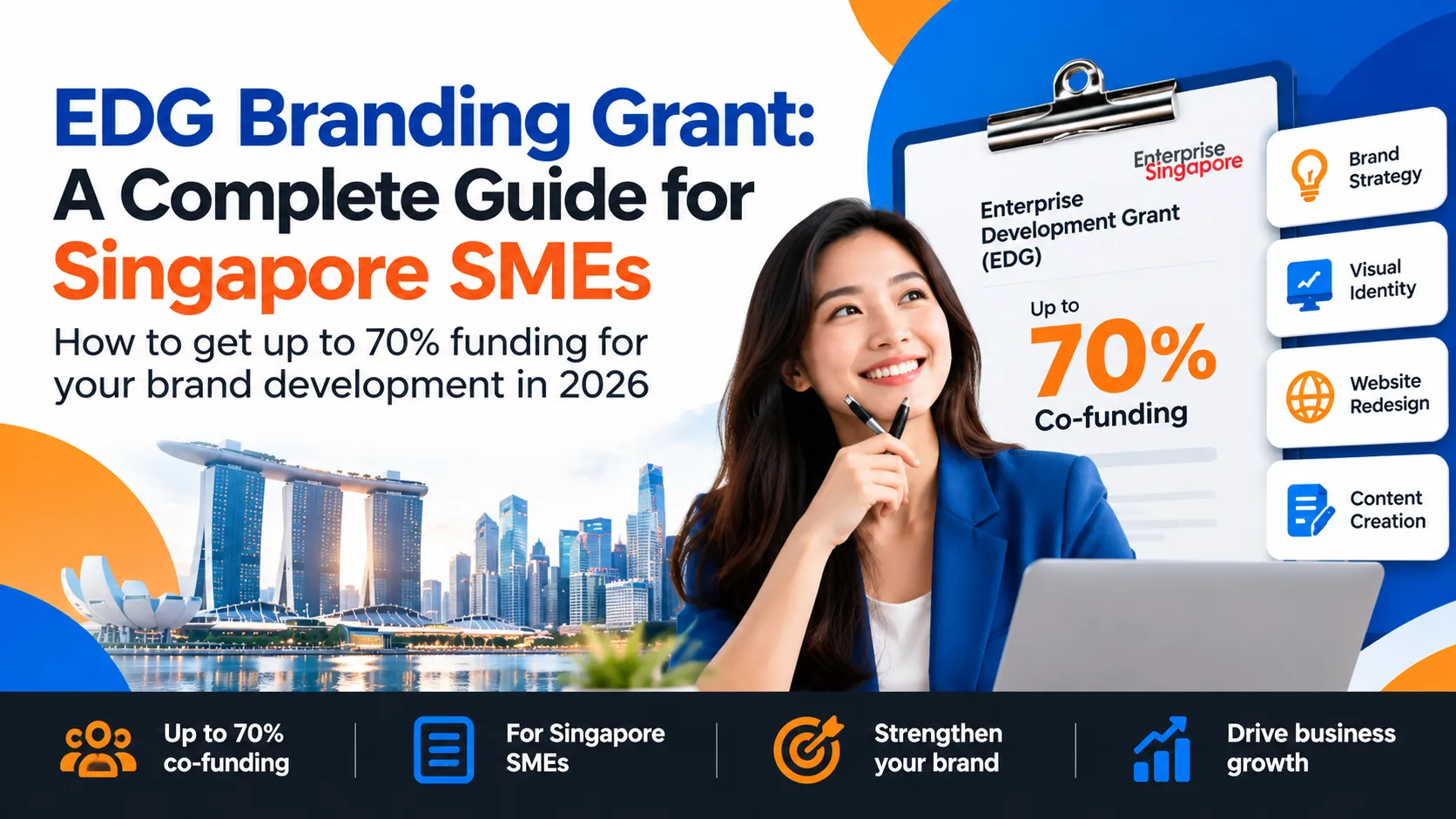
The Enterprise Development Grant (EDG) Branding component is one of Singapore’s most accessible funding schemes for small and medium-sized businesses wanting to strengthen their brand identity. Managed by Enterprise Singapore (EnterpriseSG), the scheme offers up to 70% co-funding of eligible branding work, capped at S$100,000 per project. Unlike broader innovation or productivity grants, EDG Branding specifically funds the intangible assets that shape how customers perceive and remember your business: your visual identity, brand positioning, storytelling and digital presence.

This guide covers what qualifies, who is eligible, how to apply, and how to avoid common pitfalls that cause rejections or delays. Whether you are repositioning for a new market segment, launching a rebrand after a merger, or strengthening your presence against better-known competitors, you will find concrete steps and real-world logic to maximise this grant.
Key Takeaways
- The EDG Branding Grant covers up to 70% of eligible branding costs (capped at S$100,000) for Singapore SMEs with fewer than 200 staff and under S$100 million annual turnover, making professional brand development financially accessible without full out-of-pocket investment.
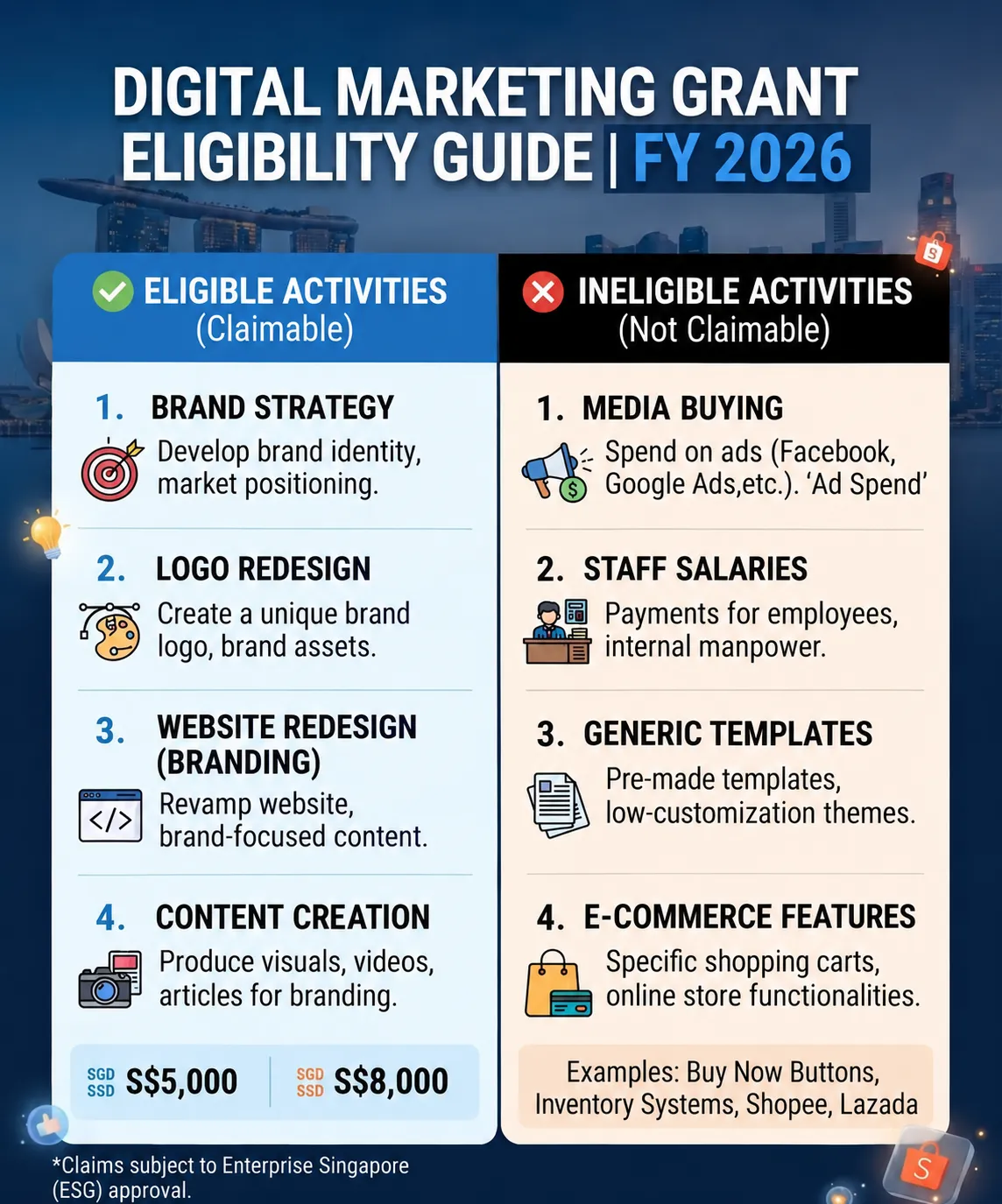
- Only professional consulting and creative deliverables qualify: brand strategy, visual identity, website redesign, and content creation are eligible; media buying, staff salaries, and generic templates are not, so clarify scope before requesting a quotation to avoid rejection.
- Applications are typically assessed within 4-6 weeks; approved projects must start within 4-8 weeks and commonly take 6-12 months to complete, depending on project scope and EnterpriseSG workload, with claims submitted after final delivery using supplier certificates and proof of payment.
- Anchor your application to a specific business outcome (e.g., “reposition for the premium segment” or “expand into a new geographic market”) rather than aesthetic goals; EnterpriseSG prioritises grants tied to revenue, market share or capability impact.
- The most common rejection reasons are overestimating eligible activities (claiming advertising spend or internal salaries), submitting vague or single quotations, and failing to align the branding project to measurable business objectives that justify the grant investment.
- Post-grant success depends on activation planning: the grant funds development, while you fund the launch. Set measurable metrics (website traffic uplift, brand awareness lift, qualified lead growth) before starting the project so you can demonstrate return on investment and support future applications.
What Is the EDG Branding Grant?
Core definition and purpose
The EDG Branding component is a co-funding scheme that helps Singapore-registered businesses invest in professional brand development. It covers up to 70% of eligible project costs, with a maximum funding cap of S$100,000 per project.
The scheme is designed for small and medium-sized enterprises (SMEs) seeking to professionalise their brand positioning, digital presence and market perception. EnterpriseSG administers it as part of the broader Enterprise Development Grant portfolio.
A key feature is the co-funding structure: you contribute 30% of costs, and the grant covers the remaining 70%. This shared investment demonstrates genuine business commitment to EnterpriseSG’s assessment team and ensures substantial stakeholder investment.
Important: Eligibility criteria are current as of 2026. Please verify all thresholds and requirements with EnterpriseSG before applying, as policies may have been updated.
Who qualifies for the EDG Branding Grant?
Your business must meet all of these criteria to qualify:
| Criterion | Your Status |
|---|---|
| Headcount and turnover | Fewer than 200 employees and annual turnover not exceeding S$100 million. |
| Registration | Singapore-registered company with operations in Singapore. Foreign-owned businesses can apply if they have a Singapore-registered entity. |
| Financial standing | Not insolvent, under receivership, or in breach of previous grant conditions. EnterpriseSG screens companies against the Accounting and Corporate Regulatory Authority (ACRA) registry. |
| Repeat applications | You can apply multiple times but cannot claim the same project twice and must wait for one approval to conclude before starting another application. |
Some EnterpriseSG schemes require local shareholding thresholds. Please check EnterpriseSG’s current guidelines to confirm whether EDG Branding has such requirements when you apply.
Key differences from other EnterpriseSG grants
EDG Branding sits within the broader EDG scheme but has a distinct scope. The branding component targets intangible brand assets: visual identity, positioning, storytelling, and digital presence. Other EDG tracks fund productivity upgrades, innovation projects or capability training.
Two other schemes sometimes overlap with branding work:
Market Readiness Assistance (MRA) covers brand-related work in the context of market entry or export expansion. If you are rebranding purely for domestic repositioning, EDG Branding is the right fit. If your rebrand involves entering a new geographic market or exporting, MRA may better suit your needs.

Design for a Cause targets social enterprises and requires projects to have measurable community or social impact. EDG Branding applies to any business model with no social impact requirement.
| Aspect | EDG Branding | MRA | Design for a Cause |
|---|---|---|---|
| Best for | Domestic brand strengthening | Market entry or export expansion | Social enterprises with community impact |
| Focus | Brand positioning, identity, digital presence | Market-entry branding and launch | Social impact combined with design |
| Who can apply | Any Singapore SME | Any Singapore SME | Social enterprises only |
Choose based on your primary business objective: strengthening your brand at home (EDG Branding), entering a new market (MRA), or combining design with measurable social impact (Design for a Cause).
Eligible Branding and Marketing Activities Under EDG
Brand strategy and positioning work
Professional consultancy that defines your target audience, clarifies competitive positioning and develops brand messaging frameworks qualifies for EnterpriseSG funding. This covers brand audits, in which an external consultant assesses your brand’s current perception. It also includes strategic repositioning exercises that reshape how the market understands your business and tone-of-voice development that defines how your brand communicates across all channels.
The critical requirement is that external professional consultants must deliver the work. Your internal marketing team’s ideas or oversight do not qualify, even if they drive the project. Only paid consultant deliverables count toward your grant claim: strategy reports, positioning statements and audience personas.
To substantiate a claim, please retain all formal consultant deliverables. A strategy report should be substantive enough to demonstrate strategic depth, typically spanning at least 15-20 pages. Positioning documents must specify your target customer profile and key differentiators. Persona documents should describe detailed customer archetypes covering demographics, pain points and decision criteria. Without these tangible outputs, EnterpriseSG will reject or reduce your claim.
Visual identity and design projects
Logo redesign, brand guidelines development, packaging design and corporate identity systems are core eligible activities. The program also includes photographic and videographic style guides, colour palettes, typography systems and brand asset libraries that standardise how your brand appears across different channels.
Designers delivering this work must be registered professional firms or freelancers with verifiable portfolios. Before engaging, verify the supplier’s Unique Entity Number (UEN). You should verify supplier credentials; EnterpriseSG may also conduct checks during assessment. The grant does not cover purchasing stock photos or generic vector libraries. It does cover bespoke creative development where a designer creates original assets tailored to your brand.
For example, if your rebranding includes a new logo, custom brand colours and a 30-page guidelines document specifying typography, imagery style and logo placement rules, all of this qualifies. The supplier invoice must itemise these deliverables separately, so that your grant claim links each cost to a specific output.
Digital brand presence development
Website redesigns or launches centred on brand experience qualify for funding. The focus must be brand perception and positioning, not e-commerce transactional features. If you redesign your site to showcase your brand story, refresh the visual identity and improve how users navigate your brand narrative, it qualifies. A pure e-commerce rebuild focused on checkout optimisation does not qualify unless it is paired with strategic branding work.
A brand-centred social media strategy qualifies. This means a documented plan for how your brand will communicate on each platform over 12 months, including tone, content themes and posting cadence. Content creation for brand storytelling also qualifies: video scripts, blog articles about your brand heritage or values, and infographics explaining your positioning.
Search engine optimisation work tied to brand keyword visibility qualifies. If you optimise your website so that searches for “sustainable packaging supplier” or “luxury wellness retreat” rank your site higher because those terms match your new positioning, that SEO work qualifies. Paid search advertising spend (the cost of Google Ads or Facebook ads themselves) does not qualify under EDG Branding.
Email marketing systems and customer relationship management (CRM) customisation may qualify if their primary purpose is to nurture customers around your brand message rather than to automate sales transactions. A system that segments customers by brand preference and sends them story-driven content aligns with brand building. A system that only triggers cart-abandonment reminders does not achieve this.
Brand awareness and launch campaigns
Campaign conceptualisation and production for brand launches, repositioning announcements or market expansion efforts qualify. This includes developing the campaign idea, creative assets such as video, photography, copy and graphics, and strategy documents that outline the campaign’s objectives and messaging.
Public relations support qualifies: a PR agency developing media pitches and press releases around your rebrand or market entry. Trade show design and activation also qualify, including custom booth design, branded collateral and live demonstrations that embody your new brand positioning. Sponsored content creation qualifies: articles or videos you fund a publication to create, focused on your brand story rather than product promotion.
The critical distinction is that the grant covers creative production and strategy work, not media buying. If a campaign costs S$30,000 total (S$12,000 for creative production and S$18,000 for media placement), only the S$12,000 production cost qualifies for the grant. You are responsible for the S$18,000 media spend.
Ineligible activities
Several common expenses do not qualify, even if they are classified as brand-related:
- Stock photo and video libraries: Generic imagery you purchase for marketing does not qualify.
- Off-the-shelf website templates: Generic templates do not qualify; custom-built brand sites do.
- Generic social media management retainers and agencies posting content without a bespoke brand strategy document underlying the work are ineligible.
- Internal staff salaries: These never qualify, regardless of time spent on branding work.
- Advertising spend: Media placements are not covered.
- Website hosting, domains and standard software subscriptions: These do not qualify unless customised as part of a brand system build.
- Operational system redesigns: Work aimed at improving warehouse efficiency or internal operations does not qualify as a branding activity, even if new brand colours are applied to the interface.
Before committing a budget to any supplier, confirm the scope aligns with EnterpriseSG’s definition. When in doubt, contact EnterpriseSG’s Small and Medium Enterprise hotline at +65 6898 1800 during business hours to verify eligibility before incurring costs.
EnterpriseSG retains discretion in all assessments. Listed ineligible activities are common reasons for rejection but are not exhaustive.
Eligibility criteria are current as of 2026. Verify with EnterpriseSG before applying, as thresholds and eligible activities may be updated.
Step-by-Step Application Process for EDG Branding in 2026
Pre-application: eligibility check and planning
Start by confirming your business meets EnterpriseSG’s headcount and turnover thresholds. Visit the official Enterprise Singapore website and verify that you employ fewer than 200 staff and have annual turnover not exceeding S$100 million. Gather your Unique Entity Number (UEN) and your latest two years of financial statements; you will need these for the application.
Eligibility criteria are current as of 2026; verify with EnterpriseSG before applying, as thresholds may be updated.
Next, define the specific branding challenge you will address. Ask yourself: Is this a brand refresh to compete in a new market segment? A positioning overhaul for market entry? A digital-first rebrand to reach younger customers? The clearer your objective, the tighter your project scope and the lower your budget risk.
Finally, prepare a shortlist of three potential branding consultants or agencies. You cannot submit an application without quotations, and EnterpriseSG expects competitive quotes from multiple suppliers.
Obtaining supplier quotations
Request detailed project quotations from at least two independent suppliers; EnterpriseSG strongly recommends three. Each quotation must itemise deliverables (for example, logo redesign, brand guidelines document, website redesign), timelines and costs line-by-line. Quotations must be dated and come from registered businesses with valid UEN numbers printed on the invoice.
The grant assessment panel evaluates whether quoted costs are reasonable for the scope. Inflated bids or quotations that lack itemisation may be queried or revised down. A S$50,000 logo redesign alone will raise questions; the same quotation paired with brand strategy, a visual identity system, and a website redesign is justifiable.
Ensure each supplier provides a UEN and relevant business registration number for verification. If you plan to use a preferred agency, ask them to match or beat competing quotes. Please explain how their approach justifies the higher cost of their quotation.
You should verify supplier credentials; EnterpriseSG may also conduct checks during assessment.
Application submission
Log in to your company’s account on the Business Grants Portal (hosted by EnterpriseSG) using your Singapore company credentials. Navigate to the EDG Branding section and select “Branding” as your project type. Then complete an online form with three core elements.

Company and project details section:
Enter your company name, UEN, headcount and annual turnover. Please confirm your financial results for the last two years.
Project description (500-800 words):
Write a clear, business-focused narrative. Describe the branding challenge (for example, “Our brand is seen as a legacy player; we need to reposition as innovation-led to compete for Gen Z customers”). Explain what the branding project will deliver (for example, a new visual identity, a positioning statement, and a website redesign). Link the outcome to a business result (for example, “Expected to increase online-channel engagement by 20% and raise brand awareness in the under-35 demographic from 8% to 15%”).
Supplier and cost section:
List all three quotations with supplier names and contact details. Enter the total project cost. Confirm that you understand the co-funding split: you pay 30%, EnterpriseSG pays 70% (capped at S$100,000).
Upload supporting documents in PDF format: your company registration certificate, financial statements for the last two years, all three quotations, and a brief one-page resume of your marketing or business lead. This shows relevant branding or business leadership experience. The portal generates a submission reference number on completion; save this for your records.
Assessment and approval timeline
EnterpriseSG’s assessment team typically reviews applications within 4-6 weeks of submission, depending on application volume and project complexity. During this period, they evaluate your eligibility, the business case for the branding project and the reasonableness of supplier quotations.
They may request clarifications: for example, asking why you chose one supplier over another or requesting evidence that the project outcome links to a real business metric. When EnterpriseSG requests clarification, you typically have 14 days to respond. Missing this deadline risks rejection of your application.
If approved, you receive a formal grant approval letter. It specifies three key items: the funding quantum (70% co-funding, capped at S$100,000), your approved project timeline (commonly 6-12 months from approval, depending on project scope and EnterpriseSG workload), and the claims procedures you must follow. The typical approval-to-project-start window is 4-8 weeks; use this time to finalise contracts with your supplier and set up project governance.
Listed rejection reasons are common; EnterpriseSG retains discretion in all assessments.

Project execution and milestone tracking
Once approved, you must begin the project within the agreed timeline. Many applicants delay supplier engagement and then rush delivery, risking incomplete work or quality shortcuts. Notify your approved supplier of the grant approval immediately. Schedule a project kick-off meeting within two weeks.
Maintain a simple project journal throughout. Document each supplier meeting, the deliverables handed over, the dates and payment amounts. Request a formal delivery certificate from your supplier at each project milestone (for example, “Brand positioning strategy delivered 15 September 2026; brand guidelines delivered 20 October 2026”). The supplier should sign this certificate, state what was delivered, and include the date.
Retain all original invoices (printed or PDF copies with UEN visible), proof of payment (bank statements showing the transaction, cheque stubs or transfer receipts), and all deliverable files (design files, strategy reports, campaign assets, website code, social media templates). These documents are essential for your grant claim; missing documents may reduce or delay your reimbursement.
Grant claims and final submission
After your project is complete, submit a grant claim form to EnterpriseSG within 30 days of the final project completion. Include all supporting documents: final invoices, proof of payment for each invoice, supplier delivery certificates (signed and dated), and a signed acceptance statement confirming you received the deliverables and are satisfied with the quality.
Also include a brief project report (300-500 words). Describe what was delivered (for example, “New brand positioning statement and visual identity system, website redesign of 10 core pages, social media asset library for 12 months of content”). Include the timeline (start and end dates) and whether milestones were met on schedule. Note early business outcomes you have observed (for example, “Website traffic increased by 18% in the first two months post-launch; social media engagement increased by 22%; brand awareness in our target segment lifted from 12% to 19% in a post-launch survey”).
EnterpriseSG processes claims within 6-8 weeks. They may request clarification on invoices, delivery certificates or your project report. Once approved, EnterpriseSG transfers funds to your designated company bank account via GIRO or direct bank transfer.
Maximising Grant Value: Strategic Considerations for Singapore SMEs
Timing your application relative to business cycles
The timing of your EDG Branding application significantly affects both approval odds and project impact. EnterpriseSG reviews applications more favourably when submitted during your business’s natural growth windows: product launches, market expansion into new regions, leadership transitions or strategic repositioning.
Conversely, applying during financial downturns or cash flow crises signals lower strategic intent. EnterpriseSG’s assessment teams prioritise applicants with stable financials and clear growth trajectories. If rebranding is tied to a hard deadline, such as a regional expansion rollout or franchise system launch, ensure your approved project timeline aligns with that milestone. This alignment demonstrates that the grant funds a genuinely urgent business need, not a discretionary refresh.
Practical timing: if your business enters a new market segment in Q2 2027, submit your EDG application in Q3 2026. This typically allows 4-6 weeks for assessment and 4-8 weeks between approval and project start. Most projects then run for 6-12 months, depending on scope and the EnterpriseSG workload, so you can complete them before your market launch.
Choosing between internal and external branding expertise
The co-funding model for EDG requires you to contribute 30% of project costs from your own budget. The grant covers the remaining 70%, up to a maximum of S$100,000 in total eligible spend. This constraint forces a realistic choice about resource allocation.
If your business has established in-house marketing capability (product managers with design sensibility, social media staff with content production skills, or a marketing manager with strategic grounding), structure your project as a hybrid. Hire an external brand strategist or positioning consultant to lead the strategic work and create frameworks (30% of total cost). Your internal team then executes design refinements, website builds and content calendars. This approach cuts your cash outlay by keeping execution in-house while importing expert strategy.
For startups or product-centric firms without deep marketing infrastructure, budget for a full-service branding agency. The S$100,000 grant ceiling limits total scope anyway. With a full agency, prioritise brand strategy, visual identity system and brand guidelines over extended advertising campaign design. A complete rebrand typically costs S$35,000 to S$65,000 when scoped tightly. The grant covers most of that, leaving your 30% co-investment manageable.
Avoiding scope creep and budget overruns
Vague project briefs are the silent killer of grant-funded projects. A request to suppliers for “a brand refresh” will generate widely inflated quotes because consultants pad uncertainty. Instead, specify deliverables with precision before requesting quotations.
Example tightly scoped brief:
- Logo redesign (3 concepts, 2 rounds of revision)
- Brand guidelines document (typically 20-30 pages, covering colour palette, typography, imagery style, tone-of-voice and application examples)
- Website redesign for 10 core pages (mobile-first, no e-commerce functionality)
- Social media asset kit (12 months of post templates for Instagram, LinkedIn and TikTok)
This level of specificity reduces quote variance significantly and prevents mid-project scope creep. When EnterpriseSG reviews your claim, they audit whether deliverables match the original project scope. Additions requested mid-project often fall outside grant eligibility; you must fund them privately.
Document the approved scope in a signed Statement of Work before project kickoff. If genuine business needs require scope expansion (for example, additional website pages after stakeholder feedback), request a formal amendment to your grant approval before proceeding.
Leveraging the grant for competitive differentiation
Treat the EDG Branding grant as an opportunity to address a specific competitive weakness, not as a subsidy for generic modernisation.
Conduct a brief competitive audit before application. If your three largest competitors have stronger brand awareness in your target segment, prioritise brand awareness work and stakeholder communication campaigns. If your brand perception is fragmented (some customers see you as budget-friendly, others as premium), prioritise your positioning strategy and unified messaging frameworks. If you operate in a crowded category but lack distinct visual identity, invest heavily in logo redesign and visual guidelines.
The grant funds professional branding expertise that bootstrap-budget approaches cannot deliver. An external strategist brings tested frameworks, competitive benchmarking and customer insight that internal teams rarely generate alone. Extract full strategic value: use their recommendations to inform not just the immediate project but also your marketing and business strategy for the next 12-24 months.
Post-grant brand activation and measurement
A common misconception is that EDG funding covers brand launch and activation. It does not. The grant pays for brand development; activation (media spend, launch events, staff communication, point-of-sale rollout) is your responsibility.
Plan a 3-6 month post-project activation window. In months 1-2 after deliverables are complete, roll out the new brand across customer touchpoints: website, social channels, physical signage, staff uniforms, and packaging. Conduct internal staff training so your frontline team understands and can articulate the new brand positioning.
Set measurable outcomes before the grant project starts, not after. This forces clarity and provides evidence for future applications. Examples include:
- Website traffic: “15% uplift in organic visits within 6 months of rebrand”
- Brand recognition: “20% improvement in aided awareness of our brand positioning among target segment, measured via customer survey”
- Lead quality: “10% increase in qualified sales enquiries traced to improved website conversion or social engagement”
- Customer perception: “Shift from ‘commodity player’ to ‘specialist’ or ‘premium provider’ in customer perception surveys”
Capture baseline metrics (current website traffic, current brand awareness, current lead volume) before activation begins. Measure again at 3, 6 and 12 months post-launch. These metrics justify the grant investment internally to your board and stakeholders, and they become compelling evidence if you apply for future EnterpriseSG support.
Common Mistakes Singapore Businesses Make When Claiming EDG Branding
Overestimating eligible activities
The most frequent rejection risk is conflating general marketing spend with “branding” work. Media buying (Facebook ads, Google Ads, sponsorship fees) is ineligible even if those ads promote your new brand identity. Staff salaries for internal marketing teams do not qualify, even when they oversee the branding project. Budget-conscious applicants often blur this boundary to stretch grant value.
The distinction is straightforward: EnterpriseSG funds professional external consulting and creative development, not your payroll or advertising costs. When in doubt, contact EnterpriseSG’s SME hotline (+65 6898 1800) before submission rather than risk application rejection or a demand for reimbursement after delivery.
Submitting insufficient or unverified quotations
Vague quotations from freelancers without a Unique Entity Number (UEN), or a single quote with no competitive comparison, raise immediate red flags. EnterpriseSG may reject the application outright or cap reimbursement at a lower rate if quotations appear inflated or lack market-reality checks.
Obtain three quotes from registered suppliers. If you have a preferred agency, justify your choice in the application (track record, specialist expertise in your sector) and request they match or beat competing bids. You should also verify supplier credentials; EnterpriseSG may conduct checks during assessment. Prices should align with industry benchmarks for the scope. A brand identity project priced at S$25,000 from an unknown freelancer indicates either underpricing or incomplete deliverables, whereas three comparable quotes ranging from S$15,000 to S$20,000 suggest market-realistic costs.
Failing to align the project with business outcomes
Applications that describe branding work in aesthetic terms face lower approval odds. Phrases like “improve visual appeal” or “modernise the logo” focus on cosmetics, not business impact. EnterpriseSG prioritises grants linked to revenue, market share or strategic capability gains.
Instead, frame your application around a specific business challenge the branding project solves:
- Reposition for a premium segment: justify with addressable market size and margin uplift potential
- Clarify sustainability credentials: support with customer feedback or market research
- Differentiate from lower-cost competitors: cite specific competitors and positioning gaps in a crowded market
- Enter an adjacent market: for example, a hospitality brand extending to retail, where current brand positioning creates friction
A strong application answers: what business outcome does this branding work unlock, and how will you measure it?
Incomplete or late documentation during claims
Approved applicants often forfeit funds by submitting incomplete claims. Missing items include proof of payment (bank statement extracts or cheque scans), supplier delivery certificates, or a final project report summarising outcomes.
EnterpriseSG may reject incomplete claims outright or delay reimbursement by 4 to 8 weeks while requesting missing documents. By then, cash flow impact can be significant.
Maintain a claims checklist from day one:
- Supplier invoice and payment proof (bank transfer receipt, cheque number)
- Formal delivery certificate signed by the supplier (dated, listing deliverables)
- Your sign-off on delivery (internal approval email or form)
- Project completion report (300-500 words covering scope, timeline and initial outcomes)
Request delivery certificates from suppliers at each milestone handover, not months after the project ends, when supplier contact may have lapsed.
Not monitoring project timeline compliance
Your grant approval letter specifies an execution window, commonly 6 to 12 months from approval depending on project scope and EnterpriseSG workload. If you delay supplier engagement by 4 months, you compress the actual work timeframe and risk incomplete delivery within the deadline.
Incomplete projects trigger grant forfeiture: EnterpriseSG will not reimburse work not completed by the approval deadline, regardless of partial progress.
Begin supplier onboarding within 4 weeks of approval. Schedule kickoff meetings, finalise contracts and set milestone dates before the first month closes. If delays become unavoidable (supplier capacity constraints, internal resource limits), request a formal timeline extension from EnterpriseSG in writing before the original deadline expires. Retroactive requests are rarely approved.
A clear project plan with supplier sign-off on milestones (brand strategy by month 2, design deliverables by month 4, website launch by month 6) prevents timeline drift and ensures you meet the grant deadline.
Eligibility criteria are current as of 2026; verify with EnterpriseSG before applying, as thresholds may be updated. Listed rejection reasons are common; EnterpriseSG retains discretion in all assessments.
Summary and Next Steps
The EDG Branding Grant offers Singapore SMEs a high-leverage opportunity to fund professional brand development at 70% subsidy, capped at S$100,000. The scheme works best when applied to a specific strategic objective: market entry, competitive repositioning or brand-led growth, rather than general modernisation.
Success hinges on three core factors:
Clear eligibility. Only professional branding consulting and creative development qualify. Media spend and staff salaries do not. This distinction, detailed earlier in this guide, remains the most common reason for rejection. Eligibility criteria are current as of 2026; verify with EnterpriseSG before applying, as thresholds may be updated.
Tight project definition. Specific deliverables reduce quote variance and claim disputes. A vague request for “brand refresh” generates inflated bids and scope creep. A detailed specification (logo redesign, brand guidelines, website redesign, social media templates) yields competitive quotes and streamlined approval.
Business outcome alignment. Frame the branding project as a solution to a revenue or market-share challenge, not an aesthetic upgrade. EnterpriseSG prioritises applications that link brand work to customer behaviour, market perception or competitive positioning. A business seeking to enter the premium segment or clarify sustainability credentials will receive higher assessment scores than one seeking a “modern look”.
Applications open year-round. The full cycle, from submission through assessment to final claims payout, commonly takes 6 to 12 months, depending on project scope and EnterpriseSG workload. Approved applicants must execute projects within their approved timeline and submit detailed claims with supplier delivery certificates and proof of payment to unlock reimbursement.
Immediate next steps
- Confirm eligibility. Verify on the official EnterpriseSG website that your business meets the staff threshold of fewer than 200 employees and turnover under S$100 million.
- Define your objective in one sentence. Examples: “Reposition as a sustainability leader in the local F&B sector” or “Build awareness in the premium casual-dining bracket.” This clarity drives every subsequent step.
- Request three quotations. Approach branding consultants, design agencies or specialist freelancers aligned to your objective. Request itemised quotes specifying deliverables, timelines and costs. Ensure suppliers have a valid Unique Entity Number (UEN) and registered business status. You should verify supplier credentials; EnterpriseSG may also conduct checks during assessment.
- Gather supporting documents. Prepare your company registration certificate, the latest two years of financial statements, and a brief resume or bio of your marketing or business lead.
- Submit via the EnterpriseSG portal. Log in to the Enterprise Singapore Business Grants Portal, select Branding as your project type, and complete the online form. Upload your quotations, company documents and a 500 to 800 word project description. Explain the branding challenge, expected outcomes and business impact.
- Prepare for assessment clarifications. EnterpriseSG typically requests additional details on project scope or supplier credentials within 4 to 6 weeks. Respond within the stated deadline (usually 14 days) to keep your application on track.
For detailed guidance, visit the Enterprise Development Grant page or call the SME hotline at +65 6898 1800 during business hours (Monday to Friday, 8.30am to 5.30pm). Support officers can clarify eligibility questions, review your project scope informally and guide your preparation before you submit.
The grant genuinely reduces your branding investment cost. Your business will pay 30% of the eligible project costs from its own resources. If your project costs S$60,000, the grant covers S$42,000, and you pay S$18,000. That leverage, combined with clear strategic intent and tight execution discipline, transforms a discretionary branding project into a funded competitive advantage.
Frequently Asked Questions
What is the difference between the EDG Branding grant and the broader EDG scheme?
The Enterprise Development Grant (EDG) is an umbrella programme managed by EnterpriseSG. The branding component specifically funds brand strategy, visual identity and digital presence work. Other EDG tracks cover productivity upgrades, innovation projects and capability development. You can apply for multiple EDG components in a single business year if projects are distinct. However, you cannot double-fund the same activity across different schemes.
Can I use the EDG Branding grant to fund a website redesign alone?
Yes, but only if the website redesign is brand-centred and focused on brand experience, messaging and positioning rather than e-commerce or transactional functionality. The redesign must include brand strategy work, new visual identity application and brand-aligned content. A purely functional or e-commerce rebuild would not qualify. Pair it with strategic branding work to meet eligibility criteria.

Do I have to use a local supplier, or can I engage an overseas branding agency?
You may engage overseas suppliers, but the work must be delivered to a Singapore address and managed by a Singapore-registered entity (your company or a local agent). Invoices and payments must be traceable. EnterpriseSG may require proof that work was customised for your Singapore market context rather than a generic offshore deliverable.
What happens if my project costs less than S$100,000 and I claim less than the maximum grant?
You receive 70% co-funding on your actual project cost, not necessarily the full S$100,000 ceiling. If your project costs S$40,000, you can claim S$28,000 (70% of S$40,000), and your company invests S$12,000. There is no penalty for not using the full grant cap. However, claims substantially below the funded amount may trigger a lower approval outcome on your next application.
Can I claim for work my internal marketing team completed, even if I hire an external consultant to oversee it?
No. Internal staff salaries and in-house work do not qualify for co-funding, regardless of oversight. Only external consultant and agency deliverables (with invoices and UEN verification) qualify. If your internal team contributes ideas or feedback, that is your co-investment. The grant covers the professional external work only.
If my grant application is rejected, can I reapply?
Yes. EnterpriseSG will provide feedback on the reasons for rejection: insufficient business case, ineligible activities, or incomplete documentation. Address the feedback in a revised application, typically resubmissible within three to six months. Many businesses succeed on a second application after clarifying their project scope or business rationale. Listed rejection reasons are common; EnterpriseSG retains discretion in all assessments.
How much co-funding must I contribute, and can I claim it back from other sources?
You must contribute 30% of eligible project costs from your own resources. This must be genuine cash outlay from your business. You cannot claim the same 30% from another grant scheme or use tax credits to offset it retroactively. If you receive co-funding from a third party (investor, bank loan facility tied to brand development), you must declare this to EnterpriseSG. It may affect your approved grant quantum.
What if my supplier goes out of business mid-project or fails to deliver?
You are responsible for supplier performance. If a supplier fails to deliver, you must either engage a replacement supplier to complete the work or absorb the loss and claim only for work actually completed. EnterpriseSG will reimburse only for deliverables you can substantiate with invoices and delivery certificates. A supplier’s insolvency does not automatically trigger grant cancellation, but you must notify EnterpriseSG promptly and explain the remedial steps you are taking.
Is there a maximum number of times I can apply for EDG Branding grants?
There is no explicit annual limit on applications. However, EnterpriseSG assesses repeat applications more critically. They expect demonstrable business outcomes (increased revenue, market share, brand metrics) from your previous grant before approving a second project. If your first rebrand yielded minimal business impact, a second application may face rejection or reduced funding. Document and communicate outcomes from your first project to strengthen your second application.
Can a startup or newly incorporated company apply for the EDG Branding grant?
Yes, provided the startup meets the headcount and turnover thresholds and is registered in Singapore. However, EnterpriseSG requires financial statements for the last two years. Newly incorporated companies without two full years of operating history may struggle to demonstrate business stability. If you have less than two years of history, prepare a detailed business plan and financial projections alongside your application to strengthen your case.
What if I need to make changes to my approved project after the grant is approved?
Minor changes (for example, revised design concepts from your supplier) do not require prior approval. However, substantial changes to scope (adding new deliverables, removing major activities, changing supplier) require a formal amendment request submitted to EnterpriseSG before you proceed. Submitting claims for work outside the approved scope risks claim rejection or demand for reimbursement. When in doubt, seek written approval before committing additional budget.