Every Singapore business owner who inquires about app development cost receives a different number.
The short answer: price is set less by the type of app than by three decisions made before any code is written — which platforms you target, how many core features you commit to, and whether you launch a minimum viable product first.
This article gives you a five-decision framework to estimate your own starting budget, shows how to compare agency quotes like for like, and sets out the first-year costs most quotes leave out.
Key Takeaways
- Three decisions set most of your budget: platform choice, feature scope, and whether you start with an MVP.
- Quotes rarely compare like for like. Some cover design only, others a full launch. Check what each includes before comparing.
- Cross-platform builds with Flutter or React Native are commonly estimated at 30–40% below separate native apps — treat that as an industry rule of thumb, not a measured guarantee.
- Budget the first year, not just the build. Hosting, store accounts, maintenance and marketing all recur.
- Singapore freelance and contract rates for app development generally fall between S$50 and S$130 an hour, depending on seniority and whether you use a freelancer or an agency.
- Phase the roadmap. An MVP tests demand before you commit the full budget.
Why App Quotes Diverge So Widely
Most app development quotes in Singapore look similar on paper, then diverge sharply once work starts. One agency prices design only, another a build with no testing, a third the full launch. Comparing headline numbers without knowing what each includes is the most common budgeting error.
Published figures make the confusion worse. Singapore app development is quoted anywhere from around SGD 10,000 to SGD 500,000+ depending on scope — MediaPlus puts the 2026 range at SGD 10,000 to SGD 500,000+, and SleekDigital’s September 2026 review breaks it down usefully: simple apps from SGD 15,000, most business apps SGD 30,000 to SGD 80,000. NetSet’s Singapore analysis puts a lean MVP at around SGD 20,000 and complex enterprise platforms above SGD 500,000.
Those ranges do not conflict so much as measure different scopes. The job is to work out which scope you are actually buying.
The Five-Decision Cost Map
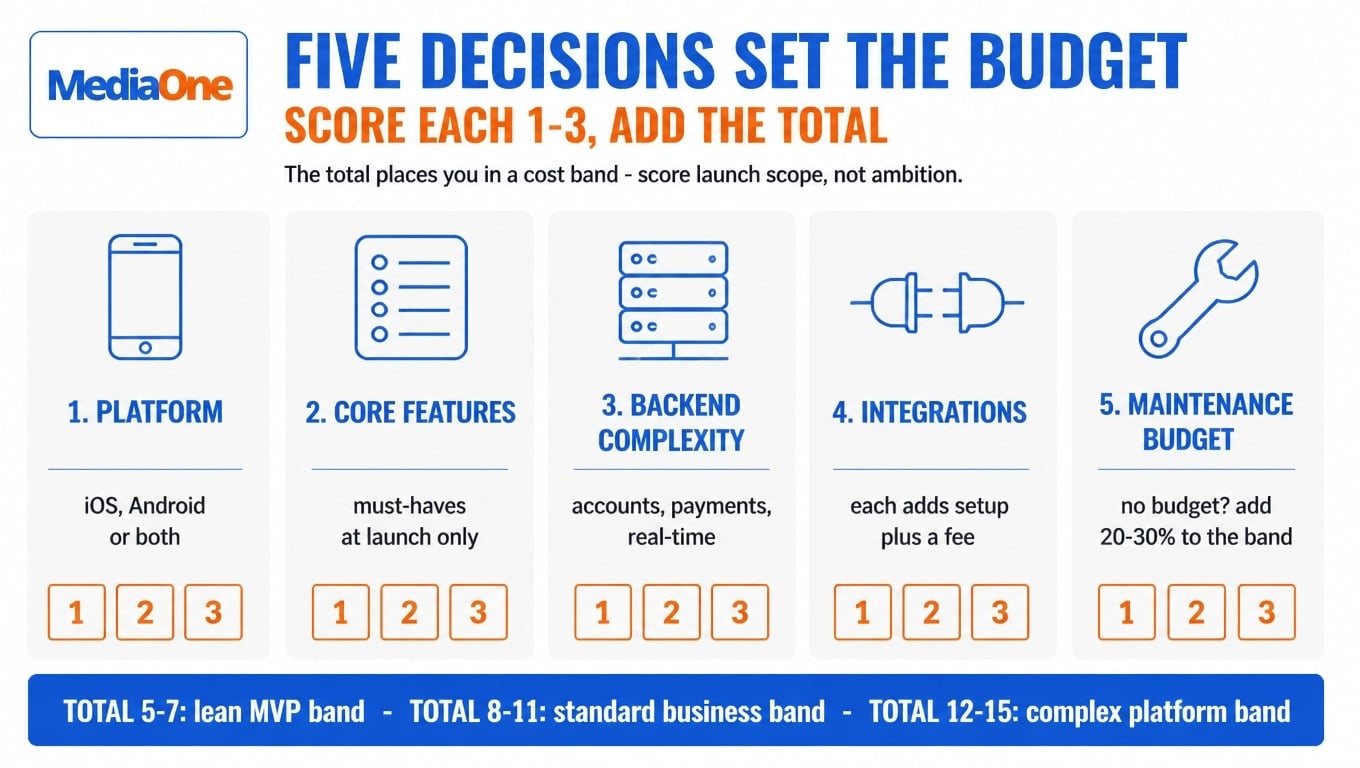
Score each decision 1 (low), 2 (medium) or 3 (high). Add the five scores. The total places you in a cost band and tells you which decision to revisit first if a quote comes in too high.
Reading the total
|
Total |
Band |
Typical Singapore range (build) |
What to do |
|
5–7 |
Lean MVP |
SGD 15,000 – 40,000 |
Validate demand before adding features |
|
8–10 |
Standard business app |
SGD 40,000 – 90,000 |
The normal band for most SMEs |
|
11–13 |
Complex platform |
SGD 90,000 – 250,000 |
Requires discovery phase and staged releases |
|
14–15 |
Enterprise |
SGD 250,000+ |
Fixed-scope contract, dedicated team |
Two rules keep the score useful. Score your launch scope, not your ambition — the roadmap after launch does not belong in the first build. And if decision 5 scores 1, add 20–30% to whatever band you land in, because a build without a maintenance budget is a build you cannot keep running.
What Drives the Cost
Complexity moves price more than anything else
Business of Apps’ 2026 research puts a simple app at $5,000–$50,000, medium complexity at $50,000–$120,000, and complex builds higher. Singapore agency rates sit at the upper half of those global bands because of local labour costs.
For scale: a medium app needing roughly 600 hours of work is the point where a Singapore agency quote typically crosses SGD 100,000, because agency rates include design, project management, QA and deployment — not just coding hours.
Platform choice
Nearly every Singapore business should assume both platforms. The StatCounter mobile OS data shows Android leading globally while iOS holds a disproportionate share of higher-value transactions in mature markets, and Singapore is widely reported to skew more heavily toward iOS than the global average.
Verify the current Singapore split yourself before making a single-platform decision — StatCounter publishes a Singapore-specific view, and the figure moves month to month. The strategic point does not depend on the exact number: a single-platform launch excludes a large share of your market, and in Singapore that excluded share skews toward higher-spending customers.
The cross-platform saving
Flutter or React Native builds are commonly estimated at 20–40% below separate native iOS and Android builds for the same feature set. That figure appears consistently across Netguru’s React Native analysis and TeaCode’s 2026 cost guide, which is why it is quoted so often.
Treat it as a rule of thumb rather than a guarantee. The savings are largest for standard features — forms, lists, accounts, checkout — and narrow sharply for apps that depend on deep device functions, custom hardware, heavy animation or platform-specific SDKs. In those cases, part of the code gets written twice anyway, and the gap closes.
Cost by App Type and Feature Set
App type sets the baseline. Features drive the variation. A basic consumer app and a food delivery platform with live tracking can look similar on the surface and differ several times over in build cost.
|
App type |
What pushes cost up |
Typical band |
|
Catalogue/content |
Little beyond design and CMS |
Lean MVP |
|
E-commerce |
Checkout, payments, inventory sync |
Standard |
|
Booking/scheduling |
Availability logic, reminders, calendar sync |
Standard |
|
On-demand services (taxi, delivery) |
Real-time GPS, matching logic, two user interfaces |
Complex |
|
Fintech/healthcare |
Security, compliance, audit trails, integration with regulated systems |
Complex to enterprise |
Categorising by type gives a rough ballpark but hides the real question: how many core features must work at launch? An e-commerce app with a standard catalogue and checkout sits at the lower end. A taxi app adds real-time GPS, matching logic and two interfaces — rider and driver — which moves it up a band regardless of how simple the idea sounds.
Feature-level costs
Each feature adds design, build and testing time. Authentication and push notifications are usually modest. Payments, GPS tracking, live chat and AI features are heavier because they depend on third-party services and careful edge-case testing.
Two things get forgotten in early budgets:
- The admin dashboard. You need a way to manage users, orders, content and refunds. It is rarely in the first quote and always needed before launch.
- The integration list. Each external service — payment gateway, mapping API, AI model — carries setup effort plus a recurring fee. Ask every agency to itemise these separately so you can see which costs are one-off and which return every year.
Phases, Timelines and Rates
How long it takes
Most apps take 3 to 9 months from concept to launch. Standard consumer apps with moderate complexity typically run 4 to 7 months, and enterprise builds 9 months or longer — a range consistent across Cynoteck’s 2026 process guide and Essential Design’s timeline analysis.
Five phases: discovery, design, development, testing, deployment. If a vendor’s timeline skips discovery or compresses testing into a few days, the price is understated, and the risk is yours.
What each phase costs
|
Phase |
What it produces |
Rough share of budget |
|
Discovery |
Requirements, user flows, technical scope |
5–10% |
|
Design |
Wireframes, UI, design system |
15–20% |
|
Development |
The build itself |
40–50% |
|
Testing |
QA, device coverage, bug fixes |
15–20% |
|
Deployment |
Store submission, launch support |
5–10% |
Wireframes alone typically run SGD 500 to SGD 5,000, and design for a small app SGD 800 to SGD 7,000 depending on screen count. Ask every vendor to itemise by phase — that is what makes two quotes comparable.
Rates in Singapore
Freelance and contract app development in Singapore generally falls between S$50 and S$130 an hour. SecondTalent’s Singapore rate card puts mobile app developers at S$70–130/hour depending on experience; Techtiq’s Singapore cost guide puts outsourced development at S$50–100/hour; Lemon.io’s contract data shows mid-level software developers around $43/hour equivalent, with seniors higher.
Agency rates sit above the freelance band because they bundle project management, QA, design and account handling. That is not automatically worse value — but a quote far outside these ranges needs explaining, in either direction.
Check the arithmetic. Multiply the hourly rate by the estimated hours and confirm that total covers project management, testing and deployment, not only coding. A quote that covers only build hours is not comparable to one that covers a launch.
Hidden Costs Most Budgets Miss
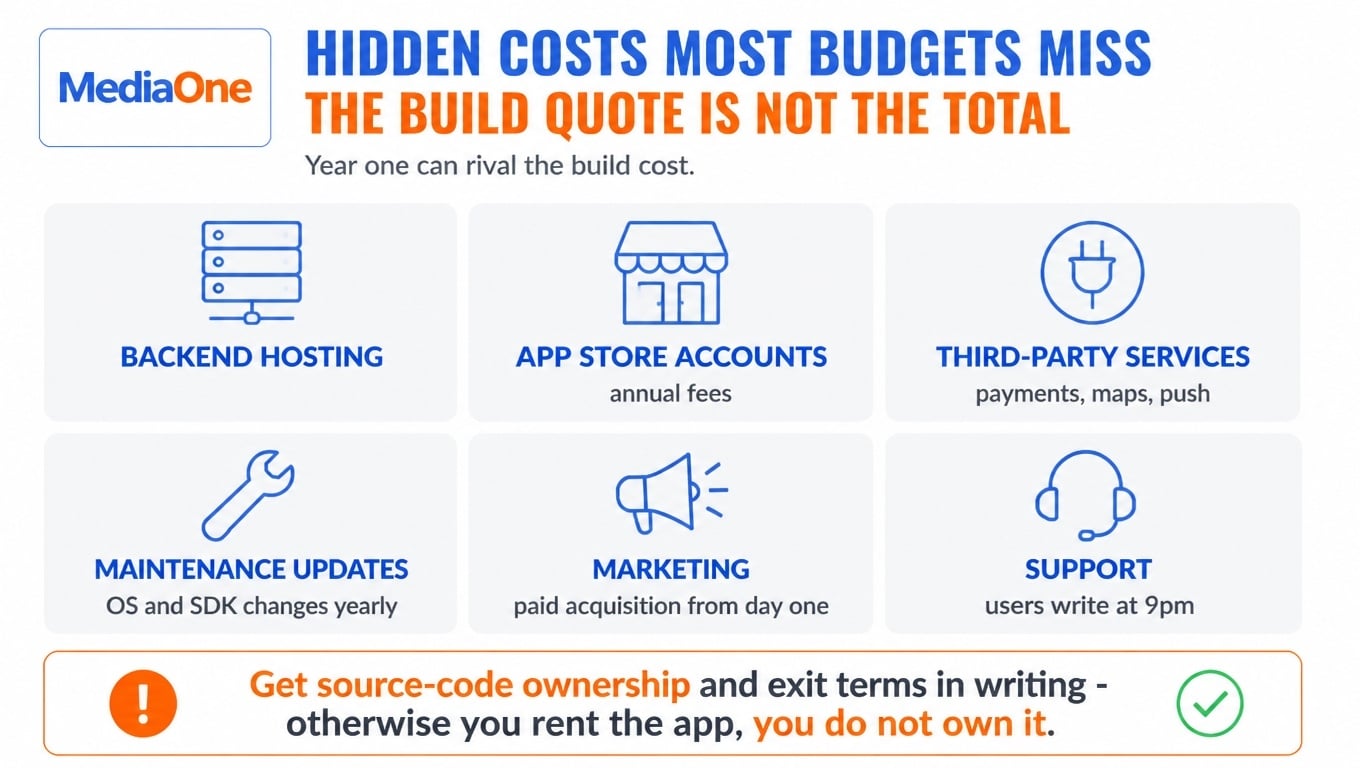
The build quote gets an app live. It doesn’t keep it alive, and it doesn’t find users.
Recurring technical costs
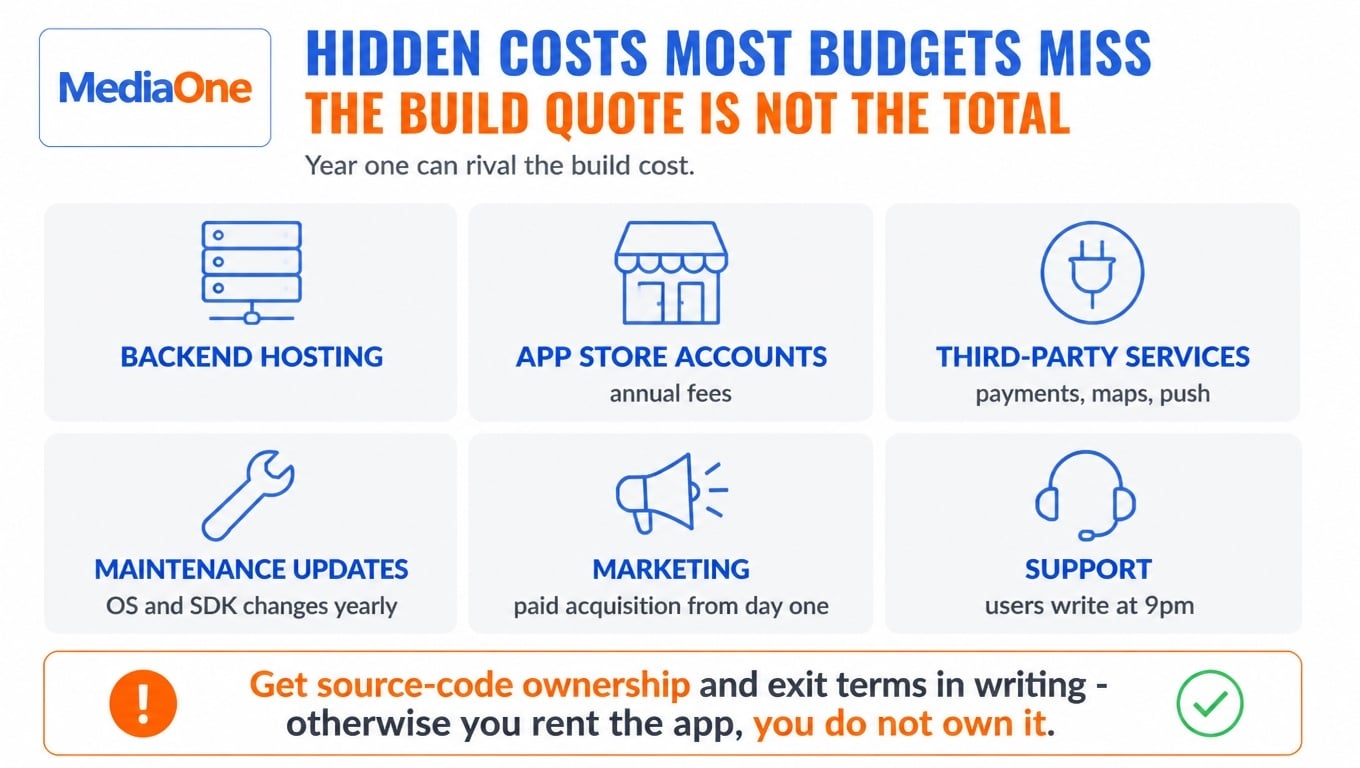
Every app needs a backend server, a database, and often paid third-party services: payment gateways, push providers, mapping APIs, analytics. Apple’s Developer Program and Google Play Console both charge annual fees. None is large alone; together they form a fixed annual cost a build quote rarely shows. Ask the vendor to list every service and its subscription price in writing.
Maintenance
Operating systems and devices change every year, and store policies change faster. An app needs regular updates to keep working — SDK updates, OS compatibility, security patches, bug fixes. Ask what maintenance covers, how it is priced, and what happens if you stop paying.
Marketing and support
An app nobody downloads earns nothing. Budget for store listing assets, paid acquisition and user support from day one. If a paid install costs more than the revenue each user returns, no amount of build efficiency saves the business case — see our customer acquisition cost formula for how to check that before you commit.
Ownership and exit
Ask two questions before signing, and get the answers in writing:
- Who owns the source code and intellectual property? It should be you, on payment.
- What happens if the vendor stops supporting the app? If you cannot take the code elsewhere, you do not own the product — you rent it.
Those answers determine whether you can switch teams later without rebuilding from scratch.
Reducing Cost Without Reducing Quality
- Start with an MVP. An MVP launches with only the features that test your core idea; everything else waits for real user evidence. Because a standard app takes 4 to 7 months and an enterprise build 9 months or longer, a smaller first release also shortens the period you pay a team before revenue arrives.
- Prioritise ruthlessly. Sort features into three lists: must have at launch, useful later, and nice to have. Only the first goes into the initial budget. Most first apps die from scope, not from missing features.
- Choose cross-platform where it fits. The 30–40% saving is real for standard feature sets. Check whether your must-have list depends on deep device functions before assuming it applies.
- Phase the roadmap. Plan the product as a series of releases, each with its own budget and success measure. Ship one, learn, then fund the next. Keep a maintenance reserve from day one so updates do not stall for lack of money.
- Check grant support. Some of the cost may be offset — our EDGE grant guide for SMEs covers eligibility, and the grant portal guide explains how to apply. Confirm current criteria before you build funding into a budget.
App Development Cost Should Not Scare You
A realistic app budget starts with five decisions made before any code is written: platform, core features, backend complexity, integrations, and whether you are budgeting for launch or lifecycle. Score each, total it, and you have a defensible starting estimate.
Use that estimate to test every quote. Ask each vendor to price the same scope, including design, testing and deployment. Confirm the rate covers more than coding hours. And budget the first year after launch, not just the build — because that is where most projects run out of money.
If you want the build assessed alongside the marketing case, our ecommerce web development service and mobile-responsive design guide cover the surrounding decisions, and our web design buyer checklist sets out what to verify in any development contract.
Frequently Asked Questions
How much does a simple app cost in Singapore?
Simple apps start around SGD 15,000, and most business apps fall between SGD 30,000 and SGD 80,000. A lean MVP can be built for around SGD 20,000 with a local team. Design alone for a small app runs SGD 800 to SGD 7,000 depending on screen count. Always check whether a quote covers design, build or full launch before comparing.
Is cross-platform development always cheaper?
Usually, but not always. Flutter and React Native builds are commonly estimated at 30–40% below separate native apps for the same feature set. The savings shrink — sometimes to nothing — if your app depends on deep device hardware, custom native modules or heavy platform-specific work, because part of the code gets written twice regardless.
How long does app development take?
Most apps take 3 to 9 months. Standard consumer apps typically run 4 to 7 months, and enterprise builds 9 months or longer. Timelines depend on how well requirements are defined before development starts, and how quickly feedback moves through design and testing. Poorly specified projects take longer, not shorter.
Hosting, third-party service subscriptions, app store developer accounts, ongoing maintenance and marketing. These recur annually and in the first year can rival the build cost. Set a yearly figure for them from day one rather than treating the build quote as the total.
Should I start with an MVP?
In most cases, yes. An MVP limits initial scope to the features that prove the core idea, lowering upfront cost and shortening time to launch. You then add features based on real usage rather than assumptions — and you find out whether anyone wants the product before spending the full budget.