
| AI Summary
Website design services help businesses plan, build and launch websites that explain their services and support enquiries or sales. Singapore business owners should compare page allowances, content writing, features, mobile usability, maintenance and ownership before accepting a quote. A complete proposal separates the initial build from recurring charges and explains how the agency handles changes, testing and handover. |
Website design services usually cover page planning, visual design, development, mobile layouts and launch testing. Content writing, hosting, maintenance and extra features depend on the agreement. Singapore businesses should compare written deliverables and ongoing costs before choosing a provider, since the starting price alone does not show the full expense.
Key Takeaways
- Page counts need context. Ten pages using one layout can involve less work than five pages with different features.
- Hosting setup and hosting fees are separate items. A package may include one without covering the other.
- A prototype tests the proposed design. The completed website still needs checks before launch.
- Access and ownership need separate answers. An admin login does not explain rights to code, images or paid software.
- Support needs measurable terms. Backup frequency, response hours and renewal charges should appear in writing.
Buying a website is a marketing decision that a small business may live with for years. Yet quotes for website design services in Singapore can look very different. One covers writing and development. Another covers the layout but leaves the business to arrange everything else.
A lower starting price can still represent good value. The question is whether it covers the work your business needs and the cost of keeping the site running.
A fair comparison starts with the same page list, features and support needs. That gives you a way to assess each proposal without needing to understand every technical term.
What do website design services include?
Website projects involve several jobs. The design controls how pages look, while development makes them work. Content supplies the words, photographs and product information visitors need.
A complete proposal explains who handles each job. A written website project scope also records what the agency will deliver, what the business must supply and how both sides will approve the work.
Core deliverables to check
A website package should describe the finished result in terms you can recognise.
| Deliverable | What the proposal should explain |
| Page planning | Which pages the website needs and how visitors reach them |
| Visual design | Layouts, colours, fonts and use of your branding |
| Development | Platform setup, page building and agreed features |
| Content | Who writes, checks and uploads text and images |
| Mobile layouts | How pages work across phone, tablet and desktop screens |
| Testing | Which functions, devices and browsers receive checks |
| Launch | Who publishes the site and connects the domain |
| Handover | Which accounts, files and training you receive |
| Support | What happens when something breaks after launch |
A contact form shows why detail helps. A simple form may send an email. Another may upload documents, filter spam and pass enquiries into a customer database. Both can appear as “contact form” in a quote, despite requiring different work.
Content writing and content entry are different services
Content writing creates or rewrites the words. Content entry places approved material into the website. A package that includes uploading ten pages does not automatically include writing them.
Your proposal should identify responsibility for:
- Service descriptions and product details.
- Photographs, illustrations and image permissions.
- Prices, contact details and opening hours.
- Checking the finished copy before publication.
A provider may write the pages, but your team still needs to check business facts. A designer cannot know whether a service has changed or a product is no longer available unless someone supplies that information.
Features need their own descriptions
Bookings, online payments, customer accounts and multilingual pages can add work beyond the page layout.
A booking feature, for example, might link to an existing booking service or manage appointments within the website. Those options have different setup, subscription and support needs.
A feature list should name the tool, explain what customers can do and identify any separate fees. That gives the agency something specific to build and your team something specific to test.
How much do website design services cost in Singapore?
Website design prices depend on the work involved. Page count affects the quote, but so do layouts, writing, product data and connections to other systems.
MediaOne’s published website design services currently list these starting packages. These are MediaOne’s prices, not a Singapore-wide market average.
| Package | Published starting price | Published scope |
| Basic Website | S$3,000 | Up to 10 pages |
| Premium Website | S$7,900 | Up to 50 pages, including custom website structure |
| Customisable Website | S$10,000 | Unique layouts and custom features |
The service page lists WordPress development, content writing, hosting setup, domain purchase assistance and one year of free maintenance across these packages. Stock images are included if required. Hosting setup should not be read as a promise that recurring hosting bills are covered.
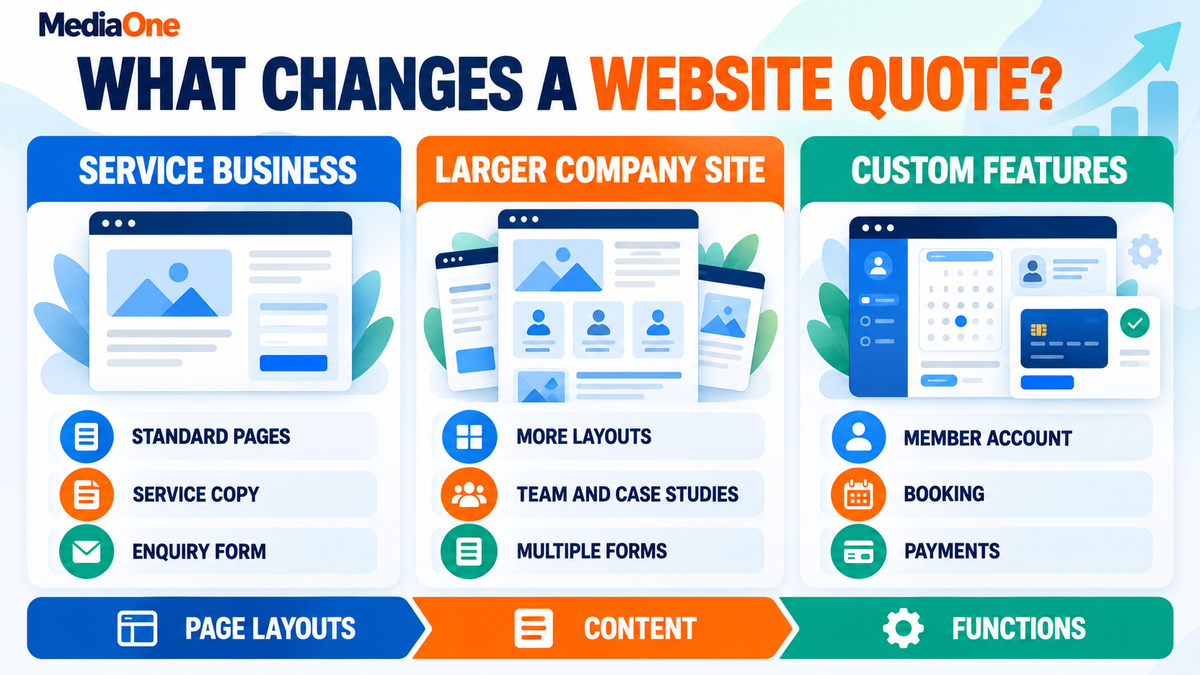
What changes the final quote?
A provider needs more than a page total to price a project.
- Different layouts: A product catalogue, team directory and service page may each need their own design.
- Special features: Booking systems, member accounts and payment connections require setup and testing.
- Content volume: Product descriptions, image editing and data entry can add substantial work.
- Existing website changes: Moving content and preserving old page links can increase the scope.
- Review requirements: Several decision-makers or extra revision rounds can extend delivery.
A 14-page website does not automatically require a particular package. A provider might offer extra pages, a different package or a separate quote. The written proposal should explain which option covers the requirements.
Fixed-price packages and custom work
A fixed-price package can suit a business with agreed pages and standard features. The price is easier to compare when the package lists its limits and exclusions.
Custom work can suit a business with unusual workflows or features that standard tools cannot provide. A distributor might need different prices for approved trade customers, for example.
Neither approach is always cheaper over time. MediaOne’s coverage of website design costs in Singapore provides further context on the items that influence a build budget. Your own decision should come from the work required and the cost of supporting it.
Which website platform should your business choose?
The platform affects how your team edits pages, which features you can add and who maintains the software. A familiar name alone does not tell you whether the platform supports your daily work.
A short demonstration can reveal more than a feature list. Your team should see how to change an image, edit a service description and publish a page before agreeing to the build.
WordPress, hosted builders and custom development
| Approach | What it offers | What needs attention |
| Self-hosted WordPress | Control over hosting, themes and plugins | Updates, backups, compatibility and support |
| Hosted website builder | Editing and hosting within one service | Subscription limits, export options and app fees |
| Custom development | Features built around specific requirements | Documentation, specialist support and future development |
A website builder service can suit a business that needs straightforward editing and standard features. Self-hosted WordPress offers another approach when the business wants control over its hosting and software choices.
MediaOne’s WordPress website design service is one option for businesses considering that platform. The practical test remains the same: can your team manage routine work, and is someone responsible for the technical upkeep?
A practical editing test
Your agency should demonstrate the tasks your staff will perform most often.
- A restaurant might change its menu and opening hours.
- A consultancy might add a staff profile or case study.
- A retailer might update stock information and product photographs.
Your team should also see what happens when someone makes a mistake. Draft previews, saved revisions and suitable user permissions can reduce the risk of publishing an unwanted change.
Training should use your actual website. A recording of common tasks can help when another employee takes over later.
How should a business compare website design providers?
An agency portfolio shows visual work, but the proposal reveals how the provider manages delivery. Both deserve attention.
A freelancer, a specialist studio and a larger agency may each suit different projects. MediaOne’s article on hiring a freelance web developer in Singapore explores that option. The comparison should focus on the person or team doing the work, their availability and the support arrangement.
Evidence beyond the homepage
A portfolio review should include live websites with similar needs to yours. A service business gains more from seeing a working enquiry process than an unrelated animation-heavy homepage.
Your checks can include:
- Whether the provider completed the whole project or one part.
- Whether the live site works on your phone.
- Whether the examples show the functions you need.
- Whether the provider can explain its decisions in plain language.
- Whether someone remains responsible after launch.
A portfolio does not prove that every future project will perform the same way. It gives you examples to discuss and features to inspect.
Five lines for comparing proposals
A short comparison sheet can expose gaps without turning the decision into a technical exercise.
| Comparison point | What to record |
| Scope | Pages, layouts, writing and features included |
| Reviews | Prototype stage, revision allowance and approval process |
| Delivery | Responsibilities, milestones and exclusions |
| Running costs | Hosting, licences, maintenance and change charges |
| Handover | Accounts, files, permissions and training |
Each provider should answer against the same brief. A missing item is a reason to ask for a fuller proposal before comparing totals.
A provider does not need to create an unpaid prototype to demonstrate reliability. Existing examples and an explanation of the paid design stage can show how the process works. The agreement should state when your own prototype arrives and how feedback affects the build.
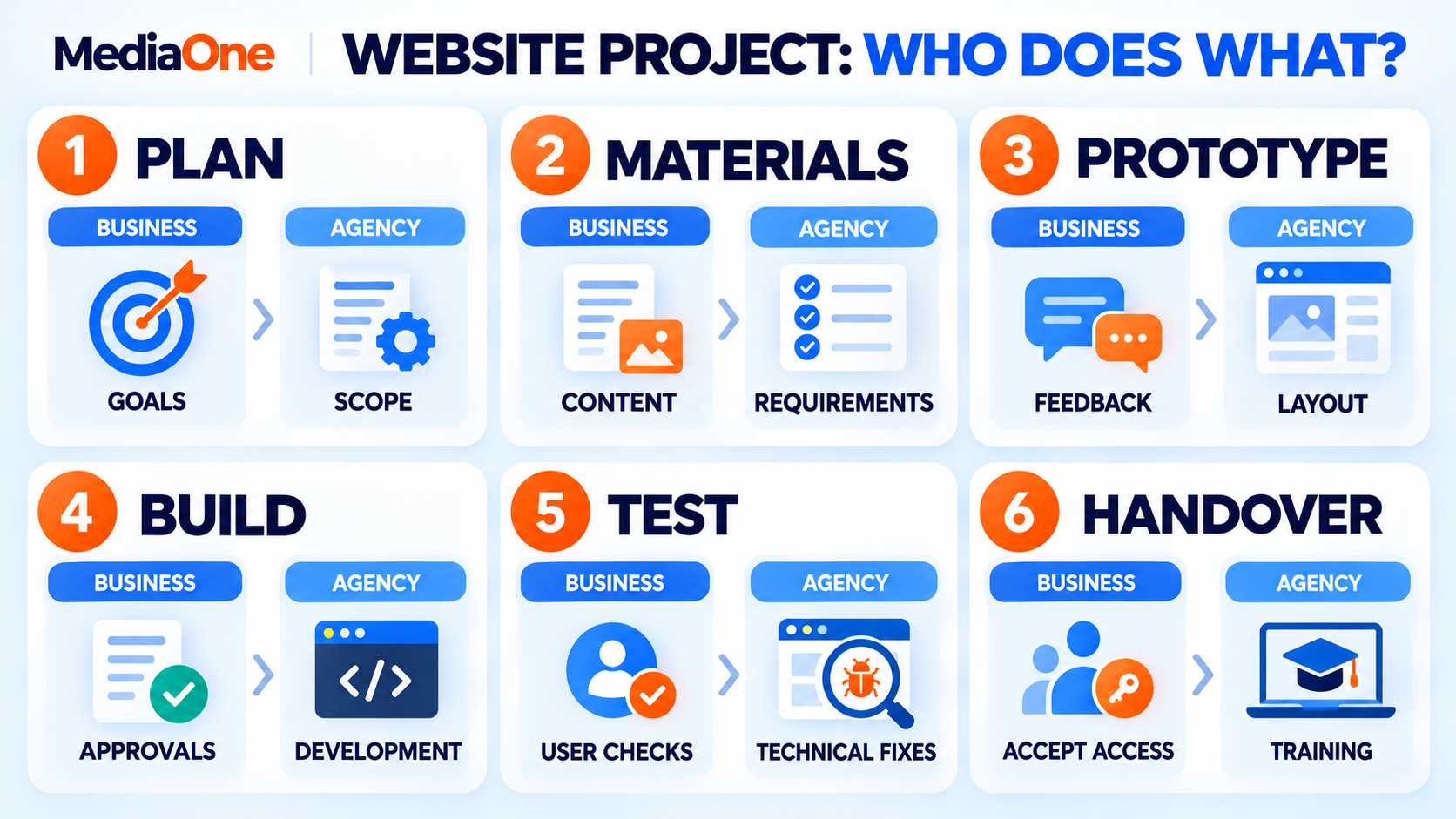
What happens during a website design project?
A website project needs agreed stages so both sides know what happens next. The exact names vary, but planning, design review, development, testing and handover each serve a different purpose.
The schedule should also show what your team must provide. A launch date can become difficult to meet when photographs, product information or approvals arrive late.
Planning and materials
The first stage turns business needs into a page list and feature list. Your main goal might be enquiries, appointment bookings or online orders.
A short brief can include:
- The customers the website serves.
- The main action visitors should take.
- The services or products needing their own pages.
- Existing branding and available photographs.
- Required tools, such as booking or payment systems.
- The person authorised to approve the work.
A page list is easier to assess when each page has a purpose. A separate service page should help someone understand that service, including what it covers and how to enquire.
Prototype, feedback and approval
A prototype shows the proposed layout before the full website is complete. Some prototypes are clickable; others show screens without working forms or payment tools.
Your agency should explain what you can test at that stage. A clickable button may demonstrate the next screen without sending a real enquiry.
A shared feedback document keeps comments together. Each comment should identify the page, explain the problem and state the requested change. One final decision-maker can resolve conflicting feedback before it reaches the agency.
Development and changes
Development turns the approved design into working pages and features. The team adds content, configures tools and checks how the parts work together.
A change request should describe the extra work, its price and its effect on the schedule before work begins. That protects both sides from different expectations.
A spelling correction and a new customer account system are different requests. The agreement should explain how the provider handles corrections, revisions and additions.
What should a business test before launch?
Launch approval should follow checks on the completed website. An attractive prototype cannot show whether live forms send messages or whether a payment connection works.
A shared test sheet gives each issue an owner and a status. The launch decision can then depend on completed checks instead of a quick look at the homepage.
Mobile usability and accessibility
Google uses the mobile version of a website’s content for indexing and ranking. Its mobile-first indexing documentation supports keeping important content available on mobile.
A phone check should cover more than whether the page opens.
- Text should remain readable without sideways scrolling.
- Buttons should be easy to tap.
- Menus should open and close reliably.
- Form labels and error messages should explain what visitors need to do.
- Important information should remain available on smaller screens.
The W3C’s accessible design principles also cover text contrast, visible controls, labelled forms and consistent menus. These features help more people read and operate the site.
Speed and page behaviour
A site can feel slow even when a speed tool reports a reasonable score. A large image may appear late, or a button may move while someone tries to tap it.
Google’s Core Web Vitals measure loading, responsiveness and layout stability. Those measures help the developer investigate problems, but a single score does not replace checks on real pages.
A practical review includes the homepage, a service page and the main enquiry or purchase process. Large photographs, videos and third-party tools deserve attention because they can affect performance.
Search basics and working enquiries
Google’s SEO Starter Guide explains how site organisation, links and descriptive content help search engines understand pages. These foundations support search visibility, but they do not guarantee rankings.
Your launch checklist should cover:
- Page titles and descriptions.
- Descriptive page addresses.
- Working internal links.
- Removal of settings that block the public site from search indexing.
- Tested contact forms and confirmation messages.
- Correct enquiry email addresses.
- Agreed analytics and enquiry tracking.
A test enquiry should reach the person who handles new business. That final check can catch a problem that visual testing misses.
What does a website cost after launch?
The build fee is one part of the expense. Hosting, domains, software subscriptions and support can continue for as long as the website remains online.
A running-cost table helps you see which bills come from the agency and which come from another supplier. Renewal dates also deserve attention, especially when several services start at launch.
A budget beyond the first year
| Cost | What to establish |
| Domain | Renewal price, account holder and expiry reminders |
| Hosting | Renewal fee, storage and support |
| Paid software | Licence costs and who manages renewals |
| Maintenance | Included tasks, exclusions and renewal terms |
| Content changes | Included allowance and extra-work rates |
| External services | Booking, email, payment or other subscription fees |
A three-year comparison can reveal costs that the launch quote leaves out.
Illustrative example only: A website costs S4,000tobuild,withhosting,licencesandmaintenancetotallingS900 each year. If those annual charges apply for all three years, the total is S4,000+(S900 × 3) = S$6,700.
Those figures are invented for the calculation. A real budget should use the quoted fees and count included services only once.
Maintenance, backups and recovery
An ongoing website maintenance plan should describe tasks and responsibilities. “Support included” leaves too much unanswered.
WordPress’s backup documentation explains that a complete recovery needs both website files and the database. A folder of downloaded images alone cannot restore the whole site.
The agreement should state:
- Backup frequency and storage location.
- How long copies remain available.
- Whether restoration is included.
- How software updates are tested.
- Who responds when the website stops working.
WordPress’s security documentation also stresses keeping the platform and plugins updated. A maintenance provider should explain how it handles those updates and any problems they cause.
Hosting, certificates and support hours
Hosting stores and serves the website. The domain supplies its address. A security certificate enables an encrypted HTTPS connection.
Certificates do not always require a separate purchase. Let’s Encrypt provides free certificates, although a host or agency may charge for setup or management.
Support terms should distinguish between receiving a ticket, replying and fixing the problem. A service that accepts messages at any hour may still have different response times for urgent outages and routine edits.
What should the website handover include?
Handover gives your business the information and access needed to operate the site. A finished website without those details can create problems when staff or suppliers change.
The handover record should separate ownership, access and licences. Each has a different meaning.
Accounts, files and permissions
Your business should know which accounts it controls and which services remain managed by the provider.
| Handover item | What the business needs |
| Domain account | Registrant details, renewal access and recovery contacts |
| Hosting | Account details or a written managed-hosting arrangement |
| Website administration | Appropriate login access for authorised staff |
| Website files | Transfer or backup arrangements where applicable |
| Paid tools | Licence holder, renewal terms and transfer limits |
| Documentation | Instructions for routine work and technical support |
An admin login allows certain actions inside the website. It does not, by itself, transfer rights to photographs, custom code or a subscription held by the agency.
A hosted platform may also limit what can be exported. The proposal should explain those limits before the business commits.
Existing pages and redirects
A rebuild needs care when page addresses change. Customers may still arrive through old bookmarks, search results or links from other websites.
Google’s site migration documentation recommends mapping old addresses to relevant new pages and using permanent redirects where appropriate. Sending every old link to the homepage can leave visitors without the information they expected.
The handover should include the redirect record and confirm who checks for broken links after launch. That makes future changes easier to manage.

Compare website design services by the work included
Website design services should give your business a working site, a manageable editing process and agreed support after launch. A detailed proposal helps you see whether the price covers those needs.
At MediaOne, we help businesses plan and develop websites around their services and customer actions. Your page list, required features and existing website address give us a starting point for a proposal that explains the work, costs and delivery stages.
FAQs About Website Design Services
Should a business buy its domain before hiring a designer?
A business can buy its domain before appointing a designer, provided it has settled on the name. The account should use a business-controlled email address. A business that already owns its domain usually does not need to buy another one for a redesign.
Can a website have more than one language?
A website can support several languages. Each version needs translated content, menus and a way for visitors to choose a language. The quote should state who supplies translations and how later content changes reach every language version.
Will a new website automatically include business email?
Business email is a separate service, even when the agency arranges it alongside hosting. The proposal should identify the email provider, mailbox allowance, renewal fees and any transfer work. Existing email accounts need their own plan when hosting details change.
Can a business launch its website in phases?
A phased launch can work when the first release contains everything customers need to complete the main action. Later additions should have their own scope and budget. Features that depend on each other need planning together, even when their launch dates differ.
Does every business website need online payments?
A service business that quotes after discussing a project may only need an enquiry form. A retailer selling standard products may need checkout and payment tools. The decision should follow how customers buy and how the business handles orders.
What happens if the project stops before completion?
The agreement should explain payment for completed work, access to approved materials and the status of unfinished work. A cancellation section helps both sides understand their responsibilities. Any handover should identify what another provider would need to continue the project.