| AI Summary
Account-based marketing helps B2B sales and marketing teams focus on selected companies. This guide explains how Singapore teams can prepare a shared account list, score opportunities, choose campaign types and divide the work. A sample budget and measurement plan show how to test a small programme without treating clicks, forecast sales or existing deals as proof of profit. |
Account-based marketing (ABM) is a B2B strategy in which marketing and sales select specific companies and coordinate campaigns for the people involved in buying. Teams research each account, address its business needs and measure progress through conversations, sales opportunities and won business.
Key Takeaways
- Account scores should reward commercial potential and access; strong competitors should reduce the opportunity score.
- Campaign depth depends on the work a team can deliver, not the size of its database.
- Different buying roles need different evidence, even within the same company.
- Advertising platforms have audience requirements that can limit a small campaign.
- Programme costs include staff time, research and production alongside advertising spend.
- A signed contract provides stronger evidence than pipeline value, but revenue still needs delivery costs deducted.
A company can attract plenty of enquiries and still struggle to reach the customers it wants. For a Singapore B2B team, the problem may be that marketing attracts individual contacts while sales needs agreement from several people inside one organisation.
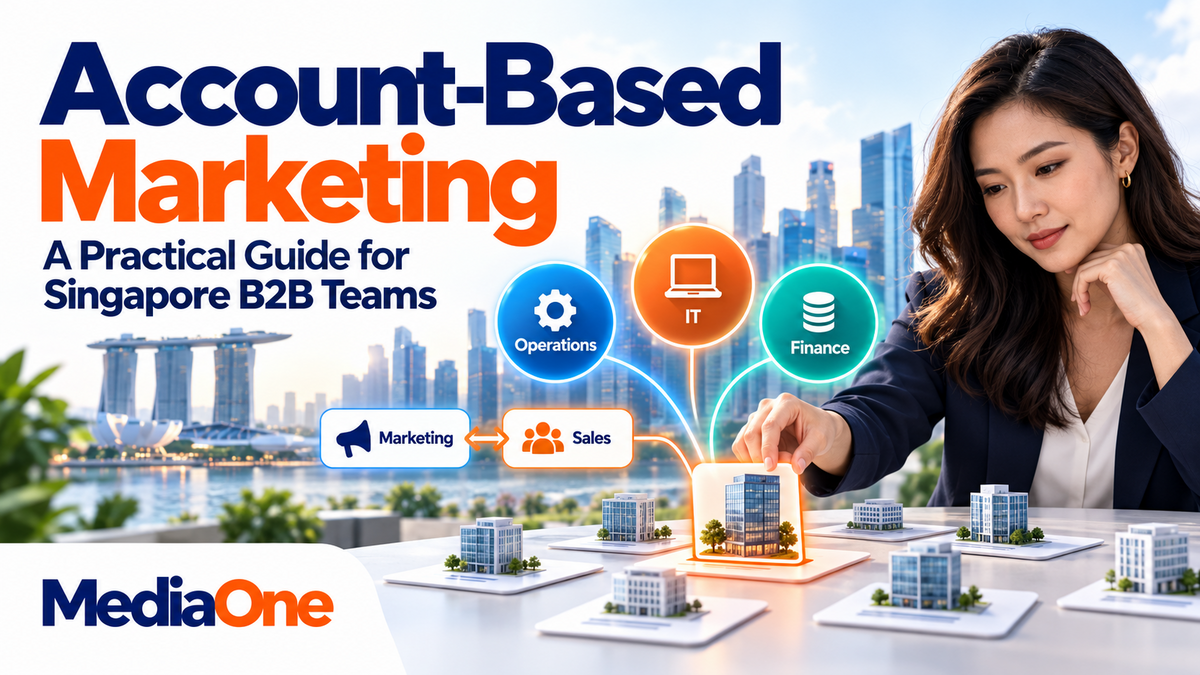
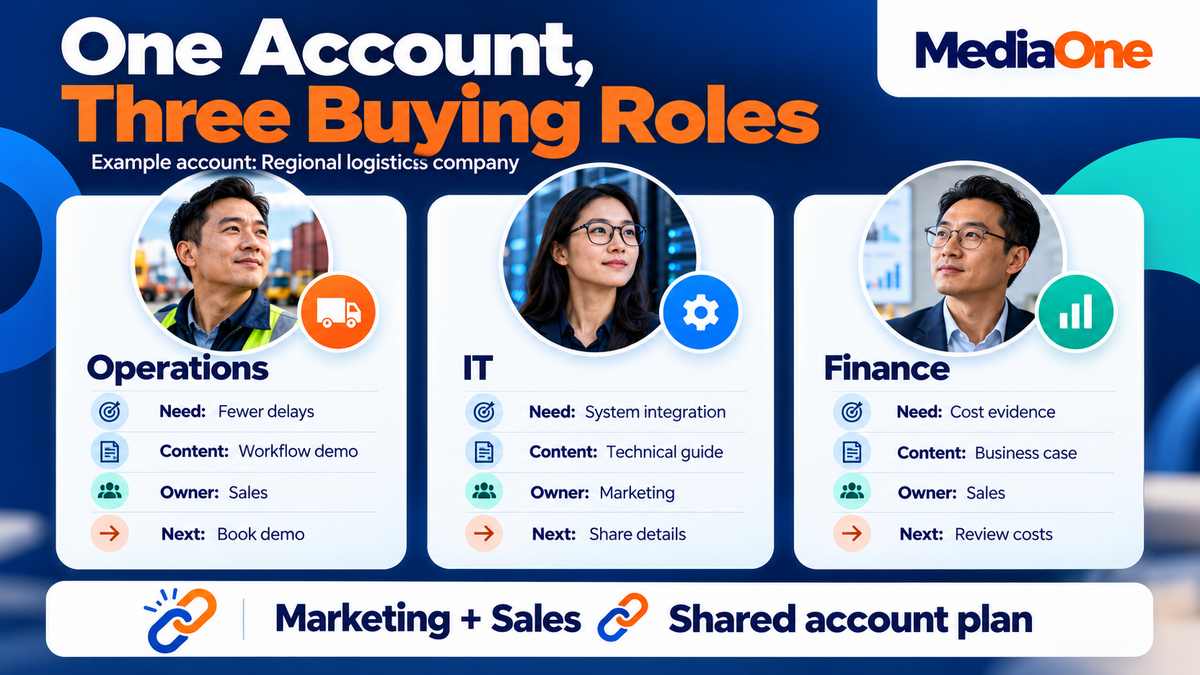
Account-based marketing brings those efforts together. A logistics software supplier, for example, might concentrate on selected regional operators and create separate material for operations, IT and finance. Each conversation supports the same potential purchase.
The practical challenge is deciding which accounts deserve that attention. This guide focuses on the first campaign: the account list, scorecard, people, budget and evidence needed to decide what happens next.
What Is Account-Based Marketing?
Account-based marketing starts with named companies your business wants to serve. An account is an organisation you may sell to, or an existing customer you want to support and grow.
Marketing and sales agree on those accounts before building campaigns. Their work then centres on the people who influence a purchase, the problems they need to solve and the evidence they need to approve spending.
LinkedIn describes account-based marketing as an approach focused on specific high-value companies. Its defining feature is coordinated attention to selected accounts.
How Does ABM Differ From Demand Generation?
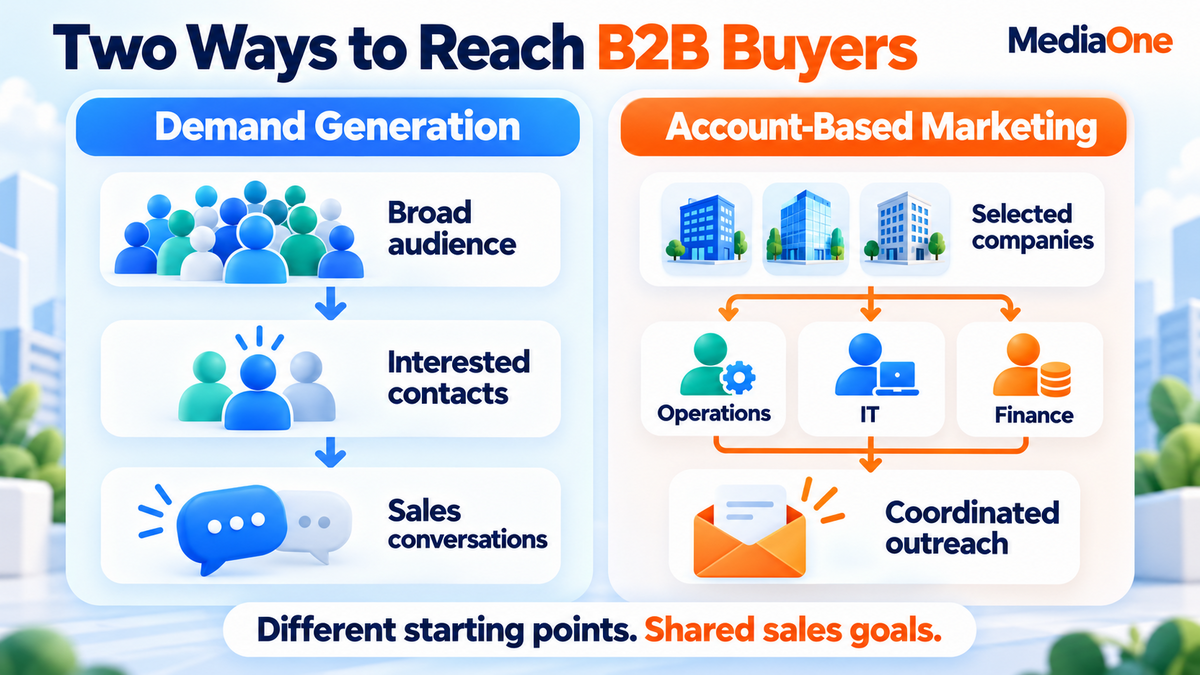
Demand generation builds awareness and interest across a market. ABM gives selected companies additional research, content and sales attention. Both approaches can operate together.
| Area | Demand generation | Account-based marketing |
| Starting point | A market or audience | Named companies |
| Content | Shared needs across an audience | Needs of an account or account group |
| Sales involvement | Varies by campaign | Begins during account selection |
| Measurement | Audience response and sales outcomes | Progress within selected accounts |
Broad lead generation methods can introduce new prospects while ABM supports deeper conversations with priority companies.
Which Singapore B2B Teams Should Consider ABM?
ABM deserves consideration when the potential value of an account can support the extra work involved. A large company name alone is not enough. Your offer must address a problem the organisation has reason to solve.
A Singapore software provider might target regional logistics firms whose operations span several countries. A training company might focus on employers preparing a department-wide programme. In each case, several people may influence the purchase.
These examples describe possible applications, not evidence that every firm in those sectors needs ABM.
What Should a Team Check Before Starting?
A first campaign needs answers to four questions:
- Commercial value: Would a realistic contract leave enough profit to cover the work of winning it?
- Buyer access: Can the team identify relevant roles and a reasonable way to begin a conversation?
- Sales capacity: Does someone have time to research, contact and follow up with each account?
- Evidence: Can the business demonstrate how its product or service addresses the account’s needs?
An inexpensive, self-service product may not justify individual account campaigns. A business with limited sales capacity may also need a smaller list before adding marketing activity.
An ABM trial should answer a commercial question, such as whether role-specific content helps a team secure meetings with regional buyers. A trial built around that question is easier to assess than a general aim to increase engagement.
What Are the Three Main Types of ABM?
The three common approaches describe how much attention each account receives. A team can combine them, provided the workload remains manageable.
| Approach | How it works | Example activity |
| One-to-one, or strategic ABM | An individual plan for one company | Account research and a tailored business case |
| One-to-few, or ABM lite | Shared material for a small group with similar needs | An industry workshop with individual follow-up |
| One-to-many, or programmatic ABM | Technology supports campaigns across a larger named list | Company-targeted ads and industry pages |
One-to-one work needs more research and coordination. One-to-few campaigns allow some material to be reused. One-to-many programmes rely more heavily on accurate data and systems.
A group of logistics companies may share a delivery-planning problem, allowing one workshop to address a common need. Each company would still receive follow-up based on its own questions.
Programme size does not determine quality. A long account list with generic messages may produce little progress, while a smaller campaign can reveal why buyers accept or reject a conversation.
Your account score can inform the level of attention, but it should not automatically decide the campaign type. Two highly rated companies may need separate plans because their operations differ.
A shared list turns ABM into work both teams can organise. Each entry needs a reason for inclusion, supporting evidence and someone responsible for the next action.
The list should begin with customers the business can serve well. Sales history, delivery experience and customer feedback can help identify suitable industries, company sizes and business needs.
What Information Belongs in the Account Record?
A first account record can contain:
- Company name, website and relevant business unit.
- Reason for targeting the company.
- Likely buying roles and known contacts.
- Estimated contract value and the basis for that estimate.
- Current supplier, where known.
- Sales owner, marketing owner and next action.
- Source of the information and date checked.
ACRA’s Bizfile entity search supports checks of registered names, live status and registered addresses. Company websites, published reports and previous conversations can add business context.
A registered address does not establish where purchasing decisions happen. A Singapore office may use a regional procurement team, so the account record should separate the local contact from the team approving a contract.
Research notes should distinguish facts from assumptions. A company announcement about a new warehouse confirms expansion; it does not confirm dissatisfaction with existing software. The sales conversation can test whether that expansion creates a problem your offer can address.
Sources also need dates. An old report may describe a business unit that has since closed, while a previous contact may no longer handle purchasing. The account record should preserve enough context for another team member to check the reasoning.
A Four-Part Scorecard for a First Campaign
The following scorecard is a planning example, not an industry benchmark. Every criterion runs in the same direction: a higher score means a stronger reason to invest attention.
| Criterion | 1 point | 2 points | 3 points |
| Commercial potential | Limited likely return | Moderate potential | Strong potential supported by evidence |
| Buyer access | Relevant roles unknown | Some roles identified | Relevant contacts and a credible introduction |
| Relationship strength | No meaningful interaction | Some relevant engagement | Active discussion of a business need |
| Opportunity to win | Strong barriers or an entrenched rival | Some barriers remain | Evidence of openness to alternatives |
The fourth criterion addresses competition without rewarding difficulty. An account locked into a rival’s long-term contract should not receive extra priority simply because the competition is strong.
Unknown information needs its own label. A team can leave a criterion unscored until research provides an answer. An incomplete total should stay outside the ranking until those gaps are resolved.
A Worked Example With Fictional Accounts
The table below shows completed scores for three fictional companies.
| Account | Commercial potential | Buyer access | Relationship | Opportunity to win | Total |
| Regional logistics company | 3 | 3 | 2 | 2 | 10 |
| Professional services firm | 2 | 2 | 3 | 2 | 9 |
| Small manufacturer | 1 | 1 | 2 | 1 | 5 |
For this example, scores of 10–12 prompt a review for individual attention. Scores of 7–9 prompt a review for a shared campaign. Scores of 4–6 receive lower-cost ongoing contact or further research.
These bands are working rules for the example. They do not prove that an account is ready to buy. A high score still needs a relevant offer, sufficient staff time and a realistic next step.
The manufacturer should not automatically enter a paid advertising programme. Its lower commercial potential and limited access may make that spending difficult to justify.
How to Reach the People Behind a B2B Purchase
An account can contain several buyers with different concerns. An operations manager may want fewer delays, while IT needs integration details and finance needs cost information.
The account plan should connect each role to the information needed for a decision. Job titles provide a starting point; conversations reveal who actually influences approval.
| Buying role | Likely concern | Supporting material |
| Business sponsor | Whether the problem deserves attention | A summary of the business problem |
| Day-to-day user | How the service changes daily work | A demonstration or workflow example |
| Technical evaluator | Whether implementation is practical | Integration and support information |
| Finance or procurement | Cost, terms and commercial risk | Pricing assumptions and contract details |
| Final approver | Whether the investment supports business goals | A concise business case |
These roles can overlap. A smaller business may have one person handling finance and approval, so the team should avoid inventing a large committee.
What Does Personalised ABM Content Look Like?
Personalisation connects a relevant business problem to evidence. A company name inserted into a standard email adds little on its own.
A logistics software supplier might explain how dispatch teams handle exceptions in a demonstration. Its finance material could show which costs the buyer would need to supply before estimating savings.
Any example savings should carry their assumptions. A fictional calculation should never appear as a result achieved for that account.
A consistent marketing messaging strategy keeps the core offer recognisable across these materials. Different roles receive different detail, but the product’s capabilities and limitations remain the same.
Existing content marketing assets can supply case studies, explanations and comparison pages. New production should address a missing buyer question, avoiding unnecessary versions of the same brochure.
What Team and Budget Does an ABM Campaign Need?
ABM needs enough time for research, production and follow-up. A fixed marketer-to-salesperson ratio cannot account for differences in contract size, campaign depth or existing workload.
A better starting point is a task estimate. Each team member records the time needed for their work, and the account list stays within the capacity available.
| Responsibility | Main contribution |
| Marketing lead | Research, campaign planning, content and reporting |
| Sales owner | Buyer conversations, account updates and next actions |
| Customer success contact | Delivery knowledge and existing customer needs |
| Budget owner | Spending approval and commercial review |
One person may hold several responsibilities. Each account still needs a named sales owner, and each campaign needs someone checking whether planned actions happened.
A Sample Budget in Singapore Dollars
The following fictional three-month budget illustrates cost categories. It is not a Singapore market rate or a recommended spending level.
| Cost category | Example amount |
| Research and account preparation | S$1,500 |
| Content and landing-page production | S$2,000 |
| Advertising | S$2,500 |
| Workshop or event delivery | S$1,000 |
| Allocated sales and marketing staff time | S$3,000 |
| Total programme cost | S$10,000 |
Each category should capture a different cost. Separately allocated staff time should not include hours already charged to research or production.
A small team may remove advertising or events and concentrate on direct conversations and existing content. Its staff time still belongs in the calculation, even when no new supplier invoice arrives.

What Tools Are Necessary?
A shared spreadsheet can hold the shortlist. A customer relationship management system, or CRM, can connect company records, contacts, meetings and deals.
The minimum setup also needs a way to distribute content and record responses. Additional data or advertising software should solve a specific problem the team has identified.
A tool purchase becomes easier to assess when the team can describe the missing capability, who will operate it and what existing work it replaces.
How to Run a Coordinated ABM Campaign
A campaign needs a shared offer and an agreed response process. A workshop invitation, for example, should connect to a relevant sales conversation and supporting material.
Different lead nurturing activities can support that process. Follow-up should reflect what a buyer asked or did, with sales able to see the same account history.
Which Channels Should the Team Choose?
Channel choice depends on buyer access and the information being shared.
- Direct email: A relevant business message can introduce a specific discussion.
- LinkedIn: Professional posts and company-targeted advertising can support awareness.
- Workshops: A focused session can address a shared industry problem.
- Sales conversations: Questions and demonstrations can test whether the need is real.
- Website pages: Service details, evidence and contact options support independent research.
An email marketing lifecycle helps organise messages around the relationship stage. A buyer who has requested a demonstration needs different communication from someone reading an introductory explanation.
Consistent website design also helps visitors connect an invitation with the offer on the page. The headline, evidence and next step should match the campaign’s promise.
Can a Small Account List Support LinkedIn Ads?
LinkedIn’s Company Targeting supports advertising to selected companies and relevant professional audiences. Its upload and audience requirements still apply.
The current company-list requirements specify at least 300 rows for an upload and at least 300 matched member accounts for an active ad set. A ten-company shortlist should therefore not be presented as an upload-ready audience.
Other targeting options may be available, but the actual audience and delivery settings need checking in Campaign Manager. A small ABM campaign can also proceed through conversations, content and introductions without paid ads.
What Should Weekly Coordination Cover?
A short weekly review should connect activity to the next buyer decision. Each account owner reports the latest response, any missing information and the next action with a date.
An explicit rejection should stop the same sales request being repeated. A request for later contact should become a dated reminder. Contact preferences and applicable outreach rules remain part of campaign planning.
Repeated messages across channels can frustrate buyers. A shared record helps prevent marketing and sales from sending conflicting invitations to the same person.
What Could the First Three Months Look Like?
The schedule below is an example of how a small team could organise its work. It sets review points, not deadlines for buyers to purchase.
| Period | Main task | Evidence for the review |
| Month one | Research a manageable group and prepare the campaign | Completed account records, checked content and tested tracking |
| Month two | Begin outreach and hold initial conversations | Buyer responses, meetings held and reasons for declining |
| Month three | Follow up on agreed actions and assess progress | Changes in account status, time spent and spending to date |
The team should also define a review decision before launching. A campaign testing a workshop offer, for example, needs to establish whether relevant buyers attend and request further discussion.
Low attendance could reflect an unsuitable topic, inconvenient timing or poor delivery of invitations. Those explanations require different changes. A brief record of buyer feedback helps the team decide which explanation has evidence behind it.
One change at a time can make the next test easier to interpret. A revised offer sent to a similar group provides a more informative comparison than a campaign that changes its audience, content and channels together.
The review may support continuing, reducing activity or stopping the trial. Unspent budget does not need to be exhausted when the evidence no longer supports the original plan.
How to Measure Account-Based Marketing Results
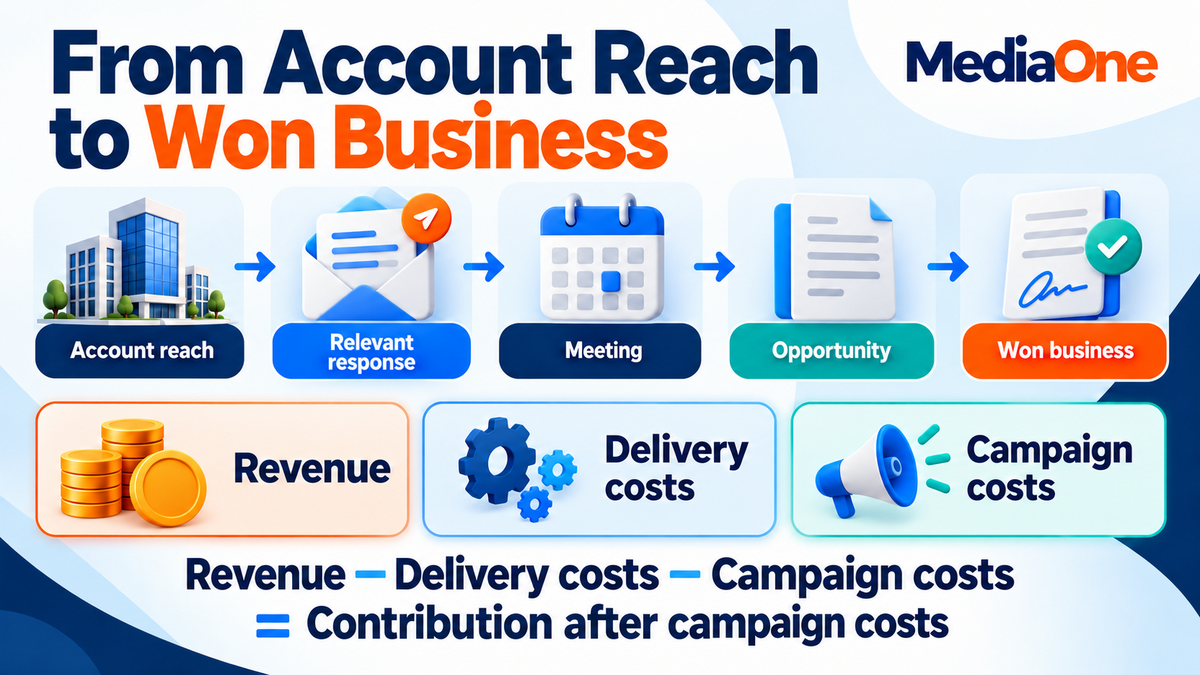
ABM measurement should distinguish attention from buying progress. A click shows interaction. A meeting establishes a conversation. A qualified opportunity requires evidence that the buyer has a relevant need and a plausible purchasing process.
| Stage | What to record | What it can show |
| Reach | Target companies reached | Whether activity reaches the selected market |
| Engagement | Relevant responses and content activity | Whether people interact with the offer |
| Conversation | Meetings held and buyer questions | Whether the account wants further discussion |
| Opportunity | Agreed need, next step and estimated value | Whether sales has a credible potential deal |
| Won business | Signed contracts and revenue basis | Whether an opportunity becomes a customer |
| Commercial return | Delivery costs and programme spending | Whether the work produces a financial return |
LinkedIn’s Companies Hub provides company engagement reporting. Its revenue reporting requires a connected CRM. Platform reports can add evidence, but the team still needs its own record of meetings and deals.
Google Analytics campaign parameters identify traffic from tagged links. Consistent source, medium and campaign names help separate workshop invitations from advertising visits.
Google’s restrictions on personally identifiable information also apply to campaign parameters and page URLs. Contact names and email addresses should stay out of those fields.
What Is the Difference Between Pipeline and ROI?
Pipeline is the estimated value of potential deals. It is not earned revenue. A campaign with S$100,000 in open opportunities may still produce no won business.
For a simple hypothetical return calculation:
- Revenue assigned to the campaign: S$30,000.
- Direct delivery costs: S$18,000.
- Contribution before campaign costs: S$12,000.
- Programme cost: S$10,000.
- Contribution after programme costs: S$2,000.
The illustrative return is (S$12,000 − S$10,000) ÷ S$10,000 × 100 = 20%. This calculation excludes other overheads and taxes, so it does not represent company-wide net profit.

How Should Teams Judge Campaign Influence?
A deal that existed before the campaign should retain that history. New content may support the sale, but the campaign should not automatically claim the entire contract.
Google Analytics attribution settings determine how recorded interactions receive credit. Attribution allocates credit; it does not prove the campaign caused a purchase.
A comparable group of untreated accounts can help assess additional impact where practical. Small samples and differences between accounts still limit the strength of any conclusion.
Which Results Deserve Further Investment?
A final review should consider the number of accounts progressing alongside the cost of that progress. For example, S$10,000 spent on five qualified opportunities produces an illustrative cost of S$2,000 per opportunity. That figure needs comparison with expected contribution and eventual wins before more spending is justified.
Results can also be uneven across the list. One large deal may dominate the total while most accounts show no interest. Separate reporting by account group helps reveal whether the campaign works repeatedly or depends on one exceptional result.
Staff feedback belongs beside the numbers. A campaign requiring more follow-up than the team can sustain may need fewer accounts, even when early response looks promising.
Starting Account-Based Marketing With a Measurable First Campaign
The first campaign should leave your team with better evidence about the accounts it can win and the work each one requires. Its review should identify which conversations progressed, where buyers stopped and whether the commercial return supports further spending.
Our lead generation services can support a wider plan for reaching prospective customers. A conversation with MediaOne can help connect your account priorities with campaign activity and measurement.
FAQs About Account-Based Marketing
Should ABM Content Require a Form?
Content that explains a service or answers an early buying question can remain openly accessible. A form can suit an offer requiring registration, such as a workshop. The decision depends on whether collecting information improves the experience enough to justify the extra step.
What Happens When a Contact Leaves a Target Company?
The account record should show that the person has left, and automated messages to the old address should stop. A new role holder may have different priorities. Previous discussions provide context, but they do not establish the replacement’s interest or agreement.
Can ABM Support a New Product Launch?
ABM can support a launch when selected companies have a relevant problem the new product addresses. Early conversations can test the offer and identify unanswered questions. Campaign material should distinguish available features from planned development, and early feedback should not be presented as proven market demand.
Can a Business Target Two Competing Companies?
A business can include competitors in its account list while keeping their confidential information separate. Campaign examples should use approved material or public information. Details learned in one company’s private meeting should not appear in another company’s proposal.