
| AI Summary
Voice marketing helps people find business information or complete simple tasks by speaking to a phone, smart speaker or other voice-enabled service. Singapore brands can start by checking whether customers get the right branch details, public holiday hours or collection instructions when they ask aloud. A dedicated voice tool is worth testing when customers repeat the same task, the business can keep the answer current, and the team can measure whether people finish. |
Voice marketing is the use of spoken search and voice-enabled tools to help customers find a business, get an answer or complete a task. Examples include checking if a café is open, getting directions to a shop and using a voice-enabled service to reorder an item.
Key Takeaways
- Each branch needs its own accurate details. A correct answer for the Orchard outlet can still send a customer to the wrong place.
- The five-part Voice Fit Score gives teams a way to compare ideas before they spend money on a pilot.
- Fast-changing information, such as stock or daily specials, needs a current source and a reply for times when the system cannot check it.
- A voice pilot needs a way to count completed tasks. Search impressions, map taps and calls each tell a different part of the story.
- One person should own each answer, with a backup who can correct it when the business changes its hours, terms or services.
A customer leaving work asks their phone, “Is the bakery at Tampines open when I get there?” The answer can help them decide whether to make the trip. If it gives the hours for another branch, the customer may reach a closed shop.
Voice marketing starts with moments like that. The first decision is which customer question to work on. The next is whether the business already has what it needs to answer it well.
What Is Voice Marketing?
Voice marketing covers the ways a business helps customers who speak a request instead of typing it. A customer might ask a phone for the nearest shop, use a smart speaker to ask about a service, or speak inside an app to repeat a past order. Some requests end with a spoken reply. Others open a map, bring up a web page or start a call.
The term sits close to voice search, voice commerce and audio marketing. Each describes a different part of the experience.
| Term | What it covers | Example |
| Voice search | A person speaks a search request. | “Which branch is open now?” |
| Voice marketing | A business makes its information or services available through spoken requests. | A retailer publishes branch details that help a customer find the right shop. |
| Voice commerce | A person uses speech during a shopping task. | A customer asks a service to bring up a previous order. |
| Audio marketing | A business uses sound to reach or remind an audience. | A café runs a podcast ad or uses a short tune in its ads. |
How a spoken request becomes an answer
The device first turns speech into words. It then works out what the customer wants to know or do. Depending on the device and the request, it may use a business listing, a web result or an app connected to a company’s system.
Take “Can I collect my cake at six?” A public page can explain when the collection counter closes. To check whether a specific cake is ready, the service needs access to that order and a way to confirm who is asking. Those two questions sound alike, but they call for different tools.
Which Voice Marketing Use Cases Are Worth Testing in Singapore?
The best starting point is a question people already ask and whose answer helps them act. A café may hear the same question before a public holiday. A retailer may get calls from people at the wrong entrance. A supplier may spend part of each week taking repeat orders by phone.
A week of enquiry notes can reveal where to start. The team can group calls, chats and emails by what the customer wanted to do. It can also note the cost of a wrong answer. Sending someone to a closed outlet can waste a trip. Confirming the wrong order can cost the business time and money.
Everyday questions that can make a good first test
| Business | What a customer might ask | What the business needs |
| Café or bakery | “Is the Tampines shop open on Deepavali?” | Holiday hours for that branch and someone to post changes. |
| Retail shop | “Where do I collect my online order at the Orchard outlet?” | A branch page with the building, floor and collection point. |
| Repair service | “Can I drop off my phone on Saturday?” | Drop-off hours and any cut-off time for same-day service. |
| Office supplier | “Can I order the same paper again?” | Access to past orders, a way to check the customer’s identity and a step to confirm the order. |
A location question can often be handled by updating a listing or branch page. A reorder asks for more work because the service has to find the right account and pass the request to an order system. The two projects deserve separate budgets, even if both start with the customer speaking into a phone. 
The five-part Voice Fit Score
The Voice Fit Score is a planning tool for this guide. It helps a team compare ideas using the same criteria. Each idea gets a score from zero to two in five areas, for a total of ten.
| Criterion | 0 points | 1 point | 2 points |
| Task | The request needs a long discussion. | The request needs one follow-up question. | The request has a short answer or one simple action. |
| Frequency | Customers rarely ask. | Customers ask from time to time. | The team hears the request often. |
| Data | The team has no reliable source. | The team can check and update the answer by hand. | The team has a current source and an owner. |
| Customer benefit | Speaking adds an extra step. | Speaking helps in some situations. | Speaking saves time or effort in a common situation. |
| Measurement | The team cannot tell what happened. | The team can count related actions. | The team can count successful tasks. |
A score of seven to ten supports a small test. A score of four to six points to improving the current listings, pages or data first. At zero to three, the team can spend its time on another customer problem. For any idea that relies on live stock, order status or payment, a zero for data puts the project on hold, whatever the total.
A worked example for a two-branch bakery
Suppose customers often call to ask when the Tampines branch opens on Sundays. The task is simple (2), the question comes up often (2), and the outlet manager keeps the hours current (2). A spoken answer may save a call, though customers can also check a map (1). The team can count calls about opening hours but cannot see every time a phone answers the question (1). The total is 8 out of 10.
Today’s pastry stock deserves its own score. If staff have no current stock count, an assistant cannot say whether the last croissant is still on the shelf. The bakery can publish when the next batch usually goes on sale and give customers a way to check stock before visiting.
Where Should Your Brand Start With Voice Marketing?
A business can start with three kinds of work. It can improve the facts that people find in public search, add a voice feature to a tool customers already use, or build an experience for a device such as a smart speaker. The choice depends on the task and where customers already go to complete it.
Phone search and map listings for public information
For a shop, restaurant or service counter, branch details are a good place to begin. This work is part of local SEO. A business name, address, phone number and opening hours should match across the places customers use to plan a visit. Google’s local ranking documentation explains how complete business details help Google understand a location and match it to relevant searches.
Branch pages can also answer questions that a pin on a map leaves open. A customer may need the mall unit number, the nearest entrance or the last time they can drop off a repair. Those facts also help people who find the business through the other channels in a mobile marketing plan.
Voice features in an app for repeat tasks
A voice feature inside an existing app may be worth testing when customers already sign in to perform the same action.
The app team can compare the spoken and tap-based versions by time, errors and completed tasks. For a reorder, the test should cover changes to price, quantity and delivery address. A previous order gives the system a starting point. The customer still needs a chance to review what they are about to buy.
Smart speaker skills for a specific audience
Amazon’s Alexa Skills Kit gives developers tools to build Alexa skills. A brand considering one needs a reason to expect customers to use it on that device. A list of device owners gives little information about whether those people want to carry out the brand’s task there.
The budget should cover the work after launch. Someone has to check how the skill handles new requests, repair broken links to other systems, and update the answers when the business changes a product or rule. A team that cannot give those jobs an owner can start with the channel it already maintains.
How Do You Write Voice Content People Can Follow?
A good spoken answer gives people the fact they asked for, then adds any detail that affects what they do next. A customer standing outside a mall may miss a long reply. A customer who hears two closing times without the branch names may remember the wrong one.
A practical test is to read the answer aloud to someone who has never seen the page. Can they tell which branch the answer refers to? Can they repeat the time or next step after hearing it once? A team that already plans its content marketing around customer questions can use that same research to decide which replies to write.
Sample spoken answers for common requests
| Customer asks | Sample spoken answer |
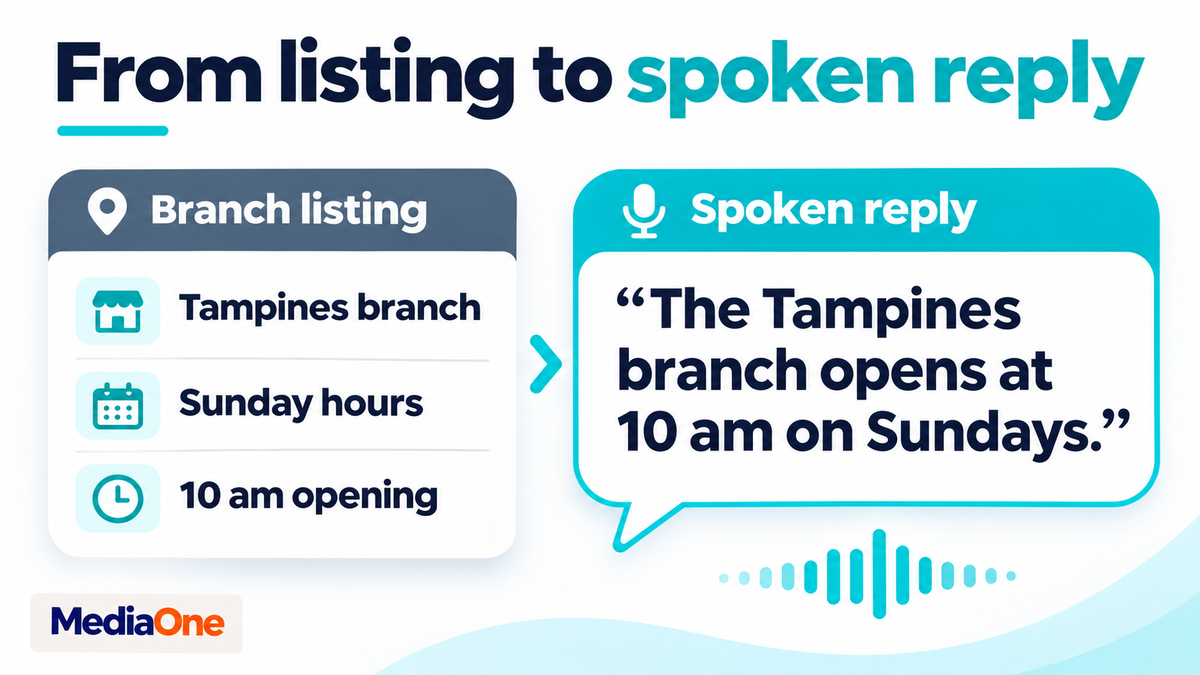
| “What time does the Tampines branch open on Sunday?” | “The Tampines branch opens at 10 am on Sundays.” |
| “Where do I pick up my order at Orchard?” | “The collection counter is on level two, next to the main lifts.” |
| “Can I drop off my phone for repair tonight?” | “The service counter takes its last drop-off at 7 pm today.” |
| “Do you still have the blue jacket at Orchard?” | “I can’t confirm stock right now. The Orchard shop can check it for you.” |
The detail after the answer should earn its place. A customer asking whether the shop is open may need to know that the service counter closes an hour earlier. They can hear about a sale or loyalty programme another time.
What the assistant can say when it cannot answer
A follow-up question helps when one detail would resolve the request. If a customer asks, “Are you open on Sunday?” and the business has two shops, the assistant can ask, “Do you mean Orchard or Tampines?” Repeating the full opening hours for both shops adds work for the customer.
A different reply is needed when the information itself is missing. If the system cannot reach the stock list, it can say so and offer the branch’s contact option. A team can prepare for these situations by testing three cases:
- Missing detail. The customer gives a product name or shop name that could mean two things.
- Missing information. The service cannot check stock, order status or a delivery time.
- Request outside the service. The customer asks to change an order when the tool can only show its status.
A phone number or web option gives the customer a way to carry on. In an app with a screen, the same reply can show a button or display the details for the customer to check. A voice-only reply should give an action the customer can take without seeing a button.
How Can Singapore Brands Optimise for Voice Search?
A spoken search can ask the same thing as a typed search. Someone might type “Tampines bakery Sunday hours” or say “What time does the bakery in Tampines open on Sunday?” Both customers need the hours for the right location. A page with the answer in normal text can serve both.
This part of voice search optimisation starts with the facts on the page. The branch name should sit next to its address and hours. Each location should have enough detail for a customer to identify it, including the unit number or building name when relevant. A photo of a sign can support that information, while the text gives people something they can copy, search or hear through a screen reader.
Branch pages and listings need the same facts
A Singapore café may keep its usual hours on its menu page, then post its public holiday schedule on social media. Customers who check a listing can still see the regular hours. Google Business Profile lets businesses set special hours for dates when their schedule differs. Businesses that manage location details through Apple Business can also review what customers see in Apple Maps.
A branch check can cover five items:
- The business name and branch name.
- The street address, building, floor and unit number.
- Regular hours, holiday hours and service cut-off times.
- The number or booking option for that branch.
- Any collection or access details that could affect the visit.
When a location changes its hours, the same person can update the website and listing in one go. That saves the customer from having to choose which result to believe.
Search engines need facts they can read
A page that answers a branch question can put the reply directly under a heading such as “When does the Tampines branch open?” A short table can help if the hours vary by day. Details that only apply to collection or repairs can sit beside the hours for that service.
LocalBusiness structured data is code that labels facts such as opening hours or an address for Google. Those details should match the information customers can see on the page. The code can help Google understand the page, while the search system decides how to present it.
The same work can support answer engine optimisation. Google says that its existing search practices apply to AI Overviews and AI Mode, with no special markup needed for those features. An answer that is easy to find, backed by current information and tied to the correct branch serves the reader even when the result appears as a link or map.
How Can You Test and Measure a Voice Marketing Pilot?
A pilot should answer a business question. Can customers find the correct collection counter? Can they check Saturday drop-off hours without calling? Can returning buyers review and repeat an order using speech? Each question gives the team a result it can observe.
Before launch, a small test group can try the task without seeing the expected wording. People may say the full branch name, shorten it or name the mall instead. A test in a quiet room and another with street or shop noise can show where replies break down. The team should record the words people use, the answer they receive and what they do next.
Match each metric to the task
| Goal | What to track | What the result can tell you |
| Customers find an outlet | Successful test requests and direction requests | Test requests can confirm whether the result gives the right branch. Direction requests show interest in visiting. |
| Customers find holiday hours | Correct replies during tests and calls about hours before and after the update | A change in calls is a clue. Demand, promotions and the holiday itself can also affect the count. |
| Customers finish a reorder | Confirmed orders, abandoned attempts and order corrections | Completed orders show use. Corrections can reveal a problem with how the service confirms items. |
Google Search Console’s Performance report shows search clicks, impressions and queries. It has no filter that separates spoken searches from typed searches. A question in the report could have come from either. Business Profile performance reports actions such as call-button clicks and direction requests. A call-button click counts a tap, while a completed call or sale needs a separate record.
An example of a pilot with a decision at the end
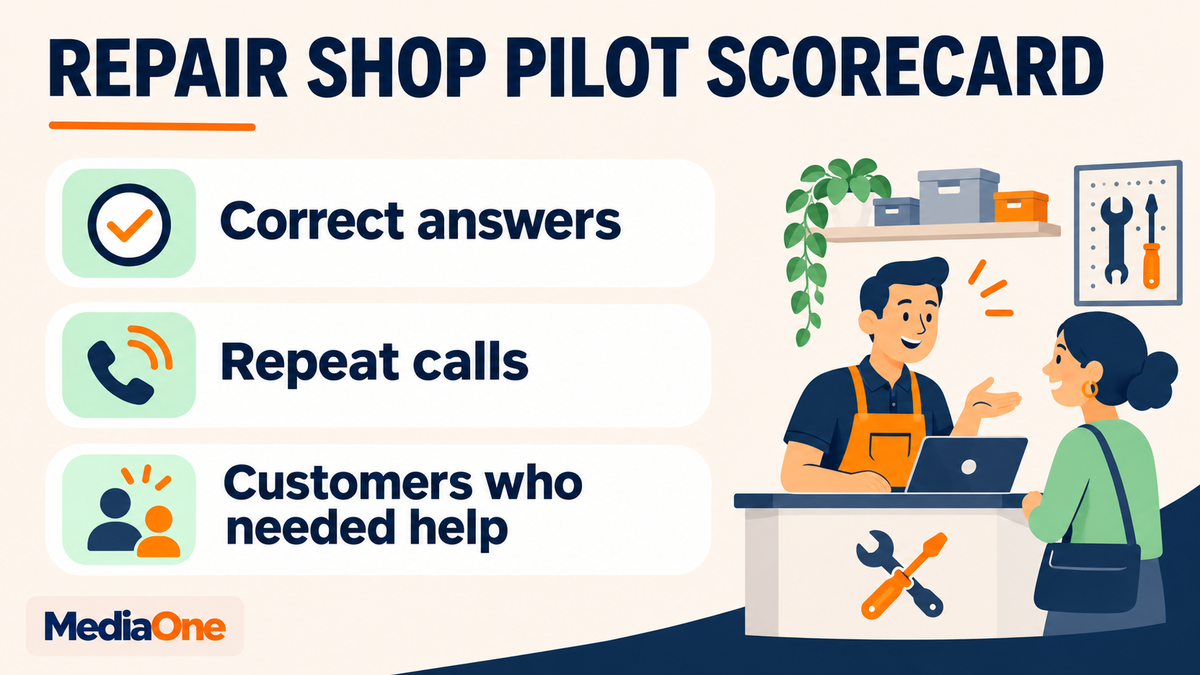
A repair shop finds that customers often ask whether they can drop off a phone after work. During two comparable weeks before the test, staff tally calls about the last drop-off time. The shop then adds the cut-off to the branch page and checks how phones respond to questions such as “Can I drop off my phone at half past six?” and “What’s the last drop-off at Tampines?”
At the end of the trial, the team compares the enquiry tally and repeats the spoken checks. If calls fall and the test replies give the right time, the team has a reason to keep the update and watch the result for longer. If calls rise because people hear the shop’s closing time instead, the team has found the next problem to fix.
Who keeps the answers current after launch?
An outlet manager may know when the hours change, while the marketing team controls the page and listing. The pilot needs a named owner who can publish a correction and a backup who can act when that person is away. An assistant that pulls from an order system also needs someone who can check whether that connection is working.
The team can use a shared log with the customer question, the answer it should receive, the source and the last test date. When staff change a cut-off or move a collection counter, that log shows which replies to test again.
Where Singapore Brands Should Start With Voice Marketing
A voice marketing project can begin with one question from one branch. A café might check what a customer hears about its public holiday hours. A retailer might check whether someone can find the collection counter by asking their phone. A supplier can test a reorder once it can show the right items and confirm the purchase.
For Singapore brands that want help finding gaps in their listings and branch pages, MediaOne’s SEO services cover the search work behind those customer questions. The consultation form gives teams a place to share the outlet, search term or customer task they want to work on first.
FAQs About Voice Marketing
Should Singapore brands offer voice replies in more than one language?
The decision can start with the languages customers use when they call, message or visit. A team can choose one request and test it with speakers of each language it plans to support. Product names, numbers, street names and branch names deserve extra attention because a translated reply can sound natural while sending someone to the wrong place.
Can a business choose the exact words a phone assistant reads out?
A business can write the replies in a voice experience it manages. With public search, the device or search service decides what to show or say. The company can publish accurate wording on its website and update its listings, but a test on one phone does not show how every device will respond.
Can voice marketing help a business without a storefront?
A business without a storefront can focus on questions about its service area, booking process or delivery schedule. A mobile repair service, for instance, can explain which neighbourhoods it visits and what customers need to provide when they book. Those answers belong on a public service page if every customer can use them.
A team can reuse the facts and rewrite the options for callers. Someone asking a phone assistant may need one direct answer. Someone calling the shop may need to hear a choice, such as opening hours, order collection or staff support. Both versions can draw from the same source so changes reach both channels.
How should a team test voice access for customers who prefer typing or tapping?
A test can ask customers to finish the same task by speaking, typing or tapping. Each method should let them find the same facts and complete the same action. If a customer begins with speech and moves to the screen, the next screen should carry forward the information they already provided where the tool supports it.