Choosing a digital marketing certification in Singapore is harder than it looks. Many programmes promise to make you job-ready, but their prices, formats, and employer recognition vary widely. A certificate that helps one candidate can be a weak line on another candidate’s CV. This guide helps you separate the credentials that matter from those that mostly look impressive on a brochure.

The best-value certification is the one issued by a recognised platform or accredited body, includes a real assessment, and fits the role you want. Fresh graduates, career switchers and working marketers should weigh verifiability, practical assessment and funding eligibility before the number of topics covered. Throughout, we use a simple scorecard so you can compare options on the same terms.
Key Takeaways
- Prioritise verifiable credentials over course names. A certificate from a recognised platform, university or accredited body, with an assessment behind it, is more valuable than a completion badge from an unfamiliar provider. Use the Credential Fit Scorecard (Recognition, Assessment, Depth-to-Cost and Funding Eligibility, each scored 1 to 5) to compare options side by side.
- Free platform certifications can outperform costly courses for fresh graduates. Google and Meta certifications are well known because they cover the platforms many Singapore businesses use. A free credential backed by a portfolio can be a stronger first step than an expensive diploma with no portfolio.
- Check the expiry and renewal before you enrol. Platform credentials need periodic revalidation. Plan time for renewal rather than treating them as permanent qualifications.
- Match the certification to your career stage. Fresh graduates need certifications that build a portfolio. Career switchers need structured programmes with practical projects and career support. Experienced marketers gain most from specialist credentials in analytics, performance marketing or marketing technology.
- Confirm your funding eligibility on the official SkillsFuture portal at enrolment. Singapore citizens may be able to use SkillsFuture Credit and other schemes towards course fees, but eligibility rules are set by SkillsFuture Singapore and can change. Verify fees and funding figures at enrolment.
- Avoid paying twice for the same skills. Many certifications overlap in content, especially the free platform courses on SEO, analytics and social media. Map each course against your target role first, then choose the fewest credentials that close the gap.
Table of Contents
- Shortlist: The Certifications Worth Your Time First
- How This Guide Was Researched and What It Covers
- Choosing the Right Certification for Your Career Stage
- The 20 Certifications Compared: Free and Platform Certifications
- Professional and Accredited Programmes in Singapore
- Costs, Grants and Funding Options Explained
- Current Trends Shaping Digital Marketing Skills in 2026
- Conclusion and Recommended Next Steps
- Frequently Asked Questions
Shortlist: The Certifications Worth Your Time First
For most readers, these are the credentials to consider first, ranked by how well they balance recognition, assessment and cost:
- Google Analytics Certification (GA4): suits fresh graduates and marketers who need proof of measurement skills. It is free and widely recognised.
- Google Digital Garage and Google Skillshop certifications: suit career switchers and fresh graduates who want a free, platform-backed foundation to build a portfolio on.
- Meta Blueprint certifications: suit anyone planning a role in paid social advertising on Facebook and Instagram.
- HubSpot Academy certifications: suit those aiming at inbound marketing, content or marketing operations roles. Most are free.
- Vertical Institute’s digital marketing programmes: suit career switchers who want a structured course with trainer support and practical projects. Confirm current fees and funding eligibility before enrolling.
How This Guide Was Researched and What It Covers
Most listicles rank certifications by how impressive the name sounds. This guide asks a practical question instead: which credentials will a Singapore employer read as proof of skill? Each recommendation that follows is tested against that question.
Who this guide is for
The guide serves three groups of readers, each with different needs.
- Fresh graduates with a degree in communications, business or a related field and little paid marketing experience. The most useful options are free platform credentials that let you build a portfolio and show you can use real tools.
- Career switchers moving into digital marketing from sales, administration, teaching or another field. They usually need a structured programme with a clear syllabus, an industry-experienced trainer, and some form of career support.
- Marketers upskilling who already have a role and want a specialist credential in analytics, paid media, search or marketing technology. They are often short of time and need options that fit around full-time work.
If you sit between these groups, the Credential Fit Scorecard later in this guide will help you place yourself.
How we assessed each certification
We reviewed each certification against the same criteria, so you can compare a free badge and a paid diploma on equal terms.
| Criterion | What we looked at | Why it matters |
|---|---|---|
| Cost | Listed fee in S$, and whether there is a free tier | Sets the true entry barrier |
| Format | Online, classroom, blended, self-paced or cohort-based | Determines fit with working schedules |
| Syllabus depth | Topics covered and whether hands-on practice is included | Shows whether the credential teaches skills or only concepts |
| Recognition | Whether the issuer is a platform, university, accredited body or private training provider | Indicates how hiring managers are likely to read it |
| Assessment | Proctored exam, practical project, portfolio or attendance only | Separates a verifiable credential from a completion badge |
| Trainer background | Stated industry experience of instructors | Affects the quality of applied learning |
| Reviews | Publicly available learner feedback | Gives a signal of real-world outcomes; read with caution |
Where a provider did not publish a detail, this guide says so rather than filling the gap with an estimate.
Where the information comes from
The guide draws on the following sources. Access dates matter because fees, funding rules and platform syllabi change often, so confirm current details before you enrol.
- Vertical Institute’s Singapore certification overview, used as the reference point for the range of digital marketing certifications available locally: Digital Marketing Certifications in Singapore. Accessed for this guide on 30 October 2026.
- Course provider pages for each certification, including the platform learning hubs listed below. Fees and syllabus details should be checked against these pages at enrolment.
- SkillsFuture Singapore course listings for funding eligibility. The scheme sets the rules and claimable amounts, so check the official SkillsFuture portal at skillsfuture.gov.sg when you enrol.
- Google and Meta learning platforms publish free certification content and renewal requirements for their credentials at skillshop.withgoogle.com and facebookblueprint.com.
Any price, funding amount or eligibility detail that could not be confirmed from these sources is marked “to be verified” in the relevant section. This guide does not invent figures, reviews or credentials to fill gaps.
What this guide covers that others do not
Three areas get more attention here than in typical rankings. First, whether a certificate is a verifiable credential backed by an assessment or only a record of attendance. Second, how long each credential stays valid, since platform certifications often need renewal. Third, how much the content of different certifications overlaps, so you do not pay twice for the same skills.
The core claim of this guide is that the best-value certifications for Singapore are those tied to a recognised platform or accredited body and backed by a clear assessment, rather than those with the most elaborate titles. For example, a free Google Analytics certification that an employer can verify will usually outscore a costly completion certificate with no assessment behind it. The sections that follow test that claim and show how to apply it to your career stage.
The 20 Certifications Compared: Free and Platform Certifications
Platform certifications are where most Singaporean marketers should start. Many are free, and they are issued by the companies whose tools local agencies and in-house teams use every day. Each comes with a built-in assessment.
A platform badge shows you can use a tool. It does not show you can run a campaign. Keep that gap in mind as you read.
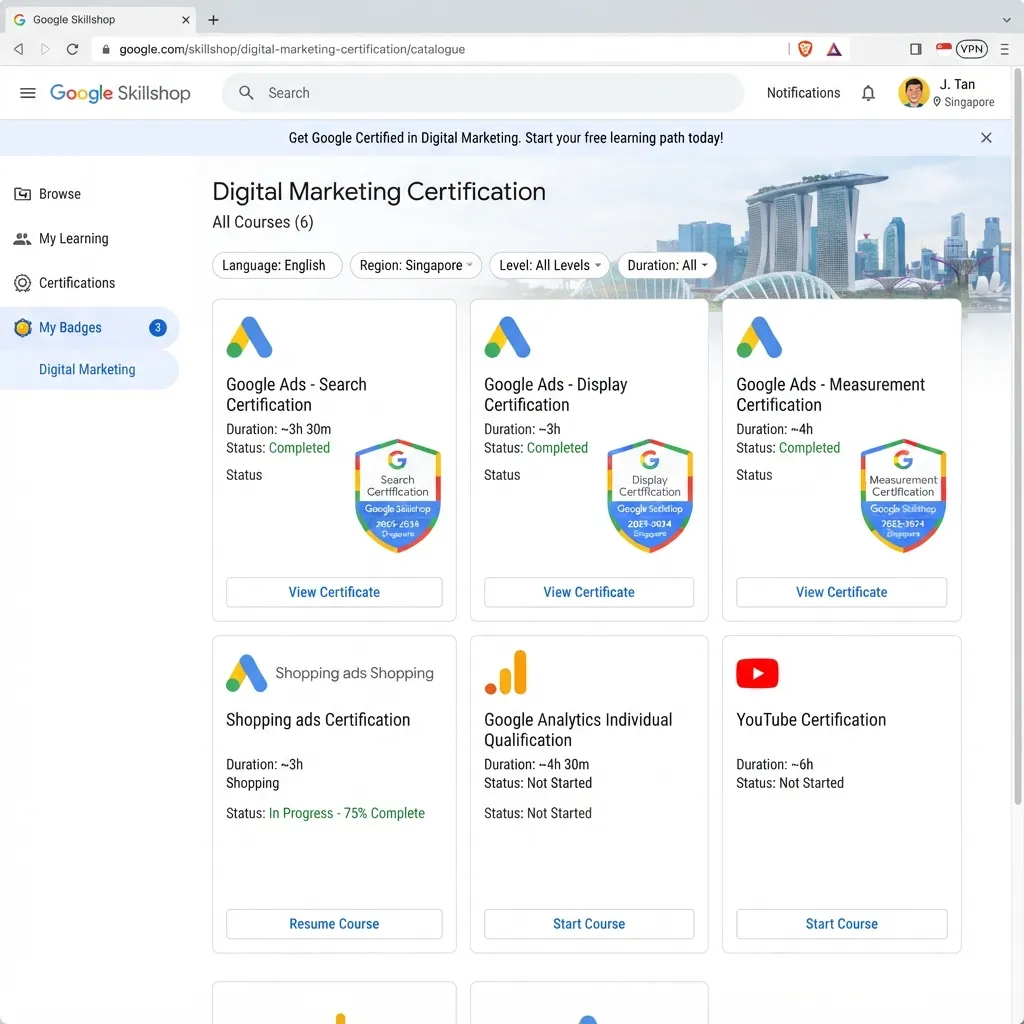
This section covers six platform families. For a wider view of the landscape, see the Vertical Institute’s guide to digital marketing certifications in Singapore. Prices, syllabus lengths, and exam formats change often, so recheck every platform detail on the provider’s page before you enrol.
Google Digital Garage and Google Skillshop Certifications
Google runs its learning content through two channels. Google Digital Garage hosts free courses on digital marketing fundamentals. Google Skillshop hosts the product certifications, including Google Ads, Google Analytics and Google Merchant Centre. Google Ads sits at the centre of much local paid search work, so Singapore hiring managers often recognise Skillshop exams by name.

- Format: Online and self-paced. Free to take.
- Assessment: Multiple-choice exams with a passing score. Certifications are time-limited and must be renewed. Check the current validity period on the Skillshop page.
- Best for: Fresh graduates who need a verifiable badge for a CV and career switchers testing whether paid search suits them.
- Watch out for: The Digital Garage fundamentals course is a good starting point, but it does not replace a campaign you have managed. Pair the badge with a small self-funded campaign or a sample account.
Meta Blueprint Certifications
Meta Blueprint is Meta’s official training programme for Facebook and Instagram advertising. The free courses cover ad formats, audience targeting and campaign setup. The certification exams are multiple-choice assessments tied to specific product areas.
- Format: Online and self-paced. Most learning content is free. Some advanced or live options cost extra.
- Assessment: Certification exams for product areas such as Meta ads and business solutions. Credentials expire and need renewal. Check the current expiry rules on the Meta Blueprint site.
- Best for: Anyone working in e-commerce, F&B, retail or consumer brands, where Meta ads take a large share of spend.
- Watch out for: Meta’s ad products change often. A certificate earned a few years ago may not reflect current tools, so treat the badge as a starting point and keep learning on the platform.
HubSpot Academy Certifications
HubSpot Academy offers free courses in inbound marketing, content strategy, email marketing, social media and CRM. Its certifications are well regarded among content and inbound marketers, and the material is written for practitioners rather than theory students.
- Format: Online and self-paced. Courses are free and built from modules with short quizzes and a final exam.
- Assessment: Module quizzes plus a certification exam per course. Certificates are issued digitally and can be verified.
- Best for: Content marketers, B2B marketers and anyone in a marketing operations or CRM role.
- Watch out for: Parts of the coursework assume familiarity with the HubSpot platform. Newcomers should expect a learning curve on the software, although the strategy content transfers to other tools.
Google Analytics Certification (GA4)
The current Google Analytics certification is built around GA4. Its exam focuses on the practical use of GA4 rather than the older Universal Analytics material. If you find older guides, check the syllabus against GA4 before relying on them.
- Format: Online and self-paced. Free.
- Assessment: An exam on GA4 reporting, data collection and analysis concepts, with a passing score required.
- Best for: Performance marketers, data-minded marketers and anyone who needs to interpret campaign results.
- Watch out for: The badge proves knowledge of the tool and its concepts. Hiring managers will still ask whether you have built tracking, read conversion data and made recommendations from it. Build a dashboard or write up an analysis to back the badge.
Hootsuite Academy and Later-Style Social Media Credentials
Hootsuite Academy offers short courses and certificates in social media management and social strategy. Later and similar scheduling platforms run their own short programmes on Instagram and Pinterest marketing. These are the lightest credentials on this list and suit people who want a quick, low-stakes entry point.
- Format: Online, short courses, often a few hours in total. Some are free, others low-cost.
- Assessment: Usually a completion certificate, sometimes with a short quiz. Typically less rigorous than the Google or Meta exams.
- Best for: Social media coordinators, junior community managers, and anyone interested in social media without a long commitment.
- Watch out for: Completion certificates carry the least weight with hiring managers. Use them to support a portfolio of content you have produced, not as your main proof of ability.
Semrush and Ahrefs SEO Academies
Semrush Academy and Ahrefs Academy provide free SEO training and certificates, often tied to their paid tools. Both are widely used by SEO professionals, and their content covers keyword research, technical audits, link building and reporting.
- Format: Online and self-paced. Free core courses. Some advanced features and tool trials depend on a paid subscription.
- Assessment: Course quizzes and a certificate on completion. Some exams are included; others are completion-based.
- Best for: SEO specialists, content marketers who need technical SEO awareness, and anyone who wants hands-on practice with keyword and site audit tools.
- Watch out for: Both academies are run by software companies, so course examples will favour the vendor’s own tools. Learn the concepts, then compare other tools before you subscribe.
How to Read the Platform Credentials Together
Platform certifications overlap more than their names suggest. Google Analytics, Google Ads, Meta Blueprint and HubSpot all cover campaign measurement and audience targeting in different forms, so taking all six is rarely the best use of your time.
The practical route is to pick two or three that match your target role, then add one assessment-based credential you can show a hiring manager. Platform credentials score well on depth-to-cost and on funding eligibility where they apply. They score lower on recognition unless you pair them with real work.
Professional and Accredited Programmes in Singapore
Platform certifications from Google or Meta show you can use a tool. Professional and accredited programmes show you understand the discipline behind it. For a career switcher applying to a role that filters on credentials, this distinction matters. This section covers the main local routes, what to check before paying, how to judge whether fees can be funded, and how to tell whether a certificate will carry weight with a Singapore employer. Most people looking for the top digital marketing certifications Singaporeans should take will find at least one of these routes suits their stage.
Institute-led diplomas and certificates delivered locally
Several Singapore training institutes run diploma and certificate programmes in digital marketing. These usually sit between a short course and a full qualification. Common formats include part-time evening classes, weekend intakes and blended learning, which suit working adults.
When you compare them, look at three things:
- Format: Classroom, online live, or self-paced with live sessions. Classroom suits people who need structure. Online live suits people who commute long distances or work shifts.
- Duration: Short certificates often run a few weeks to a few months. Diplomas usually run longer, with more assessments and a capstone project.
- Cost: Fees vary widely. Check the course page for the current S$ figure, as fees can change between intakes. Before enrolling, confirm whether the fee includes exam or assessment fees, textbooks and any certification charges.
A diploma is not automatically better than a certificate. A shorter, well-assessed certificate in one skill, such as paid search or analytics, can be more useful for a career switcher who needs a portfolio piece quickly. For most career switchers, a focused certificate with a practical project gives a faster return than a long diploma.
Vertical Institute’s digital marketing certification programmes
Vertical Institute is one of the most widely referenced providers of digital marketing training in Singapore. Its resource on digital marketing certifications in Singapore is a useful starting point for comparing options.
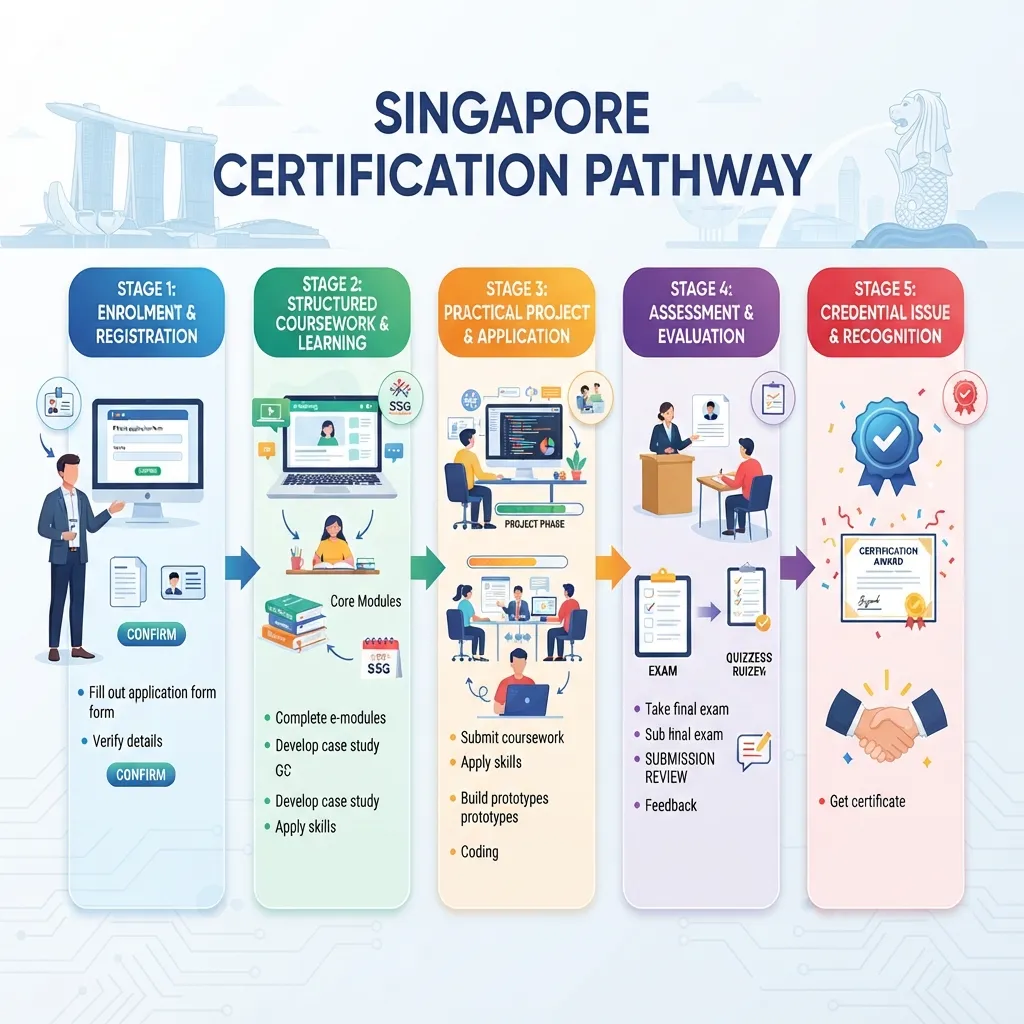
Before you enrol in any Vertical Institute programme, check the following on its current course pages:
- Delivery mode: Confirm whether the course is offered online, in classroom form, or both, and which dates are available.
- Syllabus: Read the module list line by line. Check whether it covers search, paid media, analytics, content, social and email, and whether it includes a practical project you can show employers.
- Trainer profile: Look for trainers who list hands-on industry roles, not just teaching titles. Ask whether they have run campaigns in Singapore or the region.
- Reviews: Read graduate reviews from several platforms, not only testimonials on the provider’s own site. Note whether reviewers were fresh graduates or career switchers.
- Assessment: Find out how you are assessed. A final project or portfolio means more to an employer than attendance alone.
Verify current fees, intake dates and funding eligibility directly with the provider. Provider details can change, so treat this section as a guide, not a price list.
Programmes with SkillsFuture funding eligibility and how to check claimable amounts
The SkillsFuture movement supports Singaporeans in developing their skills throughout life and remaining relevant and competitive long after graduation. Singapore citizens aged 25 and above may be able to use SkillsFuture Credit, and course fees for approved courses may be partly funded. SkillsFuture Singapore sets the eligibility rules and claimable amounts, which can change, so check the official SkillsFuture portal when you enrol.
To check whether a digital marketing programme is claimable:
- Search for the course on the SkillsFuture course directory and confirm it is listed.
- Check the listed course fee and any funding support shown.
- Log in to your SkillsFuture account to see your current SkillsFuture Credit balance and any other eligible funding.
- Confirm with the training provider how they process the claim and whether you must pay anything upfront.
- Keep your enrolment and payment records, as you may need them for the claim.
Do not assume a course is funded because it covers digital marketing. Eligibility depends on whether the specific course is approved, and funding support can change.
University and polytechnic continuing education offerings
Universities and polytechnics in Singapore offer continuing education courses that carry institutional recognition. Options worth reviewing include:
- Nanyang Polytechnic, which offers short courses in areas such as marketing, supply chain management and eCommerce.
- SMU Academy, which spans over 1,500 programmes in areas like Finance and Investment, Environmental, Social & Corporate Governance.
- NUS Professional Development, which runs short courses and professional programmes through the National University of Singapore.
The advantage of an institutional name is recognition. Hiring managers tend to know these institutions, and the programmes usually include formal assessment. The trade-off is often price and rigidity: these programmes can cost more than private short courses and may follow a fixed academic calendar. Check each course page for current fees, schedules and SkillsFuture listing.
Industry body credentials: Marketing Institute of Singapore and Chartered Institute of Marketing modules
Professional bodies offer credentials that cover marketing theory and management as well as digital practice. Two are worth a look:
- Marketing Institute of Singapore, which plays a leading role in providing training, learning and development solutions to professionals and corporations in Singapore and around the region. Check its current listings for digital modules.
- The Chartered Institute of Marketing (CIM), a UK-based professional body, sometimes delivers its modules locally through accredited training partners. Confirm with the institute or its local partner which modules are available in Singapore and whether they are digital-focused.
Industry body credentials usually take longer than platform certifications and often include written examinations. They suit marketers who want formal professional standing, especially those aiming for management roles. For a fresh graduate who needs a quick, portfolio-ready credential, these may be more than they need at the start.
Other accredited short courses in SEO, paid media, e-commerce and content marketing
Beyond diplomas and institute credentials, many accredited providers offer short courses focused on one discipline. These are often the most practical choice for career switchers who want to test a direction before committing to a longer programme.
When you assess a short course, check:
- Accreditation: Is the course listed on SkillsFuture, or does the provider name a recognised accrediting body? Please provide the accreditation reference so we can verify it.
- Assessment: Does the course end in a practical assessment, a project or a timed test? A course that ends only with a certificate of attendance carries less weight.
- Specialisation: SEO, paid media, e-commerce and content marketing need different skills. A course covering all four in a few days is unlikely to build depth in any one of them.
- Trainer experience: Look for trainers who run or have run live accounts, not only those who teach from slides.
Short courses are often the fastest way to add a specific skill to a CV. Pair them with real work, such as a managed ad account, a published content series or an SEO audit of a local business, so the credential means something to a hiring manager. For broader strategy and agency-side support, the Media One Marketing team works with Singapore businesses on the same disciplines covered here.
Comparison of Institute and Accredited Programme Types
| Programme type | Typical format | Typical duration | Main advantage | Main trade-off |
|---|---|---|---|---|
| Institute diploma or certificate | Classroom, online live or blended | Weeks to months | Structured learning and assessment | Higher fees, fixed schedules |
| Vertical Institute programmes | Online or classroom | Check course page | Industry-focused syllabus and trainer profiles | Verify current fees and intake dates directly |
| Polytechnic or university continuing education | Classroom or part-time | Varies by course | Institutional recognition | Often higher cost, fixed calendar |
| Industry body credentials | Study with written exams | Often several months | Formal professional standing | Longer and more demanding |
| Short accredited courses | Classroom or online | Days to weeks | Quick, specific skill building | Depth depends on the course and assessment |
Final Note on Choosing Within This Section
No single programme type suits all. A fresh graduate may get more from a short, assessed course plus a portfolio than from a diploma. A career switcher may need the structure and career support of a longer programme. An experienced marketer may only need an industry body credential to move into management. Use the assessment, recognition, and funding checks in this section to narrow your shortlist before making any payments.
Choosing the Right Certification for Your Career Stage
The certification that suits a colleague may not suit you. Fresh graduates, career switchers and experienced marketers each need different things from a credential. Start with your career stage, then use the criteria below to narrow your options.
Before you compare anything, take a moment to clarify what you need the credential to achieve for you. If the goal is a first job, recruiters need to recognise the credential and back it with a practical assessment. If the goal is a career change, you also need structure, mentorship and projects you can show. If the goal is a promotion or a specialist role, the credential should prove depth in one area.
For fresh graduates: foundation certifications that build a portfolio
Fresh graduates usually have a degree but little proof of applied skill. For this group, a platform certification is the simplest first step. Google Skillshop and Google Digital Garage courses are free and self-paced, and many Singapore agencies running Google Ads accounts recognise them. Meta Blueprint offers the same for paid social. Both platforms issue credentials that recruiters can verify, and both fit around a part-time job or an internship search.
The certificate alone is not enough. Each course should produce something you can show. Build a sample Google Ads campaign in a practice account, draft a mock content calendar, or create a simple GA4 dashboard. Save screenshots and write a short case note covering the objective, the setup and what you would change. Place these in a portfolio page. A hiring manager will rarely ask about your course list but will often ask you to walk through a piece of work.
A realistic plan for a fresh graduate is one core platform credential in the first month, one analytics credential in the second, and two portfolio pieces by the end of the third month. The time each credential takes depends on how far you go into the optional exercises. Before you commit, please check the expected hours and any renewal rules on each provider’s page.
For career switchers: structured programmes with career support and practical projects
Career switchers face a different problem. They have transferable skills, such as writing, sales, customer service or project management, but they need to show they can apply digital channels to business goals. Self-paced free courses work for some, but many switchers need structure, deadlines and feedback from a trainer.
For this group, look for programmes with scheduled sessions, graded assignments, a capstone project that resembles real client work, and some form of career support such as CV review or interview preparation. Ask the provider whether an instructor assesses the capstone and whether past graduates can be contacted. Vertical Institute’s digital marketing certifications guide for Singapore is a useful starting point for comparing local programme structures. Confirm the current syllabus, schedule and fees directly with the provider. For a broader view of how these options compare with agency work, see MediaOne Marketing’s guide to SEO agencies in Singapore.
Check whether the programme is eligible for SkillsFuture funding. The SkillsFuture movement supports Singaporeans in developing their skills throughout life and remaining relevant and competitive long after graduation. SkillsFuture Singapore sets eligibility rules, which may change, so confirm them on the official SkillsFuture portal before you enrol.
For experienced marketers: specialist credentials in analytics, performance marketing or marketing technology
Experienced marketers rarely need a broad foundation course. They need evidence of depth in an area the business is hiring for or under pressure to improve. Three areas stand out in the Singapore market: analytics (GA4 measurement, data layers, and attribution), performance marketing (paid search, paid social, and bidding strategy), and marketing technology (CRM, marketing automation, and tag management).
For these credentials, the most useful test is whether the assessment checks applied skill. A multiple-choice exam tests recall. A practical exam, a case study or a portfolio review tests whether you can make decisions. Choose the credential that asks you to configure an account, diagnose a problem or write a recommendation.
An experienced marketer can also use a specialist credential to move sideways. For example, moving from content to analytics often results in better pay progression than remaining in the same role.
A decision framework: the Credential Fit Scorecard
Use this scorecard to compare any two or three options. Score each criterion from 1 (weak) to 5 (strong), then multiply by the weight shown. The highest possible total is 500 before weighting, which scales to 100.
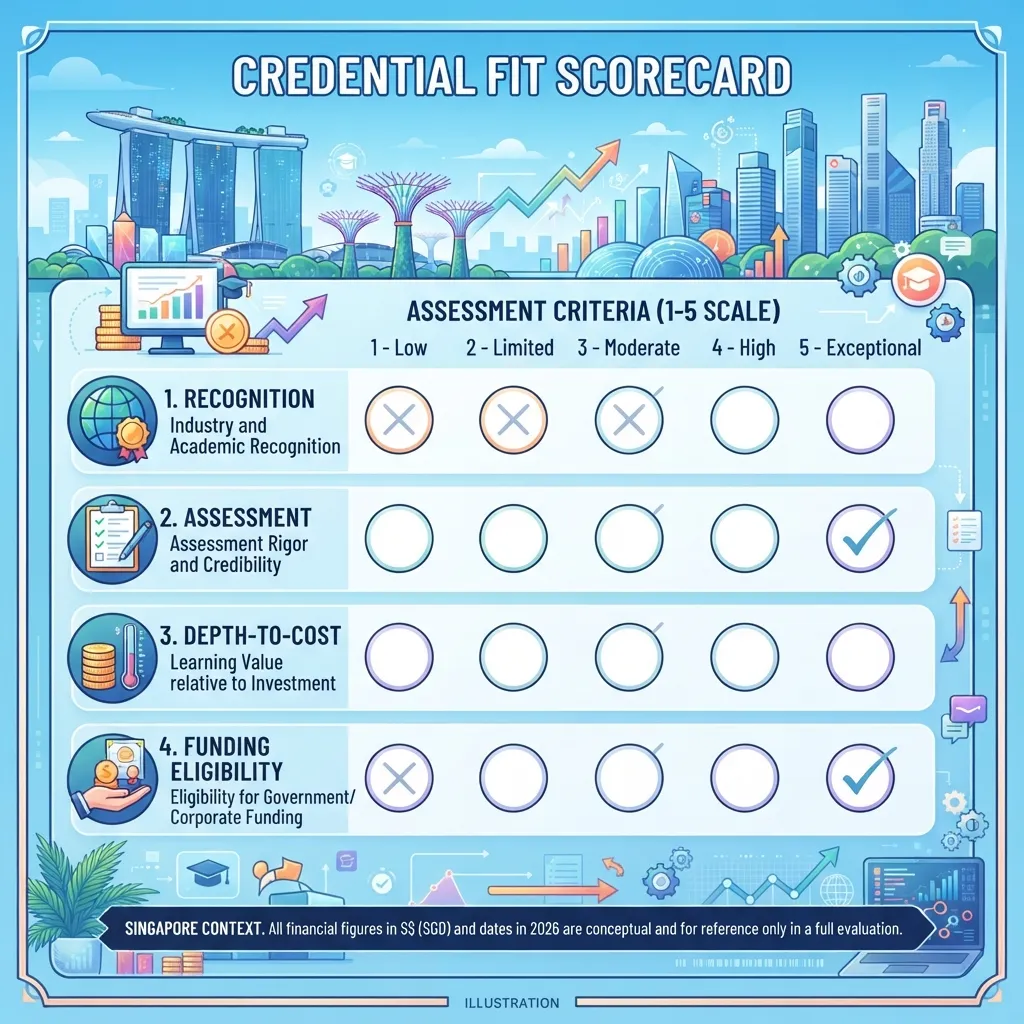
| Criterion | Weight | What a score of 5 looks like |
|---|---|---|
| Cost after grants | 25% | Net cost is low or fully covered by funding you qualify for |
| Time commitment | 20% | Hours fit around your current job, and the schedule is flexible |
| Employer recognition | 25% | Issued by a major platform, university or recognised body that hiring managers know |
| Hands-on practice | 20% | Assessment requires a live account, project, portfolio piece or proctored exam |
| Trainer experience | 10% | Trainers have verifiable industry roles and can be named on the provider’s page |
To calculate, multiply each score by its weight, then add the results. A worked example shows why the scorecard favours verifiable, practical credentials over more expensive ones. Credential A is a free Google Skillshop course with a practical account exercise, scoring 5 on cost, 4 on time, 5 on recognition, 5 on practice and 2 on trainer experience. Credential B is a paid programme with a named trainer team, scoring 2 on cost, 3 on time, 4 on recognition, 3 on practice and 5 on trainer experience. Credential A totals (5×25)+(4×20)+(5×25)+(5×20)+(2×10) = 125+80+125+100+20 = 450, or 90 out of 100. Credential B totals (2×25)+(3×20)+(4×25)+(3×20)+(5×10) = 50+60+100+60+50 = 320, or 64 out of 100. The cheaper, verifiable credential outranks the costlier one because it scores higher on the criteria hiring managers check. Compare totals only across options you have scored with the same method.
Weight recognition and practice more heavily if you are a fresh graduate or career switcher, because hiring managers look closely at these. Weight cost and time more heavily if you are employed and self-funding.
Employer recognition depends on the employers you target. Check job listings in your target role on platforms such as LinkedIn and JobStreet, and note which certifications appear in the requirements. Local recruiters often mention Google Ads and Meta Blueprint, but a specialist role may ask for a different credential. Verify against live listings rather than relying on general advice.
Red flags to avoid
Some providers overpromise. These warning signs should prompt careful checking before you pay.
Guaranteed job claims. No training provider can guarantee employment. Be wary of phrases such as “100% job placement” unless the provider publishes a method for calculating the figure, names its source and defines what counts as a placement.
Unverifiable accreditation. Ask for the accrediting body’s name and verify it independently. A logo on a brochure is not accreditation. You can usually verify platform credentials through the issuer’s certificate lookup and check funding eligibility on the SkillsFuture portal.
Hidden fees. Ask for a full fee breakdown in writing, including examination, material, certificate and renewal fees. A low headline price can become expensive once you add these.
Vague trainer profiles. A provider that doesn’t name its trainers or describe their industry roles is likely hiding something. Ask for names, roles and a sample of recent client work or published material.
Pressure to enrol today. Discounts that expire within hours are a sales tactic. A credible provider will let you take a week to compare options.
Syllabus with no assessment. If a course ends with attendance only and no test, project or portfolio review, it is a completion record, not a verified skill. That is not always wrong, but you should pay accordingly and not present it to employers as proof of ability.
Together, the scorecard and the red flag checks help you narrow a long list of options to one or two credentials that match your career stage, budget, and target roles.
Costs, Grants and Funding Options Explained
Most Singaporeans comparing digital marketing certifications look at the sticker price first. That is the wrong starting point. A S$300 platform certificate with a proctored exam can be worth more to a hiring manager than a S$6,000 course that ends in an attendance certificate. Funding can narrow that gap. This section explains typical price bands, how government funding works and how to calculate what you will actually pay.
Typical price ranges by certification type in S$
Prices vary widely, so treat the bands below as planning ranges, not quotes. Confirm every fee on the provider’s own page before you enrol, as course fees, promotions, and GST treatment may change.
| rtification type | Typical cost range (S$) | Examples | What you usually get |
|---|---|---|---|
| Platform certifications | Free to about S$100 | Google Skillshop, HubSpot Academy, Meta Blueprint | Online modules, badges or certificates, sometimes a timed exam |
| Short paid courses | About S$200 to S$1,500 | Hootsuite Academy and similar short courses, SEO academies on subscription | Short modules, a completion certificate, and sometimes an assessment |
| Institute and industry body programmes | About S$1,000 to S$4,000 | Industry body modules, polytechnic and university continuing education short courses | Structured syllabus, assessment, accredited or recognised certificate |
| Full diplomas and intensive programmes | Often S$4,000 and above | Multi-month diploma or bootcamp-style courses | Longer curriculum, practical projects, career support in some cases |
Two points matter more than the headline number. First, verify whether the fee includes examination fees, which are sometimes billed separately. Second, confirm whether the quoted price is before or after GST. If the difference is unclear, ask the provider for a written fee breakdown.
How SkillsFuture Credit and course fee funding work for eligible Singaporeans
The SkillsFuture movement helps Singaporeans build skills throughout life, so they stay relevant and competitive long after graduation. It is the main government channel for subsidising training in Singapore. The details below reflect the scheme’s general structure. SkillsFuture Singapore sets eligibility rules, which may change, so check the SkillsFuture portal before you rely on them.
- SkillsFuture Credit: Singapore citizens aged 25 and above can receive a credit balance for approved courses. The government tops up the credit periodically, and the SkillsFuture portal publishes the balance and top-up rules.
- Course fee funding: Many approved courses are eligible for a government subsidy on their course fees. The subsidy rate depends on the course, the provider and the learner’s profile, and you will see it at enrolment.
- Eligibility check: Course listings on the SkillsFuture portal show whether a course is funded. Look for the course reference number and confirm that it appears on the portal before you pay.
Please confirm the funding status in writing before paying a deposit or signing a contract. Providers that promise funding without a verifiable course listing are a warning sign.
Other support schemes relevant to career switchers and mid-career workers
Beyond SkillsFuture Credit, a few other channels may help, depending on your situation. Check current eligibility on each agency’s official site.
- Mid-career and career switch support: Government agencies run programmes for mid-career workers and career switchers, including career matching and training support. Check the SkillsFuture portal and the Ministry of Manpower website for schemes open when you apply.
- Employer sponsorship: Some employers fund certifications for staff, particularly those tied to platform tools the business already uses. Ask your manager or HR before paying out of pocket, and get the terms in writing, including any clawback clause if you leave within a set period.
- Attendance and assessment conditions: Funded courses often require a minimum attendance rate or a passed assessment before the subsidy is released. Read the conditions before you start, because missing them can leave you paying the full fee.
A checklist for estimating your net out-of-pocket cost
Use this checklist to work out what you will actually pay:
- Note the listed course fee, including or excluding GST, as the provider states.
- Add any exam, registration or material fees billed separately.
- Check whether the course is listed as eligible for SkillsFuture funding on the SkillsFuture portal, and record the reference number.
- Confirm the subsidy percentage or the amount deducted from your SkillsFuture Credit.
- Subtract the funded amount from the total to get your gross out-of-pocket cost.
- Check whether any employer sponsorship applies, and subtract it if it does.
- Ask whether a refund applies if you withdraw and how long the refund window lasts.
- Compare the final figure against your scorecard for recognition, assessment and depth, rather than choosing on price alone.
Used this way, the checklist often shows that a mid-priced, funded, assessed certification costs less net than a cheap course with no recognised assessment. The price tag alone won’t reveal this.
Current Trends Shaping Digital Marketing Skills in 2026
Certifications age fast. A credential that was valuable in 2023 may now teach a workflow that no longer exists, so be sure to check which skills employers are asking for now. Three shifts matter most for the 2026 buyer: how people search, how advertising is automated and how measurement works after privacy changes.

Shifts in search, AI-driven advertising tools and generative search
Search is no longer just a list of blue links. Generative answers now appear above or alongside traditional results on many queries, so some clicks that once reached brand websites are answered on the results page. For marketers, the job shifts from ranking one page to being cited, mentioned and trusted across many sources. Skill demand moves toward topical authority, structured content, clear definitions and brand presence across the web, not keyword density alone.
Advertising has followed the same direction. Google’s Performance Max and Meta’s Advantage+ campaigns hand much of the bidding, audience selection and creative combination to machine learning systems. The marketer’s work shifts to supplying good inputs such as conversion data, creative variety, and audience signals, setting sensible targets, and reading the outputs critically. Google Skillshop and Meta Blueprint have both updated course material to cover automated campaign types. A certification with a recent syllabus is more useful than an older one that still treats manual bid management as the default.
What this update means for your choice:
- Prioritise certifications that cover automated campaign types and how to feed them quality data.
- Check whether the syllabus covers generative search or AI-assisted content workflows, not just traditional SEO checklists.
- Treat a course not updated in several years as a warning sign, no matter how low its price.
Privacy changes affecting measurement and what this means for analytics credentials
Measurement has become harder. Browser limits on third-party cookies, platform tracking changes and consent settings mean much conversion data is now modelled rather than directly observed. Modelled conversions are estimates the platform fills in for users it cannot track. Google Analytics 4 is built around event-based tracking and includes modelled conversions when consent is declined. Advertisers increasingly rely on server-side tagging and first-party data to fill the gaps.
Modelled conversions and consent mode can make reported figures differ between platforms. For example, a campaign might report 100 conversions in the ad platform and 80 in analytics. The gap can come from modelled conversions added for users who declined consent, from attribution windows that count the same sale differently, or from tags that fire on some pages but not on others. A marketer who understands these nuances can explain the gap, state which figure to trust for which decision and set a reporting rule the team follows. A marketer who lacks integrity may simply report whichever number looks better.
This shift raises the value of analytics credentials that test understanding of the data model, not just the interface. Ask any provider: Does the curriculum explain how attribution works when some users are not tracked, how to set up event and conversion tracking correctly and how to reconcile platform-reported results with analytics data? A feature tour of dashboards will not prepare you for the measurement problems employers now care about.
Hiring managers in Singapore often test these skills in interviews. Expect questions such as why a campaign’s reported conversions differ from the analytics platform or how you would measure a campaign when much of the traffic is consent-restricted. A certificate that covers these topics in an assessment gives you a concrete answer. A badge for attending a dashboard walkthrough does not.
Demand signals from Singapore job listings and what employers are asking for
Digital marketing job listings in Singapore repeatedly ask for a similar cluster of skills: paid search and paid social management, analytics and reporting, SEO fundamentals, content production with some understanding of search, and marketing automation tools. Performance-marketing roles frequently name Google Ads and Meta Ads, which is one reason platform certifications carry weight locally.

Before enrolling, read ten to twenty current listings for the role you want and note the tools and outcomes they mention. Build a simple tally: how many mention Google Ads, Meta Ads, GA4, SEO tools, CRM or marketing automation, and AI-assisted content. Your shortlist should then cover the tools that appear most often. This method reflects the local market on the day you check, which a generic ranking list cannot do.
Job listings reflect employer wording, which can lag reality or overstate requirements. Treat the tally as a guide to priorities, not a checklist to complete before applying. Verify the current salary and demand data on the job boards and government labour market resources you use, as these figures change and are not reproduced here.
Conclusion and Recommended Next Steps
Most Singaporean marketers do not need every credential on the market. They need the right two or three, earned in the right order. The certifications that pay off are the ones a hiring manager can verify that include a real assessment and that fit the role you are aiming for. Use the Credential Fit Scorecard from earlier to make that call, then act within the next 30 days.
Which Certifications Suit Which Reader?
Choose your career stage first, then select the credentials that match your next role.
| Reader | Start with | Add next | Why |
|---|---|---|---|
| Fresh graduate with no experience | Google Digital Garage, Google Skillshop, HubSpot Academy | Meta Blueprint | Free and self-paced, so you can build a portfolio at no cost |
| Career switcher | A structured programme with a practical project and career support | Google Analytics certification | Employers look for evidence of applied work, not just a completion badge |
| Experienced marketer upskilling | A specialist credential in analytics, paid media or marketing technology | Semrush or Ahrefs SEO academy | Targets a specific gap, and some costs may be claimable through SkillsFuture where eligible |
Our recommendation: Fresh graduates should start with Google Digital Garage and HubSpot Academy. Career switchers should start with a structured programme that includes a practical project. Experienced marketers should add one specialist credential in analytics or paid media. If you are unsure, start with the free platform certifications. They show you whether you enjoy the work before committing to a costly programme.
A Practical 30-Day Plan
Week 1: Define your goal and check your eligibility
- Write down the one role you would like to pursue in the next 12 months.
- Pull five Singapore job listings for that role and note which tools and certifications they name.
- Check your SkillsFuture Credit balance and eligibility on the official SkillsFuture portal. Please treat any claimable amount as unverified until you have confirmed it there.
Week 2: Complete one free platform certification
- Choose one Google or Meta credential that matches the job listings.
- Set a fixed study schedule of about 30 minutes, five days a week.
- Finish the assessment and add the credential to your LinkedIn profile.
Week 3: Build one piece of proof
- Run a small project, such as a test ad campaign with a modest budget, a keyword analysis for a local business, or a short content plan.
- Record your objective, method and results in a one-page case study.
Week 4: Decide on the next step
- Score your next two options using the Credential Fit Scorecard: recognition, assessment, depth-to-cost and funding eligibility.
- Enrol in only one paid or accredited course, and only if its score is clearly higher than the free alternatives.
A Realistic Expectation
Thirty days will not make you job-ready on its own. It will give you one verified credential, one portfolio piece and a clear decision about what to pursue next. That is a strong start and far more useful than collecting several certificates you cannot explain in an interview.
For readers who want help choosing and sequencing their learning, Mediaonemarketing.com.sg can be a practical place to start the conversation once your goal and budget are clear.
Frequently Asked Questions
Do Singapore employers recognise free digital marketing certifications?
Yes, for the right roles. Platform certifications such as Google Skillshop and Meta Blueprint are widely understood by local agencies because those platforms run much of the paid search and social advertising in Singapore. A hiring manager can check that a credential is genuine, and a free badge shows you can use the tools. It rarely replaces a degree or work experience on its own, so pair it with a portfolio of campaigns or case studies.
Can I claim course fees with SkillsFuture Credit for a digital marketing course?
Some courses qualify, but not all. You can use SkillsFuture Credit on eligible courses listed on the SkillsFuture portal, and Singapore citizens aged 25 and above are generally eligible for the credit. SkillsFuture Singapore sets the eligibility rules, which may change. Check the course listing, confirm your balance on the portal, and verify the current terms before you enrol.
Which certification is best for a fresh graduate with no marketing experience?
Start with a free foundation credential that includes a graded assessment, such as Google Digital Garage or a HubSpot Academy course, then build a small portfolio. Use the Credential Fit Scorecard in this guide. A short, verifiable certification with a practical assessment is usually more useful than an expensive course with attendance-only completion. Move to a paid, structured programme only if you need guided projects or career support.
How long does it typically take to complete a digital marketing certification?
It depends on the credential. Many platform courses can be completed in a few hours to a few weeks of part-time study, while diplomas and accredited programmes typically take several months. Plan around your job by estimating total instruction hours and dividing them by the hours you can study each week. Please confirm the exact hours with the provider before making a payment.
Do I need a certification if I already have a degree in marketing or communications?
Not always. A degree shows foundational knowledge, but employers often want evidence of current platform skills such as analytics, paid media or SEO tools. A targeted certification can close that gap and show that your skills are up to date. If you already work in marketing, a specialist credential in one area is usually more useful than another general qualification.
Are online digital marketing certifications as valuable as classroom-based ones?
The value depends on the assessment, not the format. An online course with a proctored exam or a graded portfolio project can be just as valuable as a classroom course that only requires attendance. Classroom options suit learners who want structured feedback and networking, while online options suit people balancing shift work or family commitments. Please check how the course is assessed before making your decision.