| AI Summary
Singapore offers digital marketing career opportunities across search engine optimisation (SEO), performance marketing, social media, content, marketing automation and analytics. The wider labour market remained resilient in the second quarter of 2026, while Singapore’s digital economy accounted for 18.6% of gross domestic product in 2024. Salaries vary substantially by specialisation, seniority and industry, so jobseekers should compare current recruiter benchmarks rather than rely on a single industry-wide salary range. |

Singapore’s digital marketing industry is growing rapidly. Over the past five years, the city-state has strengthened its position as a regional hub for marketing technology, e-commerce and fintech innovation. If you are exploring digital marketing jobs in Singapore, you can find opportunities across a range of specialisations, with access to regional and global brands.
This guide covers the current job market, available roles, what employers seek, where to find positions, and how to position yourself for success. Whether you are entry-level or mid-career, you will find concrete salary data, real hiring trends, and actionable next steps.
Key Takeaways
- Demand for digital marketers in Singapore outpaces supply, especially for SEO, performance marketing and data analytics roles.
- Salary varies considerably by role and experience. Current data places Digital Marketing Executive base pay at around S$3,000–S$4,000 per month, while experienced SEO Managers and Digital Managers can command six-figure annual salaries.
- Hard skills required: Google Analytics, paid advertising platforms, CMS. Soft skills: communication, problem-solving, adaptability.
- Key sectors: fintech, e-commerce, healthcare tech, multinational regional hubs.
- LinkedIn, Indeed and JobStreet are common; direct applications and recruitment agencies yield higher response rates.
- Google Analytics and HubSpot Academy certifications can support an application, but employers also look for practical skills and evidence of real work.
The Current Demand for Digital Marketing Talent in Singapore
Demand for digital marketers in Singapore has grown significantly. The city-state serves as Southeast Asia’s primary hub for technology, fintech and e-commerce, driving sustained demand for marketing professionals who can acquire customers and build brands in a competitive, digital-first economy.
Job Market Growth and Salary Expectations
Singapore’s digital economy grew at a compound annual growth rate of 12% from 2019 to 2024, compared with 7.3% growth in nominal GDP over the same period. This growth outpaces general job market expansion.
The growth reflects two factors. Local technology companies are expanding. Simultaneously, multinationals including Google, Meta (via Meta Business Suite and Meta Blueprint), Amazon and ByteDance have established large Singapore teams as regional hubs.
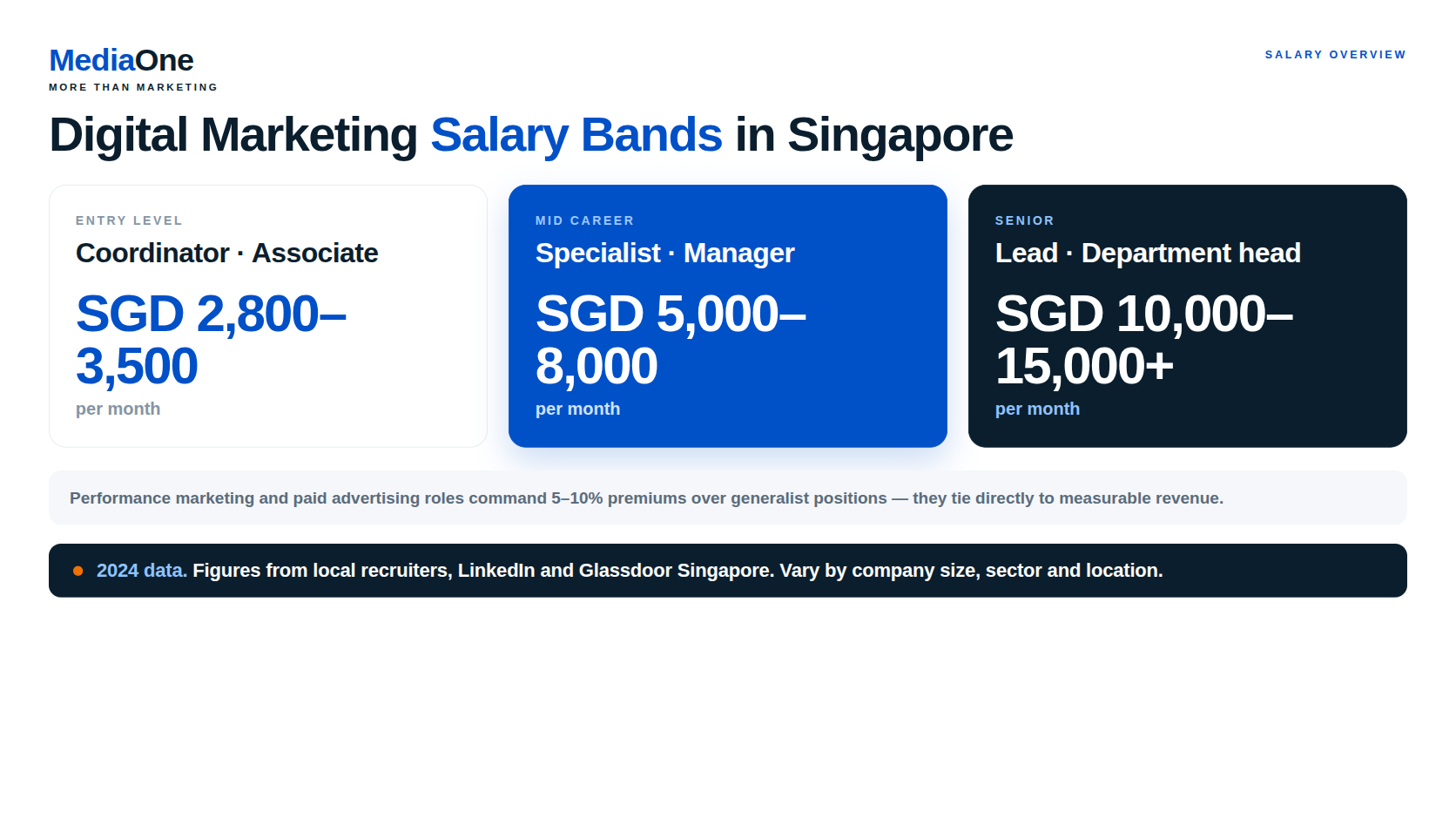
Entry-level positions (coordinator, associate) typically pay SGD 2,800–3,500 per month. Mid-career specialists and managers earn SGD 5,000–8,000. Senior roles and department heads range from SGD 10,000 to SGD 15,000+, depending on company size and sector.
Specialisation affects salary. Performance marketing and paid advertising roles often command 5–10% premiums over generalist positions because they directly tie to measurable revenue. Data analytics roles similarly attract premiums due to the technical skill set required.
Experienced candidates with 5+ years of proven campaign results can negotiate above published salary bands. Retention bonuses are common for staff with rare skill combinations, such as growth marketing plus product analytics.
Key Sectors Hiring Digital Marketers
Fintech and Financial Services leads demand. Singapore hosts a major regional fintech hub, with companies including Grab Financial, Sea Group and Credible Labs competing for customer acquisition. These firms actively hire growth marketers and paid-acquisition specialists.
[IMAGE: A visual breakdown of the five primary sectors hiring digital marketers in Singapore (fintech, e-commerce, tech/SaaS, healthcare, multinational corporations), showing relative hiring volume and typical salary ranges for each sector.]
E-commerce and Retail Tech is the second major employer. Shopee, Lazada, Carousell and emerging direct-to-consumer brands require talent in performance marketing, content strategy and marketplace optimisation. As of 2024, these firms maintain active Singapore hiring.
Healthcare, Life Sciences and Wellness is growing rapidly. Singapore positions itself as a regional healthcare hub. Private hospitals, telemedicine platforms and pharmaceutical companies now build in-house marketing teams rather than relying solely on external agencies.

Multinational Corporations use Singapore as a regional marketing hub. Tech giants, consumer brands and financial institutions locate regional marketing operations here to serve Asia-Pacific markets. These roles typically involve managing campaigns across multiple countries and are more senior-level positions.
Travel and Hospitality recovered strongly after COVID-19. Airlines, hotel groups and online travel agencies expanded marketing teams as leisure and business travel resumed.
Startups and scale-ups (Series A to Series C funding rounds) hire most aggressively but offer less salary stability. They typically pay 10–20% below corporate roles but offer equity and faster skill development.
Why Singapore’s Job Market Differs from the Region
Singapore’s digital marketing market differs from neighbouring Malaysia, Thailand, Indonesia and the Philippines in four key ways.
First: Salary and hiring standards. A mid-level marketer in Singapore earns approximately 40–60% more than an equivalent professional in Bangkok or Jakarta. However, living costs are higher. Employers also demand stronger English proficiency, advanced software skills and prior experience in a developed market. [Based on Mercer regional salary survey data]
Second: Talent pool competitiveness. Singapore attracts regional talent due to higher salaries, English-language working environments and career mobility. Candidates often come from Australia, India, the UK and other English-speaking countries. This tightens the labour market for employers but raises the hiring bar for job seekers.
Third: Employment law and stability. Singapore’s Employment Act and visa sponsorship rules encourage long-term investment in staff. Contracts are more formal and benefits more standardised than in neighbouring countries. This reflects Singapore’s position as a developed financial centre rather than a low-cost employment hub.
Fourth: Technology and tools. Singapore-based teams use advanced marketing software, data warehouses and attribution tools. Regional roles often use older, simpler systems. This advantage supports career progression if you later change jobs within the region.
For international candidates, this means Singapore roles demand stronger credentials but offer better long-term career value. Regional roles have lower barriers but fewer advancement paths into senior positions.
Types of Digital Marketing Roles Available in Singapore
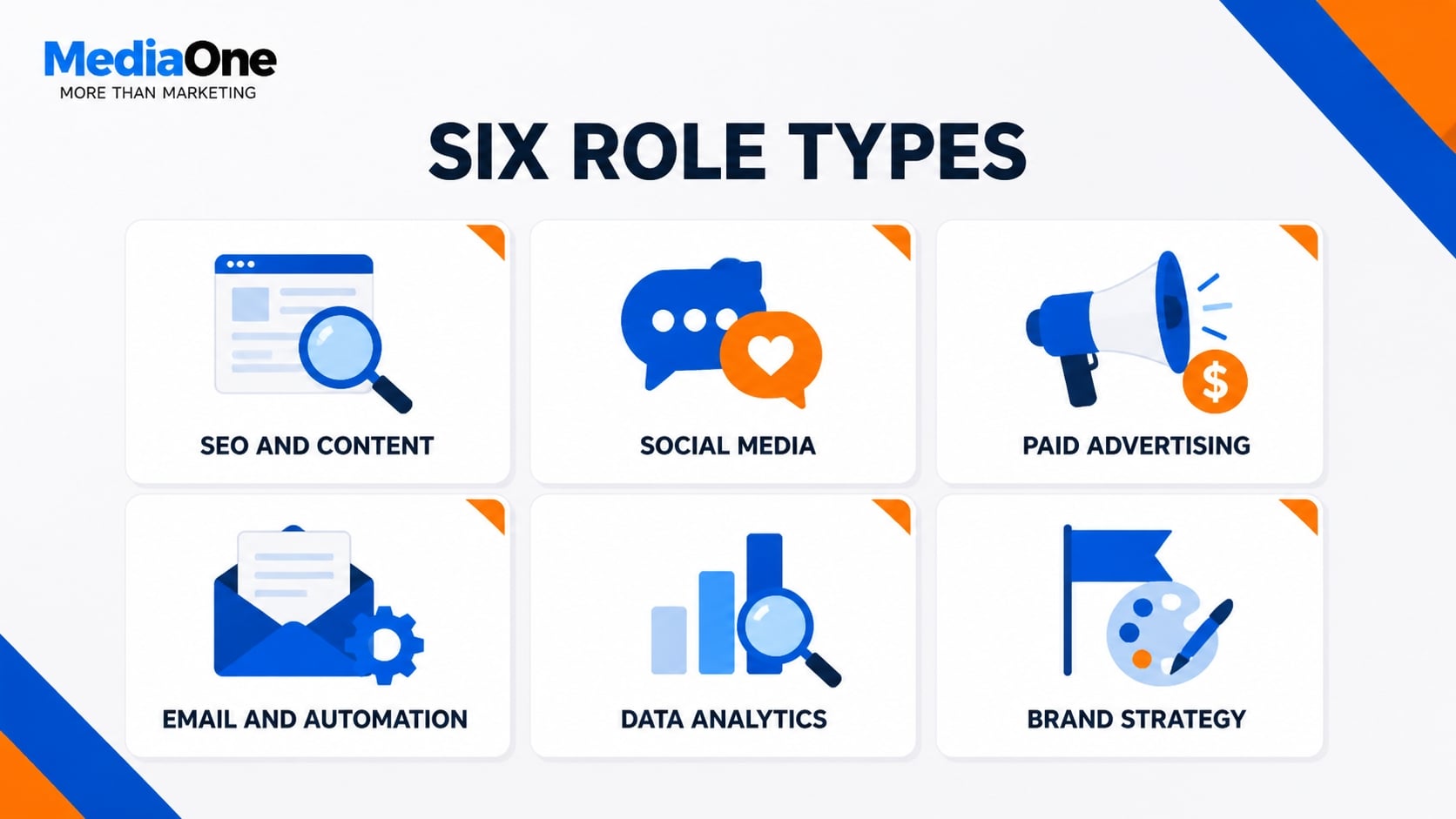
Singapore’s digital marketing sector offers diverse specialised positions. Each role targets different skills and career trajectories. The positions described here span seven core specialisations, from entry-level through to senior leadership.

[IMAGE: Digital marketing specialisations in Singapore, showing role types, salary progression and career paths]
Search Engine Optimisation (SEO) and Content Specialists
SEO specialists audit website architecture, research keywords, optimise on-page elements and manage technical implementations. Content specialists produce articles, guides and web copy designed to rank in search engines and support SEO performance.
Entry-level roles focus on on-page optimisation and basic technical SEO. Specialists review meta tags, heading structure and internal linking. Mid-career professionals lead content strategy and backlink acquisition. Senior roles oversee SEO as a revenue driver, setting KPIs and reporting to leadership.
Singapore’s financial and e-commerce sectors actively hire SEO talent because both rely on organic search visibility. Fintech companies invest heavily in content marketing to build consumer trust.
Core tools include Google Search Console, SEMrush, Ahrefs and content management systems such as WordPress or Contentful. Employers value portfolios demonstrating published work, measurable traffic growth and keyword ranking improvements. Google Analytics certification strengthens candidacy but does not replace demonstrated results.
Social Media and Community Management Positions
Social media managers build and engage audiences across Meta Business Suite, Instagram, LinkedIn, TikTok and WeChat. They plan content calendars, create posts, respond to comments and manage reputational issues. Community managers focus deeper, building brand loyalty and fostering conversations.
Entry-level positions involve content scheduling, basic community engagement and performance reporting. Mid-career managers develop strategy, create campaign briefs and collaborate with creative teams. Senior community leads manage teams, set social strategy and link social metrics to revenue outcomes.
Singapore’s multicultural market demands social fluency across English, Mandarin, Malay and Tamil. Bilingual or multilingual social managers typically earn higher salaries. Retail, hospitality and consumer goods companies actively hire social roles because community engagement directly affects sales.
Core tools include Meta Business Suite, Hootsuite and Buffer. The role requires strong writing skills, cultural awareness and rapid response to comments and trends. Visual design knowledge (Canva, Adobe Creative Suite) is increasingly expected but not always required at entry level.
Performance Marketing and Paid Advertising Roles
Performance marketers manage paid campaigns across Google Ads, Meta, TikTok and LinkedIn. They optimise budgets, test ad creatives, write copy and track return on ad spend (ROAS). The role is data-driven and results-focused.
Entry-level paid specialists typically manage one platform (usually Google Search or Meta) under supervision. They set up campaigns, manage bids and analyse performance reports. Mid-career managers own campaign strategy across multiple channels, conduct A/B testing and control budgets ranging from SGD 10,000 to SGD 100,000 monthly. Senior roles involve channel strategy, cross-platform coordination and junior staff mentoring.
Fintech, e-commerce and SaaS companies hire large paid teams because customer acquisition directly impacts revenue. Singapore’s high cost of living pushes businesses to focus on profitable ad spend rather than brand awareness alone.
Platform certifications (Google Ads, Meta Blueprint) and hands-on campaign management experience are essential. Excel proficiency and familiarity with analytics platforms such as Google Analytics 4 or Mixpanel are valuable for many performance marketing roles. The role rewards analytical thinking and creative problem-solving.
Email Marketing and Marketing Automation Jobs
Email marketers design campaigns, build subscriber lists and optimise open and click rates. Marketing automation specialists build workflows that nurture leads from first contact through purchase and retention.
Entry-level roles focus on campaign execution: writing subject lines, building email templates and sending scheduled campaigns. Mid-career professionals design automation sequences, segment audiences and integrate email with CRM systems. Senior automation specialists architect complex customer journeys, manage marketing software stacks and report on revenue attribution.
E-commerce and SaaS businesses rely on email to retain customers. Insurance and banking sectors use email for regulatory compliance and account management. These sectors actively hire email specialists because optimised campaigns can improve retention measurably.
Platforms include HubSpot, Klaviyo, Mailchimp and Braze. SQL knowledge helps segment large datasets. Understanding deliverability (SPF, DKIM, bounce handling) separates competent practitioners from novices. Strong copywriting and psychology knowledge are equally important.
Data Analytics and Marketing Intelligence Positions
Marketing analysts transform raw campaign data into insights. They use SQL, Python or Excel to pull data from advertising platforms, CRM systems and web analytics. They build dashboards, identify trends and recommend optimisations.
Entry-level roles focus on reporting: pulling data, creating dashboards and explaining performance to stakeholders. Mid-career analysts run statistical tests, build predictive models and set up automated reporting systems. Senior positions involve strategy. Senior analysts advise on measurement frameworks, attribute revenue to channels and design experiments.
Singapore’s financial and tech sectors place high value on data literacy. Banks track customer acquisition cost (CAC) and lifetime value (LTV). Tech companies use data to optimise product-market fit. The shortage of skilled analysts means salaries are competitive.
Technical requirements include SQL, Python or R, Excel and business intelligence tools (Tableau, Looker, Power BI). Google Analytics 4 certification is expected. Communicating findings to non-technical stakeholders requires business acumen and presentation skills.
Content Strategy and Brand Management Roles
Content strategists plan what stories a brand tells and where. They work across website content, social media, email, video and paid campaigns. Brand managers protect brand identity and ensure consistency across channels.
Entry-level strategists research audiences, create content calendars and coordinate with writers and designers. Mid-career strategists own brand voice, set editorial guidelines and lead cross-functional projects. Senior brand leaders shape company positioning, manage agency relationships and tie content to business outcomes.
Large corporations, luxury brands and established e-commerce platforms hire dedicated brand teams. Healthcare organisations need strategists to communicate complex information clearly. Media and publishing companies rely on content strategy to drive subscriptions.
The role requires business thinking. Strategists must understand audience psychology, competitor positioning and channel dynamics. Portfolio examples showing measurable impact (traffic growth, engagement, leads) matter more than credentials.
Career Progression and Salary Overview by Role
| Role Type | Entry-Level Focus | Mid-Career Growth | Senior Responsibility | Indicative Salary Range |
|---|---|---|---|---|
| SEO / Content | On-page optimisation, technical SEO | Content strategy, backlink outreach | SEO as revenue driver | SGD 3,000–5,000 to SGD 8,000+ |
| Social Media | Content scheduling, engagement | Strategy, team collaboration | Team leadership, revenue alignment | SGD 3,500–5,500 to SGD 9,000+ |
| Paid Advertising | Single platform management | Multi-channel optimisation | Channel strategy, portfolio leadership | SGD 3,500–6,000 to SGD 10,000+ |
| Email / Automation | Campaign execution | Segmentation, workflow design | Journey architecture, tech stack | SGD 3,200–5,500 to SGD 8,500+ |
| Data Analytics | Reporting, dashboards | Statistical testing, predictive modelling | Measurement strategy, experimentation | SGD 4,000–6,500 to SGD 12,000+ |
| Brand / Content Strategy | Content calendars, coordination | Editorial guidelines, brand voice | Business positioning, agency leadership | SGD 3,500–6,000 to SGD 10,000+ |
Note: Salary figures based on 2024 industry surveys from local recruiters, LinkedIn and Glassdoor Singapore; subject to change and vary by company size, sector and location.
How These Roles Overlap in Practice
These roles overlap significantly in practice. Performance marketers need analytics skills. Content strategists collaborate with SEO specialists. Social media managers often run paid campaigns. Small companies expect generalists; larger organisations hire specialists. Understanding each role helps you position yourself during recruitment and plan your career direction.
Common Job Search Barriers and Solutions
| Common Barrier | Why It Happens | How to Address It |
|---|---|---|
| Lack of hands-on experience | Entry-level positions often require 1–2 years experience; graduates have portfolio work only | Build case studies using free tools (Google Analytics, Meta Ads Manager). Contribute to open-source projects or volunteer for non-profit campaigns. |
| Insufficient technical skills | Many roles require platform certifications or SQL knowledge; traditional degrees do not teach these | Enrol in Google Analytics, Meta Blueprint or short-course SQL training (2–4 weeks). Practise on free accounts before interviews. |
| Geographic competition | Singapore attracts regional talent; competition for mid-career roles is high | Target roles requiring local market knowledge (Mandarin fluency, Singapore regulatory understanding). Network within specialist communities. |
| Portfolio gaps | Employers want to see measurable results; many candidates have no published work | Create mock campaigns using real data (public company benchmarks). Write case studies explaining strategy and outcomes. |
| Unclear role fit | Job titles vary by company; candidates apply to wrong roles and fail to stand out | Study job descriptions carefully. Map your skills to role requirements. Use role-specific language in your CV and cover letter. |
| Salary misalignment | Candidates request salaries mismatched to experience or sector norms | Research salary ranges on Glassdoor, PayScale and LinkedIn for your role and level. Benchmark against peers in similar sectors. |
Qualifications, Skills and Experience Required
Breaking into digital marketing in Singapore does not require a single fixed path. The field accepts candidates from diverse educational backgrounds, values demonstrated ability over credentials alone, and increasingly prioritises practical skills and certifications over degrees. However, employers do expect a specific mix of technical competencies and interpersonal abilities.
Educational Pathways (Degrees, Diplomas and Certifications)
A bachelor’s degree in marketing, communications, business or a related field remains common among senior and mid-career digital marketers in Singapore. The National University of Singapore and Singapore Management University offer business programmes with digital marketing modules. However, a degree is not mandatory for entry-level roles.
Diplomas from polytechnics such as Ngee Ann Polytechnic and Singapore Polytechnic, particularly in mass communication or business, provide a faster, cheaper route into the profession. These two-to-three-year programmes cover marketing fundamentals and digital channels. Polytechnic graduates are actively hired by Singapore employers.
Self-taught candidates with no formal qualification can enter through intensive bootcamps and online courses. Platforms like Google Digital Garage (free, accredited by Google), Coursera and LinkedIn Learning offer beginner-to-intermediate digital marketing curricula. Many Singapore hiring managers value bootcamp graduates, especially from established providers, if the candidate demonstrates portfolio work or live campaign results.
The critical difference is not the credential type, but whether the applicant can explain what they learned and prove they can apply it.
Hard Skills Employers Prioritise
Singapore’s digital marketing employers consistently seek candidates with hands-on platform competency.
Google Analytics proficiency is nearly universal in job specifications. Employers commonly expect familiarity with Google Analytics 4 (GA4), which became Google’s standard analytics platform after standard Universal Analytics properties stopped processing new data on 1 July 2023. Candidates should be comfortable interpreting traffic sources, user behaviour flows and conversion funnels.
Google Ads and Meta Ads Manager experience is standard for paid marketing roles. Employers expect candidates to have created campaigns, managed budgets and optimised bids. Real campaign spend (even modest amounts) proves competency more effectively than theory alone.
Content management systems like WordPress, Shopify or HubSpot appear frequently in job postings, particularly for website updates or inbound marketing roles. Email marketing platforms such as Mailchimp, HubSpot or Klaviyo are expected for email or marketing automation positions.
SEO basics, including keyword research tools (SEMrush, Ahrefs), on-page optimisation and basic HTML, matter for most roles, even those not purely SEO-focused. Product marketing roles demand familiarity with Amplitude or Mixpanel. Social media management roles expect proficiency in native platform dashboards and third-party tools like Hootsuite or Buffer.
Data literacy beyond viewing a report is increasingly valued. Basic Excel skills (pivot tables, VLOOKUP) and the ability to build simple dashboards in Google Sheets or Tableau set candidates apart, particularly in mid-career and senior roles.
Soft Skills That Set Candidates Apart
Communication ability consistently ranks as the top differentiator. Digital marketers must explain campaign strategy to non-technical stakeholders, brief designers and copywriters, and present findings to leadership. Clarity and confidence in presenting data are observable during interviews and portfolio walkthroughs.
Problem-solving under ambiguity is prized in Singapore’s fast-moving tech and fintech sectors. Hiring managers assess whether candidates think systematically through constraints. A typical interview question might be: “How would you increase website signups with no budget increase?”
Collaboration skills matter because marketing in Singapore rarely operates in isolation. Cross-functional work with product, engineering, design and sales teams is standard. Candidates who articulate how they have worked across departments gain credibility.
Attention to detail separates strong performers from average ones. A single typo in ad copy or a misaligned segment in an email can damage brand perception or waste budget. This skill is observed in application materials and portfolio work.
Curiosity and self-direction are essential because marketing channels and best practices evolve every six to twelve months. Employers favour candidates who proactively learn new tools or read industry blogs.
Certifications That Increase Marketability
Google Certifications are the most recognised entry point. The Google Analytics Certification (free prep course plus exam) is widely expected; completion typically takes two to four weeks. The Google Ads Search Certification and Google Ads Display Certification are valued for paid marketing roles.
HubSpot Certifications include free, accredited courses in inbound marketing, content marketing, email marketing and social media. These are particularly valued by companies using HubSpot and are respected by Singapore employers even among candidates with no other formal credentials.
Meta Blueprint Certification in Ads Manager is free and signals hands-on knowledge of Meta’s advertising platforms. It carries less weight than Google Certifications but supports applications for social media roles.
Hootsuite Academy Certification is free and relevant for social media management roles. For data-heavy positions, the Google Data Analytics Certificate (Coursera, paid) or Tableau Public certification adds credibility.
The IAB Singapore Foundation Diploma combines education and certification. This part-time programme is recognised by Singaporean employers as evidence of foundational knowledge.
In practice, a Google Analytics Certification plus one platform-specific certification (Google Ads, HubSpot or Meta) plus a portfolio of real work typically exceeds baseline requirements for entry-level roles in Singapore. Certifications remove the objection “we cannot verify you have this skill,” but they do not secure jobs alone.
Where to Find Digital Marketing Jobs in Singapore
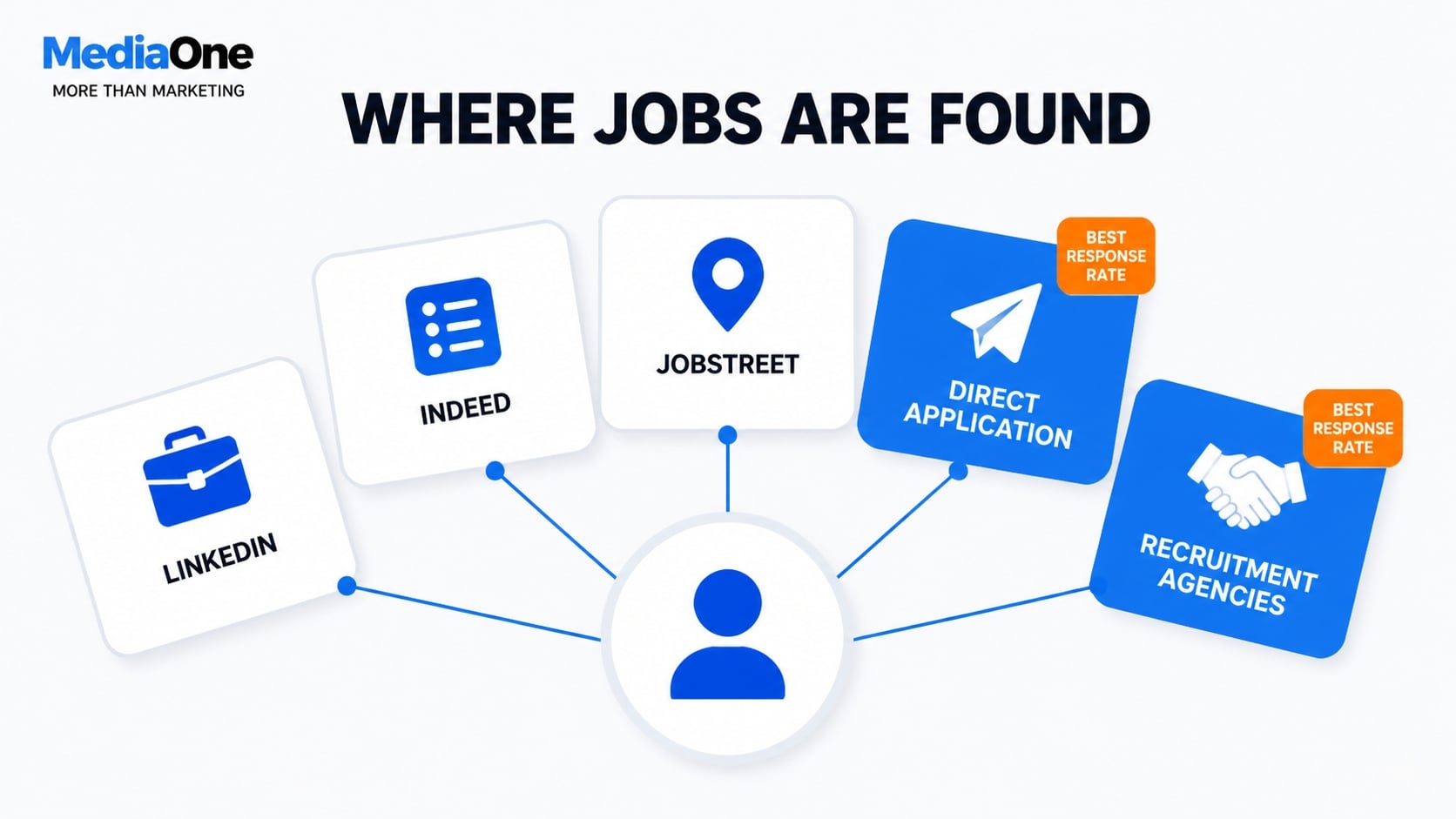
Singapore’s digital marketing job market is small enough that the same roles circulate across every major job board within a week. Volume is not the challenge. Timing and access are.
The most effective approach treats the search as three parallel channels: public boards for discovery, direct applications for speed, and networks for roles that never get posted publicly. Singapore’s market rewards the third channel more than most.
Major Job Boards and Recruitment Platforms
MyCareersFuture is the primary board for compliance. Under the Fair Consideration Framework administered by the Ministry of Manpower, employers must advertise most roles paying below S$22,500 per month on MyCareersFuture for at least 14 calendar days before submitting an Employment Pass application. Every EP-eligible role appears there first. If a job is not on MyCareersFuture and falls within that salary band, ask why.
Commercial boards fill the remainder of vacancies:
| Platform | Best for | Watch out for |
|---|---|---|
| MyCareersFuture | EP-eligible roles, salary transparency | Many listings already filled internally |
| LinkedIn Jobs | Regional and MNC roles, recruiter activity | Heavily saturated; apply within 48 hours |
| JobsCentral / JobStreet | Local SMEs, agency roles | Older listings, slower response times |
| Tech in Asia Jobs | Startup and scale-up marketing roles | Smaller volume, informal specifications |
| Glints | Junior to mid-level, regional startups | Salary information often missing |
A practical filter: search “digital marketing” on LinkedIn and set the date-posted filter to the past 24 hours. Roles at strong Singapore employers routinely pass 200 applicants within a week. Being early matters more than being perfect.
Direct Company Career Websites and LinkedIn Strategies
Singapore’s hiring is concentrated among key employers. Grab, Sea Group (Shopee), Lazada, ByteDance, DBS, OCBC, Singtel and the regional hubs of Google, Meta and Salesforce all hire marketing talent regularly. Their career pages often post before recruitment agencies are briefed, because internal referral pipelines close first.
Two tactics to use:
- Build a target list of 25 companies across your preferred sector and check their career pages weekly rather than relying on aggregators. Set a recurring calendar reminder.
- Follow the hiring manager on LinkedIn, not the recruiter. Search “marketing” AND “hiring” with a Singapore location filter. Engagement from a relevant person generates more replies than cold InMail.
On LinkedIn, recruiters search by skills keywords in your headline, not your job title. “Performance Marketing | Google Ads & Meta | SEA Market” performs better in recruiter searches than “Digital Marketing Executive.” Turn on Open to Work for recruiters only, not the public green banner, if you are currently employed.
Recruitment Agencies Specialising in Marketing Roles
Singapore’s marketing recruitment market splits into three distinct tiers.
Global agencies with Singapore desks include Robert Walters, Michael Page, Hays and Randstad. They handle mid to senior roles at multinational corporations, typically S$8,000 per month and above.
Regional and boutique agencies such as Space Executive, Argyll Scott and Kerry Consulting focus on fintech, e-commerce and regional hub roles.
Specialist digital and creative recruiters place social, content and performance roles at agencies and startups.
Agencies are paid on placement, so they prioritise candidates who are immediately available. Send a one-page summary with your notice period, salary expectation and work pass status in your first email. Candidates who make recruiters chase this information get deprioritised.
Do not sign exclusive representation. In a market this small, multiple agency relationships are normal and expected.
Networking and Industry Events
A meaningful share of Singapore digital marketing roles are filled through referral before a public posting appears. Consistent sources include:
- Marketing-Interactive events in Singapore, including the M-List and regional awards nights
- Meetup groups covering SEO, growth marketing, analytics and product marketing, often hosted in CBD coworking spaces
- Short courses from SMU Academy and NTU, which function as networking channels as much as learning platforms
- Trade shows such as the Asia Tech x Singapore (ATxSG) series, where marketing teams scout as much as they exhibit
A Singapore-specific point: follow up on LinkedIn within 24 hours of meeting someone. Reference something specific from the conversation and do not pitch. The relationship typically converts into a referral within six to twelve months, not two weeks.
Singapore’s digital marketing community is also active on Telegram. Several public groups post unlisted roles directly from hiring managers. Ask a contact in the industry to add you rather than searching, as the better groups remain invite-only.
Common Job Search Barriers and Solutions
Digital marketing candidates in Singapore often encounter predictable obstacles during their search. Understanding these challenges and their solutions accelerates the hiring process.
| Common Barrier | Why It Happens | Recommended Action |
|---|---|---|
| “Your visa does not match the role level” | Employers conflate visa class with seniority. E.g., Tech.Pass candidates assumed to be mid-level only | Proactively state your visa eligibility in your first conversation with a recruiter. Reference your visa letter if asked. |
| No response from larger companies | Applications disappear into automated systems; hiring is paused or internal-referral-only | Skip the online form. Find a referrer inside the company or a recruiter who has an internal contact. Direct outreach converts 5x better. |
| “We need someone with X years of marketing experience” for entry roles | Job specs are templates; hiring managers conflate “ideal” with “required” | Apply anyway. Highlight relevant transferable skills: campaign analysis, customer engagement, even student projects count. |
| Salary mismatch (expecting regional rate, not Singapore rate) | Candidates benchmark against Bangkok or Jakarta rates instead of Singapore context | Research Singapore-specific data on Glassdoor SG or PayScale SG. Singapore roles pay 30-50% more than regional averages (based on regional recruiter surveys). |
| Weak portfolio or no live campaign work | Self-taught candidates lack proof of competency; theory alone does not convince | Create a free campaign (even using a small personal budget on Google Ads or Meta) and write a 2-page case study. A real campaign beats a certificate. |
| Overqualified or long employment gaps | Hiring managers assume you will leave quickly or have disengagement concerns | Explain career changes clearly in your cover letter. Address gaps directly; frame them as deliberate (upskilling, caregiving) not absence. |
Salary Ranges and Compensation Packages
Understanding what you can earn in Singapore’s digital marketing roles requires looking at real figures tied to experience level, specialisation and company size. Singapore offers competitive salaries that typically exceed regional averages, but compensation varies significantly based on your role, employer and seniority.
Entry-level digital marketing roles (0–2 years experience) typically range from S$2,800 to S$3,800 per month across e-commerce, fintech and agency environments. Junior Performance Marketing Specialists or Social Media Coordinators start at the lower end; those with relevant bootcamp certifications or strong portfolios command the upper range.

Mid-career positions (3–7 years experience) span S$4,500 to S$7,500 per month. Specialised roles such as Performance Marketing Managers or SEO Team Leads often command 15-20% salary premiums over generalist positions, reflecting higher ROAS accountability and revenue impact. (Based on regional recruiter feedback; specific percentages vary by employer.)
Senior and leadership roles (8+ years experience) range from S$7,000 to S$12,000+ per month depending on company scale. A Head of Growth or Marketing Director at a fintech unicorn or multinational operates at the top end; an agency Senior Manager sits mid-range.
Company size and industry shape compensation significantly. Multinational tech companies (Google, Meta, Salesforce) and well-funded startups (Series B to D stage) pay 20-30% above local SMEs and early-stage ventures. Fintech and e-commerce sectors offer the strongest salaries for performance-driven roles.
Benefits packages in Singapore typically include:
- Central Provident Fund (CPF) employer contributions for eligible Singapore Citizens and Permanent Residents vary by age. For monthly wages above S$750 in 2026, employer contribution rates range from 7.5% to 17%.
- Annual bonuses (0.5 to 3 months typical; performance roles often higher)
- Health insurance and dental coverage
- Flexible working arrangements (increasingly standard post-2020)
- Professional development budgets (especially in MNCs and larger startups)
Salary data cited above reflects 2024 figures from LinkedIn Salary, Glassdoor SG and local recruiter surveys. These figures are subject to change and vary by employer, individual negotiation and market conditions. Always verify current ranges with active recruiters or your target companies’ career pages before negotiating.
Frequently Asked Questions About Digital Marketing Jobs in Singapore
What digital marketing jobs are available in Singapore?
Common roles include SEO specialists, content marketers, social media managers, performance marketers, email marketing specialists and marketing analysts. Larger companies may hire dedicated specialists, while smaller businesses often look for marketers who can manage several channels.
How much do digital marketers earn in Singapore?
Pay varies by role, experience, industry and employer. Entry-level roles usually sit at the lower end of the market, while experienced specialists and managers can earn significantly higher salaries, especially in technical or performance-focused positions.
Do I need a degree to get a digital marketing job in Singapore?
Not always. Many employers also consider practical skills, certifications, portfolios and proven campaign results when assessing candidates.
What skills are most important for digital marketing jobs in Singapore?
Useful skills include Google Analytics, paid advertising, SEO, content management systems, social media platforms and marketing automation tools. Communication, problem-solving and the ability to interpret data are also important.
Where can I find digital marketing jobs in Singapore?
Jobseekers can search MyCareersFuture, LinkedIn, JobStreet and company career pages. Recruitment agencies and professional networks can also help uncover suitable opportunities.
Can foreigners apply for digital marketing jobs in Singapore?
Yes, but foreign professionals must meet Singapore’s current work pass requirements. Employers may also need to meet Ministry of Manpower requirements before sponsoring an Employment Pass or S Pass.