| AI Summary
Singapore businesses can choose social media ads by scoring each platform on buyer behaviour, ad format and the team’s ability to produce new ads. A first test should focus on one offer, one buyer action and a budget based on what the business can afford per sale or qualified lead. Platform reports show which results the platform credits to ads. Sales and finance records help show whether those results covered the cost of the campaign. |
Social media ads are paid placements on platforms such as Facebook, Instagram, TikTok and LinkedIn. To choose a platform, find where customers discover, compare or buy your offer. Match the ad to their next step, then measure cost per sale or qualified lead and check it against your margin.
Key Takeaways
- One weak score can rule out a platform. A strong audience counts for little if your team cannot make ads for it.
- A lead form needs a definition of a qualified enquiry before the campaign starts.
- A daily budget controls spend. The cost per sale or qualified lead tells you what that spend buys.
- A campaign can report a high return on ad spend and still lose money once other costs are included.
- A test should have a review date, a spending limit and a record of what changed.
A Singapore bubble tea shop might need customers to claim a weekday deal. A payroll software company might need an HR manager to book a demo. Both can use social media ads, but the first ad has to make a shop visit easy. The second has to give someone a reason to take a meeting.
The decision starts with what a customer needs to see before taking that step. From there, you can choose a platform, set up the ad and work out whether the results paid for the campaign.
How Social Media Ads Work
Social media ads are paid messages that can appear in feeds, Stories and video streams. The advertiser sets a budget, chooses an audience or provides signals about who to reach, and tells the platform which action to seek. Depending on the campaign, that action could be a video view, a form submission or a purchase.
An organic post can also reach people who do not follow the business, through shares, search or recommendations. Paid social gives the business more control over the audience, spending and campaign goal. A shop might use an organic post to see which new drink draws questions, then advertise a weekday offer to people who can reach the outlet.
What affects the price of an ad?
Ad space is often sold through an auction. The platform considers factors such as the bid and how likely someone is to take the action the advertiser wants. The details vary by platform. Competition for the same audience can affect costs, and an ad that gets clicks may still produce few orders if the product page leaves buyers with questions.
Three prices are worth tracking:
- Cost per 1,000 impressions (CPM) shows what it costs for the ad to appear 1,000 times. The same person can account for more than one impression.
- Cost per click (CPC) shows how much the campaign spends for each click counted in the report. A link click is the better measure when the goal is to send people to a page.
- Cost per acquisition (CPA) shows how much the campaign spends for each action you define as an acquisition. For a shop, that could mean a paid order. For a service business, it could mean a new client.
How to Choose a Social Media Ads Platform
The first shortlist should come from customer behaviour. Sales staff can note where buyers first heard about the offer, what they checked before making contact and what helped them decide. A few customer conversations can reveal whether people use a channel to discover products, compare options or make a purchase.
A three-question platform scorecard
Each candidate platform gets a score from 1 to 5 on each question. A score of 1 means weak evidence or a gap your team cannot cover, 3 means enough to test and 5 means strong evidence or a format your team already produces well.
| Question | What to check before scoring |
| Do buyers use it at this stage? | Customer interviews, past enquiries, sales records or campaign data show how people use the platform. |
| Can the ad show what buyers need? | The platform supports a format that can explain the offer and lead to the next step. |
| Can the team keep making ads for it? | Someone can produce, check and replace the images or videos while the campaign runs. |
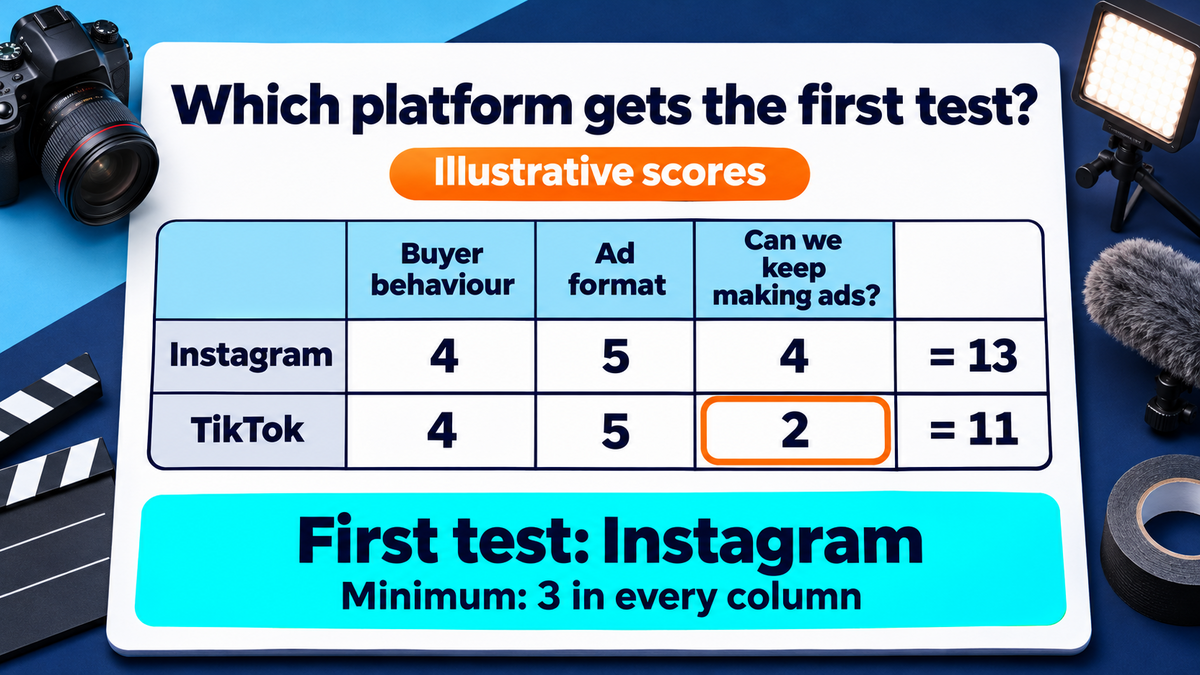
A platform should score at least 3 on all three questions before it gets a test budget. The highest total among eligible platforms gets the first test. For example, a retailer might give Instagram 4, 5 and 4, for a total of 13. TikTok might score 4, 5 and 2, for a total of 11. Instagram gets the first test because the retailer can keep making ads for it. The TikTok score gives the team a specific problem to solve before spending there.
Facebook, Instagram, TikTok and LinkedIn
| Platform | A reason to test it | First ad to try |
| Buyers ask questions about a local service, event or offer before booking. | An image ad with the service area and an enquiry form. | |
| Buyers need to see what a product looks like, how it works or how it is used. | A Reel showing the product or a carousel showing the options. | |
| TikTok | A short demonstration can explain the offer, and the team can make follow-up clips. | A video that shows the product in use, then gives viewers one next step. |
| The offer serves people in a particular industry or job role. | A demo or event ad that explains who it is for and what they will get. |
Meta Ads Manager lets advertisers run Facebook and Instagram ads through the same tool. The two platforms can still play different roles. A home services company might use Facebook advertising to answer common questions and Instagram to show examples of completed work.
TikTok Ads Manager offers objectives for awareness, consideration and conversion. A food brand can test a short recipe that shows its sauce in use. The campaign’s objective depends on what the video asks for. A video view and a sale answer different questions about how well the recipe ad worked.
LinkedIn’s targeting options include job title and company industry. That can help a payroll software provider reach the people involved in choosing a system. A LinkedIn ads campaign should also give sales staff a way to see which enquiries became demos or sales opportunities.
When YouTube, Pinterest or X belongs on the shortlist
YouTube video campaigns are worth considering when a demonstration answers a question buyers have before purchasing. A furniture retailer could show how a dining table extends or how much space it takes up when closed. The video gives shoppers information they can use when comparing sizes.
Pinterest is worth looking at if customer research shows that buyers save ideas or compare styles there before shopping. X can be a candidate if buyers follow a specific event or industry conversation on the platform. The same scorecard applies. A team that can support one campaign well can start there and add a second test when it has the budget and time.
How to Match Ads to Buyer Decisions
A campaign objective tells the platform which result to seek. The offer and ad format give the buyer a reason to take that step. If the business needs qualified enquiries, a campaign that seeks website visits may deliver plenty of visits while leaving the sales team with little to follow up.
What to show at each buying stage
| Buyer decision | What the ad can show | What to measure |
| “Is this for me?” | A short demo, a familiar problem or a product in use. | Reach, impressions or video views, based on the campaign goal. |
| “How does it compare?” | Product sizes, pricing details, an example or answers to common questions. | Product-page visits or another action that shows people explored the offer. |
| “Am I ready to act?” | The price, delivery terms, booking details or what happens after an enquiry. | Purchases, bookings or qualified enquiries. |
A bubble tea shop near Lau Pa Sat could show how it prepares a seasonal drink to introduce the menu. An offer ad can then give customers a reason to visit on a weekday. The outlet, offer hours and redemption terms belong in the ad or on the page it opens. A till code can connect claimed offers to purchases.
A payroll software company faces a different decision. An HR manager might first need to know how the system handles a month-end task. A demo ad can explain what the session covers and who should attend. The company’s lead generation process can then show whether people who booked the demo had a need the sales team could serve.
When to use image, video, carousel or lead ads
- Image ads suit a single offer or product. A café could show a lunch set, the price and the hours it is available in one frame.
- Video ads help when motion explains something a photo cannot. A short clip can show how a table folds or how a drink is made. Captions can carry spoken details when someone watches without sound.
- Carousel ads can show several products, options or steps. Each card should make sense on its own because viewers can stop swiping at any point.
- Lead ads let people submit details through a form. A service business can ask one or two questions that help staff decide whether they can serve the enquiry. LinkedIn’s objective-based ad formats show how format choices vary by campaign goal.
Stories and Reels often use a vertical frame. The first frame should make the subject easy to recognise, and the product, price or caption should stay in view when the platform adds buttons. A landscape clip may work in a vertical placement after reframing. The placement preview shows whether the product and text survived the crop.

How to Set a Test Budget for Social Media Ads
A test budget starts with the amount a business can pay for a sale or qualified enquiry. For a shop, the starting figure is the selling price less direct costs such as stock, packing, payment fees and any delivery the shop covers. The money left helps pay for ads, other campaign costs and profit. An ecommerce marketing plan can account for costs and sales across channels when customers buy through more than one of them.
For a service business, the close rate helps translate a customer acquisition limit into a lead cost limit. Suppose the business can spend S$300 to acquire a customer and closes one in five qualified leads. Its starting limit is S$60 per qualified lead. If the S$300 also needs to cover ad production or campaign management, the amount available for media spend is lower.
What to decide before the test starts
- One offer and one outcome. A retailer could test one product and count paid orders. A service business could test one offer and count enquiries that meet its service and location criteria.
- A spending limit and a review date. The amount should cover enough opportunities to observe the action you want. The review date should allow time for the buyer to act and for staff to log the result.
- A comparison you can explain. Two ads could use the same offer, audience and landing page while testing different opening images. That makes it easier to tell which opening helped.
- A record of what ran. The campaign name, dates, ad versions, spend and any changes belong in one place. A price change or a stock issue can help explain an unexpected result.
Platform minimums also affect what a team can run. TikTok’s budget rules set minimums at the campaign and ad group levels. If the planned spend cannot support a test, the business can put the budget into one platform or test the message in organic posts before paying to distribute it. A social media advertising strategy can use the same cost limit across campaigns so each test has a business target.
What to check before spending more
Many clicks and few visits can point to a slow page or a broken link. Visits without orders can point to missing prices, delivery terms or product details. Plenty of enquiries and few qualified leads can mean the ad or form needs to say who the offer is for. A landing page review can help check whether the page keeps the promise made in the ad.
Ad frequency shows how often people saw the ad on average. When frequency rises and cost per result gets worse, the team can check whether people are seeing the same ad too often. A new opening image or demo gives the team something to test. Other changes, such as a price increase or an out-of-stock item, can also explain the drop.
How to Measure the Return From Social Media Ads
An ad report can show the purchases or enquiries it credits to the campaign. Business records show what happened next. A shop can check which orders were paid and kept. A service company can see which enquiries qualified, attended a call and became customers.
How to connect ads to orders and enquiries
- Campaign links identify where visits came from. Google Analytics can read campaign details from tagged URLs. A team can use the same campaign naming system across its ads and website reports.
- A test order or enquiry checks the full route. The team can open the ad link on a phone, complete the action and confirm that it appears in the right report and business record.
- Sales records confirm which outcomes had value. The campaign or offer code can be recorded with the order or enquiry. Refunds, duplicates and unqualified enquiries can then be taken out of the totals used to judge results.
Different reports can give credit to different ads. An ad platform may count a purchase after someone saw an ad, while website analytics may credit a later visit from another channel. Google Analytics attribution settings include a lookback window that affects which earlier interactions are eligible for credit. The same sale can appear in more than one platform report, so the order total should come from the business’s records.
What a 3× return on ad spend can leave behind
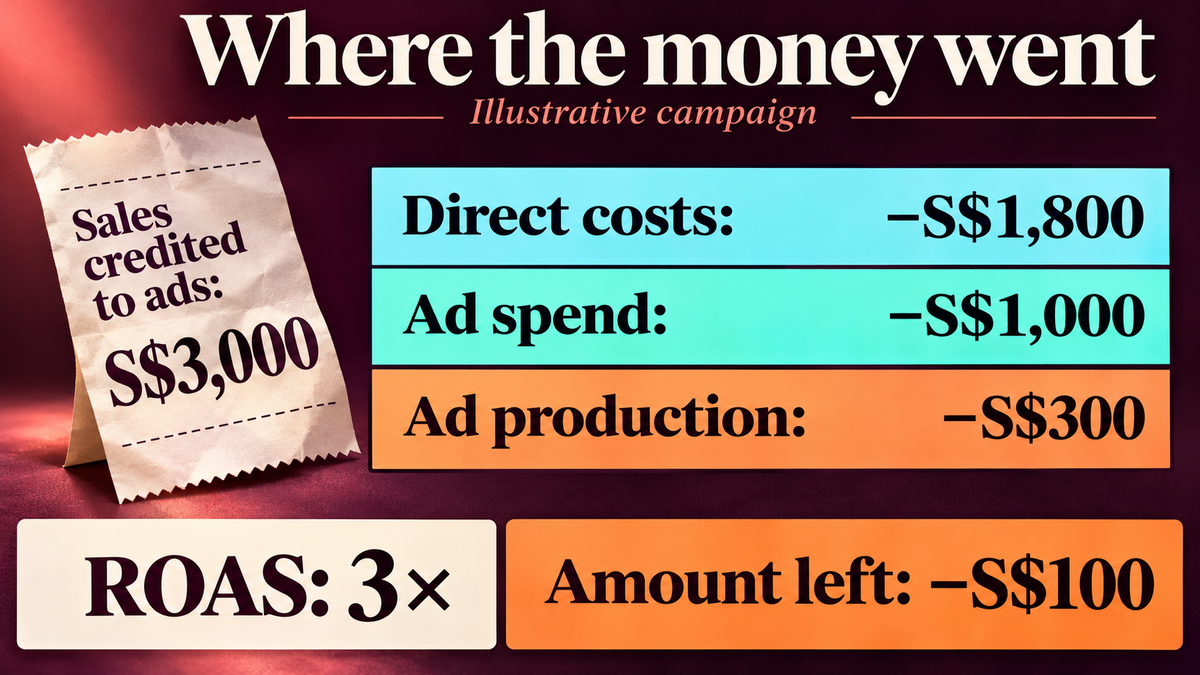
Return on ad spend, or ROAS, divides the revenue credited to ads by the amount spent on those ads. Suppose a Singapore retailer records S$3,000 in sales attributed to a campaign and S$1,000 in ad spend. The campaign reports 3× ROAS, or S$3 in attributed sales for every S$1 spent on ads.
| Campaign figures | Illustrative amount |
| Sales attributed to the campaign | S$3,000 |
| Less direct costs for those orders | S$1,800 |
| Less ad spend | S$1,000 |
| Less ad production costs | S$300 |
| Amount left after these costs | −S$100 |
The campaign shows a S$100 loss on the costs listed even though its ROAS is 3×. This calculation uses sales credited to the campaign. Some buyers might have bought anyway. If a team wants to estimate how many extra sales the ads caused, a test that keeps ads away from a comparable group can help answer that question.
A lead campaign needs the same link to business results. If S$600 in ad spend brings in 30 forms and 10 qualified enquiries, each form costs S$20 and each qualified enquiry costs S$60. If two of those enquiries become customers, the ad spend per customer is S$300. The three figures show where the campaign loses people and what the business ultimately pays for a customer.
Plan Your First Social Media Ads Test
A first test can focus on one offer, one platform and one buyer action. The campaign brief should state what customers need to see, what counts as a result and how much that result can cost. Those details give the person making the ad, the person running it and the person following up on enquiries the same target.
A business with plenty of clicks and few sales may need help connecting its ads to what happens after the click. MediaOne’s social media marketing services cover paid campaigns, ad content and measurement. Our lead generation services can also help service businesses connect forms and sales follow-up.
FAQs About Social Media Ads
Who should own the ad account if an agency runs the campaigns?
The business should keep administrative access to its ad account, pages and billing settings. Agency staff should have the access they need for their work. A handover list can record who manages each account, where ads and reports are stored and who can remove access when the work ends.
Yes. Some campaigns can send people to an in-app lead form or open a chat, depending on the platform and campaign settings. A business using this setup needs a place to record enquiries and a person to answer them. The sales record can show whether each chat led to a booking or purchase.
What should a paid creator post disclose?
A paid creator post should make the commercial relationship easy for viewers to spot. The Advertising Standards Authority of Singapore’s social media guidelines cover marketing communications on social media. The business and creator can agree on the disclosure wording and placement before filming or publishing the post.
Can one campaign advertise several outlets in Singapore?
Yes. A shared campaign can work when all outlets run the same offer and the ad tells people where they can use it. Separate ads can help when outlets have different prices, stock or opening hours. Outlet-specific links or redemption codes can show which locations received enquiries or sales from the campaign.
The rejection notice is the first place to check for the reason. The issue could be in the copy, image, video or page the ad opens. The advertiser can fix the stated issue and resubmit the ad, or request a review if the platform offers that option and the advertiser believes the ad meets its rules.