| AI Summary
Paid postings are job advertisements that employers pay to publish or promote to increase visibility and attract suitable candidates. In Singapore, recruitment platforms offer various pricing models, including fixed fees, sponsored advertisements and prepaid credits. Paid postings are particularly useful for urgent, competitive or hard-to-fill vacancies. Employers can maximise results through competitive salaries, clear job descriptions and relevant candidate targeting. Tracking cost per qualified applicant and cost per hire helps businesses evaluate recruitment effectiveness and optimise advertising budgets. |
Paid postings are job advertisements that employers pay to publish, promote or distribute across recruitment platforms. They help businesses increase job visibility, reach relevant candidates and fill vacancies that free listings may struggle to attract.
In Singapore, employers use paid postings for various hiring needs. These range from temporary warehouse positions and retail assistants to experienced technology professionals and senior managers.
However, paying for a job advertisement does not guarantee qualified applicants or successful hires. The results depend on the platform, competition, salary offered and quality of the advertisement.
We recommend starting with a clear hiring objective before purchasing a paid listing. This guide explains how paid job advertisements work, what they cost and how Singapore businesses can maximise their recruitment budget.
Key Takeaways
- Paid postings increase recruitment visibility through promoted placements, candidate targeting and additional distribution options.
- Singapore employers can choose from free and paid listings on platforms such as JobStreet, Indeed, FastJobs and MyCareersFuture.
- Advertising costs vary depending on the role, platform, package and billing model.
- Employers should assess hiring urgency, candidate availability and expected recruitment costs before purchasing an advertisement.
- Transparent salaries, accurate job descriptions and convenient application processes improve the chances of attracting suitable candidates.
- Paid job advertisements do not replace mandatory MyCareersFuture advertising requirements under Singapore’s Fair Consideration Framework.
- Measuring cost per qualified applicant and cost per hire helps employers determine whether paid recruitment advertising delivers value.
What Are Paid Postings and How Do They Work?
Paid postings allow employers to advertise vacancies using additional recruitment features that may not be available through standard free listings. Depending on the platform, employers can purchase an individual advertisement, sponsor an existing listing or subscribe to a recruitment package. These options help vacancies gain exposure among active job seekers and, in some cases, candidates who are not actively searching.
Paid recruitment advertisements typically work through the following methods:
- Promoted search placement: The job appears in prominent positions within relevant search results.
- Candidate targeting: The platform recommends vacancies to candidates whose profiles match the job requirements.
- Featured listings: Employers receive enhanced visibility through special placements or promotional labels.
- Additional distribution: Vacancies may appear in job alerts, email campaigns or partner recruitment channels.
- Recruitment tools: Some packages include applicant screening, candidate management and shortlisting features.
The exact benefits depend on the product purchased. Employers should check what each package includes before assuming that an upgrade provides all these features.
A paid posting is also different from a daily-paid job. The former refers to the employer’s advertising expenditure, while the latter describes how an employee’s wages are calculated or paid.
For example, a company may purchase a premium advertisement for a permanent accountant who receives a monthly salary. It may also use paid advertising to recruit temporary event workers who receive daily wages.
Both are paid postings, even though their employment arrangements differ.
Paid Postings vs Free Job Listings: What Is the Difference?
Free job advertisements allow businesses to publish vacancies without paying an advertising fee. They provide a useful starting point, particularly for employers with flexible hiring timelines or access to a large candidate pool.
Paid listings offer additional visibility or recruitment features. However, these benefits vary across platforms.
| Feature | Free Job Listings | Paid Postings |
|---|---|---|
| Advertising cost | Generally S$0, subject to platform conditions | Fixed fee, advertising credits or variable sponsorship costs |
| Search visibility | Standard or limited exposure | Enhanced exposure, depending on the package |
| Candidate targeting | Basic matching or general search results | Additional targeting and recommendation features may be available |
| Listing duration | Determined by the platform | Determined by the purchased package or campaign settings |
| Recruitment tools | Basic applicant management | May include advanced screening and candidate outreach |
| Best suited for | Routine hiring and flexible deadlines | Urgent, competitive or difficult-to-fill vacancies |
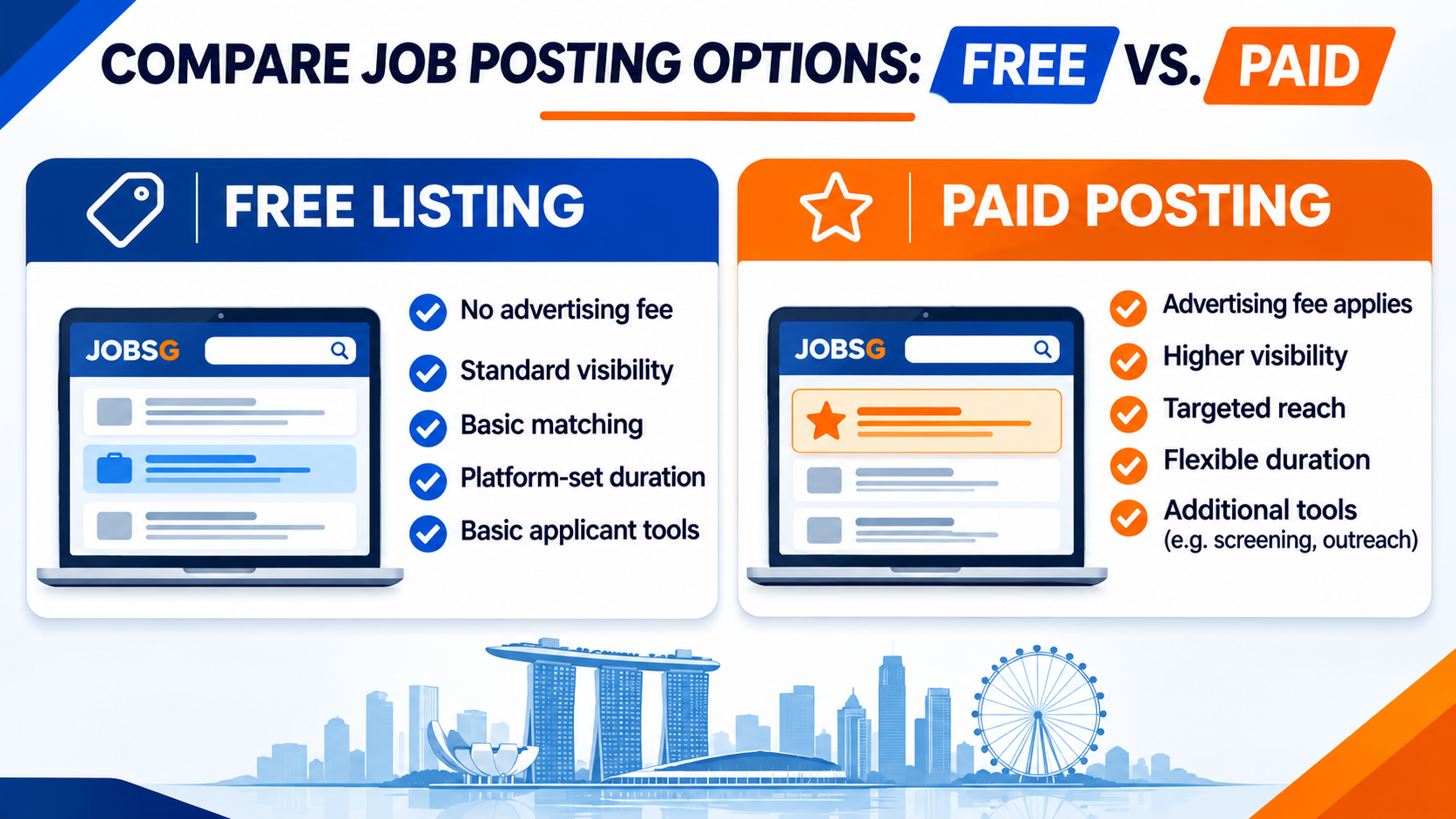
Free listings can generate strong results when the employer offers competitive compensation and the vacancy attracts sufficient interest. For example, a retail company recruiting several sales assistants may receive enough applications through free job boards and employee referrals. Paying for additional exposure may provide limited value if the existing recruitment channels already produce suitable candidates.
By contrast, a logistics company recruiting experienced drivers during a seasonal peak may benefit from promoted listings. Greater visibility could help the employer reach qualified candidates within a shorter recruitment window.
We recommend assessing the performance of free listings before upgrading, unless the operational cost of leaving a vacancy unfilled justifies immediate advertising expenditure.
How Much Do Paid Postings Cost in Singapore?
There is no standard price for paid job postings in Singapore. Recruitment platforms use different pricing structures, which can vary according to the job type, advertising period and level of exposure.
Some platforms provide free entry-level advertisements with optional upgrades. Others charge employers through prepaid credits or performance-based advertising.
Singapore job posting platform comparison
| Platform | Free Posting Option | Paid Advertising Model | Best Suited For |
|---|---|---|---|
| JobStreet by SEEK | Yes, through Lite Ads | Variable pricing for enhanced advertisement packages | General, professional and specialist recruitment |
| Indeed | Yes, subject to eligibility and platform conditions | Sponsored job advertising based on candidate clicks | Flexible recruitment advertising across industries |
| FastJobs | Employer registration is free; publishing generally requires credits | Prepaid FastCoins | Part-time, contract and non-executive recruitment |
| MyCareersFuture | Yes | Free government-supported recruitment platform | Local recruitment and applicable FCF requirements |
JobStreet by SEEK
JobStreet by SEEK offers several advertisement options in Singapore, including Lite, Basic, Advanced and Premium advertisements. Lite Ads allow employers to advertise without paying an upfront listing fee. Other packages provide varying levels of search exposure, candidate recommendations and recruitment assistance.
The cost of paid advertisements depends on factors such as the job title, classification, location and selected package. According to SEEK’s official pricing guide, market competition, salary information and the likelihood of successful recruitment also influence advertisement prices.
Employers can obtain a current quotation through the platform’s advertisement creation process or its price lookup tool. JobStreet is worth considering for businesses recruiting administrative employees, sales professionals, technical specialists and managerial candidates.
Indeed
Indeed Singapore offers free job advertisements subject to its eligibility requirements, quality standards and usage limits. Employers who want additional visibility can sponsor vacancies. Indeed’s Singapore pricing information explains that sponsored advertisements charge employers when candidates click on the promoted listing.
Businesses can select a daily or total campaign budget. This provides flexibility when testing different recruitment strategies.
However, clicks do not necessarily result in completed applications or qualified candidates. Employers should monitor application quality alongside advertising expenditure.
Indeed may suit businesses that want to start with a limited budget and increase spending when campaign performance supports the investment.
FastJobs
FastJobs focuses on non-executive recruitment. It is particularly relevant to employers recruiting part-time, contract and full-time operational employees. The platform uses prepaid advertising credits called FastCoins. Employers can use these credits to publish advertisements, extend active listings and purchase visibility boosts.
According to the official FastCoins guide, the platform displays the required credits before employers confirm a transaction. FastJobs also offers promotional packages and additional distribution options. Employers can view available packages through their accounts.
Businesses recruiting warehouse assistants, retail staff, food service employees or production workers may find its audience particularly relevant.
MyCareersFuture
MyCareersFuture is Singapore’s government-supported employment platform. The Ministry of Manpower (MOM) confirms that advertising on MyCareersFuture is free.
Employers should consider this platform when recruiting locally. It also plays an important role in fulfilling mandatory job advertising requirements for applicable Employment Pass and S Pass applications.
We recommend including MyCareersFuture in the recruitment mix rather than relying exclusively on commercial job boards.
Understanding the Different Job Advertising Pricing Models
Choosing a pricing model is as important as selecting the recruitment platform. Each approach has different implications for budget control and campaign performance.
Fixed-fee advertisements
Employers pay a predetermined amount to publish a vacancy for a specified period. This model works well when businesses need a predictable recruitment budget. It is particularly useful for employers managing several vacancies with approved spending limits. The disadvantage is that employers may pay the full amount even when the vacancy generates few suitable applications.
Performance-based advertising
Some platforms charge employers based on interactions with their advertisements, such as candidate clicks. This allows businesses to control campaign budgets and monitor results during the advertising period.
However, a low cost per click does not necessarily indicate successful recruitment. Employers should examine whether those clicks produce relevant applications and interviews.
Prepaid recruitment credits
Under a credit-based model, businesses purchase credits and redeem them for recruitment activities. These activities may include publishing vacancies, extending advertisements or purchasing additional exposure.
Employers should calculate the Singapore dollar cost of each credit-based activity. This makes it easier to compare packages against alternative platforms. Check whether credits expire or carry usage restrictions before purchasing a large package.
Subscription and bulk advertising packages
Businesses with ongoing recruitment needs may benefit from subscription plans or packages covering multiple vacancies. These arrangements can simplify purchasing and reduce the administrative work involved in launching separate campaigns.
However, a package only provides value when the employer uses its included features. A small business that recruits infrequently may find individual advertisements more economical.
Listing Duration, Expiry and Upgrade Options
The duration of paid postings depends on the platform and advertising product. It is incorrect to assume that every job advertisement expires after 30 days.
For example, Workforce Singapore states that MyCareersFuture job postings remain valid for up to 30 calendar days. Employers can also select an earlier expiry date.
Meanwhile, FastJobs offers standard posting periods of one week or four weeks. Employers can extend an active listing before it expires.
Before publishing a vacancy, check the following details:
- The date the advertisement becomes publicly visible.
- The scheduled expiry date.
- Whether employers can edit an active listing.
- Available extension and renewal options.
- Whether additional exposure requires separate payment.
- Any restrictions on changing the job title or recruitment requirements.
An advertisement’s expiry date should align with the hiring timeline. A vacancy that must be filled within ten days requires a different advertising strategy from a specialist role with a three-month recruitment window.
When should employers upgrade a job posting?
An upgrade may be worthwhile when an advertisement attracts insufficient visibility despite having competitive employment terms. For example, an employer may receive few views for an experienced technician vacancy. A package offering enhanced targeting could help reach additional candidates with the required skills.
However, upgrading is unlikely to resolve problems caused by below-market salaries, unclear responsibilities or inconvenient working conditions. We recommend correcting these issues before purchasing additional exposure.
When Are Paid Postings Worth the Investment?
Paid advertisements are most useful when the expected recruitment benefits justify the cost. Employers should consider the following situations.
Urgent recruitment needs
Unfilled vacancies can affect customer service, production schedules and revenue.
A restaurant opening a new outlet may need several employees before its launch. A warehouse may require additional workers before a large shipment arrives.
Paid postings can support these recruitment efforts by increasing visibility within a limited timeframe. However, employers should maintain realistic recruitment deadlines. Advertising cannot eliminate the time needed for candidate assessment, interviews and onboarding.
Difficult-to-fill positions
Some vacancies require specialised qualifications, industry knowledge or relevant licences. For example, recruiting an experienced cybersecurity specialist may require access to a narrower candidate pool than recruiting a general administrative assistant.
A paid package with candidate targeting may help employers reach suitable professionals. For particularly specialised roles, businesses may also need direct candidate sourcing or recruitment agency support.
High-volume recruitment
Employers recruiting multiple workers may benefit from advertising campaigns that reach a larger audience. Retail expansion, seasonal fulfilment operations and large-scale events are examples of recruitment situations that may require additional advertising expenditure.
Where vacancies share identical duties and employment terms, a single advertisement with an accurate vacancy count may be sufficient. Separate listings are useful when salaries, locations or shift schedules differ significantly.
Competitive recruitment markets
Employers often compete with other organisations for candidates with similar qualifications. Additional visibility can help a vacancy gain attention when many comparable roles are available.
Nevertheless, the advertisement must offer a compelling employment proposition. A promoted listing with an uncompetitive salary may generate views without producing suitable applications.
A Practical Scoring Method for Deciding Whether to Pay
We recommend using a simple decision framework to determine whether paid job advertising is appropriate. The following scoring method is an illustrative planning tool. It is not an industry benchmark or a guaranteed predictor of recruitment success.
Assess each vacancy across four criteria.
| Assessment Criteria | 0 Points | 1 Point | 2 Points | 3 Points |
|---|---|---|---|---|
| Hiring urgency | No immediate deadline | More than one month | Two to four weeks | Within two weeks |
| Candidate availability | Many suitable candidates | Adequate candidate supply | Limited suitable candidates | Significant talent shortage |
| Cost of an unfilled vacancy | Minimal impact | Minor disruption | Noticeable operational impact | Significant revenue or service impact |
| Advertisement readiness | Essential information missing | Several details unclear | Most details complete | Clear, competitive and accurate |
Interpreting the total score
- 9–12 points: Consider paid advertising, provided the advertisement is ready to publish.
- 5–8 points: Start with free channels or test a modest paid campaign.
- 0–4 points: Prioritise free recruitment options and improve the advertisement where necessary.
Advertisement readiness requires special attention. If the vacancy has an unclear salary, inaccurate requirements or unresolved employment conditions, correct those issues regardless of the total score.
Worked example: Recruiting a warehouse assistant
Suppose a Singapore logistics company needs a warehouse assistant within ten days.
The vacancy has the following characteristics:
- Hiring urgency: 3 points.
- Candidate availability: 2 points.
- Operational impact: 2 points.
- Advertisement readiness: 3 points.
The total is 10 points.
A paid advertisement may be justified because the vacancy is urgent, suitable candidates are limited and leaving the position unfilled could disrupt operations. The employer should still select a platform that reaches warehouse and logistics candidates. Purchasing an expensive package on an unsuitable platform could waste the recruitment budget.
How to Create Paid Job Postings That Attract Suitable Candidates
Employers should develop the advertisement before purchasing additional visibility. A strong listing answers the questions candidates need to resolve before applying. These include what the job involves, how much it pays and whether the working arrangements suit their circumstances.

1. Write a clear and searchable job title
Use a title that candidates recognise and are likely to search for. For example, “Warehouse Assistant – Jurong West” is clearer than “Operations Team Superstar”.
Include a relevant specialisation when necessary. A title such as “Class 4 Delivery Driver” immediately communicates an important qualification. Avoid excessive promotional wording, unnecessary capitalisation and misleading titles.
2. Include an accurate salary range
Salary information helps candidates assess whether a vacancy meets their expectations. State whether the advertised figure refers to basic salary, gross salary, hourly wages or daily wages. Explain variable payments separately.
For instance, an employer could advertise an illustrative monthly basic salary of S$2,200–S$2,600 for a warehouse position. Any overtime payments, shift allowances or attendance incentives should be clearly distinguished from that amount.
This example is not a verified market salary benchmark. Employers should establish their actual ranges using current market data and applicable wage requirements.
Businesses should also review Singapore’s Progressive Wage Model and Local Qualifying Salary requirements where applicable.
As of November 2026, the Local Qualifying Salary for applicable full-time local employees working 35 to 44 hours weekly is S$1,800 in gross monthly wages. The applicable gross hourly rate for part-time local employees is S$10.50.
These requirements apply within their prescribed employment and foreign-worker hiring conditions. Employers should verify the relevant wage rules before publishing an offer.
3. Explain working hours and employment arrangements
Candidates need accurate information about the expected working schedule. Include the employment type, working days, shift hours and contract duration where applicable.
For shift-based vacancies, explain whether employees work fixed or rotating shifts. State if weekend work or public holiday coverage is required. Do not advertise a role as daily-paid unless the payment arrangement genuinely provides daily payment.
Under the Employment Act, covered employees generally receive their salaries at least monthly and within seven days after the salary period ends. Employers can agree to shorter payment intervals. MOM provides further guidance on salary payment requirements.
4. Provide the exact work location
Location is an important consideration for candidates working on-site. State the actual workplace rather than using broad descriptions such as “West Singapore”.
For example, a warehouse advertisement could specify Tuas South and identify any company shuttle service from a nearby Mass Rapid Transit (MRT) station. Include pickup times when the transport arrangement is relevant to the shift. Do not promise transport that the employer has not arranged.
5. Separate essential skills from preferred qualifications
A job advertisement should distinguish mandatory requirements from optional qualifications.
An employer recruiting a production operator may require familiarity with safety procedures. Previous manufacturing experience might be preferred rather than essential if training is available.
Unnecessary requirements can discourage suitable candidates from applying. Review every qualification to determine whether it is relevant to performing the job.
6. Make the application process straightforward
Complicated application forms create additional barriers for candidates. Request the information needed for initial assessment, such as relevant experience, qualifications and availability.
Explain what happens after submission. Candidates should know whether shortlisted applicants will receive a phone call, email or interview invitation. A straightforward application process can help employers capture interest generated by paid advertising.
Singapore’s Legal and Fair Recruitment Requirements
Employers must comply with applicable employment requirements regardless of whether they publish free or paid job advertisements.
Fair Consideration Framework
The Fair Consideration Framework requires employers to consider candidates fairly. Employers submitting applicable Employment Pass (EP) or S Pass applications must generally advertise the vacancy on MyCareersFuture for at least 14 consecutive days before submitting the application.
Certain vacancies qualify for advertising exemptions. Employers should confirm whether an exemption applies to their circumstances. Publishing a paid advertisement on JobStreet, Indeed or another commercial platform does not replace the mandatory MyCareersFuture advertisement.
MOM also states that employers should not make a job offer during the mandatory advertising period. This gives candidates sufficient opportunity to apply and allows employers to assess applications fairly.
Accurate and non-discriminatory advertisements
The Tripartite Alliance for Fair and Progressive Employment Practices (TAFEP) provides guidelines for writing fair job advertisements. Employers should focus on qualifications, experience and skills relevant to the vacancy.
Avoid discriminatory requirements relating to age, gender, race, religion or other characteristics unrelated to job performance. Where a specific requirement is genuinely necessary, employers should explain its connection to the role.
For applicable EP advertisements, MOM also requires the salary range to be visible and specific. The maximum advertised salary cannot exceed twice the minimum salary.
These requirements help ensure that candidates receive an accurate representation of the employment opportunity.
How to Improve Visibility, Reach and Candidate Engagement
Paid postings are most effective when employers understand how candidates discover and evaluate vacancies. A recruitment campaign typically begins when a candidate encounters an advertisement. The candidate then reviews the job title, employment terms and requirements before deciding whether to apply.
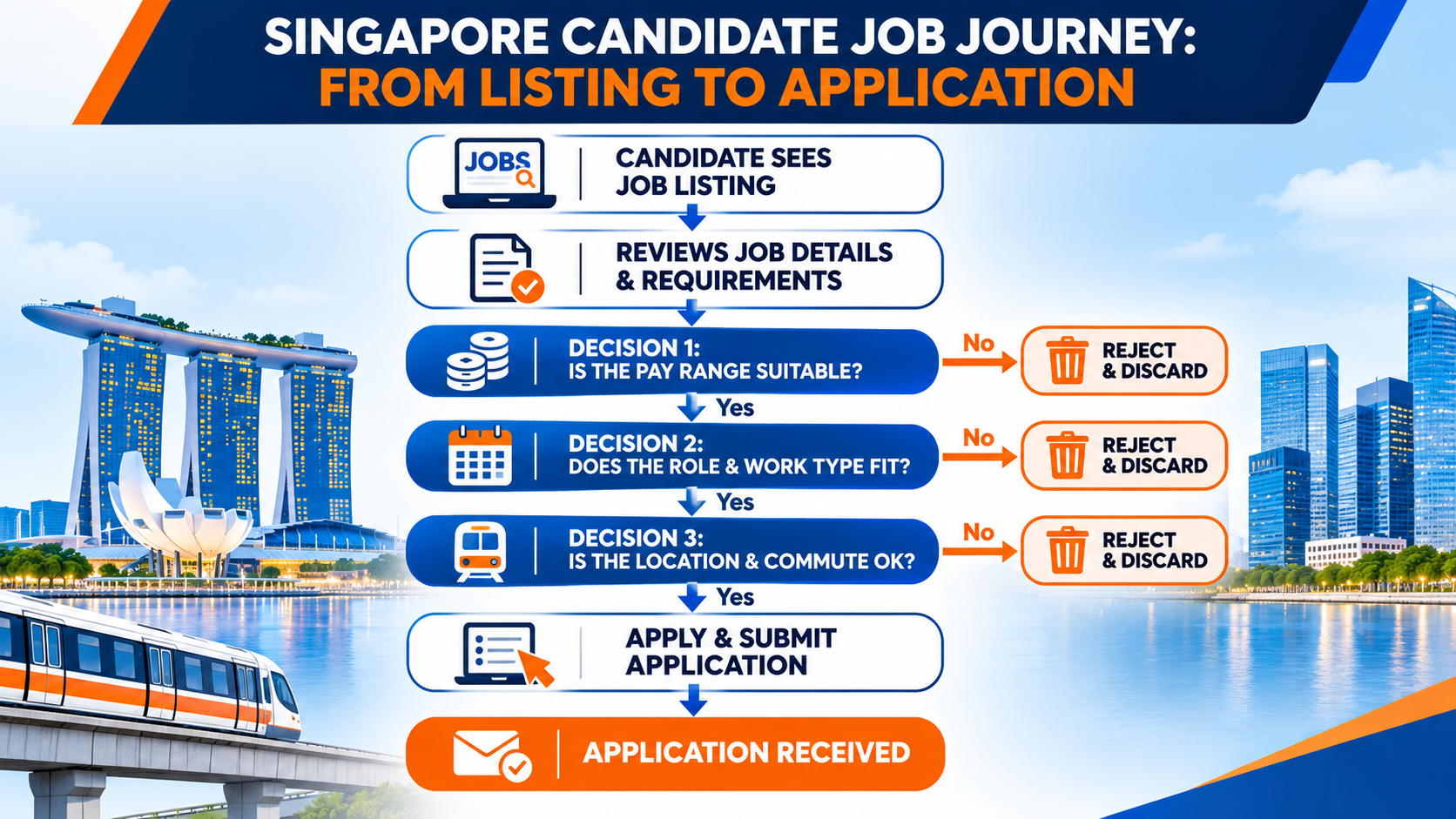
If a paid advertisement receives many views but few applications, increasing the budget may not address the underlying problem. The employer should identify where candidates disengage.
Low advertisement visibility
Review the job title, classification and chosen platform. Candidates may struggle to discover an advertisement that uses unfamiliar terminology or appears in an incorrect job category. A more accurate title or suitable advertising package may improve visibility.
High visibility but few applications
Review the salary, employment terms and job description. Candidates may be interested initially but decide against applying after discovering unclear responsibilities or unsuitable working hours. Improve the information before increasing spending.
Many applications but few qualified candidates
Examine the job requirements and targeting settings. The advertisement may appeal to a broad audience without clearly explaining essential qualifications. Refine the selection criteria and consider a platform with a more relevant candidate base.
Qualified applicants but few successful hires
The problem may occur after the application stage. Slow responses, lengthy interview processes and uncompetitive employment offers can cause candidates to withdraw. Coordinate with hiring managers to ensure applicants receive timely communication and consistent assessments.
How to Measure the Performance of Paid Postings
Recruitment success should be measured against business objectives rather than advertisement views alone. We recommend tracking several metrics to determine whether paid advertising generates meaningful hiring outcomes.
| Recruitment Metric | Calculation | What It Measures |
|---|---|---|
| Cost per click | Advertising spend ÷ clicks | Cost of generating advertisement traffic |
| Cost per applicant | Advertising spend ÷ completed applications | Cost of attracting applications |
| Cost per qualified applicant | Advertising spend ÷ qualified applications | Efficiency of attracting suitable candidates |
| Application-to-interview rate | Interviews ÷ applications × 100 | Effectiveness of applicant screening |
| Advertising cost per hire | Advertising spend ÷ hires | Direct advertising expenditure per successful hire |
| Time to fill | Days from approved vacancy to accepted offer, using a consistent definition | Recruitment speed |
Example: Comparing two paid recruitment campaigns
Assume a business tests two recruitment platforms for comparable vacancies.
| Metric | Campaign A | Campaign B |
|---|---|---|
| Advertising expenditure | S$300 | S$450 |
| Applications | 60 | 35 |
| Qualified applications | 6 | 15 |
| Successful hires | 1 | 3 |
| Cost per applicant | S$5 | S$12.86 |
| Cost per qualified applicant | S$50 | S$30 |
| Advertising cost per hire | S$300 | S$150 |
These figures are illustrative and do not represent actual platform rates or MediaOne campaign results.
Campaign A produces more applications at a lower initial cost. However, Campaign B generates more qualified applicants and successful hires. The second campaign therefore delivers better recruitment efficiency in this example.
Businesses should also consider employee retention, onboarding costs and recruiter time when evaluating overall hiring expenditure. Advertising cost per hire covers only the advertising component. A complete cost-per-hire calculation should include other relevant recruitment expenses.
Common Mistakes to Avoid When Using Paid Job Listings
Employers can waste recruitment budgets when they prioritise visibility without reviewing their hiring processes. The following mistakes are particularly important to avoid.
- Purchasing the most expensive package immediately: A higher-priced advertisement may provide unnecessary features for a straightforward vacancy.
- Using outdated salary information: Candidates may ignore an advertisement if compensation does not reflect current market conditions.
- Combining unrelated vacancies: Different duties, salaries and work locations can make an advertisement confusing.
- Ignoring applicant response times: Qualified candidates may accept other offers while waiting for an employer to respond.
- Renewing underperforming advertisements without changes: Repeating the same advertisement may produce similar results.
- Measuring applications instead of hiring outcomes: High application volumes do not necessarily indicate effective recruitment.
Review each campaign while it is active. For urgent vacancies, assess initial performance within the first few days. For longer recruitment campaigns, conduct regular checks throughout the advertising period. This allows employers to adjust their spending before the entire budget is exhausted.
Frequently Asked Questions
What are paid postings in recruitment?
Paid postings are job advertisements that employers pay to publish or promote on recruitment platforms. They can provide enhanced search visibility, additional candidate targeting or recruitment management features.
Are paid job postings better than free listings?
Paid postings can help employers attract additional attention, especially for urgent or competitive vacancies. However, free listings may be equally effective when there is sufficient candidate demand and the employment terms are attractive.
How much does it cost to advertise a job in Singapore?
Costs depend on the recruitment platform, advertisement package and billing model. Some platforms offer free advertisements with optional upgrades, while others charge through credits, fixed fees or sponsored advertising budgets.
Do paid postings expire?
Yes, although listing periods vary by platform and package. MyCareersFuture advertisements remain active for up to 30 calendar days, while FastJobs offers standard periods of one week or four weeks.
Can employers advertise multiple vacancies in one job posting?
Employers may advertise multiple openings in one listing when the vacancies share the same duties and employment conditions, subject to platform requirements. Separate advertisements are preferable when salaries, responsibilities, locations or schedules differ significantly.
Does a paid job posting guarantee qualified applicants?
No. Paid advertising can increase visibility, but applicant quality depends on the job requirements, targeting accuracy and employment offer. Employers should assess the cost per qualified applicant rather than relying on total application numbers.
Do employers need to advertise on MyCareersFuture before hiring foreign workers?
Employers submitting applicable Employment Pass or S Pass applications must generally advertise on MyCareersFuture for at least 14 consecutive days and consider candidates fairly. Advertising exemptions apply in certain situations, so employers should check MOM’s current requirements.
When should an employer stop paying for a job advertisement?
Employers should stop or pause advertising when a vacancy is filled, sufficient qualified candidates are available or the campaign no longer provides reasonable value. If performance is poor, improve the listing and recruitment strategy before spending additional money.
Make Every Paid Posting Count: Build a Smarter Recruitment Strategy
Paid postings can help Singapore businesses reach suitable candidates, reduce recruitment delays and manage difficult hiring requirements. Their effectiveness depends on selecting the right platform, communicating accurate employment terms and monitoring recruitment outcomes.
We recommend starting with free advertisements for routine vacancies. Consider paid upgrades when candidate availability is limited, hiring deadlines are urgent or leaving a position unfilled creates significant operational costs.
Businesses should also review their employer brand and online recruitment experience. Candidates often research an organisation’s website, reputation and workplace culture before accepting an offer.
A clear careers page and consistent employer messaging can support recruitment advertising by giving potential employees the information they need to make a decision.
At MediaOne, we approach recruitment visibility through the same principles that guide effective digital marketing: relevant audience targeting, clear messaging and measurable results. Our digital marketing services help Singapore businesses strengthen their online presence and communicate their value to relevant audiences.
Whether you are recruiting your first employee or expanding an established workforce, use paid postings strategically. Set a clear hiring objective, establish a realistic budget and measure the quality of the candidates your advertisements attract.
The goal is to turn recruitment expenditure into successful hires who support your business’s long-term growth.