
| AI Summary
A Singapore startup should set its marketing budget around a clear growth target and an affordable customer acquisition cost. A marketing agency for startups makes sense once the business has a defined audience and an offer that already shows demand. For 2027 planning, founders should separate agency fees from media spend so they can see where the budget goes. Government support should only be added after checking the latest EDGE Grant rules. |
A marketing agency for startups can give founders access to specialist skills without the cost of building a full in-house team. The timing still has to be right. If the offer is unproven or the target market is unclear, a broad agency retainer can burn through cash before the business knows what drives sales.
We recommend starting with one commercial goal. That may be more customers or a set number of qualified leads. Once the target is clear, work backwards from the acquisition cost your margins can support.

This guide explains what startup marketing can cost in Singapore and when agency support makes sense. It also covers service priorities and hiring choices. You will also see how to measure performance, plan around 2027 grant changes and account for Singapore data requirements.
Key Takeaway
- Start with the commercial target. Decide how many customers or qualified opportunities you need. Work backwards from your acceptable acquisition cost.
- Separate your main cost areas. Agency fees, media, creative work, technology and testing all serve different purposes. Combining them can hide waste.
- Hire for the actual gap. A freelancer can solve one specialist problem. An agency fits better when several functions need to work together.
- Treat government support as conditional. New applications move to the EDGE Grant from 30 September 2026. Check eligibility before counting grant support in your budget.
How Much Should a Singapore Startup Spend on Marketing?
There is no reliable percentage that works for every startup. Business model, margin, sales cycle and company stage change the answer.
A pre-revenue company cannot use a percentage of revenue when revenue sits near zero. A subscription software business also faces different economics from an ecommerce brand.
SaaS Capital’s 2026 spending research surveyed more than 1,000 private business-to-business software companies. It reported a median marketing spend of 8 per cent of annual recurring revenue.
That figure can help software founders compare their plans with a wider market. It does not represent a Singapore startup average.
We recommend three budgeting methods.
| Startup Stage | Budget Method | Main Basis | Main Risk |
| Pre-revenue | Fixed learning budget | Runway and one demand test | Funding too many channels |
| Early traction | Acquisition budget | Customer target and acquisition cost | Scaling before conversion quality improves |
| Repeatable growth | Revenue ceiling plus acquisition economics | Revenue, gross margin and payback | Growing faster than cash flow allows |
A useful budget should answer three questions. What must the spend achieve, how long will the test run and what result will cause you to stop or increase it?
Split the Budget Into Five Cost Areas
One marketing total can hide where the money actually goes. We recommend splitting the budget into five clear areas before you compare agency proposals.
Strategy and Specialist Fees
This covers agency retainers, project fees and specialist support. Pay for expertise your internal team cannot provide consistently.
Do not judge a proposal only by its monthly retainer. A cheap fee can still sit beside expensive media and production requirements.

Media Spend
Keep advertising spend separate from agency fees. You should know how much money reaches Google, Meta, LinkedIn, TikTok or another platform.
This split also makes performance easier to judge. You can compare management cost with the amount of media the agency manages.
Creative and Conversion Work
Landing pages, copy, video and design belong in this category. Paid traffic becomes expensive when the page fails to explain the offer or guide the user towards action.
Startups often underfund this area. They increase media spend while using the same weak creative or landing page.
Data and Marketing Technology
This includes analytics, customer relationship management software and email tools. Start lean, but track meaningful actions before you increase paid acquisition.
You do not need an expensive technology stack from day one. You need clean data that helps the team judge lead quality and sales outcomes.
Testing Reserve
Keep part of the budget available for new messages, audiences and landing pages. A startup needs room to respond when campaign evidence changes.
A fully committed budget can trap the team in a weak plan. Reserve money gives you space to test a better option.
What Could a Monthly Startup Budget Look Like?

The figures below show planning examples. They do not represent Singapore market averages.
| Monthly Budget | Specialist Fees | Media | Creative Work | Data and Tools | Testing Reserve |
| S$3,000 | S$600 | S$700 | S$700 | S$300 | S$700 |
| S$10,000 | S$2,500 | S$3,500 | S$1,500 | S$500 | S$2,000 |
| S$25,000 | S$6,000 | S$10,000 | S$3,000 | S$1,000 | S$5,000 |
At S$3,000, we would not fund five acquisition channels. We would choose one clear hypothesis and spend enough to learn from it.
At S$10,000, the business can support one main acquisition channel, along with conversion work and content. At S$25,000, a multi-channel programme can make sense if the sales team or ecommerce operation can handle the added demand.
The budget should change when the evidence changes. Cheap leads have little value when sales reject most of them.
How Do You Calculate an Affordable Customer Acquisition Budget?
Start with customers, not leads. Customer acquisition cost measures total acquisition spend divided by the number of new customers.
Cost per lead measures lead-generation spend divided by the number of leads. These two figures answer different questions.
Assume your startup wants 20 new customers next month. Finance sets an acceptable customer acquisition cost of S$500.
Your acquisition ceiling becomes S$10,000.
Now look at the sales funnel. If 20 per cent of qualified leads become customers, you need about 100 qualified leads to produce 20 customers.
If your target cost per lead is S$70, the lead-generation budget would be about S$7,000. The remaining S$3,000 could cover management, creative work and measurement.

Do not multiply customer acquisition cost by the number of leads. Customer acquisition cost relates to customers.
Add Payback Before You Increase Spend
Lifetime value can make an expensive acquisition campaign look attractive. Cash flow can tell a different story.
For a subscription business, divide customer acquisition cost by monthly gross profit per customer. This gives you an estimate of the number of months required to recover the acquisition spend.
A startup with limited runway may not be able to wait a long time for that money to return. We would check payback before increasing the campaign budget.
What Does a Marketing Agency for Startups Cost?
Agency cost depends on scope, channel count, creative needs and reporting requirements. Founders should compare total programme cost, not only the monthly agency fee.
MediaOne currently publishes pricing for individual services on its website. These starting prices do not represent a full startup marketing programme.
You can review MediaOne’s digital marketing services to compare search engine optimisation, paid media, social media, lead generation and other services.
Our lead generation services also show how a wider acquisition programme can involve several channels and qualification steps. That type of scope can cost far more than a single-service package.
When comparing quotes, ask the agency to separate these costs.
- Agency or specialist fees
- Media spend
- Creative production
- Software and tracking
- One-off setup work
This breakdown gives founders clearer control. It also helps you identify which cost to reduce when performance falls short.
When Should You Hire an Agency, Freelancer or In-House Marketer?
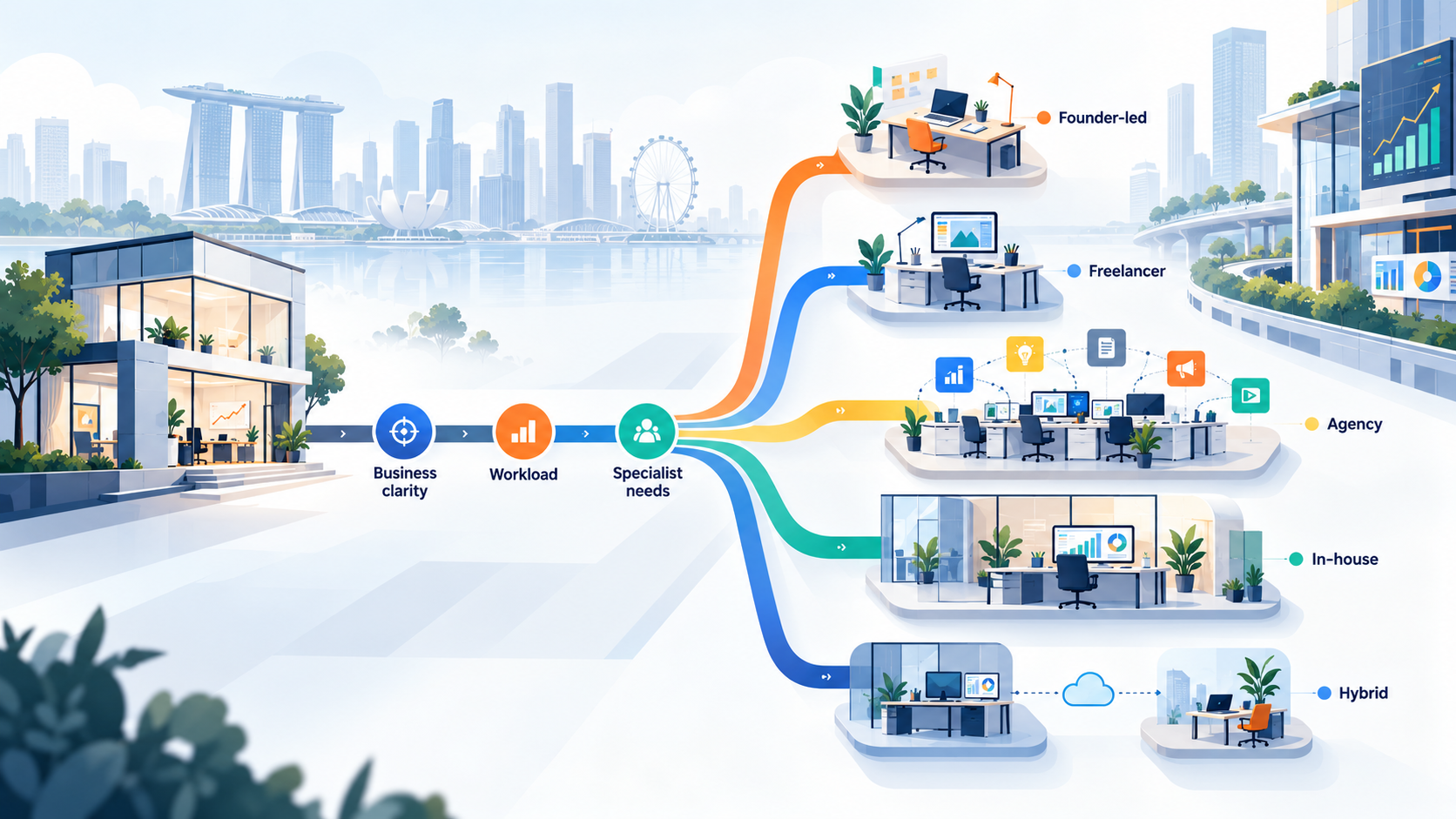
Choose the smallest team that can solve the current problem. Early-stage startups often hire for the company they hope to become instead of the problem they need to solve now.
| Option | Best Fit | Main Benefit | Main Risk |
| Founder-led | Customer discovery and early sales | Direct customer learning | Limited founder time |
| Freelancer | One defined skill gap | Flexible specialist support | Founder still manages coordination |
| Agency | Several connected functions | Shared strategy and execution | Broad scope can cost too much too early |
| In-house marketer | Stable daily workload | Close access to product and sales | One person cannot cover every speciality |
| Hybrid team | Proven channel plus specialist gaps | Internal ownership plus outside support | Roles can overlap |
We would not hire a full-service agency because the founder feels overloaded. We would hire when the company has enough clarity for specialists to improve a measurable system.
Use four checks before signing. You should know who buys and why. You should also know the acceptable acquisition cost.
Your website or app should track meaningful conversions. Someone inside the company should also own approvals, product knowledge and sales feedback. If two of those areas remain unclear, start with a smaller project.
Which Marketing Services Should Startups Fund First?
Fund the service that addresses the nearest commercial problem. Channel popularity gives you little guidance.
Before Product-Market Fit
Focus on customer research, positioning, a clear landing page and basic analytics. Small paid campaigns can test demand, but they should produce learning before you try to scale them.
Search engine optimisation may come later if the team still does not understand buyer language. Our guide to keyword intent and buyer needs explains why intent can offer more value than raw search volume.
After Early Traction
Choose one acquisition channel and test it properly. Search engine marketing can capture existing demand, while paid social can help test audiences and creative.
Search engine optimisation can also support longer-term acquisition once the startup understands the problems customers search for. Our SEO services buyer’s guide explains the work behind a serious search programme.
During Repeatable Growth
Add another service only when it solves a measured constraint. A startup with enough traffic but weak conversion needs different work from one that lacks demand.
For longer sales cycles, our lead generation funnel guide shows how traffic, leads, opportunities and customers connect.
This is also the stage when a broader marketing agency for startups can provide more value. Several functions may now need to work together.
How Should You Measure a Marketing Agency?
Track the deepest commercial outcome that your data can support. Impressions and clicks help diagnose campaigns, but they should not become the final score for a startup that needs customers.
Google Analytics 4 now separates key events from advertising conversions. Google’s current guidance on key events and conversions explains how businesses can track important actions and use conversion data for advertising measurement.
For sales-led startups, measurement should continue after the form submission. Google Ads guidance on enhanced conversions for leads explains how first-party lead data can help connect later customer outcomes back to advertising.
We would track a simple commercial chain.
- Qualified visits
- Leads
- Sales-accepted leads
- Opportunities
- Customers
- Customer acquisition cost and payback
The exact stages can change by business model. The principle stays the same. Marketing should connect with the commercial outcome that follows it.
Lead Quality Can Matter More Than Lead Cost
Our published Majestic Immigration search engine marketing case shows why lead quality needs close attention. The campaign attracted irrelevant enquiries about jobs and work permits.
We removed irrelevant terms and added qualification through the WhatsApp flow. Also, we do not use this case as a universal startup benchmark. It shows a practical point. A lower cost per lead can still produce a weak result when the sales team rejects those leads.
What Changes for Singapore Startups Planning for 2027?
Three areas deserve attention as founders prepare next year’s budget. They affect funding, search visibility and customer data.
EDGE Replaces the Previous Grant Mix
Enterprise Singapore states that the Enterprise Development Grant, Market Readiness Assistance Grant and Productivity Solutions Grant cease on 29 September 2026. New applications move to the EDGE Grant from 30 September 2026.
Enterprise Singapore states that EDGE can support up to 70 per cent of eligible costs for small and medium-sized enterprises. Non-SMEs can receive support of up to 50 per cent.
The programme also sets a S$100,000 annual grant-support cap across activities. Claims use a reimbursement model.
Do not subtract an assumed grant from an agency quote. Check the specific activity and support level first.
The old Enterprise Development Grant also excluded several implementation costs from its strategic brand and marketing development scope. Those exclusions included search engine optimisation, search engine marketing and media buying.
You can review the Enterprise Development Grant scope for the published details. The old rules offer a useful warning against assuming that general campaign execution will qualify for government support.
Search Visibility Now Extends Into Generative AI
Google published new guidance for generative artificial intelligence search in May 2026. The Google Search Central guidance for AI search says established search engine optimisation practices still apply.
Google also encourages publishers to create useful content that adds unique value. Generic pages that repeat common information offer weak long-term value.
For startups, this changes content spending. We would put more budget into expert evidence, first-party examples, clear comparisons and useful answers.
Lead Generation Needs Data Controls
Singapore’s Personal Data Protection Act sets rules for organisations that collect and use personal data. The Personal Data Protection Commission’s business resources give organisations guidance on data protection and Do Not Call requirements.
Keep an internal owner for customer data even when an agency runs campaigns. That person should control access, consent records and account permissions.
What Should You Ask Before Hiring a Startup Marketing Agency?
A good proposal should explain how the agency makes decisions. A long service list tells you little about budget discipline.
Ask these questions before you sign.
- What would you avoid in the first month? The agency should know when the budget cannot support another channel.
- Which business result controls spend? The answer should connect campaigns with qualified leads, customers or revenue.
- Who owns the accounts and data? Your company should keep practical access to core platforms.
- How do you separate agency fees from media spend? You need clear cost visibility.
- What result causes you to increase or cut the budget? Agree on decision rules before scaling.
- How does sales feedback change the campaign? Lead quality should influence targeting, creative and keywords.
- What happens at handover? Confirm access and documentation before the contract starts.
Avoid an agency that activates every channel simply because it sells those services. A small startup usually learns more from one properly funded acquisition test.
Choose the Smallest Marketing System That Can Prove the Next Step
A startup marketing budget should buy evidence before scale. Pre-revenue companies need proof of demand, while early-growth companies need repeatable acquisition.
Scaling businesses need stable unit economics and enough capacity to serve new customers. Marketing spend should grow only when the business can support that growth.
We would hire an agency when the startup has a clear buyer, measurable conversion path and enough budget for specialist work plus distribution. We would keep the scope smaller when positioning, product fit, or sales qualification still changes often.
We do not think every startup needs a broad agency programme from day one. Some founders need a focused audit or a single acquisition channel first.
Once the business has clearer demand, our digital marketing services can connect search, paid media, social media, content, lead generation and website work. You can also use our keyword intent guide if you need to assess search demand. Review our lead generation services if your main need involves qualified enquiries and sales opportunities.

Frequently Asked Questions
How much should a startup spend on marketing in Singapore?
There is no reliable percentage that suits every Singapore startup. Start with the customers or qualified opportunities you need, then calculate the highest acquisition cost your business can support.
What does a marketing agency for startups do?
A startup agency can support paid acquisition, search engine optimisation, content, social media, conversion work and measurement. The right scope should solve the company’s current commercial problem.
When should a startup hire a marketing agency?
Hire when you have a defined buyer, repeatable offer and measurable conversion path. Use a smaller specialist project if those areas still change often.
Is an agency cheaper than an in-house marketer?
It can cost less when you need several specialist skills but not a full-time employee for each one. An in-house marketer becomes more useful when the workload stays consistent and requires daily collaboration.
Can Singapore startups use the EDGE Grant for marketing?
Do not assume general marketing execution qualifies for support. Check the current EDGE Grant requirements before adding grant funding to your budget.
What marketing channel should a startup fund first?
Choose the channel that matches how your buyer discovers and evaluates the product. High-intent search can suit existing demand, while paid social can support discovery-led products.
How should a startup measure agency performance?
Track the deepest commercial result you can measure with reliable data. Use traffic and clicks for diagnosis, then connect them with qualified leads, opportunities, customers and acquisition cost.